“One Race, Every Medalist Ever”

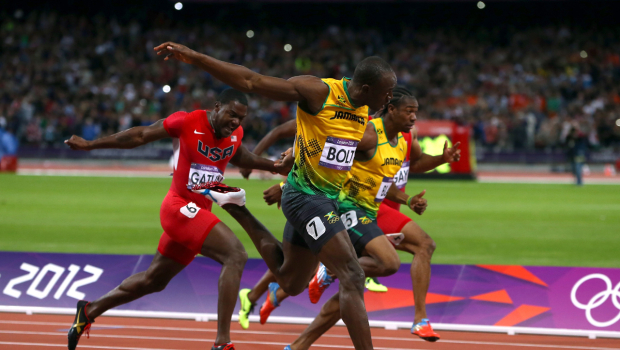
Usain Bolt set an Olympic record in the men’s 100 meter final the other day. (9.63 seconds!)

But did you know that 100 years ago, a sprinter would merely have had to crack 11 seconds to win the 100 meters?

The New York Times has a great graphic/video that shows all 100 meter medalists since 1896 on the same track. As a friend of mine on Facebook said, “I’d be willing to bet this is one of the coolest things you’ll see today.” He’s right. Check it out.

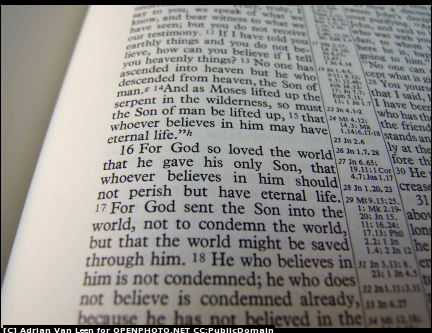
What language did Jesus speak?

In my top 10 reasons why you need the Septuagint I conclude with the #1 reason being that the Gospel writers record Jesus’ words as occasionally matching the Old Greek of the Hebrew Bible against the Hebrew. This has become a new research interest of mine, and there is no lack of scholarly opinion on the issue! It’s hard to tell if there’s scholarly consensus. The conventional wisdom seems to be that Jesus spoke Aramaic and read from and recited Hebrew scrolls, but that’s certainly not a universal view, from what I can tell. For example, Stanley E. Porter suggests:

… Jesus not only had sufficient linguistic competence to converse with others in Greek but also even to teach in Greek during his ministry. 

I believe that, first, it can be firmly established that Jesus did speak Greek and that we do indeed have some of his actual words. 

Porter explores the question “Did Jesus Ever Teach in Greek?” here (pdf). Thanks to the LXX Yahoo! group for the link.

Words on the Word Weekend Recap

Here’s a Words on the Word weekend recap. Friday through Sunday at WotW had the following:

Family: “Less ball sports, more boat sports”

Bible: Part 1 of BibleWorks 9 review / The Bible as Narrative… sort of / Damon+Wahlberg in I Heart Maccabees?

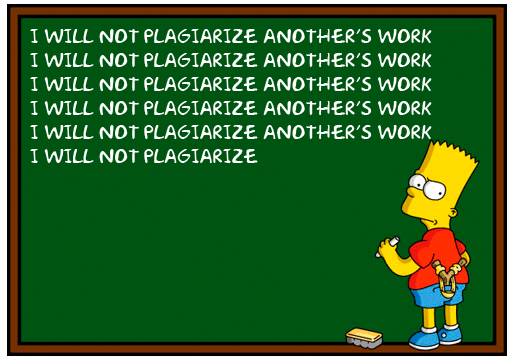
Grad School: I guest post about “null curriculum” / The Simpsons on grad students / Thou shalt not plagiarize

Today for Magnificent Monograph Monday I review a book that asks the question: Did God the Father kill God the Son on the cross?

Forsaken: Did God the Father kill Jesus on the cross?

“My God, my God, why have you forsaken me?”

“Never will I leave you; never will I forsake you.”

“I and the Father are one.”

Wondering how these three verses of Scripture fit together? I often have. Cognitive dissonance finally got the better of me, and I decided I should try to think through this one a little more deeply. To that end I read Thomas H. McCall’s Forsaken: The Trinity and the Cross, and Why It Matters (InterVarsity Press, 2012). Here, on Magnificent Monograph Monday, I offer a review of the book. (Thanks to IVP for the free review copy, in exchange for an unbiased review.)

First, the very short summary of my review, if you want to cut to the chase and head off and do something else after this next paragraph.

McCall tackles some difficult questions: “Did God forsake Jesus [on the cross]? Did the Father turn his back on the Son in rage? Was the Trinity ruptured or broken on that day?” His answers and arguments are rooted in Scripture, the history of interpretation of that Scripture, and are consistently compelling. McCall really helped me through my own struggles to grasp some of these questions, leading me to a fuller understanding of the life of the Trinity and the relationship between its persons, particularly in terms of what happened on the cross. And he spells out the implications of his assertions beautifully. God is not divided, he concludes, but God–all of God–is for us. So we can rejoice and rest secure in that. Five stars, no doubt.
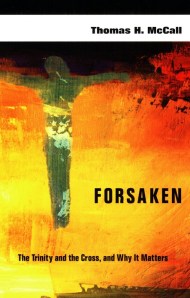
McCall writes “not for other scholars…but for pastors, students and friends–indeed, for anyone genuinely interested in moving toward a deeper understanding of God’s being and actions.” Forsaken is heavy theological lifting for a non-scholar (and not lightweight for a scholar, either), but the effort is well worth it. McCall answers some very common questions people ask (or are scared to ask and should ask) about the Trinity, also showing ramifications for our relationship to God.

Forsaken has four chapters. Each asks a theological question, addresses it, then concludes with some theological assertions to avoid, some to affirm, and why it matters.

The first chapter asks, “Was the Trinity Broken?” Here McCall discusses the theological concept of “dereliction,” or the idea that Jesus was abandoned by God on the cross. Recent theology notwithstanding, McCall makes a strong Scriptural case that God the Father did not forsake the Son on the Cross. Understanding Psalm 22 as an “interpretive key” to Jesus’ death, McCall writes:

No, the only text of Scripture that we can understand to address this question directly, Psalm 22:24, says that the Father did not hide his face from his Son. To the contrary, he has “listened to his cry for help.”

Not only that, the author argues, but if God truly had forsaken Jesus, why would Jesus bother–after his cry–to say, “Father, into your hands I commit my spirit”? Jesus “prefaces his last words with a sense of deep relational intimacy: Jesus addresses his ‘Father.'”

In chapter two McCall asks, “Just what are we to make of the biblical witness to the wrath of God? Is it opposed to his love? Is it a ‘dark side’ to God that is inconsistent with his holiness or with his mercy?” He makes a pretty hard-to-argue-with case that “the biblical witness does not set love and wrath in opposition to one another.” McCall, I thought, was at his best in this chapter when he highlighted multiple New Testament references to wrath–not only the wrath of God generally, but Jesus’ wrath specifically. So there’s no Old Testament God=wrath, New Testament God=mercy conclusion to be drawn from the Bible. The author utilizes the theological categories of divine impassibility and simplicity to show that “wrath” as God exhibits it is not what we might envision in human anger; rather, it is an expression of holy love.

McCall’s third chapter asks whether God’s divine foreknowledge means that God killed Jesus, since he knew it was going to happen, could have stopped it, but didn’t. “God’s plan was to use the death of Jesus for his purposes and for our good,” but God himself did not cause the death. As Acts so often makes clear, McCall points out, “The apostolic proclamation of the gospel places the fault and blame on the sinners who are responsible for the death of Jesus.”

Chapter four articulates a robust theology of justification (forensic; instantaneous; by which I enter into the life of God) and sanctification (separation unto God; progressive; by which I grow in communion with God). Page 145 and following has a brilliant interpretation of Paul’s famous Romans 7:14-25 passage where he (seemingly) wrestles with sin.

One difficult implication of this book for me as a worship leader (and coach of worship leaders) is that, if McCall is right, we may be singing some not-quite-right theology in two well-known songs. “How Deep the Father’s Love for Us” has a line that says, “The Father turns his face away.” And the song “In Christ Alone” says, “…till on that cross, as Jesus died, the wrath of God was satisfied.” McCall addresses these two claims head on and (in my opinion, successfully) refutes them. The Father did not turn his face away (see the block quote above). And to say that God the Son mollified the wrath of God the Father is to bifurcate the Trinity in some unorthodox ways. (!)

I’m not sure if it’s generally accepted for a book reviewer to admit to shedding tears when reading a review copy. (Objectivity! Right?) No matter. McCall’s concluding postscript (“A Personal Theological Testimony”) moved me to tears, as he recounted the difference “the trinitarian gospel” made for him and his family as they processed the death of his father.

Getting the theological details of the Trinity right (as best we can!) matters. It matters for our understanding of God, our relationship with him, and for all of life. In the life and truths of the Trinity–properly understood, and I think McCall a good guide here–there is great comfort. We see a God who, as McCall says, is for us. We find a God who has granted us victory over sin and death, making it possible for us to enter into communion with the triune God of love.

You can find Forsaken here at the IVP product page or on Amazon.

Septuagint Sunday: I Heart Maccabees


I’d give away half a bookshelf worth of books to see Mark Wahlberg or Matt Damon star in a film adaptation of 1 Maccabees. Judas Maccabeus (“Hammer” will be his nom de film) and his Hasmonean family drive out imperial powers and call the Jewish people back to faithful observance of the Torah. They do it with great violence, against all odds. (This would be an action movie, and not for small children.)

Here’s how Jonathan A. Goldstein, in his 1 Maccabees Anchor Bible commentary, begins his introduction. Try to call to mind that deep male voice that does movie trailer voice-overs:

The faithful Israelite living in Judaea under the rule of the Ptolemies and the Seleucids in the third and second centuries B.C.E. learned from childhood that the LORD’s chosen people had nothing to fear if they kept the LORD’s commandments. Subjection to the great empires of Persia and the Hellenistic kings had brought stability and security over long periods, which in part compensated for galling exploitation and servitude and for episodes of devastating warfare. Then, under the Seleucid Antiochus IV from 167 to 164 B.C.E., obedience to the LORD’s commandments became a crime punished with extreme severity. No harsher trial ever tested the monotheistic faith of the Jews.

[Cue music swell.] Goldstein/our movie trailer goes on:

The outcome was entirely unexpected: the desperate resistance of the Jews prevailed, and for a time the “yoke of foreign empires” was lifted from the Jews as they became independent under the Hasmonaean dynasty. After the centuries of heartbreaking delay, were the glorious predictions of the prophets of a mighty restored Israel being fulfilled?

That’s got to be good watching, folks. It’s certainly making for great reading! (I’m focusing on the first four chapters for a directed study for one of my seminary classes.) Here is a “Quick and Dirty Summary” of 1 Maccabees from Gordon College professor Ted Hildebrandt.

As I wrote in an earlier post about the Septuagint:

Books like 1 Maccabees, especially, fill out the intertestamental gap between Malachi and Matthew. I’ve been working my way through 1 Maccabees lately, and it’s really helping me better understand Jewish expectation of a conquering Messiah who would expel oppressive Roman rule.

Good book. Would make an awesome movie. The Maccabean Identity? Or, perhaps, simply: I Heart Maccabees.

Avoid plagiarism like the plague

Charles Halton writes about how one can avoid plagiarism. He links in his post to a set of tutorials from Duke that help students identify (and avoid) plagiarism. Good reading for all. I’m not a professor, but… oh, the stories I could tell!

And as for Bart’s presence above… one good Simpsons/academia piece of media deserves another.

The Bible as Narrative… sort of

I always bristle a little bit whenever I read things like, “The Bible is not a set of rules to follow or doctrinal propositions to which we must assent. It is a story to live into.”

I’ll give you that the Bible, among other things, tells the story of God’s great redemptive love for his people. And God does invite us–through Jesus and in the power of the Holy Spirit–to dwell in the blessed realities of his story. Many parts of the Bible are narratives. And the disparate books of the Bible, I firmly believe, join together in a unity that we can rightly call “the Bible,” which does have a grand sweep and storyline.

But it’s not all story, and to call it just that leaves out some important things.

The 10 Commandments are, actually, rules. Verily, they are even a list of rules to follow.

And there are doctrinal propositions to which confessing Christians must assent. I think of the Scripturally-rooted, “Christ has died; Christ is risen; Christ will come again,” for example. Or Paul’s great confession of faith in 1 Corinthians 15.

Leslie Leyland Fields calls for Bible readers to carefully rethink “narrative theology,” calling instead for a more robust, “literary theology” of the Bible. In a new Christianity Today article she writes:

Story, as all high-school English students know, relies not simply on what happened but also on the language and literary devices used to tell it: metaphor, description, analogy, repetition, parable, image. Nor does this larger narrative movement pay heed to the other literary genres God chose to speak his words through—poetry, lament, epistle, proclamation, prophesy.

I don’t agree with everything in her article. For example, I wonder whether some of my emergent / ex-emergent / “postmodern” / postpostmodern friends would agree with her representations of that movement. (Although I love this line of hers: “[Rob] Bell defines even hell in terms of story: ‘Hell is our refusal to trust God’s retelling of our story,’ which I found to be the most frustrating line in all of Love Wins, which I otherwise didn’t think quite as offensive as others did.)

Her cautions are words of wisdom. And I think she’s right on the money with the title and thesis of her article. Read “The Gospel is More Than a Story” here.

BibleWorks out of the box: Review of BibleWorks 9, part 1 (setup and layout)

The perennial question: Should I upgrade my BibleWorks program? I was perfectly happy with BibleWorks 7 until I upgraded to 8. (Then I was really happy with 8.) I thought 8 was such a vast improvement that when 9 came out, I saw no need… at least until I got to know version 9 a little better. Versions 7 or 8 are certainly still powerful in their own right, but my upgrade to 9 has been a great experience so far. In this and future posts, I’ll highlight why. Today: BibleWorks 9, out of the box.

The installation is easy and quick. I consider myself somewhat proficient when it comes to computer know-how, but certainly don’t have programming expertise. No matter. BibleWorks is easy to install and keep updated. And the BibleWorks staff is constant in making updates available if and as they find bugs in the program. Better than any other computer software I’ve used, in this sense.

BibleWorks 9 comes with a “Quick-Start Guide,” which has the Installation Instructions (they are mercifully short–three pages and easy to follow) and a 12-page Orientation to BibleWorks guide. The guide focuses on the Search Window, the Browse Window, and the Analysis Window, and gives instructions and specific examples as to how to best utilize each in studying the Biblical text. My only quibble with the helpful guide is that the images contained therein seem to be from BibleWorks 8, not 9. But that doesn’t really keep it from doing what it needs to, namely, quickly and effectively orienting the new or only somewhat experienced user to using the program well. (The instructions do detail the contents of the new tabs in version 9.)

BibleWorks 9 adds a delicious fourth column (essentially, a second analysis window). It looks like this (click on the png below for a larger view, if you wish):

Already this opens more options. There are also more available tabs in the Analysis Window. For example, the new “Use” tab, in my third column above, instantaneously shows you all the uses of a word with how many occurrences it has in that book and version (here, the WTT=Hebrew Bible). You had to search on a word in previous versions to do this (using the first column above). I find this particularly useful for vocabulary acquisition. As I come across a word I don’t know in the text, I can easily see–does this occur 121 times and I should know it? Or is it just in the text two or three times, so I was okay in not knowing right away what it means?

The “Verse” tab and the “Mss” tabs are new, too–those are worthy of their own post. (Anyone familiar with BibleWorks, whether they have 9 or not, may already know that this new version allows you to look at and work with images of original manuscripts.)

And, what I find best of all, you can drag and drop the tabs between the third and fourth columns so that you can customize your setup. I had already figured out a setup so that I had my own equivalent of a “fourth column” in BibleWorks 8. Now I can do even more! Check this out (from a previous post):

It’s a thing of beauty.

BibleWorks has unbeatable customer service. The user forums are active and always helpful. (Good things to know when you’re considering getting set up with them.) And they’ve provided quite a few videos to show users their way around the program. If you don’t want to wait for the rest of my review, you can see all that’s new in BibleWorks 9 here. You can order the full program here or upgrade here. It’s even on Amazon!

I received a free upgrade to BibleWorks 9 in exchange for an unbiased review. See my prolegomenon to a review here.