Restoration in the Wilderness

From the wilderness comes restoration.

The wilderness for Israel was all too often a place of dissension and lack of trust in God’s promises.

Exodus 17:7 says, “Moses called the name of the place Massah and Meribah, on account of the quarreling of the children of Israel, and on account of their testing Yahweh, which they did by saying, ‘Is Yahweh in the midst of us or not?'” (AKJV) Massah means testing and Meribah means strife or quarreling. “Whining” would not be an inappropriate translation for Meribah. Psalm 78 (go here and scroll down to 78) details the repeated lack of faith Israel had in their delivering God.

(Disclaimer: I am not claiming I would have done better or have done better in wilderness settings.)

In the Gospels, however, Jesus redeems and transforms the wilderness experience on behalf of the entire people of God. In the New Testament Jesus serves as a stand-in for the people of God, both in the wilderness and on the cross.

One of Mark’s first καὶ εὐθὺς statements has Jesus going into the wilderness to be tempted by Satan. But unlike the people of God in Exodus, Jesus did not sin when he was tempted to walk away from God and worship another. I once heard a preacher say that where Adam failed, where Israel failed, and where all humanity failed… Jesus succeeded on behalf of all people when he refused to listen to Satan in the wilderness.

The wilderness, isolated place that it is, connects with hope to the whole of salvation history.  John the Baptist, the “voice of one crying in the wilderness,” hearkens back to Old Testament prophets that “prepare the way of the Lord.”  John self-identifies as the prophet par excellence who prepares the way for Jesus. The wilderness may be lonely and despairing, but it is also the place to which Jesus comes.

As R.T. France writes, “The wilderness was a place of hope, of new beginnings…in the wilderness God’s people would again find their true destiny.”

From the wilderness comes restoration—even if it’s only the beginning of the process of restoration. Saint Mark’s first listeners/readers saw the wilderness motif immediately at the beginning of the Gospel (no birth narrative!), with John as prophet in the wilderness and with Jesus conquering Satan’s temptation in the wilderness. This alerted them that something significant was about to happen.

“Is God in our midst or not?”

I confess I’m too quick to ask that question with Israel when I find myself in a proverbial desert. But the desert wilderness is the exact place to which God saw fit to send John, preaching the good news of forgiveness and calling people to a baptism of repentance. The desert wilderness is the exact place to which God saw fit to drive Jesus, so that he could resist the devil’s temptations, beginning to win for us a victory we could never win for ourselves. God in Jesus restores what we have made “Massah” and “Meribah” by our lack of trust and rush to complaint.

Next wilderness I come to, I’m going to try to ask myself… what restoration is on the other side of this?

Junia

My wife and I just gave birth to our third child, Junia. The name Junia comes from Romans 16:7–she was an “outstanding” apostle, as noted by the apostle Paul.

There is nothing else about Junia in the New Testament except for the rest of what Paul says about her in that verse, the full text of which is, “Greet Andronicus and Junia, my fellow Jews who have been in prison with me. They are outstanding among the apostles, and they were in Christ before I was.”

What we know about Junia from Paul is:

  • She was a fellow Jew;
  • She is mentioned alongside Andronicus, presumed to be her husband and ministry partner;
  • She was in prison with Paul at some point;
  • She and Andronicus were “outstanding among the apostles”;
  • She and Andronicus were “in Christ” before Paul was.

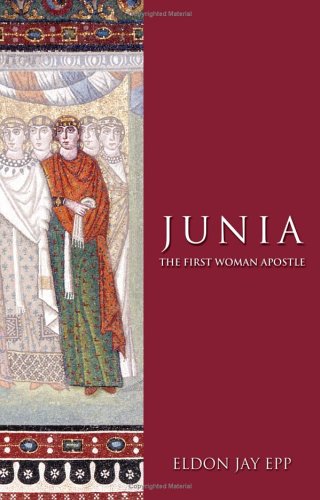
There is a little bit of literature about Junia. She is the source of a short but dense scholarly study by Eldon Jay Epp (the cover is pictured above). Epp explores the difference that comes up in some English translations–i.e., why Junia occasionally (but incorrectly, according to him) appears as a male “Junias.” There is also an investigative journalist’s take on Junia, exploring some of the church’s history as to how and why the apostle Junia has sometimes been understood in the text (incorrectly, she also says) as a male Junias.

Finally, Scot McKnight has just come out with a short Kindle-only monograph called Junia is Not Alone, which explores Junia’s contribution to the church, as well as other “overlooked” women in Scripture and church history. (The publisher’s description unfortunately calls the essay “fierce.” I’ve not yet read it, but all that I’ve read and heard from Scot is anything but fierce. (UPDATE: I review it here.) He is a gentle and caring Biblical scholar, not polemical. Unless they mean “that’s fierce” in a Project Runway sense.) He posts about his e-book here.

UPDATE: Read all my Junia posts here.

The “Preacher’s Trash Bin” (A Review of What Not to Say)

Here is some great preaching advice from my mother-in-law, a pastor: Never say from the pulpit that a certain idea came you to while you were in the shower.  Because who wants to think about their pastor in the shower?

Or as John C. Holbert and Alyce M. McKenzie put it, “Don’t tell stories that involve listeners picturing you naked. …So you received an insight into the cleansing power of God’s love in the shower on the mission trip as the cleansing and healing water cascaded over your body. Find another setting to tell about your epiphany.”

I set out to read What Not to Say: Avoiding the Common Mistakes That Can Sink Your Sermon, thinking that the book would be full of practical ideas like not sharing shower epiphanies as having taken place in the shower. Yet Holbert and McKenzie also write with theological depth and care as they coach preachers on what not to say and do in the pulpit.

Their chapters cover what not to say (and what to say): about God, about the Bible, at the sermon’s beginning, about the congregation, in the middle of the sermon, about yourself, in stories, and at the end of the sermon.

The goal of the book is “to give very direct advice out of the store of [the authors’] combined sixty years of preaching and over forty years of teaching others how to preach.”  They write, “It’s important in preaching to be as clear about what we are not saying as we are about what we are saying.” Here is where the theological depth of the authors comes to the fore, right in the first chapter: “First, affirming the sovereignty of God is not the same as insisting that everything that happens in my life and the world is directly the result of God’s actions.” The authors have a high view of God’s sovereignty, yet caution preachers against saying or implying, “Everything happens for a reason… and that reason is God.” Especially in a funeral sermon, for example, they say it’s theologically misguided for the preacher to say that God just “needed” the deceased’s voice to join the heavenly choir, or wanted “another flower for his heavenly bouquet.” God is sovereign, yes, preachers should affirm, but did he really cause a drunk driver to kill your daughter? No, the authors would say; free choice gone awry (i.e., stupidity) caused that. But preachers have to be careful that their words don’t somehow affirm that God’s sovereignty means He somehow took away that life. He may have allowed it; he didn’t ordain it.

Though the reader may not always find herself or himself in lock-step with the authors’ theology (I think the Bible is more of an “answer book” than they seem to indicate, and I respectfuly disagree with their interpretation of Romans 1, that Paul didn’t really understand the nuances of homosexuality), the reader will certainly appreciate their theological, Biblical, and homiletical care that grounds the eminently practical advice they give. The authors’ love of the Gospel, of the Church, and of preaching is on full display in these pages… and it inspired me as I read.

A few more highlights ought to convince anyone with an interest in preaching or public speaking to read this book:

  • The authors say the preacher should ask herself or himself this question honestly: “Do I habitually base my sermons on my favorite passages and avoid others I know little about or that may prove difficult?”
  • “Preachers throughout history have known that it is as important to exegete the congregation as it is to exegete the text. Jesus certainly did….”
  • “Sermons these days need to teach biblical and theological themes to often biblically illiterate listeners.”
  • “When we stir up people’s emotions without tying them to a biblical and theological message, what are they to do with their stirred-up emotions?”
  • Holbert and McKenzie want the preacher to ask: “Does the sermon tell the truth of the Gospel, not a domesticated version I assume the congregation would prefer to hear?”
  • On bad preaching habits (verbal filler, overused non-verbal gestures, etc.), they say: “Anything you do in the pulpit again and again will become over time the source of boredom and finally ridicule. When the youth sit in the balcony and count the number of times you say or do a certain thing, it is time to take stock of your preaching patterns.”
  • “Never make yourself the hero or heroine of your sermon” by using yourself as a positive example of how to apply a certain Scripture. “The sermon is not about us; it is about God.”
  • “Never use any of your children as sermon examples.” (Whether the reader finally agrees with this or not, the authors make a good case for it.)
  • Ask anyone for permission to talk about them in a story, even if that story shares something positive about them: “There are people in your church who would immediately transfer their membership if you thanked them publicly or singled them out in a positive way.”

It would be easy for me to go on about the helpful things I read in this book. I highly recommend it to all who preach or teach, in the Church or elsewhere.

The book is out now through Westminster John Knox Press.  (I am grateful to have received a digital galley of What Not to Say for review through Net Galley.)

I’ll give the authors the last word:

Preachers and teachers of preaching like to talk about the preacher’s toolbox. That is a positive metaphor. It signifies a repertoire of useful, effective sermonic strategies. There is also a preacher’s trash bin, a receptacle where we ought to put all the ineffective sermon strategies we don’t ever want to use again.

Seminary with Young Kids

I’ve been known to try to do too many things at once.

In the fall of 2010 I was working 20 hours a week in youth ministry at a local church, preaching monthly there on top of that, taking four seminary classes (all of which were either Biblical Greek or Hebrew-based), and doing a wee bit of youth ministry consulting work. Suffice it to say I wish I had not done so much then–even three classes instead of four would have been a welcome relief. I did do most of my schoolwork at home, which at the time seemed like a good idea, because I could be around my wife and kids as I worked… but in retrospect, they weren’t getting any more of my attention than they would have if I had been off somewhere studying. So maybe that actually made it worse, to have me there, but not really have me there.

On Monday my wife and I are scheduled to have our third baby delivered.  So this is perhaps an appropriate time to link to this great article, “How to Survive Seminary with Young Children.” It’s written from a mom’s perspective, though the bulk of this advice is also helpful for those who are trying to be faithful dads and good seminarians at the same time.

Sustainable Youth Ministry: The Study Guide

Probably the best youth ministry book I’ve read is Sustainable Youth Ministry by Mark DeVries. I liked it so much that I created a study guide to help youth ministers and other church leaders take teams of people through the book. The ideas Mark presents on how to build a sustainable youth ministry have the potential to transform churches, ministries, and lives. As I write at the beginning of the Study Guide:

I began reading Sustainable Youth Ministry shortly after its initial release, and by the time I got to chapter 3, I realized this was too important a book to read alone. After hearing Mark stress the concept of “key stakeholders” over and over again in the book, I wanted to bring as many stakeholders with me in the journey of implementing the systems of sustainability.

So in a recent youth ministry setting, I took notes as I led a team of youth ministry volunteers through the book–summary points and key concepts from each chapter, Bible verses and prayers centered around the themes Mark presented, and discussion questions. As I prepared for these weekly volunteer meetings, I had two thoughts:

  1. This sure is time consuming!  (but worth it)
  2. I’d love it if others could get the same payoff of coming to a meeting to lead folks through this book with questions and discussion points in hand… without having to do all the prep work!

That led to the creation of Sustainable Youth Ministry: The Study Guide. Sustainable Youth Ministry really is “too important a book to read alone.”

Mark’s book can be found here. The Study Guide (a downloadable PDF) is here. My good friend and former youth ministry partner Robbie Pruitt has written a review of the study guide over at youthworker.com, here.

Mark the Action Movie

And immediately!

Mark’s Gospel has earned a reputation as the fast-moving, action-oriented Gospel out of the four. It is shorter than the other two Synoptic Gospels and John (cool chart on NT book length here). At times Mark’s urgency in his narrative accounts feels like an action movie. He frequently uses the Greek  εὐθὺς (“at once” or “immediately” in most English translations) as he shifts from scene to scene, especially in his first chapter. And unlike the other Synoptic Gospels of Matthew and Luke, there is no birth story of Jesus, no genealogy. Instead, Mark announces right off the bat what his book is about: “The beginning of the gospel of Jesus Christ, Son of God” (1:1), then quickly brings in John the Baptist to introduce a full-grown Jesus, who begins his ministry preparation by receiving John’s baptism.

“And immediately, as he came up out of the water, he saw the heavens opening and the Spirit descending on him like a dove, and a voice came from the heavens: ‘You are my beloved son; with you I am well pleased” (1:10-11).

“And immediately the Spirit compelled him to go into the wilderness” (1:12)….

“And” (Greek  καὶ), “immediately” ( εὐθὺς), and “then immediately” ( καὶ εὐθὺς) are favorites of Mark’s. I once heard someone compare his storytelling style to an excited young kid who really wants to tell you a story: “And then… and then… and then!”  Mark’s enthusiasm, even coming through this one small literary device, is contagious to the reader who is listening to Mark tell about Jesus, the Son of God. Mark seems barely able to catch his breath as he recounts his gospel.

Birthmark

This post is technically not “Words on the Word,” so I’d imagine that’s an indicator that, even early on, this blog may go in different directions than I originally intended. The initial focus will stay the same: to offer reflections on what I’m learning as a student of the Bible, ministry, life, etc. But as I’m working on vocabulary in the Septuagint of Micah this evening, I’m really enjoying a new record by a group called Birthmark. It’s actually just one guy, Nate Kinsella, who used to be in a band I once tried really hard to like, Joan of Arc.

Birthmark (Nate Kinsella’s solo project) is much smoother than Joan of Arc’s music. It’s electronic and creative, melodic and intriguing.  The layering of strings, synths, vibraphone, and guitars keep the music interesting, and the vocals are… in tune!  (Not that Joan of Arc ever made that a priority, but it’s nice all the same.)  Nate’s quite a good singer in fact.

His brother Mike Kinsella is Owen, one of my all-time favorite musical artists, though I’m not a huge fan of Owen’s sometimes potty mouth, which was completely absent on his first album.

Read more about Birthmark here, and stream the full new album here.

Micah and the Septuagint

A few semesters ago I had the privilege of taking a great class at Gordon-Conwell with Dr. Doug Stuart: Intermediate Hebrew Grammar (syllabus PDF).  Dr. Stuart is an excellent professor and scholar.  In that class we worked our way through the Hebrew text of Micah (which is quite a challenge!).  The class left a lasting impression on me, and kindled in me a love for the prophet Micah.  (It doesn’t hurt that I have a really great brother with that same name.)

Now I’m doing a “reading course” (directed study) with Dr. Al Padilla in the Greek Old Testament version of Micah (as well as I Maccabees 1-4).  The Greek in Micah is as difficult as the Hebrew (which it translates), but I’m having a great time working my way through the book again and trying to increase my Greek vocabulary.

Part of my course is to read a book I’ve wanted to read for a long time, Invitation to the Septuagint, by Dr. Karen Jobes (who teaches at Wheaton, where I did undergrad) and Moises Silva (who used to teach at Gordon-Conwell).  It’s a fantastic introduction–simple enough, yet still challenging.  The Greek Old Testament (“Septuagint”) translated the Hebrew Bible beginning in about the 3rd century B.C.  Thus it “was the primary theological and literary context within which the writers of the New Testament and most early Christians worked” (23).  Our English Bibles today translated the Old Testament from Hebrew, whereas New Testament writers quoted the Old Testament in Greek–which is why a NT quotation may differ from the OT when you go look it up in an English Bible.

I’m excited to read more of this book and continue my studies in Micah.  What is really fascinating to me is how Septuagint scholars have to know both Greek and Hebrew cold, since much of their work is trying to figure out what Hebrew the Greek before them translated.  I may never get to that level with my languages, but I’m going to at least make a little progress in the meantime.