which made me think of Malachi 4:6 (versification from English Bible):
NRSV He will turn the hearts of parents to their children and the hearts of children to their parents, so that I will not come and strike the land with a curse.
It’s as if two possible realities (choose wisely!) are being prophesied in each place… surely Jesus had Malachi in mind?
Maybe! The Septuagint does not have the parents-children-children-parents rhythm, but gives instead:
NETS who will restore the heart of the father to the son and the heart of a person to his neighbor so that I will not come and utterly strike the land.
If Jesus did have the Malachi text in mind to allude to here (of course he knew it), he sure does seem to favor the Hebrew text over its Greek translation.
This itself is not shocking, as Jesus would have known the Hebrew Scriptures (in Hebrew) well, have heard them read at synagogue, etc. But as much as the NT writers seem to employ the LXX over the Hebrew (where they diverge), this was surprising to me.
But in the post linked in the sentence above, I also found this from R.T. France (may he rest in the good Lord’s great peace!) that seems to suggest perhaps I should not be surprised (IF Jesus has Malachi in mind in the first place).
Summarizing the results so far, we may now say that of the sixty-four Old Testament quotations in the sayings of Jesus which may be regarded as certain or virtually so, twenty are to some degree independent of the LXX, and of these twenty, twelve are closer to the MT at this point. The addition of a further ten cases of likely or possible allusions to the MT against the LXX further strengthens the impression that it is wrong to speak of the Old Testament quotations in the sayings of Jesus as basically LXX form.
The textual comparisons are fun, but at the end of the day, all I really want is to be a father whose heart is turned to his children, and whose children turn their hearts to me!
Then Jesus came from Galilee to John at the Jordan, to be baptized by him. John would have prevented him, saying, “I need to be baptized by you, and do you come to me?” But Jesus answered him, “Let it be so now; for it is proper for us in this way to fulfill all righteousness.” Then he consented. And when Jesus had been baptized, just as he came up from the water, suddenly the heavens were opened to him and he saw the Spirit of God descending like a dove and alighting on him. And a voice from heaven said, “This is my Son, the Beloved, with whom I am well pleased.”
–Matthew 3:13-17 (NRSV)
The Problem with New Year’s Resolutions
According to one study only 9% of people in the U.S. succeed in achieving their New Year’s resolutions. 9 per cent.
More than 40% of Americans make New Year’s resolutions, but 91% of people who make them admitted to failing to meet their goals. Only 9% were successful with their resolutions.
There are myriad reasons for such bad odds, many ways that New Year’s resolutions are problematic: We set resolutions that are not specific enough or are too hard to measure. We may make resolutions that are not realistic, or resolutions that work against other deeply embedded values we hold. We don’t have the patience to develop new habits. Etc.
One church worker writes of his experience of Christians at the turn of a year. He says:
Church people—our people—don’t just resolve to go to the gym or call their moms more often. They ramp it up. They resolve to get up at 6 a.m. for quiet time, to read the whole Bible through in a year, to have family devotions every night. They resolve to boycott ungodly [companies] and write their congressmen more often. They volunteer at soup kitchens and take up tutoring. I can’t keep up with them!
A week in to this new year it strikes me there is something even more problematic about New Year’s resolutions, besides our inability to keep them.
It’s this: if we’re not careful yearly resolutions—that we set— have power to shift our focus from Jesus, too much onto ourselves. Aggressive resolutions for self-improvement run the risk of overdoing effort and undergoing grace.
Wherever there is discipline, there must always also be grace. When discipline, then also grace—God’s grace, to be specific. Otherwise we risk leaving Jesus in the dust, running to what a priest I know once called “life-enhancement spirituality.”
Who really sets direction?
It’s a good time to remember the Proverb (16:9): “The heart of a man plans his course [the heart of a woman plans her course], but the LORD directs their steps.”
Better than just about any New Year’s resolution is an openness to let God direct my steps. To let the LORD direct my steps in this coming year.
It is Jesus, after all, who sets the direction of our faith.
John the Baptist learned this first-hand.
Our text says, “Then Jesus came from Galilee to John at the Jordan, to be baptized by him.”
One commentator says, “Christ did not wait for John to complete his career before he arrived on the scene, but, while John was still teaching, he appeared.” Jesus just shows up at the Jordan River.
Matthew should be able to go right on, “So John baptized Jesus.” But instead verse 14 gives us, “John would have prevented him, saying, ‘I need to be baptized by you, and do you come to me?’” Or in another translation, “John tried to deter him.”
Jewish understandings of relating to God seem to leave more room for push-back than Christian tradition does.
Even so, John campaigns for his own agenda. Wait, Jesus, I’m the one doing the baptizing here. Like Peter on Maundy Thursday: Wait, Jesus, you’re not going to wash my feet, are you? That’s not how this goes. Or like probably all of his disciples: Jesus, wait, you don’t really have to die, do you?
That’s how I find myself relating to Jesus more often than I’d like: Okay, God, this is what 2018 will be like. I’m going to do this, stop doing that, do a little bit more of this other thing, our congregation is going to take on this… NOW, THEREFORE, BE IT RESOLVED, O LORD, and you may resolve with me if you like….
Jesus says to John: “Let it be so now; for it is proper for us in this way to fulfill all righteousness.” John tries to deter Jesus and Jesus says, “Dude, chill. Let it be so.” This is how it will be. Same thing to Peter with the skittish feet: Jesus says, “You do not realize now what I am doing, but later you will understand.”
And to us who would chart a new and improved course for ourselves, to us who might invite Jesus to walk after us or maybe alongside us, to us Jesus says, “You. Come, follow me.”
Who is really setting the direction for how it will be?
“Seeing what is actually there”:
God who knows and loves
John follows Jesus’s lead. John abandons his own agenda for Jesus, and follows Jesus’s agenda for Jesus, and Jesus’s agenda for John. Verse 15 says John “consented.” He said yes to Jesus, even though it wasn’t in his original plan.
Many followers of Jesus have said yes, have consented to Jesus, even when he called us to something we hadn’t anticipated. And at any given time there are a lot of us who have an unexpected opportunity to say yes to God, when God shows up not-in-the-way-we-wanted! We may plan our way, but the Lord directs our steps. Will we follow?
A whole new reality is open to John, when he gives Jesus his, “I do.” He has left behind the world of how Jesus can be part of my plan and is in the realm of how I can get in on what Christ is doing.
And he hears something! He baptizes Jesus, Jesus comes out of the water and sees the Holy Spirit like a dove. And then, a voice from heaven comes. “This is my Son, the Beloved, with whom I am well pleased.” “This is my Son, whom I love; with him I am well pleased.”
John is privy to this, because he has consented to following Jesus. He has said yes to letting Jesus chart the course. He hears, “This is my Son, the Beloved, with whom I am well pleased.”
When was the last time you experienced writer’s block?
Michael McGregor, an author and professor of writing, talks about how writing teachers sometimes tell their students to lower their sights when they get stuck with a blank page. “Lower your sights.” But McGregor says, “A better thing to say might be, ‘Forget about the writing and concentrate on listening more carefully, probing more deeply, seeing what is actually there.’” He says, “Viewed in this way, writing is not a craft or even a talent but a way of understanding the world, others and ourselves. The focus isn’t on writing beautiful sentences or telling a compelling story but on seeing and understanding what is really in us and around us….”
Isn’t this more than great writing advice? Isn’t this the kind of re-focusing John had to do with his agenda? “Forget about the [baptizing] and concentrate on listening more carefully, probing more deeply, seeing what is actually there.”
And isn’t this how we want to follow Jesus, too? “Forget about the [doing and the striving] and concentrate on listening more carefully, probing more deeply, seeing what is actually there.”
“What [was] actually there” for John, when he listened, was a Father who intimately knew Jesus (“My Son”). “What was actually there” for John, when he listened, was a Father who deeply loved the Son (“whom I love, with whom I am well pleased”).
“What is actually there” for us, when we stop and listen carefully, is that same God, who has adopted us into his family with Jesus and the Holy Spirit. This same God says to you, “You are my son, whom I love.” “You are my daughter, whom I love.” I know you as well as a good parent knows their children. And I love you so much I delight in you. I smile when I think of you, and I take great joy in calling you daughter, son. “I have called you by name; you are mine.”
As 2 Timothy says, “God’s solid foundation stands firm, sealed with this inscription: ‘The Lord knows those who are his.’” You are God’s, and he knows you and loves you. He demonstrates his love for us—shows us what it is—in a million ways, but especially through the act of self-giving sacrifice at the cross.
“Before we lift a finger”
Matthew tells the story of Jesus’s baptism before he’s narrated any of Jesus’s actions. Jesus hasn’t done anything in the Gospel at this point, in Matthew 3. But still, “This is my Son, the Beloved, with whom I am well pleased.”
It’s as if Matthew wants us to see that God doesn’t love Jesus because of his miracles or because of the great sacrifice he will make or because of who his mother is or because of anything else….
God the Father just… loves… his child. God’s daughters and sons are loved just… because… God wants to love.
Adopted into the family of God, you and I, too, are God’s beloved children. It’s not due to anything we have done. It’s not because of who we think we already are. God’s love doesn’t come to us as a result of our contributions to humanity… God doesn’t shower his love on us because we have set out to have the best year yet. God loves us not because of who we are, but because of who GOD is. And then God’s abiding love for us makes us who we are. When we follow the trail blazed by God’s love, then we find out how to live and what to do.
We may still try to shape our identity around what we contribute, the service we can render to another, the brilliant solutions we can offer in a murky situation.
But to borrow a line from a book I never finished two Januarys ago, God’s love is about “how God views us before we lift a finger.” It’s about “how God views us before we lift a finger.”
So, “Come, all you who are thirsty, come to the waters; and you who have no money, come, buy and eat! Come, buy wine and milk without money and without cost.”
And, sure—look back to 2017, look ahead to 2018, but let’s first look up with John the Baptist to see a God who knows and loves those who are his.
The above is adapted from the sermon I preached this past Sunday.
It’s interesting that Matthew quotes Jesus as saying that not a ἰῶτα will pass away/fall away/disappear from the law. That’s a Greek letter. Could this mean Matthew/Jesus are referring to the Septuagint translation of the Torah, specifically? Or at least had the Greek translation in mind, alongside the Hebrew Torah?
More questions, maybe unanswerable: Was Jesus speaking Aramaic here? Or Greek? Or Aramaic and then said ἰῶτα in Greek?
“To what does Matthew intend ἰῶτα to refer? While ἰῶτα is the simplest of the Greek letters (a vertical line), it does not make a particularly striking image for a tiny detail of the wording of the Law. The synagogue practice of giving the reading from the Law in Hebrew, followed by translation, may suggest that Matthew has the Hebrew text in mind. In that case ἰῶτα could represent yod (as frequently claimed), the smallest of the Hebrew consonants, and one which sometimes contributes nothing to the meaning.”
I find this less than compelling. If Matthew had the Hebrew Law in mind, couldn’t he have put a Greek transliteration of yod (or some other Hebrew letter) on Jesus’s lips?
Or is Nolland right, and Matthew simply translated Jesus’s “yod” into Greek, much as he would already be translating Jesus’s Aramaic speech into Greek (assuming Jesus did, in fact, primarily speak Aramaic)?
The larger interpretive question of what Jesus means theologically doesn’t seem to hinge on these language-specific questions, but I find them interesting all the same.
I am one week in with the Greek Gospels in 2018 reading plan I made. Last week I also invited my congregation to join me in English, so I’ll be able to have some good in-person conversations about the content of the Gospels, too.
Each Gospel has its own three months. Readings are listed for Monday-Friday, with weekends left open for review, other reading, catch-up, or a break. Friday always ends with the last verse of a chapter.
The plan linked below also includes suggested passages each week for lectio divina, an ancient way of reading Scripture that goes back to at least the Middle Ages. Lectio divina, many readers of this blog will be aware, is Latin for “divine reading” or “holy reading,” where we read Scripture slowly, reflectively, and prayerfully. (There is a short primer on the practice here, based on a sermon I preached in Lent 2016.)
Let me know if you’ll be reading along! The plan is here.
I plan to read through the four canonical Gospels in Greek in 2018: Matthew, Mark, Luke, and John.
I’ve created a reading plan, which divides the Gospels into three months each, Monday through Friday (with weekends to catch up, review, or take a break).
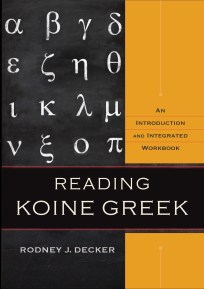
There is also a weekly reading suggestion for an accompanying Greek textbook to help with vocabulary and grammar: Rod Decker’s Reading Koine Greek.
The plan also includes suggested passages for lectio divinaeach week, for those who want to engage with the Greek text reflectively and prayerfully. Finally, the plan concludes with 16 tips for Scripture memory, for those who want to add that component, as well.
Phew! I am looking forward to reading through the Gospels in this way.
Here is the plan as a PDF, with navigable/hyperlinked Table of Contents: PDF.
And here is the plan as an interactive Accordance User Tool: User Tool.
Would you like to join me? Let me know in the comments or by emailing me through this form. I’m off all social media in 2018 (woo hoo!), but will respond to comments here, as well as at Accordance Bible Software’s “Greek in a Year” forum (here).
Brian S. Rosner has just published a book I’m excited about working through. It’s called Known By God: A Biblical Theology Of Personal Identity. Here is the overview from the publisher:
Who are you? What defines you? What makes you, you?
In the past an individual’s identity was more predictable than it is today. Life’s big questions were basically settled before you were born: where you’d live, what you’d do, the type of person you’d marry, your basic beliefs, and so on. Today personal identity is a do-it-yourself project. Constructing a stable and satisfying sense of self is hard amidst relationship breakdowns, the pace of modern life, the rise of social media, multiple careers, social mobility, and so on. Ours is a day of identity angst.
Known by God is built on the observation that humans are inherently social beings; we know who we are in relation to others and by being known by them. If one of the universal desires of the self is to be known by others, being known by God as his children meets our deepest and lifelong need for recognition and gives us a secure identity. Rosner argues that rather than knowing ourselves, being known by God is the key to personal identity.
He explores three biblical angles on the question of personal identity: being made in the image of God, being known by God and being in Christ. The notion of sonship is at the center – God gives us our identity as a parent who knows his child. Being known by him as his child gives our fleeting lives significance, provokes in us needed humility, supplies cheering comfort when things go wrong, and offers clear moral direction for living.
The book is part of Zondervan’s Biblical Theology for Life series. (Check the first results here to see more in the series.)
Especially with a new year approaching—and the potential resolutions that come with it—I’m looking forward to reading Rosner’s theology of personal identity.
The book is here (Zondervan) and here (Amazon). I’ll write more about it as I am able.
My 25K (15.5-mile) run in September was so invigorating, I decided to do another long race: a half marathon in early November with my spouse.
Here I am, ready to be done. (But, let’s be honest, also having the time of my life.)
My time improved by 0:20/mile from the September run, and my wife and I got to spend a rare Sunday morning together. The ocean views were stunning, and the route was awesome. Lots of fun, and a good challenge.
Unfortunately the next day I sprained my ankle playing basketball.
The good news is I made the shot I was driving in to take, before I landed on my defender’s leg and rolled my left ankle out, landing on it with all my weight.
My ankle ballooned immediately, and I was on crutches for the first couple days.
As I sat on the couch, my ankle elevated, the joy of making that shot dissipated. I had been looking forward to using the perfect November weather to achieve some new 5K and 10K personal records!
That was a month ago, and I’ve come a long way since then. I’m in physical therapy and just this last week got the go-ahead to start running again—a little bit at a time. My 1.5-mile run last night was so refreshing—even if I was a little sore afterwards, and despite my getting winded more easily than I did a month ago!
The day after my injury, I read Mario Fraioli’s excellent weekly newsletter, The Morning Shakeout. (Go here and subscribe. It’s one email newsletter you’ll read!)
He had a perfectly timed section called, “Everybody hurts.” As it is just three paragraphs, I reproduce it here (source):
“I realized quickly [after getting injured and having to pull out of this year’s Boston Marathon], getting over feeling sorry for myself, that I think, essentially, I needed that break. I hadn’t really allowed myself to ever really take any downtime or rest,” Shalane Flanagan admitted to me back in June. “I just am constantly throwing new projects and goals in front of myself, and I think I needed that break. Not until I allowed myself to just take a step back and rest, did I realize how tired I was. I think [taking a break] has rejuvenated me mentally and physically more than I ever would have thought, and it allowed me to appreciate the other amazing things in my life.”
I’m sharing this excerpt for all the injured runners out there. Flanagan had a stress fracture in her back that kept her out of Boston in April. Disappointing as that diagnosis was at the time, those 10 weeks of forced downtime allowed her body and mind to recover, reshaped her perspective, and helped her recharge for the remainder of the year ahead. Flanagan clawed her way back into shape over the summer and on Sunday posted the biggest victory of her career on one of marathoning’s grandest stages. Look at the emotion on her face in this photo. That’s a lifetime of hard work, sacrifice, disappointment, triumph, raw joy, and gratitude captured in one moment. I get goosebumps every time I look at it.
The lesson here? Injuries happen, even to the best amongst us. And when we’re forced to take time off from running, it’s not the end of the world—it’s an opportunity: to rest and recharge, refocus and re-evaluate, and return with renewed vigor and redefined purpose.
Here’s that awesome picture of Shalane Flanagan:
So this month I’ve done my best to (a) not feel sorry for myself, (b) quit complaining about this one thing (of many, many things) that was largely beyond my control, (c) use the time to write and reflect and enjoy relationships more fully, (d) wait patiently.
Now that I’m back on my feet, the trick is going to be not coming back too fast, so I don’t re-injure myself.
That said, round two of my basketball league’s playoffs is this Monday….
Edited by Eberhard Bons and Jan Joosten (Université de Strasbourg)
This large-scale collective and interdisciplinary project aims to produce a new research tool: a multi-volume dictionary providing an article of between two and ten pages (around 600 articles in all) for each important word or word group of the Septuagint. Filling an important gap in the fields of ancient philology and religious studies, the dictionary will be based on original research of the highest scientific level.
This project has benefitted from funding from the Agence Nationale de la Recherche (French Research National Agency), the Maison Interuniversitaire des Sciences de l’Homme – Alsace (Strasbourg), the Melanchthon-Stiftung (Tübingen), and the Armin Schmitt Stiftung (Regensburg).
The first volume is projected to be published in 2018.
You can check out a lengthy PDF sample here, with a “Wordlist of the First Volume,” as well as some sample articles.
It’s always a little bit sad when a young band with a ton of talent puts out a couple of great records and then stops releasing music.
My brother introduced me to Amusement Parks on Fire in 2005. Their song “Blackout” is a shoegazing classic. They put out a couple of LPs in the mid-oughts, followed some EPs in the following years. In 2010 they released Road Eyes. I was impressed at the time, but the album didn’t impact me as much as their earlier stuff. Still, this is Amusement Parks on Fire, and even a less-than-stellar album from them is really good.
It had been quiet on the APOF front since 2010’s Road Eyes. Now, however, they are back. There’s a two-song EP dropping next week. (I love both songs.) And I hear rumors of a full-length to follow….
A few months ago the band re-released 2010’s Road Eyes as a deluxe edition. The re-release adds some demos, some tracks that came out on other EPs, and the glorious unreleased track “Airstrike.” (How this did not make it onto an LP or EP already is beyond me.) There are other previously unreleased tracks, too, giving you a full nine-track “Side B” that complements the original Road Eyes LP.
There are very few APOF songs I don’t love, and none I don’t like. I bought Road Eyes the week it came out, seven years ago, but it didn’t wow me then as much as the first two LPs. Going back and listening again now, though, I think Road Eyes is just as good as anything APOF has released. Having new music to digest in this deluxe edition is an added bonus.
I’m stoked that Amusement Parks on Fire is recording again. The deluxe edition of Road Eyes will both fill your APOF-less void and get you ready for their upcoming offerings. Can’t wait.
Check out the album here. It’s currently digital-only, but in February 2018 will be available in vinyl and CD formats.
Thanks to the kind folks at Saint Marie Records for giving me access to the album so I could write about it.
One of the abiding questions about the life of Dietrich Bonhoeffer is: How did a theologian with pacifist leanings choose to join a conspiratorial effort to kill Adolf Hitler? How could he justify his action, let alone feel compelled to seek the life of another human?
Larry L. Rasmussen explores the question in his amazing book Dietrich Bonhoeffer: Reality and Resistance. (See my earlier book note here.)
In the section I’ve been reading recently, Rasmussen draws on two key concepts for Bonhoeffer: deputyship and guilt.
Deputyship is “the master mark of responsibility” (38). It is vicarious being and action. As Rasmussen puts it, “Man is not man [sic] in and by himself but only in responsibility to and for another” (38). And Jesus Christ is “the Responsible Man par excellence” (51), the ultimate “deputy” through his sacrifice-for-others on the cross.
Then there is guilt. Rasmussen writes:
If deputyship is the master mark of responsibility, acceptance of guilt (Schulduebernahme) is the heart of deputyship. …Jesus did not seek first of all to be good or to preserve his innocence. Rather, he freely took upon himself the guilt of others. (51)
Rasmussen concludes, “Responsible men should do the same.”
You can see where this is going: the concepts of deputyship and guilt have a great deal of explanatory power when it comes to Bonhoeffer’s attempt to take Hitler’s life.
I love this idea of Bonhoeffer’s that Rasmussen describes, namely, that preservation of our sinlessness, innocence, or purity is not to be our primary motivation in acting in the world. Rather, our deputyship (responsibility for the other) should drive us. This means for Bonhoeffer that we may need to get our hands dirty if a tyrant is threatening the well-being of the “others” on whose behalf we act.
But this notion of guilt is difficult for me to fully grasp, and I wonder how we can still leave room for the fact that Jesus, even if not seeking to preserve his innocence, did preserve his innocence.
1 Peter 2:22 quotes Isaiah 53:9 when it says, “He committed no sin, and no deceit was found in his mouth.” The verse before even says that Christ’s suffering for us in this way leaves us “an example, that you should follow in his steps.”
Specifically in 1 Peter the example we are to follow is Jesus’s suffering for doing good and enduring it (1 Peter 2:20). But Jesus also suffered innocently and is lauded for so doing. 1 Peter 2:23 says:
When they hurled their insults at him, he did not retaliate; when he suffered, he made no threats. Instead, he entrusted himself to him who judges justly.
Are we called to follow Jesus’s example in patient suffering on behalf of others (Bonhoeffer’s deputyship) and in emulating Jesus’s innocence when we suffer on behalf of others?
Yet we will never be like Jesus who “committed no sin.” Should we cut our losses and leave room for our guilt—as Rasmussen seems to read Bonhoeffer—when it comes to suffering for others?
(If so, it could be important to distinguish between the guilt Jesus took on through the crucifixion (not a direct consequence of his own impure action) and any guilt a co-conspirator has (presumably a direct consequence of the “impurity” of conspiratorial involvement)).
Bonhoeffer’s idea of deputyship, and acceptance of any guilt deputyship entails, leads Rasmussen to this utterly astounding summary of Bonhoeffer’s thought:
To maintain one’s innocence in a setting such as that of the Third Reich, even to the point of not plotting Hitler’s death, would be irresponsible action. (51)
It’s as if Bonhoeffer thought one could not resist in Nazi Germany in a sinless, innocent, or pure way. This was no longer the non-violent resistance in The Cost of Discipleship. Again: “To maintain one’s innocence in a setting such as that of the Third Reich, even to the point of not plotting Hitler’s death, would be irresponsible action” (51).
If that’s not enough, here’s where Rasmussen, describing Bonhoeffer, gets really intense. (How’s this for a take on martyrdom?)
To refuse to stand with others trying desperately to topple the perpetrators of mass crimes, to refuse to engage oneself in the demands of necessità [where necessity transcends law], would be the selfish act of one who cared for his own innocence, who cared for his own guiltlessness, more than he cared for his guilty brothers. It would be a rejection of deputyship as the form of the responsible life and of acceptance of guilt as the heart of deputyship. If responsible men have no choice but to infiltrate Hitler’s war machinery, the Christian does not forsake them but joins them. And if in the process he becomes a martyr he will not be a saintly martyr but a guilty one. He may have to forfeit every taint of perfectionism in his pacifism. He may have to join the grotesque, evil enterprises of his very enemy. He may even have to consider and carry out tyrannicide, or actively support those who do. He will bear his colleagues’ burdens and share their sinfulness even when they are not related directly to his own actions. And he will do so as an extraordinary form of the imitatio Christ in a demonic society. (52)
Amazing. I’m still trying to work through all this. It at least helps shed light on how Bonhoeffer could actively join efforts to take Hitler’s life. And a step further: Rasmussen suggests Bonhoeffer saw his conspiracy to murder as not just permissible, but as a Christian duty of sorts: deputyship with guilt.



 There is also a weekly reading suggestion for an accompanying Greek textbook to help with vocabulary and grammar: Rod Decker’s





 You can see where this is going: the concepts of deputyship and guilt have a great deal of explanatory power when it comes to Bonhoeffer’s attempt to take Hitler’s life.
 Words on the Word