Below is the text from R.R. Ottley’s Book of Isaiah According to the Septuagint. Ottley is also here in Logos (reviewed here) and here as a free, downloadable pdf in the public domain. The full reading plan for our group is here (pdf).
See here for more resources and links to texts for Greek Isaiah.
Yesterday we started fall Sunday School. For the first six weeks I am teaching/leading the adult class. We’ll spend those six weeks with Foster and Smith’s Devotional Classics book. Here are the writers for each session:
Week 1: St. Augustine
Week 2: François Fénelon
Week 3: Evelyn Underhill
Week 4: Apocryphal Literature
(This is not in Devotional Classics. But we’ll look at Ecclesiasticus (Sirach), Wisdom of Solomon, and the Prayer of Manasseh.)
Week 5: Catherine of Siena
Week 6: Kathleen Norris
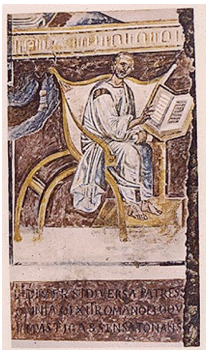
The first class covered Augustine and his Confessions. They key quote (which also serves as an (if not the) overriding theme of the book) is the best-known one, which comes from Book I, chapter 1, first paragraph:
Can any praise be worthy of the Lord’s majesty? How magnificent his strength! How inscrutable his wisdom! Man is one of your creatures, Lord, and his instinct is to praise you. He bears about him the mark of death, the sign of his own sin, to remind him that you thwart the proud. But still, since he is a part of your creation, he wishes to praise you. The thought of you stirs him so deeply that he cannot be content unless he praises you, because you made us for yourself and our hearts find no peace until they rest in you.
That’s Pine-Coffin’s translation (with the now outdated generic “he” and “man”). Italics represent Scripture quotations.
Each week we’ll do a short bio of the writer, some reading, some discussion, and some prayer.
The following is adapted from the sermon I preached today on Luke 15:1-10, covering the Parable of the Lost Sheep and the Parable of the Lost Coin.
Luke 15:1 Now the tax collectors and “sinners” were all gathering around to hear [Jesus].
The tax collectors and “sinners” in Luke 15 were about as despised as you could get. Tax collectors were sometimes mentioned in the same sentence as prostitutes. Continue reading “Hound of Heaven on Our Trail”→
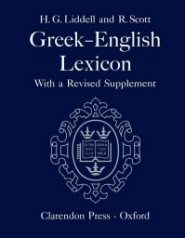
The massive LSJ Greek-English Lexicon for Logos (9th ed. with revised supplement) is an invaluable resource for Greek lexicography, covering the classical and New Testament eras. I wrote more about the lexicon in Logos here. How does it look and work on an iPad?
As much as I still look back nostalgically on my early days of Greek and Hebrew reading–where I used only a paper lexicon to look up words I didn’t know–I don’t miss how time-consuming it was. I’m able to do more reading now, not just because of (hopefully!) increased language proficiency, but also because of computerized versions of the same lexicons.
The Liddell and Scott Greek–English Lexicon (LSJ) covers Greek of the classical variety (Homer, Plato, Aristotle, etc.) and of the Septuagint, New Testament, and early church variety. I’ve had the pleasure recently of accessing LSJ via Logos Bible Software.
Something I immediately appreciated about the Baker Exegetical Commentary set is its clear statement of purpose in the Series Preface, found in each of the 15 volumes published so far:
The chief concern of the Baker Exegetical Commentary on the New Testament (BECNT) is to provide, within the framework of informed evangelical thought, commentaries that blend scholarly depth with readability, exegetical detail with sensitivity to the whole, and attention to critical problems with theological awareness. We hope thereby to attract the interest of a fairly wide audience, from the scholar who is looking for a thoughtful and independent examination of the text to the motivated lay Christian who craves a solid but accessible exposition.