What kind of Messiah was Jesus?

What kind of Messiah was Jesus?

Recently for a seminary class I had to describe the difference between “the Maccabean hope in a Messiah and Jesus’ fulfillment of that hope.”

Maccabean hope on first glance would appear to be a hope in military power. This poem at the beginning of 1 Maccabees 3, for example, extols Judas for his might (NETS translation):

And he spread glory to his people and put on a breastplate like a giant and strapped on his war instruments.

And he conducted battles, protecting the camp by the sword.

And he resembled a lion in his works and was like a whelp roaring in the hunt.

And seeking out the lawless, he persecuted them and burned up those who disturbed his people.

And the lawless drew back for fear of him, and all the workers of lawlessness were disturbed, and salvation was successful by his hand.

1 Maccabees closes similarly, in 16:23-24:

The rest of the acts of John and his wars and the brave deeds that he did, and the building of the walls that he completed, and his achievements, are written in the annals of his high priesthood, from the time that he became high priest after his father.

It is difficult not to read Maccabees as, in some sense, a narrative of one war after another. There was a Maccabean respect for leaders/priests who would lead them in battle. Certainly, then, the expectation of a Messiah would have been affected by this. “Maccabean hope” would have called for a Messiah to be a Jewish freedom fighter—in the militaristic sense of the word.

However, I think there is another, perhaps fuller way of understanding “Maccabean hope in a Messiah” that honors the author of 1 Maccabees and that book on its own terms. While a Maccabean hope certainly expected military might from a Messiah, Mattathias and his sons above all valued upholding the law. Their military resistance flowed from and was a result of that desire to keep the law.

1 Macc. 2:27 has, “And Mattathias cried out in the city with a loud voice, saying, Let everyone who is zealous in the law and is upholding the covenant follow me’” (my emphasis, from the NETS again). Only having established zealousness in the law did Mattathias and his family wage their series of wars. (Although these few verses are preceded in 2:24 by Mattathias killing a Judean man who was making a sacrifice that was not in accordance with the law!)

So, to try to read 1 Maccabees on its own terms, Maccabean hope in a Messiah must have been hope in a Messiah who was “zealous in the law” and who was “upholding the covenant.” Christians believe that Jesus was the perfect fulfillment of the law. But the descendants of the faithful Hasidim mentioned in Maccabees did not see it that way.

As I recently read through 1 Maccabees, I was surprised by how much anti-Gentile language and imagery there is in the book. In the institution of Hannukah at the end of 1 Macc. 4, to take just one example, there is a sense of fortifying the temple against the Gentile enemies.

I can appreciate the need for protection and purity–especially given how the temple had been profaned previously. This was truly a matter of life and death for God’s chosen people, physically and spiritually. But I wanted to say to the Maccabees’ author and the Maccabean family: With all due respect, what about all those verses in the prophets and other parts of the Hebrew Scriptures that say things like “nations will stream to your light” and “all nations will be blessed through you“?

Law-abiding Jews who were influenced by 1 Maccabees seem to have been expecting a Messiah who would clear the temple of the nations/Gentiles, as Judas Maccabeus did. Instead, Jesus reminded the Jewish people of their own Scriptures that said the temple was to be a house of prayer “for all nations” (Isaiah 56:7).

What kind of Messiah was he, then?

Jesus fulfilled his role as Messiah by being a conqueror, but not in an earthly, militaristic way. He fulfilled the law, but did not uphold it in a manner many had hoped for. And he drew all nations to himself, but in a way that angered anti-Gentile, exclusivist Jews.

A zealous Jewish freedom fighter? Yes. But not like Maccabees.

Would Mark’s Jesus have us handle snakes and drink poison? (part 2 of 2) (BibleWorks 9 review, concluded)

The Gospel of Mark has a couple of possible (disputed) endings. I wrote a couple of weeks ago about the options for how to understand Mark’s closing chapter.

It is the so-called longer ending of Mark that has Jesus appearing to some of his followers and talking about their picking up snakes and drinking poison.

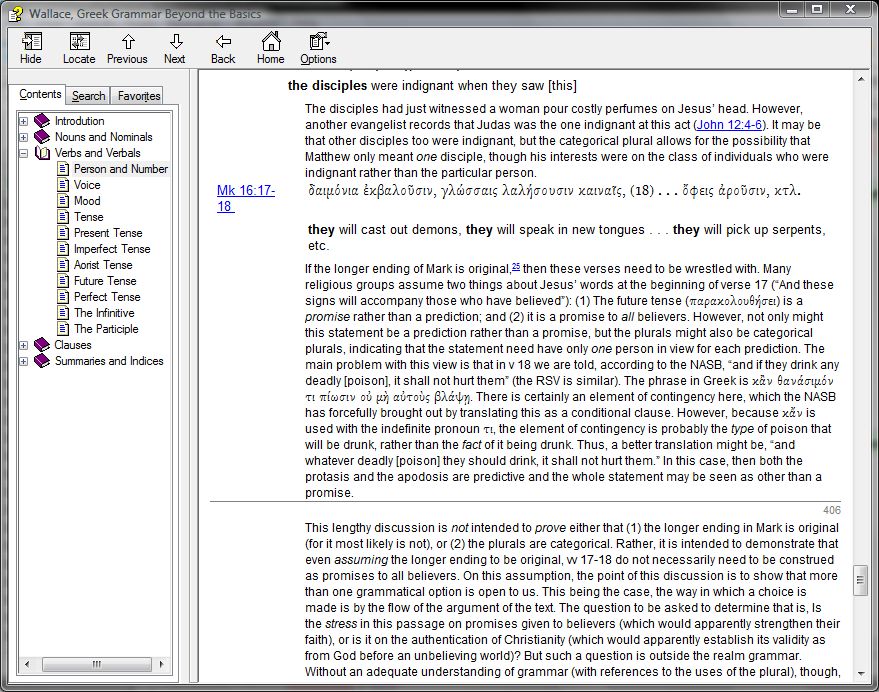
Of course, even if the longer ending is authentic and original to Mark, there is still the matter of interpretation. As a way to complete my review of BibleWorks 9, I set out to use BibleWorks to try to examine some of the manuscript evidence. A BibleWorks module of Daniel Wallace’s Greek grammar (included in BW9) offered some insight into interpretation, which you can read briefly here (screenshot).

BibleWorks 9 features the BibleWorks Manuscript Project, where you can “compare and analyze original manuscript text and images.” As a part of the Analysis Window, the manuscripts are integrated with the Browse Window, so that as you move around in the latter, the former tracks with you. The perfect complement to the Manuscripts Project is the Center for New Testament Textual Studies’ (CNTTS) NT Critical Apparatus. BibleWorks describes it:

For the first time, the New Testament Critical Apparatus from the Center for New Testament Textual Studies is available for PCs. This exhaustive apparatus covers the entire New Testament. The BibleWorks version has been enhanced to show a matrix of Aland categories and time period for the mss for each reading. Users will especially appreciate having the apparatus track and update as the mouse moves over the text in the BibleWorks main window. In addition, the start of each verse entry summarizes the significant, insignificant, and singular variants. When examining a variant, the text of the verse is shown with the variant text highlighted. No unlock required!

You can’t get NA27 and its textual apparatus in BibleWorks but with what CNTTS offers (it’s thorough), it doesn’t matter! Greek textual critics benefit immensely from the additions in BibleWorks from version 8 to 9.

BibleWorks has some great mini-training videos. Here they explain the CNTTS Apparatus. And here they discuss the Manuscripts Tab. If you’re serious about either (a) considering purchasing BibleWorks 9 or (b) have it and want to figure out how to use those two features, those two videos will get you there.

Now, on to the manuscript evidence regarding Mark’s ending in BibleWorks 9. This gives an idea of what the program can do in an applied Bible study.

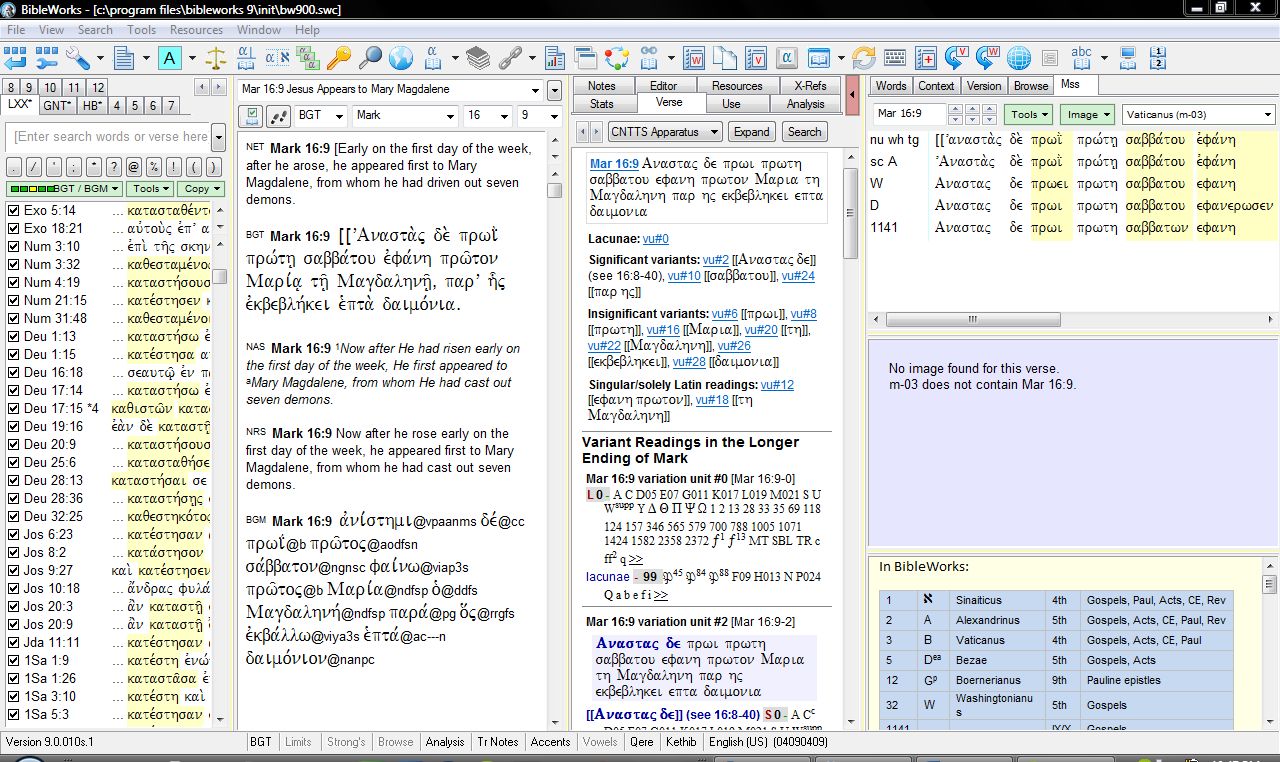
If I’m wondering what Codex Vaticanus (“B”) has in Mark 16:9, I can simply select that Codex in the drop-down menu in the Mss Tab. (BibleWorks refers to it as m-3, too.) The screenshot below (click for larger) shows that there’s no image for Vaticanus at 16:9. This is because Vaticanus ends Mark at 16:8.

Note, too, something I find exceedingly helpful in the bottom right of the shot above–a key to not only BibleWorks’ manuscript numbering system but to abbreviations for manuscripts, their dates, and their contents. This is the stuff budding text critics always have to look up, flipping from page to page and resource to resource. (Or just using that little insert in the NA27. But this is easier!)

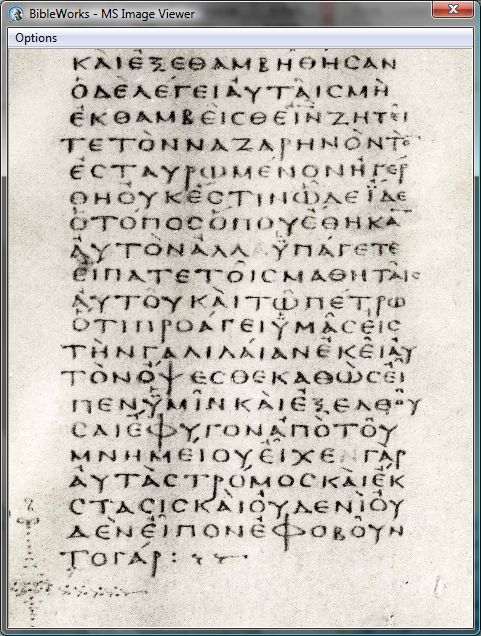
In fact, by right-clicking when you do see an image (e.g., Vaticanus at Mark 16:8), you can “load image in viewer” to pull it out and look at it more closely. There you can zoom and drag your way through the various parts of the text. It looks like this:

The top right section of the Mss Tab (in the full screenshot image above) lines up the various readings available in the manuscripts that BibleWorks contains. I can quickly see that “A” (Alexandrinus) and “W” (Washingtonianus) do have text for a longer ending of mark. Pulling up the image for Alexandrinus, I see this for Mark 16:9 ff.:

Hovering over the verse references (superimposed over the manuscript) brings up the pop-up window that you see there, where I can compare the given manuscript, the English, and the BGT Greek text in BibleWorks. (!!) This is all pretty amazing.

The Mss Tab is easy to figure out. Using the CNNTS Apparatus was less than intuitive for me. But this BibleWorks video explained it quite well. I’ve had to work at it to figure out how to best use it, but having done that, it’s a great apparatus. Especially helpful is its classification of variation types (significant, insignificant, lacunae, etc.). The Apparatus is chock full of abbreviations to learn, but what critical apparatus isn’t? And this one hyperlinks the abbreviations to what they stand for, so it’s not too bad.

For the Greek manuscripts that include some parts of the Septuagint (Sinaiticus, Vaticanus, Alexandrinus), I would love to be able to see both testaments in future BibleWorks editions. That was a loss for me, especially given my appreciation of the Septuagint. So be aware that even though BibleWorks has images of manuscripts that contain parts of the LXX, it’s just the New Testament that appears in BibleWorks.

But the images are already some 8 GB, and this is a work in progress (with future updates promised), so the lack of the LXX/Old Greek is understandable. Viewing Hebrew manuscripts in the future would also be awesome! Until then, what BibleWorks includes and gives the user access to (as part of the purchase price) is pretty remarkable.

BibleWorks won’t actually answer the question I posed in the title of this post: Would Mark’s Jesus have us handle snakes and drink poison? Exegetes will always have to interpret and answer questions like this. (This one’s a bit of a softball, admittedly.) BibleWorks also can’t determine with certainty what the actual ending of Mark is.

But it can sure show you a lot of evidence, and give you just about everything you need to try to have an informed opinion on the matter. Being able to look at images of actual manuscripts still boggles my mind. And it’s not only being able to view those manuscripts (much of which you could do online anyway)–it’s the fact that they’re tied to BibleWorks’ analysis tools that’s truly astounding to me. BibleWorks has enhanced my Bible study immensely.

BibleWorks 9 is easily a five-star program in my book. I’ve enjoyed being able to review it.

See all that’s new in BibleWorks 9 here.

I received a free upgrade to BibleWorks 9 in exchange for an unbiased review. (Thank you, BibleWorks!) See the other parts of my BibleWorks review here. You can order the full program here or upgrade here. It’s on Amazon (affiliate link), too.

The Gospel According to Isaiah 53, reviewed

Isaiah 53 is one of the clearest prophecies of Jesus the Messiah in the Hebrew Scriptures. This chapter has changed the lives of thousands of people–both Jews and Gentiles–who have read the text and believed in the One who fulfilled these prophecies in glorious detail.

Thus begins Mitch Glaser’s Introduction in The Gospel According to Isaiah 53: Encountering the Suffering Servant in Jewish and Christian Theology (affiliate link). In three parts the book expounds how the prophecies of Isaiah 53 relate to and are ultimately fulfilled in the person of Jesus. (The full passage the book treats is Isaiah 52:13-Isaiah 53.)

The first section, a sort of exegetical prelude, discusses “Christian interpretations” and “Jewish interpretations” of Isaiah 53. The second section is a biblical theology of Isaiah 53 (with particular attention to its use throughout Scripture). The third and concluding section speaks to “Isaiah 53 and Practical Theology,” with an emphasis on how to preach the passage, both from the pulpit and in conversation.

The book is “designed to enable pastors and lay leaders to deepen their understanding of Isaiah 53 and to better equip the saints for ministry among the Jewish people.”

The first thing I noticed about the book is that it’s just as much an apologetic for Jesus-as-suffering-servant as it is an academic study of Isaiah 53. It’s not that it lacks academic substance, though. This is a meaty book, and pleasingly so.

Regarding the book’s explicitly evangelistic intent–there may be some who are uncomfortable with the description of Chosen People Ministries’ “Isaiah 53 Campaign” (including 75,000 postcards to Jewish homes and 40,000 voice blasts=robo-calls?). I’ll admit that I question the potential efficacy of pre-recorded phone messages for reaching anyone with the Gospel (though God can use anything!). But see blogger Joel Watts for his helpful (refreshing!) take on the blending of the academic and evangelistic enterprises, especially in the context of this book.

You can find a full list of contributors in the table of contents here (pdf). A few names to highlight are Walter C. Kaiser Jr., Darrell L. Bock (one of the co-editors), Craig A. Evans, and Donald R. Sunukjian. I particularly appreciated the book’s treatment of the New Testament use of Isaiah 53. The chapter by Michael J. Wilkins lists the quotations of Isaiah 53 in the NT and additional allusions to it in the Gospels. (He makes a key point, that Jesus himself understood “his mission and death in the light of Isaiah 53.”) Darrell Bock goes in depth with a comparison of the Greek and Hebrew texts of Isaiah 53:7-8, highlighting its use in Acts 8 where Philip explains the passage to the Ethiopian eunuch.

Something to critique in this book is that there were a few generalizations of Jews that I found to be unfair, particularly in the chapter “Using Isaiah 53 in Jewish Evangelism.” Mitch Glaser writes:

I think I can safely say that, in the United States, most Jewish people would recognize Isaiah as the first name of a professional athlete sooner than they would recognize the prophet of biblical literature.

Granted, he is operating from the assumption that “most Jewish people are not Lubavitch, Hasidic, or Orthodox,” but still…. What was more surprising to me: “Most Jewish people do not understand or believe in biblical prophecy” and, “Most Jewish people do not believe in sin.” Glaser does (only later) qualify these with, “We must note that all of the above does not apply to those who hold to traditional Jewish theological positions,” but he would have been better off saying something like “many secular or ethnic but non-religious Jews…” or at least supporting his statements with statistics from surveys rather than anecdotal evidence. Glaser himself is a converted Jew who has a compelling conversion story, but I still found those characterizations to be frustrating. I wonder how helpful such statements could be in advancing an evangelistic cause in conversation with another Jew.

This next thing to highlight may seem a small point to some, but as someone seeking to keep my Hebrew and Greek going, I appreciated the actual Hebrew and Greek fonts throughout the book (i.e., not just transliteration), which are clear and easy to read. I did think, however, about an intended audience of “pastors and lay leaders” who may have desired transliteration, too. (All Hebrew and Greek is translated into English.)

Darrell Bock’s conclusion summarizes all the essays of the book, with key quotations. Having this there was a big help in piecing everything together again. The Gospel According to Isaiah 53 will not be far from my reach in coming months and years. I expect I will often reference this compendium of biblical scholarship on a vital text. My hesitations about the characterizations of Jews above notwithstanding, there is a good deal here that can be useful for Christian-Jewish conversations about the Suffering Servant.

I received a free copy of The Gospel According to Isaiah 53 with the only expectations of providing an (unbiased and honest) review on this blog. Its publisher’s product page is here. It’s on Amazon here (affiliate link).

Would Mark’s Jesus have us handle snakes and drink poison? (part 1 of 2) (BibleWorks 9 review, continued)

First century snake handler?

Many believe that Mark’s Gospel ends rather abruptly at 16:8 (“for they were afraid”), but others have found it difficult to think of a Gospel ending with Jesus’ followers’ being afraid to say anything to anyone about the resurrection.

So there is the so-called shorter (add-on) ending of Mark, which adds to the above, “…the sacred and imperishable proclamation of eternal salvation” (RSV). This has 10 words that otherwise appear nowhere else in the book.  In my view the vocabulary and style of the shorter ending do not seem to fit well with the rest of the Gospel, and have the feel of an effort to give the book closure well after the fact of the writing.

Then there is the so-called longer ending of Mark, which is also not satisfied in ending with his followers’ fear. This records Jesus’ appearance to some of his followers, as well as the commissioning of his disciples, including the hard-to-understand reference to picking up snakes and drinking poison.

Mark could well have ended with “For they were afraid”–Mark is not unknown for being abrupt—nor would he have a problem upbraiding (or reporting Jesus’ upbraiding) people for their lack of faith or for their fear.  But would someone who started so positively with a proclamation of Jesus as “Son of God” in 1:1 have truly ended on such a dour note?  One possibility is that Mark’s original ending was lost.  R.T. France says, “It is one thing to emphasise and exploit paradoxical elements within the story of Jesus’ ministry and passion, as we have seen Mark doing again and again, but quite another to conclude his gospel with a note which appears to undermine not only his own message but also the received tradition of the church within which he was writing” (683).

Of course, lacking evidence of such a “lost” ending means that to postulate one is speculative, and it is perhaps a wiser hermeneutic to accept the text as we have it to be the intended one.

Can BibleWorks help here? One of the major new features in BibleWorks 9 is the BibleWorks Manuscript Project. From the BibleWorks site:

This massive project has been years in the making. BibleWorks 9 includes the first installment of this ongoing work. The BibleWorks Manuscript Project’s initial release covers the following:

  • Sinaiticus
  • Vaticanus
  • Alexandrinus
  • Bezae
  • Washingtonianus
  • Boernerianus
  • GA1141

For these manuscripts, the BibleWorks Manuscript Project includes the following:

  • New full NT transcriptions
  • Complete NT digital image sets (over 7.5 GB!!)
  • Verse location tagging in images
  • Extensive transcription notes
  • MSS comparison tool
  • Morphological tagging (not complete for all manuscripts but updates will be provided free of charge to BibleWorks 9 users as they become available)

Manuscripts are fully searchable and integrated with the full array of BibleWorks analysis tools. As you change verses in BibleWorks, the MS image display tracks with the current verse. Compare, inspect, and analyze the text and images of key original manuscripts. Tweak and enhance the manuscript images using the sophisticated image processing panel now included in BibleWorks.

Before I could even get into the manuscripts, there were two ways BibleWorks immediately helped me to explore this issue. First, with my NET Bible notes open in the Verse Tab (which I review here), I see a nice, lengthy note that explains the options–with manuscript evidence–for Mark’s possible ending. (You can see the NET note itself by clicking on footnote 9 here.) That much I’ve come to expect from BibleWorks.

What pleasantly caught me by surprise was that the NET note mentions a section in Wallace’s Greek Grammar that discusses the grammar of the contested snake-handling verses. I quickly and easily navigated over to the “Resources” tab in my analysis window and looked it up (click for larger image, or open in a new tab):

Wallace’s grammar is free with BibleWorks, a nice bonus. And it’s set up so that as you’re working your way through a text, Wallace tracks with you, so you can easily look up what he has to say about a given verse or grammatical topic.

Already some great help from BibleWorks in exploring a difficult textual issue. In my next post, I’ll use BibleWorks to get into the Mark manuscripts themselves, exploring the possible endings of the Gospel of Mark.

See all that’s new in BibleWorks 9 here.

I received a free upgrade to BibleWorks 9 in exchange for an unbiased review. See my prolegomenon to a review here, part 1 (setup and layout) here, and part 2 (the Verse tab) here. You can order the full program here or upgrade here. It’s on Amazon, too.

What language did Jesus speak?

In my top 10 reasons why you need the Septuagint I conclude with the #1 reason being that the Gospel writers record Jesus’ words as occasionally matching the Old Greek of the Hebrew Bible against the Hebrew. This has become a new research interest of mine, and there is no lack of scholarly opinion on the issue! It’s hard to tell if there’s scholarly consensus. The conventional wisdom seems to be that Jesus spoke Aramaic and read from and recited Hebrew scrolls, but that’s certainly not a universal view, from what I can tell. For example, Stanley E. Porter suggests:

… Jesus not only had sufficient linguistic competence to converse with others in Greek but also even to teach in Greek during his ministry. 

I believe that, first, it can be firmly established that Jesus did speak Greek and that we do indeed have some of his actual words. 

Porter explores the question “Did Jesus Ever Teach in Greek?” here (pdf). Thanks to the LXX Yahoo! group for the link.

Forsaken: Did God the Father kill Jesus on the cross?

“My God, my God, why have you forsaken me?”

“Never will I leave you; never will I forsake you.”

“I and the Father are one.”

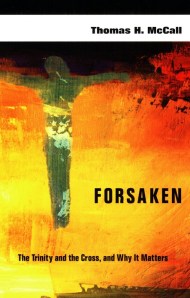
Wondering how these three verses of Scripture fit together? I often have. Cognitive dissonance finally got the better of me, and I decided I should try to think through this one a little more deeply. To that end I read Thomas H. McCall’s Forsaken: The Trinity and the Cross, and Why It Matters (InterVarsity Press, 2012). Here, on Magnificent Monograph Monday, I offer a review of the book. (Thanks to IVP for the free review copy, in exchange for an unbiased review.)

First, the very short summary of my review, if you want to cut to the chase and head off and do something else after this next paragraph.

McCall tackles some difficult questions: “Did God forsake Jesus [on the cross]? Did the Father turn his back on the Son in rage? Was the Trinity ruptured or broken on that day?” His answers and arguments are rooted in Scripture, the history of interpretation of that Scripture, and are consistently compelling. McCall really helped me through my own struggles to grasp some of these questions, leading me to a fuller understanding of the life of the Trinity and the relationship between its persons, particularly in terms of what happened on the cross. And he spells out the implications of his assertions beautifully. God is not divided, he concludes, but God–all of God–is for us. So we can rejoice and rest secure in that. Five stars, no doubt.

McCall writes “not for other scholars…but for pastors, students and friends–indeed, for anyone genuinely interested in moving toward a deeper understanding of God’s being and actions.” Forsaken is heavy theological lifting for a non-scholar (and not lightweight for a scholar, either), but the effort is well worth it. McCall answers some very common questions people ask (or are scared to ask and should ask) about the Trinity, also showing ramifications for our relationship to God.

Forsaken has four chapters. Each asks a theological question, addresses it, then concludes with some theological assertions to avoid, some to affirm, and why it matters.

The first chapter asks, “Was the Trinity Broken?” Here McCall discusses the theological concept of “dereliction,” or the idea that Jesus was abandoned by God on the cross. Recent theology notwithstanding, McCall makes a strong Scriptural case that God the Father did not forsake the Son on the Cross. Understanding Psalm 22 as an “interpretive key” to Jesus’ death, McCall writes:

No, the only text of Scripture that we can understand to address this question directly, Psalm 22:24, says that the Father did not hide his face from his Son. To the contrary, he has “listened to his cry for help.”

Not only that, the author argues, but if God truly had forsaken Jesus, why would Jesus bother–after his cry–to say, “Father, into your hands I commit my spirit”? Jesus “prefaces his last words with a sense of deep relational intimacy: Jesus addresses his ‘Father.'”

In chapter two McCall asks, “Just what are we to make of the biblical witness to the wrath of God? Is it opposed to his love? Is it a ‘dark side’ to God that is inconsistent with his holiness or with his mercy?” He makes a pretty hard-to-argue-with case that “the biblical witness does not set love and wrath in opposition to one another.” McCall, I thought, was at his best in this chapter when he highlighted multiple New Testament references to wrath–not only the wrath of God generally, but Jesus’ wrath specifically. So there’s no Old Testament God=wrath, New Testament God=mercy conclusion to be drawn from the Bible. The author utilizes the theological categories of divine impassibility and simplicity to show that “wrath” as God exhibits it is not what we might envision in human anger; rather, it is an expression of holy love.

McCall’s third chapter asks whether God’s divine foreknowledge means that God killed Jesus, since he knew it was going to happen, could have stopped it, but didn’t. “God’s plan was to use the death of Jesus for his purposes and for our good,” but God himself did not cause the death. As Acts so often makes clear, McCall points out, “The apostolic proclamation of the gospel places the fault and blame on the sinners who are responsible for the death of Jesus.”

Chapter four articulates a robust theology of justification (forensic; instantaneous; by which I enter into the life of God) and sanctification (separation unto God; progressive; by which I grow in communion with God). Page 145 and following has a brilliant interpretation of Paul’s famous Romans 7:14-25 passage where he (seemingly) wrestles with sin.

One difficult implication of this book for me as a worship leader (and coach of worship leaders) is that, if McCall is right, we may be singing some not-quite-right theology in two well-known songs. “How Deep the Father’s Love for Us” has a line that says, “The Father turns his face away.” And the song “In Christ Alone” says, “…till on that cross, as Jesus died, the wrath of God was satisfied.” McCall addresses these two claims head on and (in my opinion, successfully) refutes them. The Father did not turn his face away (see the block quote above). And to say that God the Son mollified the wrath of God the Father is to bifurcate the Trinity in some unorthodox ways. (!)

I’m not sure if it’s generally accepted for a book reviewer to admit to shedding tears when reading a review copy. (Objectivity! Right?) No matter. McCall’s concluding postscript (“A Personal Theological Testimony”) moved me to tears, as he recounted the difference “the trinitarian gospel” made for him and his family as they processed the death of his father.

Getting the theological details of the Trinity right (as best we can!) matters. It matters for our understanding of God, our relationship with him, and for all of life. In the life and truths of the Trinity–properly understood, and I think McCall a good guide here–there is great comfort. We see a God who, as McCall says, is for us. We find a God who has granted us victory over sin and death, making it possible for us to enter into communion with the triune God of love.

You can find Forsaken here at the IVP product page or on Amazon.

William L. Lane free downloads on the Gospel of Mark

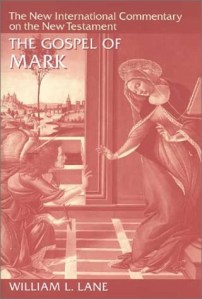
Here’s a link to a Mark teaching series that Dr. William L. Lane led at Christ Community Church in Franklin, TN in 1998. He’s the author of the commentary pictured at right, one of the best for the Gospel of Mark. (Click on the image to look inside the book at Amazon.) From the By/For site:

This Mark teaching series is led by Dr. William L. Lane, author of The Gospel According to Mark from the New International Commentary on the New Testament series. This series was the final time Dr. Lane lectured on Mark.

The study page includes a pdf file of class notes and 13 lectures by Dr. Lane. See it all here.

Tonight’s theological questions at dinner from the 4-year-old

There were two:

Does Jesus make people do stuff?

and

What does “crucified” mean?

My answer to the first question (after a long pause): “Jesus can make people do stuff. Jesus can do anything he wants to. But he usually doesn’t make people do stuff. He lets them decide.” Some will disagree with this. But I think it has pretty good Scriptural warrant. I’m sure this question will come up again. And I thought the sex question was hard!

The second question I answered as specifically and succinctly as I could. I actually got a little teary-eyed as I described crucifixion to him. His response to my answer was appropriate, I thought: “Why did they do that?”

The hyphen in my last name, and, What happens when kids with hyphenated last names marry?

This post is not about sex or colonization.

NPR’s All Things Considered played a story yesterday called, “When Hyphen Boy Meets Hyphen Girl, Names Pile Up.” It’s Family Friday at Words on the Word, and in my family we all roll with the hyphenated last name (K-J). My wife was K, I was J, she wanted to be K-J, invited me to do the same (with no pressure), and I agreed. So we and our three kids are all K-J.

But we’ve often asked, what happens when they get married? What will they do with their last names? And what if they meet someone else with a hyphenated last name?

Read and listen to NPR’s story here.

It doesn’t offer much by way of answers to my questions above, but at least our children will not be alone.

Why did my wife and I opt for K-J? For me, it’s simple: joining our two last names together with the hyphen seemed a perfect “outward and visible sign of an inward and spiritual grace,” namely, what Jesus teaches–“the two will become one flesh” (Mark 10:8).