Reading through the Greek of Isaiah in a year

Here is a well put together reading plan for going through the Greek (“Septuagint”) of Isaiah in a year. I like that, as blog author John Meade writes, “The key is working a little each day for many days.”

So this (PDF) is the plan I want to start using, beginning with the new year. (UPDATEThis is the plan we’ll use (PDF download), with slightly different versification than Meade’s plan.) And by “new year,” of course I mean when Advent begins (the start of the church calendar year), December 2.

If anyone wants to join me… let me know in the comments or by emailing me through this form.

UPDATE: Go here for a vocabulary list to aid reading in the LXX of Isaiah.

UPDATE 2: If you want to join along, here’s the central place on Facebook for discussion, helpful files, questions, companions, etc.

How to Read and Understand the Göttingen Septuagint: A Short Primer, part 1

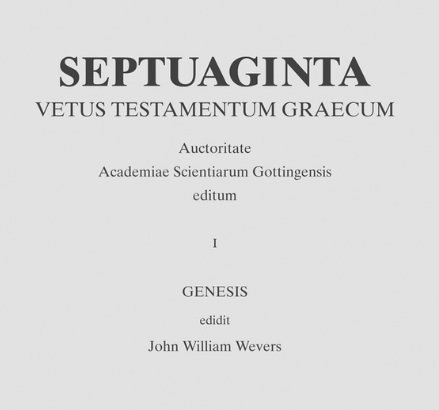
The Göttingen Septuagint is the Cadillac of Septuagint editions. It’s the largest scholarly edition of the Greek translation of the Hebrew Bible. Its full name is Septuaginta: Vetus Testamentum Graecum Auctoritate Academiae Scientiarum Gottingensis editum, published by Vandenhoeck & Ruprecht in Göttingen, Germany. The Göttingen Septuagint has published more than 20 volumes spanning some 40 biblical books (counting the minor prophets as 12), and publication of additional volumes is in progress.

But the Göttingen Septuagint is not for the faint of heart, or for the reader who is unwilling to put some serious work in to understanding the layout and import of the edition and its critical apparatuses. A challenge to using Göttingen is the paucity of material available about the project, even in books about the Septuagint. An additional challenge is that the critical apparatuses contain Greek, abbreviated Greek, and abbreviated Latin. The introductions to each volume are in German, though below I cite from English translations of the introductions to the volumes of the Pentateuch.

It is my intention with this post, and a second to follow, to give a short primer or user’s guide to the Göttingen edition. Here I offer suggestions on how to read and understand the text, the apparatuses, the sigla/abbreviations, the introductions, and point to additional resources that will be of benefit to the Göttingen user.

I recently put together a basic orientation to the scholarly editions of the Hebrew Bible and the Greek translation of the same. That is here. It is worth noting again that the International Organization for Septuagint and Cognate Studies (IOSCS) has a good, succinct article on the various editions of the Septuagint. Below, “OG” stands for “Old Greek.” They write:

The creation and propagation of a critical text of the LXX/OG has been a basic concern in modern scholarship. The two great text editions begun in the early 20th century are the Cambridge Septuagint and the Göttingen Septuagint, each with a “minor edition” (editio minor) and a “major edition” (editio maior). For Cambridge this means respectively H. B. Swete, The Old Testament in Greek (1909-1922) and the so-called “Larger Cambridge Septuagint” by A. E. Brooke, N. McLean, (and H. St. John Thackeray) (1906-). For Göttingen it denotes respectively Alfred Rahlfs’s Handausgabe (1935) and the “Larger Göttingen Septuagint” (1931-). Though Rahlfs (editio minor) can be called a semi-critical edition, the Göttingen Septuaginta (editio maior) presents a fully critical text….

In other words, rather than using a text based on an actual manuscript (as BHS, based on the Leningrad Codex, does), Göttingen utilizes a reconstructed text informed by a thorough examination of manuscript evidence. Göttingen has two critical apparatuses at the bottom of the page of most volumes. Because it is an editio maior and not an editio minor like Rahlfs, a given print page can have just a few lines of actual biblical text, with the rest being taken up by the apparatuses. Here’s a sample page from Genesis 1. Note the #s 1-4 that I’ve added to highlight the different parts of a page. Below I explain #1 and #2; the rest comes in a follow up post.
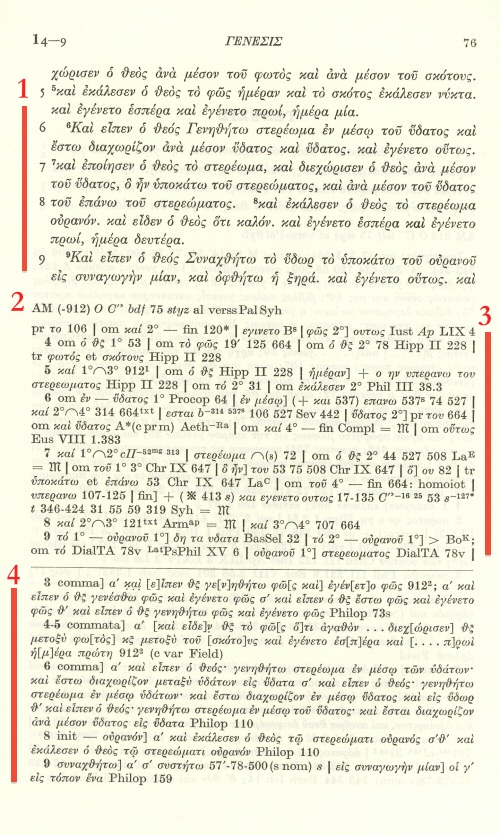
1. The reconstructed Greek critical text (“Der kritische Text”)

With verse references in both the margin and in the body of the text, the top portion of each page of the Göttingen Septuagint is the editorially reconstructed text of each biblical book. In the page from Genesis 1 above, you’ll notice that the text includes punctuation, accents, and breathing marks.

Like the NA27 (and now NA28) and UBS4 versions of the Greek New Testament, Göttingen is a critical or “eclectic” edition, which “may be described as a collection of the oldest recoverable texts, carefully restored book by book (or section by section), aiming at achieving the closest approximation to the original translations (from Hebrew or Aramaic) or compositions (in Greek), systematically reconstructed from the widest array of relevant textual data (including controlled conjecture)” (IOSCS, “Critical Editions”).

Of the critical text, John William Wevers, in his introduction to Genesis in Göttingen, writes:

Since it must be presupposed that this text will be standard for a long time, the stance taken by the editor over against the critical text was intentionally conservative. In general conjectures were avoided, even though it might be expected that future recognition would possibly confirm such conjectures.

It must be clearly evident that the critical text here offered labored under certain limitations. The mss, versions and patristic witnesses which are available to us bring us with few and small exceptions no further back than the second century of our era. Although we do know on the basis of second and third century B.C.E. papyri something about the character of every day Greek used, our knowledge of contemporary literary Greek is very limited indeed. In other words, the critical text here offered is an approximation of the original LXX text, hopefully the best which could be reconstructed on the basis of the present level of our knowledge. The editor entertains no illusion that he has restored throughout the original text of the LXX.

One cannot simply say, “The LXX says…,” because then inevitably an appropriate response is, “Which LXX? Which manuscript? Which or whose best attempt at reconstruction?” So “approximation of the original” and “hopefully the best which could be reconstructed” are key phrases here.

All the same, especially in the newer Göttingen editions, the volume editors have viewed and listed the readings of many manuscripts and versions. The critical apparatuses are where they list those readings, so the user of Göttingen can see other readings as they compare with the critically reconstructed text. (Because the Göttingen editions are critical/eclectic texts, no single manuscript will match the text of the Göttingen Septuagint.) And although scholarly editions of the Greek New Testament also present an eclectic text, neither the NA27 nor UBS 4 is an editio maior, as Göttingen is. (The Editio Critica Maior is just recently begun for the GNT.) Serious works in Septuagint studies, then, most often use the Göttingen text, where available, as a base.

2. The Source List (“Kopfleiste”)

Not every volume has this feature, but the five Pentateuch volumes, Ruth, Esther, and others do. The Kopfleiste comes just below the text and above the apparatuses. Wevers notes it as a list of all manuscripts and versions used, listed in the order that they appear in the apparatus on that page. A fragmentary textual witness is enclosed in parenthesis.

In the above Kopfleiste, the parentheses around 912 mean that papyrus 912 is fragmentary. The “-” preceding it, Wevers notes, means that its text ends on the page in question. So although this particular Göttingen page has Genesis 1:4-9 reconstructed in the critical text (“Der kritische Text”), “(-912)” in the Kopfleiste indicates that the fragmentary papyrus 912 does not actually contain text for all the verses on the page. Looking up papyrus 912 in Wevers’s introduction to Genesis, in fact, confirms that this third to fourth century papyrus contains only Genesis 1:1-5.

By contrast, the “(D-)” here

indicates that the uncial manuscript D has its text beginning on the page in which it appears in Göttingen. The above shot is from the Göttingen page containing Genesis 1:9-13. The first time D has anything to offer (since it is fragmentary, indicated by its enclosure in parentheses) is at 1:13. This alerts the reader that D has no witness to Genesis 1:1-12. Wevers’s introduction then gives more information about the contents of that manuscript. So, too, with the minuscule manuscript 128 above–the introduction says of 128, “Init [=Latin initium=the beginning] – 1,10 is absent.”

Wevers adds:

Should a piece of text be lacking due to some external circumstance in a particular ms, this is noted in the Source-List. For example if ms 17 lacks the text this is shown as O-17. What this means is that the entire O except 17 (which belongs to O) has the text in question. The abbreviation al (for alia manuscripta) refers to the mss which belong to no particular group, i.e. the so-called codices mixti as well as mss which are too fragmentary to allow classification. The expression verss designates all the versions which have the complete text of Genesis. Versions such as Syh to (31,53) and Pal, whose texts are not complete, are listed at the end of the Source-List (Kopfleiste).

In terms of the order of citing Greek textual witnesses:

In the apparatus the citation of Greek sources appears in the following order: First place is occupied by the uncial texts in alphabetical order, and characterized by a capital letter. Then the papyri are cited in the order of 801 to 999. Then the hexaplaric group [AKJ: “O” above] is given as well as the Catena groups [AKJ: C‘’], with the mss groups following in order as: b d f n s t y z; then the codd mixti, followed by the mss without a Rahlfs number. Next come the NT citations, and finally, the rest of the patristic witnesses in alphabetic order.

In the next part of this Göttingen Septuagint primer, I’ll explore #3 and #4 above, the First Critical Apparatus (“Apparat I”) and the Second Critical Apparatus (“Apparat II”), as well as take a closer look at the contents of the Introductions in the Göttingen editions (“Die Einleitung”).

UPDATE: Part 2 of the primer is here, with still more to follow.

Thanks to Brian Davidson of LXXI for his helpful suggestions on an earlier draft of this post.

My Logos 4 review: all six parts

Here, collected in one place, are all six parts of my review of the Bible software program Logos 4.

Part 1Logos 4 Review: Install and Initial Impressions

Part 2Logos 4 Review: The Septuagint

Part 3The Original Languages Library in Logos 4

Part 4Using the Exegetical Guide and Passage Guide in Logos 4

Part 5 (excursus)Logos 4: a quick note about a portable library

Part 6Searching in Logos Bible software (concluding part of my Logos 4 review)

UPDATEGo here to see my Logos 5 reviews.

UPDATE: Go here to see my comparative review of BibleWorks, Accordance, and Logos.

Thanks again to Logos for the review copy of the Original Languages Library.

Septuagint Sunday: Congratulations to…

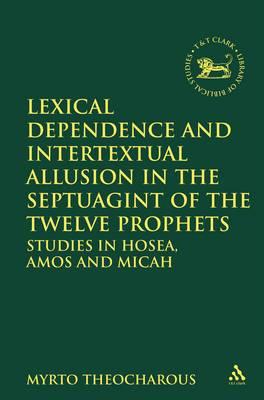
This past week I’ve received some 50 entries in a giveaway contest for a study by Myrto Theocharous called Lexical Dependence and Intertextual Allusion in the Septuagint of the Twelve Prophets: Studies in Hosea, Amos and Micah.

You can read more about the book here. I’ve made some progress in reading the book myself this week, and will be offering a review in the near future.

To choose a winner, I assigned a number to every entry (both a comment on this blog and a share of any kind qualified), then used a random number generator to select the winner.

The winner is…William Varner!

Congratulations, William, and enjoy the new book.

Thanks very much to all who entered and spread the word. I write about the Septuagint at Words on the Word at least once a week. You can bookmark this tag for my Septuagint posts; it updates as I add new posts. If you like what you see here, you can subscribe/follow this blog using the button on the right sidebar.

While you’re here, here are some highlights of what I’ve written about the Septuagint:

And coming soon:

  • My own review of Lexical Dependence and Intertextual Allusion
  • A short primer on how to read and understand the Göttingen Septuagint

Thanks for reading, and congratulations again to William Varner!

N.T. Wright: how he studies

Great stuff from N.T. Wright on how he starts his days (reading Greek and Hebrew), how he responded when an adviser told him to choose between the Church and the Academy (he chose both), and more:

Book Giveaway Reminder

This is a reminder that Sunday night I’ll be announcing the winner of a study by Myrto Theocharous called Lexical Dependence and Intertextual Allusion in the Septuagint of the Twelve Prophets: Studies in Hosea, Amos and Micah.

If you haven’t already entered the giveaway, there’s still time. Go here to read more and enter.

Paul and the Old Testament

There are over 100 explicit quotations of Scripture in Paul’s letters and at least double that number of allusions. However, what is potentially more useful than just citing Paul’s answers to first-century questions is to study how Paul interpreted Scripture, and that is the theme of this book. (1)

This summer I reviewed the third volume of a de facto trilogy by Steve Moyise. In that same series is Paul and Scripture: Studying the New Testament Use of the Old Testament (click on book cover image to see at Amazon). In 160 packed pages Moyise surveys Paul’s use of the Hebrew Bible/Septuagint.

Moyise’s approach is a thematic one, rather than book-by-book. This helps the reader focus on how Paul treated the same topic across his various letters.

The author begins with an introduction to Paul, his “conversion” experience, his missionary activity, and a wonderful problematizing of the issue: because Paul was familiar with Greek, Hebrew, and Aramaic versions of Scripture, “[W]hen Paul introduces a phrase or sentence with an introductory formula (IF) such as ‘it is written’, we have to ask ourselves which version of the Scriptures he has in mind” (10). For Paul “would not have had our concept of ‘Bible’, a bound volume of 66 books (for Protestants) residing on his bookshelf” (10).

Moyise keeps his and the reader’s eye on this issue throughout Paul and Scripture. He explores how Paul used:

  • “The figure of Adam” and creation accounts (with Christ as a Second Adam)
  • The story of Abraham, including a brief but helpful look at “Abraham in Jewish tradition”
  • Moses–“an ambiguous figure for Paul. He speaks to God face to face, but his use of a veil is interpreted as a lack of openness” (59)
  • The law. This was perhaps the most interesting section of the book, as Moyise surveyed not only Paul’s use of Scripture, but how modern theologians have tried to make sense of what looks on first glance like conflicting statements about the law. This section is what led me to write:

I don’t even mind that at the moment I’m a bit perplexed by how Paul could both praise the law as being from God yet also refer to it as a “the ministry that brought death.”

  • The prophets–both to develop a theology of Israel and the Gentiles, and to provide instructions for how the Christian community should live
  • The Psalms, Proverbs, and Job

The final chapter is a more detailed survey dealing with “modern approaches to Paul’s use of Scripture,” which Moyise divides into “an intertextual approach,” “a narrative approach,” and “a rhetorical approach” (111 ff.).

Appendices include a focus on Paul’s quotations from Isaiah, an index of Paul’s quotations of Scripture, and pertinent excerpts from the Dead Sea Scrolls.

As with The Later New Testament Writings and Scripture, the book is accessible to a non-scholar or non-specialist in this field, though it will require some work. Due to the book’s brevity, and what I assume was Moyise’s desire to still cover all the proper territory, the book is dense. This means that even a short volume like this will be a great reference to me for some time, as I seek to better understand the ways in which Paul used the Old Testament, and the ways in which Christians have tried to make sense of that use for some 2,000 years, especially recently.

The gray shaded boxes throughout explain key concepts such as the Septuagint, Origen’s Hexapla, Greek grammar, the Dead Sea Scrolls, and so on. As with Moyise’s other book, one does not need to know Greek or Hebrew to read Paul and Scripture, but he does not hesitate to use transliterated Greek to aid his explanation.

I have begun to appreciate Moyise’s even-handedness in presenting various viewpoints and interpretations. Even when discussing potentially controversial aspects of Paul (which books Paul authored, the “New Perspective,” or the idea of some that Paul actually exhibited “contradictory” and inconsistent views of the law), Moyise is fair and presents the various views in a way that the reader is left to consider them for herself or himself. (And the reader knows where to go to find more.)

One thing that seems rare in a work like this is that Moyise generally writes out a Scripture he is citing, rather than just placing a slew of references in parentheses for the reader to slowly work through. This latter method is not all bad, but Moyise’s quotation or summation of the references he cites makes for a smooth read.

I found helpful Moyise’s employment of “an eclectic view, using whatever methods or approaches were helpful for understanding the particular quotation” (111). Moyise doesn’t conclusively answer all the questions that arise when studying Paul’s use of Scripture, nor does he seek to. He hopes “that this book has both laid a foundation and stimulated an interest to go on and read further” (125), a mission he very much has accomplished (at least in this reader) with Paul and Scripture.

Thank you to Baker Academic for providing me with a review copy of the book. See its product page at Baker here.

Free Book! Septuagint Sunday Giveaway: Lexical Dependence and Intertextual Allusion in the LXX 12 Prophets

I am giving away a book at Words on the Word this week. It’s a study by Myrto Theocharous called Lexical Dependence and Intertextual Allusion in the Septuagint of the Twelve Prophets: Studies in Hosea, Amos and Micah. This author had me at the title. (Seriously.) It’s part of the Library of Hebrew Bible/Old Testament Studies series from Continuum/T&T Clark. (Thanks to the publisher for making the giveaway possible.) It’s got nice library binding, good quality paper, clear and easy-to-read Greek and Hebrew fonts.

I’ve been enjoying working my way through it, and in coming weeks will offer a review of the book. You can browse inside by clicking here (Amazon affiliate link). Here’s an excerpt from the publisher’s description of the book:

This book explores various aspects of intertextuality in the LXX Twelve Prophets, with a special emphasis on Hosea, Amos and Micah.

Divided into five parts, the first introduces the topic of intertextuality, discusses issues relating to the Twelve Prophets and their translator and concludes with various methodological considerations. Chapter two deals initially with the lexical sourcing of the prophets in their Hellenistic milieu and tests proposed theories of influence from the Pentateuch.

The rest of the book examines specific cases from the books of Hosea, Amos and Micah.

Theocharous summarizes her book in this short pdf. From what I’ve read so far, I can already recommend it.

I will choose a winner at random this time next week. To enter the drawing, simply comment on this blog post with your greetings, thoughts about the Septuagint or prophets, World Series predictions, etc.

Then if you link to this post on your Facebook, Twitter, blog, etc., come back here to tell me in the comments section that you did, and you’ll receive a second entry. I will announce the winner on the blog before midnight Sunday, October 21.

And you can now like Words on the Word on Facebook.

BHS module in Accordance 10, reviewed

Oddly enough, the biggest challenge for me in my Hebrew exegesis classes was not to do with the Hebrew language itself. Instead, learning how to decipher the abbreviations and sigla in the “critical apparatus” of a scholarly Hebrew Bible stretched me most.

I recently wrote a brief introduction to the available scholarly editions of the Hebrew Jewish Scriptures (“Old Testament”), the Greek Jewish Scriptures (“Septuagint”), and the Greek New Testament, with most of the emphasis on that post falling on the Hebrew Bible:

Most students of the Hebrew Bible who read Hebrew know of the premier scholarly edition, the Biblia Hebraica Stuttgartensia (BHS, here on Amazon).  The BHS is now being updated by the BHQ (Q=Quinta), about which you can read more here. Both the BHS and BHQ are “diplomatic” editions of the text, which means that they reproduce a single “best” manuscript, the Leningrad Codex, in their cases. The footer in each page contains a critical apparatus, which lists variant readings from other manuscripts and versions that the editors have deemed to be of importance for getting even closer to the “original” (now often being called the “earliest attainable text”). In some cases, the editors may wish to show where another manuscript or version differs from the Leningrad Codex; the critical apparatus is where they do it.

However, the BHS editors show manuscript and version differences in their critical apparatus through the use of abbreviated Latin. Even those who know Latin will have to learn the abbreviations, and those who don’t know Latin will have an even harder time trying to decipher the apparatus.

Having figured out my way around the print edition of the BHS, and having reviewed Accordance 10, I have been eager to use the BHS module in Accordance. Here I review it.

The Original Languages base package in Accordance comes with HMT-W4, which gives the user access to the Groves-Wheeler Westminster Hebrew Morphology 4.16. This text reflects additional and ongoing corrections to the Leningrad Codex. Accordance says HMT-W4 is “almost identical” to the BHS text.

But for the user who wants not just the text but the apparatus, an add-on module is needed. If you already have HMT-W4 or BHS-W4 for your Hebrew Bible in Accordance, you can save money and buy the apparatus by itself. It’s just $50, which is a good deal. (Note: there are no Masora–Masoretic marginalia–included in the module; it’s just the apparatus at the bottom of the page.)  If you have Accordance and don’t already have a Hebrew text, you could buy this package, where BHS-T is the “complete text of the Hebrew Bible, following the Biblia Hebraica Stuttgartensia, with the Groves-Wheeler Westminster Hebrew Morphology 4.14. This module includes vowel pointing, cantillation marks, and lemma and grammatical tagging information for each word in the text.”

In any of these Hebrew texts in Accordance, there is instant parsing easily available as you go through the text.

BHS with apparatus in Accordance significantly streamlines study and use of the critical apparatus. Accordance makes it easy to do textual criticism without carrying the heavy BHS around. I really appreciate being able to access the BHS critical apparatus on my laptop, and in a way that is integrated well into the Accordance program. The layout is good, the feel is intuitive, and the windows are easy to set up. Here’s how I have Accordance set up to use the critical apparatus with the Hebrew text and Old Greek in view (click to enlarge):

There’s the BHS critical apparatus, right under the text. Anything in blue in that window is hyperlinked and will display something in the Instant Details window. If I want to know what “pc Mss” means in the apparatus, I see it unabbreviated in the Instant Details just by mousing over the blue text. (If you don’t need the abbreviations expanded, you can also hover over the superscript letters in the BHS-T text, and the corresponding content from the apparatus pops up.)

Using the layout above you can quickly see what an abbreviation in the apparatus stands for in Latin, but this is not translated into English. In the above example, it’s obvious that “manuscripti” for “Mss” means manuscripts–no Latin knowledge is needed to understand that Latin word. But what is “pauci”? Those with good vocabulary may be able to recall that a paucity of something is a small number, a lack, so “pauci” here means few.

But not all Latin in the apparatus is that easy. I would like to have seen this module provide a translation from Latin into English.  This is probably my only complaint about this module. I believe this is not unique to Accordance and has more to do with how the German Bible Society may have offered the licensing for the apparatus. All the same, getting from abbreviated Latin to unabbreviated Latin, while nice, may not be enough for the beginning text critic.

Some good news, though. There are two workarounds to be able to translate the apparatus contents from Latin to English. First, there is Google Translate, which I understand has improved its accuracy over the last few years. Here is the link for Google Translate from Latin to English. Simply copy Latin from Accordance into the query box in Google translate, and you’ll have your English. “prb l c” in the apparatus becomes, “probabiliter lege(ndum) cum” in Instant Details, which Google gives me as, “probably read with.”

A yet easier way to get to English is possible within Accordance itself, and it’s quite smooth, thanks to the good programming and easy layout of the software. Dr. Hans Peter Rüger’s well-known “English Key to the Latin Words, Abbreviations, and the Symbols of BIBLIA HEBRAICA STUTTGARTENSIA” is available in Accordance.

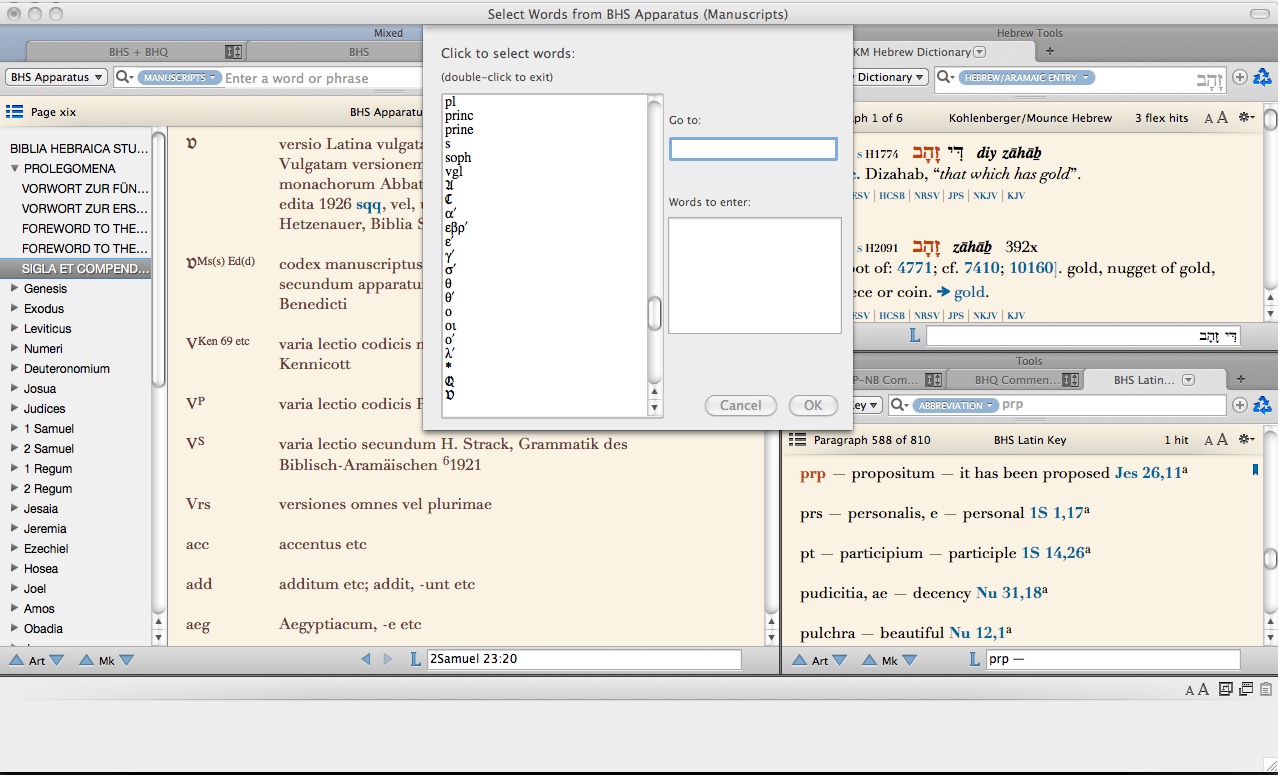
Note that in the bottom right zone, my far right tab (behind the open one) is this “BHS Latin Key.” I can easy look up an abbreviation in that tab’s search bar. It’s also simple to just right click the abbreviated word in the apparatus and “Look up” in “Dictionary” to quickly access the English/Latin key.

As far as the BHS apparatus itself, BHS remains the scholarly standard. BHQ is beginning to update/replace it, and there are other scholarly projects underway. The BHS apparatus is not exhaustive, nor could it be. But it does offer a good representation of variant readings from different versions (e.g., the Latin Vulgate, the Greek LXX, the Syriac Peshitta, Aramaic Targums, etc.) and different manuscripts (whether a specific Old Greek manuscript or just the general “Mss” for “manuscripts”).

There are different editors for different portions of the BHS, and some are less cautious than others in suggesting textual emendations. In the Minor Prophets, for example, editor Karl Elliger seems to have no trouble writing “prp”=”propositum”=”it has been proposed” when he wants to suggest an alternate reading. Sometimes this means that someone else has proposed what Elliger is footnoting; other times it’s just his suggestion, and not always with textual/manuscript evidence accompanying the suggestion. So the user of BHS should not use the critical apparatus, well… uncritically.

An especially neat feature that wowed me is that I can open up the apparatus and search by content to study all 2,146 times the Latin abbreviation “prp” occurs in the BHS apparatus. You can even search the apparatus for its Hebrew and Greek contents. Curious how often ποῦ finds its way into the apparatus? A simple search shows its four occurrences.

And you can search the apparatus by manuscripts mentioned. Change the search bar to “manuscripts,” then right click in the bar and select “Enter Word…” and you get this:

It’s a great way to be able to interact with the apparatus, much of which simply isn’t possible in print.

Bonus: Accordance offers an excellent, succinct explanation of critical editions here, with emphasis on the critical editions available in Accordance. If you’re interested in BHS in Accordance, you’ll want to read it.

If you do text criticism in the Hebrew Bible and have the money to spare, Accordance’s BHS apparatus is well worth getting, though most users will want to make sure they also have the “BHS Latin Key,” too. All in all, it’s a well-executed and seamlessly-integrated module.

Thank you to Accordance for providing me with a copy of the BHS and BHQ modules for review. See all the parts of my Accordance 10 review (including the Beale/Carson commentary module) here. I will review the BHQ separately in the future.