My Comparative Review of Software for LXX Studies, Published in JSCS

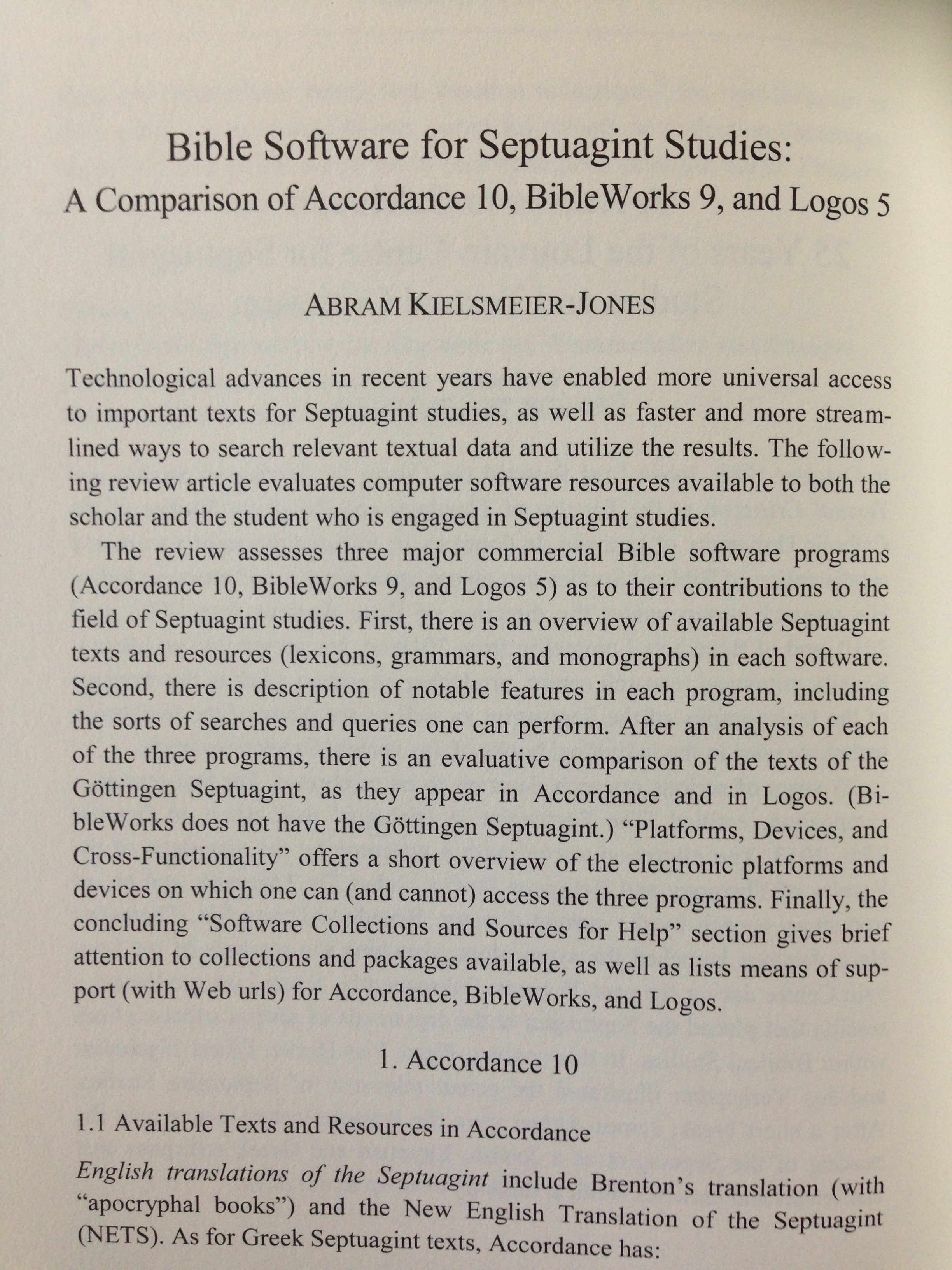
I’ve just come home to the new Journal of Septuagint and Cognate Studies (JSCS) in my mailbox. This volume (vol. 47, 2014) publishes an extensive comparative review I wrote of Bible software programs for Septuagint studies. In the review I consider and evaluate Accordance 10, BibleWorks 9, and Logos 5.

I’m excited to see it in press! Here are the journal cover, the contents, and the first page of the review. You can subscribe to JSCS at this link.

JSCS (2014) Cover
JSCS (2014) Cover


JSCS (2014) Contents


First Page of the Review

Bonhoeffer: If You Can’t Listen to Others, You Won’t Listen to God

Bonhoeffer Life Together

I’m reading Dietrich Bonhoeffer’s Life Together for the first time. As I near completion of the book, here is a convicting passage that jumped out at me:

But Christians who can no longer listen to one another will soon no longer be listening to God either; they will always be talking even in the presence of God. The death of the spiritual life starts here, and in the end there is nothing left but empty spiritual chatter and clerical condescension which chokes on pious words. Those who cannot listen long and patiently will always be talking past others, and finally no longer will even notice it. Those who think their time is too precious to spend listening will never really have time for God and others, but only for themselves and for their own words and plans.

You can find the book here (affiliate link) or here (they sent me a review copy). I’ll post again soon when I finish.

Got a Theology of Justice?

Justice ScaleI had a seminary professor who rightly noted the lack of ministers and churchgoers with a fully developed theology of justice.

“What’s your theology of justice?” he asked at the beginning of the class, which was met with blank but curious stares.

Reconciling All Things: A Christian Vision for Justice, Peace and Healing, more than any other book besides the Bible, has shaped my theological understanding of justice. Authors Emmanuel Katongole and Chris Rice develop a Christ-centered, Scripture-shaped, journey-oriented theology of justice reconciliation.

The authors urge that we slow down and take the time that is needed for true reconciliation—as a journey—to take hold. A question that permeates the book is, “Reconciliation toward what?” Katongole and Rice are aware that “reconciliation” calls to mind various “prevailing visions,” many of which lack theological rootedness in the Biblical story of God saving his people.

Reconciliation is, they suggest, a God-given gift to the world and the ultimate goal of the “journey with God from old toward new.” They write,

The journey of reconciliation hangs or falls on seeing Jesus. …For Christians, the compass for the journey of reconciliation is always pointing toward Jesus Christ.

Katongole and Rice make heavy use of Paul’s words to the Corinthians:

All this is from God, who reconciled us to himself through Christ and gave us the ministry of reconciliation: that God was reconciling the world to himself in Christ, not counting people’s sins against them. And he has committed to us the message of reconciliation. We are therefore Christ’s ambassadors, as though God were making his appeal through us. We implore you on Christ’s behalf: Be reconciled to God.  (II Corinthians 5:18-20, TNIV)

Seen as a gift, then, reconciliation becomes something that is “not for experts only,” but something that God calls all his children to. To equip us for the journey God gives us gifts: a cloud of witnesses, communion, peace and harmony, Sabbath, and the gift of Scripture, which is to shape us as God’s story in the world.

Midway through the book the authors arrive at a biblically understood definition of justice:

Justice is an aspect of God’s shalom, a notion that carries with it the idea of completeness, soundness, well-being and prosperity, and includes every aspect of life—personal, relational and national.

Justice, they say, is to include the interpersonal, relational aspect; yet it must also attend to structural considerations. To speak about justice so holistically, against dichotomies that might otherwise render our work ineffective, is wise and instructive for our journey toward reconciliation.

Reconciling All ThingsAlthough written by a black, Catholic, African academician and a white, Protestant, American practitioner, the book does not specify what issues in reconciliation may occur between any two specific groups and how those groups (or individuals) might think about moving forward. The authors do give helpful anecdotal evidence of reconciliation that bridges and heals divides of race, class, and ethnicity. But the reader wanting, for example, to mend and redress the brokenness in black-white relations in the United States may have to look to supplemental reading for more practical hints.

However, in its development of a fairly robust theology of reconciliation and justice, Reconciling All Things lays the important groundwork on top of which such future work can be built. Its chapters on lament (“The Discipline of Lament”) and leadership (“The Heart, Spirit, and Life of Leadership”) are profound in their call for Christians to slow down, locate themselves (emotionally and physically) among the broken places of the world, and to mourn and lament in those places, together with those who mourn and lament.

The one who would lead, then, is less concerned with specific techniques, tools, and strategies, and more concerned with seeing a gap, being deeply moved in response, and belonging to the gap, long before she or he would make proposals to initiate change and issue directives. In laying this groundwork, Katongole and Rice actually leave the work of developing techniques and specific reconciliation “skills” to the reader.

In the end, “You find that God has surprised you and your companions over and over with all that you needed to go on….” The assurance of this ongoing gift of God’s provision gives the Christian who would practice reconciliation all she needs to begin discerning her role in practicing reconciliation in everyday life.

I bought this book. You should, too, or check it out from your local library. Here at Amazon; here at IVP.

Accept the Incompleteness of Your Work

28102-Sabbath in the City_pYesterday I preached on Sabbath-keeping and what I think is the real reason it’s so hard for us to engage such a life-giving practice. As I’m reflecting further this week on cultivating a Sabbath-oriented mindset throughout my days, I remembered a book I read a few years ago that nourished me. It’s called Sabbath in the City: Sustaining Urban Pastoral Excellence.

Bryan P. Stone and Claire E. Wolfteich wrote this short yet compelling book on “what constitutes pastoral excellence in the urban context” and “what sustains it.” The authors use results from their project, “Sustaining Urban Pastoral Excellence,” which piloted a program of rest and renewal for 96 urban pastors across the country. According to Stone and Wolfteich, there are four primary activities or modes of being that make up pastoral excellence (which they also refer to as “virtue”):

  1. The cultivation of holy, life-giving friendships, particularly with other pastors;
  2. Regular Sabbath practices of rest that allow for acts of both creation and liberation;
  3. A renewal of the spirit through disciplines like prayer, reading Scripture, and silence;
  4. Study and reflection on the theology and practice of ministry (the authors tie this in with the above activity, renewal of the spirit).

While the authors note that pastoral excellence thus constituted is applicable to other, non-urban settings, they emphasize the uniqueness of the urban context and how it can challenge and fatigue urban pastors. They describe the city as “a place of distractions, busyness, and frenzied activity.” In contradistinction to more affluent suburban parishes, the urban church is likely to function as a full-service institution that addresses the variegated needs of the city in which it resides. The authors follow the group of 96 participants and show how the four practices listed above helped them to cultivate and sustain pastoral excellence.

Reading the book was itself an act of refreshment. Two aspects were most helpful to me:

First, the authors highlight the importance to pastors of cultivating holy, God-focused friendships. They write, “Friendships, then, are not simply a means of supporting a more healthy spiritual life. As some of the pastors in our project put it, ‘They are our spiritual life.’” The old African proverb is apropos here:

If you want to travel fast, travel alone. If you want to travel far, travel together.

Second, Sabbath-keeping is easier idealized than practiced. Stone and Wolfteich write,

[The] advice to accept the incompleteness of our work may be difficult to enact.

Though I didn’t have Sabbath in the City in mind at the time, the sermon I’ll post later this week interacts at length with this idea, i.e., why it is that we don’t take the Sabbath we know we want to take.

The book is intended for pastors in an urban setting, but even a suburban-dweller who is not involved in pastoral ministry will find rest and hope in Sabbath in the City.

You can find it on Amazon here and at Westminster John Knox Books here.

A Peaceable Psychology: Christian Therapy in a World of Many Cultures

Peaceable PsychologyThis summer I’ve been taking a course on multicultural counseling. Here I offer some interaction with and reflection on A Peaceable Psychology, pictured at left.

Key Points of Learning: Agreements and Concerns

Before reading A Peaceable Psychology, I hadn’t really thought about counseling and therapy as “political” acts. And yet Alvin Dueck and Kevin Reimer warn well against the illusion that the therapist can somehow counsel apolitically, aculturally, amorally, and areligiously. One of the key, unifying ideas of the book is: “Civility includes learning and validating the language of the ethno-religious client. It is polite to defer to the meaning framework of a client.”

I found this to be a helpful way of framing the quest for diversity competence among therapists and pastors. Dueck and Reimer do go even farther than saying this kind of psychotherapy is polite; they suggest that to counsel in this way is to be like Jesus, especially when therapist and client can inhabit the same place of suffering together.

Although Dueck and Reimer have a healthy (and hearty!) reluctance toward philosophical foundationalism as such, they see the work and life and love of Jesus as foundational to a peaceable psychology. This is especially evident in their view of the importance of the atonement.

I found myself in agreement with Dueck and Reimer when they wrote:

The reconciling atonement of Christ is not spiritual alone but contains physical, psychological, and social dimensions of human brokenness. The suffering God is a beckoning God, who in Christ offers the potential of a new beginning. Consequently, a peaceable psychology is an incarnational event whereupon the invisible spiritual reality of God’s grace is attached to and bound up in the visible life of both the victim and the offender.

They go on, “Atonement is God’s welcoming of the enemy, of the other. It is an invitation to new life, to freedom from sin. This is the basis of a peaceable psychology.”

When considering various theological theories of the atonement, I find myself convinced by an all-of-the-above approach. (How could we limit the efficacy of the atonement by proffering just one theory as to what it was and how it happened?) The work and suffering of Jesus, they suggest, is to transform the therapist-client relationship. “If Juanita were our client,” they ask, “would her suffering fully impact us?”

This, however, also was a potential point of disagreement I had with the authors. Or at least I had questions and wanted to add qualifications. To be sure, the idea of the “kenotic therapist” makes sense to me—especially as a pastor. But the following expression of kenotic therapy was too much, at least for me: “Indeed, I am held hostage by my clients’ suffering. Their face places an ethical claim on me because as a fellow human I am systemically responsible for their suffering.”

While I can agree about “an ethical claim,” I’m not sure being “held hostage” is the most useful metaphor. How many clients will—or can—a therapist allow to hold him hostage before he feels imprisoned in an unhealthy and stultifying way? I wish the authors had spoken more to the point with some practical suggestions and caveats.

Implications for Pastoral Care

Dueck and Reimer say, “We fear that the American psychologist who assumes a level playing field for the linguistic comprehension of ‘self’ has already begun a subtle process of imposition upon the client.”

This is a valuable reminder to me as a minister. I simply cannot make assumptions about the cultural backgrounds of congregants. Further, there is value in this approach (of not assuming “a level playing field for the linguistic comprehension of ‘self’”) that has already—just this last week—had practical import and payoff in my biblical hermeneutics for preaching.

Yesterday I preached on Psalm 23. Due in large part to the idea Dueck and Reimer articulate above, namely, that constructions of self are culturally conditioned and informed, I was able to observe the following about Psalm 23.

David uses the first person singular pronoun throughout the Psalm. God is the shepherd of each individual who would follow him.

This may seem slightly unremarkable to us. We live in a North American society that already tends toward individualism. Our cultural construction of the self tends to be individually-focused.

The culture in which David found himself was much more communally-oriented. …A person’s sense of self was constructed and informed and shaped in a communal context.

So it’s at least a little remarkable, in the larger context of Hebrew worshiping society, that David begins–the Lord is MY shepherd.

This really drove home the point in another article we read in class: “Since hermeneutical understanding is always intercultural and contextual, cultural self-awareness is a prerequisite to responsibly interpreting Scripture and spiritual experience” (Sandage, Jensen, and Jass).

I also do and will find it useful for my own pastoring to consider that “a peaceable therapist recognizes that healing is best conducted ethnically, in the client’s mother tongue and in his or her local culture.”

Of course no therapist can be already conversant in the mother tongue of every cultural or religious tradition. But Dueck and Reimer realize that, and are suggesting more of an “ad hoc” approach anyway: “A peaceable therapist is a linguist; he or she recognizes differences between languages and honors them by learning them.”

May God help us–therapists and ministers alike–so to do!

Find A Peaceable Pscyhology at Amazon here. Baker/Brazos has its product page here, with an excerpt (including Table of Contents) here. No review copy–I bought this one!

The Best Case You Can Get for Your iPad Mini

My favorite iPad mini case has been replaced with another one from the same company.

INVELLOP now has a slightly heavier-duty leatherette case for iPad mini that works with both the first-generation and the retina mini model.

Usually when I review gear I list pros and cons. INVELLOP’s new case, however, has really only one slight drawback, which I note below.

I find the case to be just about the perfect combination of protection and slimness.

This is what it looks like, in a few views:

In viewing mode
In viewing mode
Front of case, closed
INVELLOP 3
Back of case, closed
INVELLOP 4
Inside of the case

Here’s why I haven’t put any other case on my iPad since getting this one:

  • The cutouts (headphone jack, volume control, camera lens) are perfectly sized
  • The case covers both front and back of the iPad; it’s all one piece
  • Though I still sometimes take the case off for extended periods of reading or watching, it’s really easy to hold the iPad in one hand with the case folded back
  • I actually have dropped the iPad a couple times (on the carpet, thankfully) since getting this case… and it’s been fine (phew!)
  • After a few months of use, there is just the slightest bit of wear on the case, but it’s holding up very nicely
  • Closing the screen flap puts the device to sleep; opening it wakes it–this functions perfectly
  • At the time of this post, you can get the case for about $20 at Amazon (affiliate link to help fund ye ole blog)
  • The inside of the screen cover has microfiber, which has not scratched the screen at all
  • The screen cover is in thirds so that you can put your iPad upright (in landscape mode) in two different positions (for viewing or typing)
  • There are magnets that keep the front cover secured in place when you fold it back

The only minor critique I have is that it’s slightly heavier (by a couple ounces, maybe) than the previous iteration of this case. But that’s a small price to pay for the greater protection and classier feel. Two thumbs up. This feels like everything you’d want an iPad mini case to be.

Thanks to INVELLOP for the review sample. The case reviewed above can be found at Amazon hereYou can find my other gear reviews here.

Writing My First Paper Using Scrivener

During my first few minutes using Scrivener 2, I kept thinking the most apt comparison was “word processor on steroids.” But that’s not quite accurate. For one, there are no negative side effects here—save for the commitment the user will have to put in to learn a flexible, layered, and impressive program. And Scrivener is about as far from a word processor as LeBron James is now from Miami.

How Quickly Could I Get Started? (In About 40 Minutes)

I had a paper due this weekend for a grad school class I’m taking. I wanted to use Scrivener to write it, since I thought it would simplify the process. Yes, Scrivener processes words, but it’s really a program for writing project management. Its product page says:

Enter Scrivener: a word processor and project management tool that stays with you from that first, unformed idea all the way through to the final draft. Outline and structure your ideas, take notes, view research alongside your writing and compose the constituent pieces of your text in isolation or in context. Scrivener won’t tell you how to write—it just makes all the tools you have scattered around your desk available in one application, leaving you free to focus on the words.

Scrivener is fast and easy to install. When you open it for the first time, you see an interactive tutorial you can work through:
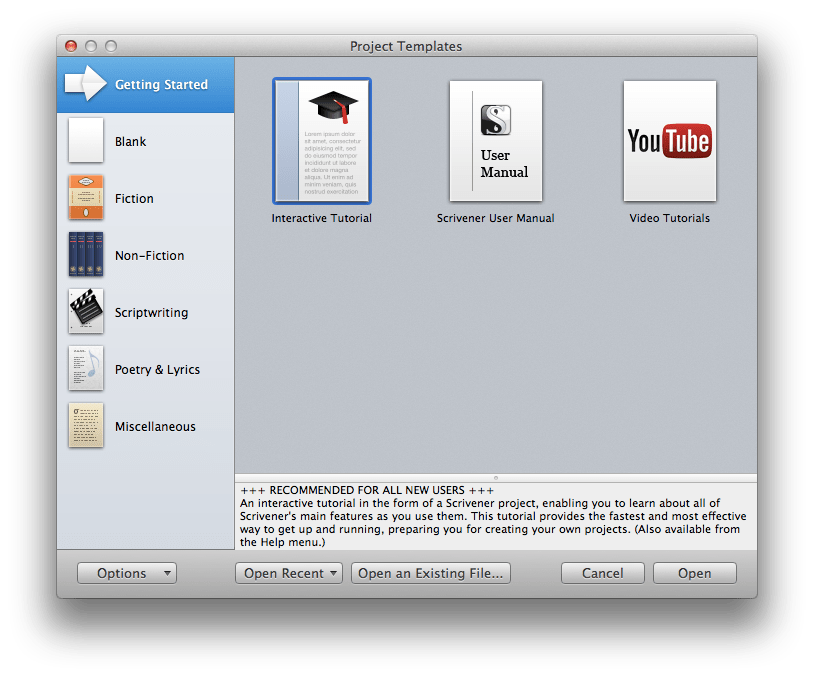
Scrivener_Getting StartedBut it says it will take “couple of hours if you go through it thoroughly,” and I needed to get started sooner than that on the paper. (I’ll go through the whole tutorial as soon as I can; it’s really well done.)

There are also tutorial videos here. A lot of them. I’ll admit to being somewhat overwhelmed at first. Scrivener is, after all, the kind of program you need to spend at least a little time to learn how to use, even if you’re already relatively computer-savvy. But it promises to be time well spent.

As an experiment, I decided to watch the ten-minute overview (the first video at the link above, “An Introduction to Scrivener”) to see if it was enough to get me “up and running as quickly as possible,” as the video description suggested. I had never used Scrivener before this month.

Sure enough—10 minutes later (plus another 30 minutes or so searching the forums, help files, and user manual) I was up and running, using Scrivener for the first time to complete a grad school writing assignment.

Writing a Paper More Efficiently

The paper I was writing requires multiple sections and is a topic I’d written about before. I also had some readings to integrate into the paper. And, of course, I wanted to keep the syllabus and specific requirements in front of me as I wrote.

So, after opening a preset template based on the Chicago Manual of Style, I got my project ready. Here’s what it looks like in Scrivener. To you Scrivener power users: this is a pretty basic setup, and I’m still learning what all I can do. To you who are not familiar with Scrivener: I’ll note below what each of the portions of the screenshot is. (Click on image to enlarge.)

Scrivener Paper LayoutThe leftmost column is the Binder. This looks a bit like a Mac’s Finder folders. Here is where I laid out my paper. The preset template took care of the “Title Page” and “Works Cited” formatting; I just had to fill them in. I outlined the “Main Content.” Underneath that is “Research,” a set of .pdfs and other files I dragged in. Instead of switching between Preview, Word, and multiple windows in multiple programs, I could access everything I needed from the “Binder,” once I put it there. This meant that once I took a few minutes to set up the project, I only needed this one app open to complete the writing assignment, start to finish.

The “Ideas” section in the Binder, by the way, allows you to do a virtual version of creating notecards, for later rearrangement and integration into the paper.

Scrivener LogoThe middle panes (the largest ones) comprise the Editor, which is where I wrote the paper. One really cool thing about this is you can have it all be one big pane, or you can open two panes at once. In the above screenshot, I’m writing my paper in the top editor pane and accessing a previous writing for reference in the bottom pane.

At right is the Inspector. This is versatile and can be used to select one of six different sub-panes. In the view above I have open a short synopsis of the section I’m writing (here I copied from the assignment so I knew what I was supposed to be writing), as well as some general Project Notes I wanted to keep before me for each section of the paper.

After I had written the paper, I selected Compile from the File menu, and Scrivener gave me a myriad of easy-to-navigate options for how I wanted to export my paper into a word processor for final formatting. I exported it to Word and only had to do a very few tweaks to have my paper come out properly formatted–including the footnotes.

More to Follow

Literature & Latte kindly supplied me with a license of Scrivener for the purposes of review. There is much, much more to the program than what I have outlined above, and I’ll write more later. I came to Scrivener this week just wondering if I could learn its basics fast enough to use it right away to write a paper, and in a way that would save me time compared to my normal workflow. This was very much the case when I had finished. I only wish I had known about the program much sooner in my graduate studies!

Want to check it out? (I recommend it.) Here you can download a free trial, for Mac or Windows. (It’s a generous trial period, too.) You can read more about Scrivener’s features here.

Counseling the Culturally Diverse

Counseling the Culturally Diverse

This week I’m beginning a course on multicultural counseling. I can’t wait to jump in.

One of the textbooks we’re using is Counseling the Culturally Diverse: Theory and Practice, 6th Edition (Wiley, 2013), by Derald Wing Sue and David Sue. Here’s a bit of the description from the book’s product page:

Filled with numerous examples, authentic vignettes, and practical case studies, Counseling the Culturally Diverse, Sixth Edition remains the best source of real-world multicultural counseling preparation for students and an influential guide for professionals.

The first chapter (which is as much as I’ve read so far) begins with the personal (and professional) journeys of two readers of the book, as well as the author’s own such reflections. From the reflection questions on the very first page, readers of this sixth edition get the sense that they, too, are in for a challenging and invigorating journey. The first reflection question is:

In what ways do our personal reactions to topics of race, gender, sexual orientation, and oppression have to do with counseling diverse clients?

Then there is:

Who are you as a racial/cultural being? How often have you thought about yourself as a man/woman, White individual/person of color, or straight/gay?

The underlying assumption behind the question is that those in so-called majority statuses in each of the above categories will not have thought as much about such identities as those in minority statuses have. Indeed, this not having to think about it characterizes what folks refer to as white privilege, male privilege, and so on.

Self-understanding around issues of culture, the book suggests, is essential to the development and effectiveness of a counselor/therapist.

Finally, the author says,

[The book’s] goals are to enlighten you about how counseling and psychotherapy may represent cultural oppression and to provide a vision of change that is rooted in social justice.

I hope to have a chance to report more about the book in the future. (And if any of you reading this post has read Counseling the Culturally Diverse, I’d love to hear your thoughts in the comments, or via this contact form.)

The book is here at Wiley and here on Amazon (affiliate link). In both places it’s available in print or electronically. Via Wiley, you can look at the full Table of Contents here (pdf) and read the first chapter in full here (pdf).

Review of Wiley’s Organic Chemistry (11th Edition)

This past school year my wife took a full-year Organic Chemistry class. For her textbook she used Organic Chemistry (11th edition) by T.W. Graham Solomons, Craig B. Fryhle, and Scott A. Snyder (Wiley, 2014). With gratitude to Wiley for the review copy, what follows is her assessment of the textbook.


The Approach of the Textbook


9781118133576.pdfOrganic Chemistry is divided into 25 chapters, covering the standard terrain like “Aldehydes and Ketones” (chapter 16), “Alcohols and Ethers” (chapter 11), and “Carboxylic Acids and Their Derivatives” (chapter 17).

It hits the core basics in the beginning and then goes through all the essential mechanisms. There’s even a chapter on NMR (chapter 9: “Nuclear Magnetic Resonance and Mass Spectometry”), in which the reader learns, among other things, about the chemistry behind an MRI.

The book’s product page says:

A central theme of the authors’ approach to organic chemistry is to emphasize the relationship between structure and reactivity. To accomplish this, the text is organized in a way that combines the most useful features of a functional group approach with one largely based on reaction mechanisms. Emphasizing mechanisms and their common aspects as often as possible, this book shows students what organic chemistry is, how it works, and what it does in living systems and the physical world around us.


Chapter-by-Chapter


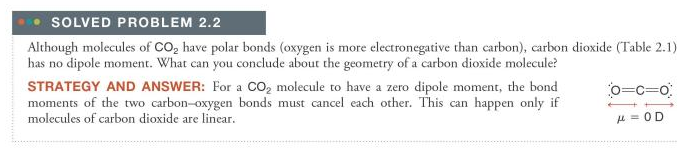
Each chapter has explanations of concepts with Practice Problems and Solved Problems scattered throughout the reading. (Solved Problems essentially model what you are supposed to be doing in the Practice Problems.) At the end of each chapter, there is a summary of the chapter and more Problems, the answers to which are in the accompanying solutions manual and study guide, sold separately. (The textbook includes just an eight-page “Answers to Selected Problems” appendix.) The full solutions manual is essential for making your way through this textbook.

Solved Problem
Example of a Solved Problem

“A Mechanism for the Reaction” boxes appear throughout the book (beginning in chapter 3). These show

step-by-step details about how reactions take place so that students have the tools to understand rather than memorize organic reactions.

These boxes helped me really understand the mechanisms and do a lot better at solving the problems. The Table of Contents includes a listing of all the places they appear.

There is also a “Concept Map” at the end of a number of chapters, which shows how the concepts are connected and relate to each other. I found this to be an excellent study tool and aid to solidifying what I had read in the chapter. This is part of the “Summary and Review Tools” that the authors include in an attempt to “accommodate diverse learning styles.”

Organic Chem_Summary and Review Tools
End-of-Chapter Summary Section, Chapter 6 (Ionic Reactions)


New in the 11th Edition


In this 11th edition there is the addition of a section called “Why Do These Topics Matter?” This feature seeks to “show the rich relevance of what students have learned to applications that have direct bearing on our lives and wellbeing.” For example, in chapter 10, the authors note:

[T]here is a natural molecule that combines radical chemistry and molecular shape in a way that can cause cell death. Chemists have used this knowledge to fashion a few anticancer drugs.

Personally, I was so focused on the class itself that I found myself skipping over a lot of these. They’re well-done, though, and others may appreciate their inclusion. Students can, after all, have a hard time connecting organic chemistry to the “real world,” and it’s easy to get stuck in the details (“Its melting point changed!”) with little awareness of the concepts’ larger import. So I see why they took this approach; I think it’s a smart one.


What I Found Helpful


In a nutshell, here is what I found most useful about the book:

  • The graphics and drawings of molecules are conceptually clear and a good aid to learning.
  • The chapter on infrared spectroscopy is a good one–this is potentially itself a whole additional course.
  • The writing is straightforward and clear. As I read the book, I could tell it is a revision of a revision of a revision….
  • Organic Chemistry prepared me very well for taking the American Chemical Society standard exam.
  • It helped reinforce the lectures in the class.


Minor Points of Critique


The pictures at the beginnings of the chapters feel a little out of place. For example, chapter 10 (“Radical Reactions”) begins with a picture of a bowl of blueberries. Granted, this is present because blueberries are an example of an antioxidant, to be covered in that chapter, but some of these images don’t feel aesthetically consistent with the rest of what’s in the book. The graphics and overall design and layout are consistent and well-executed; it’s just that the photos (including the cover photograph) feel a bit off, compared with the rest of the book’s design. All told, however, this is a minor critique.

The binding appears to be glued (not sewn), which is unfortunate for a book of this magnitude. I didn’t carry it around that much (at over 1,000 pages, it’s heavy–to be expected), but it’s still in good shape after a year of use at home. There is an e-book option for those who are willing to be at as screen more often.
 

Concluding Evaluation

 
Organic Chemistry is a very solid teaching of the core concepts and mechanisms of organic chemistry. To professors who are considering a course text, this one is a worthy choice. To students who are considering (or have been assigned) this text, a book like this requires diligence to get through, but it will serve you well!
 
Find Organic Chemistry at Amazon here (affiliate link) and at Wiley’s site here.

Review of Bear Motion iPhone 5c Case

Time for some tech talk. At Words on the Word I’ve reviewed software, as well as aspects of iOS and its apps. I’ve done gear reviews, too. This post is my review of Bear Motion’s Full Housing Case for iPhone 5c.

Here’s what it looks like:

Back of the case
Back of the case
Front of the case
Front of the case
Empty case
Empty case

Here are the pros and cons of this case:

Pros

  • Though it looks a little cheap (and the cost is, indeed, low), it seems to be, in fact, fairly well-made
    • The holes (to access camera, headphone jack, home button, etc.) are cut out just right
    • I may or may not have dropped my phone a couple times in this case, and it was well-protected
    • It protects the screen; it protects the body; it protects the whole phone (and the case is all one piece)
  • It’s not very bulky; doesn’t add much to the phone
  • The fit is secure and snug, but it’s still easy to get the phone in and out
  • The price is currently $6.99, which is a good deal
  • I’ve taken it on a bunch of runs–it has performed well in this setting, both gripping to my hand without sliding out and keeping my phone from getting sweaty

Cons

  • The screen cover has a speckled or slightly filmy look to it, which is fine in regular light, but in the sunlight it makes the screen noticeably darker than it would be without the cover and, therefore, almost impossible to read
  • It isn’t the most stylish iPhone case I’ve ever seen, but that’s not a huge deal
  • On rare occasion the thick plastic screen compromises the touch sensitivity of the device

Though I don’t exactly have a plethora of cases from which to choose, this is the case that is currently housing my phone, and has been since I got it. That’s its own testimonial, I think. Especially for the price, Bear Motion’s case is a quite solid option.

Thanks to Bear Motion for the review sample. They make plenty of other cases for various devices, too. The case reviewed above can be found at Amazon here (affiliate link). Bear Motion’s brand page at Amazon is here.