Would Mark’s Jesus have us handle snakes and drink poison? (part 1 of 2) (BibleWorks 9 review, continued)

First century snake handler?

Many believe that Mark’s Gospel ends rather abruptly at 16:8 (“for they were afraid”), but others have found it difficult to think of a Gospel ending with Jesus’ followers’ being afraid to say anything to anyone about the resurrection.

So there is the so-called shorter (add-on) ending of Mark, which adds to the above, “…the sacred and imperishable proclamation of eternal salvation” (RSV). This has 10 words that otherwise appear nowhere else in the book.  In my view the vocabulary and style of the shorter ending do not seem to fit well with the rest of the Gospel, and have the feel of an effort to give the book closure well after the fact of the writing.

Then there is the so-called longer ending of Mark, which is also not satisfied in ending with his followers’ fear. This records Jesus’ appearance to some of his followers, as well as the commissioning of his disciples, including the hard-to-understand reference to picking up snakes and drinking poison.

Mark could well have ended with “For they were afraid”–Mark is not unknown for being abrupt—nor would he have a problem upbraiding (or reporting Jesus’ upbraiding) people for their lack of faith or for their fear.  But would someone who started so positively with a proclamation of Jesus as “Son of God” in 1:1 have truly ended on such a dour note?  One possibility is that Mark’s original ending was lost.  R.T. France says, “It is one thing to emphasise and exploit paradoxical elements within the story of Jesus’ ministry and passion, as we have seen Mark doing again and again, but quite another to conclude his gospel with a note which appears to undermine not only his own message but also the received tradition of the church within which he was writing” (683).

Of course, lacking evidence of such a “lost” ending means that to postulate one is speculative, and it is perhaps a wiser hermeneutic to accept the text as we have it to be the intended one.

Can BibleWorks help here? One of the major new features in BibleWorks 9 is the BibleWorks Manuscript Project. From the BibleWorks site:

This massive project has been years in the making. BibleWorks 9 includes the first installment of this ongoing work. The BibleWorks Manuscript Project’s initial release covers the following:

  • Sinaiticus
  • Vaticanus
  • Alexandrinus
  • Bezae
  • Washingtonianus
  • Boernerianus
  • GA1141

For these manuscripts, the BibleWorks Manuscript Project includes the following:

  • New full NT transcriptions
  • Complete NT digital image sets (over 7.5 GB!!)
  • Verse location tagging in images
  • Extensive transcription notes
  • MSS comparison tool
  • Morphological tagging (not complete for all manuscripts but updates will be provided free of charge to BibleWorks 9 users as they become available)

Manuscripts are fully searchable and integrated with the full array of BibleWorks analysis tools. As you change verses in BibleWorks, the MS image display tracks with the current verse. Compare, inspect, and analyze the text and images of key original manuscripts. Tweak and enhance the manuscript images using the sophisticated image processing panel now included in BibleWorks.

Before I could even get into the manuscripts, there were two ways BibleWorks immediately helped me to explore this issue. First, with my NET Bible notes open in the Verse Tab (which I review here), I see a nice, lengthy note that explains the options–with manuscript evidence–for Mark’s possible ending. (You can see the NET note itself by clicking on footnote 9 here.) That much I’ve come to expect from BibleWorks.

What pleasantly caught me by surprise was that the NET note mentions a section in Wallace’s Greek Grammar that discusses the grammar of the contested snake-handling verses. I quickly and easily navigated over to the “Resources” tab in my analysis window and looked it up (click for larger image, or open in a new tab):
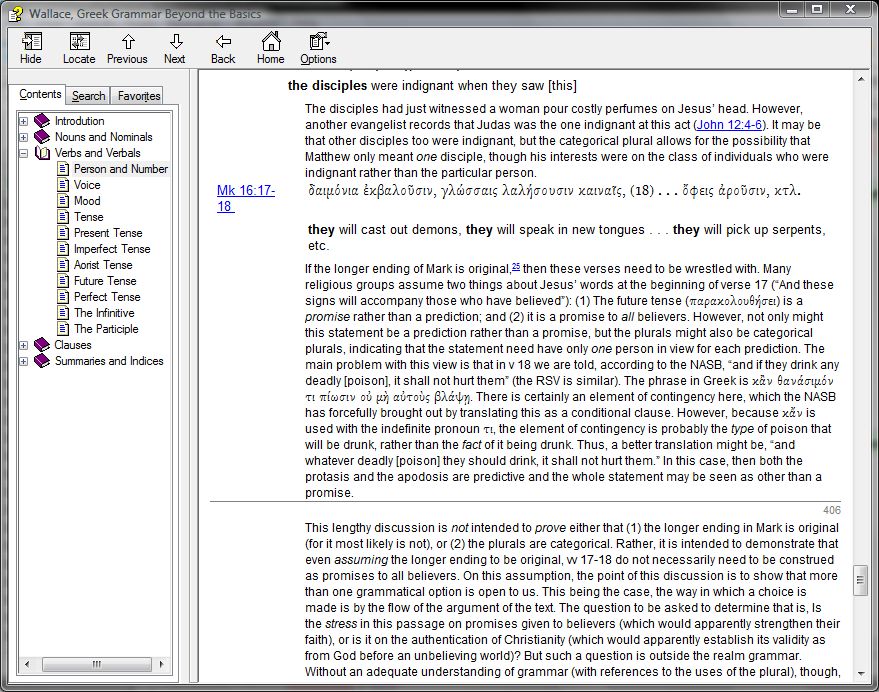
Wallace’s grammar is free with BibleWorks, a nice bonus. And it’s set up so that as you’re working your way through a text, Wallace tracks with you, so you can easily look up what he has to say about a given verse or grammatical topic.

Already some great help from BibleWorks in exploring a difficult textual issue. In my next post, I’ll use BibleWorks to get into the Mark manuscripts themselves, exploring the possible endings of the Gospel of Mark.

See all that’s new in BibleWorks 9 here.

I received a free upgrade to BibleWorks 9 in exchange for an unbiased review. See my prolegomenon to a review here, part 1 (setup and layout) here, and part 2 (the Verse tab) here. You can order the full program here or upgrade here. It’s on Amazon, too.

The Verse Tab: Review of BibleWorks 9, part 2

I continue to be impressed with BibleWorks 9. The new Use Tab is likely my favorite new feature (I posted about it in part 1 of my review). The Verse Tab is another new feature. Here’s how the BibleWorks site describes it:

The Verse Tab tracks with any Bible version. For the current verse under the mouse, it displays the relevant sections in resources such as the CNTTS apparatus, the NET Bible textual notes, the Tischendorf apparatus, Metzger’s Textual Commentary (requires unlock), and the ESV Study Bible (requires unlock).

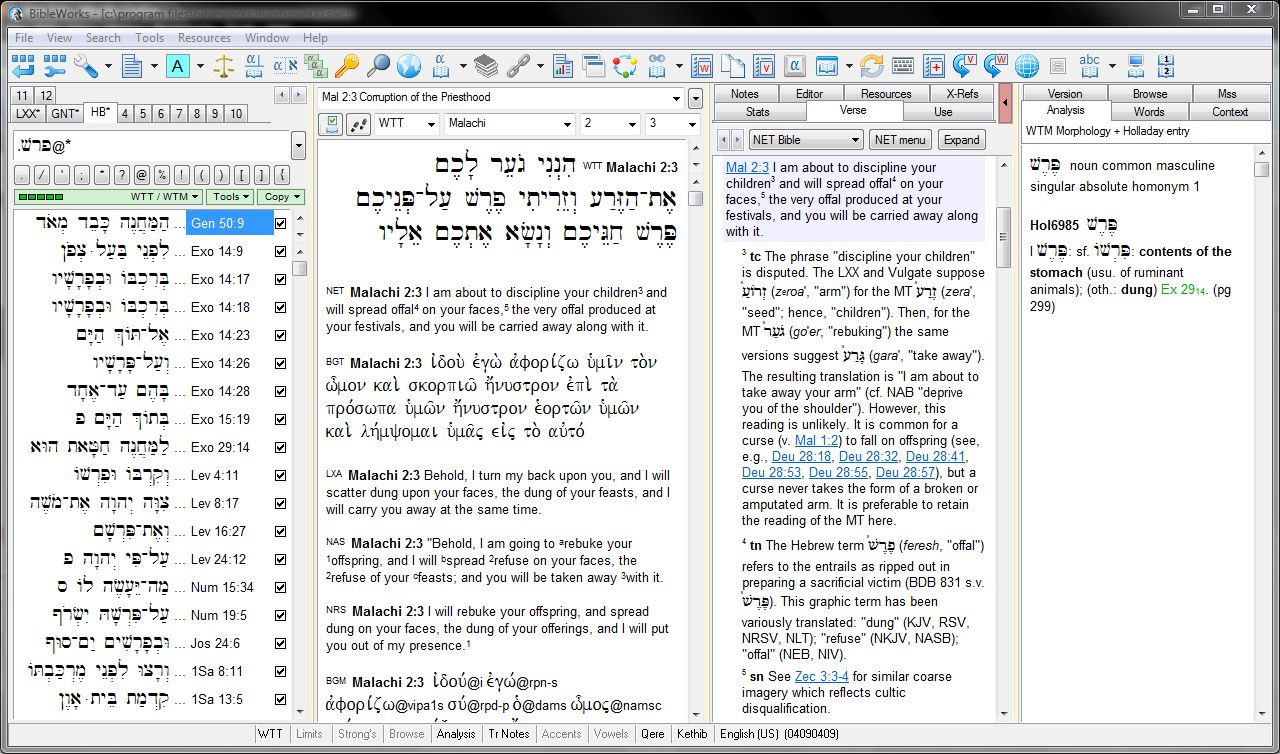
I will devote a future post to the CNTTS apparatus. Today I want to comment on and review the Verse Tab and its usefulness. Just so you can have a visual of what I’m working with, here’s a layout I’m currently using to look at the Hebrew of Malachi. (Click on the image below for larger.)

(Editorial note. File this under: can you believe that’s in the Bible? I had somehow never noticed this verse until the other day… thou shalt not trifle with the Lord, especially if you’re a priest or pastor. Take obedience to God seriously.)

Here’s the great thing about the Verse Tab. In previous versions of BibleWorks, the NET Bible study notes were only available via the Analysis Window. But this meant that if the Analysis Window were open to an NET study note, you couldn’t also at the same time easily see morphological analysis and lexical data–it was one or the other in that window. Now, however, as you can see above, you can easily access both study notes and a separate analysis window for individual word analysis. I find this new feature an immense help.

The NET study notes are fantastic. (It’s worth reading more about that translation and its notes here.) Honestly, a verse like the one I’ve chosen to highlight above might be a bit jarring to some–although in context it makes perfect sense. Yahweh was dealing with a corrupt and complacent priesthood. They were not making sacrifices in the way he had commanded (and they knew it, too). So his response in context really ought not to be a surprise. The NET note (see superscript number 4 and “tn” in the image above) clarifies that Yahweh is speaking of the entrails of to-be-sacrificed animals. The priests were supposed to dispose of these away from the sacrificial altar, but apparently were not in Malachi’s time. Bad idea. Clicking on Lev. 4:11 in the BibleWorks Search column (far left column) immediately takes me to the verse that explains this requirement.

One other neat thing about the Verse Tab: if you click on the “Expand” button, you can get a free-floating window that shows you all the NET notes for the whole Bible. This is easy to navigate through, as you can imagine:

I welcome the Verse Tab as an addition to the BibleWorks program. I’ve already made heavy use of it and will continue to in the future. For a mere $20 you can buy a module that gives you the notes and maps from the ESV Study Bible in that same tab. The program comes with the NET Bible notes already loaded.

See all that’s new in BibleWorks 9 here.

I received a free upgrade to BibleWorks 9 in exchange for an unbiased review. See my prolegomenon to a review here and part 1 (setup and layout) here. You can order the full program here or upgrade here. It’s on Amazon, too.
Avoid plagiarism like the plague

Charles Halton writes about how one can avoid plagiarism. He links in his post to a set of tutorials from Duke that help students identify (and avoid) plagiarism. Good reading for all. I’m not a professor, but… oh, the stories I could tell!

And as for Bart’s presence above… one good Simpsons/academia piece of media deserves another.

BibleWorks out of the box: Review of BibleWorks 9, part 1 (setup and layout)

The perennial question: Should I upgrade my BibleWorks program? I was perfectly happy with BibleWorks 7 until I upgraded to 8. (Then I was really happy with 8.) I thought 8 was such a vast improvement that when 9 came out, I saw no need… at least until I got to know version 9 a little better. Versions 7 or 8 are certainly still powerful in their own right, but my upgrade to 9 has been a great experience so far. In this and future posts, I’ll highlight why. Today: BibleWorks 9, out of the box.

The installation is easy and quick. I consider myself somewhat proficient when it comes to computer know-how, but certainly don’t have programming expertise. No matter. BibleWorks is easy to install and keep updated. And the BibleWorks staff is constant in making updates available if and as they find bugs in the program. Better than any other computer software I’ve used, in this sense.

BibleWorks 9 comes with a “Quick-Start Guide,” which has the Installation Instructions (they are mercifully short–three pages and easy to follow) and a 12-page Orientation to BibleWorks guide. The guide focuses on the Search Window, the Browse Window, and the Analysis Window, and gives instructions and specific examples as to how to best utilize each in studying the Biblical text. My only quibble with the helpful guide is that the images contained therein seem to be from BibleWorks 8, not 9. But that doesn’t really keep it from doing what it needs to, namely, quickly and effectively orienting the new or only somewhat experienced user to using the program well. (The instructions do detail the contents of the new tabs in version 9.)

BibleWorks 9 adds a delicious fourth column (essentially, a second analysis window). It looks like this (click on the png below for a larger view, if you wish):

Already this opens more options. There are also more available tabs in the Analysis Window. For example, the new “Use” tab, in my third column above, instantaneously shows you all the uses of a word with how many occurrences it has in that book and version (here, the WTT=Hebrew Bible). You had to search on a word in previous versions to do this (using the first column above). I find this particularly useful for vocabulary acquisition. As I come across a word I don’t know in the text, I can easily see–does this occur 121 times and I should know it? Or is it just in the text two or three times, so I was okay in not knowing right away what it means?

The “Verse” tab and the “Mss” tabs are new, too–those are worthy of their own post. (Anyone familiar with BibleWorks, whether they have 9 or not, may already know that this new version allows you to look at and work with images of original manuscripts.)

And, what I find best of all, you can drag and drop the tabs between the third and fourth columns so that you can customize your setup. I had already figured out a setup so that I had my own equivalent of a “fourth column” in BibleWorks 8. Now I can do even more! Check this out (from a previous post):

It’s a thing of beauty.

BibleWorks has unbeatable customer service. The user forums are active and always helpful. (Good things to know when you’re considering getting set up with them.) And they’ve provided quite a few videos to show users their way around the program. If you don’t want to wait for the rest of my review, you can see all that’s new in BibleWorks 9 here. You can order the full program here or upgrade here. It’s even on Amazon!

I received a free upgrade to BibleWorks 9 in exchange for an unbiased review. See my prolegomenon to a review here.

BibleWorks and the Septuagint

I recently blogged on why you need the Septuagint. And here are some great resources to begin and further pursue Septuagint study.

One indispensable resource for Septuagint study that I use almost daily is the computer program BibleWorks. I have not yet made the upgrade from version 8 to version 9, but much if not all of what I have to say here will still be applicable to users of version 9 (and 7, for that matter).

Here is what my BibleWorks looks like for 1 Maccabees (click or open in a new tab to view larger):

The following features help me navigate my way through the Septuagint:

  • A nice, big Browse Window (middle column in the top window) so that I can see the whole Greek verse easily at once, with English translations below. Both the LXA (Brenton’s Septuagint with Apocrypha, in English) and the NRS (NRSV, which includes the Apocrypha) are part of BibleWorks.
  • A stand-alone Word Analysis Window (bottom right of the screen) so I can better use my other columns. I set the default lexicon to LEH (Lust/Eynikel/Hauspie’s Greek-English Lexicon of the Septuagint, Revised Edition).
    Not only is this a fantastic Septuagint-specific lexicon; it also includes word frequency counts. What I particularly like about this is that I can use the Stats window (in the Analysis Window, the right column in the top window) to find out how many times a word appears in the whole Greek Bible (LXX+New Testament). Then using the LEH frequency counts, I can get a quick number on how many times a word is used in the LXX and the NT. This is helpful if I see an LXX word that occurs 200+ times, have never heard of it, and then see it only appears 10 times in the NT.
  • The Resource Summary Window (bottom left of the screen). Here I can access Conybeare’s Grammar of Septuagint Greek, which comes with BibleWorks and is hyperlinked both by part of speech and Scripture index. Another nice feature is that I can pull up BibleWorks paradigms quickly for a given part of speech–a helpful grammatical refresher! The IVP Dictionary of Jesus and the Gospels in that window is an add-on from WordSearch, but their IVP Dictionary package has a bunch of great Septuagint articles.
  • Note: There is no punctuation in the BibleWorks Septuagint text. This is not a display error; it’s just how it is. There are accents and breathing marks, though. And, the way I see it, even if Rahlfs in print has punctuation, the original manuscripts did not, so no huge loss.
  • I hesitate to write too much more about the Analysis window (right column in the top window), because BibleWorks 9 has significantly changed (=improved) the layout. In fact, there are now four columns, as seen here. However, for anyone using 8 or less, the above configuration allows you to work with the LXX profitably. For BibleWorks 9, I’m sure you could use the above layout as is (BW9 lets you use just three columns if you want, I believe) or make whatever modifications you wanted in BW9.

1 Maccabees has no existing Hebrew text. The scholars I’ve read on it all think that the Greek of 1 Maccabees has the flavor of translation Greek, and so translated a Hebrew original. But we don’t have it. (BibleWorks is powerful, but not quite that powerful!)

How I use the LXX when there is a corresponding Hebrew text (e.g., when I’m reading Micah) looks a little different. For example, in addition to the above, I’ll have the Hebrew text and English translation displayed. BibleWorks has the amazing Tov-Polak Parallel Hebrew/LXX Database, too, that comes with the base package.

BibleWorks allows me to read through the Septuagint in Greek with English translations displayed underneath. (I can also hide them–that’s what my “No Eng.” tab is in the left column of the top window.) It gives me instant word analysis (its parsing and then word definition and frequency count through LEH). I get grammatical helps from Conybeare and BibleWorks paradigms. I can search on a word to see how it’s used throughout the Septuagint and/or New Testament (note the highlighted word above). And with the IVP add-ons, I get historical background, too.

Using BibleWorks is a fabulous way to read through the Septuagint. I feel very blessed to have access to such a tool as this.

And I know there is much more BibleWorks can do. Fellow BibleWorks users and lovers of the Septuagint, how do you use BibleWorks for LXX success?

Septuagint Sunday is a regular feature of Words on the Word. All my LXX posts are here. The full contents of BibleWorks (now in version 9) are listed here. You can buy the program here or here.

The “Preacher’s Trash Bin” (A Review of What Not to Say)

Here is some great preaching advice from my mother-in-law, a pastor: Never say from the pulpit that a certain idea came you to while you were in the shower.  Because who wants to think about their pastor in the shower?

Or as John C. Holbert and Alyce M. McKenzie put it, “Don’t tell stories that involve listeners picturing you naked. …So you received an insight into the cleansing power of God’s love in the shower on the mission trip as the cleansing and healing water cascaded over your body. Find another setting to tell about your epiphany.”

I set out to read What Not to Say: Avoiding the Common Mistakes That Can Sink Your Sermon, thinking that the book would be full of practical ideas like not sharing shower epiphanies as having taken place in the shower. Yet Holbert and McKenzie also write with theological depth and care as they coach preachers on what not to say and do in the pulpit.

Their chapters cover what not to say (and what to say): about God, about the Bible, at the sermon’s beginning, about the congregation, in the middle of the sermon, about yourself, in stories, and at the end of the sermon.

The goal of the book is “to give very direct advice out of the store of [the authors’] combined sixty years of preaching and over forty years of teaching others how to preach.”  They write, “It’s important in preaching to be as clear about what we are not saying as we are about what we are saying.” Here is where the theological depth of the authors comes to the fore, right in the first chapter: “First, affirming the sovereignty of God is not the same as insisting that everything that happens in my life and the world is directly the result of God’s actions.” The authors have a high view of God’s sovereignty, yet caution preachers against saying or implying, “Everything happens for a reason… and that reason is God.” Especially in a funeral sermon, for example, they say it’s theologically misguided for the preacher to say that God just “needed” the deceased’s voice to join the heavenly choir, or wanted “another flower for his heavenly bouquet.” God is sovereign, yes, preachers should affirm, but did he really cause a drunk driver to kill your daughter? No, the authors would say; free choice gone awry (i.e., stupidity) caused that. But preachers have to be careful that their words don’t somehow affirm that God’s sovereignty means He somehow took away that life. He may have allowed it; he didn’t ordain it.

Though the reader may not always find herself or himself in lock-step with the authors’ theology (I think the Bible is more of an “answer book” than they seem to indicate, and I respectfuly disagree with their interpretation of Romans 1, that Paul didn’t really understand the nuances of homosexuality), the reader will certainly appreciate their theological, Biblical, and homiletical care that grounds the eminently practical advice they give. The authors’ love of the Gospel, of the Church, and of preaching is on full display in these pages… and it inspired me as I read.

A few more highlights ought to convince anyone with an interest in preaching or public speaking to read this book:

  • The authors say the preacher should ask herself or himself this question honestly: “Do I habitually base my sermons on my favorite passages and avoid others I know little about or that may prove difficult?”
  • “Preachers throughout history have known that it is as important to exegete the congregation as it is to exegete the text. Jesus certainly did….”
  • “Sermons these days need to teach biblical and theological themes to often biblically illiterate listeners.”
  • “When we stir up people’s emotions without tying them to a biblical and theological message, what are they to do with their stirred-up emotions?”
  • Holbert and McKenzie want the preacher to ask: “Does the sermon tell the truth of the Gospel, not a domesticated version I assume the congregation would prefer to hear?”
  • On bad preaching habits (verbal filler, overused non-verbal gestures, etc.), they say: “Anything you do in the pulpit again and again will become over time the source of boredom and finally ridicule. When the youth sit in the balcony and count the number of times you say or do a certain thing, it is time to take stock of your preaching patterns.”
  • “Never make yourself the hero or heroine of your sermon” by using yourself as a positive example of how to apply a certain Scripture. “The sermon is not about us; it is about God.”
  • “Never use any of your children as sermon examples.” (Whether the reader finally agrees with this or not, the authors make a good case for it.)
  • Ask anyone for permission to talk about them in a story, even if that story shares something positive about them: “There are people in your church who would immediately transfer their membership if you thanked them publicly or singled them out in a positive way.”

It would be easy for me to go on about the helpful things I read in this book. I highly recommend it to all who preach or teach, in the Church or elsewhere.

The book is out now through Westminster John Knox Press.  (I am grateful to have received a digital galley of What Not to Say for review through Net Galley.)

I’ll give the authors the last word:

Preachers and teachers of preaching like to talk about the preacher’s toolbox. That is a positive metaphor. It signifies a repertoire of useful, effective sermonic strategies. There is also a preacher’s trash bin, a receptacle where we ought to put all the ineffective sermon strategies we don’t ever want to use again.

Seminary with Young Kids

I’ve been known to try to do too many things at once.

In the fall of 2010 I was working 20 hours a week in youth ministry at a local church, preaching monthly there on top of that, taking four seminary classes (all of which were either Biblical Greek or Hebrew-based), and doing a wee bit of youth ministry consulting work. Suffice it to say I wish I had not done so much then–even three classes instead of four would have been a welcome relief. I did do most of my schoolwork at home, which at the time seemed like a good idea, because I could be around my wife and kids as I worked… but in retrospect, they weren’t getting any more of my attention than they would have if I had been off somewhere studying. So maybe that actually made it worse, to have me there, but not really have me there.

On Monday my wife and I are scheduled to have our third baby delivered.  So this is perhaps an appropriate time to link to this great article, “How to Survive Seminary with Young Children.” It’s written from a mom’s perspective, though the bulk of this advice is also helpful for those who are trying to be faithful dads and good seminarians at the same time.