Greek Isaiah in a Year, Week 4=Isaiah 3:22-5:16

Prophet IsaiahThere’s something that has seemed appropriate about beginning to read through Isaiah during Advent. At a pace of roughly five verses each weekday, I’ve been reading through Greek Isaiah in a Year with a sizeable group of folks on Facebook.

Tomorrow (Monday) is the start week 4. Below is the schedule and text for Monday through Friday, using the text from R.R. Ottley’s Book of Isaiah According to the Septuagint. (Ottley is here on Amazon, here in Logos, and here as a free, downloadable pdf, since it’s public domain.) The full reading plan for our group is here (pdf).

Also, this last week I reviewed Ottley’s work in Logos. You can read more about that here. And now, the readings. At the end of this post I’m including a link to a pdf of the schedule and text for the week, as well, at the request of one of the group members.

Monday, December 24: Isaiah 3:22-4:1

22 καὶ τὰ ἐπιβλήματα τὰ κατὰ τὴν οἰκίαν καὶ τὰ διαφανῆ Λακωνικά, 23 καὶ τὰ βύσσινα καὶ τὰ ὑακίνθινα καὶ τὰ κόκκινα, καὶ τὴν βύσσον, σὺν χρυσίῳ καὶ ὑακίνθῳ συνκαθυφασμένα, καὶ θέριστρα κατάκλιτα. 24 καὶ ἔσται ἀντὶ ὀσμῆς ἡδείας, κονιορτός, καὶ ἀντὶ ζώνης σχοινίῳ ζώσῃ, καὶ ἀντὶ τοῦ κόσμου τῆς κεφαλῆς τοῦ χρυσίου φαλάκρωμα ἕξεις διὰ τὰ ἔργα σου, καὶ ἀντὶ τοῦ χιτῶνος τοῦ μεσοπορφύρου περιζώσῃ σάκκον. 25 καὶ ὁ υἱός σου ὁ κάλλιστος ὃν ἀγαπᾷς μαχαίρᾳ πεσεῖται, καὶ οἱ ἰσχύοντες ὑμῶν μαχαίρᾳ πεσοῦνται καὶ ταπεινωθήσονται· 26 καὶ πενθήσουσιν αἱ θῆκαι τοῦ κόσμου ὑμῶν, καὶ καταλειφθήσῃ μόνη καὶ εἰς τὴν γῆν ἐδαφισθήσῃ.

4 καὶ ἐπιλήμψονται ἑπτὰ γυναῖκες ἀνθρώπου ἑνὸς λέγουσαι Τὸν ἄρτον ἡμῶν φαγόμεθα, καὶ τὰ ἱμάτια ἡμῶν περιβαλούμεθα· πλὴν τὸ ὄνομα τὸ σὸν κεκλήσθω ἐφʼ ἡμᾶς, ἄφελε τὸν ὀνειδισμὸν ἡμῶν.

Tuesday, December 25: Isaiah 4:2-6

Τῇ δὲ ἡμέρᾳ ἐκείνῃ λάμψει ὁ θεὸς ἑν βουλῇ μετὰ δόξης ἐπὶ τῆς γῆς, τοῦ ὑψῶσαι καὶ δοξάσαι τὸ καταλειφθὲν τοῦ Ἰσραήλ· καὶ ἔσται τὸ ὑπολειφθὲν ἐν Σιὼν καὶ τὸ καταλειφθὲν ἐν Ἰερουσαλήμ, ἅγιοι κληθήσονται πάντες οἱ γραφέντες εἰς ζωὴν ἐν Ἰερουσαλήμ. ὅτι ἐκπλυνεῖ Κύριος τὸν ῥύπον τῶν υἱῶν καὶ τῶν θυγατέρων Σιών, καὶ τὸ αἷμα ἐκκαθαριεῖ ἐκ μέσου αὐτῶν ἐν πνεύματι κρίσεως. καὶ ἥξει, καὶ ἔσται πᾶς τόπος τοῦ ὄρους Σιὼν καὶ πάντα τὰ περικύκλῳ αὐτῆς σκιάσει νεφέλη ἡμέρας, καὶ ὡς καπνοῦ καὶ ὡς φωτὸς πυρὸς καιομένου νυκτός· πάσῃ τῇ δόξῃ Κυρίου σκεπασθήσεται· καὶ ἔσται εἰς σκιὰν ἀπὸ καύματος, καὶ ἐν σκέπῃ καὶ ἐν ἀποκρύφῳ σκληρότητος καὶ ὑετοῦ.

Wednesday, December 26: Isaiah 5:1-7

5 ᾌσω δὴ τῷ ἠγαπημένῳ ᾆσμα τοῦ ἀγαπητοῦ τῷ ἀμπελῶνί μου. ἀμπελὼν ἐγενήθη τῷ ἠγαπημένῳ ἐν κέρατι ἐν τόπῳ πίονι. καὶ φραγμὸν περιέθηκα καὶ ἐχαράκωσα, καὶ ἐφύτευσα ἄμπελον σωρήχ, καὶ ᾠκοδόμησα πύργον ἐν μέσῳ αὐτοῦ, καὶ προλήνιον ὤρυξα ἐν αὐτῷ· καὶ ἔμεινα τοῦ ποιῆσαι σταφυλήν, ἐποίησεν δὲ ἀκάνθας. καὶ νῦν, ἄνθρωπος τοῦ Ἰούδα καὶ οἱ ἐνοικοῦντες ἐν Ἰερουσαλήμ, κρίνατε ἐν ἐμοὶ καὶ ἀνὰ μέσον τοῦ ἀμπελῶνός μου. τί ποιήσω ἔτι τῷ ἀμπελῶνί μου, καὶ οὐκ ἐποίησα αὐτῷ; διότι ἔμεινα τοῦ ποιῆσαι σταφυλήν, ἐποίησεν δὲ ἀκάνθας. νῦν δὲ ἀναγγελῶ ὑμῖν τί ποιήσω τῷ ἀμπελῶνί μου. ἀφελῶ τὸν φραγμὸν αὐτοῦ καὶ ἔσται εἰς διαρπαγήν, καὶ καθελῶ τὸν τοῖχον αὐτοῦ καὶ ἔσται εἰς <καταπάτημα>. καὶ ἀνήσω τὸν ἀμπελῶνά μου, καὶ οὐ μὴ τμηθῇ οὐδὲ μὴ σκαφῇ, καὶ ἀναβήσεται εἰς αὐτὸν ὡς εἰς χέρσον ἄκανθα. καὶ ταῖς νεφέλαις ἐντελοῦμαι τοῦ μὴ βρέξαι εἰς αὐτὸν ὑετόν. ὁ γὰρ ἀμπελὼν Κυρίου σαβαὼθ οἶκος τοῦ Ἰσραήλ ἐστιν, καὶ ἄνθρωπος τοῦ Ἰούδα νεόφυτον ἠγαπημένον· ἔμεινα τοῦ ποιῆσαι κρίσιν, ἐποίησεν δὲ ἀνομίαν, καὶ οὐ δικαιοσύνην ἀλλὰ κραυγήν.

Thursday, December 27: Isaiah 5:8-11

Οὐαὶ οἱ συνάπτοντες οἰκίαν πρὸς οἰκίαν, καὶ ἀγρὸν πρὸς ἀγρὸν ἐγγίζοντες, ἵνα τοῦ πλησίον ἀφέλωνταί τι· μὴ οἰκήσετε μόνοι ἐπὶ τῆς γῆς; ἠκούσθη γὰρ εἰς τὰ ὦτα Κυρίου σαβαὼθ ταῦτα· ἐὰν γὰρ γένωνται οἰκίαι πολλαί, εἰς ἔρημον ἔσονται· μεγάλαι καὶ καλαί, καὶ οὐκ ἔσονται οἱ ἐνοικοῦντες. 10 οὗ γὰρ ἐργῶνται δέκα ζεύγη βοῶν, ποιήσει κεράμιον ἕν, καὶ ὁ σπείρων ἀρτάβας ἓξ ποιήσει μέτρα τρία. 11 Οὐαὶ οἱ ἐγειρόμενοι τὸ πρωὶ καὶ τὸ σίκερα διώκοντες, οἱ μένοντες τὸ ὀψέ· ὁ γὰρ οἶνος αὐτοὺς συγκαύσει.

Friday, December 28: Isaiah 5:12-16

12 μετὰ γὰρ κιθάρας καὶ ψαλτηρίου καὶ τυμπάνων καὶ αὐλῶν τὸν οἶνον πίνουσιν, τὰ δὲ ἔργα Κυρίου οὐκ ἐμβλέπουσιν, καὶ τὰ ἔργα τῶν χειρῶν αὐτοῦ οὐ κατανοοῦσιν. 13 τοίνυν αἰχμάλωτος ὁ λαός μου ἐγενήθη διὰ τὸ μὴ εἰδέναι αὐτοὺς τὸν κύριον, καὶ πλῆθος ἐγενήθη νεκρῶν διὰ λιμὸν καὶ δίψαν ὕδατος. 14 καὶ ἐπλάτυνεν ὁ ᾅδης τὴν ψυχὴν αὐτοῦ καὶ διήνοιξεν τὸ στόμα αὐτοῦ τοῦ μὴ διαλιπεῖν, καὶ καταβήσονται οἱ ἔνδοξοι καὶ οἱ μεγάλοι καὶ οἱ πλούσιοι καὶ οἱ λοιμοὶ αὐτῆς. 15 καὶ ταπεινωθήσεται ἄνθρωπος, καὶ ἀτιμασθήσεται ἀνήρ, καὶ οἱ ὀφθαλμοὶ οἱ μετέωροι ταπεινωθήσονται· 16 καὶ ὑψωθήσεται Κύριος σαβαὼθ ἐν κρίματι, καὶ ὁ θεὸς ὁ ἅγιος δοξασθήσεται ἐν δικαιοσύνῃ.

Here are the week’s readings as a pdf.

See here for more resources and links to texts for Greek Isaiah. Here are previous weeks’ readings: Week 1 / Week 2 / Week 3.

Works of Richard R. Ottley (3 vols.) in Logos Bible Software

Ottley Isaiah cover

I’ve been using R.R. Ottley’s Book of Isaiah According to the Septuagint as I participate in Greek Isaiah in Year.

The two-volume work is available in print through Wipf & Stock here on Amazon. Or you can download the whole thing here for free as a .pdf, since it’s in the public domain. This will be sufficient for many folks who want to check out this work.

Logos Bible Software also has an edition of Ottley’s work (here), a three-volume Works of Richard R. Ottley. In addition to Book of Isaiah According to the Septuagint, the Logos bundle includes his Handbook to the Septuagint. That work is also free and in the public domain (get it here).

For the kind of close reading I’ve been doing with the Greek Isaiah group, having these texts integrated with the rest of Logos has been quite convenient and a big time-saver.

Volume 1 of Ottley’s Isaiah work has:

  • Introduction
    • Early History of the Septuagint
    • Text of the LXX in Isaiah
    • Methods of Rendering
    • Differences between the LXX and the Hebrew
  • List of Manuscripts containing Isaiah in Greek
  • Parallel Translations

The introduction briefly addresses issues of dating, as well as the various editions of the Greek (the Hexapla, etc.). The “Text of the LXX in Isaiah” section treats in more detail the Greek manuscripts, as well as later translations like the Syro-Hexaplar and Old Latin, which were made from the Greek. Ottley notes that Codex Vaticanus (B) “falls below its usual standard” and is “a worse representative of the LXX than usual,” being “inferior to other extant manuscripts.” Throughout these two volumes, then, he pursues “the question of securing the best available text.”

“Methods of Rendering” in the Introduction compares Septuagint Greek to New Testament Greek (finding “in it much resemblance”), yet Ottley also notes that Septuagint translators saught to keep “various Semitic idioms, and a dim reflection of Semitic arrangement and style.” These are not especially earth-shattering insights for the student of the Septuagint today, but Ottley does provide a helpful tour of the Greek grammar of Isaiah in introductory fashion. He also relates the Greek to the Hebrew it translated:

[The LXX translators] seem to have selected the aorist as the best equivalent for the Hebrew perfect, and the future for the Hebrew imperfect, and used them, when the context did not absolutely forbid, to represent rather than to translate these forms.

As far as differences between the Greek and the Hebrew, Ottley notes omissions, additions (scholars now, I believe, prefer to speak of “minuses” and “pluses,” since “omissions”/”additions” can prejudice the discussion), paraphrases, differences in syntax, and more. He includes a lengthy list of references in illustration of each kind of difference.

The rest of volume 1 is taken up with Ottley’s “Parallel Translations,” where he presents his English translations of the Hebrew and of the Greek side-by-side on different pages. Each page includes several translation footnotes.

Here is where the Logos edition becomes especially handy. Using the Text Comparison tool, I can easily see how Ottley’s English translation of the Greek compares with his English translation of the Hebrew, to get a feel for how the two underlying texts differ:

Ottley English translation comparison

Even with a free .pdf of the work available in the public domain, being able to use Logos’s tools to interact with the text makes it worth having.

Volume 2, then, contains Ottley’s own presentation of Greek Isaiah, with Codex Alexandrinus (A) as “the basis for the Greek text here printed.” As with the Göttingen edition of the Septuagint, Ottley has a critical apparatus at the bottom of the page that notes variants. His is not quite as exhaustive as Göttingen, but neither does it lack detail. In the print edition, following the Greek text are some nearly 300 pages of notes on Greek Isaiah.

And in Logos, one can view all of Ottley’s work on Isaiah at once, together with the Hebrew text and various lexicons (not included with this module). For reading Ottley’s Greek text of Isaiah, I have the Greek scrolling with the critical apparatus and the notes and translation, so that I can simultaneously see all that Ottley has about a given verse. As here:

Ottley in Logos

Note: in the image above I actually have the Göttingen text open, with Ottley right behind it in another tab. For reading through Isaiah, I like to still have a morphologically tagged text going; Ottley is not so tagged. But you can sync everything together so that you barely notice that.

It’s not impossible, of course, to flip back and forth between the pages of a print version, or to scroll back and forth through a free .pdf. But Ottley’s Book of Isaiah According to the Septuagint integrates seamlessly with the rest of Logos. And when reading his Handbook to the Septuagint, any verses or abbreviations are hyperlinked so that you can mouse over them as you read and pop-ups will display with the relevant information.

This three-volume set in Logos is very well done, and easily does things that neither a print copy nor a .pdf can do. Being able to see all of Ottley’s work on a single verse at a glance–as well as compare it with other LXX texts using the Text Comparison tool–is the true highlight of this resource.

The three volume Works of Richard R. Ottley in Logos can be found here. My thanks to Logos for the review copy, provided for the purposes of this review but not with any expectation as to its content. Ottley in Logos has also been a great help to me as the group administrator of Greek Isaiah in a Year.

More on the Connecticut school shooting: the haughtiness of humanity will collapse, says Isaiah

I wondered tonight whether this week’s Greek Isaiah readings might have something to say to the recent school shooting in Connecticut. Indeed, here is Isaiah 2:17-19 (my translation from the Greek):

Then every person will be brought low,
and the haughtiness of humanity will collapse,
and the Lord alone will be exalted in that day.

And they will hide everything that is made by hand,

as they bring them into caves
and into the clefts of rocks
and into the holes of the earth,
from before the fear of the Lord
and from the glory of his strength,
when he rises up to strike the earth.

The word for that which is made by hand (τὰ χειροποίητα) refers to idols. But as I read this I couldn’t help but think of the promise from Psalm 46:

He makes wars cease
to the ends of the earth.
He breaks the bow and shatters the spear;
he burns the shields with fire.

…bows, spears, and shields, of course, all being made by hand. I suggested here that a 21st century way of reading that verse could be something like, “He crushes guns and diffuses bombs, he destroys human weapons of destruction.”

One day either we or God himself will bring all our weapons of destruction–indeed, all our evil inclinations–into “caves” and “into the clefts of rocks and into the holes of the earth,” as we recoil at the glory of God’s strength. He will make wars cease; he will end all senseless violence; he will crush evil and wipe it away from the face of the earth.

Lord, as we mourn in the meantime, please hasten that day.

Greek Isaiah in a Year, Week 3=Isaiah 2:16-3:21

isaiah lxx

We’re through two weeks of Greek Isaiah in a Year. The Facebook group continues to grow–now 175 readers. Anyone can still join. And some are reading apart from the Facebook group, too.

Tomorrow (Monday) begins week 3. Below is the schedule and text for Monday through Friday, using the text from R.R. Ottley’s Book of Isaiah According to the Septuagint. (Ottley is here on Amazon, here in Logos, and here as a free, downloadable pdf, since it’s public domain.) The full reading plan is here (pdf).

Monday, December 17: Isaiah 2:16-21

16 καὶ ἐπὶ πᾶν πλοῖον θαλάσσης, καὶ ἐπὶ πᾶσαν θέαν πλοίων κάλλους· 17 καὶ ταπεινωθήσεται πᾶς ἄνθρωπος, καὶ πεσεῖται ὕψος ἀνθρώπων, καὶ ὑψωθήσεται Κύριος μόνος ἐν τῇ ἡμέρᾳ ἐκείνῃ. 18 καὶ τὰ χειροποίητα πάντα κατακρύψουσιν, 19 εἰσενέγκαντες εἰς τὰ σπήλαια καὶ εἰς τὰς σχισμὰς τῶν πετρῶν καὶ εἰς τὰς τρώγλας τῆς γῆς, ἀπὸ προσώπου τοῦ φόβου Κυρίου καὶ ἀπὸ τῆς δόξης τῆς ἰσχύος αὐτοῦ, ὅταν ἀναστῇ θραῦσαι τὴν γῆν. 20 τῇ ἡμέρᾳ ἐκείνῃ ἐκβαλεῖ ἄνθρωπος τὰ βδελύγματα αὐτοῦ τὰ ἀργυρᾶ καὶ τὰ χρυσᾶ, ἃ ἐποίησεν προσκυνεῖν, τοῖς ματαίοις καὶ ταῖς νυκτερίσιν, 21 τοῦ εἰσελθεῖν εἰς τὰς τρώγλας τῆς στερεᾶς πέτρας καὶ εἰς τὰς σχισμὰς τῶν πετρῶν, ἀπὸ προσώπου τοῦ φόβου Κυρίου καὶ ἀπὸ τῆς δόξης τῆς ἰσχύος αὐτοῦ, ὅταν ἀναστῇ θραῦσαι τὴν γῆν.

Tuesday, December 18: Isaiah 3:1-5

3 Ἰδοὺ δὴ ὁ δεσπότης Κύριος σαβαὼθ ἀφελεῖ ἀπὸ τῆς Ἰουδαίας καὶ ἀπὸ Ἰερουσαλὴμ ἰσχύοντα καὶ ἰσχύουσαν, ἰσχὺν ἄρτου καὶ ἰσχὺν ὕδατος, γίγαντα καὶ ἰσχύοντα καὶ ἄνθρωπον πολεμιστὴν καὶ δικαστὴν καὶ προφήτην καὶ στοχαστὴν καὶ πρεσβύτερον καὶ πεντηκόνταρχον καὶ θαυμαστὸν σύμβουλον καὶ σοφὸν ἀρχιτέκτονα καὶ συνετὸν ἀκροατήν· καὶ ἐπιστήσω νεανίσκους ἄρχοντας αὐτῶν, καὶ ἐμπαῖκται κυριεύσουσιν αὐτῶν. καὶ συμπεσεῖται ὁ λαός, ἄνθρωπος πρὸς ἄνθρωπον, καὶ ἄνθρωπος πρὸς τὸν πλησίον αὐτοῦ· προσκόψει τὸ παιδίον πρὸς τὸν πρεσβύτην, ὁ ἄτιμος πρὸς τὸν ἔντιμον.

Wednesday, December 19: Isaiah 3:6-10

ὅτι ἐπιλήμψεται ἄνθρωπος τοῦ ἀδελφοῦ αὐτοῦ ἢ τοῦ οἰκείου τοῦ πατρὸς αὐτοῦ λέγων Ἱμάτιον ἔχεις, ἀρχηγὸς ἡμῶν γενοῦ, καὶ τὸ βρῶμα τὸ ἐμὸν ὑπὸ σὲ ἔστω. καὶ ἀποκριθεὶς ἐρεῖ ἐν τῇ ἡμέρᾳ ἑκείνῃ Οὐκ ἕσομαί σου ἀρχηγός· οὐ γὰρ ἔστιν ἐν τῷ οἴκῳ μου ἄρτος οὐδὲ ἱμάτιον· οὐκ ἔσομαι ἀρχηγὸς τοῦ λαοῦ τούτου. ὅτι ἀνεῖται Ἰερουσαλὴμ καὶ ἡ Ἰουδαία συμπέπτωκεν, καὶ αἱ γλῶσσαι αὐτῶν μετὰ ἀνομίας, τὰ πρὸς Κύριον ἀπειθοῦντες· διότι νῦν ἐταπεινῶθη ἡ δόξα αὐτῶν, καὶ ἡ αἰσχύνη τοῦ προσώπου αὐτῶν ἀντέστη αὐτοῖς· τὴν δὲ ἁμαρτίαν αὐτῶν ὡς Σοδόμων ἀνήγγειλαν καὶ ἐνεφάνισαν. οὐαὶ τῇ ψυχῇ αὐτῶν, ὅτι βεβούλευνται βουλὴν πονηρὰν καθʼ ἑαυτῶν, 10 εἴπαντες Δήσωμεν τὸν δίκαιον, ὅτι δύσχρηστος ἡμῖν ἐστιν· τοίνυν τὰ γενήματα τῶν ἔργων αὐτῶν φάγονται.

Thursday, December 20: Isaiah 3:11-16

11 οὐαὶ τῷ ἀνόμῳ· πονηρὰ κατὰ τὰ ἔργα τῶν χειρῶν αὐτοῦ συμβήσεται αὐτῷ. 12 λαός μου, οἱ πράκτορες ὑμῶν καλαμῶνται ὑμᾶς, καὶ οἱ ἀπαιτοῦντες κυριεύουσιν ὑμῶν. λαός μου, οἱ μακαρίζοντες ὑμᾶς πλανῶσιν ὑμᾶς καὶ τὴν τρίβον τῶν ποδῶν ὑμῶν ταράσσουσιν. 13 ἀλλὰ νῦν καταστήσεται εἰς κρίσιν Κύριος, καὶ στήσει εἰς κρίσιν τὸν λαὸν αὐτοῦ· 14 αὐτὸς Κύριος εἰς κρίσιν ἥξει μετὰ τῶν πρεσβυτέρων τοῦ λαοῦ καὶ μετὰ τῶν ἀρχόντων αὐτοῦ. ὑμεῖς δὲ τί ἐνεπυρίσατε τὸν ἀμπελῶνά μου, καὶ ἡ ἁρπαγὴ τοῦ πτωχοῦ ἐν τοῖς οἴκοις ὑμῶν; 15 τί ὑμεῖς ἀδικεῖτε τὸν λαόν μου, καὶ τὸ πρόσωπον τῶν πτωχῶν καταισχύνετε;

16 Τάδε λέγει Κύριος Ἀνθʼ ὧν ὑψώθησαν αἱ θυγατέρες Σιών, καὶ ἐπορεύθησαν ὑψηλῷ τραχήλῳ καὶ νεύμασιν ὀφθαλμῶν, καὶ τῇ πορείᾳ τῶν ποδῶν ἅμα σύρουσαι τοὺς χιτῶνας καὶ τοῖς ποσὶν ἅμα παίζουσαι,

Friday, December 21: Isaiah 3:17-21

17 καὶ ταπεινώσει ὁ θεὸς ἀρχούσας θυγατέρας Σιών. καὶ Κύριος ἀποκαλύψει τὸ σχῆμα αὐτῶν 18 ἐν τῇ ἡμέρᾳ ἐκείνῃ· καὶ ἀφελεῖ Κύριος τὴν δόξαν τοῦ ἱματισμοῦ αὐτῶν, καὶ τοὺς κόσμους αὐτῶν καὶ τὰ ἐμπλόκια καὶ τοὺς κοσύμβους καὶ τοὺς μηνίσκους, 19 καὶ τὸ κάθεμα καὶ τὸν κόσμον τοῦ προσώπου αὐτῶν, 20 καὶ τὴν σύνθεσιν τοῦ κόσμου τῆς δόξης αὐτῶν, καὶ τοὺς χλιδῶνας καὶ τὰ ψέλια καὶ τὸ ἐμπλόκιον καὶ τὰ περιδέξια καὶ τοὺς δακτυλίους καὶ τὰ ἐνώτια, 21 καὶ τὰ περιπόρφυρα καὶ τὰ μεσοπόρφυρα,

…with the conclusion to the sentence coming on the following Monday.

See here for more resources and links to texts for Greek Isaiah. Readings from week 1 are here, from week 2 are here.

Which came first, Isaiah or Micah? Comparing Isaiah 2:2-4 with Micah 4:1-3

Isaiah Micah

Isaiah 2:2-4 shares much in common with Micah 4:1-3. But who quoted whom?

Isaiah and Micah both prophesied in the 8th century B.C. Their prophetic oracles were delivered in Hebrew, and the Greek below is translated from that. But because I’m doing Greek Isaiah in a Year right now, I’ll confine my comments to the Greek text. Of course a more thorough examination of these two passages needs to consider the Hebrew, too.

Isaiah is in black and on top below. Micah is in red and on bottom.

ὅτι  ἔσται ἐν    ταῖς ἐσχάταις ἡμέραις   ἐμφανὲς τὸ ὄρος κυρίου,
καὶ ἔσται ἐπ᾽   ἐσχάτων τῶν ἡμερῶν   ἐμφανὲς τὸ ὄρος τοῦ κυρίου,

καὶ ὁ οἶκος τοῦ θεοῦ ἐπ᾽ ἄκρων τῶν ὀρέων,
ἕτοιμον ἐπὶ τὰς κορυφὰς             τῶν ὀρέων,

καὶ ὑψωθήσεται         ὑπεράνω τῶν βουνῶν.
καὶ μετεωρισθήσεται ὑπεράνω τῶν βουνῶν·

καὶ ἥξουσιν ἐπ᾽ αὐτὸ πάντα τὰ ἔθνη.
καὶ σπεύσουσιν πρὸς αὐτὸ λαοί,

καὶ πορεύσονται ἔθνη πολλὰ, καὶ ἐροῦσιν,
καὶ πορεύσονται ἔθνη πολλὰ  καὶ ἐροῦσιν,

δεῦτε καὶ ἀναβῶμεν εἰς τὸ ὄρος κυρίου,
δεῦτε,      ἀναβῶμεν εἰς τὸ ὄρος κυρίου,

καὶ εἰς τὸν οἶκον τοῦ θεοῦ Ιακωβ, καὶ ἀναγγελεῖ ἡμῖν τὴν ὁδὸν αὐτοῦ,
καὶ εἰς τὸν οἶκον τοῦ θεοῦ Ιακωβ· καὶ δείξουσιν ἡμῖν τὴν ὁδὸν αὐτοῦ,

καὶ πορευσόμεθα ἐν αὐτῇ·
καὶ πορευσόμεθα ἐν ταῖς τρίβοις αὐτοῦ·

ἐκ γὰρ Σιων ἐξελεύσεται νόμος, καὶ λόγος κυρίου ἐξ Ιερουσαλημ
ὅτι ἐκ  Σιων ἐξελεύσεται νόμος, καὶ λόγος κυρίου ἐξ Ιερουσαλημ.

καὶ κρινεῖ ἀνὰ μέσον τῶν ἐθνῶν,
καὶ κρινεῖ ἀνὰ μέσον λαῶν πολλῶν,

καὶ ἐλέγξει λαὸν πολύν·
καὶ ἐξελέγξει ἔθνη ἰσχυρὰ ἕως εἰς γῆν μακράν·

καὶ συγκόψουσιν    τὰς μαχαίρας αὐτῶν εἰς ἄροτρα,
καὶ κατακόψουσιν τὰς ῥομφαίας αὐτῶν εἰς ἄροτρα,

καὶ τὰς ζιβύνας αὐτῶν εἰς δρέπανα·
καὶ τὰ δόρατα   αὐτῶν εἰς δρέπανα,

καὶ οὐ λήμψεται ἔτι     ἔθνος ἐπ᾽ ἔθνος μάχαιραν,
καὶ οὐκέτι μὴ ἀντάρῃ ἔθνος ἐπ᾽ ἔθνος ῥομφαίαν,

καὶ οὐ        μὴ μάθωσιν ἔτι πολεμεῖν.
καὶ οὐκέτι μὴ μάθωσιν πολεμεῖν.

The Isaiah and Micah passages are similar thus:

  • The content is virtually the same; this is clearly the same prophetic oracle
  • Both use parataxis (lots of καὶ to conjoin clauses), as was common in the Greek OT
  • Whole phrases are identical (e.g., καὶ πορεύσονται ἔθνη πολλὰ  καὶ ἐροῦσιν…)
  • The general ordering of phrases/concepts and the flow of the oracle is the same in each

The Isaiah and Micah passages differ thus:

  • Preceding this passage in Isaiah (actually part of the same passage in Isaiah, though not reprinted above) is a superscription. Isaiah 2:1 says, Ὁ λόγος ὁ γενόμενος παρὰ κυρίου πρὸς Ησαιαν υἱὸν Αμως περὶ τῆς Ιουδαίας καὶ περὶ Ιερουσαλημ (“The word which came from the Lord to Isaiah, son of Amos, concerning Judah and Jerusalem”)
  • (Micah lacks any such superscription)
  • There is minor variation in the prepositions; e.g., Micah has ἐπ᾽ ἐσχάτων τῶν ἡμερῶν where Isaiah has ἐν ταῖς ἐσχάταις ἡμέραις
  • Different synonyms are used for the same idea; e.g., “swords” in Micah is ῥομφαίας but in Isaiah is μαχαίρας. And μετεωρισθήσεται in Micah is ὑψωθήσεται in Isaiah
  • Isaiah has the emphatic πάντα τὰ ἔθνη in 2:2 (though this just follows the Hebrew, where this is not in the Hebrew in Micah)
  • Other than this phrase, Micah seems more expansive
  • What follows/concludes the oracle is different in each

If Micah is original, the changes between the two texts could just be stylistic and poetic variation. One author I read on this passage suggests that inverted quotations (e.g., the variations between λαός and ἔθνος) are deliberate and purposely show that a passage at hand is being quoted. If this oracle originates with Micah, then perhaps Isaiah 2:5 differs so much from Micah 4:4-7 because Isaiah used just what he needed, then made the application in his own way with, “And now, house of Jacob, let us walk in the light of the Lord.”

But if this is true, then why Isaiah 2:1? I’m not the first to notice this, but couldn’t “The word of the Lord which came to Isaiah” be perceived as Isaiah claiming the oracle as originally his own?

In the end it’s impossible to be sure. My best guess is that this is some kind of shared liturgical material that the people would have been familiar with–not just a once-delivered oracle. Each prophet used it, I suspect, for his own purposes, as God guided. Where or with whom did the oracle originate? As Origen said regarding the author of the book of Hebrews… God only knows!

Greek Isaiah in a Year, Week 2=Isaiah 1:26-2:15 (with text)

Isaiah 2:1-2

We had an active set of discussions during the first week of Greek Isaiah in a Year. We’re now up to 163 members in the Facebook group, which anyone can still join. A few folks have blogged about their reading, too (links forthcoming). Scroll through the Facebook group to see the kinds of things we’re talking about. Lots of great questions and comments already.

Tomorrow (Monday) begins week 2. Below is the schedule and text for the week, using again R.R. Ottley’s Book of Isaiah According to the Septuagint. (Find Ottley here on Amazon, here in Logos, and here as a free, downloadable pdf, since it’s public domain.)

Note that this week has a light day, with just two verses on Tuesday.

Monday, December 10: Isaiah 1:26-31

26 καὶ ἐπιστήσω τοὺς κριτάς σου ὡς τὸ πρότερον, καὶ τοὺς συμβούλους σου ὡς τὸ ἀπʼ ἀρχῆς· καὶ μετὰ ταῦτα κληθήσῃ Πόλις δικαιοσύνης, μητρόπολις πιστὴ Σιών. 27 μετὰ γὰρ κρίματος σωθήσεται ἡ αἰχμαλωσία αὐτῆς καὶ μετὰ ἐλεημοσύνης. 28 καὶ συντριβήσονται οἱ ἄνομοι καὶ οἱ ἁμαρτωλοὶ ἅμα, καὶ οἱ ἐγκαταλιπόντες τὸν κύριον συντελεσθήσονται· 29 διότι καταισχυνθήσονται ἐπὶ τοῖς εἰδώλοις αὐτῶν ἃ αὐτοὶ ἠβούλοντο, καὶ ἐπαισχυνθήσονται ἐπὶ τοῖς κήποις αὐτῶν ἃ ἐπεθύμησαν. 30 ἔσονται γὰρ ὡς τερέβινθος ἀποβεβληκυῖα τὰ φύλλα, καὶ ὡς παράδεισος ὕδωρ μὴ ἔχων· 31 καὶ ἔσται ἡ ἰσχὺς αὐτῶν ὡς καλάμη στιππύου, καὶ αἱ ἐργασίαι αὐτῶν ὡς σπινθῆρες πυρός, καὶ κατακαυθήσονται οἱ ἄνομοι καὶ οἱ ἁμαρτωλοὶ ἅμα, καὶ οὐκ ἔσται ὁ σβέσων.

Tuesday, December 11: Isaiah 2:1-2

2 Ὁ λόγος ὁ γενόμενος παρὰ Κυρίου πρὸς Ἠσαίαν υἱὸν Ἀμὼς περὶ τῆς Ἰουδαίας καὶ περὶ Ἰερουσαλήμ.

Ὅτι ἔσται ἐν ταῖς ἐσχάταις ἡμέραις ἐμφανὲς τὸ ὄρος τοῦ Κυρίου, καὶ ὁ οἶκος τοῦ θεοῦ ἐπʼ ἄκρων τῶν ὀρέων, καὶ ὑψωθήσεται ὑπεράνω τῶν βουνῶν, καὶ ἥξουσιν ἐπʼ αὐτὸ πάντα τὰ ἔθνη.

Wednesday, December 12: Isaiah 2:3-5

καὶ πορεύσονται ἔθνη πολλὰ καὶ ἐροῦσιν Δεῦτε ἀναβῶμεν εἰς τὸ ὄρος τοῦ Κυρίου καὶ εἰς τὸν οἶκον τοῦ θεοῦ Ἰακώβ, καὶ ἀναγγελεῖ ἡμῖν τὴν ὁδὸν αὐτοῦ, καὶ πορευσόμεθα ἐν αὐτῇ. ἐκ γὰρ Σειὼν ἐξελεύσεται νόμος, καὶ λόγος Κυρίου ἐξ Ἰερουσαλήμ· καὶ κρινεῖ ἀνὰ μέσον τῶν ἐθνῶν, καὶ ἐλέγξει λαὸν πολύν· καὶ συγκόψουσιν τὰς μαχαίρας αὐτῶν εἰς ἄροτρα καὶ τὰς ζιβύνας αὐτῶν εἰς δρέπανα, καὶ οὐ λήμψεται ἔτι ἔθνος ἐπʼ ἔθνος μάχαιραν, καὶ οὐ μὴ μάθωσιν ἔτι πολεμεῖν. Καὶ νῦν, ὁ οἶκος τοῦ Ἰακώβ, δεῦτε πορευθῶμεν τῷ φωτὶ Κυρίου.

Thursday, December 13: Isaiah 2:6-10

ἀνῆκεν γὰρ τὸν λαὸν αὐτοῦ τὸν οἶκον τοῦ Ἰσραήλ· ὅτι ἐνεπλήσθη ὡς τὸ ἀπʼ ἀρχῆς ἡ χώρα αὐτῶν κληδονισμῶν, ὡς ἡ τῶν ἀλλοφύλων, καὶ τέκνα πολλὰ ἀλλόφυλα ἐγενήθη αὐτοῖς. ἐνεπλήσθη γὰρ ἡ χώρα αὐτῶν ἀργυρίου καὶ χρυσίου, καὶ οὐκ ἦν ἀριθμὸς τῶν θησαυρῶν αὐτῶν· καὶ ἐνεπλήσθη ἡ γῆ αὐτῶν ἵππων, καὶ οὐκ ἦν ἀριθμὸς τῶν ἁρμάτων αὐτῶν· καὶ ἐνεπλήσθη ἡ γῆ βδελυγμάτων τῶν ἔργων τῶν χειρῶν αὐτῶν, καὶ προσεκύνησαν οἷς ἐποίησαν οἱ δάκτυλοι αὐτῶν· καὶ ἔκυψεν ἄνθρωπος καὶ ἐταπεινώθη ἀνήρ, καὶ οὐ μὴ ἀνήσω αὐτούς. 10 καὶ νῦν εἰσέλθατε εἰς τὰς πέτρας καὶ κρύπτεσθε εἰς τὴν γῆν ἀπὸ προσώπου τοῦ φόβου Κυρίου καὶ ἀπὸ τῆς δόξης τῆς ἰσχύος αὐτοῦ, ὅταν ἀναστῇ θραῦσαι τὴν γῆν.

Friday, December 14: Isaiah 2:11-15

11 οἱ γὰρ ὀφθαλμοὶ Κυρίου ὑψηλοί, ὁ δὲ ἄνθρωπος ταπεινός· καὶ ταπεινωθήσεται τὸ ὕψος τῶν ἀνθρώπων, καὶ ὑψωθήσεται Κύριος μόνος ἐν τῇ ἡμέρᾳ ἐκείνῃ. 12 ἡμέρα γὰρ Κυρίου σαβαὼθ ἐπὶ πάντα ὑβριστὴν καὶ ὑπερήφανον καὶ ἐπὶ πάντα ὑψηλὸν καὶ μετέωρον, καὶ ταπεινωθήσονται, 13 καὶ ἐπὶ πᾶσαν κέδρον τοῦ Λιβάνου τῶν ὑψηλῶν καὶ μετεώρων, καὶ ἐπὶ πᾶν δένδρον βαλάνου Βασάν, 14 καὶ ἐπὶ πᾶν ὄρος, καὶ ἐπὶ πάντα βουνὸν ὑψηλόν, 15 καὶ ἐπὶ πάντα πύργον ὑψηλόν, καὶ ἐπὶ πᾶν τεῖχος ὑψηλόν,

And… we’ll have to wait for that sentence in 2:15 to finish next week.

See here for more resources and links to texts for Greek Isaiah. Readings from week 1 are here.

Greek Isaiah in a Year, Week 1=Isaiah 1:1-25 (with Ottley text)

It is now Week 1 of Greek Isaiah in a Year. Here, for ease of reference, is the schedule for this week along with screenshots of the public domain R.R. Ottley text. (Download all of Ottley’s Book of Isaiah According to the Septuagint as a pdf here.) Sunday, December 2 could perhaps be spent reading all of the week’s text one time, then each day could go more in depth.

Monday, December 3: Isaiah 1:1-5

Isa 1.1-5

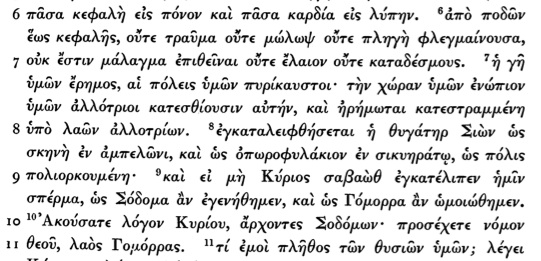
Tuesday, December 4: Isaiah 1:6–10

Isa 1.6-10

Wednesday, December 5: Isaiah 1:11–15

Isa 1.11_tempIsa 1.12-15_temp

Thursday, December 6: Isaiah 1:16–20

Isa 1.16-20

Friday, December 7: Isaiah 1:21–25

Isa 1.20-25a_tempIsa 1.25b_temp

See here for more resources and links to texts for Greek Isaiah.

Greek Isaiah in a Year: the reading plan, free online LXX texts, and more resources

Isaiah

The beginning of Greek Isaiah in a Year is nigh upon us. There are more than 100 people participating via Facebook, and others besides. This post compiles the reading plan, some texts of Greek Isaiah, and other resources. I’ll be adding to this post as often as I can.

The reading plan

Here it is. 5 verses a day (give or take), 5 days a week (Monday through Friday). 12/20/13 update: Here is the reading plan for the 2014 Greek Isaiah in a Year, the Sequel.

Texts of Greek Isaiah

Folks in the group will be reading whatever Greek texts they have available. My initial foray into Greek Isaiah has suggested that Codex Alexandrinus (A) is a better text than Codex Vaticanus (B) for this particular book. Moisés Silva writes, “While this important manuscript [Vaticanus=B] preserves an excellent text for most books of the LXX, it is less trustworthy in the case of Esaias [Isaiah].” R.R. Ottley and Ken M. Penner, both linked below, agree. Ottley bases his work on Alexandrinus, writing, “In the Book of Isaiah… it is thus quite allowable to suggest that B falls below its usual standard, relative or absolute.”

Without further ado, then, some texts to consider, and where to find them:

Rahlfs LXXIsaiah in Rahlfs LXX (German Bible Society, eclectic/critical text). Find it free, legal, and online here. Note that due to copyright restrictions I cannot post the Rahlfs text myself publicly, but you can access the whole thing from the site above. The Rahlfs edition has been called “semi-critical,” so that the textual notes in his apparatus are not extensive. But he does not base his text only on one manuscript.

Isaiah LXX OttleyR.R. Ottley’s Book of Isaiah According to the Septuagint (based on Codex Alexandrinus). See the archive.org site with description here. Or download a compressed pdf (17 MB instead of 57 MB) here from my site. (Thanks to Jim Darlack for combining both volumes 1 and 2 into a single pdf!) Volume 2 has the full Greek text with Ottley’s notes in an apparatus. This commentary is a gold mine of information about the Greek text, the Hebrew it translated, and more.
Isaiah in Swete’s edition (based on Codex Vaticanus). That’s here.

Isaiah in the NETS (New English Translation of the Septuagint), with an introduction by Moisés Silva. This is the leading English translation of the Septuagint. Find the pdf of Isaiah with intro here.

Isaiah by ZieglerThe Göttingen edition of Isaiah. Whereas everything above is available for free online, Göttingen is not. It’s here on Amazon (affiliate link) and here at the publisher’s site. It’s not cheap, but you may be able to find a used edition somewhere. This edition, edited by Joseph Ziegler, is also available from Accordance Bible Software as a single volume here, and from Logos Bible Software as part of a larger collection here. (If it’s Göttingen you’re using, I’ve begun a short primer on how to read and understand the Göttingen editions, their apparatuses, etc.)

More resources for Greek Isaiah

Ken M. Penner, who is writing the Isaiah volume for the Brill Septuagint Commentary series, graciously shared some of his notes with the Biblical Greek Forum last year. See here and here for detailed notes and discussion.

Do you like vocabulary? Like it or not, Septuagint vocabulary is more expansive than New Testament vocabulary. Here is a list (pdf) of all the words in Isaiah that occur 100 times or less in the Septuagint, sorted by frequency. Here is that same list sorted alphabetically. My friend, co-worker, and fellow churchgoer M. Ryan has put the vocabulary list into Quizlet.

The Great Isaiah Scroll (1QIsaa) from the Dead Sea Scrolls is available online for viewing. When you hover over a part of the scroll, an English translation pops up. The scroll is in Hebrew, and is close to the Masoretic Text (MT) of Isaiah, which you can access here, if you want to look at the Hebrew of Isaiah at any point.

Did I miss anything? Please let me know in the comments, and I’ll keep this page updated. Happy reading! Before Monday I will post again with the coming week’s schedule and text.

Resources for reading through Greek Isaiah

One more week until more than 50 folks and I start a read-through of Greek Isaiah! There’s an already active Facebook group page for the endeavor.

One of the readers has been working on the Isaiah volume in the Brill Septuagint Commentary Series. He’s graciously shared links with the group to some of his notes on Greek Isaiah, which he posted in the “B-Greek” Biblical Greek group last year.

Look here and here to see what Ken Penner has compiled. I’m really looking forward to his input and guidance as we work through Isaiah.

Vocabulary list for Greek Isaiah (via Accordance 10)

I’ve already gotten some good response to my last post about reading through Greek Isaiah in a year. More on that again soon.

For now, to whet all our appetites, I’ve just been able to use Accordance Bible software to generate this list.

VOCABULARY IN LXX ISAIAH (Rahlfs) (PDF)

It lists all the words in Isaiah, with their glosses (brief “definitions”), that occur 100 times or less in the Septuagint (Rahlfs). It also shows how many times that word occurs in Isaiah itself.

I used a multi-step process to compile this from Accordance. I’m sure there’s a more elegant way to do what I did, but I am happy to have this list, and know I’ll use it for less than frequently occurring LXX vocabulary when reading through Isaiah, starting December 2.

UPDATE: If you want to join along, here’s the central place on Facebook for discussion, helpful files, questions, companions, etc.