
Great stuff from N.T. Wright on how he starts his days (reading Greek and Hebrew), how he responded when an adviser told him to choose between the Church and the Academy (he chose both), and more:

PlasmaCar, a.k.a., Rocketship, a.k.a. “A COOL, COOL CAR!!!”

This is the family car of choice. In our house it’s called “cool, cool car,” so named by our 2-year-old. We got him one for his birthday. (Its real name: PlasmaCar.)
My wife got it for our 2-year-old after telling me she had scouted it out and that it was “toy of the year.” I’m generally skeptical of toys of the year, but this one has been a hit.
The only challenge was getting our two boys to share the one cool, cool car.
Side note: there was and is an accompanying song. It goes like this:
(loudly) A COOL, COOL CAR!
(softly) a cool, cool car.
(loudly) A COOL, COOL CAR!
(softly) a cool, cool car.
(loudly) A COOL, COOL CAR!
(monotone) CAR.
As I was saying, the sharing was not working out too well…until Grandma came to town and got the 5-year-old one of his very own! (Thanks, Grandma!) It’s now being called a “rocketship.”
The 5-year-old now knows how to do donuts on our back deck. The 2-year-old is not far behind. It’s hours of endless entertainment for us all.
And, yes, that’s the 2-year-old in the picture above on (you guessed it) his older brother’s cool, cool car.
Photo credit: Ian Drummond
Share this:

Book Giveaway Reminder

This is a reminder that Sunday night I’ll be announcing the winner of a study by Myrto Theocharous called Lexical Dependence and Intertextual Allusion in the Septuagint of the Twelve Prophets: Studies in Hosea, Amos and Micah.
If you haven’t already entered the giveaway, there’s still time. Go here to read more and enter.
Share this:

Memorizing a Bible verse in a congregational setting
We’ve done some Scripture memory in chapel two times in the last two weeks. It’s been fun to learn the Bible together, which helps to reinforce our common language as worshipers. This week we had our congregation of worshipers learn Proverbs 8:17.
I had us say it out loud five or six times, each time in a different way:
- once or twice just to get it in our heads
- once standing
- once sitting
- once shouting (and, wow, did they shout!)
- once whispering
My hope was that the variety of recitations (and the amount of them) would help us all commit it to memory, potential cheese factor notwithstanding. It’s a short verse, so I think the five or six times we said it out loud together (with the text on the screen) was sufficient.
Here’s one other way we could have learned the same verse, a method we employed two weeks ago with another (longer) verse.

This slide shows up first. We say it together once or twice. Then we move to this slide, saying it together again:

Then this:

Finally this:

Each of these methods–the repetition at various volumes and in various postures, as well as the slides with diminishing amounts of texts–seemed to work well for the congregation. I’d imagine this could even work well for solo memorization of Scripture. And I’m looking forward to exploring additional methods for leading congregational memorization of the Bible in the future.
Share this:

If You Give a Mom a Muffin…


Paul and the Old Testament

There are over 100 explicit quotations of Scripture in Paul’s letters and at least double that number of allusions. However, what is potentially more useful than just citing Paul’s answers to first-century questions is to study how Paul interpreted Scripture, and that is the theme of this book. (1)
This summer I reviewed the third volume of a de facto trilogy by Steve Moyise. In that same series is Paul and Scripture: Studying the New Testament Use of the Old Testament (click on book cover image to see at Amazon). In 160 packed pages Moyise surveys Paul’s use of the Hebrew Bible/Septuagint.
Moyise’s approach is a thematic one, rather than book-by-book. This helps the reader focus on how Paul treated the same topic across his various letters.
The author begins with an introduction to Paul, his “conversion” experience, his missionary activity, and a wonderful problematizing of the issue: because Paul was familiar with Greek, Hebrew, and Aramaic versions of Scripture, “[W]hen Paul introduces a phrase or sentence with an introductory formula (IF) such as ‘it is written’, we have to ask ourselves which version of the Scriptures he has in mind” (10). For Paul “would not have had our concept of ‘Bible’, a bound volume of 66 books (for Protestants) residing on his bookshelf” (10).
Moyise keeps his and the reader’s eye on this issue throughout Paul and Scripture. He explores how Paul used:
- “The figure of Adam” and creation accounts (with Christ as a Second Adam)
- The story of Abraham, including a brief but helpful look at “Abraham in Jewish tradition”
- Moses–“an ambiguous figure for Paul. He speaks to God face to face, but his use of a veil is interpreted as a lack of openness” (59)
- The law. This was perhaps the most interesting section of the book, as Moyise surveyed not only Paul’s use of Scripture, but how modern theologians have tried to make sense of what looks on first glance like conflicting statements about the law. This section is what led me to write:
I don’t even mind that at the moment I’m a bit perplexed by how Paul could both praise the law as being from God yet also refer to it as a “the ministry that brought death.”
- The prophets–both to develop a theology of Israel and the Gentiles, and to provide instructions for how the Christian community should live
- The Psalms, Proverbs, and Job
The final chapter is a more detailed survey dealing with “modern approaches to Paul’s use of Scripture,” which Moyise divides into “an intertextual approach,” “a narrative approach,” and “a rhetorical approach” (111 ff.).
Appendices include a focus on Paul’s quotations from Isaiah, an index of Paul’s quotations of Scripture, and pertinent excerpts from the Dead Sea Scrolls.
As with The Later New Testament Writings and Scripture, the book is accessible to a non-scholar or non-specialist in this field, though it will require some work. Due to the book’s brevity, and what I assume was Moyise’s desire to still cover all the proper territory, the book is dense. This means that even a short volume like this will be a great reference to me for some time, as I seek to better understand the ways in which Paul used the Old Testament, and the ways in which Christians have tried to make sense of that use for some 2,000 years, especially recently.
The gray shaded boxes throughout explain key concepts such as the Septuagint, Origen’s Hexapla, Greek grammar, the Dead Sea Scrolls, and so on. As with Moyise’s other book, one does not need to know Greek or Hebrew to read Paul and Scripture, but he does not hesitate to use transliterated Greek to aid his explanation.
I have begun to appreciate Moyise’s even-handedness in presenting various viewpoints and interpretations. Even when discussing potentially controversial aspects of Paul (which books Paul authored, the “New Perspective,” or the idea of some that Paul actually exhibited “contradictory” and inconsistent views of the law), Moyise is fair and presents the various views in a way that the reader is left to consider them for herself or himself. (And the reader knows where to go to find more.)
One thing that seems rare in a work like this is that Moyise generally writes out a Scripture he is citing, rather than just placing a slew of references in parentheses for the reader to slowly work through. This latter method is not all bad, but Moyise’s quotation or summation of the references he cites makes for a smooth read.
I found helpful Moyise’s employment of “an eclectic view, using whatever methods or approaches were helpful for understanding the particular quotation” (111). Moyise doesn’t conclusively answer all the questions that arise when studying Paul’s use of Scripture, nor does he seek to. He hopes “that this book has both laid a foundation and stimulated an interest to go on and read further” (125), a mission he very much has accomplished (at least in this reader) with Paul and Scripture.
Thank you to Baker Academic for providing me with a review copy of the book. See its product page at Baker here.
Share this:

Free Book! Septuagint Sunday Giveaway: Lexical Dependence and Intertextual Allusion in the LXX 12 Prophets
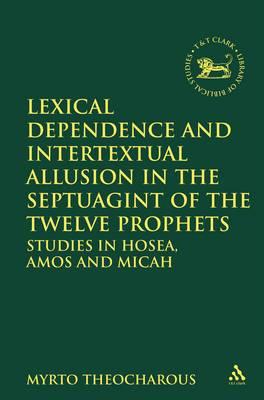
I am giving away a book at Words on the Word this week. It’s a study by Myrto Theocharous called Lexical Dependence and Intertextual Allusion in the Septuagint of the Twelve Prophets: Studies in Hosea, Amos and Micah. This author had me at the title. (Seriously.) It’s part of the Library of Hebrew Bible/Old Testament Studies series from Continuum/T&T Clark. (Thanks to the publisher for making the giveaway possible.) It’s got nice library binding, good quality paper, clear and easy-to-read Greek and Hebrew fonts.
I’ve been enjoying working my way through it, and in coming weeks will offer a review of the book. You can browse inside by clicking here (Amazon affiliate link). Here’s an excerpt from the publisher’s description of the book:
This book explores various aspects of intertextuality in the LXX Twelve Prophets, with a special emphasis on Hosea, Amos and Micah.
Divided into five parts, the first introduces the topic of intertextuality, discusses issues relating to the Twelve Prophets and their translator and concludes with various methodological considerations. Chapter two deals initially with the lexical sourcing of the prophets in their Hellenistic milieu and tests proposed theories of influence from the Pentateuch.
The rest of the book examines specific cases from the books of Hosea, Amos and Micah.
Theocharous summarizes her book in this short pdf. From what I’ve read so far, I can already recommend it.
I will choose a winner at random this time next week. To enter the drawing, simply comment on this blog post with your greetings, thoughts about the Septuagint or prophets, World Series predictions, etc.
Then if you link to this post on your Facebook, Twitter, blog, etc., come back here to tell me in the comments section that you did, and you’ll receive a second entry. I will announce the winner on the blog before midnight Sunday, October 21.
And you can now like Words on the Word on Facebook.
Share this:

BHS module in Accordance 10, reviewed
 Oddly enough, the biggest challenge for me in my Hebrew exegesis classes was not to do with the Hebrew language itself. Instead, learning how to decipher the abbreviations and sigla in the “critical apparatus” of a scholarly Hebrew Bible stretched me most.
I recently wrote a brief introduction to the available scholarly editions of the Hebrew Jewish Scriptures (“Old Testament”), the Greek Jewish Scriptures (“Septuagint”), and the Greek New Testament, with most of the emphasis on that post falling on the Hebrew Bible:
Most students of the Hebrew Bible who read Hebrew know of the premier scholarly edition, the Biblia Hebraica Stuttgartensia (BHS, here on Amazon). The BHS is now being updated by the BHQ (Q=Quinta), about which you can read more here. Both the BHS and BHQ are “diplomatic” editions of the text, which means that they reproduce a single “best” manuscript, the Leningrad Codex, in their cases. The footer in each page contains a critical apparatus, which lists variant readings from other manuscripts and versions that the editors have deemed to be of importance for getting even closer to the “original” (now often being called the “earliest attainable text”). In some cases, the editors may wish to show where another manuscript or version differs from the Leningrad Codex; the critical apparatus is where they do it.
However, the BHS editors show manuscript and version differences in their critical apparatus through the use of abbreviated Latin. Even those who know Latin will have to learn the abbreviations, and those who don’t know Latin will have an even harder time trying to decipher the apparatus.
Having figured out my way around the print edition of the BHS, and having reviewed Accordance 10, I have been eager to use the BHS module in Accordance. Here I review it.
The Original Languages base package in Accordance comes with HMT-W4, which gives the user access to the Groves-Wheeler Westminster Hebrew Morphology 4.16. This text reflects additional and ongoing corrections to the Leningrad Codex. Accordance says HMT-W4 is “almost identical” to the BHS text.
But for the user who wants not just the text but the apparatus, an add-on module is needed. If you already have HMT-W4 or BHS-W4 for your Hebrew Bible in Accordance, you can save money and buy the apparatus by itself. It’s just $50, which is a good deal. (Note: there are no Masora–Masoretic marginalia–included in the module; it’s just the apparatus at the bottom of the page.) If you have Accordance and don’t already have a Hebrew text, you could buy this package, where BHS-T is the “complete text of the Hebrew Bible, following the Biblia Hebraica Stuttgartensia, with the Groves-Wheeler Westminster Hebrew Morphology 4.14. This module includes vowel pointing, cantillation marks, and lemma and grammatical tagging information for each word in the text.”
In any of these Hebrew texts in Accordance, there is instant parsing easily available as you go through the text.
BHS with apparatus in Accordance significantly streamlines study and use of the critical apparatus. Accordance makes it easy to do textual criticism without carrying the heavy BHS around. I really appreciate being able to access the BHS critical apparatus on my laptop, and in a way that is integrated well into the Accordance program. The layout is good, the feel is intuitive, and the windows are easy to set up. Here’s how I have Accordance set up to use the critical apparatus with the Hebrew text and Old Greek in view (click to enlarge):

There’s the BHS critical apparatus, right under the text. Anything in blue in that window is hyperlinked and will display something in the Instant Details window. If I want to know what “pc Mss” means in the apparatus, I see it unabbreviated in the Instant Details just by mousing over the blue text. (If you don’t need the abbreviations expanded, you can also hover over the superscript letters in the BHS-T text, and the corresponding content from the apparatus pops up.)
Using the layout above you can quickly see what an abbreviation in the apparatus stands for in Latin, but this is not translated into English. In the above example, it’s obvious that “manuscripti” for “Mss” means manuscripts–no Latin knowledge is needed to understand that Latin word. But what is “pauci”? Those with good vocabulary may be able to recall that a paucity of something is a small number, a lack, so “pauci” here means few.
But not all Latin in the apparatus is that easy. I would like to have seen this module provide a translation from Latin into English. This is probably my only complaint about this module. I believe this is not unique to Accordance and has more to do with how the German Bible Society may have offered the licensing for the apparatus. All the same, getting from abbreviated Latin to unabbreviated Latin, while nice, may not be enough for the beginning text critic.
Some good news, though. There are two workarounds to be able to translate the apparatus contents from Latin to English. First, there is Google Translate, which I understand has improved its accuracy over the last few years. Here is the link for Google Translate from Latin to English. Simply copy Latin from Accordance into the query box in Google translate, and you’ll have your English. “prb l c” in the apparatus becomes, “probabiliter lege(ndum) cum” in Instant Details, which Google gives me as, “probably read with.”
A yet easier way to get to English is possible within Accordance itself, and it’s quite smooth, thanks to the good programming and easy layout of the software. Dr. Hans Peter Rüger’s well-known “English Key to the Latin Words, Abbreviations, and the Symbols of BIBLIA HEBRAICA STUTTGARTENSIA” is available in Accordance.
Note that in the bottom right zone, my far right tab (behind the open one) is this “BHS Latin Key.” I can easy look up an abbreviation in that tab’s search bar. It’s also simple to just right click the abbreviated word in the apparatus and “Look up” in “Dictionary” to quickly access the English/Latin key.
As far as the BHS apparatus itself, BHS remains the scholarly standard. BHQ is beginning to update/replace it, and there are other scholarly projects underway. The BHS apparatus is not exhaustive, nor could it be. But it does offer a good representation of variant readings from different versions (e.g., the Latin Vulgate, the Greek LXX, the Syriac Peshitta, Aramaic Targums, etc.) and different manuscripts (whether a specific Old Greek manuscript or just the general “Mss” for “manuscripts”).
There are different editors for different portions of the BHS, and some are less cautious than others in suggesting textual emendations. In the Minor Prophets, for example, editor Karl Elliger seems to have no trouble writing “prp”=”propositum”=”it has been proposed” when he wants to suggest an alternate reading. Sometimes this means that someone else has proposed what Elliger is footnoting; other times it’s just his suggestion, and not always with textual/manuscript evidence accompanying the suggestion. So the user of BHS should not use the critical apparatus, well… uncritically.
An especially neat feature that wowed me is that I can open up the apparatus and search by content to study all 2,146 times the Latin abbreviation “prp” occurs in the BHS apparatus. You can even search the apparatus for its Hebrew and Greek contents. Curious how often ποῦ finds its way into the apparatus? A simple search shows its four occurrences.
And you can search the apparatus by manuscripts mentioned. Change the search bar to “manuscripts,” then right click in the bar and select “Enter Word…” and you get this:
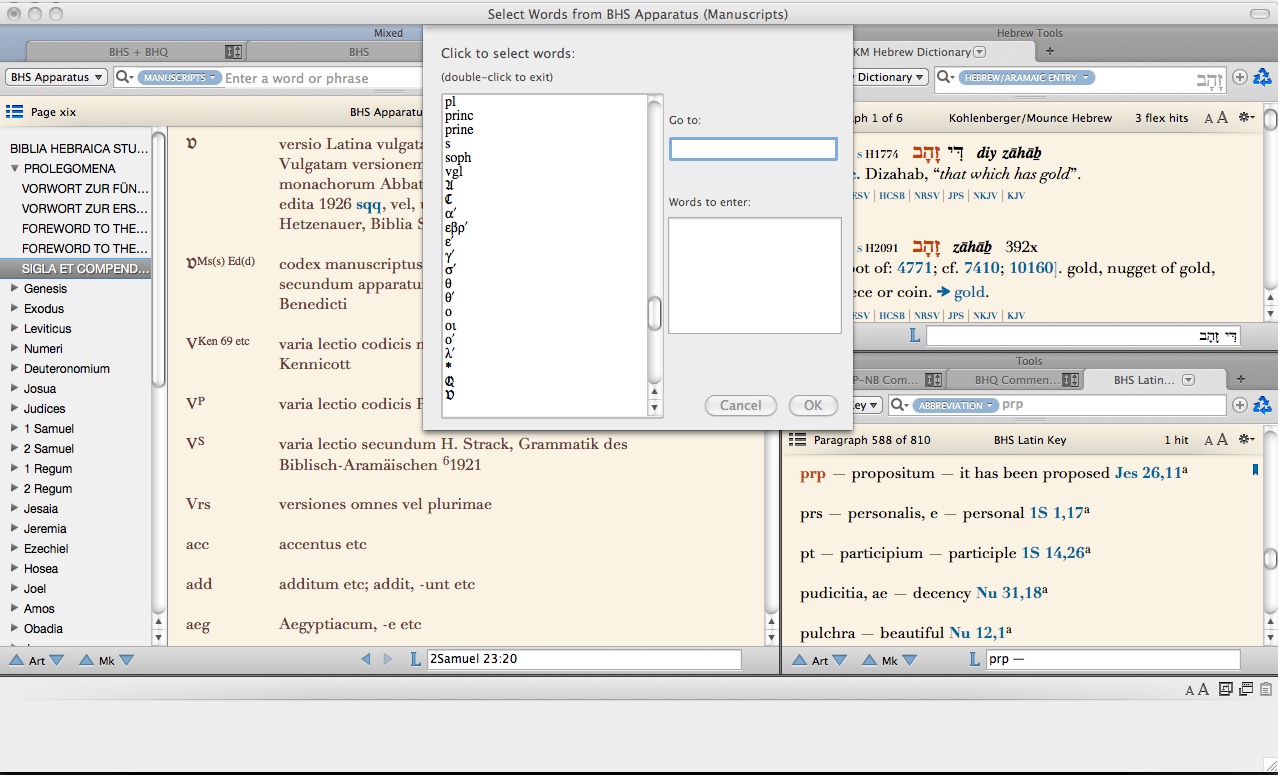
It’s a great way to be able to interact with the apparatus, much of which simply isn’t possible in print.
Bonus: Accordance offers an excellent, succinct explanation of critical editions here, with emphasis on the critical editions available in Accordance. If you’re interested in BHS in Accordance, you’ll want to read it.
If you do text criticism in the Hebrew Bible and have the money to spare, Accordance’s BHS apparatus is well worth getting, though most users will want to make sure they also have the “BHS Latin Key,” too. All in all, it’s a well-executed and seamlessly-integrated module.
Thank you to Accordance for providing me with a copy of the BHS and BHQ modules for review. See all the parts of my Accordance 10 review (including the Beale/Carson commentary module) here. I will review the BHQ separately in the future.
Share this:

Family Friday: Annisquam Lighthouse and a long walk on the beach
 Yesterday I came home from work and, not even taking the time to change out of my dress clothes, strapped on our baby girl and walked with her and my two boys to the beach.
“Look out for the poop on top of the hill,” our now 5-year-old son reminded us. “Watch out… poop on hill!” echoed his 2-year-old brother.
We went down the poop-topped hill and onto the beach in sub-50 degree weather. The 5-year-old (he of “my 4-year-old son” fame) scrambled up and down the rocks. The 2-year-old sang happy songs and found a bird feather with which he stooped down to draw a “choo-choo” in the sand. Baby girl slept, warm against my chest.
The setting sun bounced off the houses on the opposite shore. One of the houses, reflecting the sun, looked like it had windows made of pure gold.
At 5:56, the Annisquam Lighthouse turned on.
It was a moment–a long moment, since we walked for about an hour–that I’ll savor for years to come. God has indeed been good to his people.
Share this:

Praising God through Academic Biblical Studies: Less Hypermodernist Objectivism, More Affect!
Why such an emphasis on wanting to get as close to the “original text” of the Bible as possible? Or, as some scholars call it, the “earliest attainable text”?
Earlier this week I wrote a bit about scholarly editions of the Jewish Scriptures, both the Greek and the Hebrew.
But I began asking myself today, why am I so interested in a rigorous scholarly pursuit of the text of the Bible in Hebrew and Greek?
One reason is that I love to learn. On the Strengthsfinder assessment I came out with “Learner” as my top strength both times I took the test. “Achiever” was not far behind. (See here for the descriptions of the 34 strengths themes in that assessment.) Here’s an excerpt from the description of the “Learner” strength that applies to me:
You love to learn. The subject matter that interests you most will be determined by your other themes and experiences, but whatever the subject, you will always be drawn to the process of learning. The process, more than the content or the result, is especially exciting for you. You are energized by the steady and deliberate journey from ignorance to competence.
All true, except that when it comes especially to my pursuit of biblical studies, the process, the content, and the result are “especially exciting” for me.
Why?
The late Arthur Holmes articulates beautifully:
Christ the Truth becomes the dominant motivation in intellectual inquiry. No dichotomy of sacred and secular tasks can be allowed, and no subject is exempt.
The student will therefore welcome truth and submit to it wherever it is found, out of obedience to Christ. Academic work becomes an opportunity to extend the Lordship of Christ over the mind; thought merges into worship.
“Thought merges into worship.” I love this. And I think this is why–more than just being a “Learner”–I so love to delve into the depths of Scripture, in the most “original” form that I possibly can.
I’m not overly fastidious about Hebrew, Greek, and Aramaic–as if God really spoke through those languages and then anything else is just mediated and somehow a dilution of God’s actual words. (Isn’t all language already mediation anyway?) If the word of God is “living and active,” it can be living and active in its faithful translations into other languages.
But one reason I geek out so much about the Septuagint and the Hebrew Bible is that in my study I feel myself getting closer to that amazing time when God gave his word to humanity to be transmitted to future generations: first orally, then in written form. And I love seeing how the translators of the Hebrew Bible wrestled with putting the Hebrew into Greek. I love seeing how the New Testament writers grappled with, contextualized, and recontextualized the Old Testament.
I don’t even mind that at the moment I’m a bit perplexed by how Paul could both praise the law as being from God yet also refer to it as “the ministry that brought death.”
Why?
Because for me, as of late, my thoughts and my studies of Scripture–even at a scholarly level–have begun to “[merge] into worship.” How can I not praise the God behind these amazing words? Though we may never know what the autograph of any part of Scripture actually said, I believe we can get close.
And somehow the closer I get to the text of the Bible–in a scholarly setting–the closer I feel to God.
Not always, of course–sometimes I’m just confused. (Dash the heads of infants against rocks? And we pray these Psalms in liturgical settings???) But there’s been a real richness for me lately in delving into the Bible in its original languages, comparing variant readings across manuscripts and versions, trying to figure out why one Synoptic Gospel said it this way, why this one said it another way…. Even in seeking to answer those questions, I know that I am seeking more of God and God’s revelation.
This is not a taken-for-granted view of things in the field of biblical studies. Take this, for instance, from Michael V. Fox:
In my view, faith-based study has no place in academic scholarship, whether the object of study is the Bible, the Book of Mormon, or Homer. Faith-based study is a different realm of intellectual activity that can dip into Bible scholarship for its own purposes, but cannot contribute to it.
I haven’t contacted Michael V. Fox to confirm this, but I’d wager that what I’m describing above constitutes some sort of “faith-based study,” or at least, study that is informed by and that enriches faith.
But a bit more context from Fox:
The claim of faith-based Bible study to a place at the academic table takes a toll on the entire field of Bible scholarship. The reader or student of Bible scholarship is likely to suspect (or hope) that the author or teacher is moving toward a predetermined conclusion. Those who choose a faith-based approach should realize that they cannot expect the attention of those who don’t share their postulates. The reverse is not true. Scholars who are personally religious constantly draw on work by scholars who do not share their postulates. One of the great achievements of modern Bible scholarship is that it communicates across religious borders so easily that we usually do not know the beliefs of its practitioners.
I’m okay with trying to set aside a “predetermined conclusion,” though skeptical of that possibility. (Does Fox believe in the modernist project?)
Fox goes on, “The best thing for Bible appreciation is secular, academic, religiously-neutral hermeneutic.”
Sigh.
Taking the Psalms as an example, one cannot appreciate the Psalms who does not pray the Psalms. And wouldn’t good scholarship (religiously motivated or not) call for us to engage the text on the author’s terms? How can one do good scholarship on David, for example, if one is not willing to engage the text in the way that David intended for it to be engaged? If he wrote a Psalm for corporate singing or reciting, is the individual in her or his library carrel who seeks to bracket out faith commitments going to get anywhere near to uncovering the meaning and import of that Psalm until she or he sings it with others?
Fox’s whole article is here.
Parker Palmer has a good rejoinder:
Objectivism—which is a complete myth with respect to how real people have ever known anything real—has great political persuasiveness because it gives us the illusion that we are in charge.
But gospel truth, transformational truth, says that we are not masters but are subject to powers larger than ourselves—and that we are blessed with the chance to be co-creators of something good if we are willing to work in harmony with those larger powers.
If we embrace a gospel way of knowing, we can create a different kind of education and perhaps a different world: a world where all of us are called to embody whatever truth we know; where we gather together with others to check, correct, confirm, and deepen whatever insights we may have; where we understand that, even as we seek truth, truth is seeking us; and where there can be those vital transformations, personal and social, that might take us a step closer to the beloved community.
So when it comes to biblical studies, I say: less hypermodernist objectivism, more affect! Let’s allow our thoughts–as Dr. Holmes suggested–to merge into worship; our studies into praise; our reading into praying.
My quest for the earliest attainable text of the Bible, I am realizing, is driven by scholarly interest and a general drive to learn, yes. But more than that, I want to know God more fully through this academic pursuit. My insatiable desire to master Greek noun declensions, Hebrew verb parsings, and intertextual allusions is in the end a desire to be mastered by the God who stands behind the words of Scripture.
But that kind of a posture doesn’t compromise scholarship, in my view. It makes it richer, deeper, and directed toward its most proper end.
 Words on the Word