A New Reader’s Lexicon of the Greek New Testament, Reviewed

Unfamiliar vocabulary proves to be an enduring challenge for students of New Testament Greek. Even students who understand the rules of the language get bogged down having to look up uncommon words while translating. Nevertheless the correct interpretation of many passages of Scripture hinges on the meaning of its rare words.

–Michael H. Burer and Jeffrey E. Miller, Preface

Vocabulary acquisition is key to being able to read any language, but so is just reading a text straight through. A “reader’s lexicon” or “reader’s Bible” seeks to bridge the gap so students can both improve their vocabulary and engage in a continuous reading of the text. To that end, Kregel Academic and Professional has published A New Reader’s Lexicon of the Greek New Testament by Michael H. Burer and Jeffrey E. Miller.

But why a new reader’s lexicon when the old one (by Kubo) has been useful to students of the Greek New Testament for so long? That’s been the primary question before me as I’ve reviewed the New Reader’s Lexicon (NRL). Daniel B. Wallace in the preface gives the reasons for this new lexicon:

But as helpful as Kubo was, there were weaknesses. First, it was not updated to the glosses found in the third edition of the Bauer Lexicon (BDAG). Second, there were numerous errors (involving word frequency numbers, omissions of words, inappropriate glosses, etc.) that went uncorrected. Third, the special vocabulary section at the beginning of each book, involving all the words that occurred more than five times in that book but less than fifty times in the New Testament, created its own problems: designed for efficiency of space, it did not prove helpful for efficiency in learning.

While I think Wallace has it right on the first two points, I (sort of) disagree with the third–that list that Kubo offers at the beginning has actually been helpful to me for learning a given book’s vocabulary, since it groups some of that book’s common words together. However, it does mean that words in that beginning list don’t then appear in Kubo’s lexicon throughout the rest of the book. To overcome this, I would make a copy of the list and use it as a bookmark, referring to it often so I didn’t have to keep flipping pages.

Herein lies one area of strength for the New Reader’s Lexicon. There is no common vocabulary list at the beginning of each book (users now can generate those easily enough through Bible software), but it means that every word that occurs less than 50 times in the New Testament is in this lexicon… in the verse in which it appears. So as I’m beginning my way through Mark 6, I can look in the NRL to quickly see that ἐκεῖθεν in verse 1 means “from there.”

To Wallace’s first two points, that the NRL uses the updated BDAG is a great relief–readers now don’t have to guess whether recent advances in lexicography or discoveries of new papyri mean that the word in front of them actually has a slightly different nuance. The NRL updates Kubo here well.

In addition to “concisely defin[ing] in context” each word, the NRL gives statistics for how many times that word appears. (Names and proper nouns are included.) There are up to three numbers listed:

  • How many times the word appears in that given book of the New Testament
  • How many times that word appears “in all canonical works by the traditional author of the book at hand”
  • How many times the word appears in the whole NT

Kubo had the first and third numbers. This second statistic now allows me to see not only how many times ἀνάθεμα appears in 1 Corinthians (twice) and in the NT (six times), but it tells me that five of the six uses of this word in the NT are with Paul.

And here’s where the lexicon is unique and really stands out–in the instance of such a rarely occurring word, it lists cross references, so I can quickly see that the other use of ἀνάθεμα in I Corinthians is at 16:22and that Paul also uses the word in Romans 9:3, Galatians 1:8,9, and that the only non-Pauline NT occurrence of the word is at Acts 23:14.

The NRL truly does improve upon Kubo’s lexicon. It accomplishes its mission quite well.

But don’t take my word for it. I’ve found that what original language resources to own and invest in is often a matter of personal preference and what works best for an individual. If you’re still on the fence about this resource, download a free sample of the lexicon for Colossians here (pdf). Read through Colossians with it in hand and see how it goes. Personally I’ve found this to be an indispensable resource for making my way through the Greek New Testament.

One huge bonus: the book is designed well. The pages are smooth and thick and bright. The font is clear and easy to read. And the binding is sewn! This means it will stand the test of time well, which you’d hope a reference work like this would.

My thanks to Kregel Academic for providing me with a review copy of this book. Find out more about the book at Kregel’s site or look inside on Amazon.

Creation… Fall… Redemption… Consummation. (Another one hour worship service from scratch)

On Sunday I led a group of student ministry leaders in worship for an hour. As in the time I described in this post, it was a one hour worship service from scratch. In other words, I was invited to plan and lead the hour of worship from start to finish. In my previous post I mentioned one way to give shape to what otherwise could be unstructured worship, using the A.C.T.S. acronym.

Here’s how I opted to structure the hour together with this same group this year. This is a version of the run sheet the worship musicians and I had before us.

Intro: Creation, Fall, Redemption, Consummation

  • What it is: way of understanding the whole sweep of the Bible (explain each part briefly)
  • Why it’s important: tells us God’s story—and our place in it.  Situate selves at start of new year.
  • We’ll weave between Scripture and Song and Prayer, standing and sitting, together and alone

Creation

Fall

Redemption

Consummation

  • Scripture: Revelation 21:1-5
  • And so our prayer, “Make all things new” is finally answered.
  • Moment of silence to reflect on “I am making all things new.”
  • Song (standing): Grace Like Rain

Conclusion: Close in prayer

Reviews of various Hebrew, Aramaic, and Greek books, commentaries, and software

I’ve now reviewed enough Biblical languages textbooks, lexicons, commentaries, and other resources, that I thought it was time to put them together all in one place. Grouped by language and title, with hyperlinks to each review, here are the language resources reviewed-to-date at Words on the Word. I plan to keep this page updated for future reviews, so feel free to bookmark it.

Hebrew

Aramaic

New Testament Greek

Septuagint Greek

Other Biblical Commentaries

Bible Software

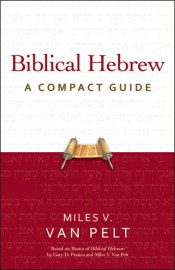
Review of Biblical Hebrew: A Compact Guide

At long last, a compact reference guide to Biblical Hebrew!  Not long ago Zondervan released Biblical Greek: A Compact Guide, a helpful and portable distillation of Mounce’s oft-used grammar. Many such little books already exist for easily reviewing Koine Greek: Dale Russell Bowne’s Paradigms and Principal Parts for the Greek New Testament, Paul Fullmer and Robert H. Smith’s Greek at a Glance, and even the back of Kubo’s Reader’s Lexicon has a good summary of Greek grammar with paradigm charts.

There seem to be more resources available to students of Biblical Greek than to students of Biblical Hebrew.  For example, while there is just one (excellent!) “Reader’s” Hebrew Bible (uncommon vocabulary is glossed at the bottom of the page), I am aware of at least three Reader’s Bibles that exist for the Greek New Testament.  So Miles Van Pelt’s Compact Guide, based on his and Gary Pratico’s Basics of Biblical Hebrew, is a welcome addition as far as this eager Hebrew student is concerned.

The book is not terribly dissimilar from Pratico/Van Pelt’s Charts of Biblical Hebrew, but unlike that work, A Compact Guide is more than just a collection of charts and paradigms.  Each section includes a distillation of what is in the larger grammar textbook, followed by paradigms and charts for quick reference. Seeing Van Pelt’s world-famous color-coded verbal diagnostics is a highlight.

Oddly enough, at times there seems to be more precision and detail in this little book than in the larger grammar.  Or perhaps it’s just more nuance or smoother grouping of material that has come about with the passage of time since the publishing of the grammar’s second edition. For example, there is a section in the Compact Guide on “particles” that is a unique and clearer grouping than what is in the larger grammar. And whereas the grammar lists three kinds of Hebrew prepositions (independent, Maqqef, and inseparable), the Compact Guide adds a fourth: compound prepositions, where “two different prepositions, or a preposition and a noun” (28) combine to make a new preposition. (This fourth category appeared in the larger textbook later in its chapter as “Advanced Information”; having everything grouped together in the Compact Guide was easier.)

The primary focus of the guide is morphology (how words are formed, including paradigm charts) and syntax (how words are used in sentences, i.e., grammar).  Unlike Basics of Biblical Hebrew there is not much in the Compact Guide by way of vocabulary, save for a Hebrew-English mini-lexicon at the back of the book.  Unfortunately, there was no explanatory note as to what constituted inclusion on the lexicon.  (In Mounce’s Greek Compact Guide, the lexicon notes that it includes words that occur in the New Testament 10 times or more.)

From what I can tell, though, the Hebrew Compact Guide reproduces exactly the Hebrew-English lexicon in its larger textbook counterpart. In this case, the lexicon covers Hebrew words that occur 50 times or more in the biblical text. The Basics of Biblical Hebrew lexicon notes that it also adds “less frequently occurring words that appear in the grammar and workbook.”

In addition to a thorough listing of paradigms (the 11-page section on pronominal suffixes is particularly helpful), the book is filled with examples from the Hebrew Bible (with English translation).  The Hebrew font used, while not quite as easy to read as that of the grammar, is readable enough. (And that may just be a matter of personal preference anyway.)

The section on verbs is a particular strength of this work–in addition to examining all the forms and stems (both strong and weak), there are extensive listings of paradigms for easy review.

All in all, I give a hearty two thumbs up to this work–and express my gratitude that it is now on the scene for those who want to keep their Biblical Hebrew fresh!  For a beginner in Biblical Hebrew I would recommend the full-length grammar textbook, but for those with even a semester or two of Hebrew (and beyond), this small reference guide will be a valuable and inexpensive addition to their library. As Van Pelt notes in his preface, even “veterans” of Hebrew will be able to utlize the guide to “keep fit” in their language use.

Icing on the cake: the pocket-sized paperback comes encased in a sturdy, translucent plastic cover.

You can preview the book here.

Note: I received a review copy from Zondervan for the purposes of this review. I had initially reviewed a digital galley version of this book through Net Galley. The above reproduces my galley review, checked now against the hard copy for accuracy.

Words on the Word Weekend Recap

Here’s a Words on the Word weekend recap. Friday the 17th through Sunday the 19th at WotW had the following:

Kids’ takes on things: My 4-year-old son reviews Duck Soup / Little kids review Radiohead’s “Paranoid Android” (VIDEO) / Calvin’s macabre snowmen

Abram’s take on two five-star books: James (Zondervan ECNT), reviewedBasics of Biblical Aramaic

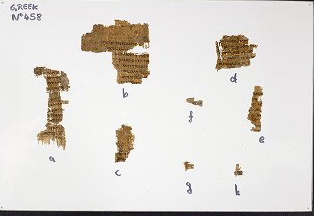
Cool stuff: Oldest known Septuagint fragments (interactive picture)

Basics of Biblical Aramaic

This textbook is a great one. I’m amazed at how much Aramaic it helped me pick up in just a long afternoon and evening. What follows is my review of Miles V. Van Pelt’s stellar text, Basics of Biblical Aramaic. It’s a winner!

Basics of Biblical Aramaic (BBA hereafter) is a “Complete Grammar, Lexicon, and Annotated Text.” I’ll review each of these components in turn.

Scope, Aim and Audience

BBA seeks to include “everything you need to learn biblical Aramaic” and is “designed for those who already have a working knowledge of biblical Hebrew.” This is a fair expectation, since most students of Aramaic only come to Aramaic having already had Hebrew (and often Greek, too). This allows Van Pelt to use Hebrew as a springboard for Aramaic throughout the book, which he does to great effect. He writes “for those students who desire to study, teach, and preach faithfully from those portions of the Bible that appear in Aramaic.”

I write as a member of Van Pelt’s target audience. I’ve had (more than) a year of Hebrew but no Aramaic to date.

Grammar

Van Pelt divides the grammar into the following sections:

  • Phonology, in which he introduces the Aramaic alphabet, vowels, and syllabification
  • The Nominal System, in which he covers nouns (absolute, determined, and construct states), conjunctions, prepositions, pronouns and pronominal suffixes, adjectives, numerals, adverbs, and particles
  • The Verbal system, in which he covers the simple Peal stem in all its conjugations (perfect, imperfect, imperative, etc.), followed by the derived stems in their multiple conjugations
  • Six pages of quick-reference Charts and Paradigms

Here is a sample pdf of the Table of Contents and first few chapters. In the book’s layout and in many other ways, BBA is like Van Pelt’s Basics of Biblical Hebrew (BBH), which he co-authored with Gary D. Pratico.

As with BBH the typical chapter layout of BBA is grammar followed by vocabulary. And in this case, since the workbook is essentially included in the text, chapters close with exercises. There is no answer key included, but the book lists the site from which it can be downloaded.

Van Pelt classifies verbs according to the “Peal” stem and its derived stems–also explaining alternate verbal terminology (G-stem, etc.). As he explains the various conjugations, he keeps aspect firmly in mind:

The incomplete (or imperfective) aspect of the Imperfect conjugation is well suited for describing present and future actions and so a present or future tense English translation is common with this verbal form. However, it is important to remember that that imperfective aspect of the imperfect conjugation may refer to actions in the past, present, or future….

One of Van Pelt’s aims in this textbook is “pedagogical sensitivity,” which he notes has not always appeared in Aramaic grammars. (He may have this one by Alger F. Johns in mind, which, good as it is, is not as user-friendly.) He succeeds immensely in this regard. That Van Pelt is a professor in an actual classroom is on display throughout the text; his tone is warm and even encouraging in many places. Each chapter concludes with a “Before You Move On” section, which helps the reader distinguish between things he or she needs to commit to memory and what he or she can leave for future reference.

Van Pelt’s grouping of vocabulary also exhibits “pedagogical sensitivity.” Initial lists have vocabulary that is similar or identical to Hebrew, so that an Aramaic student can get a quick jump on vocabulary acquisition. Van Pelt groups several lists according to semantic domain and also parts of speech. This is merciful to the students who will work their way through BBA (and good pedagogy). He includes all Aramaic words occurring four times or more in the OT, which constitute 91% of the text.

Lexicon

The lexicon is a comprehensive one that includes every Aramaic word occurring in the OT. Van Pelt bases the definitions/glosses on HALOT. There are definitions for different stems of each verb, too. There are no word frequency counts, either here or in the vocabulary lists. (Basics of Biblical Hebrew has frequencies in the vocab lists at the end of each chapter, one of its great features.) However, this may not be as essential as in Hebrew, since the Aramaic corpus in the OT is smaller. Van Pelt does include frequency statistics for many prepositions, conjunctions, adverbs, particles, and stems as he introduces them throughout the text.

Annotated Text

This is the best feature of an already great textbook. In the same way that Van Pelt and Pratico’s Graded Reader of Biblical Hebrew helps the student to really dig into the text, the Annotated Text in the back of BBA allows the student to put his or her new knowledge of Aramaic into practice. Every OT verse and passage in Aramaic is included: Genesis 31:47, Jeremiah 10:11, Daniel 2:4b-7:28, Ezra 4:8-6:18, and Ezra 7:12-26. The footnotes link back to specific chapters and sections of the text, and Van Pelt includes detailed morphological and lexical analysis of various words.

Further reflections

I have only two (minor) critiques of this textbook, which are as much as anything hopes for small adjustments that might be made in a future printing or edition of this book.

First, there is little about Aramaic in its Northwest Semitic context. This isn’t an oversight; Van Pelt says his grammar is not “written for Aramaic scholars or for students interested in comparative Semitic grammar.” Instead he wants to help produce a “working knowledge” for those who will “study, teach, and preach faithfully” from the Aramaic portions of the Bible. Fair enough. And he does allude to further discussions of Aramaic as a language in his footnotes. But as I imagine myself teaching and preaching Aramaic portions of the Bible, I think it would be helpful to know something of Aramaic’s context and development, to explain to my congregation. This could simply be a few paragraphs in a future edition.

Second, the verbal diagnostics Van Pelt highlights (using “the identification of distinctive verbal features unique to a group of related verbal forms”) are explained in the individual chapters, but not color-coded in the paradigm charts. They are given in red in the Hebrew textbook Van Pelt co-authored, and this was one of the most useful parts of that book–it really aided in learning the paradigms. Van Pelt does explain what diagnostics to look for, but I’d love if a future edition or printing could color-code the vowels/consonants that constitute the various verbal diagnostics. (UPDATE: I had thought that perhaps the lack of color in verbal diagnostics was a print cost issue. I’ve now been able to confirm that there will eventually be an electronic release of the grammar with color.)

Also, though this might be asking a lot of a single text, I found the English to Hebrew composition exercises in the BBH workbook to be a great way to improve my Hebrew. Perhaps supplemental composition exercises could find their way onto Van Pelt’s site in the future?

I initially thought a $45 retail price was steep for a paperback. But considering that this includes a grammar text, workbook exercises, a comprehensive Aramaic lexicon, and an annotated text of all the Aramaic in the Old Testament… it’s actually reasonable. In the Hebrew and Greek equivalents to this textbook, the text, workbook, and set of annotated readings are all separate volumes. This was a good move on the book’s part, I thought, and makes it easy to refer to it time and again as a one-stop shop for Aramaic acquisition and development.

What stands out most to me about Basics of Biblical Aramaic is the very-nice-to-have Annotated Text at the back with all the Aramaic OT passages. And another standout feature of this text is that Van Pelt truly does display “pedagogical sensitivity” throughout the text. Who would have thought an Aramaic textbook could have such a conversational tone without sacrificing thoroughness and good pedagogy?

Five stars. I imagine this textbook will become the standard in seminary and upper-level college courses where students learn biblical Aramaic.

My thanks to Zondervan for the review copy of this textbook. Find it here on Powell’s or here at Zondervan’s product page.

James (Zondervan ECNT), reviewed

James is no “epistle of straw,” as Martin Luther once (in)famously said of the book. But many–with Luther–find it difficult to reconcile Paul and James on faith and works.

Paul: “A person is justified by faith apart from works of the law.”

James: “A person is considered righteous [i.e., justified] by what they do and not by faith alone.”

Here I review James by Craig L. Blomberg and Mariam J. Kamell, from Zondervan’s Exegetical Commentary on the New Testament (ZECNT) series. (Click here to find my review of Luke in that same series; below I use some of my same wording from that post to introduce the ZECNT series more generally.)

Like the rest of the ZECNT series, James is “designed for the pastor and Bible teacher.” The authors assume a basic knowledge of Greek, but Greek is not required to understand the commentary. For each passage the commentary gives the broader literary context, the main idea (great for preachers!), an original translation of the Greek and its graphical layout, the structure, an outline, explanation, and “theology in application” section.

The introduction covers an outline and structure of James, the circumstances surrounding its writing, authorship and date, and significance of the book. It is shorter and less detailed than the introductions in Douglas Moo’s James commentary and that of Peter Davids. Immediately I looked for how the authors would resolve the Paul/James (alleged) discrepancy, but they note in the introduction that they discuss James’s theology after “the commentary proper.” (The ZECNT series has a separate “Theology” section at the back of the book that most other commentaries include as part of the introduction.)

They give just two paragraphs in their theology section–with a bit more in the body of the commentary–to “Faith and Works” (compare Moo’s lengthier discussion in his introduction), but they have their reasons for this:

Contrary to what the extent of the discussion of the topic might suggest, faith and works is not the main focus of James’s letter. It is a subordinate point that grows out of his concern for the poor and the dispossessed (2:14-26; cf. 2:1-13).

I’m a little embarrassed to admit that this idea of faith and works as a subordinate point in James had not really occurred to me prior to working with this commentary. (A good trait in a commentary to produce such thoughts!) But if you click on the references above or look through James 2 (and the rest of James) in your Bible, it’s easy to see where the authors are coming from.

In fact, the “three key topics” in James, according to Blomberg and Kamell, are “trials in the Christian life,” “wisdom,” and “riches and poverty.” They follow Davids here, and note that James 1:2-11 lays out each of the major themes, which James then restates in 1:12-27. 2:1-5:18 then consist of “the three themes expanded,” in reverse order, followed by a closing in 5:19-20.

Blomberg and Kamell are “the first to grant that we may still be imposing more structure on the text than James had in mind.” All the same, their outline of James makes it easier to work through the book, and then finally does, I think, justify their claim in the theology section that “faith and works” is not the central theme of the letter and should be considered in its broader context. Still, they do have a good way forward in understanding Paul and James together: “But this action, these deeds or works, are not put forward in any attempt to merit God’s favor but as the natural, spiritual outgrowth of one’s faith.”

As with Luke, the graphical layout of each passage (in original English translation) is a unique contribution in James. Being able to see main clauses in bold with subordinate clauses indented under them (plus how they relate back to the main clause) gives the reader a quick, visual grasp of the entire passage at hand. See page 45 of the commentary in this sample pdf to see how it looks. This is a highlight of the ZECNT series, and the fact that it’s in English makes it all the more accessible. The translation is smooth and readable, doing great justice to both the Greek it translates and the English language.

James has the full Greek text of James, verse by verse, and the full English translation (passage by passage in the graphical layout, then again verse by verse next to the Greek). As I’ve said before, a value for me in using reference works is not having to pull five more reference works off the shelf to use the first reference work! The authors make comments like this one in 1:5 throughout the work, wedding grammatical and lexical analysis to exegetical application:

We are told to ask of the “giving God” (διδόντος θεοῦ). Here the present participle suggests that “giving” represents a continuous characteristic of God.

To take another example, on James 2:20, which they translate, “Do you want to know, O empty person, that faith without works is workless?” they write:

James incorporates a pun on the word “work” (ἔργον), using the negative adjective from the same root–“workless” (ἀργή). The term can also mean idle or useless. Faith that lacks works does not work! In other words, it is entirely ineffective to save.

Teachers and preachers especially will appreciate the “Theology in Application” section that concludes each passage. James may already strike the preacher as a book that just preaches itself, but the authors do well in helping the preacher connect the text with today’s concerns. For example, for 2:14-17 they note that although James

provides no treatise on the most effective ways to help the poor…, true believers will take some kind of action. At the very least, they must cultivate generous, even sacrificial giving to help the poor as part of their ongoing personal and corporate stewardship of their possessions. But in light of systemic injustice, we probably need to do much more.

Amen. The authors go on, “James certainly would share the concern of liberation theologians to do far more for the poor, individually and systemically, than many branches of recent Christianity have attempted” (my italics). Moo agrees–though he wants to distance himself “from an extreme ‘liberation’ perspective,” he says “we must be careful not to rob his denunciation of the rich of its power.” And James 5:1-6 are pretty damning of the powerful rich who use their power to oppress the poor.

The authors write,

[These oppressors] are the financially wealthy in a world where the rich occupied a miniscule percentage of the population. James does not call them to change their behavior. Instead, he warns them of impending disaster in their lives by commanding them to mourn their coming fate. …”Wail” [ὀλολύζοντες] appears in the LXX of the Prophets in contexts of judgment and can refer to inarticulate shrieks of terror. …James makes it clear that these rich people are going to undergo a terrible ordeal.

There were a few times in the “Theology in Application” section that I wondered (as other reviewers have) whether the authors weren’t getting a bit off-topic from the text. For example, on 3:9-12 they say,

Abortion and euthanasia offend God deeply because they take lives made in his image. But abuse or neglect of the poor and outcast (including the homosexual) proves equally offensive because such treatments likewise demean individuals God made to reflect himself.

They say this to argue against the “stereotypical agendas of both the political and religious ‘right’ and ‘left,'” but it was hard for me to decide whether this was a case of applying an ancient text well to a contemporary set of issues, or if it was an anachronistic stretch. Nothing they say here is incongruent with James, but I did wonder here (and in another place) whether those verses in James really speak to issues like abortion and homosexuality. A minor critique, though.

Those working their way through the Greek of James may still want to have Davids on hand. But as with the Luke volume in this series, the combination of close attention to the Greek text with contemporary application makes James a commentary very much worth using. I know I will want to go back to this commentary right away when I am doing work with the book of James in the future.

(I am grateful to Zondervan for the free review copy of this commentary, which was sent to me with the understanding that I would then write an unbiased review. You can find the book on Amazon or at Zondervan.)