

That is a lot of books. Click here or on the photo above to see photos and a time-lapse video of a cool project.
 A long-time family favorite has been The Jesus Storybook Bible (subtitle: Every Story Whispers His Name). Friend and fellow blogger Robbie and his wife gave us this sweet gift when our now four-year-old was born.
Following on the heels of his first book review, my four-year-old here reviews The Jesus Storybook Bible. (Cool thing: the author of the book he reviewed blogged about it here.) As before, I did the typing, but the words below are all his. For the purposes of this review, he focuses on “The terrible lie: Adam and Eve lose everything, from Genesis 3.”
This story is about a snake, and the two people that God told them not to eat the food on that tree… and they did. And a big lie–a really, really, really, really big lie–came into the world. And then it felt like everything was going to break. And I even know that story.
God had to send them out of the garden, because they were being naughty. God sent them away. God gave them a note that said that they were going to get back to their place. God said he was going to forgive them.
It’s wroten [written] good. This book has a bird on it. And bats might come into the house and might like the book, just in case if they come in the house. [Editorial note from dad: four-year-old son just saw a news story about bats.] It’s a good book. It could help somebody if they were crying, and if they were sad, and nothing could work… except only if a book could work, and only if someone said Jesus StoryBible Book and they could buy it.
Here’s a sample page of the Bible, from Zondervan’s product page (click for larger):

There’s a great accompanying website for The Jesus Storybook Bible, with sample pages, audio files from the audio version, and more. You can also find the book on Amazon.
Maybe I’ve just been watching the Olympics at the wrong time, but I try to watch almost every evening… yet I’ve seen not a second of basketball. Am I missing something?
At any rate, McKayla is not impressed.


I continue to be impressed with BibleWorks 9. The new Use Tab is likely my favorite new feature (I posted about it in part 1 of my review). The Verse Tab is another new feature. Here’s how the BibleWorks site describes it:
The Verse Tab tracks with any Bible version. For the current verse under the mouse, it displays the relevant sections in resources such as the CNTTS apparatus, the NET Bible textual notes, the Tischendorf apparatus, Metzger’s Textual Commentary (requires unlock), and the ESV Study Bible (requires unlock).
I will devote a future post to the CNTTS apparatus. Today I want to comment on and review the Verse Tab and its usefulness. Just so you can have a visual of what I’m working with, here’s a layout I’m currently using to look at the Hebrew of Malachi. (Click on the image below for larger.)
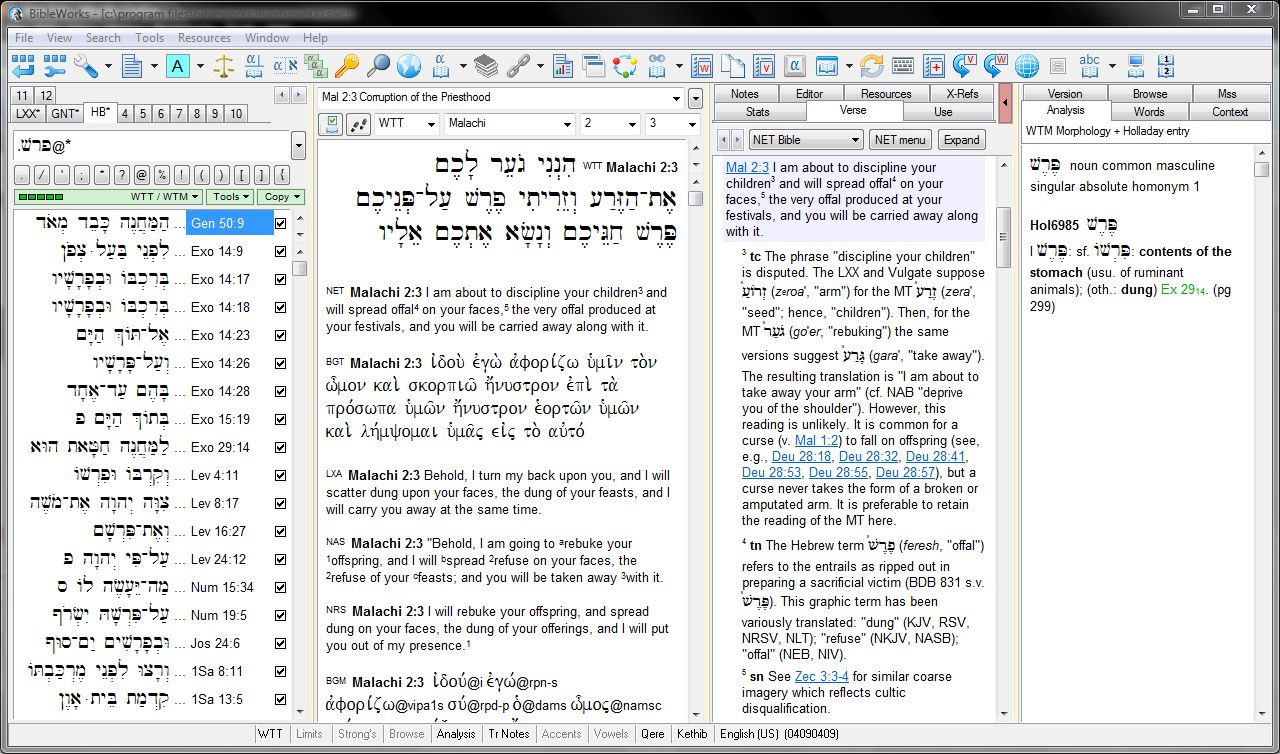
(Editorial note. File this under: can you believe that’s in the Bible? I had somehow never noticed this verse until the other day… thou shalt not trifle with the Lord, especially if you’re a priest or pastor. Take obedience to God seriously.)
Here’s the great thing about the Verse Tab. In previous versions of BibleWorks, the NET Bible study notes were only available via the Analysis Window. But this meant that if the Analysis Window were open to an NET study note, you couldn’t also at the same time easily see morphological analysis and lexical data–it was one or the other in that window. Now, however, as you can see above, you can easily access both study notes and a separate analysis window for individual word analysis. I find this new feature an immense help.
The NET study notes are fantastic. (It’s worth reading more about that translation and its notes here.) Honestly, a verse like the one I’ve chosen to highlight above might be a bit jarring to some–although in context it makes perfect sense. Yahweh was dealing with a corrupt and complacent priesthood. They were not making sacrifices in the way he had commanded (and they knew it, too). So his response in context really ought not to be a surprise. The NET note (see superscript number 4 and “tn” in the image above) clarifies that Yahweh is speaking of the entrails of to-be-sacrificed animals. The priests were supposed to dispose of these away from the sacrificial altar, but apparently were not in Malachi’s time. Bad idea. Clicking on Lev. 4:11 in the BibleWorks Search column (far left column) immediately takes me to the verse that explains this requirement.
One other neat thing about the Verse Tab: if you click on the “Expand” button, you can get a free-floating window that shows you all the NET notes for the whole Bible. This is easy to navigate through, as you can imagine:

I welcome the Verse Tab as an addition to the BibleWorks program. I’ve already made heavy use of it and will continue to in the future. For a mere $20 you can buy a module that gives you the notes and maps from the ESV Study Bible in that same tab. The program comes with the NET Bible notes already loaded.
See all that’s new in BibleWorks 9 here.
I received a free upgrade to BibleWorks 9 in exchange for an unbiased review. See my prolegomenon to a review here and part 1 (setup and layout) here. You can order the full program here or upgrade here. It’s on Amazon, too.
 Some words of wisdom from Gary A. Parrett and S. Steve Kang:
That the formation of God’s people is a legitimate concern of our worship gatherings can be demonstrated by appeal to a number of biblical passages. First of all, worship itself is presented as intrinsically formative–for good or for ill. We read in several Old Testament passages, for example, that those who worship idols are doomed to become like the objects of their worship.
…That which is true in such profoundly negative and destructive ways, however, is also true in the positive. In other words, those who worship the living God will become like the object of their worship. Those who abide in the presence of the Lord, reflecting or contemplating his glory, are “transformed into his likeness with ever-increasing glory, which comes from the Lord, who is the Spirit” (2 Cor 3:18). Worshiping the God who is love, who is holy and righteous and true, we shall ourselves become more loving, holy righteous and true.
–from Teaching the Faith, Forming the Faithful: A Biblical Vision for Education in the Church, pp. 339-340
 One of the great things about WordPress, my blog host, is that it keeps statistics for its users. This includes a running tally of what search terms led to how many pages views on my blog. So, for example, I can find out that yesterday two page views resulted from a search engine search on “reaction about the story of jesus according to luke” (it led here).
The top three sets of search terms that have led people to Words on the Word are “colorado shooting” (goes here and here), “septuagint” (here), and “honest toddler” (any of these).
Some other search terms of note that have led folks to my blog:
No exceedingly bizarre search terms have led folks to WotW. Although “colonize Doug Wilson” (goes here?) might be the strangest so far.
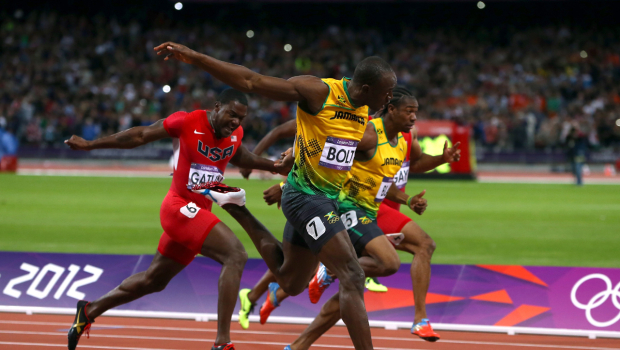
Usain Bolt set an Olympic record in the men’s 100 meter final the other day. (9.63 seconds!)
But did you know that 100 years ago, a sprinter would merely have had to crack 11 seconds to win the 100 meters?
The New York Times has a great graphic/video that shows all 100 meter medalists since 1896 on the same track. As a friend of mine on Facebook said, “I’d be willing to bet this is one of the coolest things you’ll see today.” He’s right. Check it out.

In my top 10 reasons why you need the Septuagint I conclude with the #1 reason being that the Gospel writers record Jesus’ words as occasionally matching the Old Greek of the Hebrew Bible against the Hebrew. This has become a new research interest of mine, and there is no lack of scholarly opinion on the issue! It’s hard to tell if there’s scholarly consensus. The conventional wisdom seems to be that Jesus spoke Aramaic and read from and recited Hebrew scrolls, but that’s certainly not a universal view, from what I can tell. For example, Stanley E. Porter suggests:
… Jesus not only had sufficient linguistic competence to converse with others in Greek but also even to teach in Greek during his ministry.
…I believe that, first, it can be firmly established that Jesus did speak Greek and that we do indeed have some of his actual words.
Porter explores the question “Did Jesus Ever Teach in Greek?” here (pdf). Thanks to the LXX Yahoo! group for the link.
 Here’s a Words on the Word weekend recap. Friday through Sunday at WotW had the following:
Family: “Less ball sports, more boat sports”
Bible: Part 1 of BibleWorks 9 review / The Bible as Narrative… sort of / Damon+Wahlberg in I Heart Maccabees?
Grad School: I guest post about “null curriculum” / The Simpsons on grad students / Thou shalt not plagiarize
Today for Magnificent Monograph Monday I review a book that asks the question: Did God the Father kill God the Son on the cross?
“My God, my God, why have you forsaken me?”
“Never will I leave you; never will I forsake you.”
“I and the Father are one.”
Wondering how these three verses of Scripture fit together? I often have. Cognitive dissonance finally got the better of me, and I decided I should try to think through this one a little more deeply. To that end I read Thomas H. McCall’s Forsaken: The Trinity and the Cross, and Why It Matters (InterVarsity Press, 2012). Here, on Magnificent Monograph Monday, I offer a review of the book. (Thanks to IVP for the free review copy, in exchange for an unbiased review.)
First, the very short summary of my review, if you want to cut to the chase and head off and do something else after this next paragraph.
McCall tackles some difficult questions: “Did God forsake Jesus [on the cross]? Did the Father turn his back on the Son in rage? Was the Trinity ruptured or broken on that day?” His answers and arguments are rooted in Scripture, the history of interpretation of that Scripture, and are consistently compelling. McCall really helped me through my own struggles to grasp some of these questions, leading me to a fuller understanding of the life of the Trinity and the relationship between its persons, particularly in terms of what happened on the cross. And he spells out the implications of his assertions beautifully. God is not divided, he concludes, but God–all of God–is for us. So we can rejoice and rest secure in that. Five stars, no doubt.
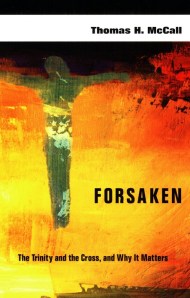 McCall writes “not for other scholars…but for pastors, students and friends–indeed, for anyone genuinely interested in moving toward a deeper understanding of God’s being and actions.” Forsaken is heavy theological lifting for a non-scholar (and not lightweight for a scholar, either), but the effort is well worth it. McCall answers some very common questions people ask (or are scared to ask and should ask) about the Trinity, also showing ramifications for our relationship to God.
Forsaken has four chapters. Each asks a theological question, addresses it, then concludes with some theological assertions to avoid, some to affirm, and why it matters.
The first chapter asks, “Was the Trinity Broken?” Here McCall discusses the theological concept of “dereliction,” or the idea that Jesus was abandoned by God on the cross. Recent theology notwithstanding, McCall makes a strong Scriptural case that God the Father did not forsake the Son on the Cross. Understanding Psalm 22 as an “interpretive key” to Jesus’ death, McCall writes:
No, the only text of Scripture that we can understand to address this question directly, Psalm 22:24, says that the Father did not hide his face from his Son. To the contrary, he has “listened to his cry for help.”
Not only that, the author argues, but if God truly had forsaken Jesus, why would Jesus bother–after his cry–to say, “Father, into your hands I commit my spirit”? Jesus “prefaces his last words with a sense of deep relational intimacy: Jesus addresses his ‘Father.'”
In chapter two McCall asks, “Just what are we to make of the biblical witness to the wrath of God? Is it opposed to his love? Is it a ‘dark side’ to God that is inconsistent with his holiness or with his mercy?” He makes a pretty hard-to-argue-with case that “the biblical witness does not set love and wrath in opposition to one another.” McCall, I thought, was at his best in this chapter when he highlighted multiple New Testament references to wrath–not only the wrath of God generally, but Jesus’ wrath specifically. So there’s no Old Testament God=wrath, New Testament God=mercy conclusion to be drawn from the Bible. The author utilizes the theological categories of divine impassibility and simplicity to show that “wrath” as God exhibits it is not what we might envision in human anger; rather, it is an expression of holy love.
McCall’s third chapter asks whether God’s divine foreknowledge means that God killed Jesus, since he knew it was going to happen, could have stopped it, but didn’t. “God’s plan was to use the death of Jesus for his purposes and for our good,” but God himself did not cause the death. As Acts so often makes clear, McCall points out, “The apostolic proclamation of the gospel places the fault and blame on the sinners who are responsible for the death of Jesus.”
Chapter four articulates a robust theology of justification (forensic; instantaneous; by which I enter into the life of God) and sanctification (separation unto God; progressive; by which I grow in communion with God). Page 145 and following has a brilliant interpretation of Paul’s famous Romans 7:14-25 passage where he (seemingly) wrestles with sin.
One difficult implication of this book for me as a worship leader (and coach of worship leaders) is that, if McCall is right, we may be singing some not-quite-right theology in two well-known songs. “How Deep the Father’s Love for Us” has a line that says, “The Father turns his face away.” And the song “In Christ Alone” says, “…till on that cross, as Jesus died, the wrath of God was satisfied.” McCall addresses these two claims head on and (in my opinion, successfully) refutes them. The Father did not turn his face away (see the block quote above). And to say that God the Son mollified the wrath of God the Father is to bifurcate the Trinity in some unorthodox ways. (!)
I’m not sure if it’s generally accepted for a book reviewer to admit to shedding tears when reading a review copy. (Objectivity! Right?) No matter. McCall’s concluding postscript (“A Personal Theological Testimony”) moved me to tears, as he recounted the difference “the trinitarian gospel” made for him and his family as they processed the death of his father.
Getting the theological details of the Trinity right (as best we can!) matters. It matters for our understanding of God, our relationship with him, and for all of life. In the life and truths of the Trinity–properly understood, and I think McCall a good guide here–there is great comfort. We see a God who, as McCall says, is for us. We find a God who has granted us victory over sin and death, making it possible for us to enter into communion with the triune God of love.
You can find Forsaken here at the IVP product page or on Amazon.


 Words on the Word