Hot Off the LXX Presses: The Text-Critical Use of the Septuagint in Biblical Research (New Edition)

TCLXX_Tov


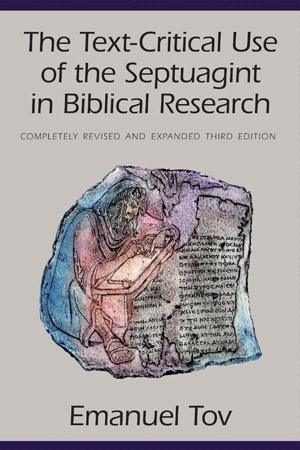
Emanuel Tov’s Text-Critical Use of the Septuagint in Biblical Research is a key text in Septuagint studies. But it’s been out of print… until now. Eisenbrauns has just published a “Completely Revised and Expanded” third edition of the book.

Here’s the publisher’s write-up:

This handbook on the Septuagint (LXX) provides a practical guide for the student and scholar alike in the perusal of that translation in the text-critical analysis of the Hebrew Bible. It does not serve as another theoretical introduction to the LXX, but it provides all the practical background information needed for the integration of the LXX in biblical studies. The LXX remains the most significant source of information for the study of ancient Scripture together with the Masoretic Text and several Qumran scrolls, but this translation is written in Greek and many technical details need to be taken into consideration when using this tool. The author presents this handbook after half a century of study of the Septuagint, four decades of specialized teaching experience in that area, and involvement in several research projects focusing on the relation between the Hebrew and Greek Bibles.

The first two editions of this handbook, published by Simor of Jerusalem (Jerusalem Biblical Studies 3 [1981] and 8 [1997]), received much praise but have been out of print for a considerable period. This, the third, edition presents a completely revised version of the previous editions based on the many developments that took place in the analysis of the Septuagint, the Hebrew Bible and the Qumran Scrolls.

I’d link to the book on Amazon, but you really should just buy directly through Eisenbrauns. They are good folk, make great resources, and have put this book on sale now. Get it here. You can also find a PDF info sheet (with Table of Contents) here.

Ulysses 2.1 for Mac and iPad: Just Released

Ulysses-Mac-1024x1024


Ulysses–writers’ darling when it comes to apps–has just received a significant update to version 2.1.

Some highlights (click the hyperlinked text for more on each):


Writing Goals on iPad (Image Via Ulysses/The Soulmen)


2.1 does not add to iPad the Mac functionality where you can navigate your sheet by headings, so users will have to hope for that in future updates.

All the same, this is a worthy update. If you can live with .docx export replacing .rtf export, Ulysses users will want to update right away.

Find Ulysses for iPad here, for Mac here. I reviewed Ulysses in two parts here and here, where you can see more screenshots and read more about its features.

Ulysses offers a free trial of its Mac version here.

New Wilco (Free Download)

Wilco Star Wars


Wilco unexpectedly released a new album and is giving it away for free. You just have to enter your email address at http://wilcoworld.net/, and you get a download link.

I’m a few songs in and looking forward to listening to more. It’s not as poppy as I thought it might be (the first track is a bit cacophonous), but I expect it may grow on me as I listen to the rest.

Is 2 Samuel 7 About Jesus?

I know–taken from the vantage point of Christian interpretation, it might seem a dumb question. So bear with me. Here is 2 Samuel 7:11b-16:

“Moreover the LORD declares to you that the LORD will make you a house. When your days are fulfilled and you lie down with your ancestors, I will raise up your offspring after you, who shall come forth from your body, and I will establish his kingdom. He shall build a house for my name, and I will establish the throne of his kingdom forever. I will be a father to him, and he shall be a son to me. When he commits iniquity, I will punish him with a rod such as mortals use, with blows inflicted by human beings.

This could all so easily be about Jesus, until you get to: “When he commits iniquity, I will punish him with a rod such as mortals use, with blows inflicted by human beings.”

Even if you want to say God somehow punished Jesus on the cross (uhh…), Christians don’t (generally) believe Jesus committed any iniquity.

So that part, at least, has to be about David’s literal next-of-kin descendant, Solomon.

Verses 15 and 16 go on:

But I will not take my steadfast love from him, as I took it from Saul, whom I put away from before you. Your house and your kingdom shall be made sure forever before me; your throne shall be established forever.

There are at least Messianic undertones to this whole passage, though. Surely God had more than just Solomon in mind when he spoke these words. He is, after all, promising a throne to David forever. Two other things:

1. The lectionary reading stops after v. 14a (!), so you don’t get the stuff about punishment. Is this to intentionally make it read more like it’s about Jesus?

2. The parallel passage in 1 Chronicles 17 also omits the iniquity part… does this mean the Chronicler was taking it to be a Messianic promise (only), too?

What say you, O readers? I’m still mulling this one over.

Free Online Tutorial on Sermon Prep, Thursday at Noon (with Accordance)

Acc 11_Simply Brilliant_logo


I’ll be presenting an online training webinar–Sermon Preparation in Action–tomorrow (Thursday the 16th) at 12 noon (EST) for Accordance Bible Software.

The webinar is free, and you can register here.

Accordance has quite a few other online trainings coming up. Check them all out.

Accordance 11 Collections Are On Sale

Image via www.AccordanceBible.com
Image via http://www.AccordanceBible.com


Accordance is offering a 20% discount on all their Collections:

Get in gear with our Back to School Sale. We are kicking off seven week of savings with a 20% off sale on Accordance Collections. Collections are the best way to build one’s Accordance Library. If you are new to Accordance, you will want to select the Collection that is best suited to your work. If you are a longtime Accordance user, consider upgrading to the next Collection level using Accordance’s new Custom Upgrades.

You can compare what’s available at the chart here.

See also my review of Accordance 11 here. It’s a top-notch program.

Review of Logitech Bluetooth Easy-Switch Keyboard K811

Images in this post via Logitech
Image via Logitech


There is a proliferation of external keyboards for iPads and iPhones. Logitech’s Bluetooth Easy-Switch Keyboard K811 is by far the best.

Here is a short video of the keyboard in action:


This is no foldable, plastic, tag-along keyboard. It looks and feels like something native to an aluminum-body Mac Laptop.

This is what’s great about the keyboard:

  • It’s backlit. You can use it in the dark and make out all of the keys easily.
  • It’s got three keyboard shortcuts for toggling between three Apple devices at a time. So once you’ve paired it with, say, a computer, an iPhone, and an iPad, you can switch between any device the keyboard is paired with… with just one press of a button. You don’t have to pair, un-pair, re-pair, etc.


Logitech K810 Image 2


  • That backlit keyboard? It’s smart. The keyboard has sensors that allow it to adjust the illumination level based on the light in the room. Amazing. (You can also manually adjust the keyboard brightness via its F5 and F6 keys.)
  • The battery life is long. It’s rechargeable via an (included) USB cable. And there’s an on/off switch, of course, so you don’t drain the battery between uses.
  • There’s no lag. The Bluetooth connection is fast, so there’s really no lag between the time you type and see a character on the screen, regardless of the device you’re using.
  • It is a full keyboard. Nothing is missing–the command key, volume up/down keys, the escape key… all here.
  • It’s got “hand proximity detection.” From the product page: “A motion sensor detects your hands as they approach the keyboard and turns the backlight on/off to help you save power when you are not typing.” From what I can tell, this feature also helps to preserve and prolong the battery life.
  • Setup couldn’t have been any simpler. I probably could have figured it out without the manual, but the manual succinctly and clearly explained how to pair with devices.
  • Having easy access to up/down and left-right arrow keys for iPad and iPhone is really cool.

And here is what I really like about the keyboard:

  • If feels better than any other keyboard (portable or otherwise) I’ve typed on. Very smooth, and just the right amount of resistance on the keys.
  • You can use keyboard shortcuts with iPad as easily as you would on a desktop computer. The app Drafts and this Logitech keyboard make for a great combo. I started this blog post in Drafts, for example, and then with a single key stroke had sent the draft to Evernote for backup and future work across devices.
  • This is a little thing, but there is a keyboard key (on the actual keyboard) that lets you toggle your iPad on-screen keyboard on and off. Unlike other external keyboards, you can even have your native iPad on-screen keyboard up at the same time as using this physical one.

As for drawbacks? Nothing significant, that’s for sure. It’s not foldable, so of course it’s less portable than other external keyboards, but that is the (small) price one pays for its durability and full-size feel. I don’t mind that it can’t be folded up. It would be nice if the keyboard came with a carrying case or simple sleeve, though–you’ll have to figure that one out on your own.

The keyboard isn’t inexpensive, but it’s the best external keyboard on the market, easily. Find out more at the product page here, or via Amazon here.


Thanks to Logitech for the product review sample, given to me for purposes of review, but with no expectations or influence on the review’s content.

How Can the Ark of the LORD Ever Come to Me?


I. “How can the ark of the LORD ever come to me?”


David, now King over all Israel in 2 Samuel 6, asks a poignant question, “How can the ark of the LORD ever come to me?” (6:9) “How can the ark of the LORD ever come to me?”

The ark of the covenant was the adorned chest in the tabernacle that symbolized the presence of God. It went with and settled among God’s people wherever they wandered. It contained the two tablets with the 10 commandments, a jar of manna—representing God’s provision in the wilderness, and Aaron’s rod—a sign of the authority and sovereignty of God to make for himself a people of his own.

There’s a weightiness in David’s question: “How can the ark of the LORD ever come to me?” There’s a sincerity to it, a desire in David’s heart to truly commune with God. But there’s also fear and frustration. The verse before says, “Then David was angry because the LORD’s wrath had broken out against Uzzah…” (6:8).


II. A God of David’s Own Choosing?


We’re still in the part of 2 Samuel that narrates David’s rise to power, and his initial establishment of his kingdom. Most outlines of 2 Samuel have this chapter in the “successes” part of the David story. His moral failings and infidelity–to God and others–really start with the Bathsheba account.

There’s some truth to that. But already here, while David is still setting up shop as King, the complexity of his spiritual life begins to emerge. Sometimes he is inspiringly faithful, sometimes he’s not-so-faithful. No wonder so many have so deeply resonated with this historical character.


A. Faithful David


Let’s trace a portion of this narrative account to look at both David’s faithfulness to God, as well as ways in which he was already “prone to wander, prone to leave the God [he loved]”… just like we are. Let’s look first at the faithfulness of David.

1. David Practiced God’s Presence (5:10)

First, we saw last week that the key to David’s ability to lead, even before he was King, was his practice of the presence of God. 2 Samuel 5:10 says, “And he became more and more powerful, because the LORD God Almighty was with him.” David was rooted and grounded in the presence of God. Out of the assurance that God was with him, David led faithfully.

2. David Attributed His Success to God (5:12, 20)

Second, David attributed his success to God. 2 Samuel 5:12 says, “And David knew that the LORD had established him as king over Israel and had exalted his kingdom for the sake of his people Israel.” David knew that “every good and perfect gift comes from above,” as the New Testament says. And in verse 20, David says it is the LORD who has defeated his enemies.

He did not take credit for his own military success, or leadership effectiveness. He knew that it was God’s doing.

3. David “Inquired of the LORD” (5:19, 23)

A third way we see David’s faithfulness so far is in 2 Sam 5:19, 23. Both of these verses, before David makes a major decision, have the phrase, “[S]o David inquired of the LORD.” “[S]o David inquired of the LORD.”

Having sought the presence of God, having affirmed that his success was from God, he continued to regularly inquire of the LORD. And it doesn’t stretch the imagination too much to assume there are even other decisions and situations not described here where David inquired of the LORD some more.

4. David Got Rid of Philistine Idols (5:21)

Here is another sign of David’s obedience to God: chapter 5, verse 21 says, “The Philistines abandoned their idols there, and David and his men carried them off.” We have trouble with some of the militarism of the Old Testament, but perhaps it helps, at least a little, to realize that this was as much as anything, a sort of war of gods… a contest as to which god is really able to save a people.

Some of God’s people get in trouble in other passages for defeating an enemy, but then failing to destroy their idols. David does right here, and carries them off… completely removes them from the scene to physically show—there is no God but Yahweh. God is the best god out of all the gods, or, so-called gods. David removed the idols that others set up against the LORD God Almighty.

5. David Did What God Commanded (5:25)

And then, check out verse 25 of chapter 5: “So David did as the LORD commanded him, and he struck down the Philistines all the way from Gibeon to Gezer.” Again—we struggle with this “struck down” language, especially when we consider the value of every human life. But the Philistines are cast here as an oppressive people who want nothing more than to destroy a chosen people, worshiping gods who cannot save and who bring not life but death. David “did as the LORD commanded him” and went up against even Israel’s terrifying oppressors.

6. Praises Wholeheartedly; Leads Others in Same (6:5)

Finally, coming to our reading today, chapter 6, we see a portrait of a David as Spirit-filled worship leader. 2 Samuel 6:5 reads, ”David and the whole house of Israel were celebrating with all their might before the LORD, with songs and with harps, lyres, tambourines, sistrums [a kind of hand-held shaker] and cymbals.”

Israel celebrates the defeat of their oppressors, and especially rejoices in the presence of God, moving alongside them, symbolized by the ark of the covenant. They went all out in praising God.


B. Not-So-Faithful David


But a picture of a not-so-faithful David also starts to come into view in chapters 5 and 6.

1. David “Took” More Women (5:13)

2 Samuel 5:13 says, “After he left Hebron, David took more concubines and wives in Jerusalem, and more sons and daughters were born to him.”

Deuteronomy had already said rulers were not to multiply wives for themselves. And we know that David would eventually kill a man to cover up his adultery with the man’s wife, later on. This would lead to severe consequences for him and his family, and would prove a major breach of his relationship with God. One of David’s moral flaws is already visible.

2. David Did Not (Always) “Inquire of the LORD” (6:1)

Second, and you can see this in your outline, too: David did not always inquire of the LORD. You remember that in 2 Samuel 5:19 and 23, it said, “so David inquired of the LORD.”

As this new chapter, chapter 6 begins, the attentive listener or reader may notice that that little formula (“so David inquired of the LORD”) is not here. Like in those two instances, here David was gathering people for a major task—this time the moving of the ark. This time, however, he does not inquire of the LORD, at least as far as we can tell.

3. David Put the Ark on A New Cart (6:3-4)

A third instance of David’s being not-so-faithful comes in chapter 6, verses 3 and 4. Look at those verses:

They set the ark of God on a new cart and brought it from the house of Abinadab, which was on the hill. Uzzah and Ahio, sons of Abinadab, were guiding the new cart with the ark of God on it, and Ahio was walking in front of it.

What could be better than a sweet new ride for the sacred ark of the covenant? Well… a better question is: did the ark of God, the ark of the covenant need a new cart? No. It didn’t.

It had been in the house of Abinadab, after it had zapped some other irreverent Philistines who didn’t take it seriously. David didn’t inquire of the LORD before bringing the ark to Jerusalem, but moving the ark to Jerusalem itself seems to be okay. He’s bringing it to the city from which he will rule, as if to show that it is really God who is king.

However…the ark had rings and places for horizontal-running poles that were to be used to carry it. David, for whatever reason, is ignoring that instruction.

Had it been carried by its poles and not balanced on a cart, Uzzah probably wouldn’t have needed to reach for it, because it would have been more stable and likely wouldn’t have fallen in the first place.        (HT: this commentary)

Not only that, but Uzzah does not appear to have been a Levite. He was not from the clan that God had commanded to be the ones to oversee the ark. So he was the wrong guy, carrying the ark the wrong way, and then he was at the wrong place at the wrong time.

Maybe his intentions were good, but so holy is this ark, says God, which symbolizes my presence, that you are not supposed to even touch it. Uzzah’s demise all begins with David’s carelessness in overseeing the transportation of the ark in the first place. David and company were not taking God totally seriously.

As king, as spiritual leader of Israel, David is in an ultimate sense responsible for this whole debacle.

4. Wants the Ark (Presence) Only for its Blessing? (6:10-11)

This event leads to the fourth and probably the biggest way in which we see David as a deeply flawed hero. Look at verses 10 and 11:

He was not willing to take the ark of the LORD to be with him in the City of David. Instead, he took it aside to the house of Obed-edom the Gittite. The ark of the LORD remained in the house of Obed-edom the Gittite for three months, and the LORD blessed him and his entire household.

David now does not want anything to do with the ark, because he is afraid, but also because he is angry at God. He’s angry that Uzzah is struck down, but I wonder, too, if he’s angry that he got called out for trying to control God. One commentator says, “The ark would become central to Israel’s worship, but David needed to learn that it was not his to control.” He’s learned this lesson, but he’s learned it the hard way, so he sends the ark away.

Once it blesses the house to which it was banished, David wants it back after all!


III. A Fundamental Choice: 
Welcoming God’s Presence on God’s Own Terms


David, I think, realizes the folly of his ways. Now he dances in a priest’s robe, worshiping God with all his might. And verse 13 tells us that just six steps in to their Take 2 of moving the ark, they offer sacrifices to God. Now David seems to realize the utter care with which he must transport the sacred ark of the covenant, that symbol of God’s history and presence with Israel… a sign of God’s love and provision, but also his holiness that no human could ever attain to.

As I sit with this text and work with it and try to let it work on me, I keep hearing David’s haunting question in chapter 6, verse 9: “How can the ark of the LORD ever come to me?”

And I ask, “How can the presence of the LORD ever come to me?”

The answer, or at least the answer that this passage gives, is: on its own terms.  God comes to us as God comes to us, not how we wish God would come to us. God comes to us when God comes to us, now when we wish God would come to us. God comes to us, fully under his own control, not in manifestations that we can control or completely delineate, or fully understand. God will not be confined by the parameters we seek to impose.

Like David, we have a fundamental choice to make—it’s a choice which arrives many times a day, actually: will we welcome God’s presence on God’s own terms? Can the ark of the LORD, the presence of God, ever come to us? Will we welcome God’s presence when it appears as a challenge, as a rebuke, as a perplexing state of affairs over which God is somehow supposed to be superintending? Or, will we receive God when he shows mercy to the ones we wish would suffer the fate of Uzzah?

Tim Keller, a Gordon-Conwell grad and pastor in New York, says, “If your god never disagrees with you, you might just be worshiping an idealized version of yourself.”

It is precisely David’s initial comfort with accepting God on David’s terms that will lead to even more trouble. And who of us cannot point to a time when we had God wrong, or realized that—either intentionally or not—we were worshiping an idealized version of ourselves? Or following just a God of our own understanding or, worse, a God of our own choosing?

Yet even after David fouls this up, chapter 7, which we’ll read next week—is one of the most beautiful and important scenes in all of Scripture. God reiterates his covenant with David and promises him a throne that will last forever–being fulfilled at last in the Kingship of Jesus.

While it is gravely important that we seek through the power of the Holy Spirit to be faithful to God—while that is a most serious undertaking, we do not, we have not, we cannot, and we will not consistently get it right. We connect so well with David not because of his military exploits or womanizing or deceitful and murderous impulse (did I miss anything?), but we connect with him because we see in him a heart like ours… a heart which at its core may be very much trained on God, but is so “prone to wander,” prone to walk off, “prone to leave the God [we] love” that we sometimes wonder if we will ever be able to find our way back to him.

Good thing being at peace with God does not depend on our choosing God always, but on God’s having chosen us. Our salvation, the letter to Titus proclaims, is “not because of righteous things we had done, but because of [God our Savior’s] mercy.”

So even when we spend more time on the not-so-faithful side of the spectrum, it is not our actions or consistency in faithfulness that actually redeems us. It is God who chooses, God who saves, and God who has mercy. On that basis we are called his own dearly-loved children, just as God would promise to be like a father to David and his family for all time.

“How can the presence [of God] ever come to us?” Only on God’s own terms, terms which include holiness and a call to lifelong obedience… and terms which also include great mercy and never-ending love, and a relentless drive to continue to pursue us. God will yet make his home among us as sovereign LORD and King.

May God give us strength, courage, faithfulness, and the openness we need to welcome God’s own presence exactly as it comes to us.


The above is adapted from the sermon I preached today at church.

Caspian: Live at the Larcom

Caspian
Image via band Website


Last night I went to a screening of Caspian’s Live at the Larcom concert film. Here’s a short write-up from the hosting venue (The Cabot):

Live at the Larcom is a 2-hour concert film chronicling CASPIAN’s momentous 10-year anniversary performance on October 18, 2014 at the Larcom Theatre in Beverly, MA. Performed in chronological order spanning all 4 of their studio albums, the set features both well known and rarely played songs by the band, captured in sweepingly atmospheric, reverent fashion by director Ryan Mackfall (Mastodon, Defeater) of Crashburn Media from London, UK.

The sound was amazing, the lights perfect, and the music and performance were incredibly moving. (And the Cabot Theater is itself lovely.) Caspian does both heavy and beautiful well, and often both at the same time. Their dynamic range is truly impressive. I’ve never seen them live, but when I closed my eyes at this film screening, I could easily imagine myself in the room with them.

Here’s the trailer (you’ll have to click through if you’re reading this post via email or other feed):


Here’s the set list:

1.) Cigarette
2.) Quovis / Further Up / Further In
3.) Moksha
4.) The Dove / ASA
5.) Ghost of The Garden City
6.) Malacoda
7.) Concrescence
8.) Sycamore
9.) Gone In Bloom and Bough
10.) Halls of The Summer
11.) Fire Made Flesh
12.) Hymn For The Greatest Generation

Check out “Gone in Bloom and Bough” (yes, it’s 10 minutes–all of it awesome):


Find Live at the Larcom available for purchase here on Blu-Ray and here as a digital download.

My First Time Using Mind Mapping

Some folks swear by mind mapping, a way to get ideas down on paper and visually display their interconnections beyond what just a text editing file can do.

I haven’t found it as easy a medium, but this last week I tried mind mapping my sermon outline before writing out the manuscript, and found the process really helpful. I used the app MindNode to do it, which I review today.


A Simple Mind Map of The Fifth Discipline


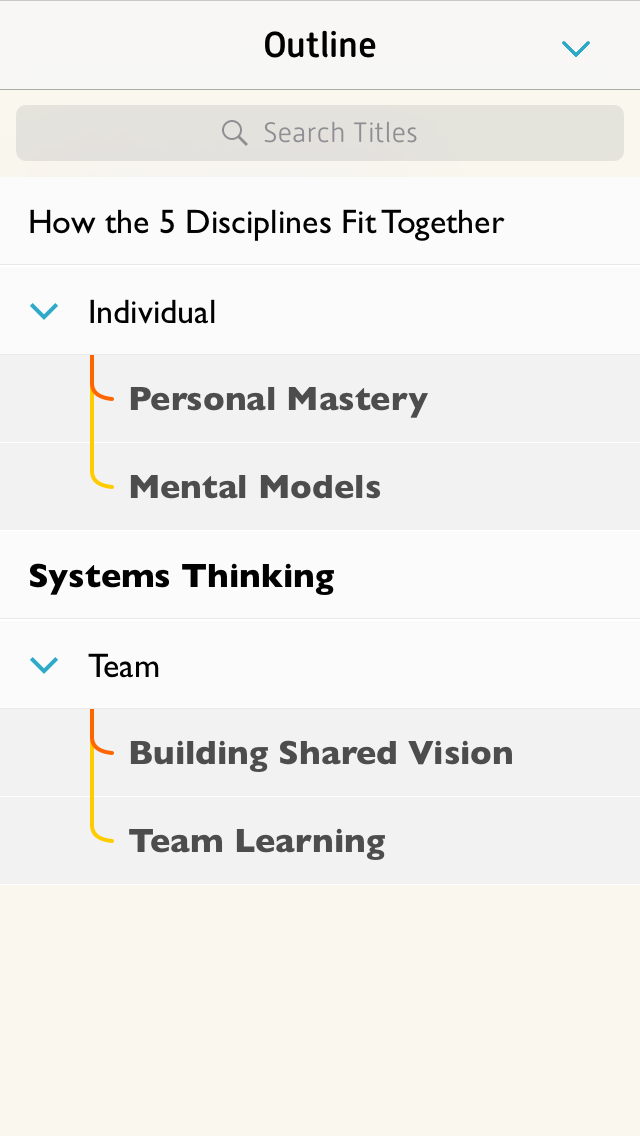
Here’s a simple mind map for understanding Peter Senge’s five disciplines in The Fifth Discipline:


5 Disciplines on an iPhone


What’s really cool is what you can do with this mind map in MindNode (iOS) once you have it. You can see a text-based outline, which can expand or collapse levels:


iOS Mind Map Outline


And you can export to MyMindNode, where you can view and publish your map on the Web:


Upload to MyMindNode 2


You can then share the link to your mind map


I was hoping to embed the above mind map right here in this post, but WordPress.com does not support plug-ins or a good deal of third-party embeds (dah!), so I simply can give you this hyperlink to see what it looks like.


More Complex Mind Mapping


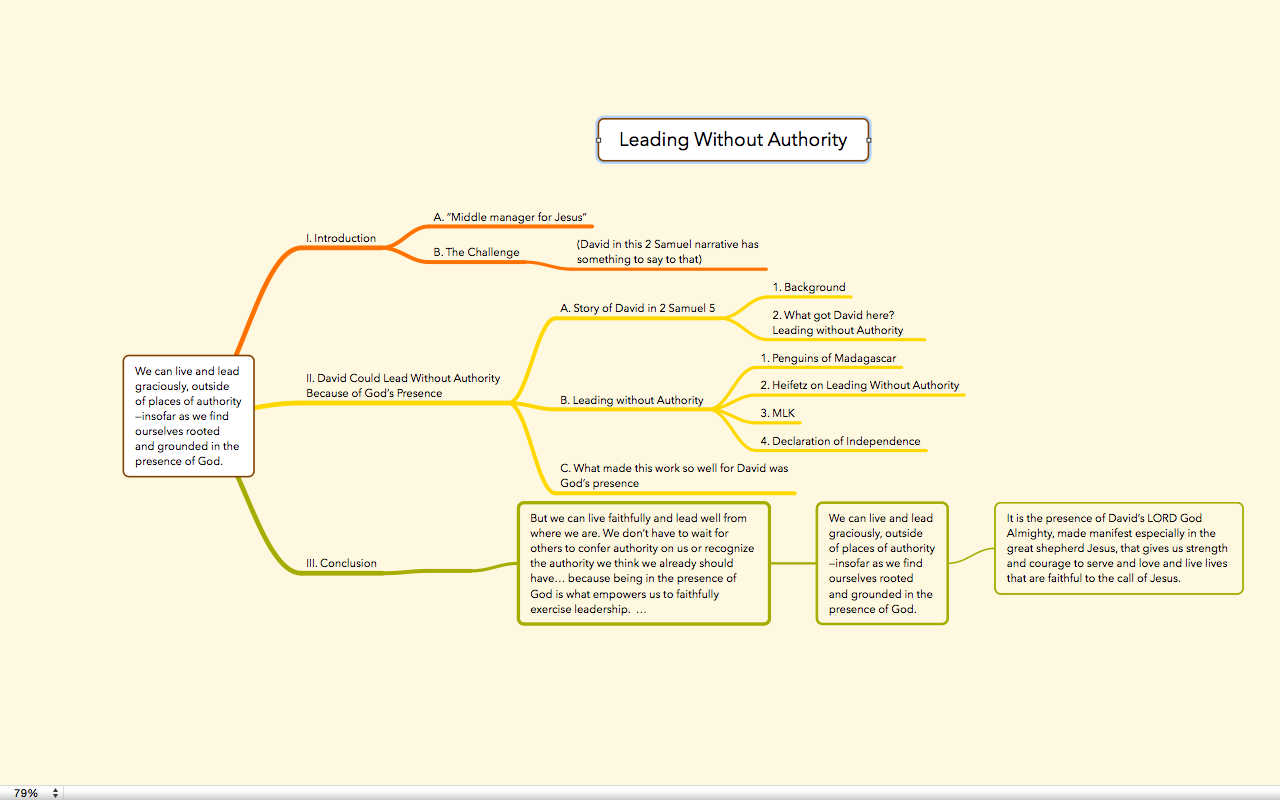
I used MindNode to map out my sermon outline this last Sunday. When I was done it looked like this:


ScreenShot from OSX app MindNode Pro (click to enlarge)


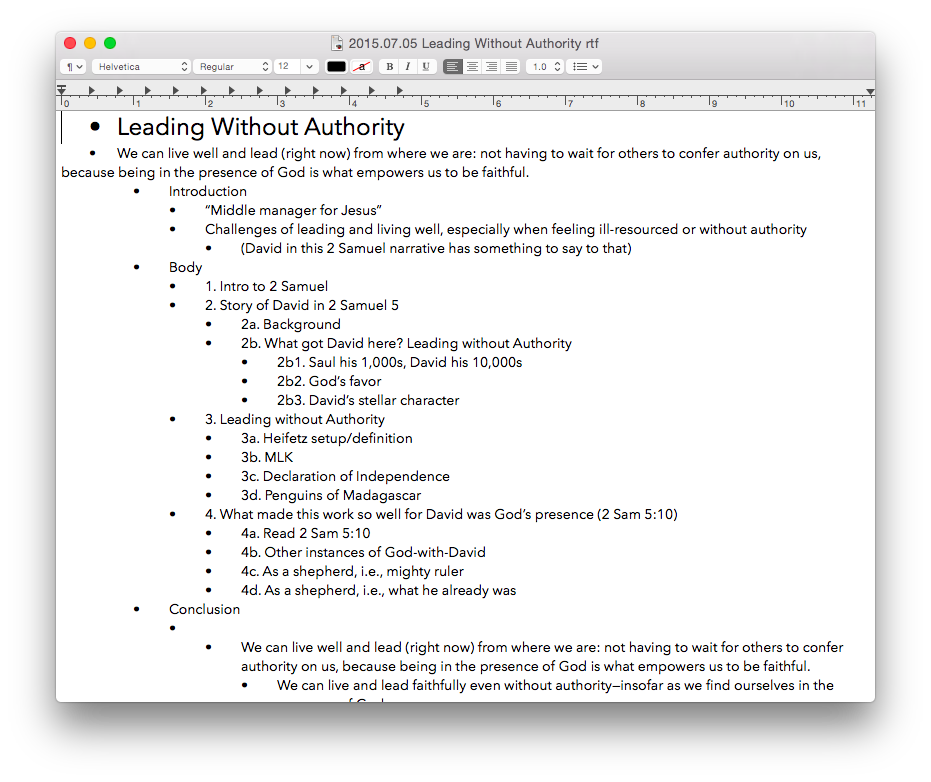
And then I thought: oops. How I am going to get this into Scrivener without re-typing everything? At first I just dragged a .png image file into Scrivener so I could see the mind map as I worked on next steps. Then I realized I could actually export it not only as a PDF or image, but as a text file. (!!)

It looked like this:


Export to text


…which was sweet, because then I could just copy and paste to Scrivener and write my manuscript into my outline, started in MindNode.

By the time I was done writing the manuscript, I’d pared down the outline a bit. Editing in MindNode was easy, so that the final map looked like this:


Final Sermon MindMap


Nodes, Parents, Siblings, Etc.: All Easy to Use


There’s a lot more to mind mapping, not the least of which is learning some terminology (nodes, parents, siblings, children, etc.). The best place to start is the MindNode Web page here. The iOS User Guide is also a great way to get to know the app; that is here.

MindNode offers iCloud and Dropbox support. iCloud has its issues (sync hanging), but MindNode has the best and most succinct troubleshooting guide I’ve seen.

Styles, fonts, and colors are all customizable. And it seems a rare treat for a writing app to exist (and be well-designed and executed) on iPhone, iPad, and Mac. Of course, for a large mind map one will probably choose Mac (or iPad) over iPhone, but moving between devices is easy. There is no Apple device on which you cannot access and edit your mind map. There’s even an accompanying Apple Watch app.

There are some other really nice touches, too, like being able to “fold and unfold” nodes, the equivalent to expand/collapse in a table of contents, for example. You can hide all of a nodes’ children if you need to clear up some screen real estate, and just as easily unhide them. You can also add notes to a node for storing even more information without having to display it.

Perhaps the best thing about MindNode is how easy it was for me to make both of the above mind maps before reading any of the support material. Moving nodes, connecting them, disconnecting them, changing fonts, dragging things around, exporting, and more… all of this was really intuitive and easy to come by both on OSX and iOS.

So… I’ll keep trying mind mapping for the outlining stage of writing. MindNode has much more still to uncover, and I’m looking forward to future use. A brilliantly executed app.


Thanks to the good people of IdeasonCanvas, for giving me a download of MindNode for iOS and OSX for the review. Check out the app’s iOS page here and the Mac app (MindNode Pro) here. Note that MindNode Pro for OSX has now been updated to MindNode2. See my other AppTastic Tuesday reviews here.