Scrivener, Nisus Writer Pro, DEVONThink Pro and Others: 25% Off SummerFest

SummerFest Sale


Some really sweet writing tools are on sale at 25% off:

It’s a midsummer night’s dream: seven great artisanal tools for writers and thinkers, ready for your summer work, each at a terrific price. It’s SummerFest: our annual summer celebration of hand-crafted software.

It’s the time for new plans and fresh projects and great new ideas. Whether you’re mapping out your next novel, finishing your dissertation, planning a product, or writing memories for your grandkids, we think these great tools will help.

I have made some use of Bookends and DEVONThink Pro (stay tuned to the blog for more on those). They are both well-designed, time-saving apps.

Scrivener and Nisus Writer Pro are two of my favorite, most-used apps. I rave about Scrivener here and here, and compare the unexpected awesomeness of Nisus Writer Pro to the 2014 Kansas City Royals here.

All those apps and more can be had at discount. Here is the link you want. It’s not a bundle–you can just check out whichever app(s) you like… and can also avail yourself to free trial options. SUMMERFEST2015 is the code.

Happy writing!

2Do Task Management App: Free This Week in App Store

2do-128The exquisitely designed 2Do app is Apple’s App of the Week in the iOS App Store. It’s usually $15 but is now free. The accompanying Mac app is 50% off, too.

I’ve reviewed Things and OmniFocus, and will soon review 2Do.

For now I can simply say: this is one of the most robust and beautifully designed apps I’ve seen on iPhone or iPad. The developers have–with their imagination and execution–far exceeded what one sees in a typical iOS app.

Read all about the iOS features here. Download it free (for a few more days) here.

And Now… Bonhoeffer *Reader’s Editions*

Bonhoeffer Reader's Editions
Super-sweet image via Fortress Press (click to enlarge)


Big news for Bonhoeffer aficionados/as: Fortress Press, publishers of the 17-volume Dietrich Bonhoeffer Works (English edition), has just announced the Fall 2015 publication of Reader’s Edition volumes of DiscipleshipLife TogetherEthics, and Letters and Papers from Prison.

I haven’t seen a ton of information yet, but here’s the publisher’s description:

Featuring the acclaimed DBWE translation and adapted for a more accessible format, the new Reader’s Edition volumes include supplemental material from DBWE general editor, Victoria J. Barnett, as well as insightful introductions by Bonhoeffer scholars which clarify the theological meaning and importance of his work.

New to Bonhoeffer? I collected some reflections on his writings after spending much of one Lent reading him. All my Bonhoeffer posts are gathered here. I reviewed the amazing Life Together and Prayerbook of the Bible (DBWE 5) here.

It’s hard to imagine how the editors of the DBWE set could offer anything to improve upon those exceptional volumes, but I do like the idea of a more accessible, annotated Bonhoeffer. Check it all out here.

Va-yikra’: A JPS Companion for Reading Leviticus

I think I am actually on pace to finish my Bible-in-a-Year reading plan in two years–but, as I’ve said before, as much as I value getting a good overview of all of Scripture in a short time, it’s so deep and rich (and sometimes surprising and/or befuddling) that I keep wanting to go slow. This is not, of course, a bad thing. The reading plan can wait.
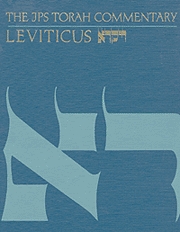
JPS Torah LeviticusThe JPS Torah Commentary has been my go-to companion for reading through the first five books of the Bible. I’m three volumes in, and each one has been excellent. See what I say about the Genesis volume here, and the Exodus volume here and here. Now I’ve found myself similarly aided by Baruch A. Levine’s JPS Torah Commentary: Leviticus as I’ve made my way through that dense book of the Bible.

Levine’s commentary is more difficult to sit down and read through than Nahum Sarna’s Genesis or Exodus volumes, but this is less because of Levine and more because Leviticus does not have the same narrative flow of Genesis and Exodus. Its descriptions of laws and rituals are difficult for the uninitiated (um… and for the initiated) to wade through. It’s dense.

But Levine matches the density of the text with detail of his own, drawing also on rabbinical traditions to help the reader understand the world of the text. Levine addresses historical background and theology, as well as exegetical detail at the word level. But even his detailed exegesis highlights the larger literary context, so you can see the interrelations of Scripture as you read this commentary.

Allow me to share a specific example.

Here is the Hebrew text (nicely included in this commentary) of the admittedly harsh-sounding Leviticus 26:21:
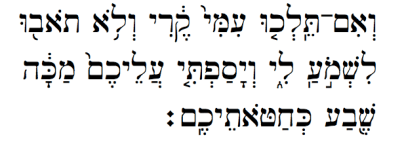
 

Hebrew text of Leviticus


Here’s the verse in the Jewish Publication Society’s New JPS translation–also included in this edition:

And if you remain hostile toward Me and refuse to obey Me, I will go on smiting you sevenfold for your sins.

Levine’s comment for the verse focuses on the phrase, “And if you remain hostile toward Me.” Note how he balances lexical analysis with both extrabiblical and biblical references (the Hebrew in the commentary is transliterated throughout):


Here, again, is a transition, where the conditions for God’s forgiveness are stated.

Hebrew keri, “hostility,” and the idiom halakh ʿim. . . be-keri, “to walk with. . . in hostility,” are unique to this chapter. Targum Onkelos translates be-kashyu, “with hardness, obstinacy,” deriving keri from the root k-r-r, “to be cold.” Compare the noun form karah, “cold wave,” in Nahum 3:17, and mekerah, “cool chamber,” in Judges 3:24. The reverse of “walking in hostility” is “agreeing to obey” (ʾavah li-shmoʿa) suggesting that keri is synonymous with meri, “rebelliousness.” Note the contrast in Isaiah 1:19–20: “If, then, you agree and give heed, / You will eat the good things of the earth; / But if you refuse and disobey (u-meritem), / You will be devoured by the sword.” The notion of meri as “rebelliousness” is a major theme in the prophecies of Ezekiel, but the term keri occurs nowhere else in the Bible; hence its meaning remains uncertain.


There is one other portion I need to quote at length, since it comes in Levine’s opening explanation of the sacrificial system in Leviticus 1. Maybe I’m obtuse or just not familiar enough with Leviticus, but I had somehow missed until now that one could not sacrifice to expiate for intentional sins:

It should be emphasized here, as the workings of the sacrificial system are introduced to the reader, that the laws of the Torah did not permit Israelites to expiate intentional or premeditated offenses by means of sacrifice. There was no vicarious, ritual remedy—substitution of one’s property or wealth—for such violations, whether they were perpetrated against other individuals or against God Himself. In those cases, the law dealt directly with the offender, imposing real punishments and acting to prevent recurrences. The entire expiatory system ordained in the Torah must be understood in this light. Ritual expiation was restricted to situations where a reasonable doubt existed as to the willfulness of the offense. Even then, restitution was always required where loss or injury to another person had occurred. The mistaken notion that ritual worship could atone for criminality or intentional religious desecration was persistently attacked by the prophets of Israel, who considered it a major threat to the entire covenantal relationship between Israel and God.

Is this why David in Psalm 51 says,” For you have no delight in sacrifice; if I were to give a burnt offering, you would not be pleased”?

Levine comes back to this theme as Leviticus introduces the various offering types. He also explains the difference between sin and impurity, in a way that is really helpful for more fully engaging Leviticus.

The Introduction is some 30 pages, addressing both “The Leviticus Text” (which summarizes the book, highlights its structure, discusses its formation, and compares early versions) and “The Context” (Levine spells out how this commentary supports “the realism of Leviticus”). The 11 Excursuses (spanning some 40 pages) are utterly fascinating, covering topics like dietary laws, the scapegoat ritual, the festivals, and more.

All that is already more than enough to help the reader or teacher in her/his quest to better enter the world of Leviticus. But then the icing on the cake is the section called, “Leviticus in the Ongoing Jewish Tradition.” Here Levine hopes that “the reader of the Commentary may catch a glimpse of continuity and change and focus attention on the lasting relevance of Leviticus.”

And here’s some icing to go on that other icing: the binding is sewn and the book is beautifully bound. I’m quite sure I’ll be returning to this commentary again, but first–I’ve got more of the Torah to read through.


Tolle, lege.


Many thanks to the folks at University of Nebraska Press/Jewish Publication Society for sending me a copy of the commentary for review. The book’s JPS product page is here; you can order it through Nebraska Press here. Find it on Amazon here.

Prefer an electronic edition? Accordance has the JPS Torah Commentary here.

Parenting Pro Tip: Vegetables are “Power Food”

"Tomato je" by Softeis - Own work. Licensed under CC BY-SA 3.0 via Wikimedia Commons
“Tomato je” by Softeis – Own work. Licensed under CC BY-SA 3.0 via Wikimedia Commons


If AC/DC was too much for you, here’s another small victory in parenting in the K-J house recently: we now call vegetables “power food.” (I.e., they make you more powerful, which of course is totally true.)

Not only that, but “power food” goes on the plate first, and the kids sit down to eat it before they eat the rest of the meal. An appetizer of sorts.

So far this lovely idea my wife had has been working like a charm. (Finally! They eat their veggies… mostly.) I raise my carrot stick to her in appreciation and celebration.

Hearing the Message of Scripture: A Fantastic (the Best?) Commentary on Jonah

HMS Jonah


When I preached through Jonah last Advent, I knew the JPS Commentary on Jonah would be helpful. What I wasn’t expecting was how often I would eagerly turn to Kevin J. Youngblood’s new Jonah volume in the recently begun Hearing the Message of Scripture commentary series. It might be the best commentary (in this reviewer’s humble opinion) written on Jonah.


Format of the Commentary


Each passage of Jonah includes the following sections:

  1. Main Idea of the Passage–a short, couple-sentence overview, where Youngblood helps you get oriented to the text.
  2. Literary Context–The author shows how the passage under consideration ties in with the rest of the book.
  3. Translation and Outline–the author’s original translation and visual layout of the biblical text.
  4. Structure and Literary Form–this looks at literary features and the rhetorical aims of Jonah. This section is especially strong.
  5. Explanation of the Text–the primary section of each passage, comprising the verse-by-verse commentary proper.
  6. Canonical and Practical Significance–though Youngblood is plenty practical throughout, this section is especially helpful for preachers, teachers, or any Bible reader wanting to know how to apply the message of the text.

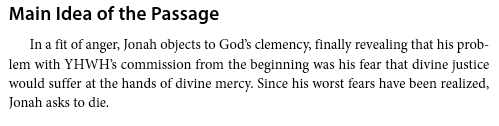
For example, here is Youngblood on the main idea of Jonah 4:1-4:


HMS Jonah 4 Main Idea


He then situates the passage in its larger context:


HMS Jonah 4


From there he relates Jonah 4:1-4 to the patterns of the rest of the book (“Every encounter with Gentiles brings Jonah to a crisis point”), surmises why Jonah wants to die (“Jonah cannot see how YHWH could simultaneously maintain his covenant faithfulness to Israel and grant clemency to Nineveh”), explains the text in detail, and then relates it to Moses and the other prophets and their interactions with “the nations.”


Youngblood’s Insights Make the Text Come Even More Alive


Youngblood makes the literary features of the text come alive. Regarding Jonah’s short stint in the belly of a fish, Youngblood writes:

The fish, however, functions as a means of deliverance and transportation from the murky depths back to the orderly realm of dry land. In this respect, the fish is the antithesis of the ship, which carried Jonah from the orderly realm of dry land out to the chaotic deadly sea.

Correspondingly, Jonah’s disposition and activity in the fish is the antithesis of his disposition and activity on the ship. Whereas Jonah pays out of his own pocket for passage on the ship, the journey in the fish back to land and life is free, courtesy of YHWH.

He continues to unpack the “important contrast” between ship and fish to help the readers with “the peak episode of the book’s first main section.”

This sort of analysis and clear explanation is emblematic of what the reader will find in every section of the book.


Final Evaluation: Easily a Top 3 Jonah Commentary


And what’s not to love about the first paragraph of the Introduction mentioning a Bruce Springsteen song? Here it is, by the way:


To write a nearly 200-page commentary with a 20-page introduction on a 4-chapter book of the Bible is no small feat; and none of what’s here is fluff. Youngblood notes in his introduction: “An understanding of three overlapping contexts–canonical, historical, and literary–is critical to the book’s interpretation.” He helps the reader attain ample understanding of those contexts and more.

Youngblood says only that this volume “strives to advance the discussion regarding Jonah’s message.” I think it does far more. This is easily a top 3 Jonah commentary–maybe even the best one I’ve used.

You can read a .pdf sample of the commentary here. See also my review of Obadiah in the same series.


I am grateful to Zondervan for the gratis review copy of this commentary, which was offered for an unbiased review. You can find the book on Amazon here. The Zondervan product page is here.

Parenting Pro Tip: Use AC/DC to Help With Brushing Teeth

AC_DC logo


Here’s a free parenting pro tip: sing the chorus of AC/DC’s Thunderstruck antiphonally with your child to help them keep their mouth open. Then you can brush their teeth and gums the way the dentist tells you to.

You say: “Thunder!”

Your child responds: “Ah-ah-ah-ahhhh-ah-ah!”

You say: “Thunder!”

Your child responds: “Ah-ah-ah-ahhhh-ah-ah!”

Repeat ad infinitum, or until your child’s teeth are clean.

It’s been working like a charm here in the K-J house all week. Here’s the song if you need a refresher.


Galileans at Pentecost

"Pentecost," by Jan Joest van Kalkar (1505 – 1508)
“Pentecost,” by Jan Joest van Kalkar (1505 – 1508)


Pentecosts reminds us that God pours out the Holy Spirit on any and all persons who would receive… and he uses unexpected persons as his conduits!

The use of “Galileans” to help usher in the era of the Spirit is also a sort of breaking of barriers. It shows that when God chooses to do something marvelous, he does not necessarily wait till a person high in earthly esteem comes along. He does use such people, of course, as we see with God’s using Paul. But he is not limited to them.

The key to usefulness is the fullness of the Spirit, and the Spirit can bring life to anyone he chooses, provided that he or she is open to this enlivening.

(Ajith Fernando, Acts: The NIV Application Commentary)

Image above via Global Christian Worship.

After Luke and Acts: Part 3 of Luke’s Trilogy

As I’ve been working on the Book of Acts for my last few sermons, Acts has been working right back on me. I’m still thinking about my encounter with the Ethiopian eunuch. This last week, as the lectionary moved from Acts 8 and Acts 10 back to Acts 1 (for the Sunday after Ascension Day), I found myself thinking in terms of Acts 1:8 as a prequel for what had been happening so far.

Just before he ascends, Jesus tells the disciples to wait for the promised gift of the Holy Spirit.

He says:

But you will receive power when the Holy Spirit comes on you; and you will be my witnesses in Jerusalem, and in all Judea and Samaria, and to the ends of the earth.

They had wanted to know when the kingdom would be restored, but Jesus points them to a different when: the when of the Holy Spirit.

One implication of Jesus’ response, I think, is that we don’t have to know when or have life’s tensions resolved to be a witness right now to what we have seen in Jesus.

We don’t have to understand all the ins and outs of the kingdom of God–we may even think of its consummation as being a loooong ways away–to be able to make a contribution to it today, through the power of the Holy Spirit.

There’s an African proverb that says, “That which is good is never finished.”

The Book of Acts is like this. It’s not finished. If Acts 1 serves as a prequel for the whole narrative, Acts’s sequel is being written by men, women, boys, and girls who make up the church today.

The Story Luke TellsJusto Gonzalez comes at this another way in his excellent new book,The Story Luke Tells: Luke’s Unique Witness to the Gospel (Eerdmans, 2015).

He points out that Luke’s story in Luke-Acts doesn’t really end: “Paul has suffered countless vicissitudes. He has been shipwrecked. He has finally made it to Rome. He is awaiting trial before Caesar. And then—nothing!”

(This helps explain why after a recent read-through of Acts, I was at a loss to remember what happened to Paul at the end!)

Gonzalez goes on:

In telling his story and leaving it unfinished, Luke is inviting his readers to be part of it, to join the throng. ….But since the story is unfinished, it is more appropriate to conclude it with “RSVP,” like an invitation that awaits a response. This is what Luke demand from us: not satisfied curiosity about the past, but a response here and now. RSVP!

Pretty amazing, isn’t it?

We are the sequel to the two-part combo of Luke and Acts–the threequel, if you like. The story of the church in the world now becomes the third part in Luke’s trilogy. Luke-Acts-Us.

Alto’s Adventure On Sale for $0.99 in the App Store

My new favorite iOS game is Alto’s Adventure. My 7- and 4-year olds love it, too.

Here are a couple of developer screenshots:


Alto
Snowboard down hills: by night or by day


Jump and flip your way over gaps and obstacles


The app has cool music, great sound effects, and a really relaxing vibe. It’s a good challenge, too.

The app is on sale right now at the App Store for $0.99 (down from $2.99). You can find it here.