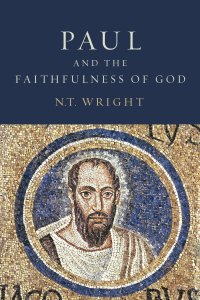
Accordance Bible Software has recently released a bunch of N.T. Wright resources, including his newly published and massive Paul and the Faithfulness of God. There are two bundles Accordance offers (here and here), and both are on sale this week.
I’ll be posting an extended book note on Wright’s new two-volume work before too long. Consider it a 2015 New Year’s resolution.
In the meantime, I commend to you Accordance 11, which I suspect will be a nice way to access and utilize Wright’s work.
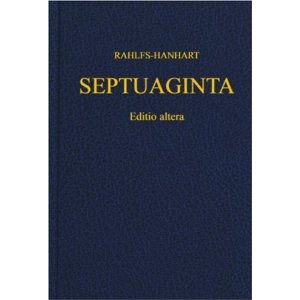
Want to read the Old Testament in Greek on all your devices? This is the cheapest way I’ve seen to get started: until midnight PST tomorrow (1/6/15) night, you can get this Septuagint bundle for less than $50. It includes
The Rahlfs-Hanhart Septuagint text
Its critical apparatus
The Kraft-Wheeler-Taylor parsings of each word in the text
The LEH Greek-English Lexicon of the Septuagint (Lust, Eynikel, and Hauspie)
This is really an incredible deal, given that the Rahlfs-Hanhart text in print is about $50 (and doesn’t include running parsings). The LEH Lexicon in print runs anywhere from $40 to $80.
What can Olive Tree do, you ask? See my gathered posts here, including my recent review of a five-volume dictionary set that is still on sale.
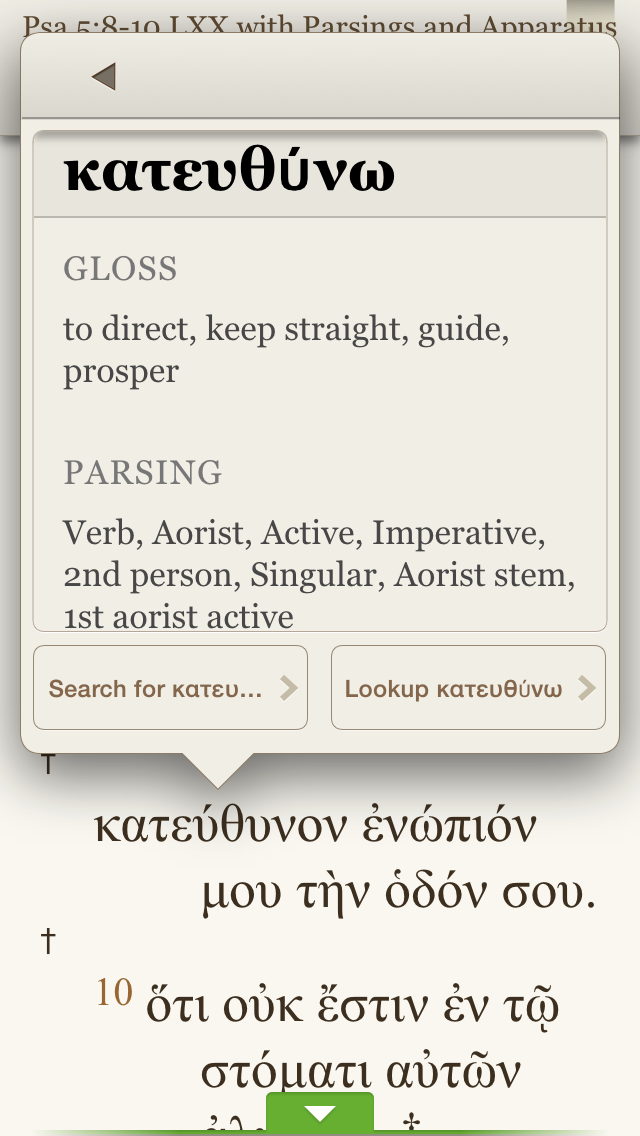
The advantage to having the above combo in Olive Tree is that you can tap any word in the Rahlfs-Hanhart Greek text and get instant parsing information.
You can instantly access that word’s lexical entry in the LEH lexicon. I especially appreciate LEH’s inclusion of word frequency counts, according to sections of the LXX:
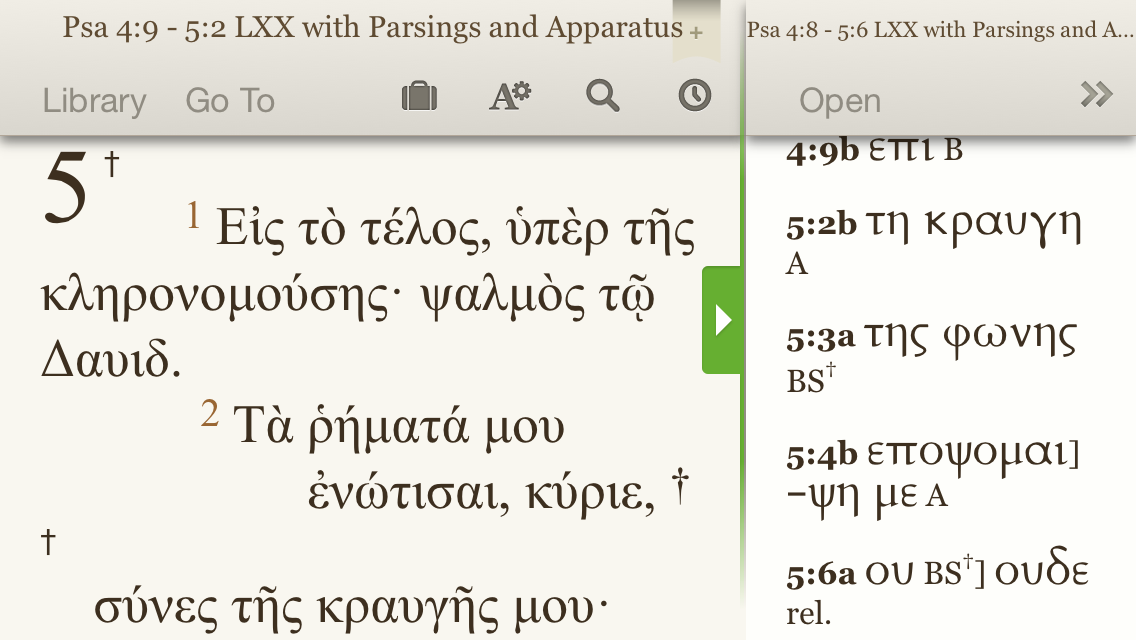
Using the split window setup, here’s what the Rahlfs text with apparatus looks like:
Though Rahlfs never intended his apparatus in this volume to be fully critical, it does help you at least compare LXX readings as found in Vaticanus (B), Alexandrinus (A), and Sinaiticus (S).
And because Olive Tree is fully cross-platform, you can sync any notes you take or highlights you make and they appear on any device on which you have Olive Tree.
Find the whole bundle here, on sale for just a little while longer.
An underrated but really good Bible dictionary is the New Interpreter’s Dictionary of the Bible (NIDB). Published by Abingdon, the five-volume set is edited by Katharine Doob Sakenfeld and includes contributions of nearly 1,000 scholars.
There are more than 7,000 articles in NIDB. The contributing scholars are diverse in terms of gender, ethnicity, and denominational background–a refreshing mix of voices. The dictionary balances reverence for the biblical text with rigorous scholarship–though the dictionary is rarely arcane.
The NIDB has been eminently useful to me in my weekly sermon preparation. Last fall, for example, when preaching through Genesis, I knew I’d have to make sense somehow of the “subdue” command that God gives the first humans regarding their relationship to the earth. The dictionary’s “Image of God” entry helpfully clarifies:
While the verb may involve coercive activities in interhuman relationships (see Num. 32:22, 29), no enemies are in view here–and this is the only context in which the verb applies to nonhuman creatures.
The same article puts nicely the implications of humanity’s creation in God’s image: the “image of God entails a democratization of human beings–all human hierarchies are set aside.”
This sort of blend between technical detail and pastoral application is present throughout the dictionary.
I’ve also found useful background for my Greek reading. This year, for example, I’m reading through the Psalms in Greek with a group of folks (see here). In the “Septuagint” entry in NIDB I find this:
The 4th-cent. CE “Codex Vaticanus” contains all of the books of the Hebrew Scripture or Protestant OT, and the following material that is today classified as deuterocanonical: 1 Esdras, 2 Esdras, Ps 151, the Wisdom of Solomon, Ecclesiasticus or Ben Sirach, the additions to Esther (several of which were originally composed in a Semitic language; others of which are original Greek compositions), Judith, Tobit, Baruch, the Letter of Jeremiah, and the additions to Daniel (Azariah and the Three Jews, Susanna, and Bel and the Dragon).
The entry goes on to describe other Septuagint manuscripts, with hyperlinks in Olive Tree to related entries.
iOS Features in Olive Tree
Olive Tree is as cross-platform as a Bible study app gets: it runs on iOS (iPhone and iPad), Mac, Windows, and Android. The app itself is free, and you can get some good texts free, too, so you can preview the app before you buy any resources in it.
I’ve got the Olive Tree app on Mac, iPhone, and iPad Mini. It’s one of the best-executed iOS Bible study apps I’ve seen. It is visually appealing, highly customizable (especially with gestures and swipes), and easy to learn.
When reading the New Interpreter’s Dictionary of the Bible (or anything else), here are a few features that have impressed me:
You can navigate with “flick scrolling” (how iBooks is set up) or “page scrolling” (like Kindle). This will make just about any user feel at home in the app. Flick scrolling (how you’d navigate a Web page) feels more natural to me, so I use that.
Dictionary entries are easy to get to. You can simply tap on “Go To” and type in the entry you’re looking for. The auto-complete feature saves having to type very much on the iPhone’s small keyboard:
You can search the entire contents of NIDB by word. If I wanted to see not just the entry for “Septuagint,” but every time the NIDB mentions the Septuagint, I would simply type that word in to the search entry bar:
Then I can select a result and read the given entry.
The full-color photos are zoomable. The NIDB contains full-color photographs that help visualize various entries. You can select the photograph and pinch-zoom for more detail.
I’ve noted this before–there is a great deal of customizable “Gestures/Shortcuts” preferences in the “Advanced Settings” menu. Olive Tree is the most versatile Bible study app in this sense. For example:
Two-finger swipe left and right takes you through your history within the app. I can swipe between NIDB, and the last NIV Old Testament passage I was reading, and a commentary, and…. No need to go through menus.
Two-finger tap gets you from any screen to your library; right away you can get at your other resources.
Concluding Assessment and How to Buy
One of my favorite features of Olive Tree’s apps is that you can view two resources at once that aren’t tied together by Bible verse. It’s like having split windows on an iPad. So you can have the NIDB open in the top half of your screen, and a Bible text or other resource open in the bottom half–even to unrelated topics if you want.
The New Interpreter’s Dictionary of the Bible is about as good a Bible dictionary as you’ll find. If you can use it to complement the Anchor Bible Dictionary (also available in OT), you’d be very well set with Bible dictionaries.
Olive Tree has done a great job, especially with its iOS apps. As much as I loved my print copy of NIDB, I unloaded it not long ago since I can essentially carry it around with me now. And getting at its contents is even easier with the enhancements Olive Tree provides.
Thanks to Olive Tree for the NIDB for the purposes of this review, offered without any expectations as to the content of the review.You can find the product here, where it is currently on sale for $99.99.
It’s been a great year! Thank you–wait… wrong platform.
It’s a little silly, but WordPress.com put together a 2014 report for Words on the Word.
Click here to read it
Here’s an excerpt from the report, which has fun data about page views, most-visited posts, top commenters, etc.:
The Louvre Museum has 8.5 million visitors per year. This blog was viewed about 98,000 times in 2014. If it were an exhibit at the Louvre Museum, it would take about 4 days for that many people to see it.
It’s got to be the best tagline I’ve ever seen in the App Store:
Launch actions, not just apps.
If you are interested a free code for the paid app that does this, read on….
The “just” in that tagline is precisely placed, too, because Launch Center Pro can launch both apps and actions. But its ability to launch actions is what sets it apart. With minimal effort required for setup, I open up Launch Center Pro (hereafter, LCP) on ye ole phone to see these options:
Yes, that’s right. I can message (or call) my wife, text my whole family, post a selfie (I don’t really do that), enter a new Calendars 5 event, and much more with a single tap.
“It’s like speed dial for everyday tasks,” the app description rightly claims.
Already included in the app (though customizable) is a slew of app search options:
You can create your own actions via the Action Composer, which requires zero knowledge of Apple’s x-callback-url functionality, even though it utilizes it.
My phone allows me just four apps in the dock. LCP is so handy, I moved the Phone app to my home screen, and put LCP in its place in the dock. If that doesn’t speak to an app’s utility—that I use it more than I place calls on my phone—I don’t know what does.
I can’t recommend it highly enough. It’s not just a five-star App (though it is that, too), but LCP is a really smart innovation that will simplify repeated actions on your phone. See it in action in this short video.
It’s been priced as high as $4.99 recently. Right now it’s $2.99 for iPhone in the App Store. There is a separate iPad version, too, which can sync with the iPhone LCP.
But you want a chance to get the app free, you say? You came to the right place. Thanks to good folks at Contrast, who make the app, I’ve got a promo code for the iPhone version to give away.
Just comment here (and make sure you type in your email address, which goes undisplayed) for a chance at winning the code… share this post (and comment where you did) for a second entry. I’ll announce the winner some time this weekend. Leave your comment where it says, “What do you think?” below.
In this post, I offer a sampling of resources–electronic and in print–that could be of help in reading through the Psalms in Greek. Do you know of anything not mentioned here? Please add it in the comments. You can also contact me with any questions or comments about the endeavor.
Behold, the dwelling of God is with humankind. He will dwell with them, and they shall be his people, and God himself will be with them, and be their God.
Revelation 21:3
During Advent our congregation read the book of Jonah, that sometimes-ignorant, sometimes-faithful, always-stubborn prophet who called the wayward city of Nineveh to turn away from their past and accept God’s second chance.
We’re complex people like Jonah. Sometimes we’re even like the people of Nineveh, we don’t know our left from our right, or up from down.
Whether we’ve created our own difficult reality by our actions, or whether others have put us in a tight spot, we all know what it is to live and walk in darkness.
So we look for light. We pray earnestly for second chances. We ask for God’s mercy to come even to lowly folks such as ourselves. We yearn to see God’s justice executed on those who actively work against it.
We grasp about for light, and we long to behold Jesus.
Alleluia! To us a child is born!
Come, let us adore him! Alleluia!
But it’s easy to get confused about Jesus. Not because Jesus is confusing or because God is unknowable. But because we’re an easily confused people.
Having seen so many paintings of a crucified Jesus, young Asher Lev asked his mother whether this was the Messiah.
Marc Chagall, “White Crucifixion,” 1938
“No,” she says, “He was not the Messiah. The Messiah has not yet come, Asher. Look how much suffering there is in the world. Would there be so much suffering if the Messiah had really come?”
A trenchant critique, to be sure.
Time and again we look for Jesus to come in glory, in power, to right wrongs on a different timetable than God seems to have in mind… but time and again Jesus insists on coming in humility, in squalor, in seemingly insignificant interactions, even showing up in the midst of a fight. He doesn’t eliminate suffering; he gets born right into it, and takes part it in it himself.
Alleluia! To us a child is born!
Come, let us adore him! Alleluia!
Still, some days we’d rather skip past his first coming and go straight to the ending, his second coming when he makes everything right.
We keep wanting him to show up in full majesty, draping white robes behind him, as he smites the naysayers and draws his people out of a dark world and unto himself.
But year after year he keeps being born in a stable, to an unwed mother, next to unbathed animals, with astrologers as front-pew worshipers.
Alleluia! To us a child is born!
Come, let us adore him! Alleluia!
One poet sums it up nicely in four lines:
They all were looking for a king
To slay their foes, and lift them high:
Thou cam’st a little baby thing
That made a woman cry.
Rather than eliminate suffering in his first coming, Jesus participates in it. He takes on vulnerable, imperfect human flesh. He becomes one of the so-called least of these. A child. A poor child.
He doesn’t vanquish the darkness all at once… he’s born into it, and lets loose every now and then with a ray of light, a glimmer of hope. Indeed, for those who have eyes to see it, there is great light coming from the most unlikely birthing story you’ve ever heard.
Jesus was born into this world as it is, not yet as it should be. This is good news for our confused and dark souls. Even our hearts can become a home in which the Christ-child can dwell. Even we can bear Jesus as Mary did and bring him to all the world. Christ has come, a “little baby thing” to dwell with us, as we are, to be our God, to make us his own.
Alleluia! To us a child is born!
Come, let us adore him! Alleluia!
The Episcopal Bishop of Pittsburgh, Bishop Dorsey McConnell, is a favorite preacher and writer of mine. He says it well for all of us:
But the Christ Child has a life of His Own, and He will be born even in as dark a stable as that of my own heart. …I suppose I will just have to let Him have His way….And I know He will have His way with you as well. Whatever you’re afraid of in your own life or soul, just remember: He’s been born in darker places. Give Him so much as a square inch of your shadows, and He will fill you with His light.
Alleluia! To us a child is born! Come, let us adore him! Alleluia!
I have Honest Toddler to thank for helping me keep my wits about me as the father of three young kids. Here’s a recent Facebook status of this all-too familiar personality:
Good Morning! Wow it’s like it has been forever. …. Anyway for breakfast I’ll have 6 plain pancakes … on the red plate. Not the red one with the green trim or the brick colored one, RED. Yes, the one that shattered yesterday. I’m sure you’ll figure something out. God help you if I see a crack. Also, I would like my pancake intact but in bite-sized pieces. Don’t break my pancakes but please cut them. I want them undamaged but in small pieces so I can eat. Do you see what I’m saying? Perfect but altered. It’s not hard. Follow your heart but keep in mind that if you get it wrong I’ll make today hard. Ok I’ll be in the family room sitting in your lap while you also cook in the kitchen. Love you. (so hungry)
Toddlers can somehow seamlessly embody two (or more) mutually exclusive desires at the same time.
I want to wear that shirt, but I don’t want it covering my top half.
I want milk on my cereal, but I don’t want my Cheerios to be wet!
Nuanced Characters
I have a hard time knowing what to do when someone I’m responsible for wants me to do their top button, but at the same time leave it unbuttoned.
But when it comes to literature, film, music, and narrative TV, I love highly nuanced and complex characters.
I appreciate people like Elsa, Jimmy McNulty, Robert Duvall in The Apostle, any character by Flannery O’Connor.
Good literature, good film, and good TV all blur the line between “good guys” and “bad guys,” because those categories aren’t so clear in real life.
Jonah’s a fascinating character in that regard. We’re not really sure what to make of him. Is he a good prophet, a bad prophet, or some of both, depending on the day? His portrayal is not an even one, or an easy one to detect. He’s a bundle of contradictions and love and judgmentalism and frustration and eagerness and obedience…. He runs away from Nineveh, but then goes flying towards it, preaching repentance as he walks into the city. And then with his message successful, he flees the city again, to watch it from afar.
Jonah: Loves God’s Compassion (for him),
Hates It (for others)
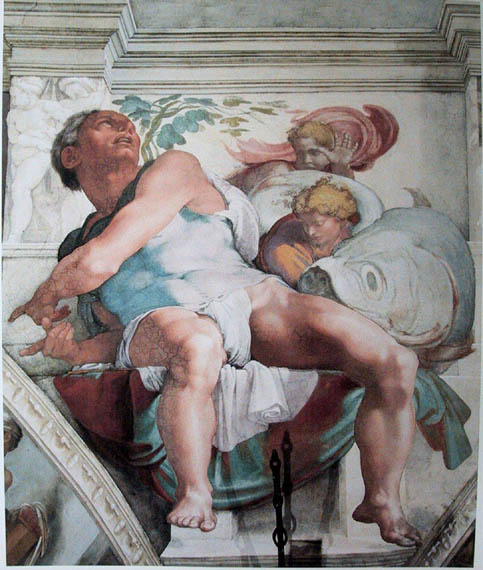
Jonah / Michelangelo / Sistine Chapel
God’s compassion is what Jonah loves most about God… when it comes to Jonah. It was God’s predisposition toward second chances, after all, that has kept Jonah alive throughout this book.
Jonah shows in Jonah 4 that he knew one of Israel’s creeds quite well: “I knew that you are a gracious and compassionate God, slow to anger and abounding in love, a God who relents from sending calamity.” And he rightly takes the shade-giving vine as God’s provision for him.
But if God’s provision and compassion toward Jonah is what keeps Jonah coming back to God, the Lord’s mercy toward despised others is what keeps Jonah running away from God.
Three times in this chapter Jonah tells God he’d rather die than watch his repentant enemies receive God’s clemency.
It almost makes you think about Peter’s three-fold denial of knowing Jesus. Jonah tries to deny God the opportunity to forgive whomever he wants to forgive.
Even the Animals
Jonah is angry enough to die. But God is concerned enough to save a clueless city…. even the animals!
Like in Jonah 4:11. Another translation follows the word order of the Hebrew a little more closely than the NIV, and punctuates the book’s ending with a mention of the animals!
“Should I not be even more concerned about Nineveh, this enormous city? There are more than one hundred twenty thousand people in it who do not know right from wrong, as well as many animals!”
A Heathen Animal of Nineveh, Pre-Repentance
Animals—there they are again! Putting on their sackcloth and mooing their repentance to the Lord.
Jonah loved the whale that saved him, but the worm that ate his shade—this animal he hated.
A vine that came up overnight, that Jonah had nothing to do with—he latched onto and cried when it withered. But a city full of hopeless people… well, he wanted them to wither like that vine… to go down into the depths and be consumed by worms.
But God loves all that he has made—evildoing humans, whales, worms, withered vines, and cursing sailors. Not one being is outside the scope of God’s loving care.
Good Theology, Bad Heart
Jonah gets a lot of things right. He’s right, I think, to be so angry at the perpetrators of injustice and oppression. He’s like every other God-inspired prophet who railed against those who tipped the scales to keep others down.
And he’s right about who God is, in verse 2 of the final chapter of the book: “a gracious and compassionate God, slow to anger and abounding in love, a God who relents from sending calamity.”
But not everything in Jonah’s head has made its way down into his heart. His theology at the beginning of this chapter sounds right, but he wants to apply the attributes of God just to himself.
It’s as if Jonah turns God’s words against him. He recites a well known formula, an articulation of who God is, but in a mocking tone of voice. In conflict resolution terminology, that’s called invalidating.
He’s like the prodigal son, who can’t stand watching lavish grace poured out on people who should have long ago forfeited the opportunity by their behavior. He’s the good guy, they’re the bad guys–why would God show them favor?
Which leads to an important question: Whom is God for? For whom exactly does God intend his salvation?
Whom is Christmas For?
And we might seasonally appropriate that question: Whom is Advent for? Whom is Christmas for?
Whose Light?
It would be easy in a season of preparation, to tend so much to our own hearts and lives, that we think only of how we receive Jesus for ourselves. We can spend so much time tending the vine, that we forget about the city we live in.
And we may be tempted to keep God’s compassion to ourselves and begrudge him when he shows mercy to those who have wronged us (and then turned to God). Well, we just wanted to see them get what was coming to them!
A Jewish commenter on this passage says, “It is not unusual for people to be so intent on the punishment of others that they lose their own way and are disappointed when people change their ways for the better.”
Jesus came into the world, offering light and life to anyone who would turn away from the darkness and turn toward him. And there are some really scummy people included in this invitation. How do we feel about that? What do we think of God’s way too liberal compassion? (I mean, he should pace himself more, right?)
Will we hide it under a bushel? Is God’s grace a proprietary character trait, only meant for the people of God? Jonah tried to hide under a vine, a divinely created shelter that he wanted only for himself.
But God sent a little worm to eat that thing up, in an effort to shake Jonah out of his self-focused slumber.
Choose Your Own Adventure
I like these stories with nuanced characters, ones whose interior lives are complex. I think this sort of storytelling is truer to the human condition.
And I resonate with Jonah. He gets it some of the time; other times, not so much. He really has a hard time just letting God be God.
One other thing that good storytellers do, besides writing full and complex characters, is to write compelling endings.
You can probably recall endings to novels that left you with goosebumps, because the last few lines of the story actually described a new beginning:
So we beat on, boats against the current, borne back ceaselessly into the past.
After all, tomorrow is another day.
Max stepped into his private boat and waved goodbye and sailed back over a year and in and out of weeks and through a day and into the night of his very own room where he found his supper waiting for him—and it was still hot.
These stories show characters with the hope of boats going on, even if into the past… they show the hope of a new day, the hope of a still-hot dinner, waiting in his room.
The narrator of Jonah is writing a new beginning into the end of the story.
But Nineveh has more than a hundred and twenty thousand people who cannot tell their right hand from their left, and many cattle as well. Should I not be concerned about that great city?
This is no tidy conclusion. It’s a question. It’s a rhetorical question, and we know the answer, just like Jonah knew the “right answer” in verse 2. But even as a rhetorical question, it invites—even demands—our response.
We have no idea how Jonah ends for Jonah. We don’t know if he’ll continue in his anger, or if he’s changed for the better.
But it really doesn’t matter… because it’s not just Jonah’s new day that the author concerned about… it’s ours. This is not The Great Gatsby or Gone with the Wind or Where the Wild Things Are. Jonah reads much more like a Choose Your Own Adventure book, where you, the reader, decide how the story ends for you.
The conclusion to Jonah requires our participation.
God has compassion on evil agents of empire when they come clean. The compassion that was always ours is now theirs—we have decide if we’re okay with sharing.
We are left with having to answer God’s question ourselves. The main character of the book of Jonah has always been God, with Jonah the most prominent supporting actor. But now we become the supporting cast, as we hear God ask:
“Should I not be concerned about that great city?”
Should I not be concerned about people who are killing each other, enslaving the innocent, beating the helpless, oppressing the poor, and destroying the environment?
Did I not come to earth to set despised evildoers free, too, should they accept my love?
Do you have any right to be angry at my gratuitous acts of incarnation, crucifixion, and resurrection for the life of the world?
Is this not the way, God asks, of my breaking in on earth, that I should have mercy on whom I will have mercy, and compassion on whomever I please?
This doesn’t mean there won’t still be justice, but do you have any right to be angry, God asks, when I decide to save the ones who should be smitten down?
The book of Jonah all boils down to that burning question: What will your response be, O reader, to the ways and work of God? Can you only accept it on your own terms, and keep God’s grace close to home? Or can you see Jesus as coming to earth for everyone, a gift of love for anyone who would believe?
Jonah ends here—but for us, the revelation of God’s concern for oppressors is not a period, but an ellipsis….
When Jesus comes, will we receive him largely for ourselves? Or can we receive him on his own terms, and open our hearts to his compassion so that we overflow with love toward even the most corrupt parts of God’s creation?
The skilled storyteller invites us now to take up the pen…
Last week Accordance released two new IVP “black dictionaries.” Both cover the Old Testament. There is Wisdom, Poetry & Writings and Prophets.
Here’s a screen grab from the Accordance page–they’re on sale through midnight EST tonight, and still reasonably priced after that.
Prophets (click image below for product page):
Wisdom, Poetry & Writings (click image below for product page):
These IVP dictionaries are really good. I usually use whatever volume I own when preparing sermons.
And Accordance 11 (just released this fall) is a nice way to use these dictionaries. You can try especially sophisticated searches with them in Accordance, like this one.
If you’ve used either of these dictionaries, I’d love to hear your thoughts in the comments. So far, I’ve really appreciated everything else from this series.

 Accordance Bible Software has recently released a bunch of N.T. Wright resources, including his newly published and massive Paul and the Faithfulness of God. There are two bundles Accordance offers (here and here), and both are on sale this week.



















 Words on the Word
