It’s not uncommon for people to ask: why the Septuagint? (That comes right after: What is it?) Why bother with the Greek Septuagint when we have the Old Testament in Hebrew, in which it was first written? English translations of the Bible in most churches use the Hebrew text as a base, anyway.
Before giving my top 10 reasons why, here are a couple ways to access the Septuagint (often abbreviated LXX after the tradition of the 70(+2) who were said to have translated it). This site has the whole Septuagint in Greek with an English translation. And here‘s a good, up-to-date English translation of the whole thing. (For hard copies, the standard complete Greek text is the Rahlfs Septuagint, and a recent English translation is the NETS.)
Here are 10 good reasons to pay attention to the Septuagint:
10. It helps us read Scripture in new, fresh ways.
9. You get to use fun words like Septuagint, intertextuality, collate, tradent, and urtext. Though I cannot bring myself to use the academy-preferred pronunciation of SEP-twa-jent. Sep-TOO-a-jent, thank you.
8. The New Testament writers often used and quoted a version of Scripture that aligns with the Septuagint. (See here for more about this.)
7. For students of Greek, the LXX is a good way to challenge oneself in Greek beyond the New Testament. There is a fuller and deeper vocabulary in the Septuagint that helps Greek students grow in their knowledge of the language.
6. The Septuagint was translated from a set of Hebrew texts that are centuries earlier than the Hebrew text underlying most English Old Testaments. This helps us get closer to the “original” text.
5. There are books that, while additional to the Protestant canon, still shed light on life. (I’m looking at you, Wisdom of Solomon!)
4. The Odes. This is a collection of texts appended to the end of the Psalms. It compiles some beautiful prayers found in the Old Testament (and apocryphal books). A few of these are in the Book of Common Prayer’s Morning Prayer canticles.
3. It connects us to the broad sweep of history in the Church. This was not only the Bible of the New Testament writers (in many though not all instances); it was the Bible of the Greek-speaking early church.
2. Books like 1 Maccabees, especially, fill out the intertestamental gap between Malachi and Matthew. Reading Maccabees can help us better understand a Jewish expectation of a conquering Messiah who would expel oppressive Roman rule.
1. Jesus used it.*
*Note: this is perhaps an oversimplification. Jesus spoke Aramaic and knew and used the Hebrew Bible. But we can at least say that the Gospel writers sometimes quote Jesus (in Greek) using a Septuagint text that differs from the Hebrew/proto-Masoretic Text. Some say this means just the Gospel writers themselves–not Jesus–used the Septuagint in such cases. But there are at least a few cases where it seems clear that Jesus is using a text closer to the Septuagint than to the Hebrew Bible.
Stanley Porter defends (here) the idea that Jesus taught (at least at times) in Greek.
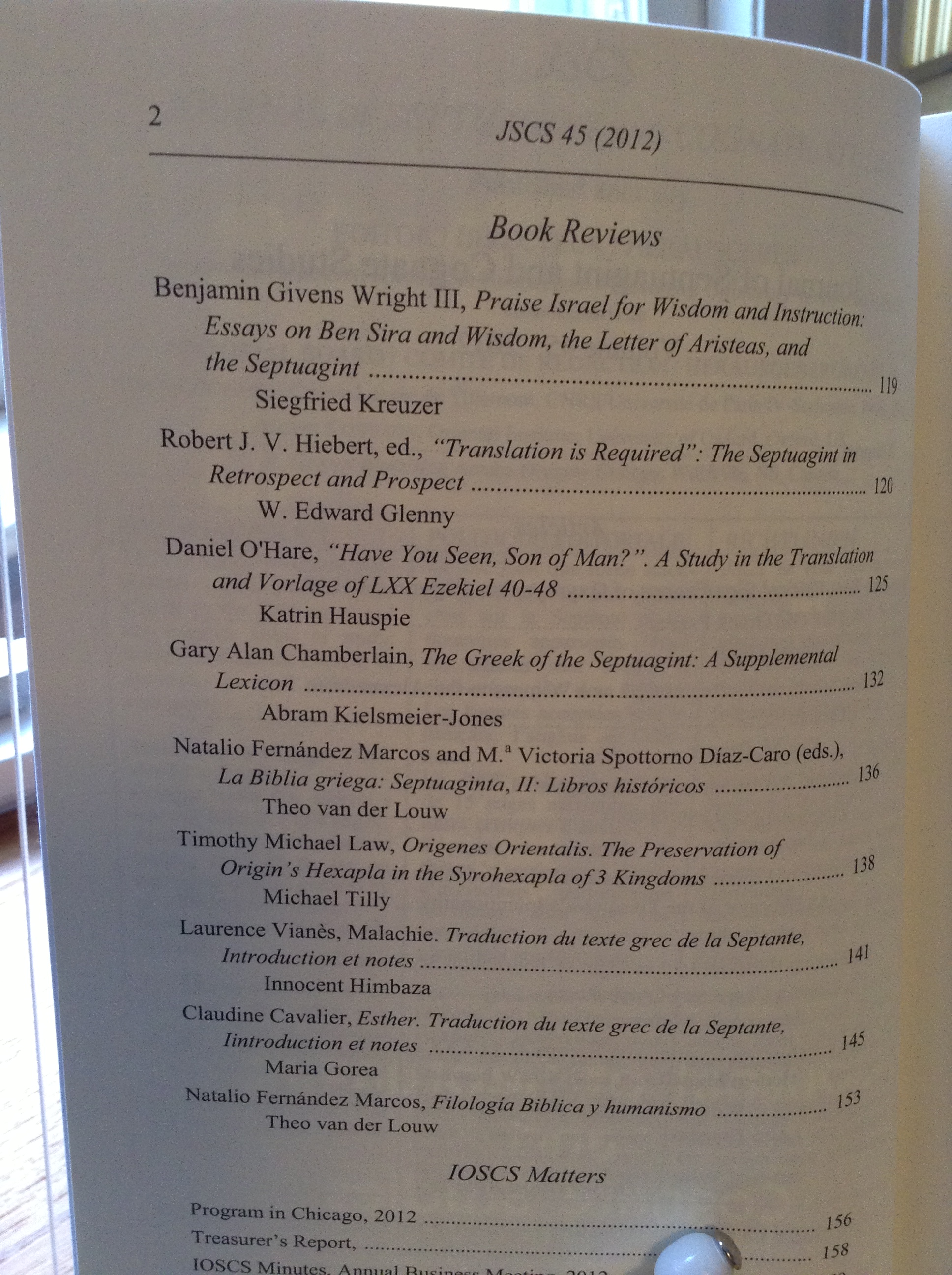
I’ve just received the new Journal of Septuagint and Cognate Studies (JSCS) in the mail today. This issue publishes my review of a Greek Septuagint lexicon. I find lexicons (more or less, dictionaries) significantly more challenging to review than books or even commentaries. (But enjoyable.) I’m glad this one has been published.
See the full contents of this year’s journal here. Photos below.
I don’t really think there is such a thing as a “literal” translation of the Hebrew or Greek Bible. Too much is lost when going from any one language to another to be able to claim literalism. As Dave Brunn points out, to translate is to necessarily change the form. The only way one could keep the form of Hebrew or Greek is to leave the text in Hebrew or Greek.
The Comprehensive New Testament claims to be “the most accurate translation of the Nestle-Aland 27th edition Greek New Testament ever produced” (Preface, i), which first struck me as a rather grandiose claim. However, the editors of that work seem to agree with Brunn in saying that “no translation can perfectly reproduce the simplicity and beauty of the original words” (i). Their claim to accuracy is not a claim regarding their original English translation of the Greek New Testament. Rather, it means that they use the Greek of the NA27 as their underlying text. Other translations may begin with that as a base, but will make textual decisions that means their underlying Greek is not identical to the NA27.
There are four primary features to The Comprehensive New Testament:
1. It is “standardized to the Greek New Testament text of the Nestle-Aland 27th edition and the United Bible Societies 4th edition.”
Why this edition of the Greek text? Editors T.E. Clontz and J. Clontz note the Protestant and Catholic agreement on the text tradition (“Alexandrian”) of the NA27 as the basis for English translations of the New Testament.
The editors seem to agree with the idea that no translation is truly literal, yet they still want to “translate the right words–and not words created by scribal mistakes or editorial changes” (i). I agree with them that the “words given through the apostles deserve our best efforts in return.”
One should still be clear, though, that even if the NA27 represents the best manuscript tradition, we don’t have the original autographs. I do believe we probably have something very close to that, but it certainly doesn’t threaten my high view of Scripture to think that there might have been a few “scribal mistakes or editorial changes” between the time of writing and the earliest manuscripts we have access to. The editors aren’t claiming access to the autographs, though, just to the NA27.
There is now a 28th edition of the Nestle-Aland text, with a few changes made from the NA27. How does this come into play? Of course, The Comprehensive NT was published before the NA28 by about 5 years, but it does raise a question for possible future editions of this volume. (I.e., did the NA27 have the wrong text? Does the NA28 have it right now? etc.)
All of these are minor quibbles, though, and no textual variants seem to make major theological differences to our faith. Indeed, the editors note that “throughout the 15,000 variations translated in this New Testament, we find the same message, and the same gospel” (i). Agreed.
The reader of this volume should understand, however, that even using the NA27 at all times doesn’t remove textual ambiguity. For example, in Galatians 1:2 Paul uses the Greek ἀδελφοὶ to describe those “who are with me.” This post is not the place to engage seriously the issues surrounding translation and gender, but given the amount of female ministry companions Paul generally had, the translation found in the NIV (2011) of “brothers and sisters” is almost certainly the more accurate translation. (In Greek, a masculine plural noun like adelphoi could be all males or a mixed group of males and females.) The editors have retained the underlying Greek, but have translated it in a way that not all will agree with.
Also, to take another example, in Romans 16:7, there is debate around whether Paul names Junia (female) or Junias (male) as an apostle. The prevailing scholarly theory is that he has Junia (female) in mind, but the Greek word itself is not conclusive, since he uses the accusative case Ἰουνιᾶν, which itself could be male or female.EDIT/UPDATE 7/24/13: Earlier printings of NA27 did indeed have Ἰουνιᾶν (male), but as of 1998, printings now contain the unequivocally female Ἰουνίαν (Junia). The Comprehensive NT has “Junias” (male) in translation. It’s impossible to prove with 100% certainty one view over the other, but even with a solid base of the NA27 at every turn, there are still ambiguities to be resolved in translation.
2. The Comprehensive NT contains “complete textual variant mapping.”
The editors encourage and facilitate the use of multiple translations when studying the Bible. To this end they offer “complete textual variant mapping” so one can easily see what other translations have for given words and verses. The preface says this is “something that no other translation offers” (i.e., “footnotes for translations beyond our own”). That’s not entirely true, as the NA27/NET diglot offers the same feature (see here).
It’s a useful and time-saving feature, though… a sort of compendium of English translations.
The Junia example above (Romans 16:7) notes the many translations that have Junia over Junias (NESV, HCS, KJV, etc.). They ascribe “Junias” (male) to the Alexandrian tradition while saying that “Junia” (female) is from the Byzantine tradition. Unless I’m missing something, it’s not quite this simple, as the NA27 itself can easily be understood as referring to a Junia. Here it’s not a question of text tradition, but rather of interpretation and translation.
The notes don’t contain rationale for the translation of the New Testament, but they don’t purport to, either.
3. It scores high on a readability scale, only requiring “a sixth grade reading level.”
I don’t doubt the high score, but the presence of words like “behold” and “begotten” (in John 3:16) and “hallowed” (in the Lord’s Prayer) stood out to me as something that a sixth grader would probably need to ask about. The New Living Translation, by comparison, has “one and only” for John 3:16 and “may your name be kept holy” instead of “hallowed be your name” in Luke 11. These latter translations, I think, are better suited to a younger age group and reading level. This translation is not abnormally wooden, though, as some “literalistic” translations (e.g., the NASB) can be. I’m just not sure I’d fill a middle school youth room full of these Bibles (intriguing cover image notwithstanding!).
4. There are nearly 300 pages of “references for the Dead Sea Scrolls, Philo, Josephus, Nag Hammadi Library, Pseudepigrapha, Apocrypha, Plato, Egyptian Book of the Dead, Talmud, Old Testament, Patristic Writings, Dhammapada, Tacitus, Epic of Gilgamesh.”
Many of these pages also include excerpted text from the above.
This is the best feature of this book, in my opinion. Anyone who wants to thoroughly research the early Christian and early Jewish literature that has to do with a given New Testament verse will save loads of time by referring to the reference list.
From Genesis and Jubilees and Sirach on Abraham in Romans 4 to a juicy quote by Papias that claims Matthew “composed the oracles in the Hebrew language,” this section is a great scholar’s companion. The preface provides a concise and helpful overview of the texts covered (e.g., Pseudepigrapha: “claim various Old Testament individuals as authors”).
Accordance Bible Software has released The Comprehensive NT, and one can see the advantage to using a hyperlinked, electronic version of these references (see here). As one reviewer noted, having this extensive list of cross-references will save many a trip to a theological library.
Whatever my critiques above regarding the translation itself, the hundreds of pages of cross-references alone make purchasing the less than $20 book an easy decision. I know of no other single work that gathers so many references in one place, sorting them by New Testament verse. It’s a great starting point for research papers or in-depth Bible studies that want to take into account other extra-biblical writings.
Find out more about The Comprehensive New Testamenthere or here. Thanks to Cornerstone Publications for the review copy. The translation and cross-references are also available in Accordance Bible Software, here.
The Expositor’s Greek Testament ranks among the most important commentaries on the Greek text of the New Testament from the 19th century, drawing from the scholarship of twenty contributors under the editorship of William Robertson Nicoll. In addition to the Greek text, this massive reference work contains textual, literary, and grammatical commentary on nearly every Greek word in the entire New Testament. The Expositor’s Greek Testament also includes lengthy introductions to each of the books in the New Testament, surveying the literary and interpretive history, along with an introduction to the historical context of each book and an extensive bibliography.
This particular volume covers 1-2 Peter, 1-3 John, Jude, and Revelation.
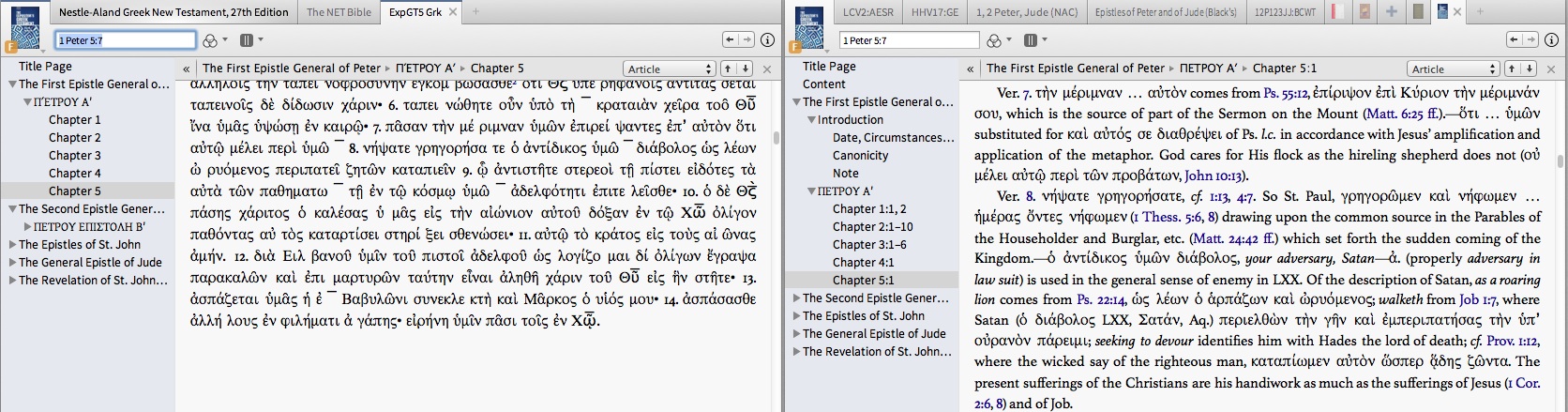
The free volume actually installs as two modules–one is the Greek text for the books above, the other is a commentary on the Greek text (including full book introductions and verse-by-verse, word-by-word comments). Here’s a screen shot of what it looks like when open to 1 Peter 5:7 (click on image to enlarge):
Everything is hyperlinked and searchable, and ties in with the rest of one’s Logos library.
As Jesus and his disciples were on their way, he came to a village where a woman named Martha opened her home to him. She had a sister called Mary, who sat at the Lord’s feet listening to what he said. But Martha was distracted by all the preparations that had to be made. She came to him and asked, “Lord, don’t you care that my sister has left me to do the work by myself? Tell her to help me!”
“Martha, Martha,” the Lord answered, “you are worried and upset about many things, but only one thing is needed. Mary has chosen what is better, and it will not be taken away from her.”
–Luke 10:38-42 (NIV, 1984)
At the Rabbi’s Feet She (!) Sits
Martha gets off to a good start in this passage. She is showing hospitality to Jesus, by having him into her home. She “opened her home to him,” Luke says, using language of gracious hospitality.
She will call Jesus “Lord” later in the passage, so she clearly loves him.
She had a sister called Mary, who sat at the Lord’s feet listening to what he said.
Have you ever heard people talking about sitting at Jesus’ feet? Perhaps one of those evangelical phrases we hear from time to time, not really sure what it’s about.
That’s what Mary was doing: sitting there, listening.
This posture of sitting at someone’s feet is not the subservient posture we might think of today. Rather, this was how learners actively engaged with their teachers. A student would sit at the feet of his rabbi.
Yes, his rabbi. This is very unusual posture for a woman to take. There were some rabbis that had female students, but most did not. Women would instruct other women in the Torah. Mary was taking on a stereotypically male role here in becoming Jesus’ student.
And students sat in the dust at the feet of their rabbis, not only so they could learn, but so that they themselves could train to become rabbis, to teach others. Mary is taking in from Jesus how she, too, can preach the Gospel of Jesus and lead others to a saving knowledge of God.
N.T. Wright says, “People sat at a teacher’s feet in that world, not to gaze languidly with drooping eyelids, but in order to become teachers themselves. … Mary had crossed a boundary, entering into the man’s world of discipleship; Jesus had affirmed her right to be there….”
Last week we saw the Samaritan–one of the last people you’d expect–seeing and having compassion on a man in a ditch. He saw him, had compassion on him, and acted on that compassion. He did what was in his power to do. And he was one of the last people who would be expected to do that.
In this passage there is a woman–one of the last people one would have expected then, certainly the wrong gender, according to society, who takes the posture of a disciple, learning from a rabbi.
Jesus has little use, sometimes, for social conventions. He can and does work through them, certainly. But he’s just as likely to turn them on their heads, teaching instead the social conventions of the Kingdom of God.
Sibling Rivalry and Other Distractions
Christ in the House of Martha and Mary, by Johannes (Jan) Vermeer
But Martha was distracted by all the preparations that had to be made. She came to him and asked, “Lord, don’t you care that my sister has left me to do the work by myself? Tell her to help me!”
It’s interesting… Luke says that Mary was “listening to what he said.” “But Martha was distracted….”
Jesus was already talking. Why wasn’t Martha putting her work on hold to listen? Or at least, were there some preparations she could have done while still in earshot of him?
I’m sure many of us have been in that situation where we have guests coming over. We nervously look at our watch and see that we only have 10 minutes left to get the food in the oven, vacuum the living room, and maybe put on some deodorant or whatever, because we’ve been running around for the last hour or two. Maybe we exchange a few terse words with spouses or children to hurry up and help prepare….
And when the guests come, we may not be done with the preparations, but that’s okay. (It really is okay!) We can invite them to sit in the kitchen with us so we can finish dinner, but also talk to them. Or we put our preparations on hold at least to say hello, shake hands, give hugs, and so on.
Was Martha avoiding Jesus?
To be clear: the work itself was not bad. She was showing hospitality to Jesus by having him in. Earlier in Luke Jesus rails against a man named Simon who had invited him over but not been hospitable. In that story a woman “who had lived a sinful life” poured perfume on his feet and wiped them with her hair, crying all the while. Jesus said,
Do you see this woman? I came into your house. You did not give me any water for my feet, but she wet my feet with her tears and wiped them with her hair. You did not give me a kiss, but this woman, from the time I entered, has not stopped kissing my feet. You did not put oil on my head, but she has poured perfume on my feet. Therefore, I tell you, her many sins have been forgiven—for she loved much.
Jesus values hospitality. In fact, in Jesus’ culture, to complain to your host was a big no-no. You thanked your host profusely for going out of their way to greet you. But Jesus had called Simon out anyway.
So Martha is doing something that is generally good.
But her focus on the tasks of hospitality kept her from seeing the guest.
She was distracted–her attention was turned from where it should have been (the presence Jesus) to a lesser good (tasks done not in the presence of Jesus).
We get the picture of Martha barging in and interrupting–Jesus was talking to Mary, Mary was listening, and now Martha blurts out, “Lord, don’t you care that my sister has left me to do the work by myself? Tell her to help me!”
She puts the focus on herself. Actually, on her sister. “She’s not doing her chores.” (A common refrain of siblings everywhere.) “Tell her to help me.”
Another distraction-someone else’s relationship to Jesus–keeps Martha from thinking about her own relationship to Jesus.
Martha’s Baditude
Martha tells Jesus what to do! We begin to get the sense that throughout Jesus’ visit she has not been having a good attitude at all. We have a word for this in the K-J house: baditude. It’s a bad attitude. Martha is sporting a serious baditude.
A number of interpreters of this passage have pointed out the difference between Martha, who tells Jesus what he has to say, and Mary, who listens to what Jesus wants to say.
“Martha, Martha,” the Lord answered, “you are worried and upset about many things,
“Martha, Martha!” There is emotion in Jesus’ response, as he says her name twice. A firmness, it sounds like, but also compassion.
“You are worried and upset about many things.” Many things!
Maybe Martha is worried and upset about more than just Jesus’ arrival.
Maybe Martha has avoidance issues more generally.
Maybe she is afraid of being known well by others.
Maybe the baditude was just a front. Maybe she was scared of being loved deeply by someone else.
Maybe she thought she could somehow earn the love and approval of Jesus and his entourage by hosting them with the most elaborate spread.
Therefore I tell you, do not worry about your life, what you will eat or drink; or about your body, what you will wear. Is not life more than food, and the body more than clothes? Look at the birds of the air; they do not sow or reap or store away in barns, and yet your heavenly Father feeds them. Are you not much more valuable than they? Can any one of you by worrying add a single hour to your life?
Take my yoke upon you and learn from me, for I am gentle and humble in heart, and you will find rest for your souls. For my yoke is easy and my burden is light.
Cast all your anxiety on him because he cares for you.
David Garland, a Bible professor at Baylor, asks, “How is it that one can do everything right and still be wrong?”
Martha welcomed Jesus in v. 38, a sign of hospitality. She calls him Lord. She seems to truly love him. She just gets distracted. And stressed out. Frustrated with her sister for not joining her in her stress. And maybe she is even jealous of her sister’s relationship to Jesus?
You Only Really Need One Thing
but only one thing is needed. Mary has chosen what is better, and it will not be taken away from her.”
Martha has allowed the Good to distract her from the Better. Her priorities are not quite right. Her affections, her emotions, the way in which her heart is going… is mis-directed.
Prioritizing where our attention goes would be easy if we could choose between a bad thing and a good thing. But sometimes life gives us a choice between two goods. And one of those goods may be better than the other. Mary used wisdom and discernment in this passage to do that. Martha did not. She was too busy doing The Good to notice The Better that was right there in her living room.
Martha may do her work in silence, but it is a sham, a mask for rage. I like to think of her as saying nothing as she bangs around the house, trying to get Mary’s attention, or better yet, make her feel guilty for not helping out. …I recognize myself all too clearly in the scene; all the internal–infernal–distractions, the clatter-bang of daily routines and deadlines, that can make me unfit company for anyone.
When our work, when our lives become just a series of tasks, it’s exhausting. I identify with Martha here; I’d imagine that a number of us do. I want to make that decision that Mary makes. She’s not just passively sitting there, doing nothing, she has deliberately chosen to listen to Jesus. And, Jesus says, she has chosen “what is better.”
“Jesus is coming. Look busy,” the bumper sticker says.
And of course we can–and sometimes should be busy for Jesus. But we need to also ask how we can keep our work and our service and our ministry in its proper relation to listening to God.
When it comes down to it, Jesus says, “Only one thing is needed. Mary has chosen what is better, and it will not be taken away from her.”
One thing–Jesus. More specifically, sitting at Jesus’ feet and listening to him. That’s what we really need to do.
Inviting Jesus into the Kitchen
Brother Lawrence in the Kitchen
I don’t read this passage as telling all of us Marthas in the world that we can’t keep actively serving others. I don’t think Jesus is saying that we have to stop our work in the kitchen altogether.
But if we are doing our work with the same sort of “baditude” Martha has here, it’s either time to take a break and be with Jesus, or more deliberately invite Jesus into the work we are doing.
A number of sermons ago I suggested using sentence prayers throughout the days tasks to connect with God:
“Lord, I know that you are with me.”
“God, thank you.”
“Jesus, please help me.”
“Lord, help me love this person the same way you do.”
“God, I offer this work to you.”
Brother Lawrence was a 17th century monk who served as cook in his Carmelite order. He was described as having a “great aversion” to the kitchen, and yet, as one brother said of him,
[I]t was observed, that in the greatest hurry of business in the kitchen… He was never hasty nor loitering, but did each thing in its season, with an even uninterrupted composure and tranquillity of spirit.
“The time of business,” Lawrence said, “does not with me differ from the time of prayer; and in the noise and clutter of my kitchen, while several persons are at the same time calling for different things, I possess GOD in as great tranquillity as if I were upon my knees at the Blessed Sacrament.”
It’s especially tragic when we are doing ministry work, like the hospitality Martha was trying to show, and we forget the main reason we are serving… for Jesus.
Work without a connection to Jesus is just being busy.
But when we deliberately sit down with Jesus, or invite him into our work, listening to what he has to say… that can never be taken away from us.
The above is adapted from the sermon I preached today. All Scripture quotations come from the NIV (1984).
This week and next week in Greek Isaiah in a Year will cover Isaiah 41:1-42:21. Here are the readings for each day:
07/15/13 Isa 41:1–5
07/16/13 Isa 41:6–10
07/17/13 Isa 41:11–15
07/18/13 Isa 41:16–20
07/19/13 Isa 41:21–24
07/22/13 Isa 41:25–29
07/23/13 Isa 42:1–4
07/24/13 Isa 42:5–9
07/25/13 Isa 42:10–17
07/26/13 Isa 42:18–21
Below is the text from R.R. Ottley’s Book of Isaiah According to the Septuagint, first in Greek, then with his English translation. Ottley is also here in Logos (reviewed here) and here as a free, downloadable pdf in the public domain. The full reading plan for our group is here (pdf).
See here for more resources and links to texts for Greek Isaiah.
41 1 Be made new toward me, ye islands: for the rulers shall renew their strength: let them draw near, and let them speak together, then let them proclaim judgments.
2 Who roused up righteousness from the rising of the sun, called it to his feet, it shall go forth? he shall set it before nations, and shall astonish kings; and he shall lay their swords upon the earth, and their bows as brushwood that is cast forth.
3 And he shall pursue them, and the way of his feet shall pass over in peace.
4 Who hath wrought and done these things? he called it, that called it from the beginning of generations; I, even God, am the first, and unto the times to come, I am.
5 The nations saw, and were afraid, the ends of the earth drew near, and came together,
6 Deciding everyone to help his neighbour and his brother, and he shall say,
7 The craftsman is strong, and the smith smiting with a hammer, beating withal; then will he say, The joining is good, they have made them strong with nails; they will set them in place, and they shall not be moved.
8 But thou, Israel, art my servant, Jacob whom I have chosen, the seed of Abraham whom I loved:
9 On whom I took hold from the ends of the earth, and called thee from the watch towers thereof, and said to thee, Thou art my servant; I have chosen thee, and not forsaken thee.
10 Fear not, for I am with thee; be not dismayed, for I am thy God that strengtheneth thee; and I have helped thee, and have saved thee from falling by my just right hand.
11 Behold, all they that resist thee shall be ashamed and turned backward; for they shall be as though they were not, and all thy adversaries shall perish.
12 Thou shalt seek them, and shalt not find the men who shall evil intreat thee; for they shall be as though they were not, and they that war against thee shall cease to be.
13 For I am God, that hold fast thy right hand, that say to thee, Fear not,
14 O Jacob, thou little Israel; I have helped thee, saith the God that ransometh thee, Israel.
15 Behold, I make thee as wheels of a cart, that thresh out; new, with teeth like a saw; and thou shalt thresh the mountains, and beat small the hills, and shalt make them as dust.
16 And thou shalt winnow them, and a wind shall take them, and a tempest shall scatter them. But thou shalt rejoice among the holy things of Israel.
17 And the poor and the needy shall triumph. For they shall seek water, and there shall be none; their tongue is dried up with thirst. I the Lord God, I the God of Israel will hear, and will not forsake them.
18 But I will open rivers upon the mountains, and fountains in the midst of the plains; I will make the wilderness into pools, and the thirsty land into watercourses.
19 I will plant in the waterless land cedar and box, and myrtle and cypress, and white poplar;
20 That they may see, and learn, and understand, and know together that the hand of the Lord hath done all this, and the Holy One of Israel hath shown it forth.
21 Your judgment draweth near, saith the Lord God; your counsels have drawn near, saith the King of Jacob.
22 Let them draw near, and declare unto you what shall come to pass; or tell ye of the former things, what they were, and we will apply our thoughts, and perceive what the last things be: and tell us the things that are coming.
23 Declare the things that are coming at the last, and we shall perceive that ye are gods: do good, and do evil, and we will wonder.
24 For whence are ye, and whence is your working? from the earth. As an abomination have they chosen you.
25 I have raised up him from the north, and him from the rising of the sun; they shall be called by my name; let rulers come, and like clay of a potter, and like a potter treading clay, so shall ye be trodden down.
26 For who shall proclaim the things from the beginning, that we may learn them? or the former things, and we shall say that they are true? there is none that foretelleth, nor any that heareth your words.
27 I will give rule to Zion, and will comfort Jerusalem in the way.
28 For from the nations, behold, no man; and from among their idols there was none that declared aught, and if I ask of them, Whence are ye? they will not answer me.
29 For they are those that make you, and vain are they that lead you astray.
42 1 Jacob is my servant, on him will I take hold; Israel is my chosen, my soul hath received him; I have put my spirit upon him, he shall bring forth judgment for the nations.
2 He shall not cry out, nor send forth his voice, nor shall his voice be heard without.
3 A bruised reed shall he not crush, and smoking flax shall he not quench, but shall bring forth judgment unto truth.
4 He shall shine out, and shall not be shattered, until he have set judgment upon the earth; and in his name shall nations hope.
5 Thus saith the Lord, the God who made the heaven and fixed it, who established the earth and the things therein, and gave breath to the people upon it, and spirit to them that tread thereon,
6 I the Lord God have called thee in righteousness, and will hold fast thine hand, and will strengthen thee, and have given thee for a covenant of a race, for a light of nations.
7 To open blind men’s eyes, to lead out from bonds them that are bound, and men that sit in darkness out of a prison house.
8 I am the Lord God: this is my name; my glory will I not give to another, nor my excellences to the graven images.
9 The things from of old, behold, they are come; and new things do I proclaim, and before they sprang up they were made plain to you.
10 Sing unto the Lord a new song; it is his dominion; glorify his name at the end of the earth, ye that go down unto the sea and sail upon it: the isles, and the inhabitants thereof.
11 Be glad, O wilderness and the villages thereof; ye lodges, and the inhabitants of Kedar. They that dwell in a rock shall be glad, upon the tops of the mountains.
12 They shall give glory to God, they shall proclaim his excellences in the isles.
13 The Lord, the God of powers, shall come forth, and shall break war in pieces: he shall stir up jealousy, and shall shout against his enemies with might.
14 I have been silent: shall I be silent even for ever, and hold my peace? I endured, as she that travaileth; I will amaze, and I will dry up together.
15 And I will turn rivers into islands, and will dry up pools.
16 And I will lead blind men by a way that they had not learnt, and will make them to tread paths which they knew not; I will make their darkness into light, and the crooked things into a straight path; these are the things which I will do, and will not forsake them.
17 But they turned away backward. Be utterly ashamed, ye hat trust in the graven images; that say to the molten images, Ye are our gods.
18 Hear, ye deaf; and look up, ye blind, and see.
19 And who is blind, but my servants? and deaf, but they that are lords over them? and the slaves of God are blinded.
20 Full oft have ye seen, and taken not heed; your ears are opened, and ye heard not.
21 The Lord God took counsel, that he might be justified, and might magnify praise.
It’s kind of a funny name–Good Samaritan. It sounds redundant to us now, since “Samaritan” generally already has positive connotations: Samaritan’s Purse relief organization. Good Samaritan hospital. Church of the Good Samaritan. And so on.
But Jesus’ listeners would have heard “Good Samaritan” as an oxymoron. Samaritans were anything but good. They were a despised people–a product of God’s people intermarrying with another, idolatrous people. They weren’t faithful, many Jews thought. A Samaritan was the last person one would have expected to help another person.
How do we get to the parable?
How do we get to the “Parable of the Good Samaritan” in the first place?
Luke 10:25 On one occasion an expert in the law stood up to test Jesus. “Teacher,” he asked, “what must I do to inherit eternal life?”
An expert in the law, a lawyer, tests Jesus. As we soon see, he already has an answer to his own question in mind.
Luke 10:26 “What is written in the Law?” he replied. “How do you read it?”
Jesus answers his question. No, he doesn’t at all. He asks him another question. It’s that great trick of the trade when you’re teaching and you want to more fully engage someone… what do you think?
“Why does a Rabbi answer a question with a question?” the joke goes.
“Why shouldn’t a Rabbi answer a question with a question?”
Luke 10:27 [The expert in the law] answered: “ ‘Love the Lord your God with all your heart and with all your soul and with all your strength and with all your mind’; and, ‘Love your neighbor as yourself.’’”
Luke 10:28 “You have answered correctly,” Jesus replied. “Do this and you will live.”
These are two Great Commandments: Love God and Love Your Neighbor. Had the lawyer heard Jesus say something like this on another occasion? Perhaps. In Mark and Matthew, it is Jesus who gives these commandments as the most important ones in the law–on these hang all of God’s other commands. Love God, Love Your Neighbor–that frames, that grounds everything else.
“Do this and you will live,” Jesus says. Yes, law expert, you know the answer. Go do it.
And the parable will actually end this way, too, with Jesus saying, “Go and do likewise.” But…
Luke 10:29 But he wanted to justify himself, so he asked Jesus, “And who is my neighbor?”
“He wanted to justify himself.” Justify–to make right, to be declared righteous. He asks, “Who is my neighbor?” One commentator speculates that the question here is expecting a specific answer like, “Your parents, your friends, your cousins, etc.” so that he can then say, “I’ve loved them all” and be praised by Jesus in front of everyone.
“Who is my neighbor? Who all do I have to love, and who can I get by without loving? Who is my neighbor, and who is my non-neighbor?”
That’s what his question seems to imply. In a sense, he’s asking the bare minimum. Or at least some sort of clarification so he can know who will be inside his circle of love and who will be outside it.
So Jesus tells him a story. We’ve heard it.
The parable
Credit: Mark Jenkins (Sculpture)
Luke 10:30 In reply Jesus said: “A man was going down from Jerusalem to Jericho, when he fell into the hands of robbers. They stripped him of his clothes, beat him and went away, leaving him half dead.
That road was rocky, full of caves, about a 17-mile journey. There was a 3,000 foot elevation change on that journey. Thieves would hide out in those caves and mug people who travelled on the road. It was a lucrative business.
31 A priest happened to be going down the same road, and when he saw the man, he passed by on the other side.
A priest–a religious ruler. Part of society’s elite in those days. Coming from Jerusalem, he was probably doing his priestly duty. So he had just been in church!
(I wonder what Scripture readings he heard that day? I wonder what the teaching was?)
32 So too, a Levite, when he came to the place and saw him, passed by on the other side.
Levites assisted the priests–they were like the worship leaders, or the music leaders. Also coming from Jerusalem, maybe from worship there.
(I wonder what songs they led. I wonder what message they were seeking to reinforce in the service–have compassion? Love your neighbor as yourself?)
Then, what is supposed to be next is a person of Israel. There was a formula throughout the Old Testament of priests, Levites, and all the people of Israel.
This is shaping up so far to be an anti-clergy story. The person of Israel is supposed the be the hero–the so-called layperson. But instead–a Samaritan!
33 But a Samaritan, as he traveled, came where the man was; and when he saw him, he took pity on him. 34 He went to him and bandaged his wounds, pouring on oil and wine. Then he put the man on his own donkey, took him to an inn and took care of him. 35 The next day he took out two silver coins and gave them to the innkeeper. ‘Look after him,’ he said, ‘and when I return, I will reimburse you for any extra expense you may have.’
A man was mugged and beaten by a gang of thugs in the park. He was left for dead.
A theology student saw the man and had the instinct to help him, but she had just taken a pastoral care class, so said,
“We were just taught it is not good to try to rescue someone. We must resist the temptation, however sincere and religiously motivated, to naively wade in and try to be someone’s rescuer.” That’s a Savior complex. I’d better not help, she thought. So she passed by.
Then, in this re-telling of the parable, the chairperson of the local church association’s social justice committee came by. He saw the man. But he was overwhelmed with all the systemic, macro-level issues that could have produces a man lying in a ditch–the economy, social structures. “To help this man,” he said, “Is simply a Band-Aid, solving nothing.” He passed by, too.
Finally, the CEO of Texaco Oil, out riding around in his new BMW, saw the beaten man. His heart was moved with compassion. He picked him up, put him in the back of his car (on his clean, white upholstery), bandaged his wounds, and drove him to the local hospital, paying all his bills.
Who was the neighbor? Not, in this re-telling, the people you might have expected. And that’s one of Jesus’ main points here–if a Samaritan, someone this law-expert would least expect, can show compassion, anyone can.
“And When He Saw Him…”
Credit: Mark Jenkins (Sculpture)
Let’s go back to the original story. After the parable, Jesus asks another question:
Luke 10:36 “Which of these three do you think was a neighbor to the man who fell into the hands of robbers?”
The expert in the law might have wondered after the Priest and Levite passed the guy in the ditch–was he their neighbor? Gosh, maybe not…
But Jesus doesn’t spend a lot of time on the man in the ditch. We don’t know much about him. In this parable he is just, “a man.” Because for Jesus, the question is not, is he the neighbor, but will you be a neighbor to the one in need?
So he asks the law-expert: “Who was a good neighbor?”
The expert in the law can’t even bring himself to say the word “Samaritan,” so he says, “The one who had mercy on him.”
Jesus is saying–much more important than finding out who is your neighbor is being a neighbor. It’s the old adage: if you want to have a friend, be a friend.
Don’t think about other people’s status and worthiness. Be the loving neighbor we know we are called to be.
This passage ends with Jesus not so much saying–now I’ve explained the law to you and you know who is your neighbor, and how to inherit eternal life… he says, here’s a story of how someone you despise is a neighbor. And if he can do it, so can you. “Go and do likewise.” Go. Do. You know what to do. Go do it. Be a good neighbor. Be the neighbor you wish to see in the world.
And this is a good enough message, one that we know we all want to strive, by God’s grace, to listen to and put into practice.
But there’s just one more thing. A small but essential detail to this story.
Look one more time at the text. In verse 31:
31 A priest happened to be going down the same road, and when he saw the man, he passed by on the other side.
Going down the same road, and when he saw the man….he passed by….
32 So too, a Levite, when he came to the place and saw him, passed by on the other side.
33 But a Samaritan, as he traveled, came where the man was; and when he saw him, he took pity on him.
Each of these three people–the priest, the levite, and the Samaritan, came to where the man was, and they saw him. They saw him.
This verb that Luke uses–take pity, have compassion… the NRSV has it as “he was moved with pity.” This particular verb, when it is used in the New Testament, is mostly used of Jesus. He has compassion. And many of those times that compassion comes after Jesus has seen a crowd. Or Jesus has seen a person in need. Jesus sees them and has compassion, and then he acts.
In the same way, the Samaritan sees the man in the ditch and has compassion, and then he acts.
I was so struck this time around, as I studied this parable, at this one word–see. And Luke is a good writer–this is all on purpose. The Samaritan totally breaks up the pattern of the story:
sees–passes by
sees–passes by
sees–has compassion–does something
Credit: Mark Jenkins (Sculpture)
It’s the same sequence in the story of the Prodigal Son. The father sees his wayward son returning home, has compassion on him, and acts–he runs to him and sweeps him up in an ecstatic embrace.
The Samaritan’s compassion moves him to act. He takes care of this half-dead stranger. He bandages his wounds, pours on oil and wine for healing and soothing. Puts him on his donkey, takes him to an inn, takes care of him. Pays for him.
The priest, the Levite, the Samaritan–they all saw him. The difference was, what the Samaritan did with what he saw.
Seeing… and doing something
“Neighborliness comes in all shapes and sizes,” one author writes.
What needs do we see around us, situations or people that cry out for a neighbor? It may be a need in another country. It may be a need right here in the city or town in which you live.
Or there may be someone within a 25-foot radius of you that is in need of a good neighbor right now.
Or perhaps you can think of a person in need that you see during the week–whether physical need, emotional need, or social need.
Being a good neighbor starts with seeing. And acting on what we see, just as the Good Samaritan did.
Let’s not be like the theology student in the re-telling of the parable, or the chair of that committee–whose concerns were valid and legitimate (and I wholeheartedly believe Jesus calls us to effect change on the macro-level!)… but those concerns paralyzed them from doing the good they could have done in a specific situation.
May we see the needs of others, may we have compassion, and may we do what is in our power to act, and to help heal the wounds of the world around us.
The above is adapted from the sermon I preached this last Sunday. All Scripture quotations come from the NIV (1984).
Accordance Bible Software, which I have reviewed at length here, has just come out with a new dot release, Accordance 10.2. There are quite a few nifty additions, which users of Accordance 10 will likely appreciate. (The improvements will also make for a better experience for new users.)
The details of all the new features are here. As a frequenter of the Accordance forums, I appreciate that at least a few of the improvements correspond to user requests.
If you’re a Mac user, you can demo Accordance free here. It’s free here for iPhone and iPad (with a few free texts, too). And it’s in beta for Windows right now, soon to be released.
This week and next week in Greek Isaiah in a Year will cover Isaiah 38:12-40:31 (that’s through 40 chapters!). Here are the readings for each day:
07/01/13 Isa 38:12–16
07/02/13 Isa 38:17–22
07/03/13 Isa 39:1–4
07/04/13 Isa 39:5–8
07/05/13 Isa 40:1–5
07/08/13 Isa 40:6–8
07/09/13 Isa 40:9–14
07/10/13 Isa 40:15–20
07/11/13 Isa 40:21–25
07/12/13 Isa 40:26–31
Below is the text from R.R. Ottley’s Book of Isaiah According to the Septuagint, first in Greek, then with his English translation. Ottley is also here in Logos (reviewed here) and here as a free, downloadable pdf in the public domain. The full reading plan for our group is here (pdf).
See here for more resources and links to texts for Greek Isaiah.
38 12 From among my kindred; I have left behind the residue of my life; it is gone forth and departed from me, like him that looseth his tent which he hath pitched; my spirit in me became as a web, when she that weaveth draweth near to cut it off.
13 In that day was I given over until morning, as to a lion; so hath he crushed all my bones; for from the day until night was I given over.
14 As a swallow, so will I cry, and as a dove, so will I rehearse it; for mine eyes have failed from looking up to the height of heaven to the Lord, who rescued me, and took away the anguish of my soul.
16 O Lord; yea, it was told thee concerning it, and thou didst rouse up my breath, and I was comforted, and came to life.
17 For thou hast delivered my soul that it should not perish, and hast cast away all my sins behind me.
18 For they that are in hell shall not praise thee, nor shall the dead bless thee, nor they in hell hope for thy mercy.
19 The living shall bless thee, as I also do; for from today will I beget children which shall declare thy righteousness,
20 O Lord of my salvation; and I will not cease blessing thee upon the psaltery, all the days of my life, in front of the house of God.
21 And Isaiah said to Hezekiah, Take a cake of figs, and bruise it, and apply it as a plaister, and thou shalt be whole.
22 And Hezekiah said, This is the sign, that I shall go up into the house of the Lord God.
39 1 At that time Merodach, the son of Baladan, king of Babylonia, sent a letter and envoys and presents to Hezekiah; for he heard that he had fallen sick unto death, and had arisen again.
2 And Hezekiah rejoiced with great joy over them, and showed them the house of the treasury, and of the balsam, and the incense, and the myrrh, and the silver, and the gold, and all the houses of the vessels of the treasure, and all that was among his treasures; and there was nothing which Hezekiah showed them not in his house.
3 And Isaiah the prophet came to the king Hezekiah, and said to him, What say these men, and from whence are they come to thee? And Hezekiah said, They are come from a land (from) afar unto me, from Babylon.
4 And Isaiah said, What saw they in thine house? And Hezekiah said, They saw all that is in my house, and there is nothing in my house which they saw not, but (they saw) even that which is among my treasures:
5 And Isaiah said unto him, Hear the word of the Lord of Hosts;
6 Behold, the days come, saith the Lord, and they shall take all that is in thine house, and all that thy fathers gathered together unto this day shall come to Babylon, and they shall leave nothing behind; and God said,
7 They shall take also of thy children, which thou shalt beget, and shall make them eunuchs in the house of the king of the Babylonians.
8 And Hezekiah said to Isaiah, Good is the Lord’s word which he hath spoken: let there be now peace and righteousness in my days.
40 1 Comfort ye, comfort ye my people, saith the Lord.
2 Ye priests, speak ye to the heart of Jerusalem, comfort her, for her humbling is fulfilled, her sin is atoned for, for she hath received of the Lord’s hand double of her sins.
3 A voice, of one crying in the wilderness, Prepare ye the way of the Lord, make straight the paths of our God.
4 Every valley shall be filled up, and every mountain and hill shall be brought low; and the crooked places shall become a straight (path), and the rough land smooth ways.
5 And the glory of the Lord shall be seen, and all flesh shall see the salvation of God, for the Lord hath spoken.
6 A voice of one saying, Cry! And I said, What shall I cry? All flesh(is) grass, and all glory of man (is) as the flower of grass.
8 The grass is withered, and the flower is fallen; but the word of our God abideth for ever.
9 Go up upon a high mountain, thou that bringest good tidings to Zion; lift up thy voice with thy strength, thou that bringest good tidings to Jerusalem: lift ye up (your voice), fear not; say thou to the cities of Judah, Behold your God.
10 Behold, the Lord cometh with strength, and his arm with power: behold, his reward (is) with him, and his work before him.
11 As a shepherd shall he tend his flock, and with his arm shall he gather lambs, and shall comfort those with young.
12 Who measured the water with his hand, and the heaven with a span, and all the earth with an handful? Who hath weighed the mountains with a scale, and the valleys with a balance?
13 Who hath understood the mind of the Lord, and who was his fellow-counsellor, that shall teach him?
14 Or with whom shared he his counsel, and he taught him? or who showed him judgment? or who showed him the way of understanding? or who gave to him at the first, and it shall be rendered him again?
15 If all the nations had been reckoned as a drop from a jar, or as the turn of a scale, shall they be reckoned even as spittle?
16 And Lebanon is not sufficient for burning, and all the (four footed)beasts are not sufficient for a (whole) burnt offering.
17 And all the nations are as nothing, and are reckoned for nothing.
18 To whom have ye likened the Lord, and with what likeness have ye likened him?
19 Hath the craftsman made an image, or a goldsmith cast gold, and gilded it over? hath he prepared it as a likeness?
20 For a craftsman chooseth out a tree which doth not rot, and seeketh cunningly how to set up an image there: and that it may not be moved.
21 Will ye not learn? will ye not hear? was it not proclaimed to you from the beginning? have ye not learnt the foundations of the earth?
22 (It is) he that holdeth the circle of the earth, and they that dwell in it are as locusts; he that setteth up the heaven as a canopy, and stretcheth it out as a tent to dwell in,
23 He that giveth rulers to rule as nothing, and he made the earth as nothing.
24 For they shall not sow, nor plant, neither shall their root be rooted in the earth; he breatheth upon them, and they are withered, and a tempest shall seize upon them as brushwood.
25 Now therefore to whom liken ye me, and I shall be exalted? saith the Holy One.
26 Look up on high with your eyes, and see; who hath shown forth all these things? he, that bringeth forth his array by number, will call them all by name from the abundance of his glory, and in the might of strength nothing faileth thee.
27 For say not, Jacob, and why sayest thou, Israel, My way is hid from God, and my God hath taken away my judgment, and hath stood aloof!
28 And now, hast thou not learnt? hast thou not heard? the everlasting God, God who hath framed the ends of the earth, will not hunger, nor grow weary,—nor is there any finding out of his understanding—,
29 Giving strength to the hungry, and pain to them that suffer not.
30 For youths shall hunger, and young men shall be weary, and chosen men shall be without strength:
31 But they that wait for the Lord shall renew their strength; they shall put forth wings as eagles; they shall run, and shall not be weary; they shall walk, and shall not hunger.

 It’s not uncommon for people to ask: why the Septuagint? (That comes right after: What is it?) Why bother with the Greek Septuagint when we have the Old Testament in Hebrew, in which it was first written? English translations of the Bible in most churches use the Hebrew text as a base, anyway.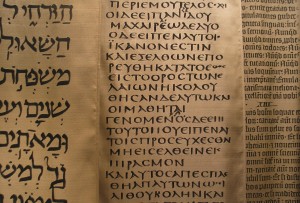
















 Words on the Word