Do bosses over time gradually lose the ability to rightly estimate how other perceive them? Yes, according to a recent article in The Economist:
So not only do bosses set too much store by their strengths, as our Schumpeter column notes, they also habitually overestimate their ability to win respect and support from their underlings. Somehow, on reaching the corner office, they lose the knack of reading subtle cues in others’ behaviour: in a further experiment Mr Brion found that when a boss tells a joke to a subordinate, he loses his innate ability to distinguish between a real and fake smile.
Read the whole article (“Deluded Bosses: Who’s Behind Me?”) here.
I wonder if this is more an issue in the corporate world than in the church, although I suppose it’s true that any leader could be prone to this phenomenon.
It reinforces the importance of regular evaluation in organizations (especially large ones)–as well as making sure that there are accessible systems and processes in place for folks to meaningfully offer input.
This week in Greek Isaiah in a Year covers (covered!) Isaiah 37:26-38:11. Here are the readings for each day:
Below is the text from R.R. Ottley’s Book of Isaiah According to the Septuagint, first in Greek, then with his English translation. Ottley is also here in Logos (reviewed here) and here as a free, downloadable pdf in the public domain. The full reading plan for our group is here (pdf).
26 Hast thou not heard long since of these things that I have done? from ancient days have I ordained it, and now have I shown it forth, to make nations in strong places desolate, and them that dwell in strong cities.
27 I slackened their hands, and they were withered up, and became as green grass upon house-tops, and as wild couch-grass.
28 But now I know thy resting place, and thy going out, and thy coming in.
29 But thy rage with which thou ragest, and thy bitterness, have come up toward me, and I will put a muzzle on thy nose, and a bit in thy lips, and will turn thee back by the way by which thou camest.
30 And this is the sign to thee; eat, for this year, what thou hast sown, and in the second year that which is left; and in the third year sow and reap ye, and plant vineyards, and ye shall eat the fruit thereof.
31 And there shall be they that are left in Judah, they shall strike root downward, and bear seed upward.
32 For they that are left shall go forth from Jerusalem, and they that are saved upon mount Zion; the jealousy of the Lord of Hosts will do this.
33 Therefore thus saith the Lord against the king of the Assyrians, He shall not come into this city, nor cast a spear against it, nor bring up a shield against it, nor compass it with a trench,
34 But by the way that he came, by it shall he return. Thus saith the Lord,
35 I will hold a shield before this city, to save it, for mine own sake, and for David my servant’s sake.
36 And there went forth an angel of the Lord, and destroyed out of the camp of the Assyrians an hundred and fourscore and five thousand; and men arising early found all the dead bodies.
37 And Sennacherib king of the Assyrians turned, and departed, and dwelt at Nineveh.
38 And as he was worshipping the god of his fathers in the house of Nisroch, Adrammelech and Sharezer his sons smote him with swords; but they made good their escape into Armenia; and Esarhaddon his son reigned in his stead.
38 1 And it came to pass at that time, Hezekiah fell sick unto death; and Isaiah the prophet, the son of Amoz, came unto him, and said unto him, Thus saith the Lord, Give orders concerning thine house; for thou diest, and shalt not live.
2 And Hezekiah turned his face to the wall, and prayed unto the Lord,
3 Saying, Remember, O Lord, how I have walked before thee with truth, with a true heart, and have done that which is pleasing in thy sight; and Hezekiah wept with great weeping.
4 And the word of the Lord came to Isaiah, saying,
5 Go, and tell Hezekiah, Thus saith the Lord, the God of David thy father, I have heard the voice of thy prayer, and have seen thy tears; behold, I add unto thy time fifteen years:
6 And I will save thee out of the hand of the king of the Assyrians, and I will hold a shield before this city.
7 And this is the sign to thee from the Lord, that God will accomplish this word.
8 Behold, I turn the shadow of the steps, down which the sun has gone, the ten steps of the house of thy father; I will turn the sun back the ten steps. And the sun went up (again) the ten steps, down which the shadow had gone.
9 A song. Prayer of Hezekiah king of Judah, when he had fallen sick, and arisen from his sickness.
10 I said, At the height of my days, in the gates of hell I shall leave the residue of my years.
11 I said, I shall no more see the salvation of God in the land, I shall no more see man.
See here for more resources and links to texts for Greek Isaiah.
KRISTA DALTON (Thursday, July 25th, http://kristadalton.com/blog/)
5 Gog and his Not-so-Merry Grasshoppers
6 Bird Droppings, Stoned Elephants, and Exploding Dragons
ABRAM K-J (Saturday, July 27th, https://abramkj.com/) 7 E Pluribus Unum
8 The Septuagint behind the New Testament
AMANDA MacINNIS (Wednesday, July 31st, http://cheesewearingtheology.com/)
11 God’s Word for the Church
12 The Man of Steel and the Man who Worshipped the Sun
There still (shocking!) aren’t that many books about the Septuagint, so I’m sure this will be a welcome addition. Law writes on his blog, “I shall not rest until there is a Septuagint in the hand of every woman, man, girl and boy.”
I think he’s kidding (but not sure about this), but TML loves his LXX. I’m looking forward to being part of the review. More to follow here.
I watched the television show Saturday Night Live just about every week in the early 1990s, one of its best eras, in my opinion. One of the regular features was “Deep Thoughts by Jack Handy.” Jack Handy would read a pithy statement as its text scrolled across the screen, set to some relaxing piano music and an image of various nature scenes in the background—a beach, some mountains, etc.
The thoughts were all farcical. One of the most memorable ones was,
If God lives inside us, like some people say, I sure hope he likes enchiladas, because that’s what he’s getting.
The apostle Paul is one of those people who says God lives inside us. Jack Handy implicitly raises the question—what does that really mean?
Paul writes in Galatians 2:20, “I have been crucified with Christ and I no longer live, but Christ lives in me. The life I live in the body, I live by faith in the Son of God, who loved me and gave himself for me.”
This is one of the most theologically dense parts of Galatians, especially so far. What does it mean that Christ lives in me?
In this post I’ll offer an attempt at answering that question, based on my sermon last Sunday. To that end I’ve reproduced the text of Galatians 2:11-21 with my comments below.
The play-by-play: high school cafeteria and (almost) Matt Damon-style
Gal 2:11 When Peter came to Antioch, I opposed him to his face, because he was clearly in the wrong.
One writer notes that this phrase Paul uses, “opposed him to his face,” is used in the Old Testament for situations where a people successfully wards off an invading army. Paul looks at Peter as an imperial oppressor. Translation: Paul’s getting ready to throw down.
Gal 2:12 Before certain men came from James, he used to eat with the Gentiles. But when they arrived, he began to draw back and separate himself from the Gentiles because he was afraid of those who belonged to the circumcision group. 13 The other Jews joined him in his hypocrisy, so that by their hypocrisy even Barnabas was led astray.
Mean Girl
It’s like the high school cafeteria all over again! You’re willing to sit with the kids at the awkward people table, until someone you’re trying to impress comes along and sees you, then all of a sudden… “I’m not sitting here! These aren’t my people!”
It’s a similar dynamic here. Some men came from James, one of the big leaders in the Christian church in Jerusalem. All of a sudden, Peter is afraid to eat with Gentiles. There were Jewish purity laws on the books that called for Jew and Gentile to eat separately, but in Christ, Jew and Gentile were supposed to already be one at this point. Which is why Peter was eating with them in the first place.
So Paul calls him out for changing on that:
Gal 2:14 When I saw that they were not acting in line with the truth of the gospel, I said to Peter in front of them all, “You are a Jew, yet you live like a Gentile and not like a Jew. How is it, then, that you force Gentiles to follow Jewish customs?
How can you make people follow what you yourself don’t follow, Paul says? They were “not acting in line with the truth of the gospel.” I love this—the Gospel, according to Paul, is not just something you believe. Not just a set of propositions, though it does include that. It’s a way of life! And Peter is not living that life here.
This is Peter! You may know him from such works as 1 Peter… and 2 Peter. He’s a big deal:
But he wasn’t acting according to the Gospel.
If look back at Galatians 1:8, Paul has said, “But even if we or an angel from heaven should preach a gospel other than the one we preached to you, let him be eternally condemned!” Even if we or an angel from heaven… or the apostle Peter should preach a gospel other than the one we preached…! Strong words for Peter here. You get the sense this is about to turn into a Matt Damon action movie.
Gal 2:15 “We who are Jews by birth and not ‘Gentile sinners’ 16 know that a man is not justified by observing the law, but by faith in Jesus Christ. So we, too, have put our faith in Christ Jesus that we may be justified by faith in Christ and not by observing the law, because by observing the law no one will be justified.
This “Gentile sinners” is sarcastic. Of course, Paul is saying, we’re all sinners. We all fall short of God’s standards.
But we are not made right with God by what we do. We’ve already seen Paul address this as a major theme in the letter. The grace of God in Christ wasn’t enough for the Galatians, who were being led astray by other teachers. They wanted to add to the requirements one had to fulfill to get right with God.
Three times in verse 16 Paul says—not justified by observing the law. We’re not reconciled with God that way. Three times in verse 16 Paul says, it’s by “faith in Jesus” that we can stand before God.
Gal 2:17 “If, while we seek to be justified in Christ, it becomes evident that we ourselves are sinners, does that mean that Christ promotes sin? Absolutely not! 18 If I rebuild what I destroyed, I prove that I am a lawbreaker. 19 For through the law I died to the law so that I might live for God.
The law, in other words, is dead to me. Requirements of ritual, keeping days like the Sabbath—Paul will say elsewhere those are still good things! They’re just not what justifies a person—makes a person right—before God.
An answer for Jack Handy
20 I have been crucified with Christ and I no longer live, but Christ lives in me. The life I live in the body, I live by faith in the Son of God, who loved me and gave himself for me. 21 I do not set aside the grace of God, for if righteousness could be gained through the law, Christ died for nothing!”
Again, a person isn’t righteous—or made right, holy—because of things they’ve done; it’s because of what Jesus has done.
And here we’re back to Jack Handy—“If God lives inside us, like some people say….”
What is Paul getting at?
What he doesn’t mean is that we’re robots, somehow brainwashed, sterilized, and taken over by some sort of Divine Control. We still have personality. We still have these bodies. These bodies are good—all that God has created is good.
But we also know that these bodies and these personalities aren’t all that they could be.
There is the story of John Newton—a sailor and slave trader in the 18th and early 19th century. He talked about sinning “with a high hand.” “I made it my study,” he said, “to tempt and seduce others” to sin.
After a dramatic conversion on a boat that was fast filling with water in the middle of the night, Newton went on to become an Anglican clergyman and slave trade abolitionist. And he gave us one of the best-known and well-loved hymns of all time: “Amazing Grace.”
“I am not what I might be,” he once wrote, “I am not what I ought to be, I am not what I wish to be, I am not what I hope to be; but I thank God I am not what I once was, and I can say with the great apostle, ‘By the grace of God I am what I am.'”
I have been crucified with Christ and I no longer live, but Christ lives in me.
Even if we don’t have a story as dramatic as Paul’s or John Newton’s, we who have turned to Jesus can say with Newton, “I once was blind, but now I see.” “I have been crucified with Christ and I no longer live”—it’s the death of the “old me.”
“Out with the old, in with the new.” As one commentator puts it, “The old life of self-effort has been condemned and put on the cross.”
To put it another way (as this truth has captivated musicians and lyricists throughout the ages): “My sin… not in part, but the whole… is nailed to the cross, and I bear it no more!”
I have been crucified with Christ and I no longer live.
But I’m not dead—there’s still a self here. It’s just a self that Christ inhabits, lives in. Christ lives in me.
Samuel Ngewa, a Kenyan seminary professor, writes, “This experience is difficult to define…But the meaning is clear. Christ so dominates Paul’s whole experience that Christ-likeness is all that is seen in him.”
Christ lives in me.
Having been changed by grace, we are transformed by Jesus, inside and out. Christ lives in us, and “Christ-likeness is all that is seen in [us].”
But it’s not just personal!
Looking at the rest of Gal. 2:20: The life I live in the body, I live by faith in the Son of God, who loved me and gave himself for me.
Faith is personal, on the one hand—I believe the promises of Jesus. I believe that what God says about himself is true. I believe that what God says God will do… God will do.
And to live life by faith is a highly social activity, too. It’s not just “Jesus and Me.”
Remember that Paul’s theologizing here arose out of that high school cafeteria lunch scene—Peter was not living out the Gospel in his interactions with others.
To “live by faith in the Son of God” means to live by faith in my interactions with others. It means to remember that Christ lives in me and to live like it!
One of the ways I’ve tried to do that is through short phrases I call to mind, prayers I pray in the midst of a situation that calls for faith.
Alcoholic Anonymous arms themselves does a similar thing (and they do it well), using short phrases in the time of struggle. “Easy Does It.” “First Things First.” “One Day at a Time.”
Here are some others, as we try to live life by faith in Jesus: “Lord, show me your will.” Or maybe God’s will seems to be clear in a situation, so we’d do better to pray, “Not my will but yours be done.”
Or just a simple, “Jesus, you live in me.” A prayer of affirmation to God that is also a reminder of who I am. “Jesus, you live in me.”
“God, please give me strength.”
Many other short go-to prayers we could commit to pray—perhaps starting this week.
Because we have been crucified with Christ, it is not just we who live, but Christ-in-us. We have been transformed through and through.
This is the Gospel that Paul so eagerly upholds in Galatians. This is the Gospel he calls them to, that in those moments when they are tempted to rely on what they can do in a given situation, they would call instead on Jesus, who lives in them, who has saved them, and who continues his saving work each day.
The Revised Common Lectionary is going through Galatians in six weeks, and I’m preaching on it. See my first Galatians post (Your Grace is Enough?) on Galatians 1:11-12 here. My second (Your Christian testimony has no shock value? No matter–it’s still compelling) is on Galatians 1:11-24, and is found here.
When our five-year-old son was younger, about two, his favorite movie was Cars, by Pixar. In that movie, race car Lightning McQueen finds himself stuck in a small town the week before his big Piston Cup race. He befriends an old pickup truck named Mater, who is voiced by Larry the Cable Guy.
Mater declares himself to be, among other things, “the world’s best backwards driver.” He shows Lightning his skills, using his rear-view mirrors to look behind him and quickly drive backwards through town and over various obstacles. “Don’t need to know where I’m going,” Mater says to an impressed Lightning, “Just need to know where I’ve been.”
Where have you been? What’s your story?
There’s power in our stories; there’s power in a good and compelling story. Paul knows that, and so in the second half of Galatians 1, he tells the Galatian churches his story.
He preached the Gospel in Galatia—that Jesus “gave himself for our sins to rescue us” (v. 4) and that “God the Father… raised him from the dead” (v. 1).
But this Gospel wasn’t enough. The Galatian Christians came under the influence of some teachers who said the Galatians needed not just faith in Jesus, but steadfast observance of Jewish rituals in order to be truly at peace with God. These teachers tried to undermine Paul’s authority.
So Paul tells them a story—his story. “You have heard of my previous way of life in Judaism,” he says in verse 13, “how intensely I persecuted the church of God and tried to destroy it. I was advancing in Judaism beyond many Jews of my own age and was extremely zealous for the traditions of my fathers.” Paul had been so zealous for his faith that he tried to root out and destroy people of any other faith. He treated Christians with violence, and “breathed murderous threats” against them.
The Conversion of St. Paul, Caravaggio, 1600
Then God intervened. Acts 9 tells the story of Paul (then called Saul) heading to Damascus to find some Christians to imprison. He’s on his way, part excited, part bloodthirsty, listening to Slayer or Pantera or Wolves in the Throne Room or some other heavy metal to get him pumped up. And then—a bright light from heaven flashes all around him. He gets knocked to the ground and hears a voice, “Saul, Saul, why are you persecuting me?” It’s the voice of Jesus. “Now get up and go into the city, and you will be told what you must do.”
Paul goes to Damascus, still reeling from the vision and unable to see, eat, or drink, and finds a man named Ananias who restores his sight, baptizes him, and sends him on his way, a new man.
This account is what one reader of this passage called a “Biography of Reversal.” It’s a biography of major reversal.
Where have you been? What’s your story?
Well, mine’s not quite like that. I always wanted a conversion story like Paul’s. I remember in high school when I first learned about giving a “testimony.” I didn’t think I had much to say. The questions were always—what was your life like before Christ? How did God intervene? What is your new life in Jesus like now?
I grew up in a Christian home, two pastors for parents, and as an oldest child, was a pretty well-behaved pastor’s kid. I do remember saying a prayer when I was four to ask Jesus to be God of my life, and then a recommitment to Christ in 8th grade. But nothing flashy. I wished I had a testimony like Paul’s, or like that big-name speaker at the youth rally: I was into drugs—not just doing them but selling them– and went to clubs till 3am every night, was in a gang… and then I got saved!
And here’s Paul—persecuted others, tried to destroy them, violent… then a bright light and a loud, booming voice!
It’s a great testimony, a great conversion story.
But Paul wants to point beyond the conversion itself, and to the person who is behind the conversion. Paul has this incredible testimony, but if he were here explaining this letter to us this morning, I bet he’d say—don’t get too caught up in remarkable reversal in me… give praise to the God who orchestrated it! –The God who is behind every testimony, whether it’s the testimony of a well-behaved pastor’s kid or of an ex-murderer.
This God, Paul says in verses 15 and 16 does four things–with Paul, with an ex-gang member, with anyone who comes to faith in Christ.
First, God sets his people apart from birth. God has knit each of us together in our mother’s wombs (Psalm 139:13).
Second, God calls us by his grace, by his undeserved favor. St. Patrick put it like this: “I was like a stone lying in deep mud, but he that is mighty placed me on top of the wall.” A stone that is stuck in mud has no way of pulling itself out—someone has to come along and do that. God has called us, pulled us out of our mud, by his grace.
Third, God has been pleased to reveal his Son in us. It really gives him joy to do that! It’s like a highlight of his day, this act of showing us Jesus.
Fourth, this is so that we might share the good news of Jesus with others. Jesus said, “Let your light so shine before others, that they may see your good deeds and glorify your Father, who is in heaven.” We do this, in part, by living lives that bear fruit (a testimony to grace), which Paul will elaborate on later in the letter.
Like Mater from the movie Cars, Paul knows where he’s been. His aim in the second half of Galatians 1 is to say that whoever he is, wherever he has been—that is ultimately rooted in the gracious initiative of God. “Grace means you’re in a different universe from where you had been stuck,” author Ann Lamott writes, “When you had absolutely no way to get there on your own.”
This is what makes our stories in Christ compelling—not the details of what we’ve done or haven’t done, but who has been there with us, all along… setting us apart, calling us by grace, and revealing his Son Jesus in us. This is a compelling story. Those of us who have said yes to Jesus have powerful testimonies, because the one who stands behind our testimony is powerful.
The Revised Common Lectionary is going through Galatians in six weeks. Two Sundays ago (June 9) was the second Sunday, covering Galatians 1:11-24. The above is excerpted from the sermon I preached on that passage. See my first Galatians post (Your Grace is Enough?) on Galatians 1:11-12 here.
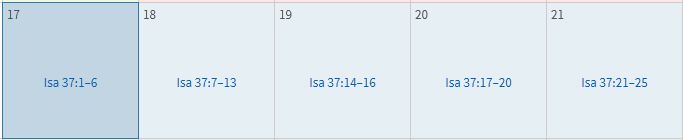
This week in Greek Isaiah in a Year covers Isaiah 37:1-25. Here are the readings for each day:
Below is the text from R.R. Ottley’s Book of Isaiah According to the Septuagint. Ottley is also here in Logos (reviewed here) and here as a free, downloadable pdf in the public domain. The full reading plan for our group is here (pdf).
What you’re seeing above is an internal beta for Accordance 10.x for Windows, running in Windows 8. Yes, Accordance, which has been exclusively on Apple platforms since it was launched in 1994, is coming to Windows. This is the second internal beta released in as many weeks. Although an exact release date (beyond simply 2013) has not yet been announced, the build I have is already starting to impress.
Read Rick’s whole post here. So far I like what I’ve seen, too.
To all my teacher and student friends who are still going with school… the below is adapted from an e-devotional I wrote that went out over email to Gordon students in December 2011.
It may seem strange to talk about Sabbath-keeping during end-of-the-semester crunch time. Who has any time to spare for rest, let alone a whole day?
Last week I was reading from Exodus during Morning Prayer, with the people with whom my family lives in intentional community. Exodus 34:21 jumped out at me, “Six days you shall labor, but on the seventh day you shall rest; even during the plowing season and harvest you must rest.”
Regardless of our familiarity with agrarian lifestyles and metaphors, this text speaks to us of a God who invites his people into rest. Sabbath-keeping, as with all of God’s commandments, brings life to those who keep it. Even during the plowing season and harvest you must rest.
You all are in the midst of final papers and exams—you likely can’t just up and take a day off, since that might mean missing an important exam. But you can seek pockets of rest, times to sit down in God’s presence and ask for him to guide you through all your comings and goings. If Israel must rest even during their plowing season and harvest, we ought to seriously consider following this timeless pattern, taking rest even during our busiest seasons.
So close your email. Go to bed (especially if you’re reading this at 3am). Go outside and walk around (even if it’s raining). Go eat a snack and talk to a friend. Some of you will need more encouragement to this than others, of course, but heed well God’s life-giving words. Even during Finals week, we must rest.
This week in Greek Isaiah in a Year covers Isaiah 35:6-36:17. Here are the readings for each day:
Monday, June 10, 2013=Isa 35:6-10
Tuesday, June 11, 2013=Isa 36:1-6
Wednesday, June 12, 2013=Isa 36:7-12
Thursday, June 13, 2013=Isa 36:13-17
Friday, June 14, 2013=Isa 36:18-22
Below is the text from R.R. Ottley’s Book of Isaiah According to the Septuagint. Ottley is also here in Logos (reviewed here) and here as a free, downloadable pdf in the public domain. The full reading plan for our group is here (pdf).


















 Words on the Word