Amazon “cracking down” on reviewers… but not really

five stars

From the Sunday New York Times:

After several well-publicized cases involving writers buying or manipulating their reviews, Amazon is cracking down. Writers say thousands of reviews have been deleted from the shopping site in recent months.

Amazon has not said how many reviews it has killed, nor has it offered any public explanation. So its sweeping but hazy purge has generated an uproar about what it means to review in an era when everyone is an author and everyone is a reviewer.

The world of reviewing is certainly open to abuse and violations of ethics. (Not long ago I read a story about a British mystery writer who, under a fake name, wrote torching reviews of his competitor’s works, praising instead his own.)

So I understand the desire to regulate here. But what’s odd to me is this quote from an Amazon spokesman:

We do not require people to have experienced the product in order to review.

It would be difficult to prove “experience” of the product one way or the other, but I certainly don’t put any stock in reviews that say, “I haven’t read this yet, but….”

As one commenter on this article noted, what I often find most helpful in shopping on Amazon–whether for books or other products–is the negative reviews.

That doesn’t mean that 5-star reviews, however, are not all to be trusted. There’s a bit of self-selection that goes on here. To wit, I tend to only request review copies of books that I think will be worth my time, so my ratings are most often four and five stars. But honesty comes first, so three stars and lower is not out of the question, and has happened before. And I am not always right that I book I want to review ends up being as good as I might have thought.

It’s a no-brainer to me that someone ought “to have experienced the product” before reviewing it. But what are some other principles of reviewing that should constitute a good ethic for product reviews?

Going for the Gold (base package) in Logos 5

It’s been interesting to watch Bible software companies make a final sales push before Christmas–Logos and Accordance seem to have been the most active that I’ve noticed. I’ve compared the “Big Three” Bible softwares here, which is hopefully of help to someone trying to decide which Bible software program is best for her or him.

Focusing for a moment again on Logos: I wrote a multi-part review of Logos 4 here, then did a review of Logos 5 when it released on November 1. At that time I had the Silver base package to review. I’ve now received a review copy of Gold, so here I offer some initial observations on that base package.

Everything in Silver and below comes in Gold. So like Silver, the Gold base package has:

  • Features like Bible Facts, Passage Guide, Bible Word Study, Exegetical Guide, Sermon Starter Guide, Timeline, and so on
  • Clause Search–this deserves its own bullet point; I have written about it here
  • The entire New American Commentary set
  • The Pulpit Commentary set
  • The Lexham Analytical Lexicon to the Septuagint (and to the Greek NT)
  • Greek and English Apostolic Fathers
  • Theological Lexicon of the OT, Theological Lexicon of the NT
  • A new English translation (!) of the Septuagint, The Lexham English Septuagint, which I’ve already been using regularly in my reading through Greek Isaiah in a Year

The Gold base package adds:

There’s more in Gold, so this is just what stands out to me on first use. See the full contents of Gold here. Compare all of the base packages in Logos 5 here.

Perhaps the best I can offer in a review of a base package like this is two implications that stem from my belief that Christians are called to be good stewards of their money:

  1. On the one hand, a package like Gold in Logos 5 really does offer great savings. You couldn’t possibly get all the resources in Logos 5 Gold in print (even used) for the same price. It might not even be close.
  2. On the other hand, one should be cautious not to buy just because there is great savings at hand. The key question is always, what resources will I use, and can I afford them now?

Logos occasionally receives criticism of offering packages that are bloated. Gold does have more than I think I’d want to use in a lifetime, and the “print value” metric is to be taken with a grain of salt, since the real question is of what value will a given resource be to the user. I still have mixed feelings about the new names and groupings found in Logos 5 base packages (as compared to Logos 4). I think it’s an oversight on the part of the company that there is no longer an Original Languages Library advertised on the Website. This was a market-driven decision, from what I understand, but I doubt scholars of Biblical Studies will appreciate it. (The user forums note that you can purchase an original languages package by phoning the sales department at Logos.)

Compatibility issues are also at play in one’s purchasing decisions. Logos for now is the only major Bible software program that can run natively (without an emulator, bottle, etc.) on any platform: Mac, PC, iPad, mobile, etc. It also is set up such that all your resources, notes, and even screen layouts sync automatically across platforms. However I close Logos on my PC is how it looks when I open it back up on my Mac. That kind of flexibility is great to have.

Gold is not a cheap package, but a lot comes with it. It makes a good long-term investment, if you’re comfortable building your library electronically. But using a resource in Logos is much more than just reading a commentary on a Kindle or as a pdf on a computer. References and abbreviations are hyperlinked throughout, and you can use the search features and “Data Sets” in Logos to more fruitfully explore any given resource. So it’s not just library-building, but information sorting, textual analysis, flexible searching of multiple resources, data manipulation, etc.

If as a pastor, professor, seminarian, or Bible translator you do a good amount of research and writing on the Bible, the Gold base package in Logos 5 combines a wealth of resources and features that could be of benefit. I’m especially eager to dig more into the UBS Handbooks, the Exegetical Summaries, the N.T. Wright works, and the Bible Sense Lexicon. I’ll post more about Gold before long. (UPDATE: See concluding part of Gold review here.)

Thanks to Logos for the gratis review copy of Gold, given me with the sole expectation that I review it honestly here on my blog.

Greek Isaiah in a Year, Week 4=Isaiah 3:22-5:16

Prophet IsaiahThere’s something that has seemed appropriate about beginning to read through Isaiah during Advent. At a pace of roughly five verses each weekday, I’ve been reading through Greek Isaiah in a Year with a sizeable group of folks on Facebook.

Tomorrow (Monday) is the start week 4. Below is the schedule and text for Monday through Friday, using the text from R.R. Ottley’s Book of Isaiah According to the Septuagint. (Ottley is here on Amazon, here in Logos, and here as a free, downloadable pdf, since it’s public domain.) The full reading plan for our group is here (pdf).

Also, this last week I reviewed Ottley’s work in Logos. You can read more about that here. And now, the readings. At the end of this post I’m including a link to a pdf of the schedule and text for the week, as well, at the request of one of the group members.

Monday, December 24: Isaiah 3:22-4:1

22 καὶ τὰ ἐπιβλήματα τὰ κατὰ τὴν οἰκίαν καὶ τὰ διαφανῆ Λακωνικά, 23 καὶ τὰ βύσσινα καὶ τὰ ὑακίνθινα καὶ τὰ κόκκινα, καὶ τὴν βύσσον, σὺν χρυσίῳ καὶ ὑακίνθῳ συνκαθυφασμένα, καὶ θέριστρα κατάκλιτα. 24 καὶ ἔσται ἀντὶ ὀσμῆς ἡδείας, κονιορτός, καὶ ἀντὶ ζώνης σχοινίῳ ζώσῃ, καὶ ἀντὶ τοῦ κόσμου τῆς κεφαλῆς τοῦ χρυσίου φαλάκρωμα ἕξεις διὰ τὰ ἔργα σου, καὶ ἀντὶ τοῦ χιτῶνος τοῦ μεσοπορφύρου περιζώσῃ σάκκον. 25 καὶ ὁ υἱός σου ὁ κάλλιστος ὃν ἀγαπᾷς μαχαίρᾳ πεσεῖται, καὶ οἱ ἰσχύοντες ὑμῶν μαχαίρᾳ πεσοῦνται καὶ ταπεινωθήσονται· 26 καὶ πενθήσουσιν αἱ θῆκαι τοῦ κόσμου ὑμῶν, καὶ καταλειφθήσῃ μόνη καὶ εἰς τὴν γῆν ἐδαφισθήσῃ.

4 καὶ ἐπιλήμψονται ἑπτὰ γυναῖκες ἀνθρώπου ἑνὸς λέγουσαι Τὸν ἄρτον ἡμῶν φαγόμεθα, καὶ τὰ ἱμάτια ἡμῶν περιβαλούμεθα· πλὴν τὸ ὄνομα τὸ σὸν κεκλήσθω ἐφʼ ἡμᾶς, ἄφελε τὸν ὀνειδισμὸν ἡμῶν.

Tuesday, December 25: Isaiah 4:2-6

Τῇ δὲ ἡμέρᾳ ἐκείνῃ λάμψει ὁ θεὸς ἑν βουλῇ μετὰ δόξης ἐπὶ τῆς γῆς, τοῦ ὑψῶσαι καὶ δοξάσαι τὸ καταλειφθὲν τοῦ Ἰσραήλ· καὶ ἔσται τὸ ὑπολειφθὲν ἐν Σιὼν καὶ τὸ καταλειφθὲν ἐν Ἰερουσαλήμ, ἅγιοι κληθήσονται πάντες οἱ γραφέντες εἰς ζωὴν ἐν Ἰερουσαλήμ. ὅτι ἐκπλυνεῖ Κύριος τὸν ῥύπον τῶν υἱῶν καὶ τῶν θυγατέρων Σιών, καὶ τὸ αἷμα ἐκκαθαριεῖ ἐκ μέσου αὐτῶν ἐν πνεύματι κρίσεως. καὶ ἥξει, καὶ ἔσται πᾶς τόπος τοῦ ὄρους Σιὼν καὶ πάντα τὰ περικύκλῳ αὐτῆς σκιάσει νεφέλη ἡμέρας, καὶ ὡς καπνοῦ καὶ ὡς φωτὸς πυρὸς καιομένου νυκτός· πάσῃ τῇ δόξῃ Κυρίου σκεπασθήσεται· καὶ ἔσται εἰς σκιὰν ἀπὸ καύματος, καὶ ἐν σκέπῃ καὶ ἐν ἀποκρύφῳ σκληρότητος καὶ ὑετοῦ.

Wednesday, December 26: Isaiah 5:1-7

5 ᾌσω δὴ τῷ ἠγαπημένῳ ᾆσμα τοῦ ἀγαπητοῦ τῷ ἀμπελῶνί μου. ἀμπελὼν ἐγενήθη τῷ ἠγαπημένῳ ἐν κέρατι ἐν τόπῳ πίονι. καὶ φραγμὸν περιέθηκα καὶ ἐχαράκωσα, καὶ ἐφύτευσα ἄμπελον σωρήχ, καὶ ᾠκοδόμησα πύργον ἐν μέσῳ αὐτοῦ, καὶ προλήνιον ὤρυξα ἐν αὐτῷ· καὶ ἔμεινα τοῦ ποιῆσαι σταφυλήν, ἐποίησεν δὲ ἀκάνθας. καὶ νῦν, ἄνθρωπος τοῦ Ἰούδα καὶ οἱ ἐνοικοῦντες ἐν Ἰερουσαλήμ, κρίνατε ἐν ἐμοὶ καὶ ἀνὰ μέσον τοῦ ἀμπελῶνός μου. τί ποιήσω ἔτι τῷ ἀμπελῶνί μου, καὶ οὐκ ἐποίησα αὐτῷ; διότι ἔμεινα τοῦ ποιῆσαι σταφυλήν, ἐποίησεν δὲ ἀκάνθας. νῦν δὲ ἀναγγελῶ ὑμῖν τί ποιήσω τῷ ἀμπελῶνί μου. ἀφελῶ τὸν φραγμὸν αὐτοῦ καὶ ἔσται εἰς διαρπαγήν, καὶ καθελῶ τὸν τοῖχον αὐτοῦ καὶ ἔσται εἰς <καταπάτημα>. καὶ ἀνήσω τὸν ἀμπελῶνά μου, καὶ οὐ μὴ τμηθῇ οὐδὲ μὴ σκαφῇ, καὶ ἀναβήσεται εἰς αὐτὸν ὡς εἰς χέρσον ἄκανθα. καὶ ταῖς νεφέλαις ἐντελοῦμαι τοῦ μὴ βρέξαι εἰς αὐτὸν ὑετόν. ὁ γὰρ ἀμπελὼν Κυρίου σαβαὼθ οἶκος τοῦ Ἰσραήλ ἐστιν, καὶ ἄνθρωπος τοῦ Ἰούδα νεόφυτον ἠγαπημένον· ἔμεινα τοῦ ποιῆσαι κρίσιν, ἐποίησεν δὲ ἀνομίαν, καὶ οὐ δικαιοσύνην ἀλλὰ κραυγήν.

Thursday, December 27: Isaiah 5:8-11

Οὐαὶ οἱ συνάπτοντες οἰκίαν πρὸς οἰκίαν, καὶ ἀγρὸν πρὸς ἀγρὸν ἐγγίζοντες, ἵνα τοῦ πλησίον ἀφέλωνταί τι· μὴ οἰκήσετε μόνοι ἐπὶ τῆς γῆς; ἠκούσθη γὰρ εἰς τὰ ὦτα Κυρίου σαβαὼθ ταῦτα· ἐὰν γὰρ γένωνται οἰκίαι πολλαί, εἰς ἔρημον ἔσονται· μεγάλαι καὶ καλαί, καὶ οὐκ ἔσονται οἱ ἐνοικοῦντες. 10 οὗ γὰρ ἐργῶνται δέκα ζεύγη βοῶν, ποιήσει κεράμιον ἕν, καὶ ὁ σπείρων ἀρτάβας ἓξ ποιήσει μέτρα τρία. 11 Οὐαὶ οἱ ἐγειρόμενοι τὸ πρωὶ καὶ τὸ σίκερα διώκοντες, οἱ μένοντες τὸ ὀψέ· ὁ γὰρ οἶνος αὐτοὺς συγκαύσει.

Friday, December 28: Isaiah 5:12-16

12 μετὰ γὰρ κιθάρας καὶ ψαλτηρίου καὶ τυμπάνων καὶ αὐλῶν τὸν οἶνον πίνουσιν, τὰ δὲ ἔργα Κυρίου οὐκ ἐμβλέπουσιν, καὶ τὰ ἔργα τῶν χειρῶν αὐτοῦ οὐ κατανοοῦσιν. 13 τοίνυν αἰχμάλωτος ὁ λαός μου ἐγενήθη διὰ τὸ μὴ εἰδέναι αὐτοὺς τὸν κύριον, καὶ πλῆθος ἐγενήθη νεκρῶν διὰ λιμὸν καὶ δίψαν ὕδατος. 14 καὶ ἐπλάτυνεν ὁ ᾅδης τὴν ψυχὴν αὐτοῦ καὶ διήνοιξεν τὸ στόμα αὐτοῦ τοῦ μὴ διαλιπεῖν, καὶ καταβήσονται οἱ ἔνδοξοι καὶ οἱ μεγάλοι καὶ οἱ πλούσιοι καὶ οἱ λοιμοὶ αὐτῆς. 15 καὶ ταπεινωθήσεται ἄνθρωπος, καὶ ἀτιμασθήσεται ἀνήρ, καὶ οἱ ὀφθαλμοὶ οἱ μετέωροι ταπεινωθήσονται· 16 καὶ ὑψωθήσεται Κύριος σαβαὼθ ἐν κρίματι, καὶ ὁ θεὸς ὁ ἅγιος δοξασθήσεται ἐν δικαιοσύνῃ.

Here are the week’s readings as a pdf.

See here for more resources and links to texts for Greek Isaiah. Here are previous weeks’ readings: Week 1 / Week 2 / Week 3.

The family bedtime rules

BedrailNot long ago we began instituting “the bedtime rules” for our two boys. The idea was to have a sequence of rules (steps, really) for the boys to follow once in bed that would provide consistency and direction each night. They were:

1. Put your head on your pillow.

2. Close your eyes.

3. Go to sleep.

Our 5-year-old added a couple, so now they read:

1. Put your head on your pillow.

2. Close your eyes.

3. Put your arms and your legs down.

4. Close your mouth.

5. Go to sleep.

Some nights, by the time I’m done with bedtime, I think the bedtime rules really just sound like:

1. Please stop talking.

2. Stop talking.

3. Stop talking right now.

4. Stop talking or I’m not going to sing to you anymore tonight.

5. SHHHH!!!!!

They will put themselves to sleep on their own eventually, right?

A short 3.5-page intro to the Septuagint by Emanuel Tov

Emanuel Tov is J. L. Magnes Professor of Bible at Hebrew University in Jerusalem. Among many other publications, his Textual Criticism of the Hebrew Bible contains a wealth of information for the student of the Septuagint and Hebrew Bible.

On his site there are lots of pdf articles you can read for free. One particularly helpful one is this very short introduction (3.5 pages) to the Septuagint. It covers the name of the Septuagint, its nature and content, date, origin, background, and more.

Works of Richard R. Ottley (3 vols.) in Logos Bible Software

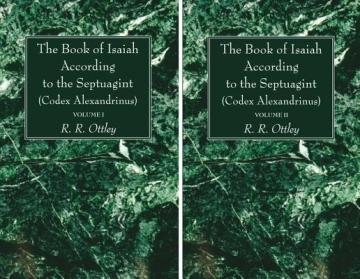
Ottley Isaiah cover

I’ve been using R.R. Ottley’s Book of Isaiah According to the Septuagint as I participate in Greek Isaiah in Year.

The two-volume work is available in print through Wipf & Stock here on Amazon. Or you can download the whole thing here for free as a .pdf, since it’s in the public domain. This will be sufficient for many folks who want to check out this work.

Logos Bible Software also has an edition of Ottley’s work (here), a three-volume Works of Richard R. Ottley. In addition to Book of Isaiah According to the Septuagint, the Logos bundle includes his Handbook to the Septuagint. That work is also free and in the public domain (get it here).

For the kind of close reading I’ve been doing with the Greek Isaiah group, having these texts integrated with the rest of Logos has been quite convenient and a big time-saver.

Volume 1 of Ottley’s Isaiah work has:

  • Introduction
    • Early History of the Septuagint
    • Text of the LXX in Isaiah
    • Methods of Rendering
    • Differences between the LXX and the Hebrew
  • List of Manuscripts containing Isaiah in Greek
  • Parallel Translations

The introduction briefly addresses issues of dating, as well as the various editions of the Greek (the Hexapla, etc.). The “Text of the LXX in Isaiah” section treats in more detail the Greek manuscripts, as well as later translations like the Syro-Hexaplar and Old Latin, which were made from the Greek. Ottley notes that Codex Vaticanus (B) “falls below its usual standard” and is “a worse representative of the LXX than usual,” being “inferior to other extant manuscripts.” Throughout these two volumes, then, he pursues “the question of securing the best available text.”

“Methods of Rendering” in the Introduction compares Septuagint Greek to New Testament Greek (finding “in it much resemblance”), yet Ottley also notes that Septuagint translators saught to keep “various Semitic idioms, and a dim reflection of Semitic arrangement and style.” These are not especially earth-shattering insights for the student of the Septuagint today, but Ottley does provide a helpful tour of the Greek grammar of Isaiah in introductory fashion. He also relates the Greek to the Hebrew it translated:

[The LXX translators] seem to have selected the aorist as the best equivalent for the Hebrew perfect, and the future for the Hebrew imperfect, and used them, when the context did not absolutely forbid, to represent rather than to translate these forms.

As far as differences between the Greek and the Hebrew, Ottley notes omissions, additions (scholars now, I believe, prefer to speak of “minuses” and “pluses,” since “omissions”/”additions” can prejudice the discussion), paraphrases, differences in syntax, and more. He includes a lengthy list of references in illustration of each kind of difference.

The rest of volume 1 is taken up with Ottley’s “Parallel Translations,” where he presents his English translations of the Hebrew and of the Greek side-by-side on different pages. Each page includes several translation footnotes.

Here is where the Logos edition becomes especially handy. Using the Text Comparison tool, I can easily see how Ottley’s English translation of the Greek compares with his English translation of the Hebrew, to get a feel for how the two underlying texts differ:

Ottley English translation comparison

Even with a free .pdf of the work available in the public domain, being able to use Logos’s tools to interact with the text makes it worth having.

Volume 2, then, contains Ottley’s own presentation of Greek Isaiah, with Codex Alexandrinus (A) as “the basis for the Greek text here printed.” As with the Göttingen edition of the Septuagint, Ottley has a critical apparatus at the bottom of the page that notes variants. His is not quite as exhaustive as Göttingen, but neither does it lack detail. In the print edition, following the Greek text are some nearly 300 pages of notes on Greek Isaiah.

And in Logos, one can view all of Ottley’s work on Isaiah at once, together with the Hebrew text and various lexicons (not included with this module). For reading Ottley’s Greek text of Isaiah, I have the Greek scrolling with the critical apparatus and the notes and translation, so that I can simultaneously see all that Ottley has about a given verse. As here:

Ottley in Logos

Note: in the image above I actually have the Göttingen text open, with Ottley right behind it in another tab. For reading through Isaiah, I like to still have a morphologically tagged text going; Ottley is not so tagged. But you can sync everything together so that you barely notice that.

It’s not impossible, of course, to flip back and forth between the pages of a print version, or to scroll back and forth through a free .pdf. But Ottley’s Book of Isaiah According to the Septuagint integrates seamlessly with the rest of Logos. And when reading his Handbook to the Septuagint, any verses or abbreviations are hyperlinked so that you can mouse over them as you read and pop-ups will display with the relevant information.

This three-volume set in Logos is very well done, and easily does things that neither a print copy nor a .pdf can do. Being able to see all of Ottley’s work on a single verse at a glance–as well as compare it with other LXX texts using the Text Comparison tool–is the true highlight of this resource.

The three volume Works of Richard R. Ottley in Logos can be found here. My thanks to Logos for the review copy, provided for the purposes of this review but not with any expectation as to its content. Ottley in Logos has also been a great help to me as the group administrator of Greek Isaiah in a Year.

Advent Wreath! Advent Wreath! Advent Wreath!

advent wreath

“Advent Wreath! Advent Wreath! Advent Wreath!”

This is the mantra my 2-year-old son repeats as soon as bedtime routines begin–and sometimes before that.

Each night since the beginning of Advent, our family has observed Advent together by praying, reading a Bible passage, lighting a candle, and singing a verse and the chorus of “O Come, O Come, Emmanuel.” There is perhaps nothing more heart-warming than hearing our two young boys sincerely belt out, “REJOICE! REJOICE!” each night around the Advent wreath. This will be a family tradition for years to come.

We made the wreath together as a family at our church before Advent. We use it to mark the time as we eagerly anticipate the celebration on Christmas of Christ’s first coming to earth, even as we await and long for his second coming. The waiting and yearning themes of Advent have been particularly appropriate given that we have yet again recently seen the evil we humans are capable of.

For those of you who plan worship services, or like to think deeply about them, the Calvin Institute of Christian Worship has a helpful Advent and Christmas Resource Guide. A reflection from that site says:

In Advent we hear the prophecies of the Messiah’s coming as addressed to us—people who wait for the second coming. In Advent we heighten our anticipation for the ultimate fulfillment of all Old Testament promises, when the wolf will lie down with the lamb, death will be swallowed up, and every tear will be wiped away.

There is something for me to learn from my two-year-old’s persistence as we gather each night. The anticipation with which he comes to our time of prayer (often clapping his hands) is what I want to offer God in this time of waiting.

More on the Connecticut school shooting: the haughtiness of humanity will collapse, says Isaiah

I wondered tonight whether this week’s Greek Isaiah readings might have something to say to the recent school shooting in Connecticut. Indeed, here is Isaiah 2:17-19 (my translation from the Greek):

Then every person will be brought low,
and the haughtiness of humanity will collapse,
and the Lord alone will be exalted in that day.

And they will hide everything that is made by hand,

as they bring them into caves
and into the clefts of rocks
and into the holes of the earth,
from before the fear of the Lord
and from the glory of his strength,
when he rises up to strike the earth.

The word for that which is made by hand (τὰ χειροποίητα) refers to idols. But as I read this I couldn’t help but think of the promise from Psalm 46:

He makes wars cease
to the ends of the earth.
He breaks the bow and shatters the spear;
he burns the shields with fire.

…bows, spears, and shields, of course, all being made by hand. I suggested here that a 21st century way of reading that verse could be something like, “He crushes guns and diffuses bombs, he destroys human weapons of destruction.”

One day either we or God himself will bring all our weapons of destruction–indeed, all our evil inclinations–into “caves” and “into the clefts of rocks and into the holes of the earth,” as we recoil at the glory of God’s strength. He will make wars cease; he will end all senseless violence; he will crush evil and wipe it away from the face of the earth.

Lord, as we mourn in the meantime, please hasten that day.