One of many cool things about Carta’s Sacred Bridge atlas is its use of original/source languages.
For example, when The Sacred Bridge (TSB) cites Eusebius’s Onomasticon (a 4th century list of Bible place names), it does so both in its original Greek and in English translation.
This, of course, got me to wondering about Eusebius in Greek. Using The Sacred Bridge in Accordance, I can easily pull up all the times TSB cites Eusebius (more on this later).
Then I wanted to know where to find more Onomasticon in Greek.
After a short hunt, I found this digital edition of the Onomasticon in Greek. I thought I would pass it on in case anyone else using the atlas in English wanted to be able to access the Greek.
Eusebius’s Onomasticon (in English translation, and with English translation of Jerome’s Latin translation/expansion of Eusebius) is here in Accordance, here on Carta’s site, and here at Eisenbrauns, Carta’s North American distributor.
Here’s another quick tip for Accordance users. This one has been there a long time, but I just noticed:
My most regular use of General Tools in Accordance (Bible dictionaries, books, etc.) is to search them for each week’s passage that I’m preaching on. For example, I’ll search the IVP Dictionary of Jesus and the Gospels first by Scripture reference and then by English content and/or section heading. (The tool may have information relevant to me that is best found with one or the other search.)
I already was aware that you could add a second search field for an “AND” search, but I just realized yesterday that you can also select “OR” (from a drop-down menu) before you select your second search field and term:
So now in one search setup (which I can save for next time), I can have this Accordance tool return hits for every time it mentions either Matthew 28 by reference or the Great Commission in the English content… and even throw in another “or” of “Discipleship” in the Entry field (dictionary section titles).
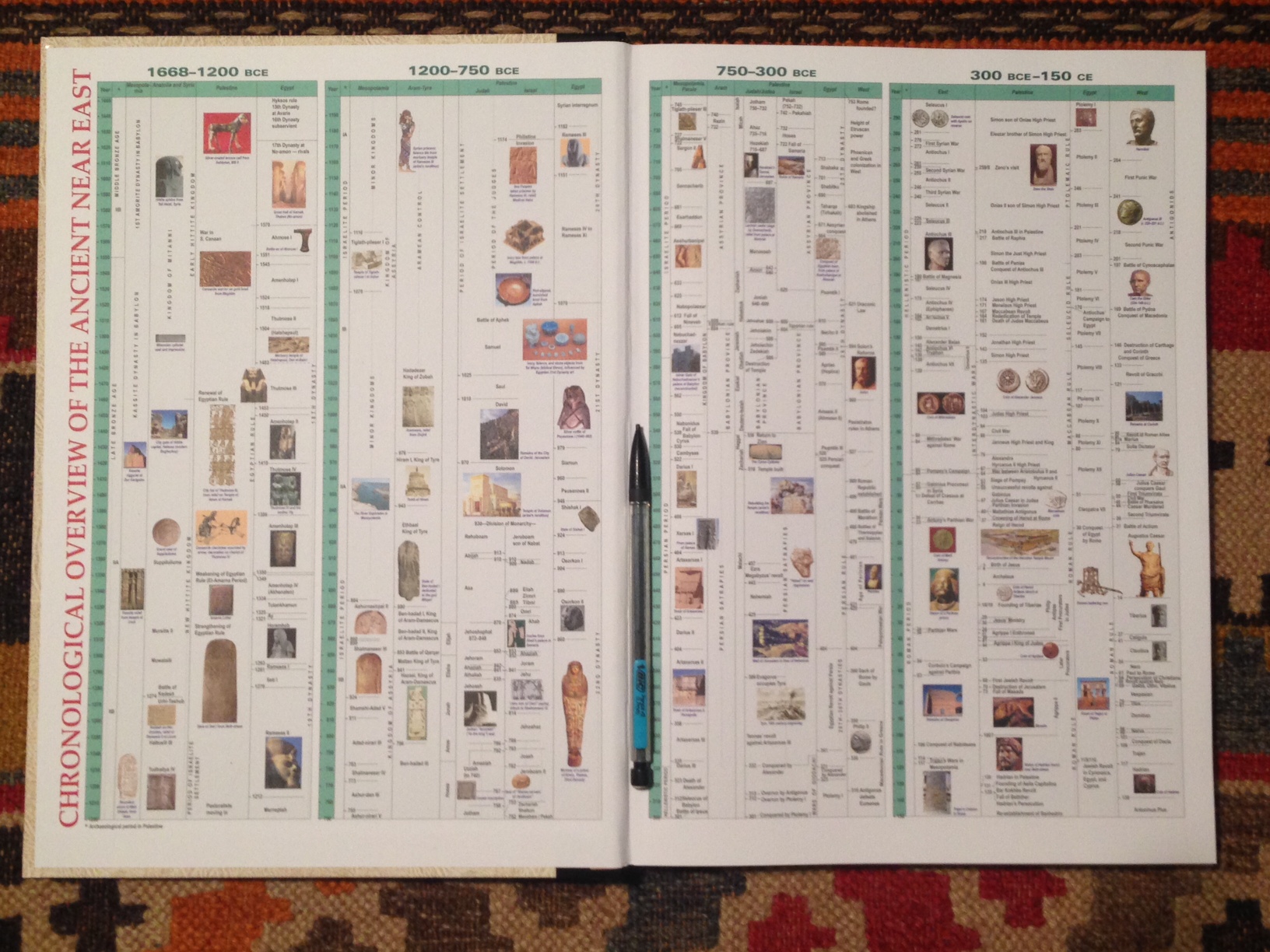
The one kind of blog post I’ve deliberately avoided till now is the “In the Mail” post. I have my reasons for this, but that’s not the point of this post. I simply wanted to say that the book I received in the mail the other day might be the first one that caused me to say, “Whoa,” when I opened to the front inside cover.
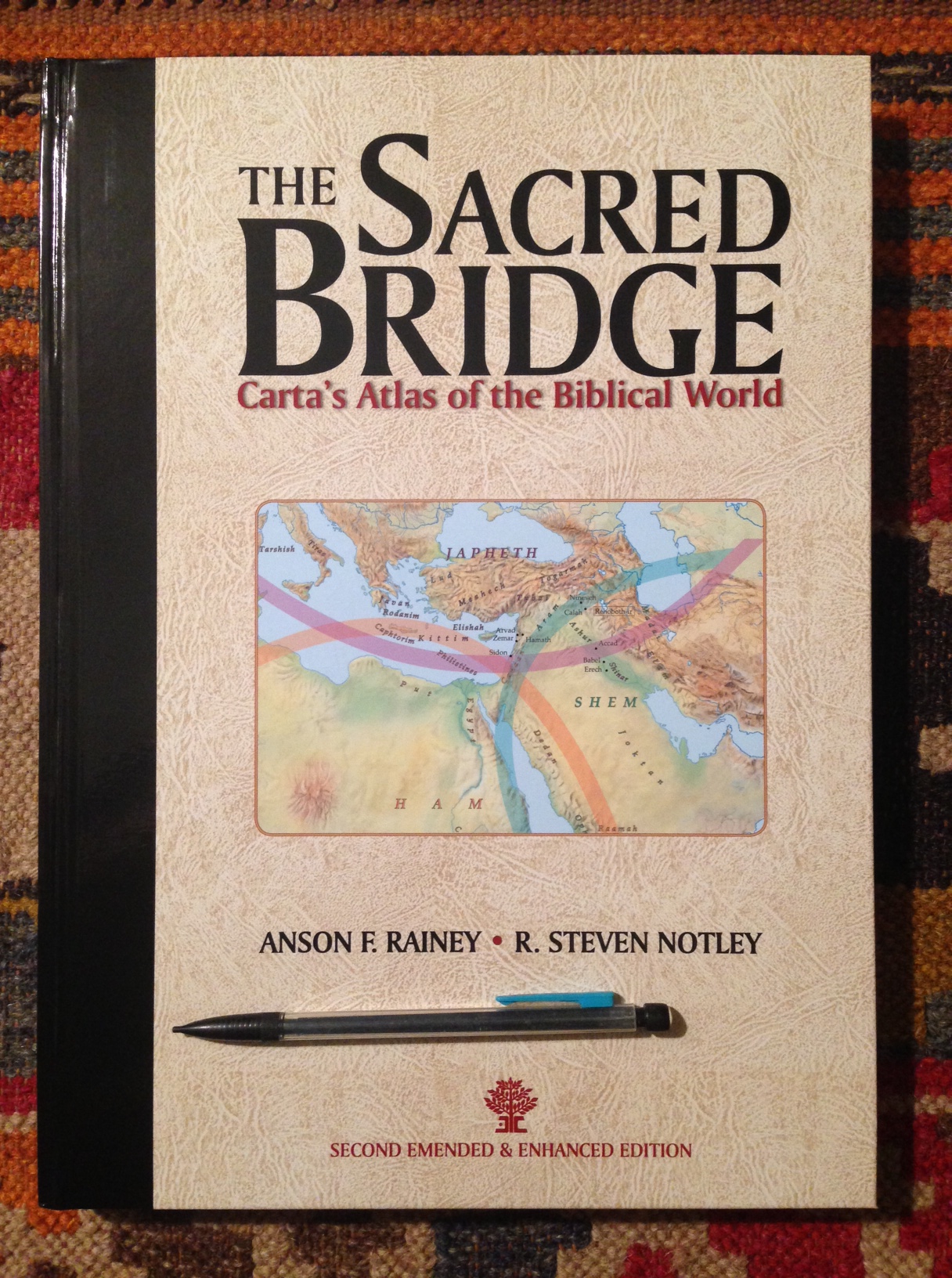
For future review I’ve received The Sacred Bridge: Carta’s Atlas of the Biblical World. This is the “Second Emended & Enhanced Edition” (copyright 2014). Here it is:
Carta Jerusalem, its publisher, describes the atlas in this way:
The Sacred Bridge will be the Bible Atlas of Record and Standard Work for the coming decades. Exhaustive in scope and rich in detail, with its comprehensive documentation of the Near Eastern Background to Biblical History, this latest Bible Atlas from Carta is one more stepping stone on the way to the study and understanding of the Holy Scriptures.
And:
This is the first Atlas to adopt the modern approach to the study of the Levant as a geographical/historical entity. Emphasis throughout the current work is on the ancient written sources – every ancient passage is interpreted firsthand, from its native language. Archaeological evidence has been taken into account whenever it is relevant.
Here is what’s inside the cover. You won’t be able to see much detail in the image (click image or open in new tab for larger), but it will give you an idea of the kind of thoroughness that seems to exist throughout the atlas. And that’s before you even get to the atlas itself.
I’m looking forward to digging in. It’s a beautiful, massive atlas, with a lot of text and full-color images packed into its large pages. The binding appears to be sewn, so it will last a long time. Here’s the product page for more information. You can also find the atlas here through Eisenbrauns, its North American distributor. More to follow.
Though Accordance for iOS currently offers the ability to just have two panes open at a time, I have found a good workaround that simulates the effect of having three texts or tools readily available at once.
This image is from an iPhone, in landscape mode. (Click or open in a new tab to enlarge.)
Reading Obadiah
The left pane is the Hebrew text of Obadiah. For my second pane (on the right) I select a tool (commentary) of some sort that has hyperlinked individual verses, which I can then tap (“19,” above) to have a popover English translation show up.
I’ve been making my way through Obadiah in Hebrew like this, for a forthcoming review (6/9/14 UPDATE: now posted here). This way I can read the Hebrew, have a commentary open, and easily get an English translation, all from the same screen.
They’re offering a host of 20 modules at $20 each in a 24-hour-sale that has been going on today. There were a couple of things that had been on my wish list for a while that I picked up this morning. Tomorrow (Friday, March 21) will introduce 20 more modules at the same price.
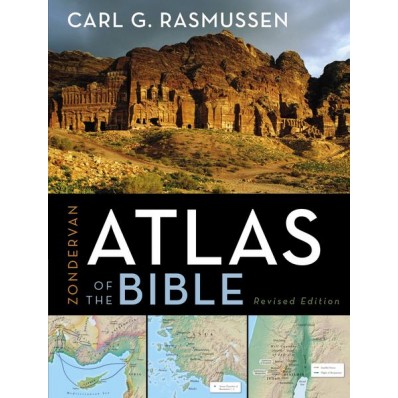
Carl G. Rasmussen has recently released a Revised Edition of Zondervan Atlas of the Bible. Below I offer a description of its contents with some evaluative remarks.
What’s in the Atlas
After the Preface and Introduction the atlas consists of a Geographical Section and a Historical Section, followed by Appendices.
The Geographical Section is first, because:
This atlas has been written in the belief that once one has a basic understanding of the geography of the Middle East, one has a much better chance of coming to grips with the flow of historical events that occurred there.
After “Introduction to the Middle East as a Whole” there are these sub-sections:
The Geography of Israel and Jordan (the longest section, covering “the Five Zones,” weather, routes, and individual regions)
The Geography of Egypt
The Geography of Syria and Lebanon
The Geography of Mesopotamia
The Historical Section covers the Bible’s history in canonical order, from the pre-patriarchal period to the churches in Revelation. It concludes with a special section on Jerusalem (“Of all the cities in the Bible, this is the most prominent one: it is mentioned 667 times in the Old Testament and 139 times in the New”) and an essay: “The Disciplines of Historical Geography.” I appreciated being able to compare the layout of Jerusalem in the Old Testament, during the time of Nehemiah, and in the New Testament.
Rasmussen covers even the so-called intertestamental period, with sections on the Greeks (4th century B.C. onward), the Maccabees, and the Hasmonean dynasty.
The Appendices are also impressive. What really makes this atlas user-friendly is the 31-page Geographical Dictionary and Index. Any place name in the atlas (whether it has appeared on a map or in the descriptive text) is in the dictionary/index. There are also identifications with modern places, so one finds out, for example, that the biblical Bethany is the current-day El-Azariya. More specifically, here is the entry for Bethany at the back of the atlas:
Bethany (near Jerusalem)—Village on road to Jericho (Mark 11:1; Luke 19:29) less than 2 mi. from Jerusalem (John 11:18). Mary, Martha, and Lazarus lived there (John 11) and it seems that Jesus spent the evenings of the week before his crucifixion there. Mentioned 11 times in NT.–El-Azariya (174131), 1.5 mi. E of Jerusalem, on E side of Mount of Olives. 212, 214, 217, 251, 252
There’s quite a lot of text in the atlas, too. (It’s far more than just maps and photos.) In the section covering Jesus’ life, for example, Rasmussen offers an almost narrative overview of the locations of Jesus’ ministry, interspersed with graphics.
The Graphics
As with other Zondervan books along similar lines, there are striking full-color images and well-drawn maps throughout the book. Photographs like this will have to suffice until I can visit the lands described in this book:
Full-color photograph from the atlas
The atlas contains both two-dimensional and three-dimensional maps:
One of many maps from the Atlas
Between the maps, photographs, and timelines throughout the book, you can easily get your bearings in any era or biblical passage of study.
Evaluation
I’ve not been able to take full advantage of all that the atlas has to offer–there is a lot here–but it is my current go-to atlas. I look forward to making further use of it. Perhaps the proof is in the pudding: even though I was given a gratis copy for review by Zondervan, I purchased an electronic version of it in Accordance Bible software so I could have access to it there, too (I rarely purchase a book in two formats). Accordance’s production of the module, from what I’ve seen so far, enhances what is already an excellent book, with the added advantages of hyperlinks and advanced searching capabilities.
My two points of critique are fairly minor ones. First, the timelines throughout the book are easy enough to follow, but they are stylized in such a way that they feel a bit cluttered. You can see examples using the Search Inside feature on Amazon here (affiliate link). Second, the font is narrow and looks crammed on a page, especially pages that have a good amount of text. The flip-side to this is that in a book that is still fairly portable (just under 300 pages), you’re getting a lot of great information, but it’s not always easy to read for long stretches of time.
Any serious reader, no matter their level of prior knowledge of biblical geography and history, could make profitable use of the atlas. It’s not highly technical or scholarly, though students and professors should still consider it, especially in a classroom or Sunday school setting.
You can view a sample pdf of the atlas (including a detailed Table of Contents) here. Its product page at Zondervan is here. Accordance has it on sale for the rest of today (Monday) here.
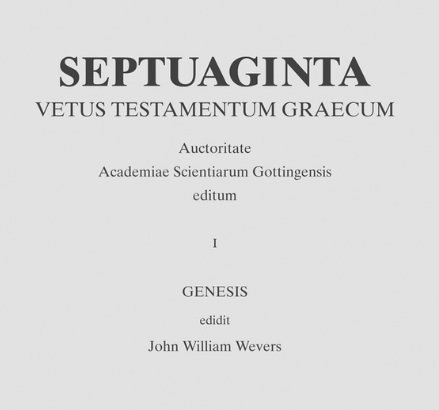
Accordance Bible has just released the Esther module in its Göttingen Septuagint. More volumes are on the way and scheduled for this month: Psalms with Odes, Jeremiah, the 12 Prophets, and Sirach. The Göttingen Septuagint is a text criticism workout. I’ve posted here and here about how to understand and use its apparatuses.
When I reviewed Göttingen in Logos earlier this year, I compared Isaiah modules between Logos and Accordance. At that time I wrote that the Logos text was more accurate to the print edition than the Accordance text, because it initially was. I was surprised, and saw this as a fluke for Accordance, whose texts–especially their original language ones–generally are the “research-grade” quality they seek to produce.
There’s been a recent update to Göttingen Isaiah in Accordance, so that it is now quite accurate in relation to the print edition. Accordance has also since dropped the price on its Isaiah module.
Search fields for Göttingen Isaiah Apparatus I
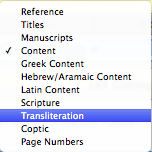
Where Accordance really excels in its presentation of Göttingen is the multiple ways it offers to search an apparatus. (See image at right.) The most helpful search field is “Manuscripts,” and one can also search by “Greek Content,” which greatly facilitates searching for a given text variant. Searching an apparatus in Logos doesn’t have nearly the options, and manipulating what search results one can get is more difficult.
The “List Text Differences” feature in Accordance is one I’ve used often, to see where Göttingen and Rahlfs differ on Isaiah, for example. Logos has a “Text Comparison” tool, similar to the “Compare” feature in Accordance, but “List Text Differences” is unique to Accordance.
One remaining fix in the Accordance apparatus (at least for the Isaiah module I’ve examined) is a symbol rendering issue. When the apparatus notes a case of homoioteleuton, what appears in print as 1°◠2° shows up in the apparatus as 1° 2°. (UPDATE: See Rick’s comment below; update is planned. UPDATE 12/14/13: This has now been corrected in Accordance.) This renders correctly in Logos.
Logos still doesn’t have the Kopfleiste (Source List) for the Göttingen volumes that have one in print, while Accordance does include it. On the one hand, the Kopfleiste makes most sense in a print edition, but one can imagine that serious students of the Septuagint may still want to be able to access it. Accordance’s Esther includes it, for example.
All the Göttingen volumes that have been published in print are in Logos already, but Accordance seems to be making fast progress of late in completing their own offering. Göttingen is more affordable in Logos (especially if you have their academic discount), but there are more advanced search options available in Accordance (both in the text and the apparatuses) that may make the user want to consider the latter software instead. If one wants just a single volume in Göttingen, that option is currently only available in Accordance.
Speaking of the Septuagint, I’ve just finished Greek Isaiah in a Year with a group of folks, and so will take recommendations for what to read next!
Recently I’ve been paying more attention to the Dictionary of Classical Hebrew and its Concise counterpart (see here).
It took me a little while to figure out how to read the frequency stats in DCH/CDCH. So I’m posting this little tidbit here to save some folks a bit of time.
The introduction to the concise version of the lexicon reads:
2. Statistics. Next comes a notation of the number of occurrences of the word in each of the four corpora of ancient Hebrew: the Bible, Ben Sira, the Dead Sea Scrolls, and the Inscriptions. Thus the notation 334.5.13.32 means that the word occurs 334 times in the Bible, 5 times in Ben Sira, 13 times in the Dead Sea Scrolls and 32 times in the Hebrew Inscriptions. If there is only one number in the statistics, the word occurs only in the Hebrew Bible, and if the notation is, for example, 0.0.7, it means that it occurs only in the Dead Sea Scrolls, and that 7 times. In the case of verbs, occurrence statistics are also given for each of the voices (or, binyanim).
The entry for נתן has a frequency count of “2015.62.228.26.” That’s straightforward enough. But then with the entry for תרומה the frequency given is “76.2.18.” This means it occurs 76 times in the Bible, 2 in Ben Sira, 18 times in the DSS, and 0 times in the Inscriptions. Another entry that has “11.4″ means 11 times in the Bible, 4 times in Ben Sira, 0 in DSS and 0 in the Inscriptions.
What took me a little while to figure out is that some entries have counts like “376.0.1,” which means 376 occurrences in the Bible, 0 in Ben Sira, 1 in DSS, and 0 in the Inscriptions.
The 0s are not noted, then, if there is not still a number to come after it that is 1 or more. In other words, you’d have “376.0.1,” but never “376.1.0.0″ or even “376.1.0.” That would be abbreviated instead to “376.1.”
It would have been easier if all the 0s were inserted in every case, so that you were always looking at 4 actual numbers (thinking of 0 as a “number” for the moment), but I am guessing that this is because the longer DCH (at 8 volumes in print) likely couldn’t afford to be filled with 0s, where they could otherwise be deleted.
In summary, the four corpora in this lexicon are:
Hebrew Bible
Ben Sira
Dead Sea Scrolls
Hebrew Inscriptions
Committing that sequence to memory (and better understanding when a 0 is used and not used) makes use of the lexicon even easier. I appreciate DCH/CDCH’s inclusion of frequency statistics, as I use it to build my Hebrew vocabulary.
I use the Concise DCH for regular Hebrew reading in Accordance, but have just recently been really getting to know it as a lexicon. The print version of The Concise DCH is here; in Accordance it is here. The full 8-volume set from Sheffield Phoenix Press is here, found also here at Accordance.
HALOT has been the scholarly standard in Hebrew lexicons, but might that change?
The mammoth 8-volume Dictionary of Classical Hebrew (DCH) is another major lexical source for readers of biblical Hebrew to consult. What is unique about the DCH is that lexicons like HALOT and Brown-Driver-Briggs (BDB) cover solely the Hebrew found in the Hebrew Bible. DCH, by contrast, covers a wider corpus–“from the earliest times to 200 CE,” it says. According to its product page:
It is the first dictionary of the classical Hebrew language to cover not only the biblical texts but also Ben Sira, the Dead Sea Scrolls and the Hebrew inscriptions. It is the first dictionary to analyse the exact sense of every occurrence of every word, to follow every Hebrew word or phrase with an English equivalent, to print a frequency table of occurrences of each word, and to provide an English-Hebrew index.
Not least among its features is its addition of more than 3500 new words to the stock of the Hebrew lexicon, together with an extraordinarily rich bibliography surveying special lexicographical studies over the last century.
The Concise Version
The 8-volume set in print is high-priced, as one would expect. It is much more affordable (as “affordable” goes, in these contexts) in Accordance, which is currently the only Bible software to carry it. The concise version seems to be financially within the reach of many students and pastors.
What is remarkable about the concise version of the dictionary is: “All the words in the full Dictionary of Classical Hebrew are to be found in the CDCH.” Of course, there are less instances of a given word’s occurrence listed, but that every word of the 8-volume set is treated in its 500-some-page younger sister is impressive.
The CDCH thus contains not only the c. 8400 Hebrew words found in the standard dictionaries, but also a further 3340+ words (540 from the Dead Sea Scrolls, 680 from other ancient Hebrew literature, and 2120+ proposed words for the Hebrew Bible not previously recognized by dictionaries).
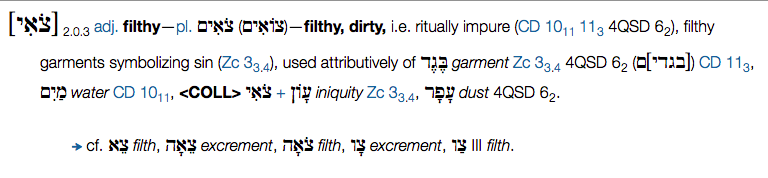
By way of comparison, here is an entry for the same (rarely occurring) word in the concise and full dictionaries, respectively:
Full DCHConcise DCH
I use the Concise DCH for regular Hebrew reading in Accordance, but have just recently been really getting to know it as a lexicon. (UPDATE: see another post here on word frequency statistics in the lexicon.) The print version of The Concise DCH is here; in Accordance it is here. The full 8-volume set from Sheffield Phoenix Press is here, found also here at Accordance.

 This, of course, got me to wondering about Eusebius in Greek. Using The Sacred Bridge in Accordance, I can easily pull up all the times TSB cites Eusebius (more on this later).












 Words on the Word