Accordance Bible Software is coming to the Greater Boston area for two trainings at the end of October.
Here are the details on the free seminars from their Website:
Boston, MA area Saturday, October 26, 2013, 10am to 6pm
Gordon-Conwell Theological Seminary
Hamilton Campus
130 Essex Street, South Hamilton, MA 01982
Bld/Rm: AC240 (Academic Center-Rm #240)
** Special focus on Greek ** Directions Campus Map
Boston, MA area
Sunday, October 27, 2013, 1pm to 9pm
Brandeis University
415 South Street, Waltham, MA 02453
Bldg/Room: TBD
Instructor: Dr. Roy Brown (Developer of Accordance)
** Special focus on Hebrew ** Map & Directions Places to Stay Places to Eat
The schedule for the Gordon-Conwell training (subject to change) is:
10:00-11:30 Accordance Introduction, Interface, Library
11:30-11:45 Break
11:45-1:15 Search Tab, Basic Greek Searches, Symbols
1:15-2:45 Lunch on your own
2:45-4:15 Using Tools, Graphics, User Notes
4:15-4:30 Break
4:30-6:00 Greek searches and Commands
Accordance recommends the use of this 46-page hard copy Training Seminar Manual (which I have and find helpful: full-color screengrabs, clear explanations, etc.).
We are getting close to the end of Greek Isaiah in a Year. This week and next week cover Isaiah 55:7-Isaiah 58:9.
Below is the text from R.R. Ottley’s Book of Isaiah According to the Septuagint. Ottley is also here in Logos (reviewed here) and here as a free, downloadable pdf in the public domain. The full reading plan for our group is here (pdf).
See here for more resources and links to texts for Greek Isaiah.
“If the worth of our prayer life depended upon the maintenance of a constant high level of feeling or understanding, we would be in a dangerous place. Though these often seem to fail us, the reigning will remains. Even when our heart is cold and our mind is dim, prayer is still possible to us.”
–Evelyn Underhill (1875-1941)
For the first six weeks I am teaching/leading adult Sunday School at my church. We are spending those six weeks with Foster and Smith’s Devotional Classics book. Here are the writers for each session:
Week 4: Apocryphal Literature
(This is not in Devotional Classics. But we’ll look at Ecclesiasticus (Sirach), Wisdom of Solomon, and the Prayer of Manasseh.)
Week 5: Catherine of Siena
Week 6: Kathleen Norris
Each week we do a short bio of the writer, some reading, some discussion, and some prayer.
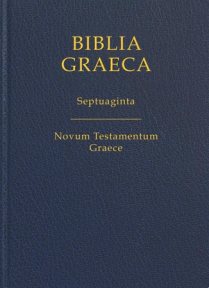
Look at that! It’s an all-Greek Bible. Just like the one Jesus carried around! Okay, not quite, but it is very good to see the Greek Septuagint and the Greek New Testament together under one cover. Augustine would be pleased:
For Greek aficionados—a 2-in-1 resource that’s designed specifically for extensive research, textual criticism, and other academic endeavors. Featuring both the Rahlfs-Hanhart Septuagint (Greek translation of the Hebrew Old Testament) and the 28th edition of the Nestle-Aland Novum Testamentum Graece, this user-friendly tool includes critical apparatus, cross-references, and more. 3216 pages, hardcover from German Bible Society.
What It Looks Like
It’s a mere three pounds (in weight, not price). Amazon lists its dimensions as 7.5 x 5.7 x 2.8 inches.
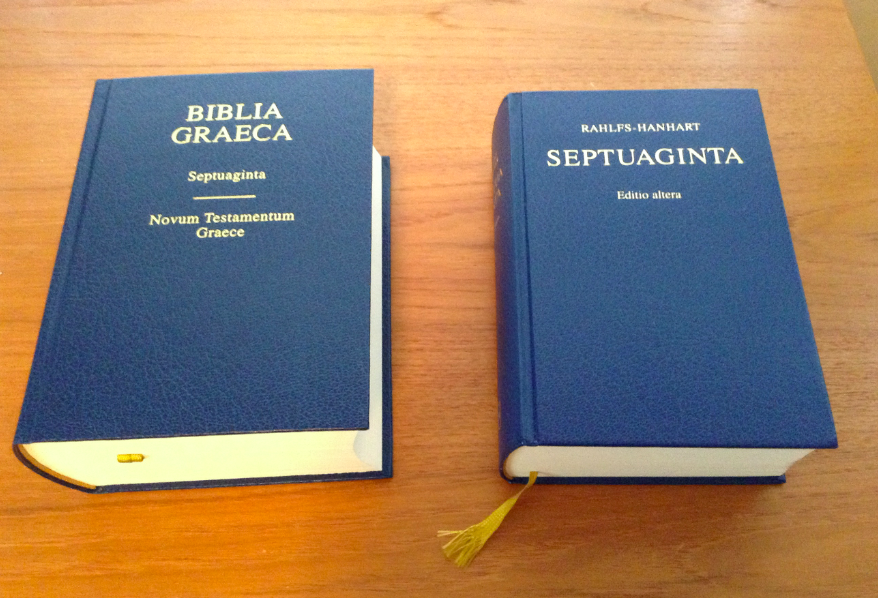
This impressive edition is two previously published Greek texts put together in one cover. It’s obviously thicker than the Septuagint alone, and just a little bigger in length and width. Here are the two side by side: the Septuagint alone on the right, and its “upgrade” version (with GNT) on the left:
v. 1.0 (at right) and v. 2.0 (at left)
Before receiving the volume, I was concerned that its 3,000+ pages would defeat Alfred Rahlfs’s initial intention to have a Handausgabe (i.e., a manual and portable edition). Indeed, Hanhart’s “Introductory Remarks to the Revised Edition” translate Handausgabe as “pocket-edition,” which this is decidedly not. (It would fit nicely in a purse or man-purse, though.) That said, the addition of the Greek New Testament really does not add a lot of bulk, as Rahlfs-Hanhart was already more than 2,000 pages. Biblia Graeca is still a (fairly) portable edition, though, if not literally pocket-sized. The sewn binding and hard cover appear that they will hold up under regular use. Here are v. 1.0 (LXX only) and v. 2.0 (LXX+GNT) stacked on top of each other:
You can barely make it out from the above photo, but the LXX/GNT combo comes (wisely) with two ribbon markers. Was it a coincidence that mine were both placed at the beginning of Odes? I think not.
The Greek Typesetting/Font
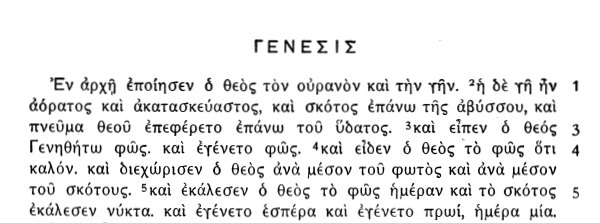
Rahlfs has not been re-typeset, so its Greek font is not as crisp or readable as that of the New Testament portion. Compare:
Genesis 1:1-5, from publisher’s pdf sample
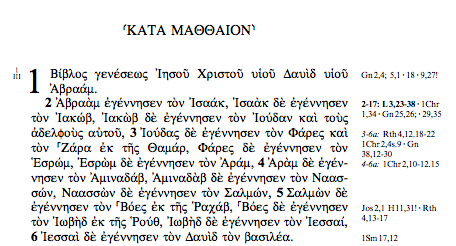
Here now is the Greek in the New Testament portion, which is clear and crisp:
Matthew 1:1-6, from publisher’s pdf sample
After reading enough Septuagint, one does get used to the Rahlfs font. It’s not too bad.
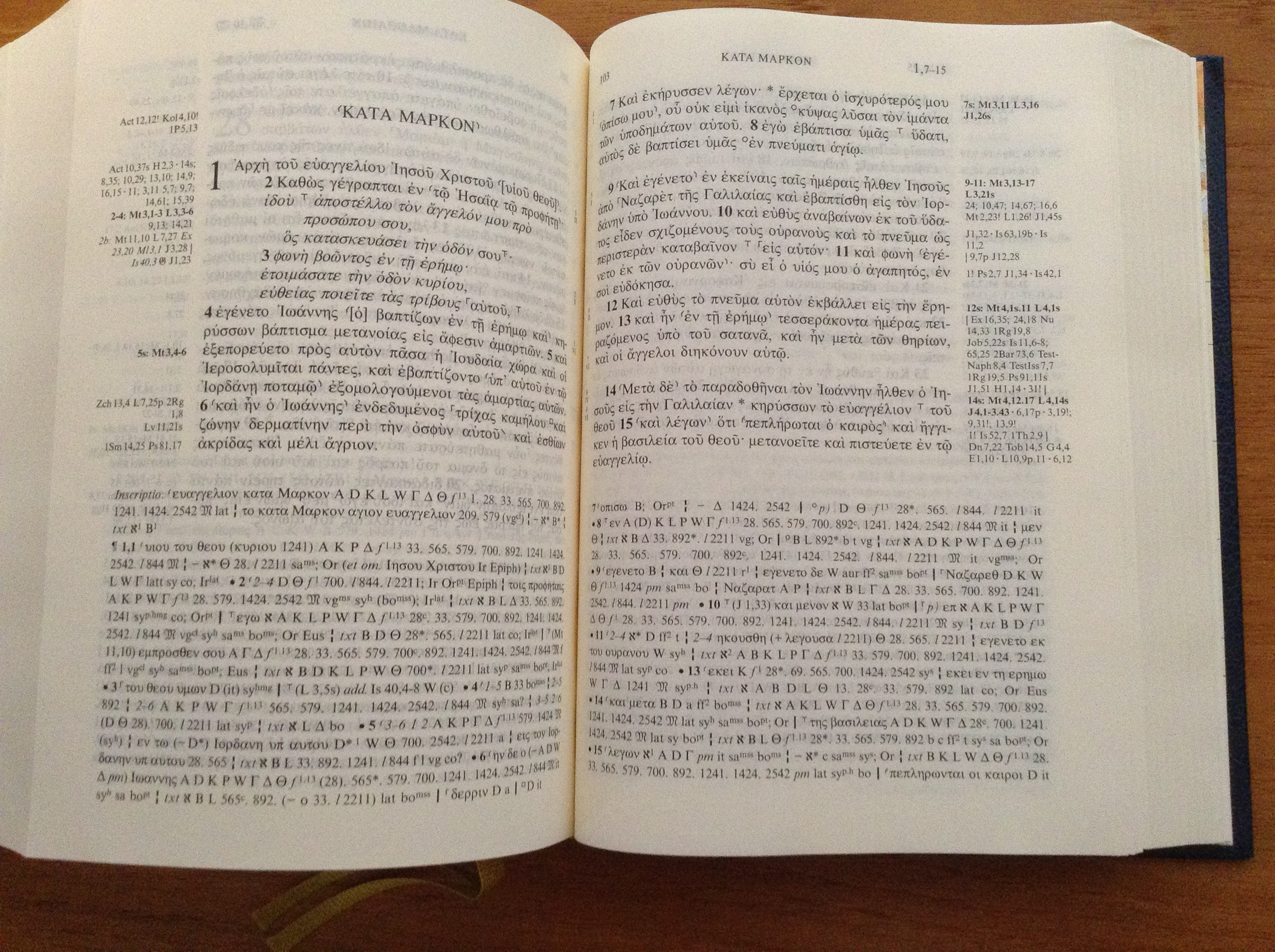
Always a concern with Bibles this big is that the requisite thin pages will mean bleed-through of text from the reverse side. This is noticeable to a degree here, but not in a way that negatively affects reading:
Mark 1
Rahlfs-Hanhart (Septuaginta)
The Rahlfs-Hanhart edition is not the go-to for extensive text-critical research that the Göttingen editions are, where they are present (on which, see my posts here and here on using Göttingen). Rahlfs is still useful, though, because it contains an entire Septuagint text, whereas Göttingen (published as individual volumes) does not.
It is probably the best starting place for readers of the Septuagint, even with its deliberately more limited apparatus. It is best thought of as a “semi-critical edition,” as noted here. Rahlfs “reconstructs” the text using, primarily, Codex Vaticanus (B), Codex Sinaiticus (S or א), and Codex Alexandrinus (A), a methodology that the revisor, Robert Hanhart, honors. Here is the apparatus for the first page, covering Genesis 1:1-14. This is a funny case, because of how much of Genesis is missing in B, so Genesis 1-46:28 up through the Greek word ηρωων is just based on A here. The rest (from πολιν in 46:28 to the end, chapter 50) take into account B and A.
Preceding the actual text and apparatus are Hanhart’s 2005 “Introductory Remarks to the Revised Edition” in German, English, and Greek. Then in German, English, Latin, and Greek follow three more sections: (1) Rahlfs’s “Editor’s Preface,” (2) an illuminating 10-page essay, “History of the Septuagint Text”, and (3) Explanation of Symbols. Everything you need to get started reading the Septuagint (minus the Greek lessons) is here.
The long-awaited 28th edition of the Novum Testamentum Graece has now been published. Once again the editors thoroughly examined the critical apparatus and they introduced more than 30 textual changes in the Catholic Letters, reflecting recent comprehensive collations. With the intent to make this book more user-friendly, the editors also revised the introductions and provided more explanations in English. This concise edition of the Greek New Testament, which has now grown to 1,000 pages, will continue to play a leading role in academic teaching and scholarly exegesis.
The NA28 has its own snazzy site here. (What a day we live in, when a Greek Bible gets its own Website! Its writers would be amazed.) Recent text-critical work on the New Testament has led to revisions in the Catholic Letters, but not elsewhere. So the Gospels and Pauline epistles, for example, retain the same text as the NA27. However, there are changes that affect the whole edition, as the publisher points out:
Newly discovered Papyri listed
Distinction between consistently cited witnesses of the first and second order abandoned
Apparatus notes systematically checked
Imprecise notes abandoned
Previously concatenated notes now cited separately
Inserted Latin texts reduced and translated
References thoroughly revised
As for the textual differences themselves, those are explained and listed here. There are more details to be digested about the new NA28 edition. I can do no better than to refer you to the writings/reviews of Larry Hurtado, Rick Brannan, Daniel Wallace, and Peter Williams.
All the quick-reference inserts you need to make sense of symbols and abbreviations are included:
Concluding Thoughts: Sell All You Have?
The product page for the beautiful Biblia Graeca is here for CBD, here at the German Bible Society, here at Hendrickson, and here for Amazon. And, best yet, you can look at a sample of the book here. If it’s just the text (and not the apparatuses) that you’re interested in, you can read the NA28 online here and the Rahlfs-Hanhart Septuagint here.
Rahlfs wrote in his preface that he sought to “provide ministers and students with a reliable edition of the Septuagint at a moderate price.” If you click the links above, you will see that this is not “a moderate price.” It’s significantly cheaper to buy the same critical editions of each Testament under separate cover.
But there are at least two major advantages to putting them together. First, when the New Testament writers quoted Scripture, they predominantly did so in a form that is closer to what we have now in a Septuagint text. Comparing a quotation (in Greek) with its source (in Greek) is facilitated by this edition. Second, that this edition exists is an important symbolic statement. Lovers of the Septuagint are fond of affirming that it was the Bible of the early Church. If that is so, why can we not have one, too? Now we can, printed and bound in a way that would shock the pre-printing press world that first heard all these Scriptures together when gathered for worship.
Professor Ferdinand Hitzig has often been quoted saying, “Gentlemen!” (and today, he would say, “Ladies!” too) “Have you a Septuagint? If not, sell all you have, and buy a Septuagint.”
In true biblical storytelling fashion, he is using hyperbole to communicate his point. But for those who are so inclined and able, if selling a few things to get a Septuagint is a good idea, how much more might someone like Hitzig encourage them to sell a few things for the Biblia Graeca?
Christians believe that the Septuagint has come to full fruition through the New Testament.
So it only makes sense to be binding the two together.
Many thanks to Hendrickson for the privilege of reviewing this fine work. A copy came my way for review, but with no expectation as to the nature of my review, except that it be honest.
The apostles said to the Lord, “Increase our faith!”
He replied, “If you have faith as small as a mustard seed, you can say to this mulberry tree, ‘Be uprooted and planted in the sea,’ and it will obey you.”
–Luke 17:5-6 (NIV 2011)
This Sunday I’ll preach on the above verses, taken from the lectionary reading of Luke 17:5-10. The rest of the passage goes on:
“Suppose one of you has a servant plowing or looking after the sheep. Will he say to the servant when he comes in from the field, ‘Come along now and sit down to eat’? Won’t he rather say, ‘Prepare my supper, get yourself ready and wait on me while I eat and drink; after that you may eat and drink’? Will he thank the servant because he did what he was told to do? So you also, when you have done everything you were told to do, should say, ‘We are unworthy servants; we have only done our duty.’”
My first three questions of the text were as follows:
How should I take Jesus’ statement about the mulberry tree? Should I really be trying to uproot trees (or move mountains, in a synoptic parallel)? Can I?
“Your mind is a beautiful thing. Learn to trust it less and you’ll make better use of it.”
So went my introduction some dozen years ago to François Fénelon, royal tutor, priest, archbishop, and wise theologian.
For the first six weeks I am teaching/leading adult Sunday School at my church. We are spending those six weeks with Foster and Smith’s Devotional Classics book. Here are the writers for each session:
Week 4: Apocryphal Literature
(This is not in Devotional Classics. But we’ll look at Ecclesiasticus (Sirach), Wisdom of Solomon, and the Prayer of Manasseh.)
Week 5: Catherine of Siena
Week 6: Kathleen Norris
Each week we do a short bio of the writer, some reading, some discussion, and some prayer.
First things first: Do we really need another commentary series? This video from Baker Publishing offers an (affirmative) answer, as it introduces the new Teach the Text Commentary Series:
I agree. As I’ve worked through the Romans volume in the Teach the Text (TTT) series, by C. Marvin Pate, I’ve appreciated the way it balances “the best of biblical scholarship” with the actual end product of the sermon in view. TTT has a fantastic accompanying Website.
Baker has summarized the layout of the commentary well here. Each text unit (or passage) is “six pages of focused commentary,” consisting of the following:
“Big Idea” at the head of each passage. This is not to be confused with “big idea” preaching, as this commentary’s “big idea” tends to stay within the world and era of the biblical text.
A “Key Themes” sidebar. This expands a bit on the “big idea” in bullet-point format to draw out key points from a given passage.
“Understanding the Text.” This is the meat of the commentary, and covers literary context, outline and structure, historical background, theology, and interpretation.
“Teaching the Text.” Here Pate offers guidance in how one could preach and/or teach the text, with an eye specifically to application. Pate suggests what sermons/sermon topics come to mind for him in a given passage. More technical or scholarly commentaries tend not to include this step.
“Illustrating the Text.” This feels like the added bonus section. Having a topic in mind is just a first step. Culling from history, literature, art, the social sciences, and more, Pate gives ideas for how the preacher or teacher could help make the sermon or lesson come alive via illustration.
The full-color photographs throughout the text are of high quality, and help connect the reader visually to the ancient world.
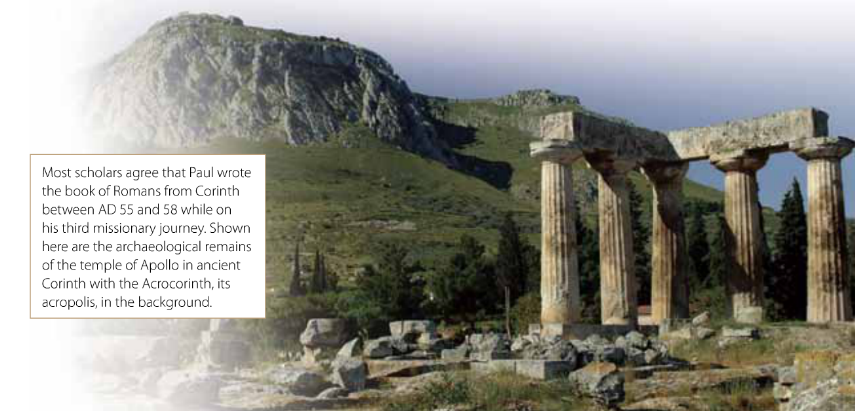
From the commentary: Corinth, where Paul wrote Romans
There are also “Additional Insights” throughout the commentary, that more fully develop themes like “The Backgrounds of Christian Baptism,” “Faith and Law in Paul,” and others.
Pate’s 15-page introduction to Romans covers Paul’s world(s), letters, theology, composition, Romans in history, date and place of writing, recipients, theme, purpose, and genre. He writes:
Paul therefore writes Romans to defend his gospel of the grace of God through Christ by arguing that it is rooted in the Old Testament (Rom. 2-5), providing the disclaimer that it is not antinomian in ethic (God’s grace is not a license to sin [so Rom. 6-8]), and holding out a future for Israel (Rom. 9-11).
Not all will agree with Pate’s view of “Romans as Paul’s official doctrinal statement,” but, then again, many will. I was wishing the introduction had given more attention to Paul’s theme of a justification by faith that is decidedly pan-ethnic. Pate does talk about “the end-time conversion of the nations,” but there is also a sense in which Paul is interested in multiethnic justification (where all are saved by faith, whether Jew or Gentile) now. Fortunately the body of the commentary does address this theme in places (e.g., in Rom. 3:21-26–“So Paul’s point is that God offers justification equitably to all”).
From the commentary: map of the Roman Empire
Pate is able to interpret from multiple vantage points, synthesizing material across centuries that will benefit preachers in their sermon preparation. He moves from lexical analysis (Greek is transliterated) to 1st century historical background to practical theology in a fairly seamless manner. The illustrations are on point, too. He points out, for example, in Romans 13:13-14, that Augustine’s conversion story included meditation on these verses. The same unit includes an illustration involving Jean Valjean and Les Mis. Movie illustrations and hymn quotations are particularly present throughout, though preachers will also want to use their own, original illustrations, too.
The series claims to be “an essential commentary for pastors.” If and as pastoral budgets permit, I’d echo the sentiment and recommend this series as a worthy bookshelf addition.
More TTT volumes are on the way, including a posthumous Luke volume by the blessed R.T. France. Lord willing, as I continue to preach through Luke, I’ll review France’s volume in the future. A full-color pdf sample of Romans (including the introduction and first passage) is here.
Thanks to Baker Publishing for the review copy of Romans. Its Baker product page is here, and it is for sale at Amazon here.
Accordance Bible Software for Windows is officially released. I’ve reviewed Accordance for Mac at length here. It’s an excellent program, the Bible software I use the most.
Accordance writes:
For over ten years, Accordance has been available to PC users with the Basilisk II emulator. While the emulator version included most of the same features as Accordance for Mac, it was an imperfect solution. We have long desired to give Windows users the native version of Accordance they truly deserve, and now that day has finally come. We are pleased and excited to announce the release of Accordance for Windows.
There’s a free trial here. See all the details here.
I got an ad in the mail the other day for a new commentary series that claimed to avoid all the weaknesses of previous commentary series while building on their strengths. (!)
With how many good “old” commentaries there are, I think commentary users should critically examine new series, and certainly not take claims like the above too seriously. (Every commentary set has weaknesses.)
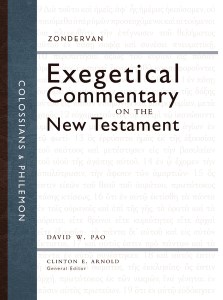
That said–Zondervan’s new Exegetical Commentary on the New Testament series is a real winner. It adds important elements to the mix that are not present in previously published commentaries. As a preacher with a scholarly interest in Scripture, I find this series to cover many bases well. It would be good for a student, professor, preacher, or even someone who didn’t know Greek and wanted to go more deeply into a given book.
I’ve (favorably) reviewed James and Luke in the same ZECNT series. Like the rest of the series, Colossians and Philemon includes the following for each passage of Scripture:
The full Greek text of Colossians and Philemon, verse by verse
The author’s English translation
First, passage by passage in the graphical layout
Second, verse by verse next to the Greek
The broader “Literary Context” of each passage (within the larger book)
An outline of the passage in its surrounding context
The Main Idea (this is a great focus point for preachers)
Structure
A more detailed “Exegetical Outline”
“Explanation of the Text,” which includes the Greek and English mentioned above, as well as the commentary proper
“Theology in Application” concludes each passage
The fact that the commentary has within it all the Greek and English of the two books under examination means you can take the single book (and no other) with you for thorough study of Colossians and Philemon.
Author David W. Pao makes frequent use of Greek throughout the commentary, but a non-Greek reader would also make profitable use of his comments.
Colossians has a 16-page introduction and 8-page bibliography; Philemon’s introduction is 13 pages, its bibliography 4. A “theology” section of 13 and 9 pages, respectively, concludes each book.
Regarding authorship of Colossians, Pao writes, “Among the various possibilities, to consider Paul as the author of Colossians is still the best hypothesis on which our reading can be constructed.” Like Murray J. Harris, Pao deduces this due to the various parallels (e.g., the opening greeting sections) between Colossians and Philemon, which is almost universally accepted as Pauline. He dates both letters to 60-62 AD, being written by Paul during his Roman imprisonment.
Pao is a good writer, too. This is from the introduction to Colossians, on its significance:
This letter that addresses a congregation challenged by a form of syncretism has significant contemporary application in a society in which the “virtues” of pluralism and tolerance are exalted as most important. Instead of simply pointing out the errors of the various practices and beliefs promoted by the false teachers, Paul begins and ends with an intense focus on Christ as the foundation of the believers’ existence. As a result, one finds powerful theoretical and practical outworkings of a robust Christology. In this letter, the readers encounter a detailed portrayal of the unique identity and final authority of Christ, and this portrayal enriches the high Christology found elsewhere in Paul’s letters.
This slightly longer excerpt on Col. 3:3 shows how adeptly Pao blends lexical study with historical background in a way that incorporates today’s Christian settings… all from an appreciated doxological posture:
That this life “is hidden with Christ” is significant in a number of ways. First, the verb “to hide” (κρύπτω) can signify close association (cf. Luke 13:21), and this meaning is certainly present in light of Paul’s identification of Christ as “your life” (ἡ ζωὴ ὑμῶν). To be “hidden with Christ” reaffirms the believers’ participation in Christ’s death and resurrection as they anticipate the final consummation of God’s salvific act at the end of time.
Second, to be “hidden with Christ” necessarily implies the security that one finds in Christ. The following verse explains the purpose of this hiddenness as it guarantees the final participation of believers in the revelation of God’s glory. This security from the evil powers is also implied in the reference to their dying with Christ, an act that points to the freedom of the threats posed by the opposing spiritual powers (2:20).
Third, in light of 2:3, where Paul asserts that in Christ “all the treasures of wisdom and knowledge are hidden,” Paul is here affirming that the lives of believers are also contained in Christ. This may serve a polemical purpose as Paul argues against those who continuously seek to get access to the heavenly mysteries. Paul’s response is that believers are already hidden with all the treasures in Christ. The sufficiency of Christ cannot be challenged, and to seek for these treasures elsewhere is to betray the true gospel.
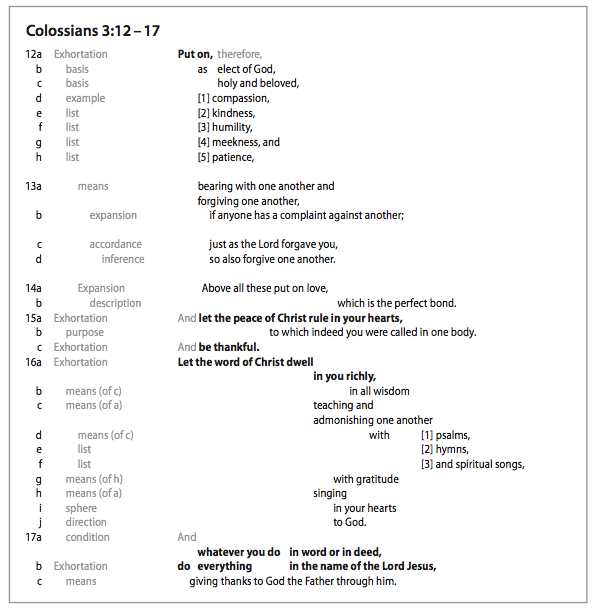
Out of all of the above features, the graphical layout is my favorite in this series and in this volume. It’s what makes the ZECNT something I’ll always reach for when preaching on a given passage–and early on in the process, too. Here’s what it looks like:
Col. 3:12-17
The main clauses are in bold, and subordinate clauses are indented under them. It’s easy to see, at a glance, how all the parts of a sentence and paragraph relate. The words in gray at left describe the function of each line (exhortation, expansion, etc.).
Pao is a refreshingly enjoyable writer who knows this terrain very well. Preaching or teaching from Colossians/Philemon (or even studying in depth on one’s own or with others) would be greatly enhanced by use of his commentary.
I am grateful to Zondervan for the gratis review copy of this commentary, which was offered to me in exchange for an unbiased review. You can find the book on Amazon here. The Zondervan product page is here. See a pdf sample of the book here.



















 Words on the Word