Searching in Logos Bible software (concluding part of my Logos 4 review)

I own a concordance, but it’s packed away in a box somewhere. Useful as a print concordance is, with sites like the NET Bible and Bible Gateway, not to mention various software programs available, I can do any word or phrase searching quickly at a computer.

This post will mark the completion of my multiple-part reviews of three major Bible software programs: BibleWorks 9, Accordance 10, and Logos 4. In this final part of my Logos review, I look at the searching features available in Logos. No print concordance necessary.

Here is the search function in action:

The above highlights four search categories: Basic, Bible, Morph, Syntax. A “Basic” search searches your library; “Bible” is just what it says it is. “Morph” can search according to a word’s inflection. “Syntax” can perform more complex grammatical searches.

There are multiple ways to search for and look up things in Logos. There’s a useful instructional video here with more information about how to do a “Basic Search” in Logos, i.e., search every resource in your library. And you can look here to watch a video that explains how to utilize the command bar on the home screen for searches.

You can also right click on a word in an open resource and search from where you are, looking it up in that resource, in all open resources, in your whole library, etc.

I was pleasantly surprised by the versatile ways one can search in Logos. The control+F search function is easy to use and remember–it’s how I search .pdfs and open Web pages already.

What was unpleasantly surprising, though, was how long some of the searches took. (Click below to enlarge.)

Nearly five seconds to return search results for a word. Granted, the above is the most frequently occurring word in the Hebrew Bible, but using different software I’ve been able to perform such a search significantly faster.

Lack of speed is perhaps the chief weakness in Logos. Part of this, I think, is because of one of its strengths, which is its massive library. Logos says, “The central metaphor Logos Bible Software is the universal digital library.” While this is a commendable project, and while the resources available in Logos are quite impressive (as I wrote here), it does seem to be at the expense of quickness of searches. Or perhaps it’s not just a library issue; it could be in the coding or some other.

Either way I hope future editions of Logos will improve upon search speed. This seems to be a vital need. I’ve had searches that turned up results faster than 5 seconds (a couple in under a second), but I also did a Bible search today that took more than 20 seconds to return results.

Once you have your search results, there are some fun ways to be able to manipulate and view the data. With a Septuagint search for ὅτι, I can view the results as a “Grid”:
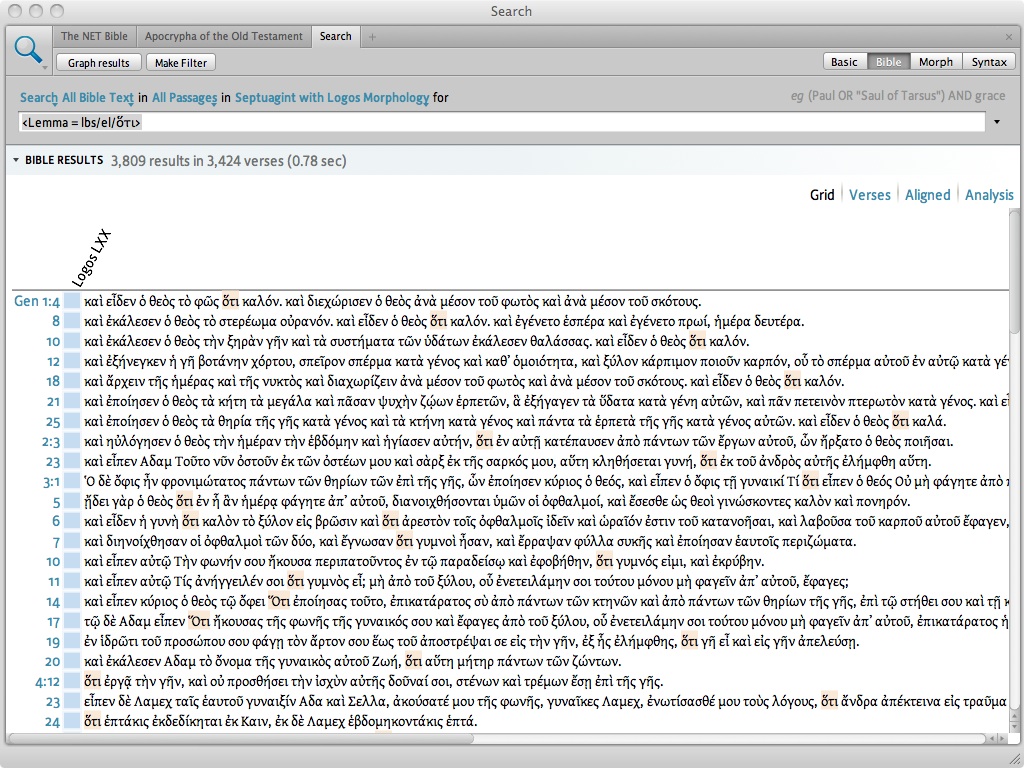
as “Verses”:

as “Aligned”:
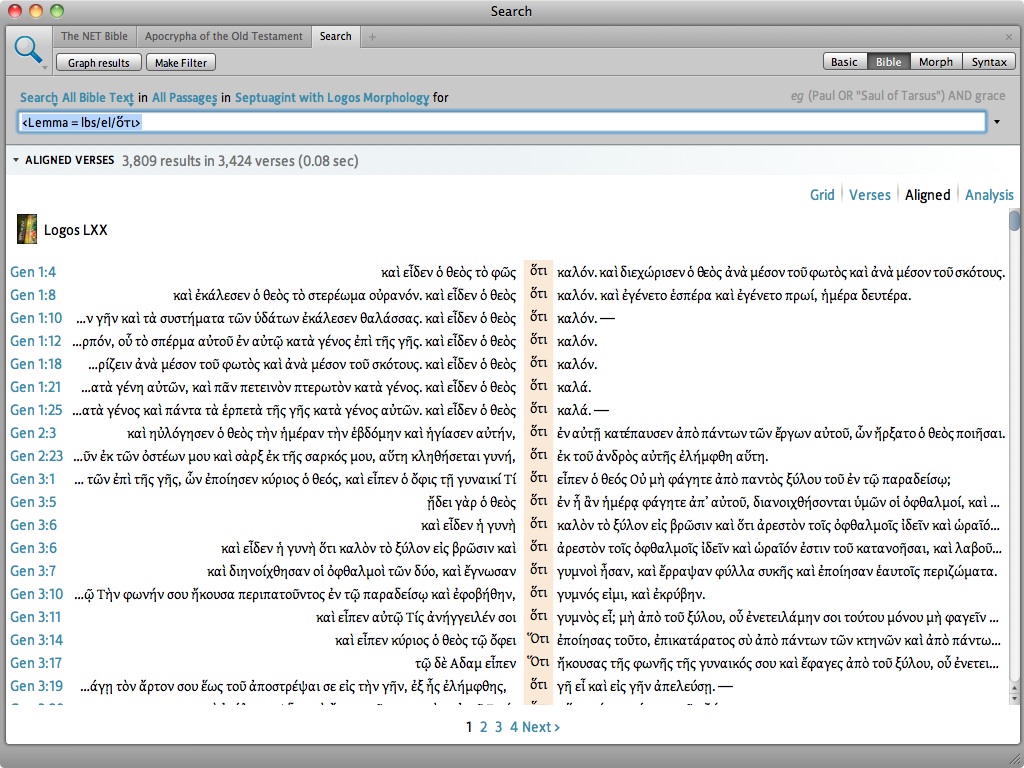
or as “Analysis”:
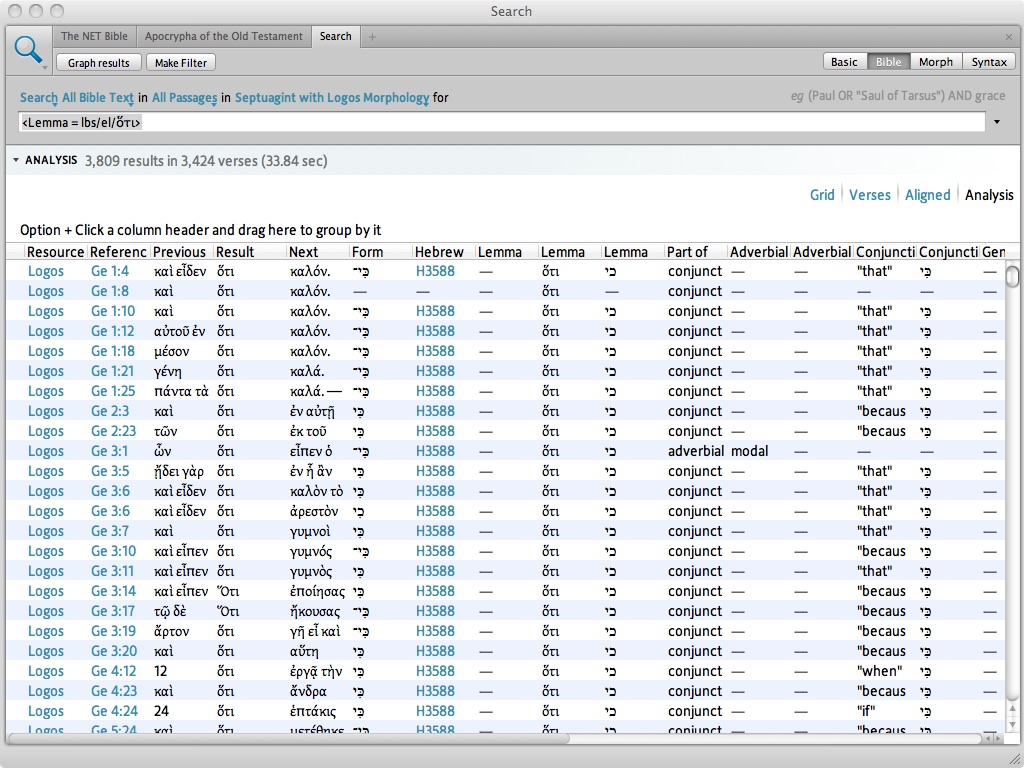
I have found the “Analysis” sorting the most helpful, since you can click on any of the column headers above and it re-sorts in the same way an Excel spreadsheet would.

A few concluding thoughts on Logos 4:

  • Their community forums are active and helpful
  • Your library, notes, highlighting, etc. all travel with you and update automatically wherever you use Logos, whether that’s on a Mac, a PC, an iPhone, or online
  • Great library–lots of resources (including some unique ones) available
  • The slowness at times of searches or just general moving around in the program is not great and can hinder productivity
  • It’s highly customizable with its tabs and resources; makes working on multiple things at once easy

One other thing to note is that Logos offers a good discount program.

For more on Logos, this promotional pdf is a helpful introduction. You can also visit logos.com.

Thanks to Logos for the review copy of Logos 4 with the Original Languages Library included. For the review copy I have been giving my honest impressions of the program in a multi-part review (here, here, here, here, and here), which this installment concludes. Look in coming weeks to this blog for a comparison of Logos, BibleWorks, and Accordance.

Christian Apologetics: free book giveaway

One good giveaway deserves another.

The other day I noted that Zondervan has just put out a primary source compendium called Christian Apologetics: An Anthology of Primary Sources, edited by Khaldoun A. Sweis and Chad V. Meister.

I have an extra copy to give away (not my review copy). It’s a good resource to have on the shelf, and I know I’ll be turning to it in the future for the work and ministry I do in a college setting.

I reviewed the book here.

I will choose a winner at random. To enter the drawing, simply comment on this blog post with your greetings, thoughts about apologetics, favorite philosopher/theologian, etc. I will accept entries through Monday afternoon, with 3pm EST being the cutoff.

Then if you link to this post on your Facebook, Twitter, blog, etc., come back here to tell me in the comments section that you did, and you’ll receive a second entry. I will announce the winner just before 5pm EST Monday.

Christian Apologetics: a review

I still remember, as a 16-year-old, sitting down at my parents’ computer, hearing the dial tone, and logging on to AOL. I would do this often, not just to check the new technological miracle known as e-mail, but also to go into chat rooms (remember those?) and seek to share my faith with others online.

I made similar efforts at my high school, starting conversations when appropriate and generally just trying to be ready to speak intelligently and compellingly about my Christian faith.

This handbook by Peter Kreeft was a constant reference guide for me. I went on to major in philosophy at a Christian undergraduate school, where I took, among others, classes on the philosophy of religion, St. Augustine, and more. Readings in the Philosophy of Religion became a new resource to which I often turned. I had begun having philosophical and existential questions of my own by that point, ones that I experienced on a profound and at times troubling level.

I’ve always had an interest in the intellectual underpinnings of my Christian faith. And I’ve often been aware that what appear to be intellectual questions or questions of “the head,” are sometimes–when one digs deeper–questions of “the heart,” as well. Since college days, then, I’ve been a bit more cautious than I was as a 16-year-old in an AOL chat room about just how effective “apologetics” can be.

Zondervan has just put out a primary source compendium called Christian Apologetics: An Anthology of Primary Sources, edited by Khaldoun A. Sweis and Chad V. Meister.

There are 54 selections divided into 11 parts, which you can see listed here (PDF) in the table of contents. Christian Apologetics begins with some methodological considerations in part 1, then moves right into various arguments for the existence of God–cosmological, teleological, ontological, moral, the argument from religious experience, and so on. From there the book narrows to more specific topics like the Trinity, the incarnation, miracles, the resurrection, the problem of evil, and more.

Christian Apologetics claims to be “a sampling of some of the best works written by Christian apologists throughout the centuries,” offering “a snapshot of Christian apologetics at its best across the spectrum of time and culture.”

The essays in this volume certainly are some of the best in apologetics. There is Paul at the Areopagus in Acts 17, Aquinas on the cosmological argument for God’s existence, Anselm and Plantinga with the ontological argument for God, Pascal’s wager, Teresa of Avila on experiencing God, Anselm on the incarnation, Swinburne on miracles, John Hick’s “Soul Making Theodicy,” Augustine on free will, and Marilyn McCord Adams on horrendous evil and the goodness of God. Each of these essays is a classic and makes a valuable contribution to the area of apologetics.

The book spans “the spectrum of time” fairly well, with a higher concentration of 20th century writers. Just a couple of the contributors are women, and the overwhelming majority hail from Western contexts–this latter an admission of the book, but a weakness all the same.

A particularly pleasant surprise to me was the inclusion of an an article by R.T. France, in which he makes the case for the historical reliability of the Gospels, which must, he argues, be understood in their proper literary context as “highly selective” records of Jesus’ life with “only a loose chronological framework.” This is not due to deficiency of the Gospels; rather, it is how the Gospel writers intended to write:

The four canonical gospels will not answer all the questions we would like to ask about the founder of Christianity; but, sensitively interpreted, they do give us a rounded portrait of a Jesus who is sufficiently integrated into what we know of first-century Jewish culture to carry historical conviction, but at the same time sufficiently remarkable and distinctive to account for the growth of a new and potentially world-wide religious movement out of his life and teaching.

As I read I appreciated a statement in the book’s general introduction:

But arguments and evidences do not of themselves bring someone into new life in Christ. Here the work of the Holy Spirit is central, and we must be willing to surrender to his leading and his truth and his goodness if we are to truly dwell with the Lord.

I hadn’t yet learned this in the AOL chat rooms, but I’ve long since been convinced of it. So I had hoped to hear more in this book about the role of the Holy Spirit in apologetics. There is a short (one paragraph) treatment by James K. Beilby in chapter 3 that asks, “What is the role of the Holy Spirit in apologetics?” He rightly (in my view) sees it as “not a zero-sum game.” The apologist should be “significantly involved” yet “still hold that the Holy Spirit will determine the effectiveness of our efforts.”

Though the Holy Spirit receives treatment in the section on the Trinity (by Origen, Aquinas, the Creeds, and Thomas V. Morris) and on the Bible (Calvin and canonization), there is never more than Beilby’s paragraph treatment about the role of the Holy Spirit in the project of apologetics. Cogent though Beilby is, I would think “a snapshot of Christian apologetics at its best” should make more mention of something like the Wesleyan view of prevenient grace or even the notion that the Holy Spirit witnesses to a person’s heart before an apologist does. Only the former can enable the latter. Christian Apologetics is not without the exploration of other methodological considerations; I just would have liked to have seen more of this one.

Several other possible areas for improvement in a future edition could be more on faith and reason and how the two interrelate, as well as arguments for the existence of God that take into account and respond to the varous assertions made by the “new atheism” (anemic though it is).

All in all, though, this is a strong work, and I’m happy for it to sit alongside my old college text, Readings in the Philosophy of Religion. Zondervan’s Christian Apologetics is a worthy, if basic, reference guide. I expect it will serve apologists well.

Thanks to Zondervan for the review copy, which I was given for the purposes of review, though without any expectations as to the nature of my review. Find the book at Amazon here (affiliate link) or at Zondervan’s product page for the book.

Septuagint Sunday: Congratulations to…

This past week I’ve received some 50 entries in a giveaway contest for a study by Myrto Theocharous called Lexical Dependence and Intertextual Allusion in the Septuagint of the Twelve Prophets: Studies in Hosea, Amos and Micah.

You can read more about the book here. I’ve made some progress in reading the book myself this week, and will be offering a review in the near future.

To choose a winner, I assigned a number to every entry (both a comment on this blog and a share of any kind qualified), then used a random number generator to select the winner.

The winner is…William Varner!

Congratulations, William, and enjoy the new book.

Thanks very much to all who entered and spread the word. I write about the Septuagint at Words on the Word at least once a week. You can bookmark this tag for my Septuagint posts; it updates as I add new posts. If you like what you see here, you can subscribe/follow this blog using the button on the right sidebar.

While you’re here, here are some highlights of what I’ve written about the Septuagint:

And coming soon:

  • My own review of Lexical Dependence and Intertextual Allusion
  • A short primer on how to read and understand the Göttingen Septuagint

Thanks for reading, and congratulations again to William Varner!

Book Giveaway Reminder

This is a reminder that Sunday night I’ll be announcing the winner of a study by Myrto Theocharous called Lexical Dependence and Intertextual Allusion in the Septuagint of the Twelve Prophets: Studies in Hosea, Amos and Micah.

If you haven’t already entered the giveaway, there’s still time. Go here to read more and enter.

Memorizing a Bible verse in a congregational setting

We’ve done some Scripture memory in chapel two times in the last two weeks. It’s been fun to learn the Bible together, which helps to reinforce our common language as worshipers. This week we had our congregation of worshipers learn Proverbs 8:17.

I had us say it out loud five or six times, each time in a different way:

  • once or twice just to get it in our heads
  • once standing
  • once sitting
  • once shouting (and, wow, did they shout!)
  • once whispering

My hope was that the variety of recitations (and the amount of them) would help us all commit it to memory, potential cheese factor notwithstanding. It’s a short verse, so I think the five or six times we said it out loud together (with the text on the screen) was sufficient.

Here’s one other way we could have learned the same verse, a method we employed two weeks ago with another (longer) verse.

This slide shows up first. We say it together once or twice. Then we move to this slide, saying it together again:

Then this:

Finally this:

Each of these methods–the repetition at various volumes and in various postures, as well as the slides with diminishing amounts of texts–seemed to work well for the congregation. I’d imagine this could even work well for solo memorization of Scripture. And I’m looking forward to exploring additional methods for leading congregational memorization of the Bible in the future.

Paul and the Old Testament

There are over 100 explicit quotations of Scripture in Paul’s letters and at least double that number of allusions. However, what is potentially more useful than just citing Paul’s answers to first-century questions is to study how Paul interpreted Scripture, and that is the theme of this book. (1)

This summer I reviewed the third volume of a de facto trilogy by Steve Moyise. In that same series is Paul and Scripture: Studying the New Testament Use of the Old Testament (click on book cover image to see at Amazon). In 160 packed pages Moyise surveys Paul’s use of the Hebrew Bible/Septuagint.

Moyise’s approach is a thematic one, rather than book-by-book. This helps the reader focus on how Paul treated the same topic across his various letters.

The author begins with an introduction to Paul, his “conversion” experience, his missionary activity, and a wonderful problematizing of the issue: because Paul was familiar with Greek, Hebrew, and Aramaic versions of Scripture, “[W]hen Paul introduces a phrase or sentence with an introductory formula (IF) such as ‘it is written’, we have to ask ourselves which version of the Scriptures he has in mind” (10). For Paul “would not have had our concept of ‘Bible’, a bound volume of 66 books (for Protestants) residing on his bookshelf” (10).

Moyise keeps his and the reader’s eye on this issue throughout Paul and Scripture. He explores how Paul used:

  • “The figure of Adam” and creation accounts (with Christ as a Second Adam)
  • The story of Abraham, including a brief but helpful look at “Abraham in Jewish tradition”
  • Moses–“an ambiguous figure for Paul. He speaks to God face to face, but his use of a veil is interpreted as a lack of openness” (59)
  • The law. This was perhaps the most interesting section of the book, as Moyise surveyed not only Paul’s use of Scripture, but how modern theologians have tried to make sense of what looks on first glance like conflicting statements about the law. This section is what led me to write:

I don’t even mind that at the moment I’m a bit perplexed by how Paul could both praise the law as being from God yet also refer to it as a “the ministry that brought death.”

  • The prophets–both to develop a theology of Israel and the Gentiles, and to provide instructions for how the Christian community should live
  • The Psalms, Proverbs, and Job

The final chapter is a more detailed survey dealing with “modern approaches to Paul’s use of Scripture,” which Moyise divides into “an intertextual approach,” “a narrative approach,” and “a rhetorical approach” (111 ff.).

Appendices include a focus on Paul’s quotations from Isaiah, an index of Paul’s quotations of Scripture, and pertinent excerpts from the Dead Sea Scrolls.

As with The Later New Testament Writings and Scripture, the book is accessible to a non-scholar or non-specialist in this field, though it will require some work. Due to the book’s brevity, and what I assume was Moyise’s desire to still cover all the proper territory, the book is dense. This means that even a short volume like this will be a great reference to me for some time, as I seek to better understand the ways in which Paul used the Old Testament, and the ways in which Christians have tried to make sense of that use for some 2,000 years, especially recently.

The gray shaded boxes throughout explain key concepts such as the Septuagint, Origen’s Hexapla, Greek grammar, the Dead Sea Scrolls, and so on. As with Moyise’s other book, one does not need to know Greek or Hebrew to read Paul and Scripture, but he does not hesitate to use transliterated Greek to aid his explanation.

I have begun to appreciate Moyise’s even-handedness in presenting various viewpoints and interpretations. Even when discussing potentially controversial aspects of Paul (which books Paul authored, the “New Perspective,” or the idea of some that Paul actually exhibited “contradictory” and inconsistent views of the law), Moyise is fair and presents the various views in a way that the reader is left to consider them for herself or himself. (And the reader knows where to go to find more.)

One thing that seems rare in a work like this is that Moyise generally writes out a Scripture he is citing, rather than just placing a slew of references in parentheses for the reader to slowly work through. This latter method is not all bad, but Moyise’s quotation or summation of the references he cites makes for a smooth read.

I found helpful Moyise’s employment of “an eclectic view, using whatever methods or approaches were helpful for understanding the particular quotation” (111). Moyise doesn’t conclusively answer all the questions that arise when studying Paul’s use of Scripture, nor does he seek to. He hopes “that this book has both laid a foundation and stimulated an interest to go on and read further” (125), a mission he very much has accomplished (at least in this reader) with Paul and Scripture.

Thank you to Baker Academic for providing me with a review copy of the book. See its product page at Baker here.

Free Book! Septuagint Sunday Giveaway: Lexical Dependence and Intertextual Allusion in the LXX 12 Prophets

I am giving away a book at Words on the Word this week. It’s a study by Myrto Theocharous called Lexical Dependence and Intertextual Allusion in the Septuagint of the Twelve Prophets: Studies in Hosea, Amos and Micah. This author had me at the title. (Seriously.) It’s part of the Library of Hebrew Bible/Old Testament Studies series from Continuum/T&T Clark. (Thanks to the publisher for making the giveaway possible.) It’s got nice library binding, good quality paper, clear and easy-to-read Greek and Hebrew fonts.

I’ve been enjoying working my way through it, and in coming weeks will offer a review of the book. You can browse inside by clicking here (Amazon affiliate link). Here’s an excerpt from the publisher’s description of the book:

This book explores various aspects of intertextuality in the LXX Twelve Prophets, with a special emphasis on Hosea, Amos and Micah.

Divided into five parts, the first introduces the topic of intertextuality, discusses issues relating to the Twelve Prophets and their translator and concludes with various methodological considerations. Chapter two deals initially with the lexical sourcing of the prophets in their Hellenistic milieu and tests proposed theories of influence from the Pentateuch.

The rest of the book examines specific cases from the books of Hosea, Amos and Micah.

Theocharous summarizes her book in this short pdf. From what I’ve read so far, I can already recommend it.

I will choose a winner at random this time next week. To enter the drawing, simply comment on this blog post with your greetings, thoughts about the Septuagint or prophets, World Series predictions, etc.

Then if you link to this post on your Facebook, Twitter, blog, etc., come back here to tell me in the comments section that you did, and you’ll receive a second entry. I will announce the winner on the blog before midnight Sunday, October 21.

And you can now like Words on the Word on Facebook.