Lee Irons’s Greek NT Syntax Guide, Reviewed

One of my favorite seminary classes was a Greek exegesis course in the book of Hebrews. The Greek of that book is difficult! Hebrews can even be a challenging read in English translation.

Part of our required assignment was to keep a translation and exegesis notebook, translating much of the book verse-by-verse, with our own comments on the vocabulary, grammar, and theology.

In those days Charles Lee Irons had a boatload of free PDFs on his Website, syntax guides for each book of the Greek New Testament. I printed out his Hebrews guide and kept it close at hand.

Now, some years later, Irons has turned his helpful work into a full book: A Syntax Guide for Readers of the Greek New Testament (Kregel, 2016).

This new resource is beautifully produced:


Irons’s goal is to help the reader toward fluid reading of the Greek New Testament: “to assist readers of the Greek New Testament by providing brief explanations of intermediate and advanced syntactical features of the Greek text.” The focus is on grammar and how words work together, rather than vocabulary helps for individual words per se.

In addition, should a sentence in the GNT lose the reader due to length, word order, or idiom, Irons’s guide provides the needed translation. Here’s an example:


Irons has created the book to be used in tandem with a reader’s GNT (see here or here), or with Kregel’s excellent New Reader’s Lexicon of the GNT.

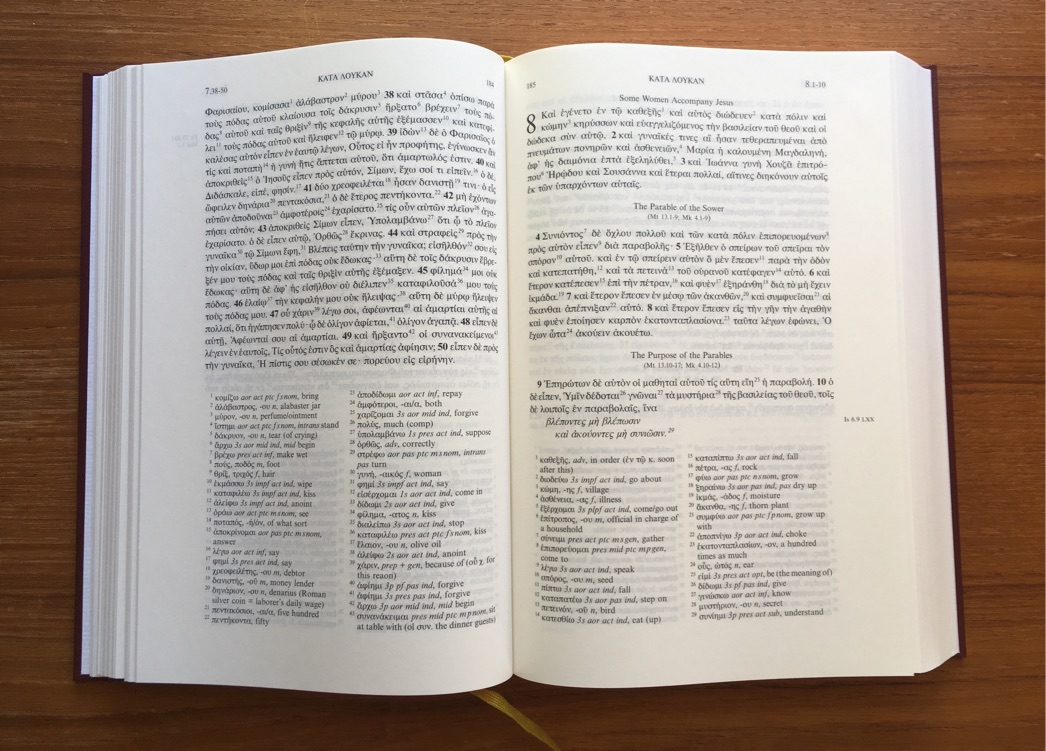
The book’s size and production is such that it fits right with other GNTs:


Here it is next to a larger Reader’s GNT:


The binding appears to be sewn. This is as hoped for with a book that a reader might want to use for many years.


One pleasant surprise is how often Irons details Hebraisms and keeps an eye on the Septuagint and its influence on the GNT. He does that right from the beginning, in fact, as with this entry for Matthew 1:2

1:2 | Ἀβραὰμ ἐγέννησεν τὸν Ἰσαάκ = LXX 1 Chron 1:34 – note the unexpected definite article τόν before the name of the person begotten, and so throughout vv. 2–16. Formula used in the LXX genealogies: x ἐγέννησεν τὸν y (see LXX Gen 5:6 ; 10:8 ; 1 Chron 2:10ff)

Here is a full sample page:


It is difficult to imagine an intermediate Greek reader working through the New Testament with just a Greek text and this book… as the author notes, the Syntax Guide is best used with a Reader’s GNT where infrequently occurring vocabulary is already glossed. And of course a book of this brevity will (inevitably) include grammatical matters that Irons does not comment on—it covers fewer words and phrases, for example, than “Max and Mary” (A Grammatical Analysis of the Greek New Testament).

But in the dozens of Greek chapters I read with just a Reader’s GNT and Irons’s book at hand, there were very few times when I had a grammatical question Irons didn’t treat.

You can check out a longer excerpt of the book here. And you can purchase it at Amazon here or through Kregel here.


Thanks to Kregel for the review copy, given for the purposes of this write-up, but with no expectation as to the content of my review.

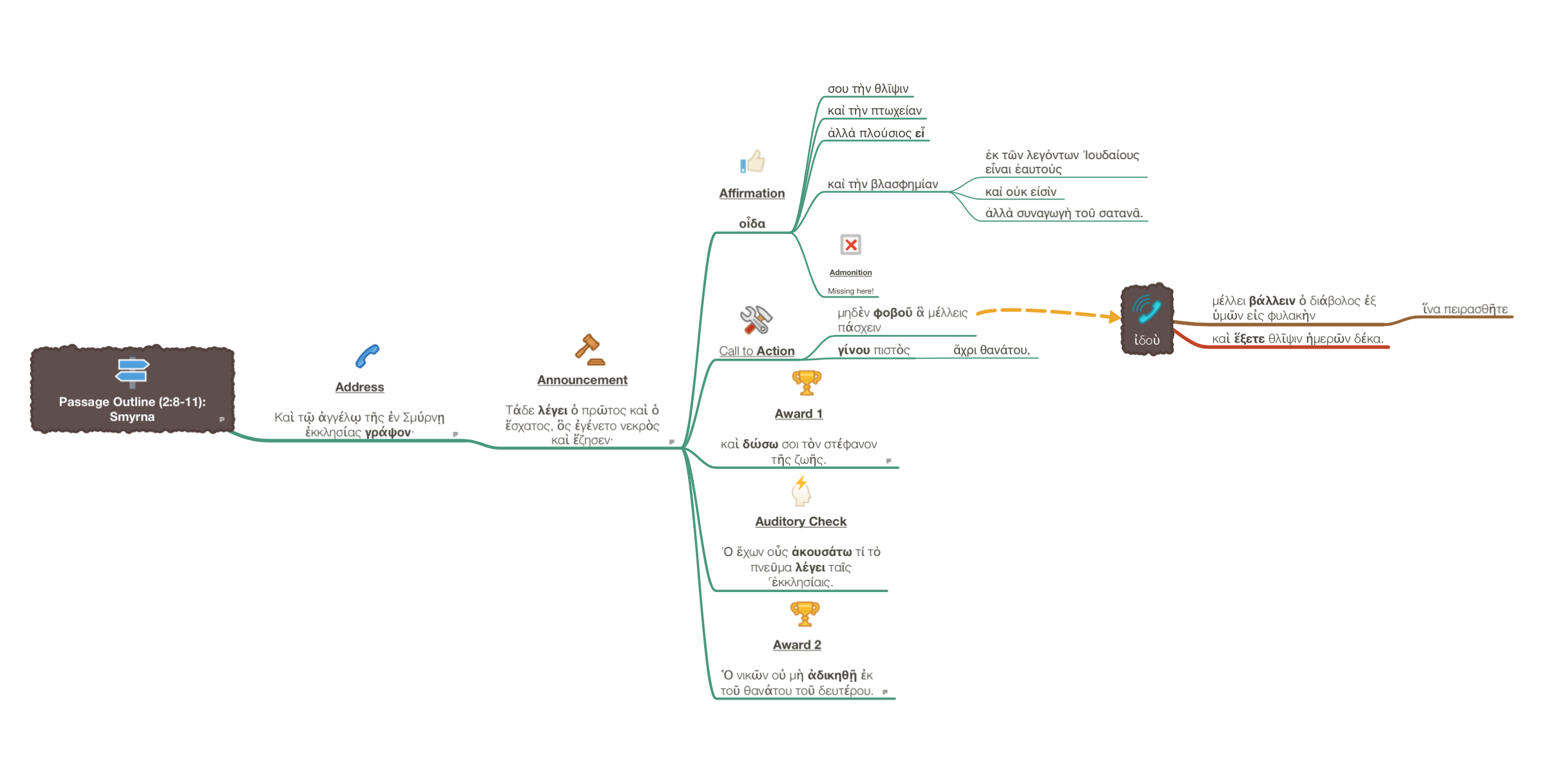
A Mind Map of Revelation’s Letter to Smyrna

Last week I posted the mind map I made to help me visualize the letter to Ephesus in Revelation 2:1-7.

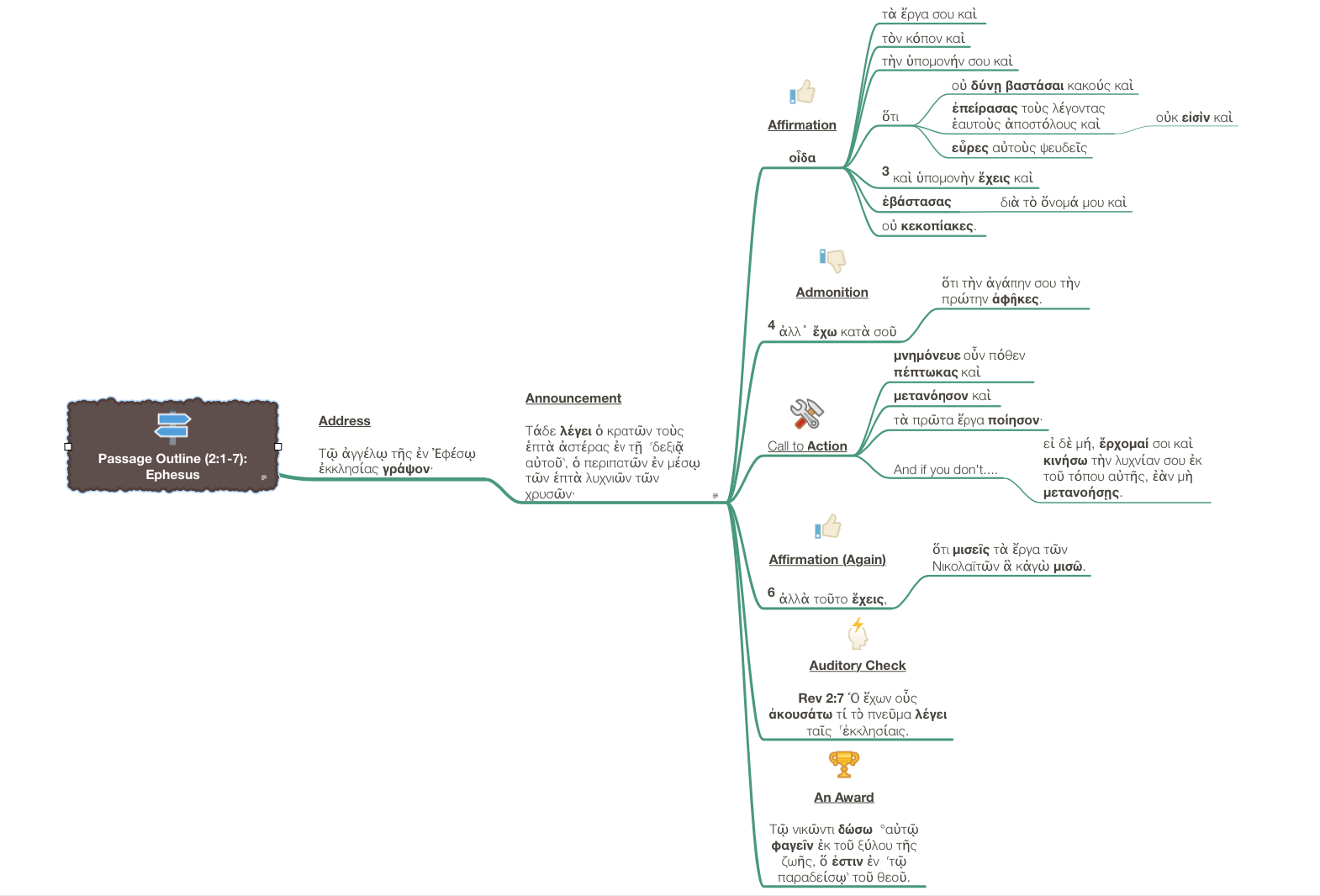
Here is my mind map of Greek Revelation 2:8-11, the letter to Smyrna. Interesting to see how the structure of this “oracle” is both similar to and different from the letter to Ephesus.


As with last time, this passage outline definitely informed my sermon outline, but the latter differs quite a bit from the former. If you want to hear these sermons, by the way, you can subscribe or listen to the podcast here.

Zondervan Reader’s Greek New Testament: An Illustrated Review


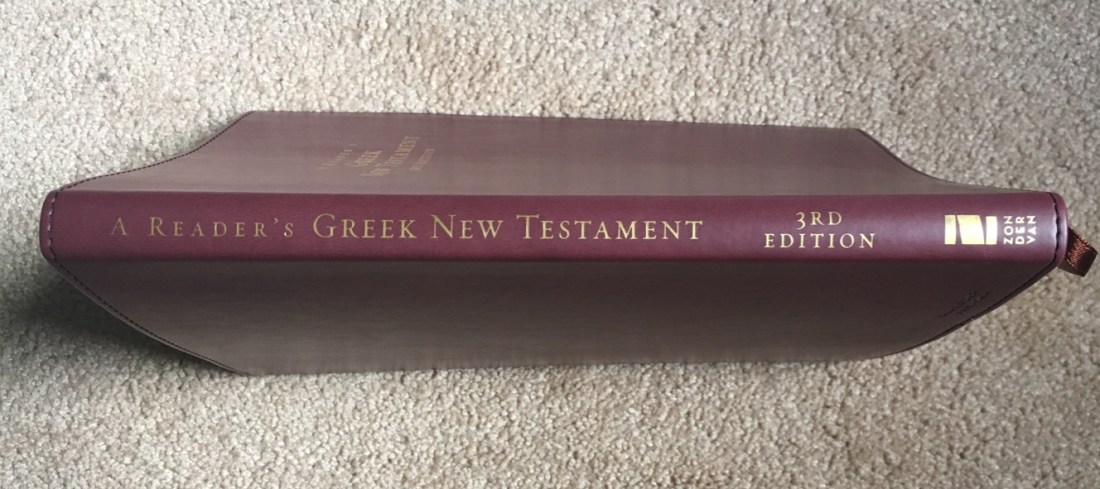
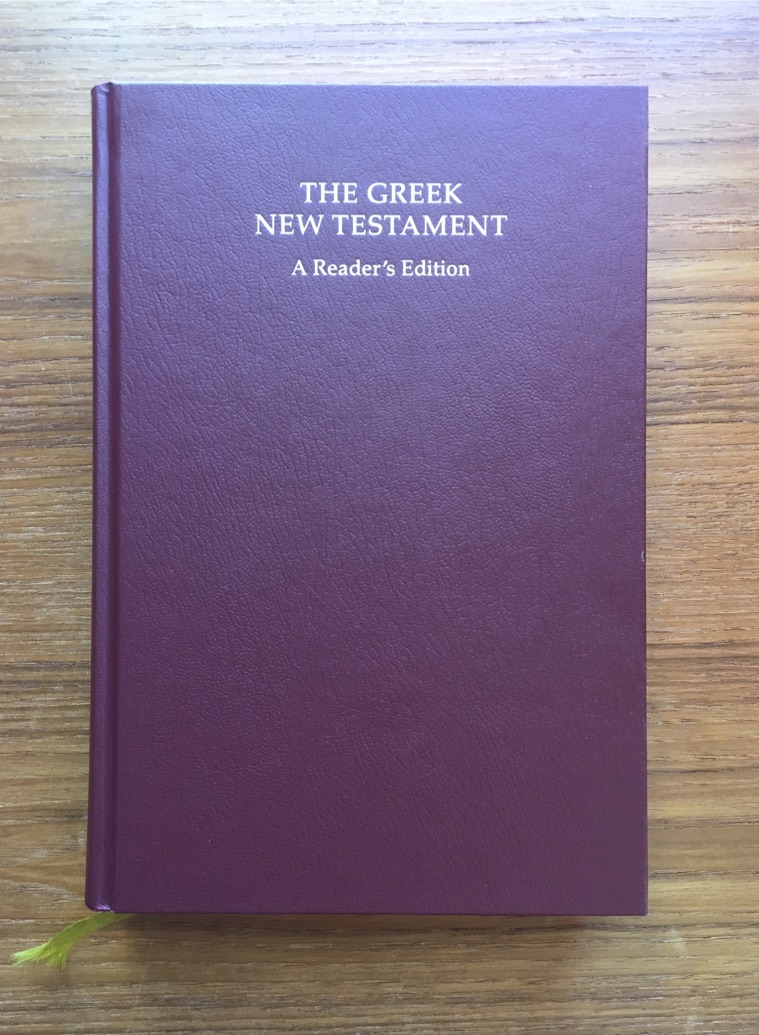
The Zondervan Reader’s Greek New Testament has undergone vast improvements in its Greek font since its first eye-hurting edition. Now in its 3rd edition, the lightweight, handsome, and well-constructed Reader’s Bible is perfect for sticking in a satchel to be able to read the Greek New Testament in transit.

Most notable is its size—it’s significantly thinner and lighter than its UBS5 Reader’s counterpart. Here it is with a 3.5” x 5.5” Field Notes notebook on top:


The included ribbon marker and gilded edges and lettering add a touch of class:


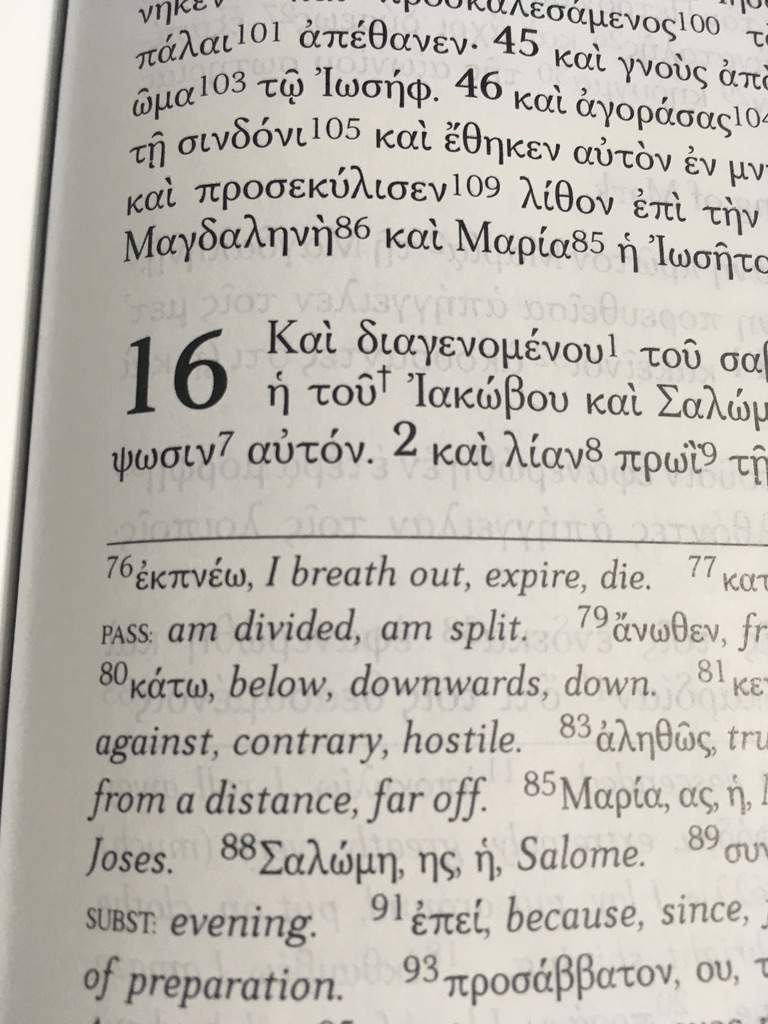
It’s worth repeating: the Greek font looks much better that previous editions. I think the UBS5 font still is the best-looking and most readable, but this one is good, too:


The text here is the Greek that underlies the New International Version—so not an exact match with the Nestle-Aland 28th edition. However, there are notes that point out where this Greek text and the NA28/UBS5 differ. For the purposes of reading through the Greek New Testament (the aim of this edition), I found the (minor) differences wholly inconsequential.

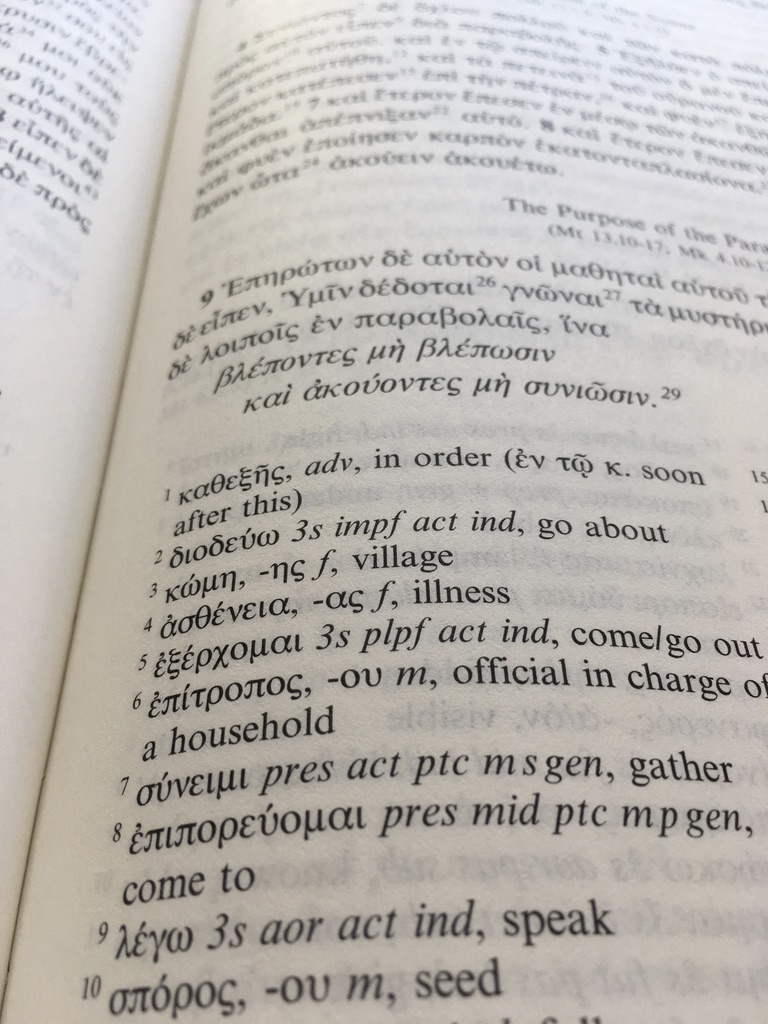
The footnoted vocabulary covers words that occur 30 times or fewer in the Greek NT. At the back is a “mini-lexicon” for everything else:


Whereas the UBS Reader’s edition has two nicely formatted columns, it can be difficult to quickly scan the single-column footnote jumble in Zondervan’s edition to find the appropriate word:


IMG_0923


And there are no verb parsings—just a list of possible glosses for each word (without a decision made based on context).

Overall I think the UBS5 Reader’s GNT is the best on the market, but the improved font, feel, and portability of the Zondervan Reader make it worth exploring. And if you’re going to own two Reader’s Greek New Testaments (because why not??), it’s nice to be able to switch between the UBS5 and this one, which is more affordable.

You can find the book here (Zondervan) and here (Amazon). See also my recent review of the UBS5 Reader’s Edition here.


Thanks to Zondervan for the review copy, given for the purposes of this write-up, but with no expectation as to the content of my review.

Reader’s Edition of the UBS5 Greek New Testament: An Illustrated Review

Typesetting is somewhat subjective, but the German Bible Society’s UBS5 has some of the best-looking Greek text you’ll find in any New Testament.

The UBS5 itself is about three years old. (Hendrickson, which distributes GBS items in the U.S., put together this excellent infographic.) Known for its full-bodied text-critical apparatus, translators and students alike benefit from its footnoted listing of variant manuscript readings. (So do NA28-loving scholars; don’t let them fool you!)

The UBS5 Reader’s Edition significantly pares down the textual apparatus and in its place provides a running list of infrequently occurring Greek vocabulary. As the name implies, the Reader’s Edition is a one-stop shop that facilitates fluid reading of the Greek text, even for those who have had just a year or so of Greek studies.

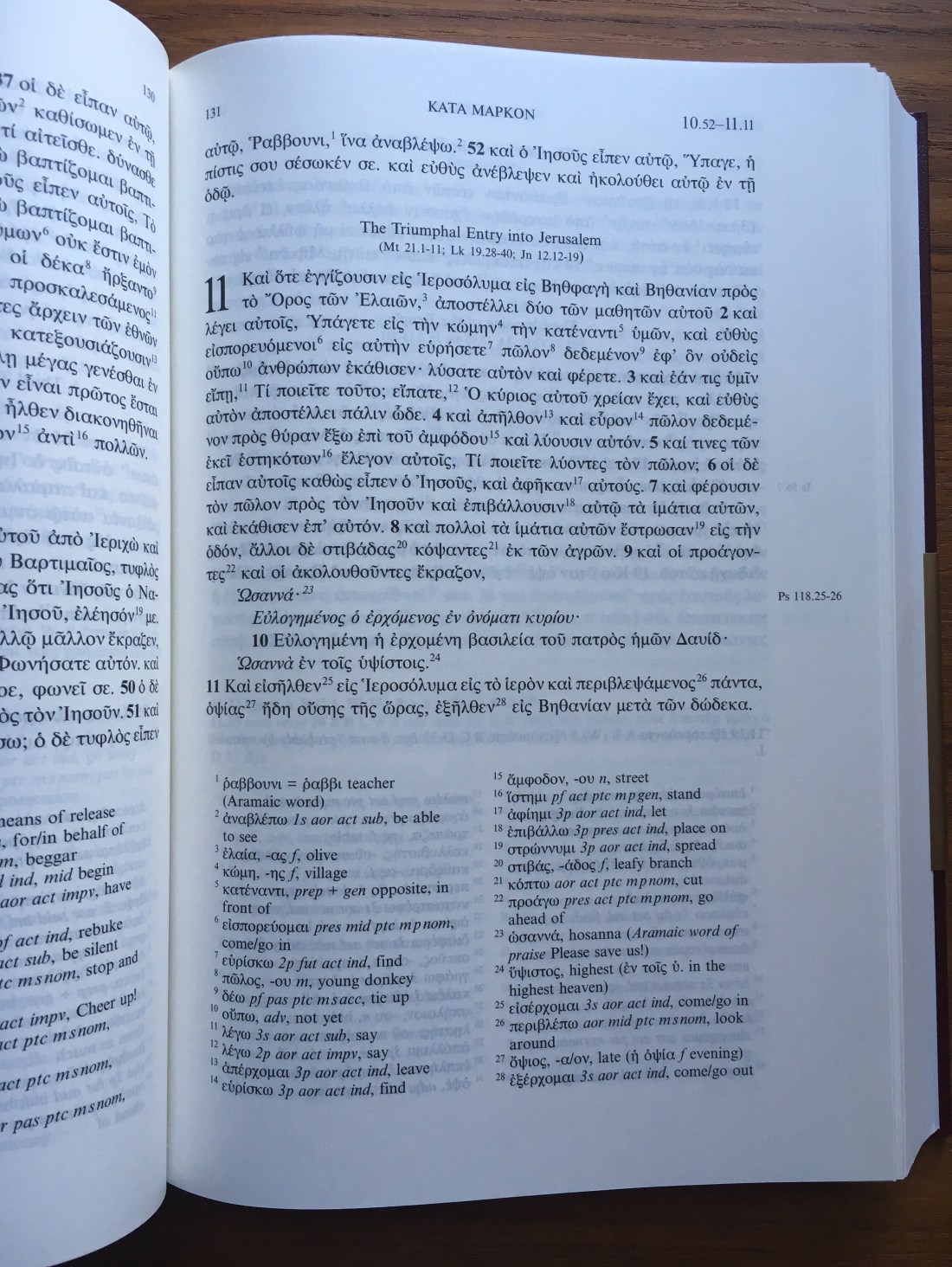
Here’s what it looks like:


The “textual notes” here just “highlight the most important differences between major Greek manuscripts and identify Old Testament references in the margins,” the latter of which I have found really useful.

As for the footnoted vocabulary, any word that occurs 30 times or less in the Greek New Testament has a “contextual” gloss (short translation equivalent) next to it. What I really like about this volume in contrast to the Zondervan Reader’s Edition is that there are verb parsings and noun genders listed with the vocabulary. This helps me not just to know what a word means in its context, but provides occasion to review verbal forms—something that can slip surprisingly quickly without review! Everything on the bottom of the page is easy to scan, too, as it is in two columns, not all jumbled together as some other reader’s editions have it.


img_6961-e1497842648504.jpeg


Between the aesthetically pleasing font and the vocabulary and parsings, this is the best reader’s edition on the market.

I’ve found parsing errors in the previous UBS Reader’s Edition. No doubt there have been corrections in this one. I cannot recall coming across any errors so far, and I’ve been using it off and on for at least a year of reading.

If a vocabulary word is not glossed at the bottom (i.e., you don’t know your vocabulary down to 30 occurrences), there is a concise Greek-English dictionary in the back of the Bible. Yes! Just about everything you need for Greek reading is here.

The only potential annoyance I can think of is that sometimes if a word is glossed already on page (n), when it occurs again on page (n+1) it is not always listed on that page—you have to flip back a page. Sometimes it’s not even footnoted when repeated, but then you recall that you just saw it (hopefully).

The inclusion of a high-quality ribbon marker is icing on the cake.

Finally, I have to say I was a little saddened that a beautiful typo (found in the UBS5 stand-alone and UBS5-NIV11 diglot and even previous UBS Reader’s Edition) is corrected in this edition! For the better, I suppose.

You can find the UBS5 Reader’s Edition here at Whole Foo—I mean, Amazon, here at Hendrickson, here at GBS, and here at CBD. There is both a hardcover edition (what is pictured in this post) and a slightly more expensive imitation leather edition.


Thanks to Hendrickson for the review copy, given for the purposes of this write-up, but with no expectation as to the content of my review.

A Mind Map of Revelation’s Letter to Ephesus

I haven’t posted about it since, but I mentioned a while ago that I’m preaching through the first three chapters in Revelation, calling the series, “The 7 Last Words to the Church.” God still speaks to the church today, I believe, but these are the 7 last “words” (or messages) as recorded in Scripture.

This Sunday I’m preaching on the message to Ephesus, the first of seven churches to be addressed (Revelation 2:1-7).

If you are reading this post, it is at least possible that you read Words on the Word because of its nerdery and not in spite of it.

So I wanted to share how much fun I had this morning working through the Greek text (via Accordance) and making a mind map outline of the passage (with MindNode). This is my passage outline, which is not always the same as the sermon outline itself (generally I think of this much alliteration as verboden). Seeing the verses visually like this has helped me get a good grasp on the flow of Revelation 2:1-7. (Click or tap the image to enlarge it.)


Preaching Revelation

I’ve just begun a preaching series on the first three chapters in Revelation, called, “The 7 Last Words to the Church.”


Just as Jesus uttered “7 last words” (or 7 series of words) on the cross, the Bible’s final book has 7 words (or passages) directed to individual churches in John’s day. Just about every interpreter that I can see, including yours truly, understands those passages as having significant universal application to today’s church.

The words to the 7 churches come in Revelation 2 and 3. Before that is one of the most remarkable chapters in all of Scripture. (I know… you can’t really rank these things.) Revelation 1 is rich and powerful and worthy of deep reflection in this season of Easter, soon to give way to Pentecost. In my church we’ll spend a number of weeks in Revelation 1 before moving to the 7 last words to the church in chapters 2 and 3.

The first week I offered our congregation the simple encouragement to read Revelation 1:3 and take it at face value. It says:

Blessed is the one who reads the words of this prophecy, and blessed are those who hear it and take to heart what is written in it, because the time is near.

Okay, I’ll admit: “face value” when it comes to Revelation’s “the time is near” is anything but agreed upon by those who read Revelation! That’s fine. John’s vision and words to the church still have a sense of urgency regardless of when “the time” is and how “near” it may be.

The book–this revelation from, by, and about Jesus Christ–begins with an apocalyptic beatitude. Maybe we’re right to be skeptical any time a preacher asks, “DO YOU WANT TO BE BLESSED?” But John begins his letter with an ironclad promise, endorsed by Jesus himself. Namely, if you read these words of Scripture, if you hear them, and if you take them to heart, you will be blessed, fulfilled, content.

It’s a great way to start this apocalyptic and prophetic letter-Gospel.

Pentecost: RSVP

The Story Luke TellsPentecost is near, which means many churches will turn their attention to the book of Acts.

A couple of Pentecosts ago I recommended Justo L. González’s excellent The Story Luke Tells: Luke’s Unique Witness to the Gospel.

González notes that Luke’s story in Luke-Acts doesn’t really end per se: “Paul has suffered countless vicissitudes. He has been shipwrecked. He has finally made it to Rome. He is awaiting trial before Caesar. And then—nothing!”

(If you can never remember how Acts ends, rest assured! This may be why.)

Gonzalez goes on:

In telling his story and leaving it unfinished, Luke is inviting his readers to be part of it, to join the throng. ….But since the story is unfinished, it is more appropriate to conclude it with “RSVP,” like an invitation that awaits a response. This is what Luke demand from us: not satisfied curiosity about the past, but a response here and now. RSVP!

It’s neat to think about the church today as being a new sequel to Luke-Acts. Or, more accurately, the threequel to those two stories: Luke, Acts, the Church Today.

May God continue to empower with his Holy Spirit those of us who would RSVP faithfully to his invitation!


(Adapted from an earlier post on this blog.)


How to Read a Book in Accordance (Screencast)

I’ve recorded a 12-minute screencast on how to read a book in Accordance Bible Software.

I highlight four features:

  1. Hyperlinks, hyperlinks, hyperlinks!
  2. The expandable/collapsible Table of Contents sidebar
  3. Search Fields to better focus your search
  4. Advanced: Amplify/Research to get from the book you’re reading to the rest of your library

You’ll never read or study a work of theology or biblical studies the same way again. Accordance makes Kindle look like a codex.

Here’s the video:


I mention these resources:

And there are Interpretation Bible studies. More about these exciting new additions to Accordance can be found here.

Thanks for watching!


Thanks to Accordance for access to the Interpretation modules shown in this screencast review. See my other Accordance posts (there are many) gathered here. I recorded the tutorial using the app Capto.

Bruce Waltke’s Epic Micah Commentary, Now in Accordance

waltke-micah


Bruce Waltke’s nearly 500-page commentary on Micah (Eerdmans, 2007) is the best treatment of Micah I know of. It might even be the best commentary on any prophet, and ranks right up there with R.T. France’s Mark commentary. Waltke’s Micah, however, is even more technical and examines just about every textual issue you could imagine. It was indispensable to me when I wrote a seminary exegesis paper on that blessed prophet. I don’t preach Micah without consulting it.

Accordance Bible Software has just released the volume, and even though I own the print edition, I made sure to get it into my Accordance library a.s.a.p. Check it out here (Accordance) and here (publisher’s page). The price is far lower than the value of the book.

A Review of Discovering the Septuagint: A Guided Reader (Jobes)

Discovering the LXX


At long last Karen Jobes’s Discovering the Septuagint: A Guided Reader, has been published by Kregel Academic. The TL;DR version of my review is: while the resource has a few noticeable flaws (easily fixable for a second edition), its addition to the world of Greek reading and Septuagint studies is long overdue.

Below is a longer review of the book, in what I hope will be easy-to-scan Q & A format.


What books of the LXX are covered?

There are ten, intended to “give readers a taste of different genres, an experience of distinctive Septuagintal elements, and a sampling of texts later used by writers of the New Testament” (9). Discovering the Septuagint treats nearly 700 verses from:

  1. Genesis (80 verses)
  2. Exodus (79 verses)
  3. Exodus 20:1–21 // Deuteronomy 5:6–21 (10 Commandments)
  4. Ruth (85 verses)
  5. Additions to Greek Esther (73 verses)
  6. Psalms (67 verses)
  7. Hosea (56 verses)
  8. Jonah (48 verses)
  9. Malachi (55 verses)
  10. Isaiah (81 verses)


For whom is this book?

Jobes says it “contains everything needed for any reader with three semesters of koine Greek to succeed in expanding their horizons to the Septuagint” (8). I think this assessment is right, as I found the book easy to understand (though I’ve had more than three semesters of Greek).


How is the book structured?

Each LXX book has a short introduction. Then there is the passage, verse by verse, with the Greek text re-printed in full. Under each verse are word-by-word and phrase-by-phrase comments on the vocabulary, usage, syntax, translation from Hebrew (the book is strong here), and so on. Following each passage is the NETS (English translation). The end of the book has a three-page, 33-term glossary and a two-page “Index of New Testament LXX Citations” for the books included in the reader.


What does a sample entry look like?

Here’s Jonah 4:6:

jobes-on-jonah-lxx


What’s commendable about Discovering the Septuagint?

It shouldn’t go without saying that the very existence of this resource is a boon to Greek readers. There is Conybeare and Stock, as well as some passages in Decker’s Koine Greek Reader, but readers of the Septuagint have far fewer resources than readers of the Greek New Testament.

The margins are plenty wide for students to jot down their own parsings, translations, and notes.

Notes on the verses are often answers to questions I’ve had as I’ve read the Greek text. In this sense the reader is a great guide. For example, here is a comment from Genesis 1:4:

ἀνὰ μέσον . . . ἀνὰ μέσον | Idiomatic prep phrase, “between.” This is a Hebraism, so there is no need to translate the second of the pair as NETS does.

And another helpful nugget from Genesis 1:11:

κατὰ γένος | Prep + neut sg acc (3rd dec) noun, γένος, kind. Remember the nom and acc forms are identical in this paradigm. Agrees with and modifies σπέρμα.

Whether or not a fourth semester Greek student should remember that nominative and accusative forms are identical in the third declension is another issue. That the reader reminds me as much is welcomed.


What is lacking?

The glued binding doesn’t do justice to a book like this, but that seems to be the way many publishers have gone recently, even with reference works in biblical studies.

Parts of the book feel under-edited or rushed to print:

  • a few typos (missing periods, etc.)
  • referring to the Rahlfs-Hanhart text as a “critical edition of the Septuagint” (9), which is technically true, but potentially misleading, as “semi-critical” is better (text criticism is not a real concern of the book)
  • a peppering of vague statements like this one on “the image of God” in Genesis 1:26: “See a commentary or study Bible” (31)
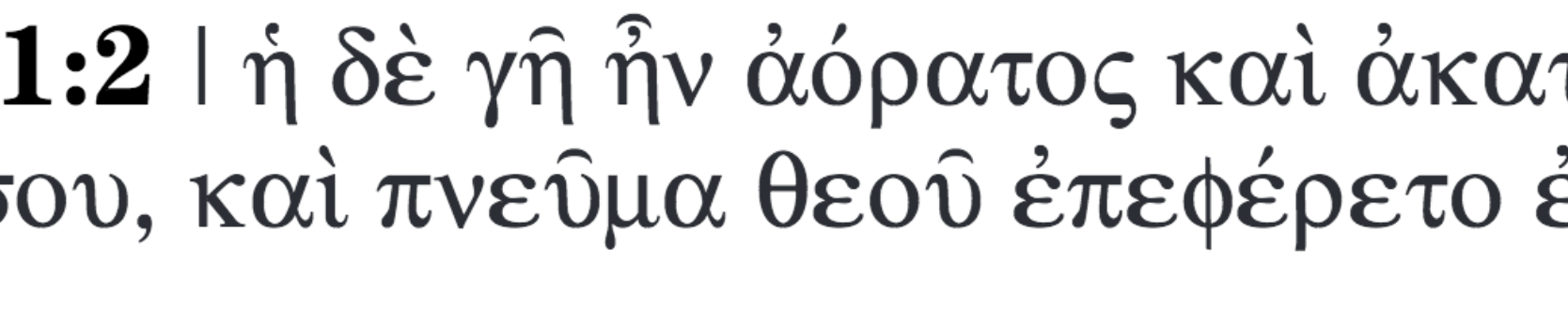
  • the typesetting on the epsilon just seems off to me. I’ve tried to convince myself it’s just me, but I haven’t since been able to unsee what just looks like a flattened ε or a backwards three, rather than an actual Greek letter:


    screenshot-2016-10-31-22-06-57


    By contrast, look at the letter in this screenshot, taken from Accordance Bible Software:


    screenshot-2016-10-31-22-08-42


    The layout and Greek font are nice otherwise! (Though a couple times in the typesetting of the book, a letter from another language intrudes mid-word.)

  • Introductory issues are quite sparse–whether in the introduction to the Greek of the Septuagint itself (just two pages) or in the introductions to books. I would have liked it if the contributing writers had offered more for each book–even three or four pages would have gone further than the one or two that are here.

This last point deserves just a couple more lines. A number of the introductions adapt or “abstract” their text from the NETS book introductions, which readers could easily enough have found on their own. In some ways the book introductions read just like exam study guides you might have made yourself for a grad-level class on the Septuagint. That may be, in fact, how they started! (Jobes is chief overseer of the book, with many contributors.) This does not make the introductions not valuable, but it will probably leave readers wishing for more detail.

All in all, Discovering the Septuagint is worth owning. The number of times I’ve gotten grammatical or morphological help from the comments far outweighs any of the volume’s weaknesses. And there is a lot of Greek help to be had here. I’ll be making repeated use of this book by Jobes and company, and am glad it’s finally on the market.

Discovering the Septuagint is available from Amazon, as well as from Kregel.


Thanks to Kregel for sending the review copy, provided to me so I could write about the book, but with no expectation as to the content of my review.