Logos 7: Review, Screenshots, Video

Image via Logos
Image via Logos


Bible software nerds, rejoice! Today Logos 7 comes into the world.

I’ve been using Logos (alongside Accordance and BibleWorks) since Logos 4. There hasn’t been a major interface overhaul since that version, but Logos has been steadily adding loads of features since then.

From a few weeks of beta testing, I offer here my initial impressions of Logos 7, as well as a look at its features in action.

Here’s the best of what’s new in Logos 7.


1. Interactives (Again)


The Interactives were my favorite feature in Logos 6. The addition of more Interactives makes it the part I most like about Logos 7.

Here is a screenshot of all the Interactives, which you can pull up from your library with the search: “type:interactive”.


Logos 7 Interactives


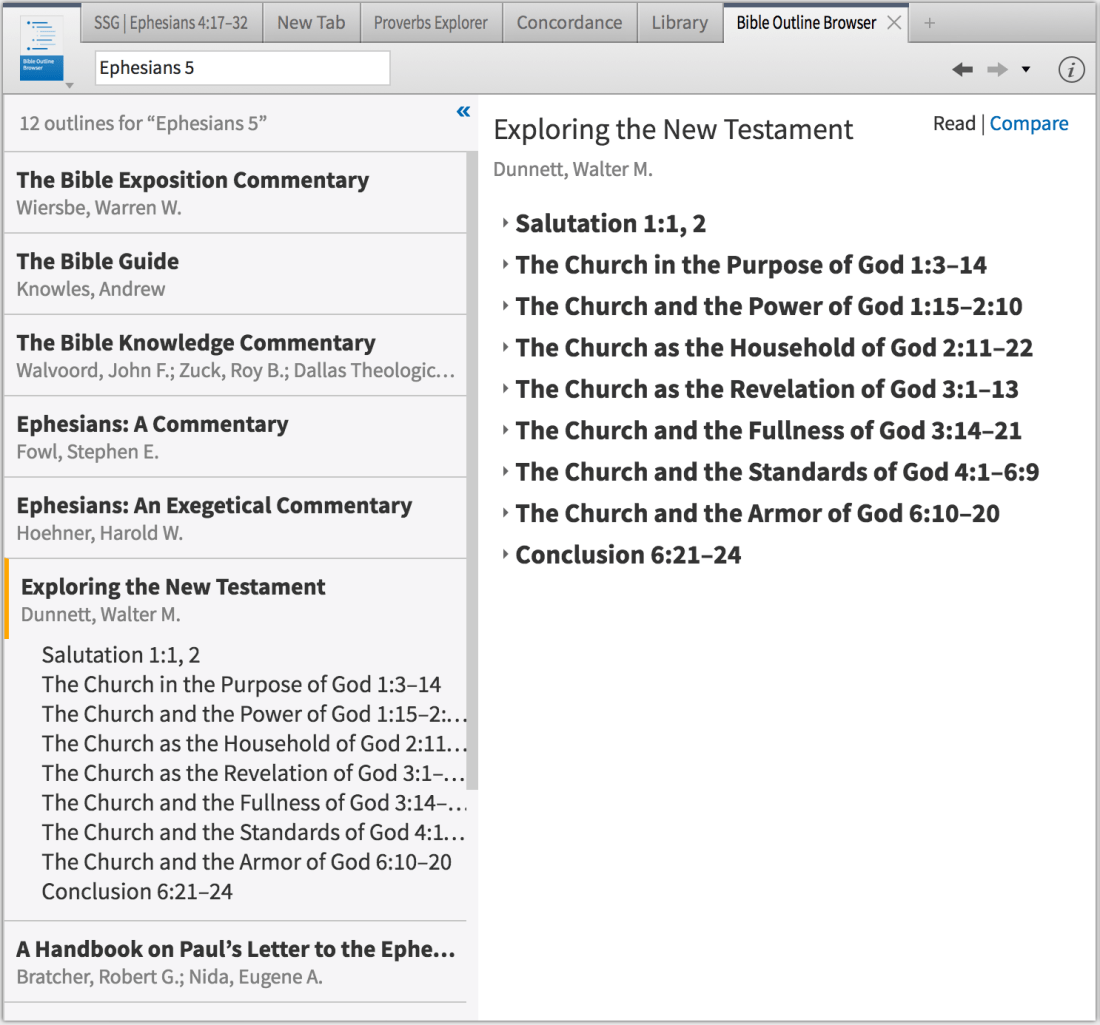
Some of those were in Logos 6, like the Bible Outline Browser, which shows you all the Bible text outlines you have in your library for the passage you’re considering.


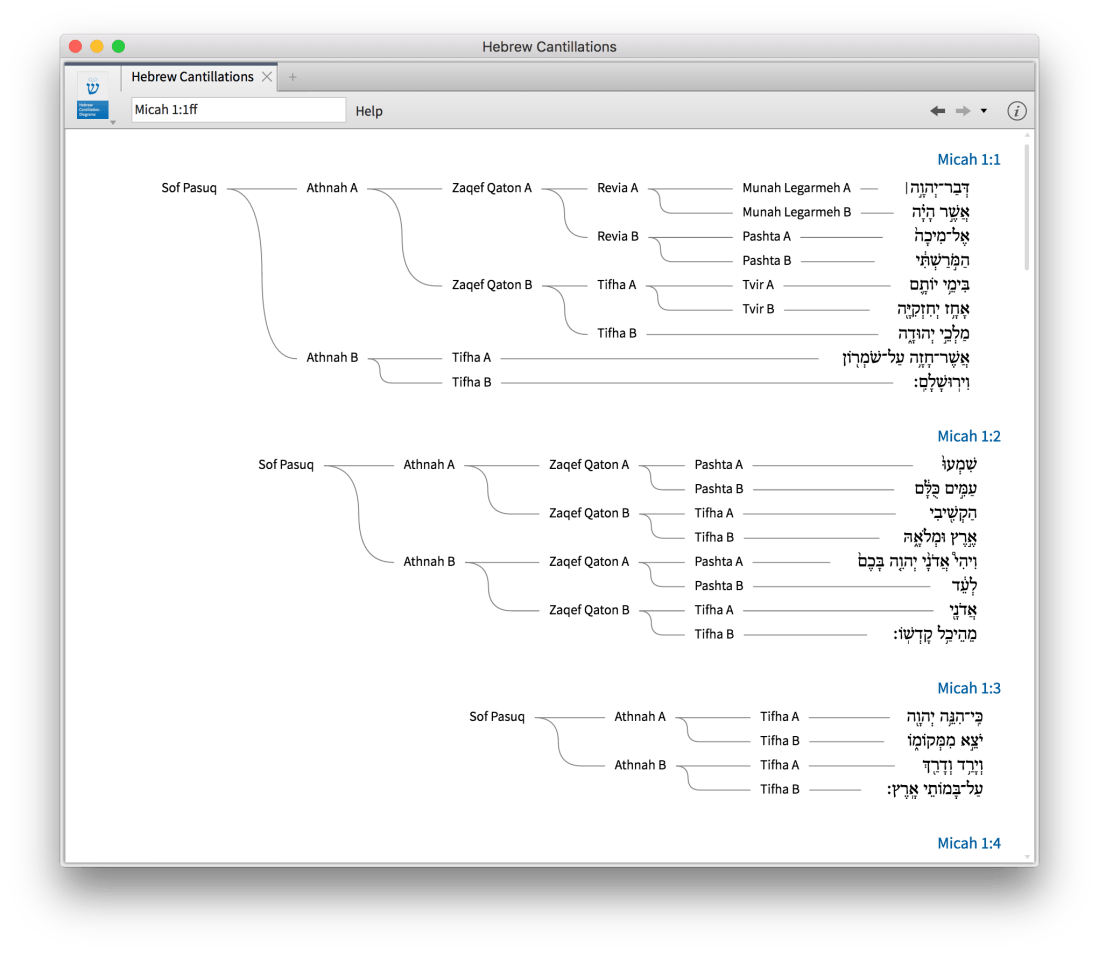
The Hebrew Cantillations Interactive in Logos 7 has seen improvement since its release in Logos 6 (it wasn’t ready for prime time initially):


Logos 7 adds the Septuagint Manuscript Explorer, which students of the Göttingen editions will especially appreciate:

We’ve cataloged information about Septuagint manuscripts, including contents, date, language, holding institute, and more. With this interactive, discover the earliest Septuagint manuscripts see how many contain the book of Psalms, and even view scanned images of many fragments, like Codex Sinaiticus.


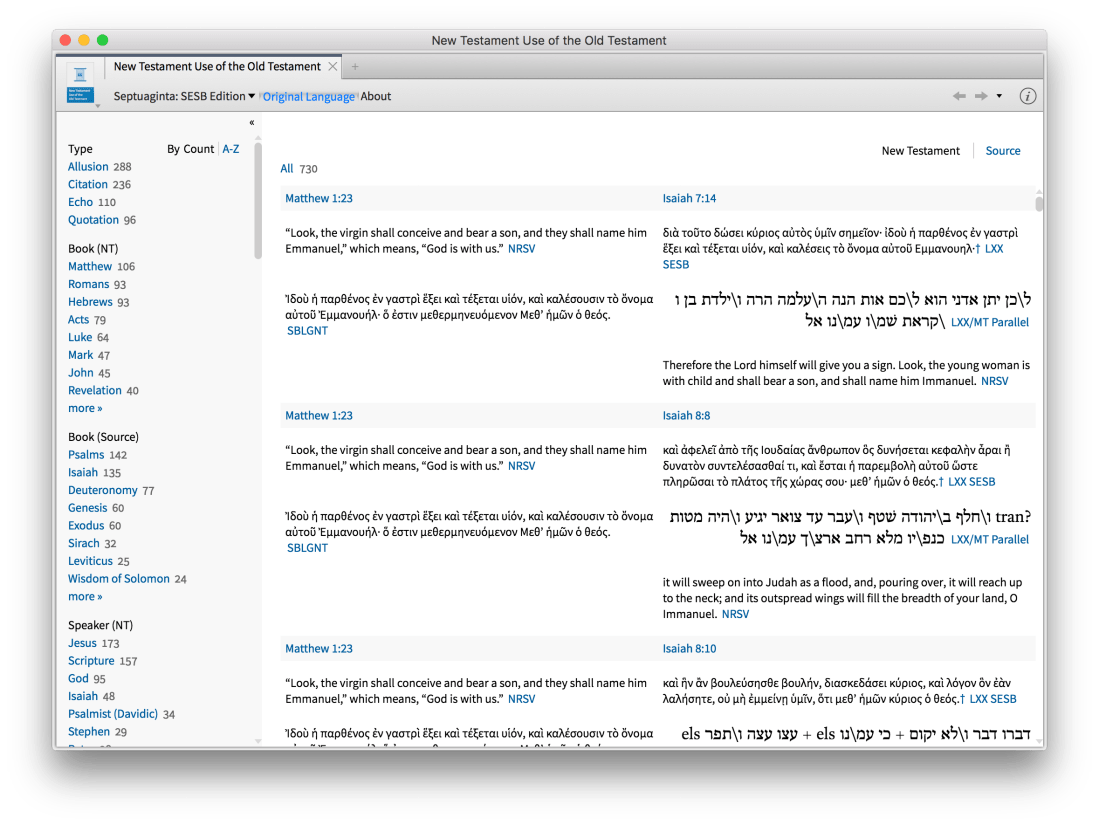
My most used Interactive at the moment is the New Testament Use of the Old Testament. I would have made great use of it when I took a seminary course by that name. There are lots of ways to get access to what OT passages the NT is using (commentaries, Bible text footnotes, words searches), but this Interactive consolidates and sorts the data in a highly convenient way.

You can sort by allusion, quotation, echo, and citation. I always thought allusion and echo were more or less the same—though the use of terminology is itself at issue in the field! At any rate, the authors of the Interactive define their terms:

• Citation: An explicit reference to scripture with a citation formula (e.g. “It is written,” or “the Lord says,” or “the prophet says”).

• Quotation: A direct reference to scripture, largely matching the verbatim wording of the source but without a quotation formula

• Allusion: An indirect but intentional reference to scripture, likely intended to invoke memory of the scripture.

• Echo: A verbal parallel evokes or recalls a scripture (or series of scriptures) to the reader, but likely without authorial intention to reproduce exact words.

This Interactive probably deserves its own post. You can change what versions it displays, and even set it so that the English NT and OT passages are displaying alongside Greek (NT) and Greek and Hebrew (OT). (Getting this part set up was not really intuitive to me.) You can even hover over Greek and it cross-highlights the corresponding English, and vice versa:


If software programs had Pulitzers, the NT Use of the OT should win one for best feature. Here’s what it looks like, including the sidebar, which allows you to focus your study using a ton of criteria. You could easily find, for example, all the times Matthew cites or alludes to an OT passage with Jesus in mind.


2. Sermon Editor


I have worked hard to get a sermon writing workflow I really like. (Detailed article at CTPastors.com forthcoming!) So I doubt I will use the new Sermon Editor much, but it looks pretty awesome, if you want to use Logos for sermon writing. In the image below, the Sermon Starter Guide (introduced in Logos 5) is next to the Sermon Editor.


Not only does the Sermon Editor offer rich text writing and multiple Export options, if you mark your Headers, it automatically generates a Powerpoint slide show for your text. It’s also got a Handout option, which allows you to easily generate a one-pager to accompany your sermon, as well as to automatically set up a handout with blanks to fill in.

AND… if you type in a Scripture reference, the Sermon Editor automatically creates a slide with the text of that Scripture, even fitting text to multiple slides if necessary. Watch:


You can also save a step and have the slides auto-generate with just a keyboard shortcut, after typing in the reference. Amazing.


3. QuickStart Layouts


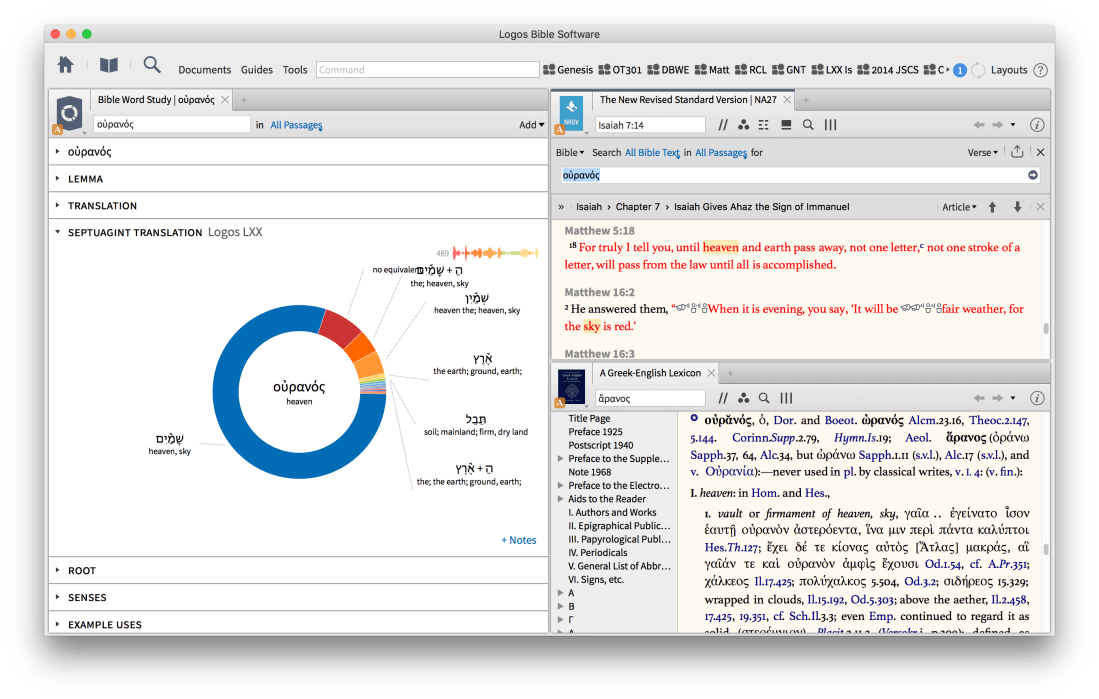
This is not a ground-breaking feature, per se, but it is a time-saving addition. Now the Layouts option in the Logos toolbar offers access to “QuickStart” saved layouts that get a user up and running for various tasks.


The Greek Word Study layout, for example, is nicely executed:


4. Systematic Theologies in the Passage Guide


The Passage Guide has been around a while, but Logos keeps adding to it. Logos 7 features a Systematic Theologies guide, an admittedly subjective but still helpful aggregator of theology resources in your library, keyed to the verse you’re studying. You can sort it by theology subject (Christology, pneumatology, etc.) or by denomination.


5. Everything Is (Still) Hyperlinked


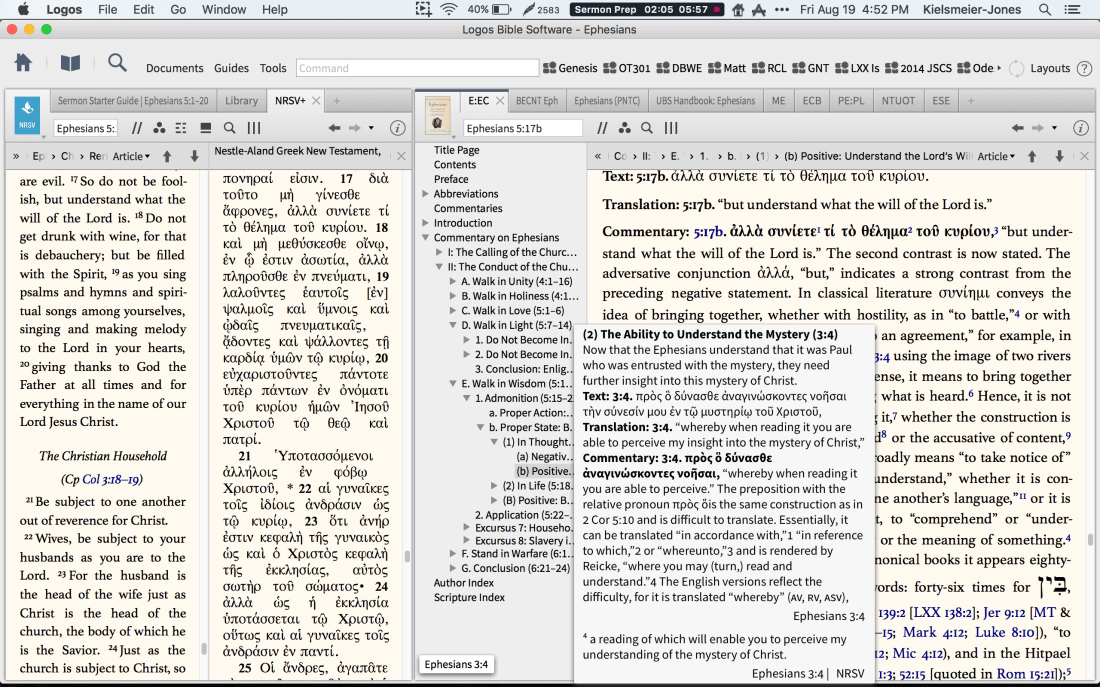
The hyperlinking seems to have improved since I was last using Logos regularly when Logos 6 launched. (Only now with a recent laptop upgrade does Logos run well on my Mac.) Of course the Scripture verses are hyperlinked, but commentaries are also hyperlinked to previous sections they mention. As here:


Improvements That Weren’t


Logos 7 is cutting-edge software, impressive in its innovation and a huge time saver from a task standpoint. The designers and developers clearly created it with real users in mind.

However, even on a new and higher-end Mac, Logos 7 is system resource intensive. It’s a CPU hog, a battery drain, and uses significant energy.

I can always tell if I have Logos open on my laptop because the computer is almost always warm when it is—and almost never warm with any other combination of apps open.

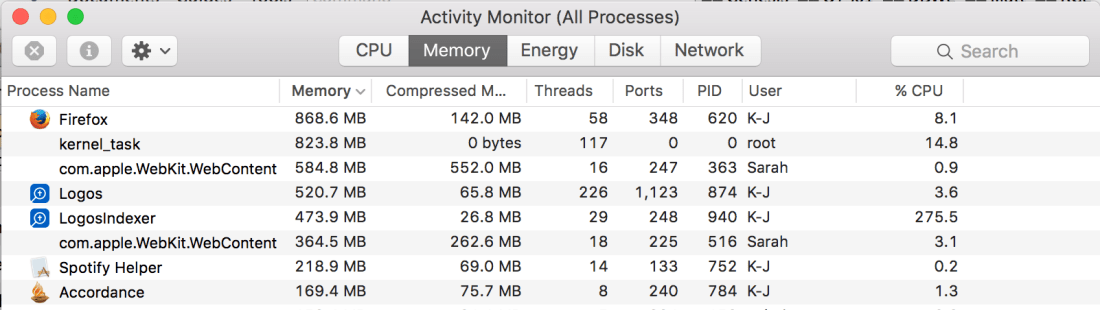


This has been my (and others’) enduring criticism of Logos since at least Logos 4, and I continue to fail to understand why program sluggishness is not Code Red at Faithlife HQ. My slightly educated opinion is that Faithlife (makers of Logos) is “going for more” instead of “sticking to the core” (to quote a Harvard Business Review article). Lots of spin-off apps and ideas and focus on marketing and shipping frequent feature updates have hindered development of the core product—at least where speed is concerned. Wanting to get at the info in the Passage Guide, for instance, can be an exercise in patience (and frustration):


Logos 7 is far more responsive and fast in searching on my newer Mac machine than it was on my previous MacBook (a 2008!). Though, for that matter, both Accordance and BibleWorks ran fast on the 2008—one shouldn’t have to buy a new machine to use Logos well, though I don’t think that stops some users from doing it, especially when they feel they’ve invested a lot of money in building their library.


In Conclusion


Speed and massive CPU usage and battery drainage are the Achilles’ Heel of Logos Bible software. I hope—for their sake and for the sake of their user base—that they shift their development focus back to whatever they need to do with the code to ensure a speedier user experience. The developers I’ve interacted with on the forums seem great—it appears to be an issue of larger company focus and resources.

It’s often not slow. (Though it’s always a CPU and battery drain.) For the couple of hours that I use Logos for sermon prep, I can search and open and highlight individual resources with ease. The feature set and Interactives are innovative and cut out unneeded research steps for users. The app itself is powerful, and does a good job of getting users into even larger libraries to cull the most relevant information for tasks at hand. Their accompanying iOS app is really good, too. Users should just be ready–even with the new Logos 7–to check email while they wait for a Passage Guide or Sermon Starter Guide to return results.

If you’re a happy Logos 6 or 5 user, should you upgrade? Definitely. The so-called data sets and features in Logos 7 are a significant step up. If you are on Windows or if your Mac is handling Logos fine and you want to keep using it, Logos 7 is a creative step in a good direction.

Never used Logos and trying to decide if you should get it? (Especially with other Bible software options available?) Then ask away in the comments below, and I’ll respond there.

Logos 7 launches with a 15% off discount. If you go to Words on the Word’s landing page, you get the discount, and the blog gets a small commission if it’s a first-time purchase. The landing page also includes links to more information about Logos 7.


Thanks to Logos for the chance to beta test and review. I received early access to Logos 7 as well as a package of library resources to test, for the purposes of this review. That did not, however, influence my objectivity…as I expect is clear. 🙂

IVP’s 5-Volume Ancient Christian Doctrine in Accordance, On Sale this Week

Ancient Christian Doctrine


This week Accordance Bible Software has put their five-volume Ancient Christian Doctrine (IVP) on sale for $129 (normally $199). Ancient Christian Doctrine is a full-blown compendium of early church commentary on the Nicene Creed. I write more about the resource here.

If you’re teaching or preaching on the Creed, this is possibly the best resource to start with. (And, of course, it’s likely available for free in print at your local theological library.)

The related Ancient Christian Commentary on Scripture (covering the entire OT and NT) is also included in the sale.

Here‘s the link to find Ancient Christian Doctrine at Accordance.


This week’s blog sponsor is MailButler, the feature set you always wished your Mac Mail had (and that I’m glad mine does). Find out more about it here or download and try it free here.


A Smooth Note-Taking Workflow for Drafts 4 and Logos in iOS

I’ve got a sweet Logos–>Drafts 4 workflow I’ve been using on the iPad for a few months now. (I find Logos’s iOS app to be significantly zippier than its Mac counterpart.) Allow me to demonstrate, using Harold W. Hoehner’s excellent Ephesians commentary.


1. Open up Logos in iOS.


Here’s Hoehner’s lovely commentary.


IMG_0383


2. Tap selected text to bring up highlighting and share options.


I’ve got Drafts open with Logos in Split View, just so you can see them together. All these steps work with Drafts not visible, however.


IMG_0384


3. Select Drafts in the share option.


IMG_0385


4. Now you can “Capture” to send the selected text right to Drafts OR prepend (add to the beginning) or append (add to the end) to an existing draft. (!)


IMG_0386


If you do Prepend or Append, Drafts comes up to let you choose where to put your text.


IMG_0387


5. When you’re done repeating this process for as much text as you want to copy, you can merge individual drafts, if needed.


IMG_0388


IMG_0389


IMG_0389


You can even choose your own text or symbol to separate merged drafts:


IMG_0390


From here it’s easy export from a single draft to Ulysses or MindNode, and on goes my sermon preparation! Drafts4 has been the most indispensable app in my attempt to do as much sermon preparation as possible on the iPad.


Thanks to Logos for the Hoehner commentary so I could write up the workflow–review of the commentary itself to follow. The Logos mobile apps are free, available here: iOS / Google Play.

It’s Prohibitively Expensive, But…

Brill LXX


…the Brill Septuagint Commentary Series is nearing availability on Logos Bible Software.

Here is how Brill describes its series:

This multi-volume series fills a significant gap in biblical studies by providing a literary commentary on the Greek text of the Septuagint. The Septuagint is widely recognized as one of the most important interpretations of the Old Testament and one of the most important sources for New Testament study. Whereas there has been much attention devoted to the two testaments, with numerous commentary series having been written, the Septuagint has been virtually neglected as a set of primary texts used by Jewish and Christian religious communities in the Greco-Roman world.

All 13 published titles will be released in late July through Logos, now available for the steep pre-order price of $1,773.99. It’s a good time to consult your local theological library. All the same, I’m encouraged to see the expanding availability of electronic resources for Septuagint studies.

Find out more here.

A Three-Volume, Multi-Thousand Page Commentary for Psalms Study

Engagement with the Psalms—reading them, owning them, singing them, praying them, and taking cues from them—is vital for robust worship and spiritual formation in the church. If they truly are “a Bible in miniature,” as Luther has said, they offer the opportunity for the church to grow in its spiritual and emotional maturity.


Descriptive, Prescriptive


The writers of the Psalms give language to the whole range of emotions: from gratitude to fear, from joy to lamentation, from petition to thanksgiving, from intimate, private prayers to national, corporate prayers. In this way they are eminently descriptive of the human experience.

The Psalms also prescriptively guide the reader into various postures of prayer, so that the one praying does not only ever approach God with petitions, or only ever with complaint, and so on. The cognitive and affective come together in the Psalms in sometimes unexpected ways. Psalms of lament, for example, often begin with a loud “Why?” (stressing the affective) yet end with a determined profession of faith like, “But I will trust in you still….” In this way they stress the use of cognitive powers in prayer—external life evidence notwithstanding!

The Psalms express (descriptively) and call forth (prescriptively) a whole spectrum of human experience in relationship to God. They teach us to bring our whole selves to God in worship.


Preaching the Psalms


But how to preach them? One will need to take into account intercultural realities. Understanding the role of a shepherd in ancient society will certainly help with Psalm 23. And soul-searching is required.


Psalms of Summer


A good set of commentaries helps, too. I preached some Psalms a couple summers ago, and found these two options quite helpful.

Just completed, too, is Allen P. Ross’s three-volume, multi-thousand page commentary on the Psalms, published by Kregel Academic.


Ross’s Commentary, in Three Volumes


Ross Psalms Vol. 1


Volume 1 has more than 150 pages of introductory material, covering:

  • “Value of the Psalms” (Ross says, “It is impossible to express adequately the value of the Book of Psalms to the household of faith”)
  • “Text and Ancient Versions of the Psalms”
  • “History of the Interpretation of the Psalms”
  • “Interpreting Biblical Poetry”
  • “Literary Forms and Functions in the Psalms” (the best starting place, I thought)
  • “Psalms in Worship”
  • “Theology of the Psalms”
  • “Exposition of the Psalms”

I haven’t seen the just-released third volume, but Kregel was kind to send me the first two volumes for review. In what follows I interact with those books. Volume 1 covers Psalms 1-41; Volume 2 treats Psalms 42-89.


The Commentary Layout (Psalm 42 as Case Study)


Even in the Table of Contents you can get a sense of where Ross will go with a given Psalm, as each Psalm listed includes summary titles. Psalm 1 is “The Life That Is Blessed.” Psalm 23: “The Faithful Provisions of the LORD.” Psalm 46: “The Powerful Presence of God.” Psalm 51: “The Necessity of Full Forgiveness.”

Introduction to the Psalm

Then there follows Ross’s introduction to the Psalm. He provides his own translation from Hebrew with extensive notes, analyzing the text and textual variants. Psalm 42:2, for example, he translates:

My soul thirsts for God, for the living God.

When shall I come and appear before God?

His footnote offers a point of interest: “This first ‘God’ is not in the Greek version; it simply reads ‘for the living God.’” He often has the Septuagint in view, which I especially appreciate. On Psalm 42:9, for example (“I say to God, my rock…”), he notes:

The Greek interprets the image with ἀντιλήμπτωρ μου εἶ, “you are my supporter/helper.”

Not that every footnote “will preach,” but they don’t need to—Ross offers a wealth of insight that will help preacher, student, and professor better understand the text as it has come down to us.

Still with each Psalm’s introductory material, the “Composition and Context” session sets the Psalm in its biblical-literary context and explores background information (where available). Regarding Psalm 42, Ross says:

And Psalm 42 is unique in supplying details of the location. The psalmist is apparently separated from the formal place of worship in Jerusalem by some distance, finding himself in the mountainous regions of the sources of the Jordan. There is no explanation of why he was there; and there is no information about who the psalmist was.

Ross Psalms Vol. 2Reading the commentary, one trusts that were there such information, Ross would have unearthed and presented it!

Then there is a summary “Exegetical Analysis,” followed by an outline of the Psalm. Anyone looking to get their bearings quickly with a Psalm will find this one of the most helpful sections. Here is Ross again, with his summary of Psalm 42:

Yearning in his soul for restoration to communion with the living God in Zion and lamenting the fact that his adversaries have prevented him, the psalmist encourages himself as he petitions the LORD to vindicate him and lead him back to the temple where he will find spiritual fulfillment and joy.

Commentary in Expository Form

After each Psalm’s generous introduction, Ross presents the commentary proper (“Commentary in Expository Form”). It’s as detailed as one would expect and hope. Here he is, for example, on Psalm 42:3-4 (“They must endure the taunts of unbelievers”):

In the meantime, the psalmist must endure the taunts of his enemies—enemies of his faith. In this he is an archetype of believers down through the ages who are taunted for their faith. This has caused him tremendous grief, so much so that he says his tears have been his food night and day (see Pss. 80:5 and 102:9; Job 3:24). The line has several figures: “tear” (collective for “tears”) represents his sorrow (a metonymy of effect); “food” compares his sorrow with his daily portion (a metaphor); and “day and night” means all the time (a merism). The cause of his sorrow is their challenging question: “when they say to me continually, ‘Where is your God’?” (see Pss. 74:10 and 115:2). The unbelieving world does not understand the faith and is unsympathetic to believers. “Where is your God?” is a rhetorical question, meaning your God does not exist and will not deliver you—it is foolish to believe. For someone who is as devout as the psalmist, this is a painful taunt.

This blend of careful attention to the text and reverent devotion to the God who breathed it is typical of the Ross’s rich comments.

Message and Application

Though Ross already offers theological interpretation in the commentary proper, the Message and Application section is one any reader will appreciate. He often reads (in a good way) through a New Testament and Christological lens, as with Psalms 42-43:

But in the New Testament the greatest longing of those who are spiritual is to be in the heavenly sanctuary with the Lord, for that will be the great and lasting vindication of the faith. Paul said he would rather be at home with the Lord—but whether there or here, he would try to please the Lord (2 Cor. 5:8–9). And Paul certainly knew what it meant to be persecuted for his faith. But the marvelous part of the desire to be in the heavenly sanctuary is that the Lord Jesus Christ desires that we be there with him, to see his glory (John 14:3; 17:24). Throughout the history of the faith believers have desired to go to the sanctuary to see the LORD (see Ps. 63); in Christ Jesus that desire will be fulfilled gloriously.

Those looking for a dispassionate commentary or for one that does not find Jesus in the Hebrew Bible will be better served looking elsewhere. To my mind, this dynamic is one of the great strengths of these volumes.

Toward the end of a Psalm, then, Ross boils it down to an italicized expositional message. This is one of the (many) highlights of the commentary, as it pulls everything together from Ross’s careful exegesis into the world of the listener. Here is how he puts Psalm 23:

The righteous desire to be in the presence of the Lord where they will feed on his Word, find spiritual restoration, be guided into righteousness, be reminded of his protective presence, receive provisions from his bounty, and be joyfully welcomed by him.

Where to Get It


Here is where to find these fine books:

Volume 1: Amazon / Kregel

Volume 2: Amazon / Kregel

Volume 3: Amazon / Kregel


Thanks to Kregel for the review copies of both books, given to me for the purposes of reviewing them, but with no expectation as to the content of this post.

Structure of Ephesians 2:1-10: The Center Is Not What I First Thought

In the past when I’ve preached on Ephesians 2:1-10, I’ve gone straight for the gold of Ephesians 2:8-10:

For it is by grace you have been saved, through faith—and this not from yourselves, it is the gift of God—not by works, so that no one can boast. For we are God’s workmanship, created in Christ Jesus to do good works, which God prepared in advance for us to do.

The first seven verses have just felt like an opening band that–while good–wasn’t necessarily what I had come to see.

I see the passage differently now, having spent a good deal of time trying to understand Paul’s flow.

Here’s the passage from the 1984 NIV, followed by the passage in Greek:

Eph 2:1       As for you, you were dead in your transgressions and sins, 2 in which you used to live when you followed the ways of this world and of the ruler of the kingdom of the air, the spirit who is now at work in those who are disobedient. 3 All of us also lived among them at one time, gratifying the cravings of our sinful nature and following its desires and thoughts. Like the rest, we were by nature objects of wrath. 4 But because of his great love for us, God, who is rich in mercy, 5 made us alive with Christ even when we were dead in transgressions—it is by grace you have been saved. 6 And God raised us up with Christ and seated us with him in the heavenly realms in Christ Jesus, 7 in order that in the coming ages he might show the incomparable riches of his grace, expressed in his kindness to us in Christ Jesus. 8 For it is by grace you have been saved, through faith—and this not from yourselves, it is the gift of God— 9 not by works, so that no one can boast. 10 For we are God’s workmanship, created in Christ Jesus to do good works, which God prepared in advance for us to do.

Eph 2:1     Καὶ ὑμᾶς ὄντας νεκροὺς τοῖς παραπτώμασιν καὶ ταῖς ἁμαρτίαις ὑμῶν, 2 ἐν αἷς ποτε περιεπατήσατε κατὰ τὸν αἰῶνα τοῦ κόσμου τούτου, κατὰ τὸν ἄρχοντα τῆς ἐξουσίας τοῦ ἀέρος, τοῦ πνεύματος τοῦ νῦν ἐνεργοῦντος ἐν τοῖς υἱοῖς τῆς ἀπειθείας· 3 ἐν οἷς καὶ ἡμεῖς πάντες ἀνεστράφημέν ποτε ἐν ταῖς ἐπιθυμίαις τῆς σαρκὸς ἡμῶν ποιοῦντες τὰ θελήματα τῆς σαρκὸς καὶ τῶν διανοιῶν, καὶ ἤμεθα τέκνα φύσει ὀργῆς ὡς καὶ οἱ λοιποί· 4 ὁ δὲ θεὸς πλούσιος ὢν ἐν ἐλέει, διὰ τὴν πολλὴν ἀγάπην αὐτοῦ ἣν ἠγάπησεν ἡμᾶς, 5 καὶ ὄντας ἡμᾶς νεκροὺς τοῖς παραπτώμασιν συνεζωοποίησεν τῷ Χριστῷ, _ χάριτί ἐστε σεσῳσμένοι _ 6 καὶ συνήγειρεν καὶ συνεκάθισεν ἐν τοῖς ἐπουρανίοις ἐν Χριστῷ Ἰησοῦ, 7 ἵνα ἐνδείξηται ἐν τοῖς αἰῶσιν τοῖς ἐπερχομένοις τὸ ὑπερβάλλον πλοῦτος τῆς χάριτος αὐτοῦ ἐν χρηστότητι ἐφ᾿ ἡμᾶς ἐν Χριστῷ Ἰησοῦ. 8 Τῇ γὰρ χάριτί ἐστε σεσῳσμένοι διὰ πίστεως· καὶ τοῦτο οὐκ ἐξ ὑμῶν, θεοῦ τὸ δῶρον· 9 οὐκ ἐξ ἔργων, ἵνα μή τις καυχήσηται. 10 αὐτοῦ γάρ ἐσμεν ποίημα, κτισθέντες ἐν Χριστῷ Ἰησοῦ ἐπὶ ἔργοις ἀγαθοῖς οἷς προητοίμασεν ὁ θεὸς, ἵνα ἐν αὐτοῖς περιπατήσωμεν.

Assuming 2:1 is the beginning of a new sentence (Καὶ ὑμᾶς ὄντας νεκροὺς τοῖς παραπτώμασιν καὶ ταῖς ἁμαρτίαις ὑμῶν), there is not a clear indicative verb in a non-subordinate clause really anywhere in sight, at least not until an indicative verb of ἤμεθα (“we were”) in 2:3 (και ἤμεθα τέκνα φύσει ὀργῆς ὡς καὶ οἱ λοιποί). (Though I confess I’m not sure why this is preceded by καὶ if it’s not a participle.)

So 2:3’s ἤμεθα is the first indicative verb in the whole passage not in a subordinate clause. 2:1 (“You, being dead…”=participle) leads to 2:3b’s “we were children of wrath” (and notice Paul’s subtle shift in 2:3a from “you” as sinner to “we” as sinners). This wrath is the outcome one would anticipate.

Then there is a construction with a participle in 2:4a, similar to how the chapter began: ὁ δὲ θεὸς πλούσιος ὢν ἐν ἐλέει–“God, being rich in mercy”=participle. This is a grammatical (and theological) balance to “you, being dead.”

Paul is about to expand on this nice contrast, but first he interrupts with this recapitulation in Ephesians 2:5a: καὶ ὄντας ἡμᾶς νεκροὺς  τοῖς παραπτώμασιν (and you, being dead in transgressions). It is nearly identical wording to how the passage started, forming an inclusio with 2:1. (Just in case we missed it the first time, that we were dead in sin!)

Now there is the continuation of θεὸς ὢν–completed with a main verb to grammatically match but theologically and narratively replace the “we were children of wrath.” It is the high point of the passage, the phrase that holds the whole passage together. It has the three main verbs the listener/reader will have been waiting for since the participle of 2:1.

συνεζωοποίησεν τῷ Χριστῷ

God made us alive in Christ!

Then the rest of the passage is the unfolding (2:6 gives two more main verbs: he raised us and seated us with Christ) and purpose (2:7) and reiteration with implications (2:8-9) of συνεζωοποίησεν τῷ Χριστῷ.

I take 2:10 and its ἐν Χριστῷ Ἰησοῦ, then, to be the “application” section of this passage.

Interestingly enough, read this way, the ever-popular 2:8-9 are not the main point of the passage, at least not on their own. They need to be understood in light of God’s specific actions of making us alive in Christ (συνεζωοποίησεν τῷ Χριστῷ), raising us (συνήγειρεν) and seating us in the heavenly realms in Christ (συνεκάθισεν ἐν τοῖς ἐπουρανίοις ἐν Χριστῷ Ἰησοῦ).

The technical commentaries confirm this way of reading the passage, namely, that the structural and grammatical center is 2:5-6, describing the three-fold action of God in making us alive, raising us, and seating us.

It’s a nuance, to be sure, and it doesn’t take away from the power of 2:8-10. But it does mean my preaching focus tomorrow will be on the three-fold action of God, and how we understand that as his saving grace, to be received by faith.

Discovering the Septuagint: A Guided Reader (Jobes) Is Now Available

Discovering the LXX


For Greek reading I’ve been so knee-deep in Ephesians that I haven’t been much in the Septuagint of late. That will change with the release of Karen Jobes’s Discovering the Septuagint: A Guided Reader, just published by Kregel Academic. I have known about this for a long time, so am happy to see it released into the wild! I think a lot of folks will benefit from it, especially those ready to freshen things up or go a step deeper in Greek learning.

While it’s available for pre-order from Amazon, it’s shipping now from Kregel, so what are you waiting for?

Guess What? Ephesians 1:15-23 is Also One Sentence in Greek: Trying a Mind Map

Just when I thought my sermon preparation was moving away from loooong Pauline sentences, Ephesians 1:15-23 offers another–a single sentence stretches across those nine verses. (See here on Ephesians 1:3-14 as one sentence and where I started my exegesis.)

This week I thought I’d see if I could wed my need to visually outline the text with my deep appreciation for mind mapping.

The result was that I got a significant step closer to understanding the focus of Paul’s prayer for Ephesian Christians. This is in rough form (and will be revised still), but here’s how I used the app MindNode to lay out the passage (click/tap to enlarge):


AKJ Mind Map Sentence Flow


It’s coming together!

Ephesians 1:3-14 is One Sentence in Greek: Where to Start

Ephesians 1:3-14 is a single sentence in Greek. It has more than 200 words. How does a preacher even begin!

Well, to start, I isolated the indicative verbs, which is as simple as typing

[VERB Indicative]

into the search entry bar in Accordance software. I wanted to start there because I thought indicative verbs (as opposed to the participles) would be the best place to begin breaking down the flow of Paul’s argument.

Then I cross-highlighted the verbs in an English translation in parallel (though I had done my own translation, too) so I could see them in both languages. The result was this (click/tap to enlarge):


Ephesians 1.1-14 Indicative Verbs


From there, you guessed it, a three-point outline emerged, which shaped my sermon on this beautiful passage. I found that the indicative verbs themselves coalesce pretty nicely into three main points.

I’m preaching on the passage tomorrow–great stuff, and much more to share, but just this simple search (with, of course, instantaneous results) has been essential in guiding my exegesis and preparation.