A Look Inside Zondervan’s New NIV Cultural Backgrounds Study Bible

Image via Zondervan
Image via Zondervan


The aim of Zondervan’s just-released NIV Cultural Backgrounds Study Bible is simple:

This study Bible has been purpose-built to do one thing: to increase your understanding of the cultural nuances behind the text of God’s Word so that your study experience, and your knowledge of the realities behind the ideas in the text, is enriched and expanded.

John H. Walton and Craig S. Keener are the editors. Walton oversaw The Zondervan Illustrated Bible Backgrounds Commentary: Old Testament (ZIBBCOT), a resource I consult for almost every passage I preach on. Walton also co-wrote the IVP Bible Background Commentary: Old Testament.

Keener has written a page or two in his time, too. Just today I found great help with Ephesians 5:21ff in his IVP Bible Background Commentary: New Testament. (Although some of Keener’s contextual explanations of “submission” and “headship” and slavery did not make their way into this study Bible, where those verses unfortunately received a less nuanced approach.)

Content from both the ZIBBCOT and the IVP Bible Background Commentary finds its way into this study Bible. (As do a couple dozen articles from the NIV Archaeological Study Bible.) As for the 2011 New International Version—used in this volume—I write more about it here.

This definitely-not-compact Bible has more than 10,000 study notes. No, I didn’t count, but check out this page from Micah 1, a chapter which needs a lot of background explanation. The Cultural Backgrounds Study Bible delivers:


thumb_IMG_8337_1024


The accompanying maps, images, diagrams, and charts are all in color:


thumb_IMG_8338_1024


Micah’s introduction is fair in presenting a few different viewpoints on dating, and concludes:

The modern reader of Micah should at least be aware of the variety of ways in which different historical backgrounds have made a difference in the understanding of, and even translations of, several difficult passages in the book of Micah.

And it’s not just historical background for its own sake. The authors and editors seem to have the aim of helping the reader understand the text.

Micah 4:4 reads:

Everyone will sit under their own vine

and under their own fig tree,

and no one will make them afraid,

for the Lord Almighty has spoken.

Here is the study note on Micah 4:4:

The vine and fig were the two most important fruits of an ancient Israelite garden. The vine, because of the length of time necessary before good grapes were produced, was often a symbol of a sedentary life. The fig was known for its sweet produce (Jdg 9:11) and, like the vine, for its pleasant shade. …[T]he picture of the vine and fig tree also point to long-term investment and stability.

The Old Testament introductory materials include a helpful “Hebrew to English Translation Chart,” for instances where “there is no English word that corresponds sufficiently to capture the breadth of nuance that the Hebrew word contains. “ It’s a nice addition, and not one I can recall seeing in a study Bible before.

The inclusion of those Hebrew words caused me to be a little surprised, then, that the study Bible missed the opportunity to point out the Hebrew wordplay on Micah’s name in Micah 7:18: “Who is a God like you…?”

So one may still want the larger background commentaries that this study Bible makes use of. However, the Bible is already fairly large, so the level of detail is understandable.

All in all, though it’s difficult to justify yet another study Bible, this one does fill a void, since many study Bibles treat background, but in nowhere near this level of detail.

You can learn much more about the study Bible here. If you want to see some nice shots of the inside of the print edition, check out this post over at Bible Buying Guide. And you can find a couple different versions of the Bible at Amazon here.


AcademicPS and Zondervan set me up with a hard copy of the Bible, as well as electronic access, so I could review it, though this kindness did not influence my objectivity.

Structure of Ephesians 2:1-10: The Center Is Not What I First Thought

In the past when I’ve preached on Ephesians 2:1-10, I’ve gone straight for the gold of Ephesians 2:8-10:

For it is by grace you have been saved, through faith—and this not from yourselves, it is the gift of God—not by works, so that no one can boast. For we are God’s workmanship, created in Christ Jesus to do good works, which God prepared in advance for us to do.

The first seven verses have just felt like an opening band that–while good–wasn’t necessarily what I had come to see.

I see the passage differently now, having spent a good deal of time trying to understand Paul’s flow.

Here’s the passage from the 1984 NIV, followed by the passage in Greek:

Eph 2:1       As for you, you were dead in your transgressions and sins, 2 in which you used to live when you followed the ways of this world and of the ruler of the kingdom of the air, the spirit who is now at work in those who are disobedient. 3 All of us also lived among them at one time, gratifying the cravings of our sinful nature and following its desires and thoughts. Like the rest, we were by nature objects of wrath. 4 But because of his great love for us, God, who is rich in mercy, 5 made us alive with Christ even when we were dead in transgressions—it is by grace you have been saved. 6 And God raised us up with Christ and seated us with him in the heavenly realms in Christ Jesus, 7 in order that in the coming ages he might show the incomparable riches of his grace, expressed in his kindness to us in Christ Jesus. 8 For it is by grace you have been saved, through faith—and this not from yourselves, it is the gift of God— 9 not by works, so that no one can boast. 10 For we are God’s workmanship, created in Christ Jesus to do good works, which God prepared in advance for us to do.

Eph 2:1     Καὶ ὑμᾶς ὄντας νεκροὺς τοῖς παραπτώμασιν καὶ ταῖς ἁμαρτίαις ὑμῶν, 2 ἐν αἷς ποτε περιεπατήσατε κατὰ τὸν αἰῶνα τοῦ κόσμου τούτου, κατὰ τὸν ἄρχοντα τῆς ἐξουσίας τοῦ ἀέρος, τοῦ πνεύματος τοῦ νῦν ἐνεργοῦντος ἐν τοῖς υἱοῖς τῆς ἀπειθείας· 3 ἐν οἷς καὶ ἡμεῖς πάντες ἀνεστράφημέν ποτε ἐν ταῖς ἐπιθυμίαις τῆς σαρκὸς ἡμῶν ποιοῦντες τὰ θελήματα τῆς σαρκὸς καὶ τῶν διανοιῶν, καὶ ἤμεθα τέκνα φύσει ὀργῆς ὡς καὶ οἱ λοιποί· 4 ὁ δὲ θεὸς πλούσιος ὢν ἐν ἐλέει, διὰ τὴν πολλὴν ἀγάπην αὐτοῦ ἣν ἠγάπησεν ἡμᾶς, 5 καὶ ὄντας ἡμᾶς νεκροὺς τοῖς παραπτώμασιν συνεζωοποίησεν τῷ Χριστῷ, _ χάριτί ἐστε σεσῳσμένοι _ 6 καὶ συνήγειρεν καὶ συνεκάθισεν ἐν τοῖς ἐπουρανίοις ἐν Χριστῷ Ἰησοῦ, 7 ἵνα ἐνδείξηται ἐν τοῖς αἰῶσιν τοῖς ἐπερχομένοις τὸ ὑπερβάλλον πλοῦτος τῆς χάριτος αὐτοῦ ἐν χρηστότητι ἐφ᾿ ἡμᾶς ἐν Χριστῷ Ἰησοῦ. 8 Τῇ γὰρ χάριτί ἐστε σεσῳσμένοι διὰ πίστεως· καὶ τοῦτο οὐκ ἐξ ὑμῶν, θεοῦ τὸ δῶρον· 9 οὐκ ἐξ ἔργων, ἵνα μή τις καυχήσηται. 10 αὐτοῦ γάρ ἐσμεν ποίημα, κτισθέντες ἐν Χριστῷ Ἰησοῦ ἐπὶ ἔργοις ἀγαθοῖς οἷς προητοίμασεν ὁ θεὸς, ἵνα ἐν αὐτοῖς περιπατήσωμεν.

Assuming 2:1 is the beginning of a new sentence (Καὶ ὑμᾶς ὄντας νεκροὺς τοῖς παραπτώμασιν καὶ ταῖς ἁμαρτίαις ὑμῶν), there is not a clear indicative verb in a non-subordinate clause really anywhere in sight, at least not until an indicative verb of ἤμεθα (“we were”) in 2:3 (και ἤμεθα τέκνα φύσει ὀργῆς ὡς καὶ οἱ λοιποί). (Though I confess I’m not sure why this is preceded by καὶ if it’s not a participle.)

So 2:3’s ἤμεθα is the first indicative verb in the whole passage not in a subordinate clause. 2:1 (“You, being dead…”=participle) leads to 2:3b’s “we were children of wrath” (and notice Paul’s subtle shift in 2:3a from “you” as sinner to “we” as sinners). This wrath is the outcome one would anticipate.

Then there is a construction with a participle in 2:4a, similar to how the chapter began: ὁ δὲ θεὸς πλούσιος ὢν ἐν ἐλέει–“God, being rich in mercy”=participle. This is a grammatical (and theological) balance to “you, being dead.”

Paul is about to expand on this nice contrast, but first he interrupts with this recapitulation in Ephesians 2:5a: καὶ ὄντας ἡμᾶς νεκροὺς  τοῖς παραπτώμασιν (and you, being dead in transgressions). It is nearly identical wording to how the passage started, forming an inclusio with 2:1. (Just in case we missed it the first time, that we were dead in sin!)

Now there is the continuation of θεὸς ὢν–completed with a main verb to grammatically match but theologically and narratively replace the “we were children of wrath.” It is the high point of the passage, the phrase that holds the whole passage together. It has the three main verbs the listener/reader will have been waiting for since the participle of 2:1.

συνεζωοποίησεν τῷ Χριστῷ

God made us alive in Christ!

Then the rest of the passage is the unfolding (2:6 gives two more main verbs: he raised us and seated us with Christ) and purpose (2:7) and reiteration with implications (2:8-9) of συνεζωοποίησεν τῷ Χριστῷ.

I take 2:10 and its ἐν Χριστῷ Ἰησοῦ, then, to be the “application” section of this passage.

Interestingly enough, read this way, the ever-popular 2:8-9 are not the main point of the passage, at least not on their own. They need to be understood in light of God’s specific actions of making us alive in Christ (συνεζωοποίησεν τῷ Χριστῷ), raising us (συνήγειρεν) and seating us in the heavenly realms in Christ (συνεκάθισεν ἐν τοῖς ἐπουρανίοις ἐν Χριστῷ Ἰησοῦ).

The technical commentaries confirm this way of reading the passage, namely, that the structural and grammatical center is 2:5-6, describing the three-fold action of God in making us alive, raising us, and seating us.

It’s a nuance, to be sure, and it doesn’t take away from the power of 2:8-10. But it does mean my preaching focus tomorrow will be on the three-fold action of God, and how we understand that as his saving grace, to be received by faith.

Guess What? Ephesians 1:15-23 is Also One Sentence in Greek: Trying a Mind Map

Just when I thought my sermon preparation was moving away from loooong Pauline sentences, Ephesians 1:15-23 offers another–a single sentence stretches across those nine verses. (See here on Ephesians 1:3-14 as one sentence and where I started my exegesis.)

This week I thought I’d see if I could wed my need to visually outline the text with my deep appreciation for mind mapping.

The result was that I got a significant step closer to understanding the focus of Paul’s prayer for Ephesian Christians. This is in rough form (and will be revised still), but here’s how I used the app MindNode to lay out the passage (click/tap to enlarge):


AKJ Mind Map Sentence Flow


It’s coming together!

Ephesians 1:3-14 is One Sentence in Greek: Where to Start

Ephesians 1:3-14 is a single sentence in Greek. It has more than 200 words. How does a preacher even begin!

Well, to start, I isolated the indicative verbs, which is as simple as typing

[VERB Indicative]

into the search entry bar in Accordance software. I wanted to start there because I thought indicative verbs (as opposed to the participles) would be the best place to begin breaking down the flow of Paul’s argument.

Then I cross-highlighted the verbs in an English translation in parallel (though I had done my own translation, too) so I could see them in both languages. The result was this (click/tap to enlarge):


Ephesians 1.1-14 Indicative Verbs


From there, you guessed it, a three-point outline emerged, which shaped my sermon on this beautiful passage. I found that the indicative verbs themselves coalesce pretty nicely into three main points.

I’m preaching on the passage tomorrow–great stuff, and much more to share, but just this simple search (with, of course, instantaneous results) has been essential in guiding my exegesis and preparation.

A Greek Word for the Twitter Age: σπερμολογος (spermologos)

Here’s a fun Greek word: σπερμολογος (spermologos). It appears only one time in the Greek New Testament, and nowhere in the Septuagint. Here it is in its context, Acts 17:18:

τινες δε και των Επικουρειων και Στοικων φιλοσοφων συνεβαλλον αυτω, και τινες ελεγον· τι αν θελοι ο σπερμολογος ουτος λεγειν; οι δε· ξενων δαιμονιων δοκει καταγγελευς ειναι, οτι τον Ιησουν και την αναστασιν ευηγγελιζετο.

A group of Epicurean and Stoic philosophers began to debate with [Paul]. Some of them asked, “What is this babbler trying to say?” Others remarked, “He seems to be advocating foreign gods.” They said this because Paul was preaching the good news about Jesus and the resurrection.

The NIV 2011 (above), NRSV, and KJV all translate σπερμολογος (spermologos) as “babbler.” HCSB has “pseduo-intellectual.” NASB has “idle babbler.” NET has “foolish babbler.” Not to be outdone, the Message offers, “What an airhead!”

Context determines meaning, which makes a word like this tricky, since it has no other uses in the Bible. The LSJ lexicon notes its use in, among other classic works, the play Birds by Aristophanes, where it refers to birds picking up seeds. In the 1st century B.C. history of Dionysius of Halicarnassus, σπερμολογος  describes a “frivolous” person. For the noun form LSJ offers, “one who picks up and retails scraps of knowledge, an idle babbler, gossip.”

BDAG has this: “in pejorative imagery of persons whose communication lacks sophistication and seems to pick up scraps of information here and there.” I also like its gloss of “scrapmonger”! In the part of the entry that covers the Acts verse, it says, “Engl. synonyms include ‘gossip’, ‘babbler’, ‘chatterer’; but these terms miss the imagery of unsystematic gathering.

Also helpful is Louw-Nida’s Greek-English Lexicon of the New Testament Based on Semantic Domains:

one who acquires bits and pieces of relatively extraneous information and proceeds to pass them on with pretense and show.

And then this gem, from the same source:

The term σπερμολογος is semantically complex in that it combines two quite distinct phases of activity: (1) the acquiring of information and (2) the passing on of such information. Because of the complex semantic structure of σπερμολογος, it may be best in some languages to render it as ‘one who learns lots of trivial things and wants to tell everyone about his knowledge,’ but in most languages there is a perfectly appropriate idiom for ‘a pseudo-intellectual who insists on spouting off.’

The implications for an easy-to-access information age are obvious–how much of the Internet is gathering information like seed and passing it on, without stopping to research and truly evaluate it?

We could pontificate, but back to Acts–this is what some Athenian philosophers called Paul: a σπερμολογος. The parenthetical statement in Acts 17:21, however, makes this the height of irony:

Αθηναιοι δε παντες και οι επιδημουντες ξενοι εις ουδεν ετερον ηυκαιρουν η λεγειν τι η ακουειν τι καινοτερον.

(All the Athenians and the foreigners who lived there spent their time doing nothing but talking about and listening to the latest ideas.)

Did you catch it? Louw-Nida says a σπερμολογος engages in “two quite distinct phases of activity: (1) the acquiring of information and (2) the passing on of such information.” Acts 17:21 says the Athenians themselves (who leveled the σπερμολογος charge against Paul) spent all their time in two phases of activity: talking (#2 above) and listening (#1) to “the latest ideas.”

Moral of the story: check yourself before you call someone a σπερμολογος.

“Can there be any day but this?” George Herbert’s “Easter”

As we are still in the Easter season, here is George Herbert’s “Easter,” quoted in N.T. Wright’s Resurrection and the Son of God.

I got me flowers to straw thy way;
I got me boughs off many a tree:
But thou wast up by break of day,
And brought’st thy sweets along with thee.

The Sunne arising in the East,
Though he give light, and th’East perfume;
If they should offer to contest
With thy arising, they presume.

Can there be any day but this,
Though many sunnes to shine endeavour?
We count three hundred, but we misse:
There is but one, and that one ever.

First Typo I’ve Ever Found in a Bible… and It’s a Good One!

Seriously–check it out. In Luke 11, the crowd demands… a hymn sing!


UBS5 Hymn Sing Typo


I found it in Zondervan’s lovely UBS5-NIV11 diglot, though it also exists in the UBS5 stand-alone version.

I can’t begin to imagine how difficult it must be to proof an entire Bible and get it all right–so no judgment here, just a funny image of a crowd getting tired of Jesus’ preaching and asking for a hymn sing instead!

Zondervan’s Newest (NIV11-UBS5) Greek-English New Testament

Cover in Wrapping


Yes, I’m aware that it’s probably better to practice Greek reading with a Reader’s Bible (N.T. Wright even told me that!) than with a Greek-English diglot.

That said, Zondervan’s new NIV11-UBS5 diglot is an excellent Greek Bible to have on hand and use for both reading and research.


What It Is


  • Zondervan’s recently revised New International Version 2011 is the English text. Read more about the 2011 NIV here
  • The Greek text is the United Bible Societies’ updated 5th edition of the Greek New Testament. If you haven’t familiarized yourself yet with this edition and the changes it contains (summary: general epistles), check out this post, especially the infographic
  • The UBS5 text is accompanied by the full critical apparatus
  • Unlike other diglots I’ve seen, the Greek is always on the left page and the English on the right page
  • Both texts are in single columns


What I Like About It


Overall this edition is really nicely produced. Here are some highlights:

  • The pages are thicker than I expected–this makes for a better reading experience
  • It’s light and portable
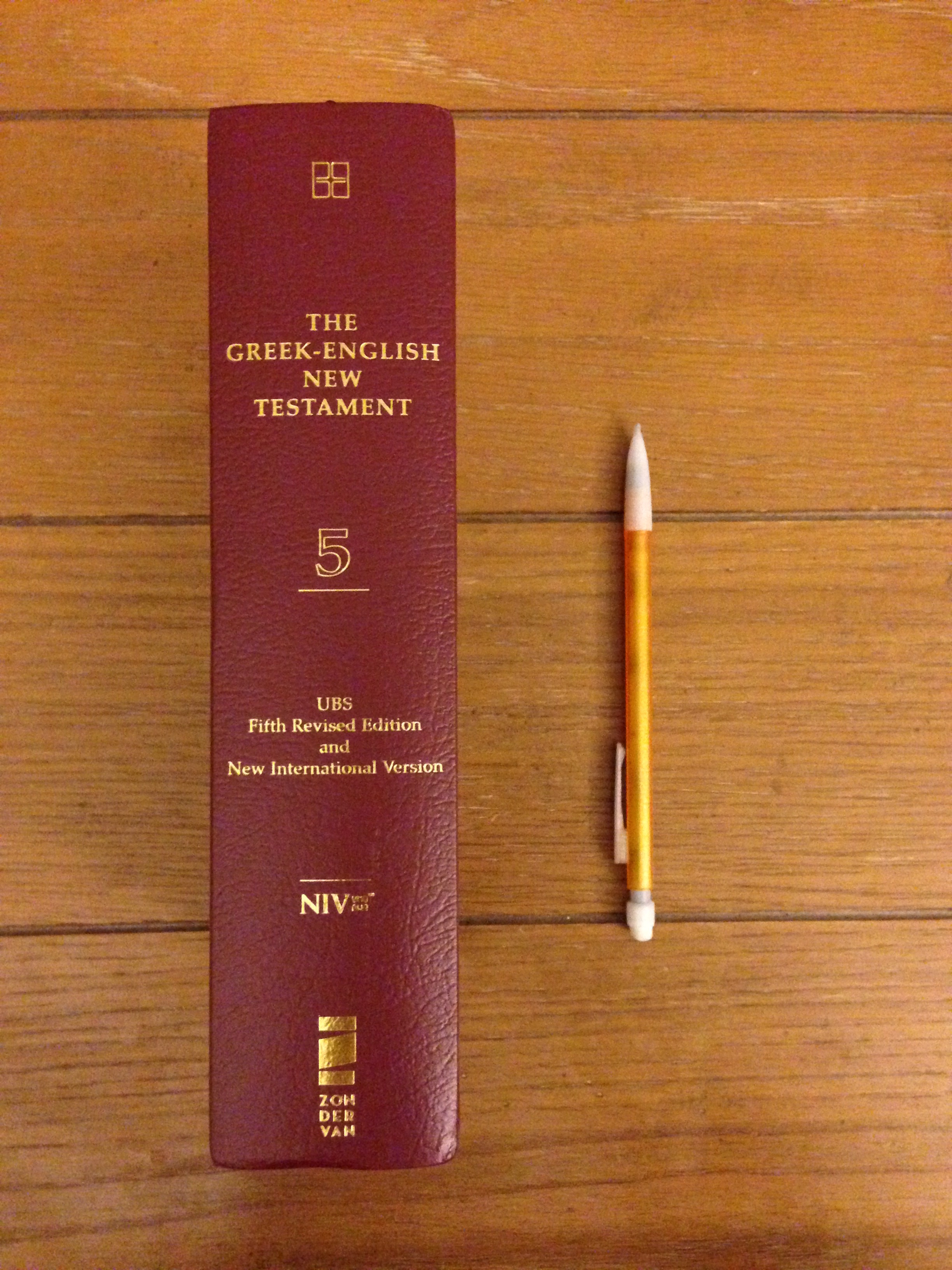
  • The exterior of the book is classy :


Spine and Pencil


  • It lays flat! Even when you’re reading the prefatory material
  • Old Testament quotations are in bold font
  • There’s a really nice ribbon marker
  • And… the Greek font looks great. Check it out:


Mark 1 in Greek


What Could Have Been Better


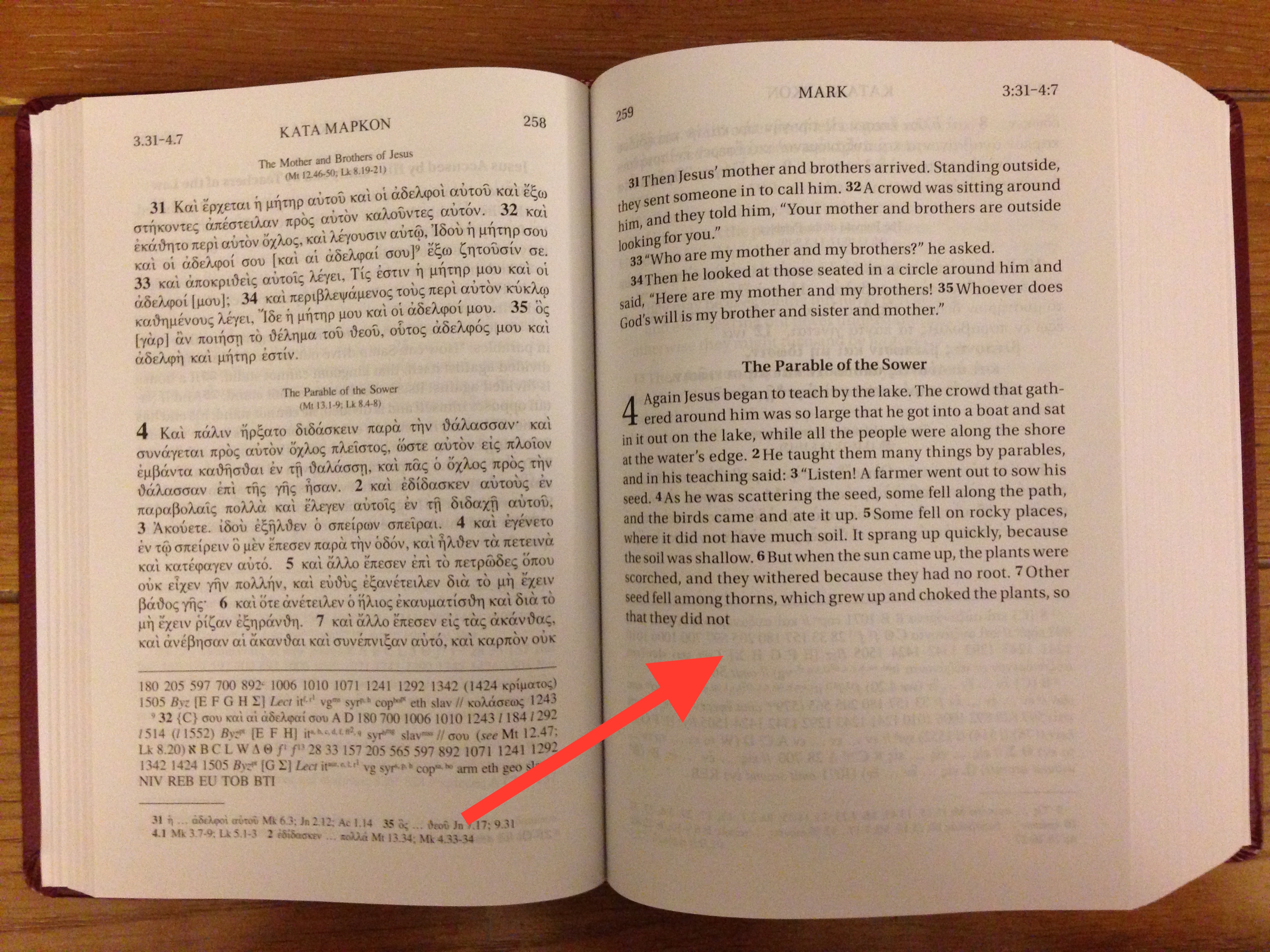
No bullet points here–just one major critique. In a deliberate move, the English on a page may cut off mid-sentence to try to more exactly match the Greek. Of course a one-to-one match is impossible because of the differences between the two languages (not the least of which is word order), but the intention is good, if not always perfectly executed in terms of matching English to Greek. Regardless, the unexpected editorial decision leads to awkward looking pages like this one (click image to enlarge):


Greek and English


To each their own, I guess, but I still haven’t gotten used to it, even after reading through full chapters of text.

But everything else (layout, font, book construction, feel, etc.) is spot on. I’m a fan of this Bible, and while I’m pushing myself to use a Reader’s edition (Greek only), when I want English and Greek side-by-side, this is my new go-to.

You can learn more at the Bible’s product page here. It’s on sale at Amazon here.


Thanks to Zondervan for the copy, provided to me as part of a series of ongoing posts about the 2011 NIV–though there was no expectation as to the content of my review.

Carta Publishing: 3 New Titles, at Introductory Discount

Carta 25 Off Banner


Carta–one of my favorite publishers–has just announced the release of some new titles. As with anything I’ve seen from Carta, they each look fascinating and thorough, even if the books themselves are brief.

Thanks to Carta, readers of Words on the Word (and anyone, really) can get 25% off a Web order at Carta’s online store. Simply click on any cover image below to go to that title, and enter the code 25-off to receive the discount. The offer is good through December 15 (UPDATE: December 31) or so.

Jerusalem City of the Great King

1. Jerusalem: City of the Great King, by R. Steven Notley (whose excellent works I have reviewed here and here)

This volume, the second of four in The Carta New Testament Atlas series, presents the latest advances in the history and archaeology of Jerusalem. The last fifty years in particular have seen significantly increased efforts to discover the city’s past. New finds every year render what is previously written almost out of date before the ink is dry. With an acknowledgement of this reality, together with a recognition that much of the Old City of Jerusalem remains inaccessible to archaeological investigation, the present work lays its shoulder to the challenge.

2. Understanding the Boat from the Time of Jesus: Galilean Seafaring, by Shelley Wachsmann

Understanding the BoatYes, an entire book (even if only 40 pages) devoted to understanding the state of the boat in Jesus’ time. When I flipped it open yesterday, I found myself drawn to and reading the two-page glossary of terms first! It’s a good sign that even the glossary is interesting. I’m excited to dig in to this one. Here’s the publisher’s description:

The ancient boat from the Sea of Galilee exhibited at the Yigal Allon Museum at Kibbutz Ginosar speaks of pivotal times on the lake two millennia ago, when an itinerant rabbi walked its shores and sailed its waters with his followers, and changed the world forever.

This volume aims to give the non-expert reader an in-depth understanding of the boat, the story of her discovery and excavation and, most importantly, her significance for illuminating Jesus’ ministry by helping us better understand its contemporaneous milieu of seafaring and fishing on the Sea of Galilee.

3. Understanding the Life of Jesus: An Introductory Atlas, by Michael Avi-Yonah, updated by R.Steven Notley

Understanding the Life of JesusUnderstanding the land of Jesus is a necessary component to comprehending the message he proclaimed. From the beginning of the four Gospels until their end, the Evangelists assume that we possess an intimate knowledge of the historical and geographical stage onto which Jesus stepped.

For most Christian readers this is unfortunately not true. Many have not had the opportunity to visit the Holy Land. Even for those who have, it can prove to be a confusing experience. Much about life in this land has changed over the course of two millennia.…

It is hoped that the maps [in this book] and the brief texts that accompany them can serve as a guide for the Christian reader to navigate the geographical stages in the Gospel accounts. …May the reader be aided in their pursuit to follow the steps of the Master and to grasp more clearly the message he preached.

As I have a chance to explore these titles more, I’ll report back. Again, the code is 25-off at Carta’s online store. (UPDATE 2: This code is good for the titles above and anything else in the store, not the least of which is this beauty of a book.) Also, if you have 13 seconds, are on Twitter, and like to share your opinions about printed maps, check out this poll, which particularly has the last title above in mind.


View my reviews of Carta works here. Check out their site here, and go here to see their works via Hendrickson, their U.S. distributor. For the next few weeks, however, the titles above are only available through Carta’s site.