

Today is the last day to enter to win the Bible above. (There will be two winners.) See here for more.
By now many of you Words on the Word readers will have heard that the UBS edition of the Greek New Testament has recently been published in its fifth revised edition, the UBS5. See here for more.
Check out this smart graphic from Hendrickson Publishers announcing the edition (academia needs more good infographics):

Just as I reviewed the amazing LXX-NA28 combo, I will soon be reviewing the UBS5 Greek New Testament.
While I work my way through it, with just about a minute of your time and a few clicks, you can enter to win your own copy of the UBS5, thanks to the great people at Hendrickson Publishers.
Simply comment on this blog post with a short sentence on what interests you in the Greek New Testament. That will give you one entry.
If you share on Facebook and/or Twitter, and then come back and post the link to your share in the comments, you get two additional entries.
If you want to earn five additional entries, you can record a (however lo-fi) video of yourself answering the questions: Why does Bible translation matter? and: What does translating the Bible mean to you personally?
To receive those five additional entries, post the url to your video (whether you’ve uploaded to YouTube, Facebook, Vimeo, etc.) in the comments. Then others can see your video, too.
I’ll select two winners using a random number generator.
If you don’t want to wait for the results of the giveaway, you can find the UBS5 on sale at Amazon here (affiliate link) or through Hendrickson here.
The giveaway is open through Sunday, September 7, 11:59 p.m. EDT. On Monday I’ll notify the winner and post about it both here and in the comments below. Then Hendrickson will mail you your UBS5 GNT! (Note: Only domestic/U.S. shipping addresses are eligible for this contest, with apologies to the rest of the world!)
Make sure in when you leave a comment that you include your email address—I can use that to contact you, and the email address isn’t public.
Happy entering, and the folks at Hendrickson and I look forward to seeing your videos. Drop me a line if you have any questions.
 Want to enter for a chance to get some free theology books? These ones won’t even take up shelf space. I’m joining with a few other bloggers and Logos Bible Software for a giveaway of Logos’s Zondervan Theology Collection.
The collection can be found here. It includes these books:
(It probably goes without saying that by posting about this collection, I don’t necessarily endorse or agree with the theologies of each of these authors.)
Logos will choose the winner at random on August 1, with the collection sent to that person’s Logos account. If you don’t have a Logos account, you can register for free here. An iOS app for Logos (and other mobile apps can be found here, also free.
To enter, log in below using either your email address or Facebook account, and the Punchtab widget walks you through the rest. You can choose which methods of entry to use. Each prompted action is its own entry.
Logos has this disclaimer: By entering this giveaway you consent to being signed up to Logos’ “Product Reviews” email list. (This just means you’d get emails with Logos-related content written by bloggers such as yours truly.)
UPDATE: WordPress doesn’t want to show the Punchtab widget for some reason. For now you can enter here.
One of many cool things about Carta’s Sacred Bridge atlas is its use of original/source languages.
For example, when The Sacred Bridge (TSB) cites Eusebius’s Onomasticon (a 4th century list of Bible place names), it does so both in its original Greek and in English translation.
 This, of course, got me to wondering about Eusebius in Greek. Using The Sacred Bridge in Accordance, I can easily pull up all the times TSB cites Eusebius (more on this later).
Then I wanted to know where to find more Onomasticon in Greek.
After a short hunt, I found this digital edition of the Onomasticon in Greek. I thought I would pass it on in case anyone else using the atlas in English wanted to be able to access the Greek.
Brill has an expensive triglot edition, and De Gruyter has one with Greek and Syriac, but the above is free and online.
Eusebius’s Onomasticon (in English translation, and with English translation of Jerome’s Latin translation/expansion of Eusebius) is here in Accordance, here on Carta’s site, and here at Eisenbrauns, Carta’s North American distributor.
Tim Keller’s For You series now includes contributions from other authors. I reviewed Keller’s Romans 1-7 For You here. In this post I review Tim Chester’s Titus For You.
But allow me to allow Chester to introduce the book. Here he is:
The books in the For You series claim to not be commentaries. Instead, the Titus For You product page describes what kind of book it is:
Written for people of every age and stage, from new believers to pastors and teachers, this flexible resource is for you to:
• READ: As a guide to this wonderful letter, exciting and equipping you to live out the truth in your life.
• FEED: As a daily devotional to help you grow in Christ as you read and meditate on this portion of God’s word.
• LEAD: As notes to aid you in explaining, illustrating and applying Titus as you preach or lead a Bible study.
 The book is short and its tone conversational. Chester begins with a short introduction to the book, then divides Titus into seven units (each of them split again into two parts) for comment. Reflection questions throughout help the reader digest the book, and could also be used in small group settings. At the close is a short glossary and six-book bibliography of sorts.
What folks will find most beneficial about Chester’s book is his ability to re-state Paul in easy-to-understand terms. For example, when discussing Titus 1:7-11 Chester says:
There are two common dangers in pastoral ministry and Paul is alert to both of them. They are what we might call over-pastoring and under-pastoring.
He elaborates on each kind of pastoring to help explain Paul’s exhortations to Titus in this first chapter.
Similarly helpful was Chester’s description in the section on Titus 2 (especially verse 14) of the Christian’s identity:
In Christ, we are members of the royal family of the universe. That is our status, and we cannot lose it. And our behaviour should match who we are. Royal children have royal manners.
One can easily see Chester’s concern with practical application of Paul’s letter in broader contexts. This makes it suitable as a go-to for devotional reading.
The introduction to Titus was not as substantive as I’d have liked. Or, at least, I wouldn’t feel prepared to lead a small group through the book from just having read this short introduction. (There was hardly anything about Crete, Titus’s setting.) Even the introduction in a good Study Bible (of similar or shorter length) could be more elucidating as to how to understand and read Titus.
I appreciated Chester’s interpretation of Titus as having to do with church “succession planning.” He (rightly, in my opinion) distinguishes between instructions for church structures that are “context-specific” and those that are “for ministry in every time and place.”
Nonetheless, I disagree with Chester’s interpretation that eldership in the church is to be male-only. This is a piece of Paul’s letter that I take to be context-specific and not universally binding–though I’m not sure Paul even intended in Titus to be talking about an elder’s sex, as such. Even as I tried to have an open mind on the issue, I didn’t think that the author made much of a case for his interpretation of Titus. And the idea of men as “good leaders in their home” does not really appear in Titus at all–not even in a context-specific instance.
UPDATE, 6/30/14: I glossed over this before, but wanted to mention (along similar lines as the above) that I found his application of Titus 2 to be offensive. I’m sure he didn’t intend it to be, but nonetheless: “It is not that younger women cannot have a career. But if they are wives and mothers, home is the primary place where they are to serve.” On the contrary, this is not a biblical mandate, and God calls plenty of “wives and mothers” to serve outside of the home, even to have robust careers… just as God calls “husbands and fathers” to the same!
There are some typos scattered throughout the book (including erroneously spelled Greek, as was also true in the Keller Romans volume) that the reader will have to try to ignore.
I did find Titus For You a largely worthwhile read (in spite of interpretive disagreements I had at other spots, too), but I think that for background and Bible study and teaching preparation, readers might want to start elsewhere. Then, perhaps, one could turn to Titus For You for some helpful suggestions as to how to understand and teach the application of the passages–theological caveat above notwithstanding.
Thanks to Cross-Focused Reviews and The Good Book Company for the review copy. You can find Titus For You on Amazon here.
On the top of my bookshelf at home sits an old, falling-apart, heavily marked-up edition of The New Oxford Annotated Bible. So it has been with anticipation and appreciation that I’ve been able to use the The New Oxford Annotated Bible in its most current, 4th edition.
The Bible text in The New Oxford Annotated Bible is the New Revised Standard Version (NRSV). I’ve always appreciated this translation’s blend of readability and fidelity to the original languages.
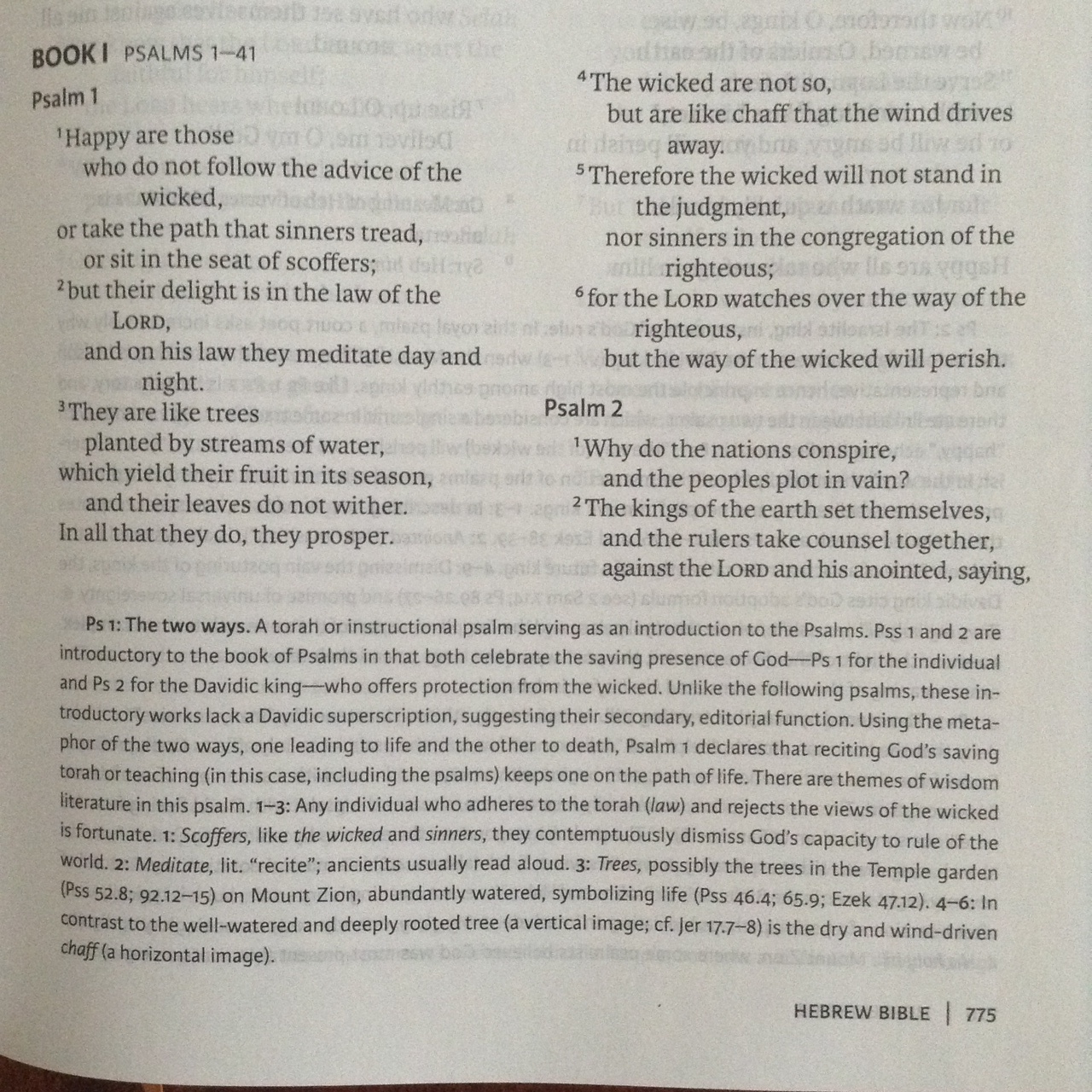
Each biblical book receives a short introduction, covering topics like authorship, date of composition, literary structure, and interpretive helps for reading. (The “guide to reading” that precedes most books is especially helpful when doing a book study or reading through a whole book of the Bible.) The biblical text itself appears in a clear, uncluttered font, with the study notes appearing at the bottom of the page. The brief but illuminating notes address each passage of the text (as a passage), and then comment more specifically on individual verses, terms and words.
Here is Psalm 1 with study notes:
The title page bills this as “An Ecumenical Study Bible.” Its balance in this regard is, indeed, fair. The Editors’ Preface reads:
We recognize that no single interpretation or approach is sufficient for informed reading of these ancient texts, and have aimed at inclusivity of interpretive strategies.
The editors and contributors have succesfully met this aim. The introduction to Colossians, for example, does not make a heavy-handed assessment one way or the author as to Pauline authorship, but lays out the different views (with support) so the reader can decide. I appreciated this.
At the end of the Bible are some “General Essays,” covering topics at considerable length, such as:
and more. Also included are a glossary, concordance, 14 color maps, and other study helps.
 One thing that sets this study Bible apart from others is its inclusion of the Apocrypha. Not only is the text included, but its contributors are top in their field: John J. Collins (3 Maccabees), Lester Grabbe (Wisdom of Solomon), Amy-Jill Levine (Additions to Daniel, Tobit), and David A. deSilva (4 Maccabees), to name just a few. The introductory articles are clear and concise, yet contain the sort of information most users of this Bible will be looking for. For example, after a section on “Definitions” of terms like “Apocrypha” and “deuterocanonical,” the introduction to the Apocryphal section has “The Roman Catholic, Orthodox, and Protestant Canons of the Old Testament.” The comparison chart in that part of the introduction is especially useful, so readers can see “which religious communities accept [the Apocryphal/Deuterocanonical books] as scripture.”
In Mattathias’s speech on his deathbed in 1 Maccabees, to explore just one passage, the explanatory note for 1 Maccabees 2:49-70 simply reads:
Jacob (Gen 49), Moses (Deut 33), and Samuel (1 Sam 12) utter similar speeches; compare also the praises of famous men in Sir 44-50.
The biblical characters that Mattathias extols (Abraham, Joseph, Phinehas, Joshua, and so on) have accompanying biblical references in the study notes so readers can explore their stories further. It’s, of course, not nearly as in-depth as a commentary would be, but neither does it intend to be. It covers the basics well, and addresses most initial questions readers would have of the text.
The leather-bound edition (what I am considering for review) is a well-constructed Bible. Despite its weight–to be expected of a Study Bible–it is a pleasure to hold and read. And to smell. Its gilded edges and two ribbon markers give it a classic feel. Its sewn binding and leather cover mean that it lays flat anywhere you have it open, even at Genesis 1:

The pages are a bit thin, though this may be inevitable. (A delicate balance in Bible production is how thick the pages can be without weighing down an already bulky Bible). I was aware of bleed-through but not really distracted by it as I read. Note, too, the book name tabs in the image above, which help readers to quickly get to a desired spot.
There have been three primary ways in which I’ve made use of the Annotated Bible. One is for personal, devotional reading. In this context I have found the book introductions and notes to be just enough to answer my top-of-mind questions, but not so much that I was distracted from a focus on the text itself.
Second, this is the Bible I had in my hands while leading a small group Bible study last Lent on the Sermon on the Mount. Again, I found that most of our questions of the text were addressed in the notes by succinct, summary statements. And the NRSV was a good version for group reading.
Third, I’ve found the introductions and essays to be helpful in teaching and preaching preparation.
You can find the Bible here at Amazon and here at OUP’s site.
Many thanks to Oxford University Press for a copy of this beautiful Bible to review. They provided it with no expectation as to the nature of my review, except that I be honest.
The one kind of blog post I’ve deliberately avoided till now is the “In the Mail” post. I have my reasons for this, but that’s not the point of this post. I simply wanted to say that the book I received in the mail the other day might be the first one that caused me to say, “Whoa,” when I opened to the front inside cover.
For future review I’ve received The Sacred Bridge: Carta’s Atlas of the Biblical World. This is the “Second Emended & Enhanced Edition” (copyright 2014). Here it is:
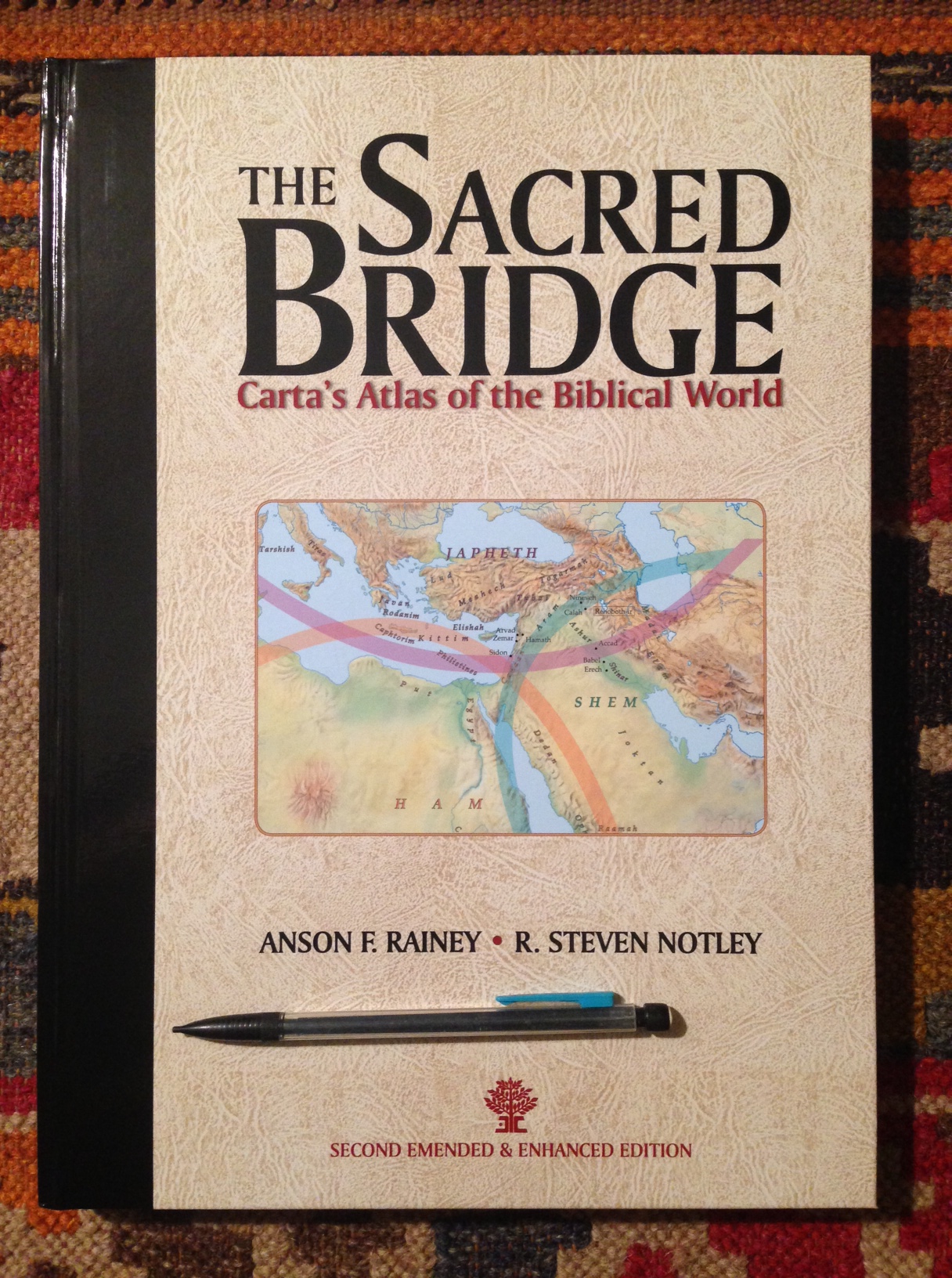
It comes highly recommended by Accordance users, where it is available electronically.
Carta Jerusalem, its publisher, describes the atlas in this way:
The Sacred Bridge will be the Bible Atlas of Record and Standard Work for the coming decades. Exhaustive in scope and rich in detail, with its comprehensive documentation of the Near Eastern Background to Biblical History, this latest Bible Atlas from Carta is one more stepping stone on the way to the study and understanding of the Holy Scriptures.
And:
This is the first Atlas to adopt the modern approach to the study of the Levant as a geographical/historical entity. Emphasis throughout the current work is on the ancient written sources – every ancient passage is interpreted firsthand, from its native language. Archaeological evidence has been taken into account whenever it is relevant.
Here is what’s inside the cover. You won’t be able to see much detail in the image (click image or open in new tab for larger), but it will give you an idea of the kind of thoroughness that seems to exist throughout the atlas. And that’s before you even get to the atlas itself.
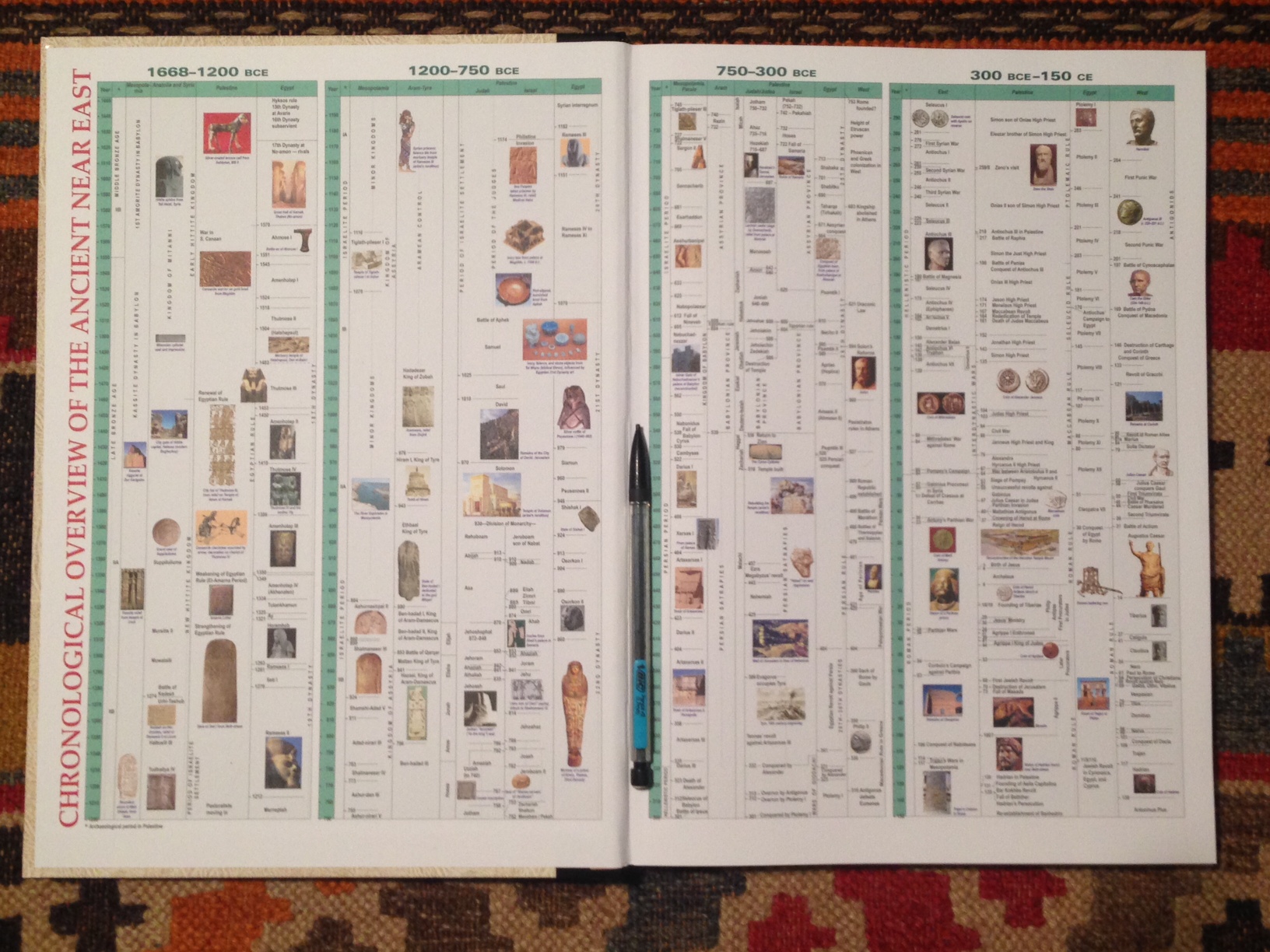
I’m looking forward to digging in. It’s a beautiful, massive atlas, with a lot of text and full-color images packed into its large pages. The binding appears to be sewn, so it will last a long time. Here’s the product page for more information. You can also find the atlas here through Eisenbrauns, its North American distributor. More to follow.
11/7/14 UPDATE: Here is my completed review.

It’s been fun to watch the Baylor Handbook series progress, with volumes on both the Hebrew Text and the Greek Text. Not only do we who are currently engaged in Hebrew and Greek reading have amazing technological tools at our fingertips, but there are also series like Baylor’s that focus specifically on the original languages.
Herbert W. Bateman IV inaugurates a new series of his own, via his Cyber-Center for Biblical Studies, with Translating Jude Clause by Clause: An Exegetical Guide. More volumes of these EBooks for Translating the New Testament have been projected to release in 2014 and 2015.
Jude is a difficult book. It receives far less teaching and preaching attention than most New Testament books. It has clear references to “apocryphal” literature, about which Protestants, in discussions on canonicity, seem to feel compelled to say, “Jude is not citing such as Scripture.”
And the Greek is tough. Paul’s letters are easier! In Jude’s 25 verses, there are more than a dozen hapax legomena (words that occur only once in a body of literature, here understood as the New Testament). Because words are best defined by their context and usage, this doesn’t give the student of the New Testament much to go by for understanding these words.
So a guide to Jude’s Greek text is welcomed by anyone who wants to work through that book. In this post I review Bateman’s Translating Jude. I was eager to receive and work my way through the book, since I found Bateman’s Charts on the Book of Hebrews to be “a top-notch resource for an important biblical book.”
There are three primary sections in Translating Jude Clause by Clause:
1. Introduction. Bateman’s first section packs a punch. After I reading it I felt very well set up to begin working my way through Jude’s Greek. In the introduction Bateman explains the layout of his uniquely structured book, includes a substantive section on independent clauses (of three types) vs. dependent clauses (of four types), and suggests “Tips for Translating Jude.” That last section explores some unique characteristics of Jude’s style, such as his frequent use of participles, long sentences, and parallel constructions (among other features).
2. Clausal Outlines for Translation. Here is where the reader will do the work of translating Jude. Bateman understands Jude as consisting of five main sections (vv. 1-2, vv. 3-4, vv. 5-16, vv. 17-23, and vv. 24-25), which is then further broken down into nine total passages, according to which Translating Jude is set up.
In addition to the robust introduction to Jude, each section of the clausal outlines begins with Contextual Orientation to the passage, which I found to be the most consistently excellent part of Bateman’s work. It is “a summary statement based on Jude’s flow of thought in order to provide some contextual orientation to the Greek paragraph to be translated.” It delivers each time.
After that there is the Greek Text for Verbal Recognition, where Bateman reprints the Greek text of Jude so that readers can mark it up to identify the various verbs and verbal forms.
Then there is the Clausal Outline for Translating Jude. Here Bateman spaces out and appropriately indents the various clauses in a passage so that the reader can visualize the flow of Jude’s thought. There’s plenty of space to write in one’s own translation, too. Here is a screenshot from the sample pdf of the interactive edition (i.e., you can fill in the blanks by typing).

3. Clausal Outlines Translated and Syntax Explained. The final section serves as a sort of answer key for the section above. Bateman shows the clausal structure of Jude again (with indentations), this time with his English translation below the Greek. His “Syntax Explained” offers explanation along the lines of “grammatical function, syntactical function, and semantical function.” Bateman often cites and points to other Greek grammars, which helps enable further study.
The book is highly interactive throughout. Even in a static, print book, I often had the feeling that I was being coached through Jude by an experienced and knowledgeable Greek professor. For those who haven’t used clausal outlining, I recommend it! Bateman walks the reader through the method well.
I especially appreciated how much the third section went from grammatical observation to exegetical insight. For example, Bateman notes the use of a constative aorist in Jude 11. He concludes:
Jude alludes to the behavior of the godless as a whole or in a summary fashion. Thus the godless have made their bed and currently lie in it.
The introduction offered far more than I expected from a book of this length. In addition to the insights noted above, Bateman includes a number of grammatical summary charts in the introduction that I found myself referring to often as I worked my way through Jude.
The user of Translating Jude will have to overlook an unexpectedly large number of misprints and typos, as well as a couple of Greek errors. I found this to be a major distraction that detracted from what is otherwise a good book. Fortunately, I understand that future printings will include corrections. (And the electronic version of Translating Jude will be easy to correct and update.)
By about verse 8 or so of the “Syntax Explained” section, I started to experience the format of the translation notes as repetitive. Perhaps their predictability serves a value–e.g., a Greek verb receives a parsing, its lexical form is noted, there is a brief BDAG gloss, and then there are sentences beginning with, “Syntactically,” “Semantically,” and, “Thus,” each in turn. But something that felt a little less boilerplate would have been more engaging, at least to me personally. Others may not find it an issue.
Finally, simply because it seemed remarkable to me, I was surprised at Bateman’s proposal for understanding the “fault finders” and “grumblers” of verse 16: “two words that might be summed up into one: bitching. They bitch regularly.” It could be just my own sensitivities, but I think that word has enough potentially derogatory connotations (surely unintended here) that leaving it out of a commentary and suggesting another English word would have been better. I otherwise appreciated the English translations.
Of course one wants to know how Translating Jude compares to the Baylor Handbook on the Greek Text series, especially since Baylor has a volume by Peter H. Davids on II Peter and Jude (review forthcoming!). Davids does not aim to do what Bateman does in terms of clausal outlining and written-out reader translations–Bateman is more interactive in that sense. Davids is more thorough when it comes to explaining the Greek text. Bateman does note that his translation notes focus on verbs and verbals, but Davids has more detail overall, even in defining and explaining the usage of various verbs.
Bateman writes that Translating Jude “is not a commentary. It is a tool designed to help translate and visualize Jude’s train of thought.” With its emphasis on clausal outlines–and with how clearly they are presented and explained–the book succeeds in its aim.
Apart from my (hopefully constructive) criticisms noted in the section above, I’d recommend this book to students of Greek, especially any who have become over-reliant on using Bible software for parsing and translating. Anyone whose Greek or grammar is rusty will also benefit from the clear introduction to Translating Jude and its verse-by-verse explanations.
Thanks to the Cyber-Center for Biblical Studies for the review copy. Prof. Bateman’s other books are here. You can find Translating Jude Clause by Clause at Amazon here (affiliate link). A sample pdf of the book is here.
Fall 2014 UPDATE: The UBS5 is out. Go here for a chance to win one of two free copies.
******
On the heels of the release of the NA28 Greek New Testament, the UBS4 is giving way to a revised UBS5. Find the book’s product page here. Just as I reviewed the NA28 (plus LXX), I hope to post more in the future about the UBS5 edition, which is geared more toward translators than academics, per se.
Here’s a sample pdf of the first few chapters of Mark, posted by Hendrickson.
The most noticeable change right off the bat is that the italicized font of the UBS4 has been replaced with something I find much more readable and aesthetically pleasing:

Other than punctuation and paragraph divisions, the text is the same as that of the NA28, with the differences between the two coming in the critical apparatus.
UBS5 is slated to release in May.


 Words on the Word
