One of many cool things about Carta’s Sacred Bridge atlas is its use of original/source languages.
For example, when The Sacred Bridge (TSB) cites Eusebius’s Onomasticon (a 4th century list of Bible place names), it does so both in its original Greek and in English translation.
This, of course, got me to wondering about Eusebius in Greek. Using The Sacred Bridge in Accordance, I can easily pull up all the times TSB cites Eusebius (more on this later).
Then I wanted to know where to find more Onomasticon in Greek.
After a short hunt, I found this digital edition of the Onomasticon in Greek. I thought I would pass it on in case anyone else using the atlas in English wanted to be able to access the Greek.
Eusebius’s Onomasticon (in English translation, and with English translation of Jerome’s Latin translation/expansion of Eusebius) is here in Accordance, here on Carta’s site, and here at Eisenbrauns, Carta’s North American distributor.
Many Greek Septuagint manuscripts do not contain them, but the Odes are a fascinating collection of texts appended to the end of the Greek Psalter in Codex Alexandrinus and a few other manuscripts.
The Odes compile some beautiful prayers from Scripture. A few of them are in the Book of Common Prayer’s Morning Prayer canticles.
Good information on the Odes is hard to come by, though. In part this is because they are generally not accorded the same status as, say, the Psalms. The NETS introduction to the Psalms, for instance, has:
One “book” not included in NETS, however, is Odes since it has dubious integrity as a literary unit, and, in any case, almost all of the individual Septuagint odes have already been included in their native setting in other books. The sole exception is Ode 12 in Rahlfs’ edition, the Prayer of Manasses, which for that reason has been separately appended to the Psalter.
I’ve just discovered, however, that David Lincicum has a nice rundown of the Odes, their numbering, and their contents. He also includes a bibliography for further reading. Check it out here.
*HT to a member of the Yahoo! LXX email group for the idea of the Odes as a sort of “little hymnal.”
On the top of my bookshelf at home sits an old, falling-apart, heavily marked-up edition of The New Oxford Annotated Bible. So it has been with anticipation and appreciation that I’ve been able to use the The New Oxford Annotated Bible in its most current, 4th edition.
What the Annotated Bible Is
The Bible text in The New Oxford Annotated Bible is the New Revised Standard Version (NRSV). I’ve always appreciated this translation’s blend of readability and fidelity to the original languages.
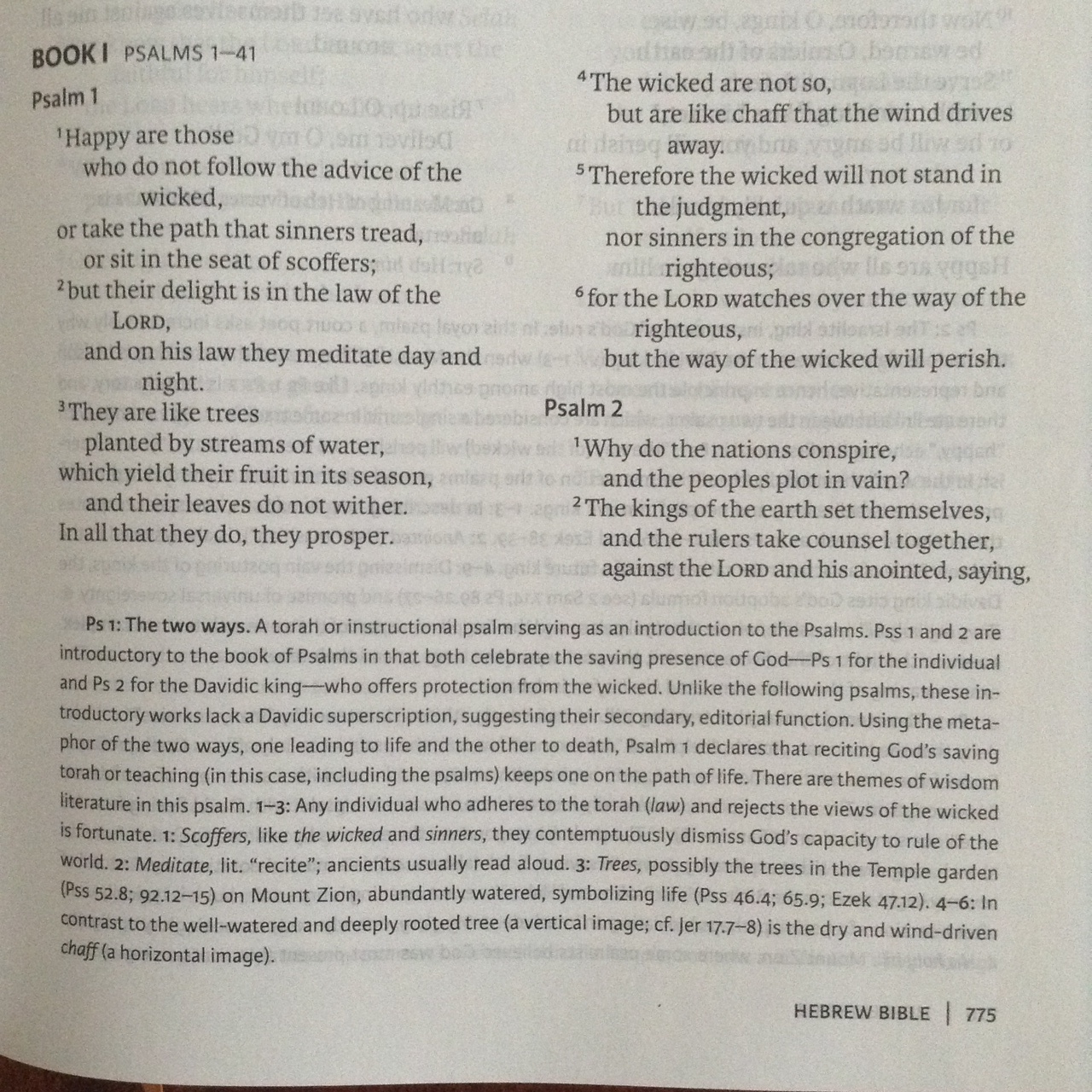
Each biblical book receives a short introduction, covering topics like authorship, date of composition, literary structure, and interpretive helps for reading. (The “guide to reading” that precedes most books is especially helpful when doing a book study or reading through a whole book of the Bible.) The biblical text itself appears in a clear, uncluttered font, with the study notes appearing at the bottom of the page. The brief but illuminating notes address each passage of the text (as a passage), and then comment more specifically on individual verses, terms and words.
Here is Psalm 1 with study notes:
Psalm 1
The title page bills this as “An Ecumenical Study Bible.” Its balance in this regard is, indeed, fair. The Editors’ Preface reads:
We recognize that no single interpretation or approach is sufficient for informed reading of these ancient texts, and have aimed at inclusivity of interpretive strategies.
The editors and contributors have succesfully met this aim. The introduction to Colossians, for example, does not make a heavy-handed assessment one way or the author as to Pauline authorship, but lays out the different views (with support) so the reader can decide. I appreciated this.
At the end of the Bible are some “General Essays,” covering topics at considerable length, such as:
The Canons of the Bible
Translation of the Bible into English
The Persian and Hellenistic Periods
The Geography of the Bible
and more. Also included are a glossary, concordance, 14 color maps, and other study helps.
“With the Apocrypha”
One thing that sets this study Bible apart from others is its inclusion of the Apocrypha. Not only is the text included, but its contributors are top in their field: John J. Collins (3 Maccabees), Lester Grabbe (Wisdom of Solomon), Amy-Jill Levine (Additions to Daniel, Tobit), and David A. deSilva (4 Maccabees), to name just a few. The introductory articles are clear and concise, yet contain the sort of information most users of this Bible will be looking for. For example, after a section on “Definitions” of terms like “Apocrypha” and “deuterocanonical,” the introduction to the Apocryphal section has “The Roman Catholic, Orthodox, and Protestant Canons of the Old Testament.” The comparison chart in that part of the introduction is especially useful, so readers can see “which religious communities accept [the Apocryphal/Deuterocanonical books] as scripture.”
In Mattathias’s speech on his deathbed in 1 Maccabees, to explore just one passage, the explanatory note for 1 Maccabees 2:49-70 simply reads:
Jacob (Gen 49), Moses (Deut 33), and Samuel (1 Sam 12) utter similar speeches; compare also the praises of famous men in Sir 44-50.
The biblical characters that Mattathias extols (Abraham, Joseph, Phinehas, Joshua, and so on) have accompanying biblical references in the study notes so readers can explore their stories further. It’s, of course, not nearly as in-depth as a commentary would be, but neither does it intend to be. It covers the basics well, and addresses most initial questions readers would have of the text.
Construction and Aesthetics
The leather-bound edition (what I am considering for review) is a well-constructed Bible. Despite its weight–to be expected of a Study Bible–it is a pleasure to hold and read. And to smell. Its gilded edges and two ribbon markers give it a classic feel. Its sewn binding and leather cover mean that it lays flat anywhere you have it open, even at Genesis 1:
Laying Flat at Genesis 1 (click to enlarge)
The pages are a bit thin, though this may be inevitable. (A delicate balance in Bible production is how thick the pages can be without weighing down an already bulky Bible). I was aware of bleed-through but not really distracted by it as I read. Note, too, the book name tabs in the image above, which help readers to quickly get to a desired spot.
Three Ways I’ve Used the Annotated Bible
There have been three primary ways in which I’ve made use of the Annotated Bible. One is for personal, devotional reading. In this context I have found the book introductions and notes to be just enough to answer my top-of-mind questions, but not so much that I was distracted from a focus on the text itself.
Second, this is the Bible I had in my hands while leading a small group Bible study last Lent on the Sermon on the Mount. Again, I found that most of our questions of the text were addressed in the notes by succinct, summary statements. And the NRSV was a good version for group reading.
Third, I’ve found the introductions and essays to be helpful in teaching and preaching preparation.
You can find the Bible here at Amazon and here at OUP’s site.
Many thanks to Oxford University Press for a copy of this beautiful Bible to review. They provided it with no expectation as to the nature of my review, except that I be honest.
The one kind of blog post I’ve deliberately avoided till now is the “In the Mail” post. I have my reasons for this, but that’s not the point of this post. I simply wanted to say that the book I received in the mail the other day might be the first one that caused me to say, “Whoa,” when I opened to the front inside cover.
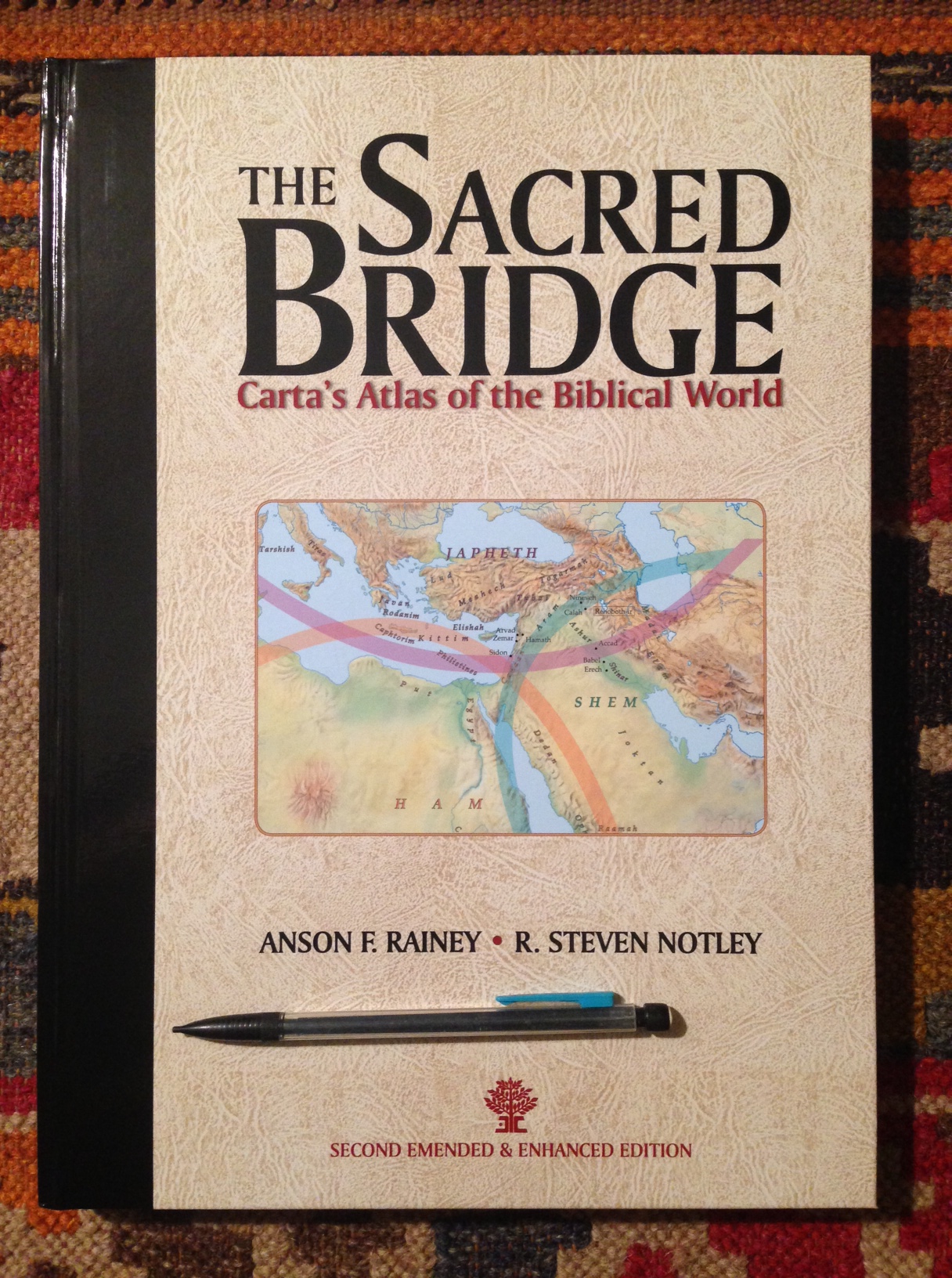
For future review I’ve received The Sacred Bridge: Carta’s Atlas of the Biblical World. This is the “Second Emended & Enhanced Edition” (copyright 2014). Here it is:
Carta Jerusalem, its publisher, describes the atlas in this way:
The Sacred Bridge will be the Bible Atlas of Record and Standard Work for the coming decades. Exhaustive in scope and rich in detail, with its comprehensive documentation of the Near Eastern Background to Biblical History, this latest Bible Atlas from Carta is one more stepping stone on the way to the study and understanding of the Holy Scriptures.
And:
This is the first Atlas to adopt the modern approach to the study of the Levant as a geographical/historical entity. Emphasis throughout the current work is on the ancient written sources – every ancient passage is interpreted firsthand, from its native language. Archaeological evidence has been taken into account whenever it is relevant.
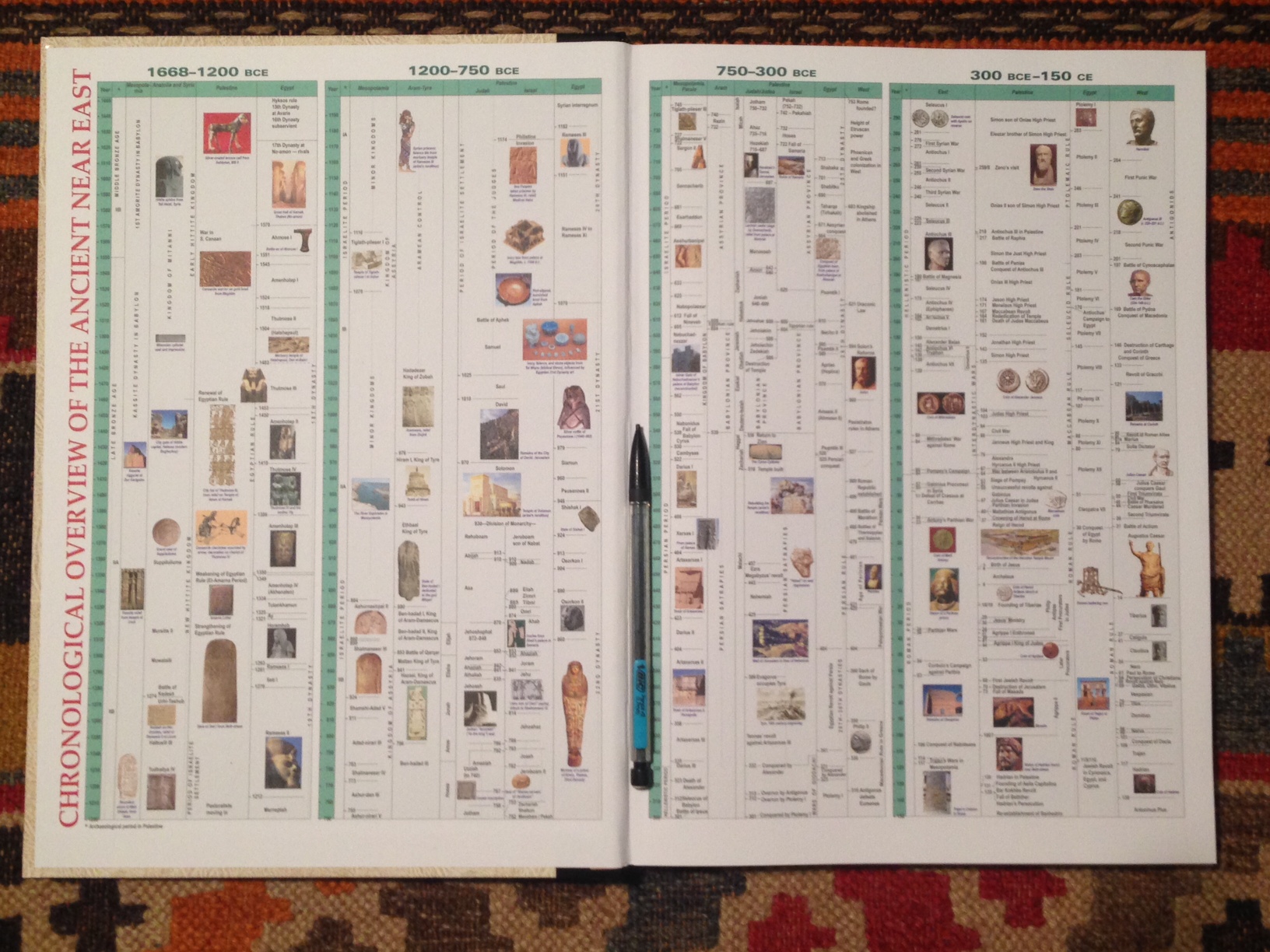
Here is what’s inside the cover. You won’t be able to see much detail in the image (click image or open in new tab for larger), but it will give you an idea of the kind of thoroughness that seems to exist throughout the atlas. And that’s before you even get to the atlas itself.
I’m looking forward to digging in. It’s a beautiful, massive atlas, with a lot of text and full-color images packed into its large pages. The binding appears to be sewn, so it will last a long time. Here’s the product page for more information. You can also find the atlas here through Eisenbrauns, its North American distributor. More to follow.
At less than 400 Hebrew words, Obadiah is shorter than many Words on the Word blog posts, including this one. But its literary and rhetorical sophistication is by no means lessened by its length. Obadiah is the prophetical incarnation of the axiom, “Brevity is the soul of wit.” Or, in Obadiah’s case, “Brevity is the soul of calling out Edom and declaring God’s restoration of Jacob.”
Earlier this year Zondervan published the first two volumes of a new Old Testament commentary series, Hearing the Message of Scripture (HMS). If you want a brief overview of the series, I’ve posted about it here. Daniel I. Block is author of Obadiah: The Kingship Belongs to YHWH, as well as the general editor of HMS. I’ve had a chance to carefully work my way through the inaugural Obadiah volume, and review it in this post.
Block’s Introduction to Obadiah
The Introduction consists of three primary parts:
Historical Background to Obadiah’s Prophecies–outlining some options for dating the book’s composition, as well as describing the historical setting of Obadiah’s oracles.
Obadiah’s Rhetorical Aims and Strategy–the largest section in the introduction, with an excellent definition of “prophet,” as well as the idea that “Obadiah’s rhetorical aim was to rebuild his audience’s hope in the eternal promises of God.”
The Structure ofObadiah—here Block outlines the book, the “climax” of which is highlighted by the “marked structure” of verse 17a (“But on Mount Zion there shall be an escape…”).
Block later summarizes Obadiah’s style as “terse elevated prose, the style being chosen for maximum rhetorical effect.” After “the climax” of verse 17, the final verse 21 “brings his proclamation to a triumphant conclusion.”
Particularly useful in the introduction was this diagram of the arc of the book, to which I frequently found myself referring:
Block’s Plot Summary of Obadiah
The Commentary Proper
Hearing the Message of Scripture intends to help its readers “to hear the message of Scripture as biblical authors intended them to be heard.” Obadiah is typeset and laid out quite a lot like Zondervan’s Exegetical Commentary on the New Testament series (which I’ve reviewed–several volumes–here). Each passage of Obadiah includes this treatment:
Main Idea of the Passage–a short paragraph overview, good for getting bearings on what the prophet is trying to do.
Literary Context–Block explains the overall flow of Obadiah here and how the passage under consideration fits within the book. This might be the best section in the commentary.
Translation and Outline–the author’s original translation and spacing of the text.
Structure and Literary Form–this looks especially at the rhetorical aims of Obadiah in a given passage.
Explanation of the Text–the longest section of each passage, and the bulk of the commentary.
Block divides the commentary into five “chapters” (8-14 pages each) that follow the five sections of his structural outline.
A good example of the kind of rhetorical analysis Block does appears in his comment on the first verse of Obadiah:
Obadiah’s preference for the name Esau reflects his rhetorical concern. As noted, he is not interested in the political history of Edom or Edom’s economic standing among the nations. To him Edom is a person, the brother of Jacob (vv. 10b, 12a), who shares a common ancestry in the first two patriarchs, Abraham and Isaac, but whose history of violence against his twin brother will finally be answered.
And again, on verse 5:
Obadiah’s penchant for cutting of a thought by inserting an erratic mid-sentence is also evident in v. 5c, “How you have been destroyed!”
One thing I really appreciated about the commentary is Block’s sense of the larger literary context of Scripture. He keeps the parallel Jeremiah 49 in view throughout the commentary, as well as other prophetical literature like Ezekiel and Daniel. Block helps the reader see how Obadiah fits into the larger sweep of the Hebrew Bible. Especially noteworthy is his elaboration of what other prophets in the Hebrew Bible had to say about Edom. As I read the commentary, in other words, I was able to reflect on and learn about much more than just Obadiah.
At the end of the commentary, there is a section called “Canonical and Practical Significance,” in which Block, having worked carefully through Obadiah, draws out some theological implications of the book.
Evaluation of Block’s Obadiah
A few observations, by way of evaluation:
The footnotes serve as an excellent source of references for a given word’s use elsewhere in the Old Testament. Footnotes also keep other versions such as the Vulgate and Septuagint in view.
I found the transliterated Hebrew throughout the book to be distracting. The ZECNT, which in many ways is the NT counterpart to this HMS series, does not transliterate its Greek. It also includes the full Greek text of the New Testament book under consideration, verse-by-verse, so it would have been nice to have had the full Hebrew text of Obadiah reproduced here, as well.The Series Introduction does note that “electronic versions of this commentary series will also include the Hebrew font.”
One intangible I appreciated–the margins are nice and roomy for notes. (I made quite a few to help me process Obadiah as I read.)
In an excellent commentary that is hard to fault for much else, it has anunusually large amount of typos. Many of these occur when the same verses from Obadiah are not consistently translated when they occur in multiple spots in the commentary. I heartily recommend this volume, but would suggest that those interested perhaps wait until the second printing, when corrections can be made.
Though this series aims to focus more on the rhetorical features of Obadiah, there is a good focus throughout Obadiah on the Hebrew syntax. My grammatical knowledge of Hebrew increased just by reading this commentary.
I didn’t fully agree with Block’s interpretation at every turn, but even in such instances I generally found his arguments to be reasonable and well-argued.
Bottom line: this is a really good commentary, and I like this series a lot so far. Even with its lexical, grammatical, and rhetorical details, Hearing the Message of Scripture: Obadiah is an engaging and page-turning read. Block explains the challenging book of Obadiah well at every turn. There are other good commentaries on Obadiah already in print, but pastors especially should start here, and academicians, too, will want to make sure to pick this book up.
You can look at the volume yourself–a sample PDF of Obadiah is here.
I am grateful to Zondervan for the gratis review copy of this commentary, which was offered for an unbiased review. You can find the book on Amazon here. The Zondervan product page is here.
I was checking to see what Fortress Press books Logos was offering, when I saw–to my very pleasant surprise–that they are offering Walter Brueggemann’s Spirituality of the Psalms for free. You can get it by clicking the image above.
I’ll be preaching through some Psalms this summer, so will be glad to have this short volume at hand. I’ll also be reviewing it from a print edition from Fortress, so keep an eye out for that in the coming months, too.
…besides the Septuagint itself, is this spot right here. It’s the Web presence of The International Organization for Septuagint and Cognate Studies (IOSCS). The IOSCS is “a nonprofit, learned society formed to promote international research in and study of the Septuagint and related texts.”
Membership in the organization is affordable (especially for students). They put out an annual journal (some volumes of which are freely available here), offer a yearly prize, and link to some useful LXX resources here.
The IOSCS home page is updated fairly regularly with news of publications, conferences, and other announcements. Check it out.
In early February I finished reading Steve Moyise’s Jesus and Scripture: Studying the New Testament Use of the Old Testament. You can read what I wrote about it here. Here is the concluding portion of that review:
Jesus and Scripture would be perfect for a seminary course on the Gospels, or on the NT use of the OT. An advanced undergrad course would also do well to adopt this book. I’d also recommend it to a serious Bible reader–no biblical languages are needed here, and I found that even with my own knowledge gaps in historical Jesus studies, Moyise explained everything I needed to know.
Though this survey is short (less than 150 pages), Moyise gives plenty of sample passages and insights that have challenged me. I know this is a book I will come back to and want to read again in the future.
This month Logos Bible Software is offering their edition of the book for free. It’s a fantastic book, and I look forward to being able to use it now electronically (with keyword searchability and hyperlinked Scripture references throughout). You can get the book here.
Prof. Rodney Decker is the creator of Koine Greek Reader, one of my favorite resources for learning and practicing Greek. The book includes grammar review, vocabulary lists, and Greek readings with helps. The Reader covers the New Testament, the Septuagint, the Apostolic Fathers, and a few early church creeds (which are really fun to look at in Greek).
His resources page has some very helpful Septuagint vocabulary lists. This one (PDF) has all words that occur more than 100 times in the Septuagint. This list (PDF) includes words occurring more than 100 times in the Septuagint but less than 25 times in the New Testament. This second list is a good starting point for those who are (somewhat) proficient reading the New Testament in Greek, but who want to expand their reading into the more difficult (and larger) vocabulary pool of the Septuagint.
You can read an excerpt (PDF) from the Reader here, and much more about it is here at Prof. Decker’s NT Resources blog.
At the age of 19 Bonhoeffer wrote a paper called, “Paper on Historical and Pneumatological Interpretation of Scripture.” When I was 19 I was just about to stumble upon the Hegelian dialectic, but I’m pretty sure I didn’t even know what “pneumatological” meant. Bonhoeffer was getting warmed up.
The Bonhoeffer Reader (pictured above) leads off with that paper, which Fortress Press has available as a sample on its Website, here (pdf). The Reader is “self-consciously a theological reader,” keeping specifically in mind “the general reader or beginning student of Bonhoeffer.” Here, by the way, are the seven major sections of the Reader:
Part 1, Student Writings: Berlin, Barcelona, New York
Part 2, University Lectures
Part 3, Ecumenical and Pastoral Writings
Part 4, Theology and the Third Reich
Part 5, Christian Life and Community
Part 6, Christian Ethics and Public Life
Part 7, Theology from Prison: Worldly, Religionless Christianity
The Reader excerpts all of Bonhoeffer’s major works, at length. Sanctorum Communio, his dissertation, is here, as well as Discipleship, Life Together, Letters and Papers from Prison, lectures, talks, and even a draft of a catechism he co-authored. It is rich.
Back to the 19-year-old Bonhoeffer. “Paper on Historical and Pneumatological Interpretation of Scripture” is engaging, dense, and refreshing, even if occasionally unclear or in want of a re-write here and there. Bonhoeffer wrote the paper in 1925 when he was a student in Berlin. In it he reflects on the historical-critical method of interpreting Scripture that was so popular in early 20th century Germany, as well as the idea of Scripture as God’s word, i.e., the locus of revelation–what Bonhoeffer calls “pneumatological interpretation.” Of the latter he writes:
The first statement of spiritual interpretation is that the Bible is not only a word about God but God’s word itself. In some way the decisive concept of revelation must be introduced here. When revelation is found, the extraordinary enters and its power is self-evident. The past is made present or—better—the contemporaneity and trans-temporality of God’s word are recognized.
As impressive as Bonhoeffer’s command of theology and language already is his use of Latin and Greek throughout the paper (which the editors of The Bonhoeffer Reader are gracious enough to translate).
The bit of brilliance that most inspired me was an almost throwaway clause where Bonhoeffer refers to God as the one
for whom the terms “God spoke” and “it became so” are identical.
Of course on a semantic and grammatical level it is not true that “God spoke” and “it became so” are identical, but Bonhoeffer’s point is that the phrases are, in fact, one and the same. God, as others have put it, spoke creation into being, so that his speaking and its becoming are one and the same act. Bonhoeffer would later develop this idea in his 1932-33 Creation and Fall lectures, also excerpted in the Reader. In a section not found in the Reader, Bonhoeffer would write,
That God creates by speaking means that in God the thought, the name, and the work are in their created reality one. What we must understand, therefore, is that the word does not have ‘effects’; instead, God’s word is already the work. What in us breaks hopelessly asunder–the word of command and what takes place–is for God indissolubly one. With God the imperative is the indicative.
It seems that even this early paper contains some buds that will more fully bloom in his later writing.
The paper closes:
Scriptural understanding, interpretation, preaching, i.e., the knowledge of God begins and ends with the plea: “Veni creator spiritus” [Come, Creator Spirit].
Scripture, for Bonhoeffer (and for us), is “where God speaks and… where it pleases God to be personally revealed.” In the moment that God speaks, it becomes so, and God is revealed.
“This,” the Scripture readers say each Sunday, “is the Word of the Lord.”
Thanks be to God.
This is the third post in “Tuesdays in Lent with Bonhoeffer.” See the first one (on forgiveness) here. The second post covers Bonhoeffer’s early life, here. I describe the series more here. The Bonhoeffer Reader can be found at Amazonhere (affiliate link) or at Fortress Press’s page here.

 This, of course, got me to wondering about Eusebius in Greek. Using The Sacred Bridge in Accordance, I can easily pull up all the times TSB cites Eusebius (more on this later).










 Words on the Word
