What are the best Old Testament commentaries to get?

OT Commentary Survey

This is a meta-review of sorts: a review of a book that briefly reviews commentaries for each book of the Old Testament. I.e., here are some words on some words on some words on the Word.

Here is the publisher’s book description:

Leading Old Testament scholar Tremper Longman III provides students and pastors with expert guidance on choosing a commentary for any book of the Old Testament. The fifth edition has been updated to assess the most recently published commentaries, providing evaluative comments. Longman lists a number of works available for each book of the Old Testament, gives a brief indication of their emphases and viewpoints, and evaluates them. The result is a balanced, sensible guide for those who preach and teach the Old Testament and need help in choosing the best tools.

It’s a recurring question: What are the best Old Testament commentaries to get? To help answer that question, Longman rates an impressive host of commentaries on a 1-to-5 star scale:

One or two stars indicate that the commentary is inferior or deficient, and I discourage its purchase. Four or five stars is a high mark. Three, obviously, means a commentary is good but not great. I also use half stars in order to refine the system of evaluation.

One nice touch in this book is that all of the five-star commentaries are separately listed in an appendix in the back. Students or pastors looking to build a library might start there. Before turning to commentaries on individual books of the Bible, Longman briefly reviews one-volume commentaries (though this one is absent) and “commentary sets and series.” In addition to the stars, Longman notes whether a book is better suited for a layperson (L), minister/seminary student (M), or scholar (S), or some combination of those three.

To have a rating system is good, but there are some odd ways in which it is applied. One unlucky book got “no stars” on what the 1-to-5 star scale. And the comments (a paragraph’s length) under each commentary don’t always seem to match the rating. For example, a commentary on 1 Chronicles that has “a very helpful discussion of all aspects of the book” and other positive evaluation from Longman receives only 2.5 stars. A Genesis commentary whose author “shows great exegetical skill and theological insight” then receives 1.5 stars. As does another whose author “is insightful and knowledgeable.” One series receives four stars as a whole, but one of the individual commentaries that is “definitely one of the best volumes in the series thus far” receives just three.

There are also some things that were missed in updating the 2007 fourth edition to this 2013 fifth edition. The Berit Olam series was “just under way” in the fourth edition, and is so here, too. The New American Commentary series in both 2007 and 2013 editions is “relatively new,” even though it has a number of volumes published in the early 1990s. In the Proverbs section, Fox’s Anchor commentary still only consists of volume 1 (“Hopefully, we will not have to wait too long for the rest of the commentary to appear”), even though volume 2 was published in 2009. And there is also no mention of the Baylor Handbook on the Hebrew Text series, which had five volumes published by the time of this new edition of Longman’s work. Also, especially with the proliferation of commentaries now available through Bible software, an appendix covering electronic books would have been nice.

As far as his written evaluation of the commentaries, Longman is especially favorable toward Old Testament commentaries that discuss how a given passage is used in the New Testament. It’s not clear to me that–even for a Christian–this would be a requirement for a good Old Testament commentary, but I see his point, and am disposed to at least somewhat agree. He writes:

I continue to hope that future commentaries produced for use by Christian pastors in the church would include more reflection on how the Old Testament message is appropriated by the New Testament.

But, in my opinion, this criterion is perhaps over-applied, resulting in ratings penalties for what are otherwise strong commentaries, including ones that may have never set out in the first place to discuss the NT use of the OT.

One final critique: though there are not many commentaries on the Septuagint text of the Old Testament, a few series have begun. I can’t totally fault Longman for not having any Septuagint commentaries here, but I had hoped that the few that have been published might have been noted. I think also of John William Wevers’s Notes on the Greek Text series, which covers the Pentateuch.

Longman’s aim is for “this commentary survey [to] help students of the Bible choose the commentaries that are right for them,” and in that he is mostly successful. For example, he lets the reader know which commentaries date a given prophet according to “critical” or “evangelical” interpretations (I’m oversimplifying a bit here). He has helpful comments like, “If you get only one commentary on Joel, this should be it.” I finished this book feeling like I had a general lay of the land of Old Testament commentaries.

Despite a sometimes quirky or inconsistent rating system, and despite what appears to be a not really thoroughly updated volume, Old Testament Commentary Survey is unique, and one I already consult and will continue to consult whenever considering commentaries on a given Old Testament book. I just know I’ll have to supplement it with my own research and with seeking recommendations from others. The book works especially well as an introductory checklist that one can use as she or he is building a library of commentaries.

A sample pdf of the book, including introductory material and Longman’s take on one-volume commentaries and various commentary sets, can be found here.

Many thanks to Baker Academic for the review copy of OT Commentary Survey. You can find it here (Baker Academic) and here (Amazon).

N.T. Wright on My Computer

Wright for Everyone

I have been benefiting lately from the wisdom of N.T. Wright. His For Everyone series now covers every book of the New Testament, with each passage being preceded by Wright’s own translation of Scripture.

I describe the series here. And here I review the Luke volume in further detail. In this post I’ll review the usefulness of the series in Logos Bible Software, both on an iPad and on a computer.

Logos syncs automatically across multiple devices and platforms. Its iOS app for iPad is one of the apps I use the most. It’s just recently received a nice makeover. It looks like this:

(click image to enlarge)
Library view

Here’s how I set up Wright in the app. You can sync the two windows of the app so that they move together, passage-by-passage. I.e., if I advance the Bible text in the top window, the commentary at the bottom follows.

(click image to enlarge)
Reading Wright on iOS

You’ll also note that you can highlight as needed, which then shows up in Logos on any other device, almost instantaneously. The pop-up is a note I took (“Even if we know what’s coming, we’re surprised”) on this section of Wright’s commentary. Notes also sync automatically.

You could also view the Passage Guide for a given portion of Scripture and see all of your commentaries and resources (which would include Wright, in this case) with information on the passage to be studied. The Passage Guide stays open at the top while the bottom window cycles through various commentaries as you tap the selection in the Passage Guide.

The desktop/laptop version of Logos offers even more options for using Wright side-by-side with other resources:

(click image to enlarge)

The little “C” at the bottom left of each of the book images shows that I’ve linked resources together, so that they scroll in tandem. In the above, I can work through English and Greek texts, with Logos’s clausal outlines and Wright’s commentary all open. The other tabs to the left and right of Matthew for Everyone are other commentaries to consult. I have all of the above saved as a workspace called “Preach Matt,” to which I can come back at any time.

One feature I appreciate is that if I type “John 1:1” into the search window of one of the Bible texts, the N.T. Wright window automatically goes to Wright’s commentary on John, even though it’s a different book in the set. And you can see that my highlight and note from iOS automatically came over to this version.

In general I find Accordance commentaries a little easier and quicker to search with their specific content fields (where you can search by reference, by English content, by Greek content, etc.). But the command (or control) + F search box gets the job done just fine in these commentaries. (For more on searches and content fields, see the discussion on the Logos forums here.)

I write more in depth about using Logos for a commentary series here. I’ve found Logos to be more responsive on a PC laptop (and it seems to index less) than on a Mac laptop.

Whether it’s through iOS or at a computer, I recommend N.T. Wright’s companionship through the Bible. The print volumes, of course, do just fine, but the Logos edition of Wright’s commentary set has some nice features that enhance study of the New Testament and use of the For Everyone series.

Thanks to Logos Bible Software for the review copy of New Testament for Everyone (16 vols. here; 2 vols. upgrade here). You can find my other Logos reviews here.

NICOT in Olive Tree, reviewed

NICOT in Olive TreeAsk a group of pastors, seminarians, professors, or serious Bible readers, “What one commentary series on the Old Testament would you most recommend?” and you’re likely to hear: “NICOT.” Eerdmans’ New International Commentary on the Old Testament blends scholarship with application in a readable and engaging manner. Few, if any, commentary series are consistently this good throughout the series. And I don’t know of any other series that has such broad ecumenical appeal.

NICOT in Olive Tree has 23 volumes, spanning 26 biblical books. The bundle includes the 2010 volume on Hosea. The only volume currently in print that is not here is The Book of Judges, by Barry G. Webb (2012). (Judges is not available in any other Bible software at the moment.)

General editor Robert L. Hubbard Jr. writes of the series:

NICOT delicately balances “criticism” (i. e., the use of standard critical methodologies) with humble respect, admiration, and even affection for the biblical text. As an evangelical commentary, it pays particular attention to the textʼs literary features, theological themes, and implications for the life of faith today.

As I preached through Isaiah this past Advent, John N. Oswalt’s two volumes on that book were the first commentary I turned to after spending time with the biblical text. While it was always clear that Oswalt knew Isaiah and his milieu well, the author would find himself swept up at times in praise of the God Isaiah preached. On Isaiah 2:2, for instance, he writes:

What Isaiah was asserting was that one day it would become clear that the religion of Israel was the religion; that her God was the God. To say that his mountain would become the highest of all was a way of making that assertion in a figure which would be intelligible to people of that time.

NICOT IsaiahOn that passage’s promise of peace among nations, he concludes:

Until persons and nations have come to God to learn his ways and walk in them, peace is an illusion. This does not mean that the Church merely waits for the second coming to look for peace. But neither does it mean that the Church should promote peace talks before it seeks to bring the parties to a point where they will submit their needs to God.

Oswalt is representative of the authors in NICOT, in that he loves the text (and its grammar, history, and background) and loves the God who inspired it.

NICOT in Olive Tree has hyperlinks to biblical references and commentary footnotes, which you can easily and quickly view in the Bible Study (computer) app through the Quick Details corner (by hovering over the hyperlink), or as a pop-up window (which can then also pop out and keep your place in a separate window). It’s just as easy to tap a hyperlink in the mobile app.

There are two ways I’ve used NICOT so far.

1. I use NICOT as my starting point in the main window.

After some time in the biblical text, I have made my way through parts of NICOT by starting from the commentary. I can use hyperlinks to read the verses being commented on, as well as any other references. I can keep a Bible open in the split window and have it follow me along as I read through NICOT.

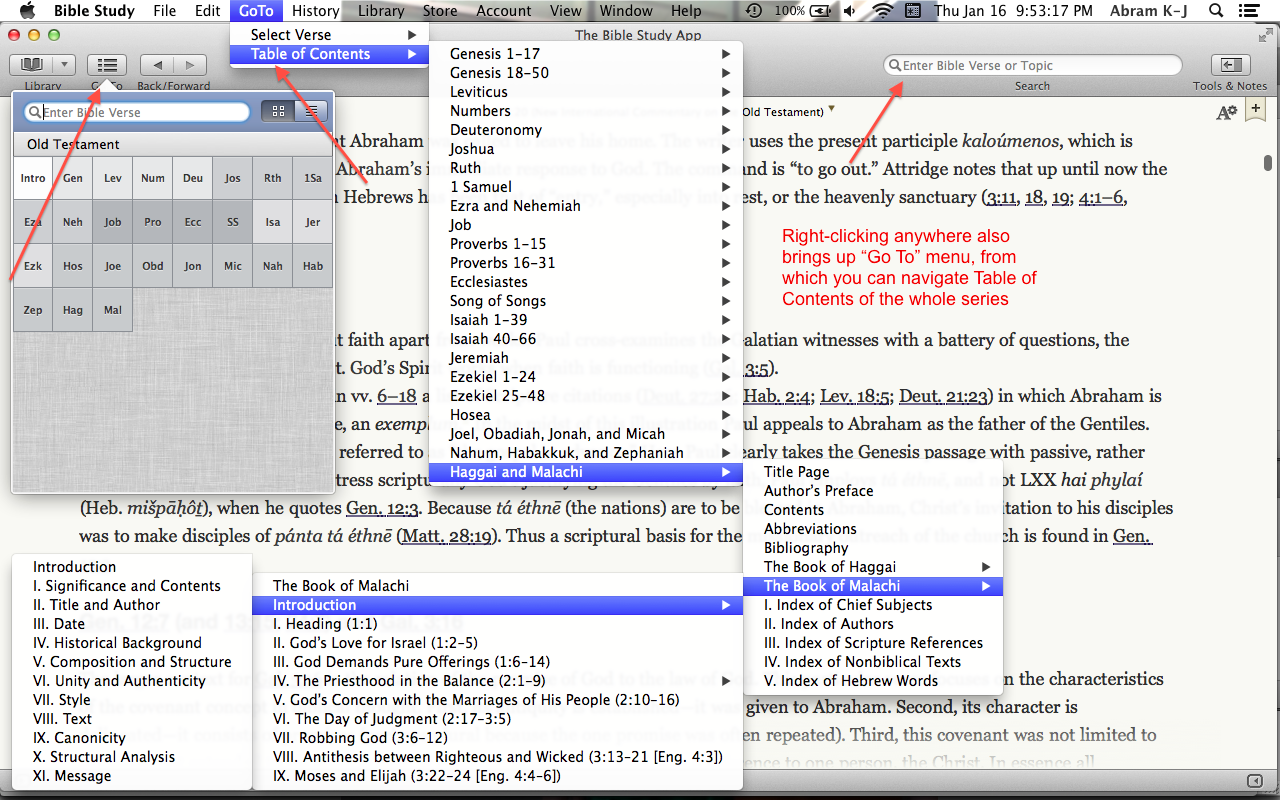
Using NICOT this way, there are quite a few ways to get around, both by looking up a verse in the commentary, and by navigating its Table of Contents. You only need to use one of these options at a time, but here they all are:

(click to enlarge image)

Note that from the Go To drop-down menu, I can keep following the sub-menus till I get to a specific place in the commentary (Introduction to Malachi in the instance above). One could also do this from the Go To item in the toolbar, which allows for both verse searching and Table of Contents navigation.

2. I use the Bible in the main window and NICOT as a supplement in the split window.

This has the advantage of letting me use NICOT as one among multiple resources in the Resource Guide, as shown (in part) here:

Resource Guide shows relevant library results (click to enlarge)

In both of the above setups you can take notes in NICOT, highlight, and bookmark your place. You can also do a search on a word or phrase in the commentary, with the results appearing almost instantaneously. One may wish, for example, to find all the times Oswalt refers to the “Suffering Servant” in Isaiah, which is an easy and fast search to run.

In reviewing Olive Tree I have found it to have the most versatile, smooth, and customizable Bible app I’ve seen on iOS. I write more about the Bible Study iOS app here. The fact that Olive Tree is cross-platform makes it appealing to many. Though the desktop app is well-designed, I would like to see a future update where you can create a saved workspace with multiple resources open in various tabs and windows. That, I think, would take the app to the next level.

But everything is here to help you work through NICOT in a way that you couldn’t in print. There are a couple of options (one free and one paid) for Hebrew Bibles, too, if you want to use NICOT in tandem with the original language. (NICOT uses transliterated Hebrew.)

NICOT volumes consistently top the charts of the Best Commentaries site. Preachers and professors, parishioners and pupils will all find much to mine here, as they seek to better understanding the Old Testament and to more faithfully love the God whose goodness its pages proclaim.

Thanks to Olive Tree for the New International Commentary on the Old Testament (NICOT), given to me for this blog review, offered without any expectations as to the content of the review. You can find the product here. For a little while longer, it’s $349.99 for the series, which is 50% off its regular price.

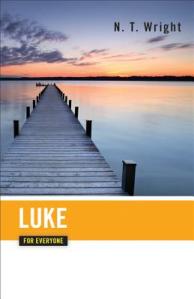
Luke for Everyone, reviewed

Luke for Everyone

“On the very first occasion when someone stood up in public to tell people about Jesus,” N.T. Wright writes, “he made it very clear: this message is for everyone.”

“N.T.” (is it coincidence that his initials also stand for “New Testament”?) wants the results of careful exegesis and historical background research (his specialties) to be accessible to the general populace–to everyone. While this is an ambitious target audience, Wright’s extensive knowledge of biblical language and history, coupled with his ability to write accessibly, make the series a success. He writes “especially to people who wouldn’t normally read a book with footnotes or Greek words in it.”

This fall I preached through parts of Luke, and had the benefit of consulting Wright’s Luke for Everyone each week as I prepared. He was often helpful, both with historical background and a better devotional understanding of the text and how to apply it. Regarding the well-known story in Luke 10 of Mary and Martha, he notes the real “problem” with Mary: “Mary was behaving as if she were a man” (Wright’s emphasis). He explains:

In the same way, to sit at the feet of a teacher was a decidedly male role. ‘Sitting at someone’s feet’ doesn’t mean (as it might sound to us) a devoted, dog-like adoring posture, as though the teacher were a rock star or a sports idol. When Saul of Tarsus ‘sat at the feet of Gamaliel’ (Acts 22:3), he wasn’t gazing up adoringly and thinking how wonderful the great rabbi was; he was listening and learning, focusing on the teaching of his master and putting it together in his mind.

“Rabbi” in the above passage is in bold, which means it corresponds to a glossary entry in the back. There are other important glossed terms throughout the book, with their entries in the Glossary.

Wright divides Luke into 89 different passages, so that each story, parable, or section can receive a good amount of treatment. This is not as long as other commentaries, so Wright doesn’t even attempt to do verse-by-verse-level detail, but the 4-5 pages per passage tend to be sufficient enough for a general orientation.

What I especially appreciated about this commentary was having someone whose knowledge of Scripture is fairly encyclopedic writing in colloquial, everyday terms. For example, he leads off his section on the parables of the lost sheep and lost coin with a story of a neighbor down the street who threw a noisy party. It led him to “thinking about how one person’s celebration can be really annoying for someone else, especially if they don’t understand the reason for the party.”

As he exposits the passage, he notes:

In the stories of the sheep and the coin, the punch line in each case depends on the Jewish belief that the two halves of God’s creation, heaven and earth, were meant to fit together and be in harmony with each other. If you discover what’s going on in heaven, you’ll discover how things were meant to be on earth. That, after all, is the point of praying that God’s kingdom will come ‘on earth as in heaven’.

He concludes:

The point of the parables is then clear. This is why there’s a party going on: all heaven is having a party, the angels are joining in, and if we don’t have one as well we’ll be out of tune with God’s reality.

The commentary itself would already be good as-is, but Wright also provides his own original translation of each passage under consideration. It’s a really good translation: highly readable and also faithful to the original. It reads as well as a modern paraphrase, but stays closer to the Greek than a paraphrase does. Here’s an example, the Lord’s Prayer:

‘When you pray,’ replied Jesus, ‘this is what to say:

‘Father, may your name be honoured; may your kingdom come; give us each day our daily bread; and forgive us our sins, as we too forgive all our debtors; and don’t put us to the test.’

Luke for Everyone would make a great devotional guide to reading through the book in one’s private Bible study, and someone taking a group through Luke would also benefit from it. Its blend of substance and accessibility is unique. Highly recommended!

Thanks to Westminster John Knox Press for the review copy of Luke for Everyone. You can find the book on Amazon here, or at the publisher’s product page here.

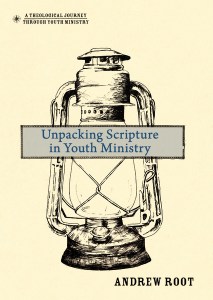
Unpacking Scripture in Youth Ministry, reviewed

Unpacking Scripture in YMWhen I was a vocational youth minister, I tried to help young people (and myself) read the Bible not just for information, but for transformation. I had a number of zealous starts in my own teenage years with an overly ambitious Bible-reading plan, only to find by January 22 that no, I can’t actually read and absorb three chapters a day. This is not to disparage Bible-reading plans, even ones that have you reading through the whole Bible in a year, but it is to say that it’s all too easy to just read the Book for the sake of being able to say, “I’ve read it.”

Andrew Root, author and professor of family and youth ministry at Luther Seminary, makes a similar suggestion. In Unpacking Scripture in Youth Ministry, he offers a short volume of “dogmatic theology written through youth ministry.” The book is part narrative, part theological mini-treatise, and follows the story of a fictional youth worker named Nadia. Throughout the book Nadia wrestles with her own views on Scripture, how to engage youth in Bible reading, and how to respond to the parents, pastors, and facilities committee members with whom she is in community.

The book is just over 100 pages and part of a larger series called A Theological Journey Through Youth Ministry. (See the other three volumes here.) A blend of fictional narrative and theology is hard to pull off in any book, but the transitions here between the two are smooth. From the very beginning scene (Nadia is called at 7 a.m. by a not-entirely-happy facilities coordinator at the church), Root’s storytelling is compelling, funny, and sometimes painfully relatable. Nadia is not the only youth minister, I’m sure, to have been grilled on her biblical theology by the building and grounds committee.

There are discussion questions for each chapter at the back of the book, which would make it easy for a youth minister to lead a team of volunteer leaders or staff through it. Unpacking Scripture and its series fill a gap in youth ministry literature–it’s great to see serious theological reflection coupled with practical application (and done creatively with Nadia’s narrative throughout).

Insatiable Interpreters

Root makes a fascinating point (that I’m still mulling over): “Today, access is more important than memory; we surrender our memory over to gigabytes.” Youth, then, and youth ministers should not see the Bible as a source of knowledge, Root suggests, but as a locus for the construction of meaning. Young people are insatiable “hermeneutical animals,” so Root warns against “frozen biblical knowledge,” since “adolescents interpret everything” in life anyway. He calls for youth ministers to ask:

What does this text mean in the midst of my life? And what does it mean in relation to my existence between possibility and nothingness? What does it say to this struggle I know in the world and in my bones? And…What does this text mean in relation to how God is moving and acting?

Root uses the story in Acts 8 of Philip and the eunuch to unpack his own vision of how to read and interpret the Bible. Philip, he writes, “is not only concerned with helping the eunuch understand the text, he wants to help the man experience it next to his own existence.” Right on.

100% Human, and…?

Root, in his chapter, “The Authority of Scripture,” leads off by talking about the paradox of Christ’s two natures–fully human and fully divine. He uses that as a springboard to look at “the Bible’s two natures,” which I expected to be an articulation of its having been written by human people (who were all too human) who were yet divinely inspired to write. However, Root goes farther than I’m comfortable accepting by saying that the “contradiction of the Bible is that the story of the divine action comes to us in a book that is simply, and profoundly human.” The Bible “contains all the shortcomings and fallibilities of any written text.” And, “The Bible is a 100 percent human book.”

Eunuch and PhilipI would have been on board, had he followed up with the ways in which the Bible is also “100 percent divinely inspired” or “breathed-into,” etc., but the emphasis seems to be largely on its human production. To be fair, this “human book,” Root notes, “is essential for encountering the living God,” but other than Acts 8, there wasn’t much discussion about what the Bible says about itself (with due respect to all the footnoted Barth). If this Word is “living and active,” and capable of transforming us (because it is God’s Word/words), doesn’t its inspiration go beyond just the fact that it is a “witness,” the purpose of which “was to reveal God’s action by articulating what God has done”? In other words, could there also be something about these very words that can transform? (Darrell W. Johnson, in his book The Glory of Preaching, notes, “[T]he word of the living God is a performative word” (my italics).)

Maybe I’m splitting hairs here, and I don’t know Root personally–I suspect that given more pages, or over a cup of coffee, he might say more about the divine inspiration of the Bible, or about its performative power. But I thought at least this book may have put too much emphasis on the human element, as it described “what the Bible is not” and “what the Bible is.”

What is the Goal in Youth Ministry?

Where I find myself agreeing with Root is in his articulation of the goal of youth ministry in relation to Scripture:

So our goal in youth ministry is not to get kids to know the Bible, but for them to use the Bible–to become familiar with its function–so they might encounter the living God, participating in God’s own action through its story.

Of course, the goal in youth ministry could/should be both of those things. We want young people to know the Bible and know how to use it, just as Root describes the eunuch’s both understanding and experiencing Scripture. Youth ministers will still need to help young people differentiate between genres (just as English teachers do) and help them know how to dig into the historical background of a text, which often helps to explain it more than just a surface read.

So we need to get both “behind the text” (“boring” or not) and “in front of the text” to be faithful interpreters. To say, as Root does, that the Bible “only can live, then, by being drawn into our world, into the world in front of the text” has the potential to turn into a me-centric way of reading.

Perhaps the length of this review is an indication that Root has succeeded in getting ministers to think about their own views of Scripture, and how they would engage others in reading the Bible. That is a good thing! I’m not sure I would use this book for youth minister training, since there’s a good deal I’d feel compelled to qualify or further nuance. (Though it’s hard to think of an alternative book along similar lines to suggest.) Unpacking Scripture in Youth Ministry has, however, very much provoked me to a great deal of reflection. I hope that Root continues to write more about theology, Scripture, and youth ministry, and that others follow suit.

Thanks to Zondervan for the review copy, given without expectation as to the nature and content of this review. The publisher’s product page is here. You can find it on Amazon here. A sample .pdf is here.

I Met N.T. Wright Once, and You’ll Never Guess What He Told Me

I’ve been seeing too much Upworthy in my Facebook news feed lately! Apologies for the sensational blog post headline.

NT WrightBut I really did meet N.T. Wright once. And you might actually guess what he told me, when I tell you what I asked him. I introduced myself to him briefly after a message he delivered a Calvin College worship symposium, and asked him how to improve my Greek. He said, “Read the text, read the text, read the text.”

He told me to really get the feel of the language. I shouldn’t think of Greek just as a one-to-one code for English; I should get into the Greek itself. I asked him what he thought about reading with a diglot, but he encouraged me to check the English translation only after reading an entire Greek paragraph, and then, only as necessary.

It’s challenging, but I’ve benefited from that advice multiple times.

The For Everyone Series

Wright for EveryoneOver the years I’ve made occasional use of his For Everyone Bible commentary series. Written under the name Tom Wright, the series brings Wright’s extensive knowledge of the biblical text and history to a general audience. Anyone wanting to know more about a passage–whether they are preaching from it or reading it in their personal devotions–would benefit from the series. It’s decidedly non-scholarly, but even scholars will find useful information here (if a bit simplified at times). Here is how Wright introduces the series:

But the point of it all is that the message can get out to everyone, especially to people who wouldn’t normally read a book with footnotes and Greek words in it. That’s the sort of person for whom these books are written.

Though Wright is a prolific writer of scholarly works, he writes well for a general audience–a rare combination. Throughout the series Wright puts key terms in bold, which the reader can then look up in a corresponding glossary (e.g., Gehenna/Hell, Covenant, Age to Come, Law, Faith, Son of Man, and more).

Between this package and this upgrade, Logos Bible Software offers the entire 18 vol. set. In a future post I will review Logos’s presentation of the series. Here I post about its content.

A Refreshing (One-Man) Translation

The Kingdom NTWright splits each biblical book up into manageable passages. His original translation does a good job of striking the balance he seeks of faithfulness to the original and readability. Here is a passage in Wright’s translation:

Romans 4:18-25

Abraham’s Faith—and Ours

18 Against all hope, but still in hope, Abraham believed that he would become the father of many nations, in line with what had been said to him, ‘That’s what your family will be like.’ 19 He didn’t become weak in faith as he considered his own body (which was already as good as dead, since he was about a hundred years old), and the lifelessness of Sarah’s womb. 20 He didn’t waver in unbelief when faced with God’s promise. Instead, he grew strong in faith and gave glory to God, 21 being fully convinced that God had the power to accomplish what he had promised. 22 That is why ‘it was calculated to him in terms of covenant justice’.

23 But it wasn’t written for him alone that ‘it was calculated to him’.24 It was written for us as well! It will be calculated to us, too, when we believe in the one who raised our Lord Jesus from the dead, 25 the one who was handed over because of our trespasses and raised because of our justification.

Wright explains, “The older language, ‘it was reckoned to him as righteousness’, gives off so many different messages now that it’s hard for us, hearing it, to think the thoughts Paul had in his head.” His translation is fresh, yet is not a paraphrase (like Eugene Peterson’s Message, for example).

“Come to Him, by Whatever Route You Can”

The For Everyone series, though divided into discrete passages, shows a literary sensitivity so that the reader can see how a given section connects to the larger flow of the book. For example, of the above passage, Wright writes:

The last verse of the chapter anticipates something Paul is going to do throughout chapters 5-8. He rounds off every stage of the argument in this long section with a reference to Jesus. This isn’t a mere pious gesture, smuggling in a mention of Jesus in case we thought he’d forgotten about him. It shows, rather, what the whole argument is all about. It brings us back home to the source and power of Paul’s thought.

Though preachers are not the target audience, the series is a good one for preachers to have on their shelves. There is not the same sort of explicit homiletical guidance that Feasting on the Word offers on every passage under consideration, but Wright is not short on practical application. For the Romans passage above, he concludes:

Do we share Abraham’s faith? Do we look in love, gratitude and trust to the creator God who promises impossible things and brings them to pass? Have we learned to celebrate this God, and to live as one family with all those who share this faith and hope?

Similarly, in Matthew’s account of the Magi’s visit to Jesus, Wright notes that the inclusion of the Gentile Magi already in chapter 2 shows one of Matthew’s themes–that Jesus is king of the Jews, and of all people. He concludes:

Listen to the whole story, Matthew is saying. Think about what it meant for Jesus to be the true king of the Jews. And then—come to him, by whatever route you can, and with the best gifts you can find.

This application comes after Wright succinctly answers who the Magi were, what the “star” they saw might have been, and what Old Testament passages are at play in the Epiphany narrative.

In Conclusion (So Far): One of the Best Reading Guides

Luke for EveryoneWright’s style is conversational, engaging, highly readable, and stimulating on both an intellectual and devotional level. As I make my way through more of the series, I’ll post more about it (with screenshots of how it looks in Logos for computer and iOS). But so far I’m a big fan of what I’ve seen. The Luke volume was a frequent reference as I preached through parts of Luke this fall.

If you’re reading through the Bible, and want to have a substantive yet concise reading guide for the journey, Wright’s For Everyone series is hard to top.

Thanks to Logos Bible Software for the review copy of New Testament for Everyone (16 vols. here; 2 vols. upgrade here). You can find my other Logos reviews here.

NA28 Greek New Testament in Olive Tree iOS, reviewed

Olive Tree logo

Which Bible software program should I buy? As 2014 begins, my answer to that question is still by far the most-visited post at Words on the Word.

Olive Tree is another popular Bible software option, running on just about any platform and device, whether iOS, Mac, Windows, or Android. I began to review their Bible Study App (for Mac desktop/laptop) here, with the Greek NA28 New Testament in view. In this post I look more in-depth at the NA28 in Olive Tree, with screenshots from their iPad (mini) app.

The Bible Study App for iOS

The Bible Study App is smooth, visually appealing, and easy to learn and use.

Here are a few things I especially like about the app:

You can use “flick scrolling” (as in iBooks) or “page scrolling” (as in Kindle). This accommodates just about any user. I prefer the flick scrolling, so that the books move as a Webpage on my computer would move.

You can search any resource, and view both the results-in-context and individual hits together. As in this screenshot:

Search Results

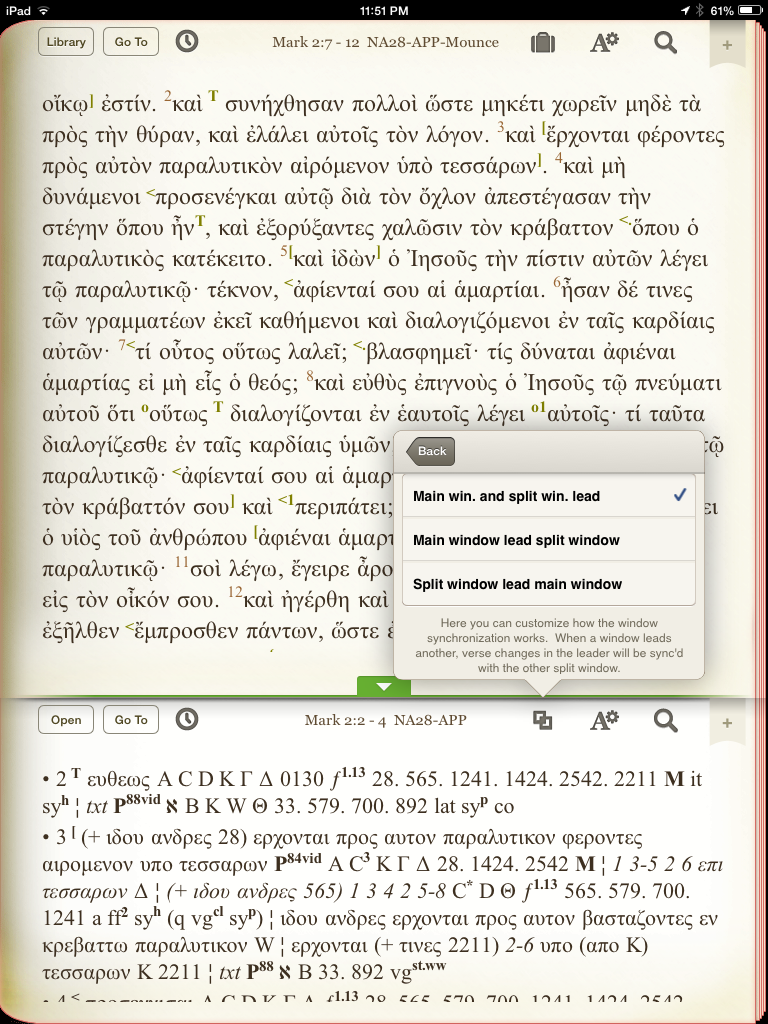
The app allows for you to view one or two resources at a time. This is the same as the iOS apps in Accordance and Logos. What I like about this app is that you can choose whether you want to sync the two windows or not. You can also choose which of the two windows “leads” the other, if you tie them together. Or you can set it up so that whichever one you move (top or bottom/left or right) causes the other to move:

Main and Split Window

There is a whole host of “Gestures/Shortcuts” preferences in the “Advanced Settings” menu. You can assign shortcuts to various gestures. I don’t know of any other iOS Bible app that is this versatile. My two favorites:

  • Two finger swipe left and right takes you through your viewing history, which makes navigation through various passages all the easier. This even works across modules, so that I can swipe between the NA28 and the iPad User Guide I might have just had open. No need to go through menus.
  • Two finger tap takes you from any screen right to your library so you can quickly get at your resources.

NA28 in Olive Tree

There are a few purchase options for the NA28 in Olive Tree. I’ll look here at the “NA28 with Critical Apparatus, Mounce Parsings, and Concise Dictionary,” which you can find hereAt the time of this blog post, it’s on sale for 50% off, so $45 instead of $90. You won’t find it cheaper elsewhere, in any format. The text and apparatus are what you’d get if you bought a print version; the parsings give morphological information, and the dictionary gives lexical detail.

There are some distinct differences between the NA28 and the NA27. If you go about halfway down this post, you can see more detail (as well as click through to some good links) as to what the changes are.

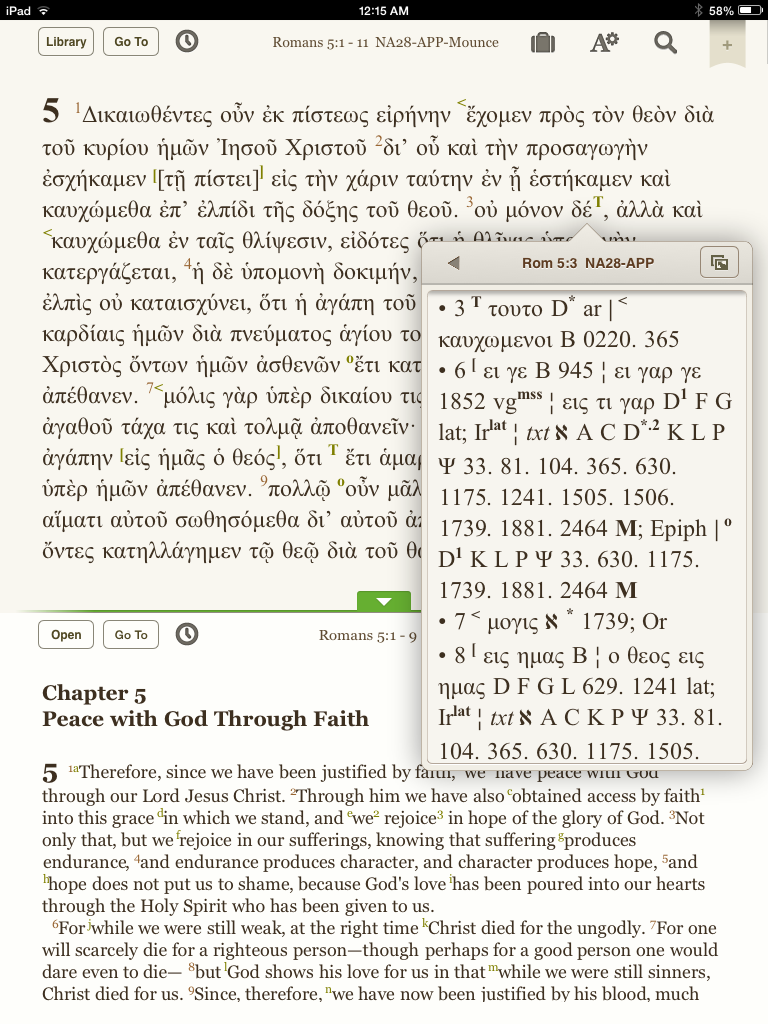
Here I have the text and apparatus open, and have simply tapped once on a Greek word to bring up a pop-up window with a gloss and parsing:

parsing popup

Another possible arrangement would be to use one window for the Greek text, and a second window for an English translation. In that case, one can click on the sigla in the NA28 text for a pop-up with the apparatus. (And still get parsing popups from the surface text, when needed.) This is a good way to economize space:

diglot with apparatus

I appreciate that just a short tap is all that’s required to bring up details about a word or information on a text-critical sign. I find the app overall to be quite intuitive and aesthetically pleasing.  It’s fast on word searches, too.

One critique of the NA28 apparatus is that the text-critical sigla are not hyperlinked to their meanings. In the Accordance version of NA28, for example, when you hover/click/tap on sigla and abbreviations from the apparatus, you instantaneously see (in a popup window or instant details window) what they represent or stand for. In Olive Tree, there is a workaround (described here: bookmark the relevant section of the introduction for quick reference), but this is not an improvement on what one would have to do with a print text anyway. It’s not unmanageable, but also not what one might hope for in this medium. So one will need to regularly consult the NA28 introduction, which is included with the text.

Olive Tree has one of the more active and better Bible software blogs I’ve seen. I’ve learned a good deal from it. Check it out here, especially this post that shows how to use a dictionary in the iOS app.

Since Olive Tree is new to me, and since I already use other Bible softwares, I’m still trying to figure out how it will make its way into my overall workflow. But its smooth interface, speed, and snazzy iOS app will have me coming back for further exploration.

Thanks to Olive Tree for the NA28 with Critical Apparatus, Mounce Parsings, and Concise Dictionary for the purposes of this blog review, offered without any expectations as to the content of the review. You can find the product here

Septuagint Studies Soirée #5

LXX Psalm 1
LXX Psalm 1

It’s the first day of a new month (and new year), which means that the Septuagint Studies Soirée has arrived. Here is a collection of what the LXX-blogosphere had to offer in December 2013.

Old School Script has an interesting post (with some good questions to think about) regarding lexicography and instincts. (E.g., “How much do we trust our (next-to-nothing?) intuitive powers?”)

J.K. Gayle asks the provocative question, “Was David a virgin when his soul was pregnant?” to “bring some attention to the way in Bible reading and translation we highlight gender and sex and motherliness so dogmatically.” Gayle seems to “know” a bit about the Bible’s “sex verbs,” as he discusses ἐγίνωσκεν in Matthew 1 here. One other post of his worth reading (all his posts are worth reading) says, “The Greek / Hebrew names here for the baby Jesus are rather political in contrast to the Empire of Alexander and the Empire of the Caesar.”

T. Michael Law’s book about the Septuagint made #2 on Near Emmaus’s year-end books list.

Though it wasn’t on a blog, per se, James K. Aitken posted a chapter on LXX neologisms (thanks, Jim, for the tip). He writes, “There is a need for more descriptors of so-called new words, identifying them as semantic extensions, unattested compounds, morphological extensions, foreign loans, and so on.” One other non-blog, LXX-related url, if you want a daily LXX fix via the Twitter, is here.

Brian Davidson at LXXI made a couple of short videos about using Logos for a sort of MT-LXX Two-way Index.

Speaking of Brian, he’s taking over Greek Isaiah in a Year (which just finished) and leading a group through Isaiah again in 2014! Join them here.

Did I miss anything? As prevalent as women are in Septuagint studies, I didn’t find any LXX blog posts by women in December, but I might have missed one! Feel free to leave more December 2013 LXX links of interest in the comments. And in case you didn’t see it, the first Septuagint Studies Soirée is here; the second one is here; the third one is here; the fourth one is here.

Feasting on the Word (concluding thoughts)

Feasting on the Word

Among preachers, there are books known as “Monday books” because they need to be read thoughtfully at least a week ahead of time. There are also “Saturday books,” so called because they supply sermon ideas on short notice. The books in this series are not Saturday books. Our aim is to help preachers go deeper, not faster, in a world that is in need of saving words.

–Feasting on the Word

I continue to utilize the 12-volume Feasting on the Word commentary series most weeks in my sermon preparation. As I described at greater length here, the 12 volumes cover the three-year lectionary cycle (A, B, and C), split into four volumes per year. Each week offers four different “perspectives” (theological, pastoral, exegetical, and homiletical) for each lectionary passage in the Revised Common Lectionary.

As far as its layout and usability in Logos, I covered that here. My favorite part about having Feasting on the Word in Logos is that I find Logos to be the most robust e-reader currently on the market. It syncs seamlessly across devices and platforms, and easily allows for highlights and notes to be made directly within the text.

In this final post, I want to interact a bit more with some of the content of the series.

The diversity of the contributors is a strong point. They come from different vocations (preachers, professors, Bishops), and reflect diversity in race, sex, and denominational affiliation, as well. I’ve found this refreshing.

There is a general evenness in style, tone, and substance across the volumes I’ve used. As one might expect with a commentary series with this many contributors, some entries end up being more helpful than others.

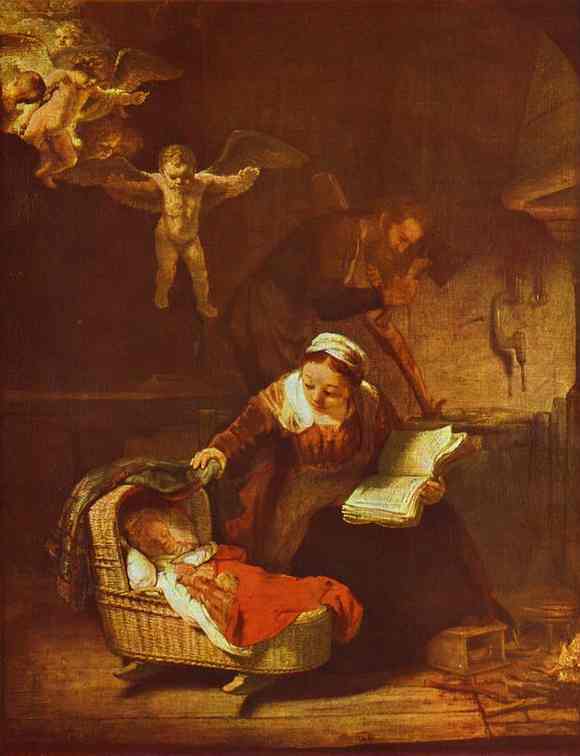
Rembrandt Holy FamilyWhile I have found the “Exegetical Perspective” and “Homiletical Perspective” sections to be of some value, the “Homiletical Perspective” and “Preaching Perspective” are the ones I use most often. Each of these help the preacher imagine how she or he might orient herself/himself and the congregation to a given text. For example, the “Homiletical Perspective” on John 1 begins with a description of Rembrandt’s “Holy Family” painting, then goes on:

I can imagine a sermon that would begin with a description of Rembrandt’s painting and that would develop the idea of the necessary dialogue between Mary’s studying the Bible and studying the child, the Word made flesh. Like Mary, we come to understand the Word more and more fully as we oscillate between the book and the child, between the Word through words and the Word made flesh.

Few commentaries offer homiletical suggestions this practical. The “Pastoral Perspective” for the same passage is worth quoting at length. After quoting Eugene Peterson’s rendering of John 1:14, preacher Frank Thomas writes:

I love this rendering of this text because of the choice of the word “neighborhood.” The Word was made flesh and blood and moved into the neighborhood. Neighborhood reminds me of the place where I grew up and the people with whom I grew up. I remember the street corner where we played baseball that had four sewer covers; one sewer cover was first base, another second, another third, and the final one home. I ran around those bases thousands of times, dreaming that I was a professional baseball player. I remember the playground, where what seemed like millions of kids played basketball, Ping-Pong, pool, volleyball, dodgeball, and tons of games. I remember block parties, where all the neighbors would sit out on the front lawns with the streets blocked off, and all day we would just have food, games, and fun together. I remember the girl across the street. That’s what I think of when I hear, “The Word was made flesh and moved into the neighborhood.” The Word was made flesh and moved into my south-side neighborhood.

He concludes, “When Peterson says that the Word was made flesh and moved into the neighborhood, I hear that the Word moved into my neighborhood.”

There is much for the preacher to mine and adapt and re-contextualize in the above, in a way that fits one’s own setting. Reading Pastor Thomas’s writing above makes it easy to think about Jesus moving into our neighborhoods, too. (Which immediately raises interesting questions for congregations–would we be a good neighbor to him? Would we need to change anything about our community life? Would we recognize him?) I find that Feasting on the Word is constantly suggesting good questions for reflection and stimulating even more.

There is a claim in the series introduction that, “Wherever they begin, preachers will find what they need in a single volume….” While the exegesis and theological analysis in these volumes is substantive, I still find myself turning to more in-depth commentaries for exegesis, before using Feasting on the Word to think through how to move from passage to sermon. That has been how I’ve most benefitted from the commentary.

I’ll continue to use the commentary series on a regular basis. While I love print books, there are advantages to the electronic version, and Logos integrates Feasting on the Word with any other Logos resources you may have. For those who preach regularly, this set is well worth checking out.

Thanks to Logos Bible Software for the review copy of Feasting on the Word (12 vols.). Find it here. The publisher’s page for the series is here. You can find my other Logos reviews here.

500 Book Sale in Logos Bible Software

500-book-mega-pack

Logos Bible Software has just announced the release of a “500 Book Mega Pack.” The bundle is up through the end of the year. More details are here. Some highlights include:

…and quite a few more. Nearly 200,000 pages (print equivalent). You probably won’t use all of it, but it’s a quick and cost-efficient way to expand a Logos library. Logos offers it at 96% off, through their Christmas sale.

As to my own personal experience using Logos, I’ve written a good deal about that here (with more reviews forthcoming). You can also see a short demo here (with a great soundtrack from Future of Forestry) on how to use Logos to research the Christmas story.

Disclosure of Material Connection: I received the 500 Book Mega Pack gratis, with the expectation that I post about it here (though with no expectation as to my evaluation of the product itself).