New Göttingen Septuagint Volume Just Published

Septuagint 2 ChroniclesWorking with the Göttingen Septuagint is not for the faint of heart, as I have noted before–though I have offered a couple of widely read (and hopefully helpful) posts on how to read and understand LXX-G.

New Göttingen volumes are not frequent; to publish one involves a great deal of work on the part of the editor.

Just this fall, under the editing of Robert Hanhart, publisher Vandenhoeck & Ruprecht released the 2 Chronicles Göttingen volume:

Here’s a screengrab of part of a page from a Google Book preview. The volume has the familiar font and layout of (a) critically reconstructed Greek text, (b) Kopfleiste (manuscript Source List), and (c) textual apparatus:

2 Chronicles LXX


Here is the book description:

This is the first-ever critical edition of the volume Paralipomenon II and represents a major step in the continued publication of the oldest Septuagint text available.


For this critical edition of the oldest available Septuagint text, the editor consulted Greek papyri predating the Christian era (3rd/2nd century BC), minuscule scripts from the 16th century AD as well as other Latin, Coptic, Syrian, Ethiopian and Armenic secondary translations. He also included Septuagint quotes stemming from Church authors in both Greek and Latin as well as the printed editions of the Septuagint from the 16th to the 20th century. This critical edition of the Paralipomenon II represents the continuation of the publication of the critical edition of the oldest Septuagint text available.

You can find the volume here at V & R and here at Amazon.

†Rod Decker’s Koine Greek Grammar

May Prof. Rodney Decker rest in peace. One of his final contributions (gifts) to the Greek-learning community was this exciting new grammar, which I just received in the mail from Baker Academic yesterday:


Decker Grammar


Here is the description from Baker’s site:

This in-depth yet student-friendly introduction to Koine Greek provides a full grounding in Greek grammar, while starting to build skill in the use of exegetical tools. The approach, informed by twenty-five years of classroom teaching, emphasizes reading Greek for comprehension as opposed to merely translating it. The workbook is integrated into the textbook, enabling students to encounter real examples as they learn each new concept. The book covers not only New Testament Greek but also the wider range of Bible-related Greek (LXX and other Koine texts). It introduces students to reference tools for biblical Greek, includes tips on learning, and is supplemented by robust web-based resources through Baker Academic’s Textbook eSources, offering course help for professors and study aids for students.

Looks great! After a quick flip through, what stands out most is that the vocabulary lists at the end of each chapter include frequency counts for both the New Testament and the Septuagint.

I’ll post more later–find the book here.

Do You Want to Contribute to a Septuagint Dictionary?

Scholar’s Publisher is seeking contributors:

The aim of the DSEGJS [Dictionary of the Septuagint and Early Greek Jewish Scriptures] is to provide a comprehensive reference guide to the Greek Jewish Scriptures (GJS) in their Greco-Roman context as well as their subsequent influence on the early church and post Second Temple Judaism. The field as well as the general interest in matters related to the GJS has grown significantly in the past 30 years, but the discipline is lacking an informative reference tool for students and specialists, as well as scholars and students in related fields. The scope of the dictionary is to provide factual information about books, persons, places, and events, as well as define words and explain theories as they relate to the GJS. In most cases, the next step is to read an article or volume that is devoted to the topic itself, though in some cases the nature of this new endeavour means the DSEGJS is the primary source of information.

Find out more here.

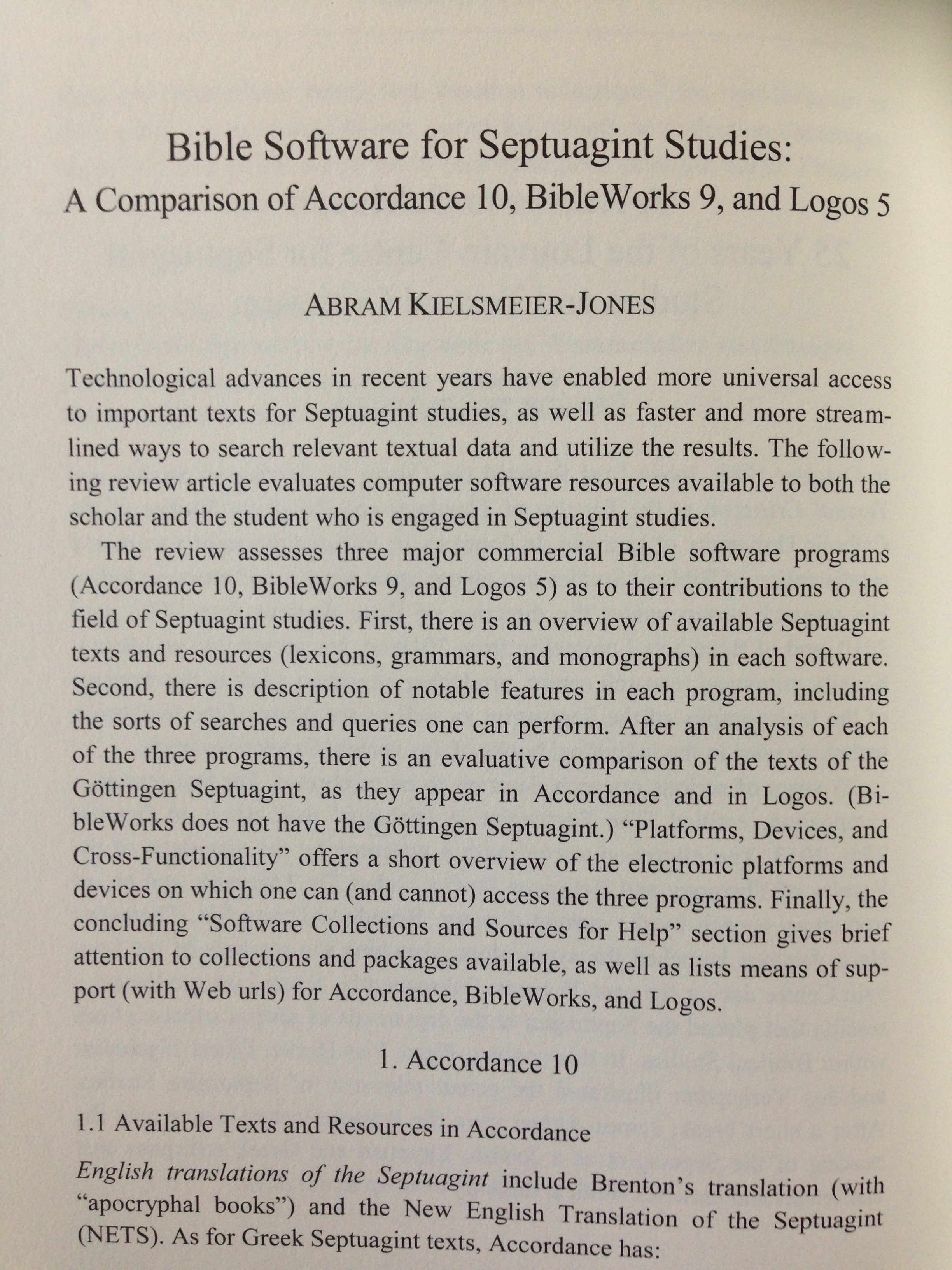
My Comparative Review of Software for LXX Studies, Published in JSCS

I’ve just come home to the new Journal of Septuagint and Cognate Studies (JSCS) in my mailbox. This volume (vol. 47, 2014) publishes an extensive comparative review I wrote of Bible software programs for Septuagint studies. In the review I consider and evaluate Accordance 10, BibleWorks 9, and Logos 5.

I’m excited to see it in press! Here are the journal cover, the contents, and the first page of the review. You can subscribe to JSCS at this link.

JSCS (2014) Cover
JSCS (2014) Cover


JSCS (2014) Contents


First Page of the Review

The Bible’s Other* Hymnal

Psalms with OdesMany Greek Septuagint manuscripts do not contain them, but the Odes are a fascinating collection of texts appended to the end of the Greek Psalter in Codex Alexandrinus and a few other manuscripts.

The Odes compile some beautiful prayers from Scripture. A few of them are in the Book of Common Prayer’s Morning Prayer canticles.

Good information on the Odes is hard to come by, though. In part this is because they are generally not accorded the same status as, say, the Psalms. The NETS introduction to the Psalms, for instance, has:

One “book” not included in NETS, however, is Odes since it has dubious integrity as a literary unit, and, in any case, almost all of the individual Septuagint odes have already been included in their native setting in other books. The sole exception is Ode 12 in Rahlfs’ edition, the Prayer of Manasses, which for that reason has been separately appended to the Psalter.

I’ve just discovered, however, that David Lincicum has a nice rundown of the Odes, their numbering, and their contents. He also includes a bibliography for further reading. Check it out here.


*HT to a member of the Yahoo! LXX email group for the idea of the Odes as a sort of “little hymnal.”

Septuagint Studies Soirée #9 and #10: Buy One, Get One Free Edition

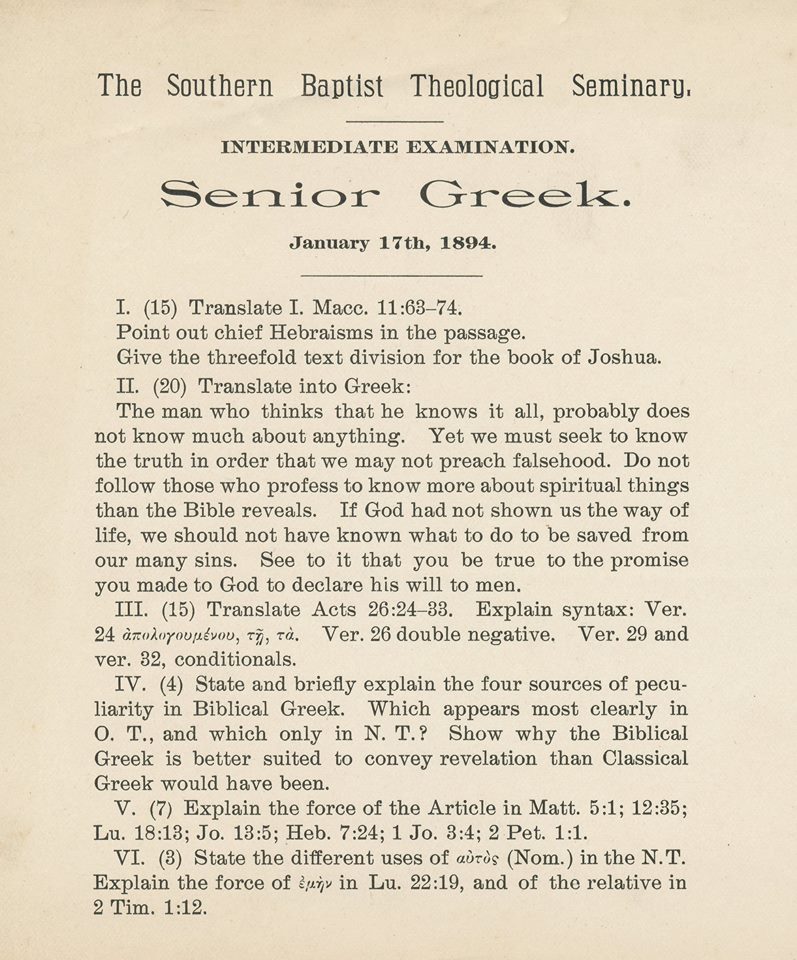
How would you do on this exam?

The Septuagint Studies Soirée is back. You can find all previous months gathered here, where I post links to what I find around the blogosphere in Septuagint studies. This soirée covers two months: April and May.

T. Michael Law continues to dominate the Septuagintablogosphere with his Septuagint Sessions podcast. Since the last soirée he posted episode 4 (on Greek Isaiah’s style), episode 5 (“Your BHS is safe with me!”), and episode 6 (“about a problem in research on the LXX that stems from a canonical bias”).

Suzanne McCarthy at BLT asks whether Judith was originally written in Greek or Hebrew. She also looked at our two “prototypical parents” in Greek Genesis 3 and 4. Her co-blogger J.K. Gayle examined the use of “baptism” in Plato and the LXX. BLT is one of the more substantive biblioblogs I read. You would do well to bookmark BLT’s Septuagint tag page, which includes even more recent LXX-related posts. (Also, add this one to your slate of BLT posts to read.)

Linguae Antiquitatum posted a nice review (with some interesting pedagogical musings) of a book about teaching beginning Greek and Latin. The same blog posted the first ever “Ancient Languages Carnival.”

Mosissimus Mose continues an ongoing review of  T. Michael Law’s When God Spoke Greek. Chapter 5 posted in May.

William Ross posted about papyri.info, and offered this and this post as to how to use it for LXX research.

Summer beach reading?

Brian Davidson at LXXI suggests some summer reading. If you have made it this far in reading this post, you might even consider his recommendations to be good beach reading.

Here is Ed Gallagher on “The Greek Bible among the Jews.” And here he is with an illuminating post on the word “deuterocanonical.”

We’ve been in Easter season. And the LXX may have had “an increasing awareness of resurrection theology.” Read a short but fascinating post about it here.

Allow me to make a plug again for The International Organization for Septuagint and Cognate Studies (IOSCS), which publishes a yearly journal. I’m excited to say that the forthcoming issue will include a fairly lengthy review article I’ve written about the use of Bible software for Septuagint studies.

Finally, check out Jacob Cerone’s post of a Greek exam given in the late 19th century by John Broadus and A. T. Robertson (pictured at the top of this post). He even takes part of it and posts his answers. Nice work, Jacob!

One last note–Rod Decker passed away this last month. Read a note from his family here. I’ve found his Koine Greek Reader and Septuagint-related vocabulary lists quite helpful. He will be missed.

Did I miss anything? Feel free to post an LXX-related link in the comments. Until next time!

The First Place on the Web to Go for Septuagint Studies…

IOSCS Logo

…besides the Septuagint itself, is this spot right here. It’s the Web presence of The International Organization for Septuagint and Cognate Studies (IOSCS). The IOSCS is “a nonprofit, learned society formed to promote international research in and study of the Septuagint and related texts.

Membership in the organization is affordable (especially for students). They put out an annual journal (some volumes of which are freely available here), offer a yearly prize, and link to some useful LXX resources here.

The IOSCS home page is updated fairly regularly with news of publications, conferences, and other announcements. Check it out.

Septuagint Studies Soirée #8: The One Week Late Edition

Translation is Required

Here are some posts from around the Septuagintabiblioblogosphere in March:

Lee Irons blogged his way through Translation is Required: The Septuagint in Retrospect and Prospect in six parts, accessible here.

T. Michael Law posted two more installments of his Septuagint Sessions podcast, here and here.

BLT blog wrote about God’s first Greek puns (brought to you largely by the letters γ and ν).

William Ross promises upcoming LXX Resource Reviews. You can see a resource page he has up now, here. Also, in the last soiree I missed his February review of Abi T. Ngunga’s Messianism in the Old Greek of Isaiah. (It’s on my shelf, too, and I’ve worked with it a little.) Here it is, in excerpted form.

Daniel Streett uses the LXX to venture an answer to the question: Did Enoch Die? He also mentions a couple options for a bound LXX-Greek NT combo.

Mosissimus Mose continues a review of  T. Michael Law’s When God Spoke Greek in dialogic form. The fourth part posted in March.

Here’s a post on “ditching flashcards” (via here).

Jacob Cerone has been posting his way through LXX Jonah. See here, here, and here.

Did I miss anything? Feel free to post an LXX-related link in the comments.

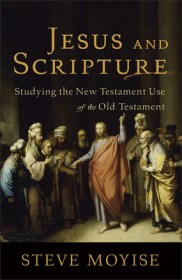
Free Book in Logos: Jesus and Scripture, by Steve Moyise

Jesus and Scripure by MoyiseIn early February I finished reading Steve Moyise’s Jesus and Scripture: Studying the New Testament Use of the Old Testament. You can read what I wrote about it here. Here is the concluding portion of that review:

Jesus and Scripture would be perfect for a seminary course on the Gospels, or on the NT use of the OT. An advanced undergrad course would also do well to adopt this book. I’d also recommend it to a serious Bible reader–no biblical languages are needed here, and I found that even with my own knowledge gaps in historical Jesus studies, Moyise explained everything I needed to know.

Though this survey is short (less than 150 pages), Moyise gives plenty of sample passages and insights that have challenged me. I know this is a book I will come back to and want to read again in the future.

This month Logos Bible Software is offering their edition of the book for free. It’s a fantastic book, and I look forward to being able to use it now electronically (with keyword searchability and hyperlinked Scripture references throughout). You can get the book here.

Koine Greek Reader and Septuagint Vocabulary Lists

Koine Greek ReaderProf. Rodney Decker is the creator of Koine Greek Reader, one of my favorite resources for learning and practicing Greek. The book includes grammar review, vocabulary lists, and Greek readings with helps. The Reader covers the New Testament, the Septuagint, the Apostolic Fathers, and a few early church creeds (which are really fun to look at in Greek).

His resources page has some very helpful Septuagint vocabulary lists. This one (PDF) has all words that occur more than 100 times in the Septuagint. This list (PDF) includes words occurring more than 100 times in the Septuagint but less than 25 times in the New Testament. This second list is a good starting point for those who are (somewhat) proficient reading the New Testament in Greek, but who want to expand their reading into the more difficult (and larger) vocabulary pool of the Septuagint.

You can read an excerpt (PDF) from the Reader here, and much more about it is here at Prof. Decker’s NT Resources blog.