They’re a real thing, and they’re the best conversation starter I’ve brought into my office in a long time.
Creator Norman Jeune III came up with the idea of Theologian Trading Cards in seminary. It’s a good one. I remember, as a kid, memorizing and quoting statistics and quizzing friends with the back of baseball cards. I could tell you how many home runs and runs batted in Andrew Dawson of the Chicago Cubs had had for the last five years. It’s a good size for a learning tool.
The product description from Zondervan reads:
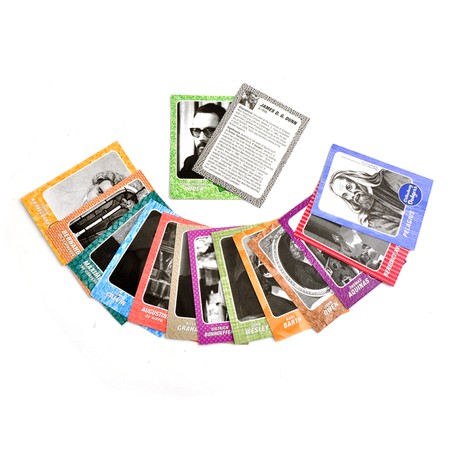
Patterned after the all-American baseball card, Theologian Trading Cards provide essential information about the major teachers, leaders, and trouble-makers throughout the history of the Church. At a glance you will have access to information regarding 288 important figures in church history, including when and where they lived, their contribution to the church, and enduring significance.
Jeune has organized the cards into 15 teams, each grouped by chronological or historical or theological commonality. The “Orthodoxy Dodgers” (great name) are the church’s heretics. Marcion (85-160), for example, “created his own canon [of Scripture], exlcuding the Old Testament and introducing numerous edits, compilations, and omissions to the New Testament.” The “St. James Padres” team consists of early church fathers: Ambrose, Augustine, Cyril, Justin, and so on.
The cards aren’t really “trading cards,” since there’s no trading to be done–you can only buy it as a complete set. But they’re just as fun as the baseball cards I collected as a kid… well, if you think theology is fun. (Which, of course, it is!) Jeune introduces a creative medium in a field that can be challenging for students. There are a lot of facts, figures, and beliefs to keep straight in a basic church history course.
Image from patheos.com
The front of the card consists of a photo (except where none is available; see below), the name of the figure, and his or her team. The back of each card has dates and two sections: biographical and significance. Of course it would be impossible to cover everything (even all the significant things) in each figure’s life on just the back of a card. But Jeune does a good job of hitting the main points.
And the cards are fun. I don’t think I’ve ever had anything on my office coffee table picked up as much as these cards. Folks want to leaf through and see who’s there, what is written about them, etc. I’d imagine that they aid exam preparation, too. The handy size makes them easy to stuff in backpack, or put a small stack in a purse for on-the-go quizzing.
Of course a set like this is prone to criticism–which figures Jeune includes, which ones he doesn’t, how much detail he includes, what detail he leaves out. There is somewhat decent representation of more than just white males–users of this set will find cards for Amy Carmichael, Elisabeth Schüssler Fiorenza, Rosemary Radford Ruether, Teresa of Avila… though still one wants for more. There is James Cone, but no MLK? Julian of Norwich, but no Perpetua? This must be impossible to get right in a set like this, but those omissions are noticeable. I’m holding out for a “booster pack” to add to the set.
Another quibble I have is that while each of the 15 teams has a checklist, there is no comprehensive checklist for the set. Even if spread out over a few cards, it would be useful to be able to quickly see all the persons that Jeune includes in the set. (Perhaps he will upload a list online in the future? If so, I’ll post here.)
A distraction in the set is the number of cards that have a blank silhouette with a question mark on it. For these the publisher was not able to procure an image. There is a good reason for this, and it’s worth reading Jeune’s explanation here. All the same, an original sketch, however basic, would have been preferred. (Remember those Facebook friends who joined but didn’t add a profile pic for months? It looks like that, only with the super-imposed question mark.)
The idea of Theologian Trading Cards is a great one, though. The cards aim to be “a fun way to learn church history and theology.” They are that, but I hope future editions or additional sets/booster packs will be more thorough in covering all the areas and players in church history and theology. Until then, this is still a set worth having. Jeune’s layout makes it easy to fill in the gaps in one’s knowledge of church history and theologians.
Thanks to Zondervan for the opportunity to review the cards gratis. Find the cards here at Amazon or at their Zondervan product page. See here for a few sample cards.
We’re here; we blog about the Bible; get used to it.
Charles Spurgeon is reported to have said, “If you have to give a carnival to get people to come to church, then you will have to keep giving carnivals to keep them coming back.”
And so we who blog in the fields of academic biblical studies and theology keep giving carnivals.
So let Words on the Word be among the first to wish you and yours a Happy New Year! Let’s welcome the year ahead with a recap of what went on in the so-called biblioblogosphere in December 2012.
Newtown, Connecticut, December 14
On December 14 there was the horrible news of a shooter who killed 26 other people at an elementary school in Newtown, CT, 20 of them young children. Peter Enns shared some thoughts from an unsettled state. Jim West wrote about it quite a bit and excoriated the NRA.
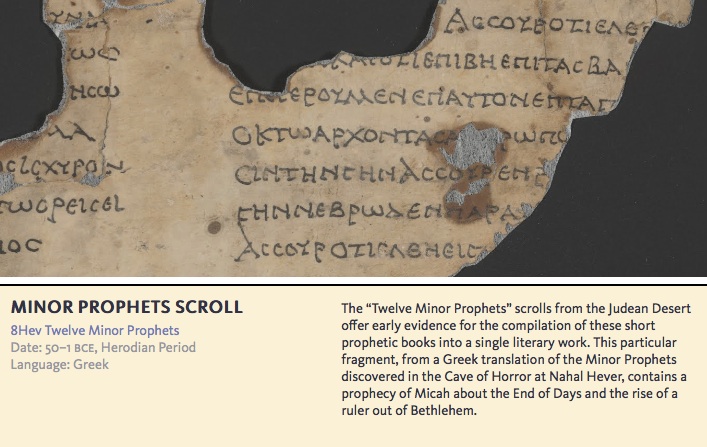
With the generous lead support of the Leon Levy Foundation and additional generous support of the Arcadia Fund, the Israel Antiquities Authority and Google joined forces to develop the most advanced imaging and web technologies to bring to the web hundreds of Dead Sea Scrolls images as well as specially developed supporting resources in a user-friendly platform intended for the public, students and scholars alike.
A number of bloggers wrote about this, not a few of whom Jim McGrath links to.
That wasn’t all that went online in December. Evangelical Textual Criticism notes quiteafewothermanuscriptsthatare now online. (As proven by the fact that every word of that last phrase is its own hyperlink.) Charles Halton of awilum.com highlights the availability of A. Leo Oppenheim’s Ancient Mesopotamia as a free pdf. Readers of this carnival may also like to take some time with ASOR’s weekly archaeology roundups in December, here, here, and here.
Septuagint
December saw a plethora of posts about παρθένος/עלמה in Isaiah 7:14, and Matthew’s use of that verse. Here is T.M. Law, saying that Greek Isaiah’s use of παρθένος for עלמה is not without precedent in the LXX (“The Greek translator of Isaiah used a perfectly acceptable rendering for עלמה.”). Here’s the Jesus Creed on the virgin birth. Krista Dalton notes, “[T]he author of Matthew is not saying that Isaiah was envisioning the birth of Jesus.” Kevin Brown of Diglotting posts here about it. And, looking at hermeneutics more generally, Brian LePort suggested three paradigms to use in studying the virgin birth.
J.K. Gayle at The WOMBman’s Bible (“An Outsider’s Perspective on the Hebrew Males’ Hellene Book”) posted reflections from Greek Isaiah not 1, not 2, not 3, not 4, not 5, not 6, but 7 times in December. Set aside some time and read them all.
Codex Sinaiticus dropped in price to just under $200 at CBD this month–a facsimile edition, that is. Theophrastus of BLT notes it here. He will later lament (which I, too, lament) that Oxford University Press no longer prints their wonderful Comparative Psalter. And while we’re on those Ψαλμοὶ, did their Greek translator(s) have Aristotle and Greek rhetoric in mind?
Anthony Le Donne is taking on the Wikipedia entry on “Historical Jesus” (best biblioblog comment of the month: here). James Tabor asked how December 25 got to be the day we observe Jesus’ birthday (with more thoughts here). Mark Goodacre produced a Christmas NT Pod in which he “explores the differences between the Birth Narratives in Matt. 1-2 and Luke 1-2 and asks how this can be the case if Luke is familiar with Matthew.” The Sacred Page produced a podcast on “the first Christmas.” For a fresh translation of Luke 1:34-38 (with the Greek reproduced beneath the English), see “She spoke yet-Miriam did.” Daniel Street even gave us some Christmas songs in Greek!
Anglican minister Rach Marszalek calls for nuance in discussions on the Trinity, as well as an appreciation of “the perichoretic beauty” of the Same. Read her “Eternal functional subordination and ontological equality?” here. While we’re on Anglicans, Brian LePort asks whether he needs a Bishop?
Gaudete Theology offers a feminist reading of “the bride of Christ” language. (“The image of the Bride of Christ needn’t be viewed only through the patriarchal perception of woman’s nature as inherently passive, docile, compliant, and receptive.”) Alice C. Linsley at Just Genesis would, I think, agree that the image and office of priest should also not be viewed through a patriarchal lens. She says, “Luther Was Wrong About the Priesthood.”
And, finally, may I offer thanks to Amanda at Cheesewearing Theology for this excellent December 2012 theology roundup? She covers yet more territory in theology than I have already covered here. If you’re disappointed that this carnival is about over, spend time reading the posts she collects.
Ευχαριστω/תודה/Thank you
Thanks for coming, and keep coming back! I blog regularly, so feel free to follow/subscribe by going back up to the right sidebar of the blog.
Click on the image to see the product page on Amazon.
Zondervan is giving away a set, for which you can enter today and tomorrow. Go here for details.
I’ve received a set to review, and expect to post that review in the not-so-distant future. They’ve already been a great conversation piece (and geeking out piece) in my office.
Katharine Bushnell lived from 1856 to 1946. She was a doctor, a missionary, an advocate for those without other advocates, and a theologian. Her commitment to the authority of Scripture was strong. About the Bible she said, “No other basis of procedure is available for us.” She learned Greek and Hebrew, and was particularly interested in applying her knowledge of biblical languages to understanding what the Bible had to say about gender. She spoke seven languages.
Author and theologian Mimi Haddad (where I first learned about Bushnell, via this PDF article) writes about her:
Bushnell grounds the ontological equality of men and women first in the early chapters of Genesis where, according to Bushnell, we learn that Adam and Eve were both created in the image of God, that Adam and Eve were both equally called to be frutiful and to exercise dominion in Eden, that Eve was not the source of sin, and that God does not curse women because of Eve.
Bushnell began a hospital of pediatrics in Shanghai, was part of the Women’s Christian Temperance Union, and helped found a homeless shelter for women in Chicago.
Psalm 68:11 says, “The Lord announces the word, and the women who proclaim it are a mighty throng.”
Bushnell joins Perpetua and countless others as part of a mighty throng of women who have proclaimed God’s word in ways that continue to inspire today.
Though All Saints Day was yesterday, I want to highlight two more lesser-known saints today and tomorrow.
John Huss is nowhere near the household name (well… Christian household name) that Martin Luther or John Calvin is. But he tilled the ground for these and others.
Huss taught and pastored in Prague. Like the better-known reformers that would follow him, Huss criticized the established church of his day. He held that the Bible should be in the hands of the masses. In his view, the only proper “head” of the Church was not any humanly established church government, but Jesus Christ. He advanced the Reformation idea of “Sola scriptura”—that the Bible alone should be the authority in issues pertaining to life and doctrine.
In November 1414, the Council of Constance assembled, and Huss was urged by Holy Roman Emperor Sigismund to come and give an account of his doctrine. Because he was promised safe conduct, and because of the importance of the council (which promised significant church reforms), Huss went. When he arrived, however, he was immediately arrested, and he remained imprisoned for months. Instead of a hearing, Huss was eventually hauled before authorities in chains and asked merely to recant his views.
When he saw he wasn’t to be given a forum for explaining his ideas, let alone a fair hearing, he finally said, “I appeal to Jesus Christ, the only judge who is almighty and completely just. In his hands I plead my cause, not on the basis of false witnesses and erring councils, but on truth and justice.” He was taken to his cell, where many pleaded with him to recant. On July 6, 1415, he was taken to the cathedral, dressed in his priestly garments, then stripped of them one by one. He refused one last chance to recant at the stake, where he prayed, “Lord Jesus, it is for thee that I patiently endure this cruel death. I pray thee to have mercy on my enemies.” He was heard reciting the Psalms as the flames engulfed him.
Luther, who later would stumble on Huss’s writings, said, “I was overwhelmed with astonishment. I could not understand for what cause they had burnt so great a man, who explained the Scriptures with so much gravity and skill.”
(I remembered Moses the Black yesterday, Perpetua on Wednesday, and wrote about All Saints Day more generally the day before that.)
Moses the Black was a 4th century African saint. He has some sweet aliases, too: Abba Moses the Robber and Moses the Strong. As in the image above (which is from here), he is also known as St. Moses the Ethiopian.
St. Moses the Black was a former gang leader, murderer, and thief in ancient Africa. However, he became a model of transformation. His is one of the most inspiring stories among the African saints.
Moses, an escaped slave, was the leader of a group of 75 robbers. He was a large and powerful man, who with his gang terrorized the entire region. Moses was transformed after he and his group attacked a monastery, intending to rob it. He was met by the abbot, whose peaceful and warm manner overwhelmed him. He immediately felt remorse for all his past sins, sincerely repented, and begged to remain at the monastery.
Moses was tortured by his past and for years was tempted to return to his old ways. One day, as he was confessing his sins to St. Macarius, it was reported that an angel appeared with a tablet full of his sins. As he confessed, the angel began wiping the tablet clean. The more he confessed, the more the angel was said to have wiped, until by the end it was completely clean. After meeting St. Macarius and St. Isidore, he completely left his old ways behind him and became a monk.
Later, St. Moses was ordained to the priesthood — a rare honor among the Desert Fathers– and founded a monastery of 75 monks, the same number as his former group of thieves. He was known for his wisdom, humility, love, and non-judgment of others. Once a brother had been caught in a particular sin, and the abbot asked St. Moses to come to the church and render judgment. He came reluctantly, carrying on his back a leaking bag of sand. When he arrived, the brothers asked him why he was carrying such a thing. He simply said, “This sand is my sins which are trailing out behind me, while I go to judge the sins of another.” At that reply, the brothers forgave the offender and returned to focusing on their own salvation rather than the sins of their brother.
In 405 A.D., at age 75, St. Moses suffered a martyr’s death when his monastery was attacked by a group of barbarians. He is remembered on the 28th of August. Today he is considered the patron saint of African Americans.
Perpetua was a nursing mother who rejected her father’s pleadings to deny her Christian faith and make the requisite sacrifice to the Roman emperor. As the story goes, depicted above, she had to help guide the sword of her trembling executioner to her throat.
Her father immediately came to her in prison. He was a pagan, and he saw an easy way for Perpetua to save herself. He entreated her simply to deny she was a Christian.
“Father, do you see this vase here?” she replied. “Could it be called by any other name than what it is?”
“No,” he replied.
“Well, neither can I be called anything other than what I am, a Christian.”
In the next days, Perpetua was moved to a better part of the prison and allowed to breastfeed her child. With her hearing approaching, her father visited again, this time, pleading more passionately….
The day of the hearing arrived; Perpetua and her friends were marched before the governor, Hilarianus. Perpetua’s friends were questioned first, and each in turn admitted to being a Christian, and each in turn refused to make a sacrifice (an act of emperor worship). Then the governor turned to question Perpetua.
At that moment, her father, carrying Perpetua’s son in his arms, burst into the room. He grabbed Perpetua and pleaded, “Perform the sacrifice. Have pity on your baby!”
…When [Perpetua and her friends] entered the stadium, wild beasts and gladiators roamed the arena floor, and in the stands, crowds roared to see blood. They didn’t have to wait long.
Immediately a wild heifer charged the group. Perpetua was tossed into the air and onto her back. She sat up, adjusted her ripped tunic, and walked over to help Felicitas. Then a leopard was let loose, and it wasn’t long before the tunics of the Christians were stained with blood.
This was too deliberate for the impatient crowd, which began calling for death for the Christians. So Perpetua, Felicitas, and friends were lined up, and one by one, were slain by the sword.
It’s easy for me to “want to be in that number” when saints like Perpetua “go marching in,” but the courage and faithfulness she exhibited in the moments leading up to her martyrdom are qualities I can only pray to attain. The Wisdom of Solomon passage I quoted yesterday is apropos:
But the souls of the righteous are in the hand of God,
and no torment will ever touch them.
In the eyes of the foolish they seemed to have died,
and their departure was considered to be suffering,
and their going from us to be destruction,
but they are at peace.
As All Saints Day approaches tomorrow, I find myself moved and inspired by this committed follower of Jesus. Perpetua, though she was mercilessly separated from her husband, family, and precious little baby, is at peace.
The Forerunners of Christ with Saints and Martyrs, by Fra Angelico (15th century)
November 1 is All Saints Day. It’s a holiday in the church calendar of multiple Christian traditions: Catholic, Anglican, Lutheran, Methodist, and others. Halloween gets its name from All Saints Day. All Saints Day used to be known as All Hallows Day, and Halloween was a contraction of All-Hallows-Even, or All Hallows Eve.
All Saints Day is meant to remember the saints, or fellow believers, who have gone on before us, walking in the way of Jesus. The author of Hebrews writes, “We are surrounded by such a great cloud of witnesses.” We have the example of men and women who have walked with God, who have struggled with God, and who have triumphed in life with God. As we look ahead to All Saints Day we can pause today to remember their example, and ask God to strengthen our faith, too. We are part of that number.
Psalm 85:8 in the NIV says, “I will listen to what God the LORD will say; he promises peace to his people, his saints.” Some 30 times Paul addresses congregations of believers as “saints.” We who follow Jesus are rightfully called “saints.” We are part of a narrative that is much bigger than ourselves, much bigger than any one community, and much bigger than this period in history. We are a part of a timeless, worldwide communion of saints—the body of Christ.
Wisdom of Solomon (yes, it’s from the Septuagint!) puts it beautifully:
But the souls of the righteous are in the hand of God,
and no torment will ever touch them.
In the eyes of the foolish they seemed to have died,
and their departure was considered to be suffering,
and their going from us to be destruction,
but they are at peace.
For even if in the sight of human beings they were punished,
their hope is full of immortality,
and having been disciplined a little, they will be greatly benefited,
because God tested them and found them worthy of himself;
as gold in the furnace, he tested them,
and as a sacrificial whole burnt offering, he accepted them.
And in the time of their visitation they will shine out,
and as sparks through the stubble, they will run about.
They will judge nations and rule over peoples,
and the Lord will be king over them for ever.
Those who trust in him will understand truth,
and the faithful will remain with him in love,
because grace and mercy are upon his holy ones,
and he watches over his chosen ones.
I have weathered the storm, several flickers of the power on and off, and have selected the winner at random. (Actually, a random number generator is to thank/blame.)
And the winner is… Matthew Hamrick! Congratulations, Matthew, and enjoy the book. Thank you to everyone who participated and spread the word.
I reviewed the book here if you’d like to learn more.
Almost every Monday at Words on the Word (and other days, too) I review new books in the field of biblical studies, original languages, and theology. I also review Bible software. Check or bookmark this link to see all my reviews.


 A distraction in the set is the number of cards that have a blank silhouette with a question mark on it. For these the publisher was not able to procure an image. There is a good reason for this, and it’s worth reading Jeune’s explanation here. All the same, an original sketch, however basic, would have been preferred. (Remember those Facebook friends who joined but didn’t add a profile pic for months? It looks like that, only with the super-imposed question mark.)


 Scot McKnight lists the “Jesus Creed Books of the Year”
 Speaking of Greek Isaiah… more than 150 of us are reading through





 Words on the Word