Words on the Word Weekend Recap

Here’s a Words on the Word weekend recap. Friday the 10th through Sunday the 12th at WotW had the following:

Family: My 4-year-old son reviews The Jesus Storybook Bible

Cool stuff: 250,000 books in a fingerprint-shaped labyrinth Kara Morgan’s Opera Sitcom, episode 1

Bible/Hebrew: Review of Malachi (Baylor Handbook on the Hebrew Text), part 1 (today concluded with part 2)

Review of Malachi (Baylor Handbook on the Hebrew Text), part 2

In this post I both explain the jarring Malachi 2:3-4 as well as offer part 2 of my review of Malachi: A Handbook on the Hebrew Text by Terry W. Eddigner (Baylor University Press, 2012). Part 1 of the review is here.

Eddinger begins each passage with his own English translation, then analyzes the Hebrew text verse by verse. Any reader will appreciate that Eddinger prints the full Hebrew text of a given verse, then reprints the various clauses and words when commenting on them. (This eliminates the need to constantly refer to another book when using Malachi.) The Hebrew font is large, clear, and easy to read. It’s fully pointed and includes the Masoretic markings that one would find in the BHS. Though at first I had wished to see the English translation verse-by-verse alongside the Hebrew, Eddinger’s decision to have English translations primarly at the beginning of a passage does force the reader more into the Hebrew itself. For the intended audience of “a second-year Biblical Hebrew student” whose focus is translation, grammar, and syntax, this is a good thing.

I was pleasantly surprised to see that Eddinger discusses textual variants throughout the handbook. He especially focuses on LXX/Septuagint variants that receive attention from the BHS editors. His conclusions regarding variants often end with something like, “X makes sense in context and so should be retained.” Thoroughgoing text critics may be left wanting more evaluation or interaction with variants than this (as I was at times)–but this is a short handbook. The fact that the author highlighted such variants at all was an added bonus, as far as I’m concerned.

Eddinger gives excellent attention to grammatical and syntactical detail–down to an assimilated dagesh lene (1:13)! He treats clauses as wholes–for example, highlighting word order and fronting for emphasis. And he treats individual words and parts of speech. He never loses the forest for the trees, and he gives the trees their due attention, too. In conjunction with the “key words” chart at the beginning of a section and the appendix of all Hebrew words in Malachi, Eddinger often notes rare Hebrew words as such, giving something of their context in the rest of the Hebrew Bible. He seems to have HALOT, TDOT, BDB, and other technical commentaries readily at hand as he comments on the text. On 1:14 he writes,

נוֹכֵל is a rare word in the Masoretic Text, occurring only four times (only here in Malachi) and means “one who acts cleverly” or “deceitfully” thus, “a cheat.”

That is the sort of insight I could come to expect on a regular basis by the end of the handbook. I loved it for that.

In terms of grammar, his discussion of individual words includes syntax and morphology, with every single word parsed / morphologically analyzed and often more detail than that. Eddinger uses the qatal and yiqtol verb classification system. This may not line up with what every Hebrew student has read regarding tense/aspect in their first-year Hebrew class, but it does (at least according to some) carry significant advantages over “perfect” and “imperfect.” (See a mini-primer on the Hebrew verbal system here.)

Regarding the verses from Malachi with which I led off part 1 of this review, Eddinger explains them well:

פֶרֶשׁ refers to the contents of the bowels of sacrificed animals, which the priests were to burn as refuse at a location away from the altar (Exod 29:14; Lev 4:11; 8:17). The phrase [feces upon your faces] is a double entendre in meaning as the act is an act of humiliation and contact with the ‘unclean’ matter makes the priests ‘unclean’ for their priestly duties.

(I allude more to Malachi 2:3 here.)

I’ve found Malachi to be an indispensable companion for reading through Malachi in Hebrew. I do have one minor critique and one larger one, though.

First, the English Bible versification at the end of Malachi gives the book four chapters; it is just three in the Hebrew text. Malachi nowhere notes this (although it does note regarding the last three verses that “some LXX texts have these verses reordered.” Again, this is a handbook on the Hebrew text, but a simple explanatory note here as to why English Bibles have four chapters in Malachi and Hebrew Bibles three would have been beneficial.

Second, I found myself often distracted (though I didn’t want to be) by the presence of typographical errors or comma splices or run-on sentences. I hope future printings can correct these, since they take away from an otherwise great book. There would be no benefit in listing typos here, but there were some 20 or more spots where either a word was misspelled, there was disagreement of number between verb and subject, punctuation was missing, and so on. Fortunately the vast majority of these are in English and so easy enough to spot. (I.e., the reader can trust the Hebrew here.) But the author’s English translation sections especially seemed to be in want of a closer edit. I do hope future printings or editions can make adjustments here; I imagine students of Malachi will want to make use of this book for years to come.

Eddinger in the end is a worthy guide through the Hebrew of Malachi. The prophets often (suddenly!) shifted pronouns or speakers or subjects in their writing. Who is talking now: God, the prophet, both, or the people? Eddinger coolly walks the reader through such grammatical challenges, and others besides.

While the obvious use of Malachi is as a reference work in which to look up a given passage, it reads well as a whole, too. I eagerly await future books in the Baylor Handbook on the Hebrew Bible series.

Thank you to Baylor University Press for providing me a free copy, in exchange for an unbiased review (which ends up being a two-part review in this case–by my choice). You can find the Baylor product page for Malachi: A Handbook on the Hebrew Text here. It’s on Amazon here.

Review of Malachi (Baylor Handbook on the Hebrew Text), part 1

“Because of you I will rebuke your descendants; I will smear on your faces the dung from your festival sacrifices, and you will be carried off with it. And you will know that I have sent you this warning so that my covenant with Levi may continue,” says the Lord Almighty.

–Malachi 2:3-4 (NIV)

Although Words on the Word has since taken fuller shape, two primary motivations in my beginning this blog were (a) to read and review good books and commentaries and (b) to interact with the original Biblical languages. This post offers a good opportunity to do both. Here I review Malachi: A Handbook on the Hebrew Text by Terry W. Eddigner (Baylor University Press, 2012).

The Hebrew prophet Malachi holds a significant place in the Hebrew Bible. Malachi is the last prophet of the Book of the Twelve (minor prophets) and the last book in the Hebrew Bible/Old Testament. The last two verses of Malachi are Yahweh’s promise to send the prophet Elijah–a promise fulfilled, Christians believe, by John the Baptist. It sets up the beginning of the Gospels well.

The Baylor Handbook on the Hebrew Bible series is a deliberately unique contribution to the field of commentaries on the Hebrew Bible. Okay, I suppose all commentary series intend to make unique contributions, but this one really does. It fills a void. Although the student of the Hebrew of the minor prophets is fortunate to perhaps be able to access Baker’s fine exegetical commentary (Malachi is in this volume), there is still a dearth in general of OT commentaries that comment extensively on the Hebrew text and grammar. In that sense I’ve been happy to see the careful attention this series gives to the Hebrew text. (Bonus: this book and some the others in the series that I’ve briefly glanced through give good treatment of discourse analysis.)

It’s important to note from the outset that Malachi (as a book in this series) is not a “full blown commentary.” It’s a “Handbook on the Hebrew Text,” which does “not attempt to replace the second step of consulting commentaries and secondary literature….” In keeping with this aim, Terry W. Eddinger gives the reader a short (five pages) introduction, yet it is plenty to be able to work well within the Hebrew text of Malachi. (And a bibliography with references throughout points readers in the direction of other Malachi-related literature.) Eddinger especially emphasizes the structure and “literary forms and devices” in Malachi. He views the structure of Malachi as consisting of a superscription, six oracles, and two appendices. Literarily, Eddinger says, Malachi is a prose and poetry hybrid, “perhaps the best example of such in the Hebrew Bible.”

There is a linguistic glossary at the back of the book, so when Eddinger says, “Hortatory style is the predominate literary form and is found in all but two verses,” the uninitiated reader can quickly determine that hortatory means “a word, clause, or sentence of direct dialogue.” This is perhaps an over-general or vague definition (the Jonah book in this series has, “Hortatory discourse is meant to exhort someone to act in a particular manner”), but I found that not to be the norm for the succinct and useful glossary.

One commendable feature is the “key words” chart at the beginning of each oracle. Malachi is the first book in this series to offer such a feature. Eddinger highlights important words that the reader will want to know as he or she makes his or her way through a pericope. Then–in what was my favorite part of this book–Eddinger has a chart at the back of the book that lists every Hebrew word in Malachi and verse references for all its occurrences. (Future printings or editions of this book could soup up this chart even more with English glosses of the Hebrew words, for the purposes of vocabulary acquisition.) Several times in making my way through Malachi and this handbook, I referred to the Hebrew word chart.  A second appendix lists all the times the “divine messenger formula” (e.g., אָמַר יְהוָה צְבָאוֹת) occurs in Malachi.

Eddinger begins each passage with his own English translation, then analyzes the Hebrew text verse by verse. In part 2 of this review (to post Monday), I’ll look at the guts of Eddinger’s handbook, that is, the verse-by-verse exposition, including his explanation of the verses that led off this post.

UPDATE: Part 2 of the review is here.

Thank you to Baylor University Press for providing me a free copy, in exchange for an unbiased review (which ends up being a two-part review in this case–by my choice). You can find the Baylor product page for Malachi: A Handbook on the Hebrew Text here. It’s on Amazon here.

My 4-year-old son reviews The Jesus Storybook Bible

A long-time family favorite has been The Jesus Storybook Bible (subtitle: Every Story Whispers His Name). Friend and fellow blogger Robbie and his wife gave us this sweet gift when our now four-year-old was born.

Following on the heels of his first book review, my four-year-old here reviews The Jesus Storybook Bible. (Cool thing: the author of the book he reviewed blogged about it here.) As before, I did the typing, but the words below are all his. For the purposes of this review, he focuses on “The terrible lie: Adam and Eve lose everything, from Genesis 3.”

This story is about a snake, and the two people that God told them not to eat the food on that tree… and they did. And a big lie–a really, really, really, really big lie–came into the world. And then it felt like everything was going to break. And I even know that story.

God had to send them out of the garden, because they were being naughty. God sent them away. God gave them a note that said that they were going to get back to their place. God said he was going to forgive them.

It’s wroten [written] good. This book has a bird on it. And bats might come into the house and might like the book, just in case if they come in the house. [Editorial note from dad: four-year-old son just saw a news story about bats.] It’s a good book. It could help somebody if they were crying, and if they were sad, and nothing could work… except only if a book could work, and only if someone said Jesus StoryBible Book and they could buy it.

Here’s a sample page of the Bible, from Zondervan’s product page (click for larger):

There’s a great accompanying website for The Jesus Storybook Bible, with sample pages, audio files from the audio version, and more. You can also find the book on Amazon.

The Verse Tab: Review of BibleWorks 9, part 2

I continue to be impressed with BibleWorks 9. The new Use Tab is likely my favorite new feature (I posted about it in part 1 of my review). The Verse Tab is another new feature. Here’s how the BibleWorks site describes it:

The Verse Tab tracks with any Bible version. For the current verse under the mouse, it displays the relevant sections in resources such as the CNTTS apparatus, the NET Bible textual notes, the Tischendorf apparatus, Metzger’s Textual Commentary (requires unlock), and the ESV Study Bible (requires unlock).

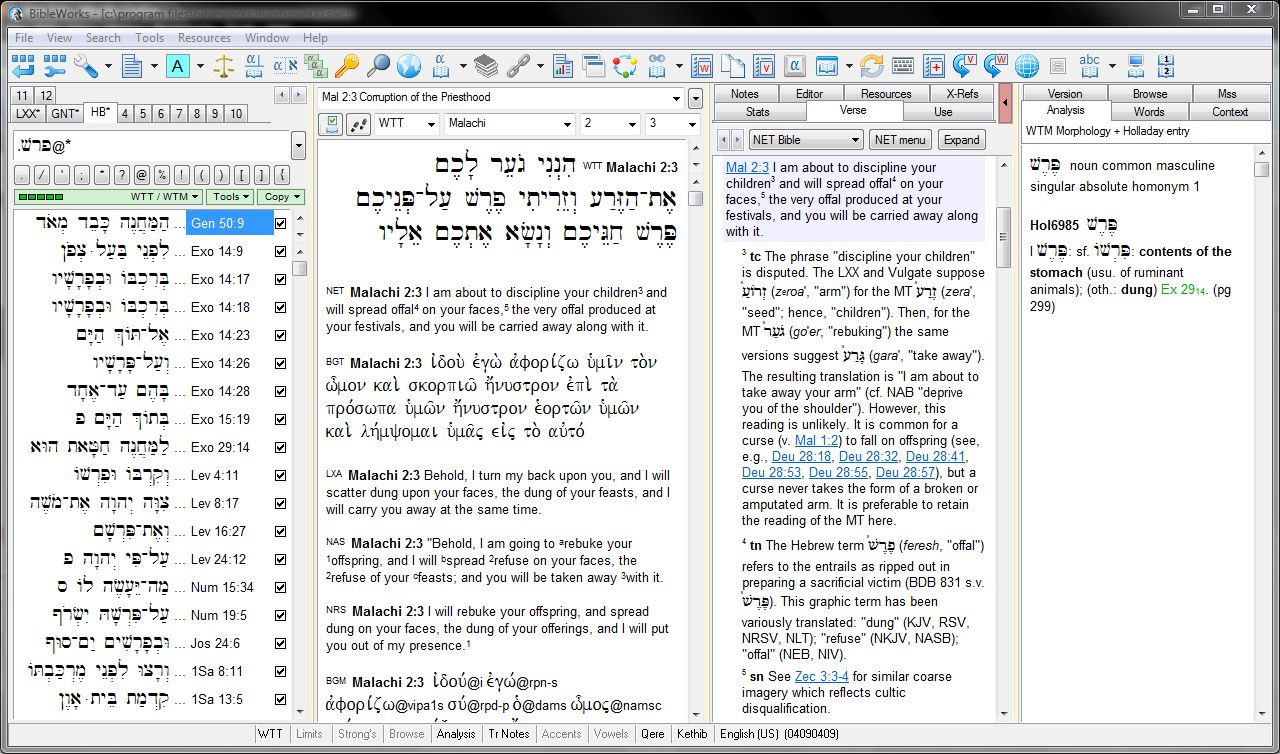
I will devote a future post to the CNTTS apparatus. Today I want to comment on and review the Verse Tab and its usefulness. Just so you can have a visual of what I’m working with, here’s a layout I’m currently using to look at the Hebrew of Malachi. (Click on the image below for larger.)

(Editorial note. File this under: can you believe that’s in the Bible? I had somehow never noticed this verse until the other day… thou shalt not trifle with the Lord, especially if you’re a priest or pastor. Take obedience to God seriously.)

Here’s the great thing about the Verse Tab. In previous versions of BibleWorks, the NET Bible study notes were only available via the Analysis Window. But this meant that if the Analysis Window were open to an NET study note, you couldn’t also at the same time easily see morphological analysis and lexical data–it was one or the other in that window. Now, however, as you can see above, you can easily access both study notes and a separate analysis window for individual word analysis. I find this new feature an immense help.

The NET study notes are fantastic. (It’s worth reading more about that translation and its notes here.) Honestly, a verse like the one I’ve chosen to highlight above might be a bit jarring to some–although in context it makes perfect sense. Yahweh was dealing with a corrupt and complacent priesthood. They were not making sacrifices in the way he had commanded (and they knew it, too). So his response in context really ought not to be a surprise. The NET note (see superscript number 4 and “tn” in the image above) clarifies that Yahweh is speaking of the entrails of to-be-sacrificed animals. The priests were supposed to dispose of these away from the sacrificial altar, but apparently were not in Malachi’s time. Bad idea. Clicking on Lev. 4:11 in the BibleWorks Search column (far left column) immediately takes me to the verse that explains this requirement.

One other neat thing about the Verse Tab: if you click on the “Expand” button, you can get a free-floating window that shows you all the NET notes for the whole Bible. This is easy to navigate through, as you can imagine:

I welcome the Verse Tab as an addition to the BibleWorks program. I’ve already made heavy use of it and will continue to in the future. For a mere $20 you can buy a module that gives you the notes and maps from the ESV Study Bible in that same tab. The program comes with the NET Bible notes already loaded.

See all that’s new in BibleWorks 9 here.

I received a free upgrade to BibleWorks 9 in exchange for an unbiased review. See my prolegomenon to a review here and part 1 (setup and layout) here. You can order the full program here or upgrade here. It’s on Amazon, too.

Worship Leading Wednesday: You are what you worship

Some words of wisdom from Gary A. Parrett and S. Steve Kang:

That the formation of God’s people is a legitimate concern of our worship gatherings can be demonstrated by appeal to a number of biblical passages. First of all, worship itself is presented as intrinsically formative–for good or for ill. We read in several Old Testament passages, for example, that those who worship idols are doomed to become like the objects of their worship.

…That which is true in such profoundly negative and destructive ways, however, is also true in the positive. In other words, those who worship the living God will become like the object of their worship. Those who abide in the presence of the Lord, reflecting or contemplating his glory, are “transformed into his likeness with ever-increasing glory, which comes from the Lord, who is the Spirit” (2 Cor 3:18). Worshiping the God who is love, who is holy and righteous and true, we shall ourselves become more loving, holy righteous and true.

–from Teaching the Faith, Forming the Faithful: A Biblical Vision for Education in the Church, pp. 339-340

How people used Google to get to Words on the Word

One of the great things about WordPress, my blog host, is that it keeps statistics for its users. This includes a running tally of what search terms led to how many pages views on my blog. So, for example, I can find out that yesterday two page views resulted from a search engine search on “reaction about the story of jesus according to luke” (it led here).

The top three sets of search terms that have led people to Words on the Word are “colorado shooting” (goes here and here), “septuagint” (here), and “honest toddler” (any of these).

Some other search terms of note that have led folks to my blog:

  • “egalitarian pleasuring party” (see here for explanation)
  • “abrams guide to grammar” (I have not as of yet written one)
  • “first sermon and what not to say” (I could just feel the nerves of this searcher… but I trust they found this)
  • “how i am to speed of reading?” (with all due respect, hopefully this person is the same who searched for “abrams guide to grammar”)

No exceedingly bizarre search terms have led folks to WotW. Although “colonize Doug Wilson” (goes here?) might be the strangest so far.