BHS module in Accordance 10, reviewed

Oddly enough, the biggest challenge for me in my Hebrew exegesis classes was not to do with the Hebrew language itself. Instead, learning how to decipher the abbreviations and sigla in the “critical apparatus” of a scholarly Hebrew Bible stretched me most.

I recently wrote a brief introduction to the available scholarly editions of the Hebrew Jewish Scriptures (“Old Testament”), the Greek Jewish Scriptures (“Septuagint”), and the Greek New Testament, with most of the emphasis on that post falling on the Hebrew Bible:

Most students of the Hebrew Bible who read Hebrew know of the premier scholarly edition, the Biblia Hebraica Stuttgartensia (BHS, here on Amazon).  The BHS is now being updated by the BHQ (Q=Quinta), about which you can read more here. Both the BHS and BHQ are “diplomatic” editions of the text, which means that they reproduce a single “best” manuscript, the Leningrad Codex, in their cases. The footer in each page contains a critical apparatus, which lists variant readings from other manuscripts and versions that the editors have deemed to be of importance for getting even closer to the “original” (now often being called the “earliest attainable text”). In some cases, the editors may wish to show where another manuscript or version differs from the Leningrad Codex; the critical apparatus is where they do it.

However, the BHS editors show manuscript and version differences in their critical apparatus through the use of abbreviated Latin. Even those who know Latin will have to learn the abbreviations, and those who don’t know Latin will have an even harder time trying to decipher the apparatus.

Having figured out my way around the print edition of the BHS, and having reviewed Accordance 10, I have been eager to use the BHS module in Accordance. Here I review it.

The Original Languages base package in Accordance comes with HMT-W4, which gives the user access to the Groves-Wheeler Westminster Hebrew Morphology 4.16. This text reflects additional and ongoing corrections to the Leningrad Codex. Accordance says HMT-W4 is “almost identical” to the BHS text.

But for the user who wants not just the text but the apparatus, an add-on module is needed. If you already have HMT-W4 or BHS-W4 for your Hebrew Bible in Accordance, you can save money and buy the apparatus by itself. It’s just $50, which is a good deal. (Note: there are no Masora–Masoretic marginalia–included in the module; it’s just the apparatus at the bottom of the page.)  If you have Accordance and don’t already have a Hebrew text, you could buy this package, where BHS-T is the “complete text of the Hebrew Bible, following the Biblia Hebraica Stuttgartensia, with the Groves-Wheeler Westminster Hebrew Morphology 4.14. This module includes vowel pointing, cantillation marks, and lemma and grammatical tagging information for each word in the text.”

In any of these Hebrew texts in Accordance, there is instant parsing easily available as you go through the text.

BHS with apparatus in Accordance significantly streamlines study and use of the critical apparatus. Accordance makes it easy to do textual criticism without carrying the heavy BHS around. I really appreciate being able to access the BHS critical apparatus on my laptop, and in a way that is integrated well into the Accordance program. The layout is good, the feel is intuitive, and the windows are easy to set up. Here’s how I have Accordance set up to use the critical apparatus with the Hebrew text and Old Greek in view (click to enlarge):

There’s the BHS critical apparatus, right under the text. Anything in blue in that window is hyperlinked and will display something in the Instant Details window. If I want to know what “pc Mss” means in the apparatus, I see it unabbreviated in the Instant Details just by mousing over the blue text. (If you don’t need the abbreviations expanded, you can also hover over the superscript letters in the BHS-T text, and the corresponding content from the apparatus pops up.)

Using the layout above you can quickly see what an abbreviation in the apparatus stands for in Latin, but this is not translated into English. In the above example, it’s obvious that “manuscripti” for “Mss” means manuscripts–no Latin knowledge is needed to understand that Latin word. But what is “pauci”? Those with good vocabulary may be able to recall that a paucity of something is a small number, a lack, so “pauci” here means few.

But not all Latin in the apparatus is that easy. I would like to have seen this module provide a translation from Latin into English.  This is probably my only complaint about this module. I believe this is not unique to Accordance and has more to do with how the German Bible Society may have offered the licensing for the apparatus. All the same, getting from abbreviated Latin to unabbreviated Latin, while nice, may not be enough for the beginning text critic.

Some good news, though. There are two workarounds to be able to translate the apparatus contents from Latin to English. First, there is Google Translate, which I understand has improved its accuracy over the last few years. Here is the link for Google Translate from Latin to English. Simply copy Latin from Accordance into the query box in Google translate, and you’ll have your English. “prb l c” in the apparatus becomes, “probabiliter lege(ndum) cum” in Instant Details, which Google gives me as, “probably read with.”

A yet easier way to get to English is possible within Accordance itself, and it’s quite smooth, thanks to the good programming and easy layout of the software. Dr. Hans Peter Rüger’s well-known “English Key to the Latin Words, Abbreviations, and the Symbols of BIBLIA HEBRAICA STUTTGARTENSIA” is available in Accordance.

Note that in the bottom right zone, my far right tab (behind the open one) is this “BHS Latin Key.” I can easy look up an abbreviation in that tab’s search bar. It’s also simple to just right click the abbreviated word in the apparatus and “Look up” in “Dictionary” to quickly access the English/Latin key.

As far as the BHS apparatus itself, BHS remains the scholarly standard. BHQ is beginning to update/replace it, and there are other scholarly projects underway. The BHS apparatus is not exhaustive, nor could it be. But it does offer a good representation of variant readings from different versions (e.g., the Latin Vulgate, the Greek LXX, the Syriac Peshitta, Aramaic Targums, etc.) and different manuscripts (whether a specific Old Greek manuscript or just the general “Mss” for “manuscripts”).

There are different editors for different portions of the BHS, and some are less cautious than others in suggesting textual emendations. In the Minor Prophets, for example, editor Karl Elliger seems to have no trouble writing “prp”=”propositum”=”it has been proposed” when he wants to suggest an alternate reading. Sometimes this means that someone else has proposed what Elliger is footnoting; other times it’s just his suggestion, and not always with textual/manuscript evidence accompanying the suggestion. So the user of BHS should not use the critical apparatus, well… uncritically.

An especially neat feature that wowed me is that I can open up the apparatus and search by content to study all 2,146 times the Latin abbreviation “prp” occurs in the BHS apparatus. You can even search the apparatus for its Hebrew and Greek contents. Curious how often ποῦ finds its way into the apparatus? A simple search shows its four occurrences.

And you can search the apparatus by manuscripts mentioned. Change the search bar to “manuscripts,” then right click in the bar and select “Enter Word…” and you get this:
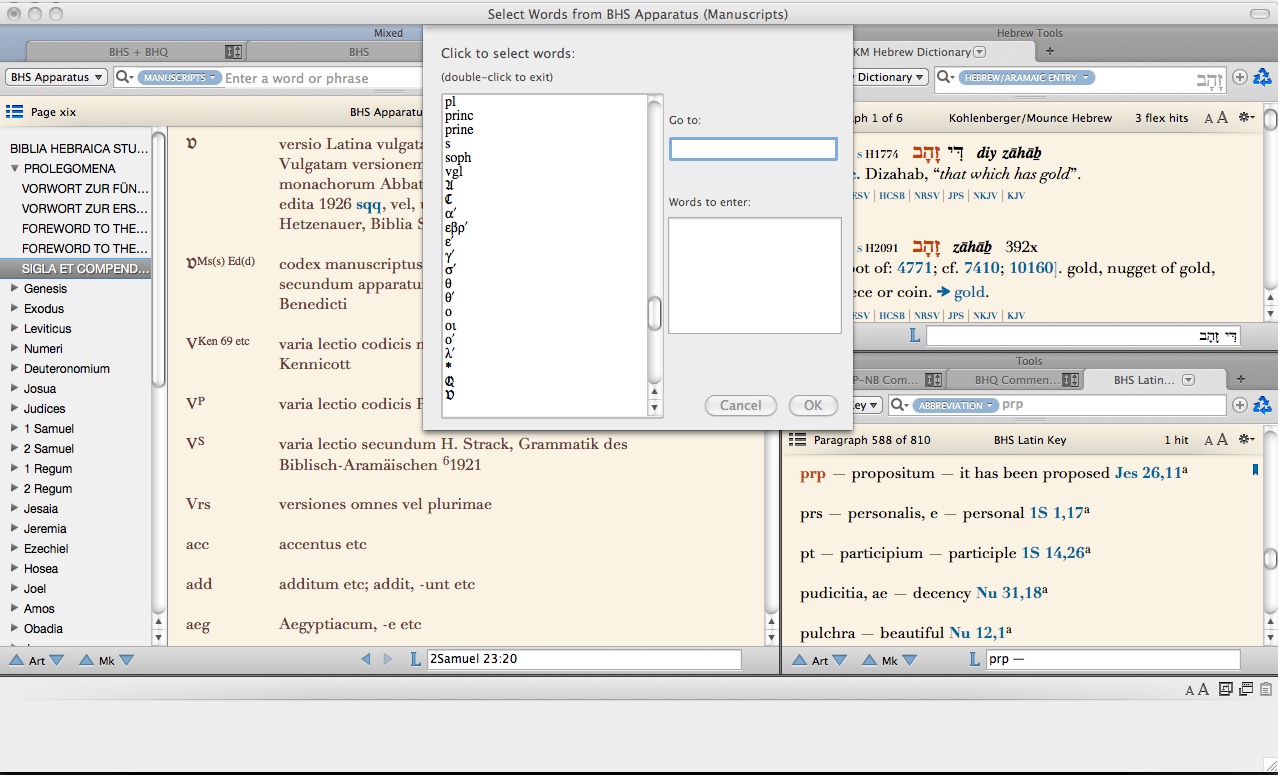
It’s a great way to be able to interact with the apparatus, much of which simply isn’t possible in print.

Bonus: Accordance offers an excellent, succinct explanation of critical editions here, with emphasis on the critical editions available in Accordance. If you’re interested in BHS in Accordance, you’ll want to read it.

If you do text criticism in the Hebrew Bible and have the money to spare, Accordance’s BHS apparatus is well worth getting, though most users will want to make sure they also have the “BHS Latin Key,” too. All in all, it’s a well-executed and seamlessly-integrated module.

Thank you to Accordance for providing me with a copy of the BHS and BHQ modules for review. See all the parts of my Accordance 10 review (including the Beale/Carson commentary module) here. I will review the BHQ separately in the future.

Praising God through Academic Biblical Studies: Less Hypermodernist Objectivism, More Affect!

Why such an emphasis on wanting to get as close to the “original text” of the Bible as possible? Or, as some scholars call it, the “earliest attainable text”?

Earlier this week I wrote a bit about scholarly editions of the Jewish Scriptures, both the Greek and the Hebrew.

But I began asking myself today, why am I so interested in a rigorous scholarly pursuit of the text of the Bible in Hebrew and Greek?

One reason is that I love to learn. On the Strengthsfinder assessment I came out with “Learner” as my top strength both times I took the test. “Achiever” was not far behind. (See here for the descriptions of the 34 strengths themes in that assessment.) Here’s an excerpt from the description of the “Learner” strength that applies to me:

You love to learn. The subject matter that interests you most will be determined by your other themes and experiences, but whatever the subject, you will always be drawn to the process of learning. The process, more than the content or the result, is especially exciting for you. You are energized by the steady and deliberate journey from ignorance to competence.

All true, except that when it comes especially to my pursuit of biblical studies, the process, the content, and the result are “especially exciting” for me.

Why?

The late Arthur Holmes articulates beautifully:

Christ the Truth becomes the dominant motivation in intellectual inquiry. No dichotomy of sacred and secular tasks can be allowed, and no subject is exempt.

The student will therefore welcome truth and submit to it wherever it is found, out of obedience to Christ. Academic work becomes an opportunity to extend the Lordship of Christ over the mind; thought merges into worship.

“Thought merges into worship.” I love this. And I think this is why–more than just being a “Learner”–I so love to delve into the depths of Scripture, in the most “original” form that I possibly can.

I’m not overly fastidious about Hebrew, Greek, and Aramaic–as if God really spoke through those languages and then anything else is just mediated and somehow a dilution of God’s actual words. (Isn’t all language already mediation anyway?) If the word of God is “living and active,” it can be living and active in its faithful translations into other languages.

But one reason I geek out so much about the Septuagint and the Hebrew Bible is that in my study I feel myself getting closer to that amazing time when God gave his word to humanity to be transmitted to future generations: first orally, then in written form. And I love seeing how the translators of the Hebrew Bible wrestled with putting the Hebrew into Greek. I love seeing how the New Testament writers grappled with, contextualized, and recontextualized the Old Testament.

I don’t even mind that at the moment I’m a bit perplexed by how Paul could both praise the law as being from God yet also refer to it as “the ministry that brought death.”

Why?

Because for me, as of late, my thoughts and my studies of Scripture–even at a scholarly level–have begun to “[merge] into worship.” How can I not praise the God behind these amazing words? Though we may never know what the autograph of any part of Scripture actually said, I believe we can get close.

And somehow the closer I get to the text of the Bible–in a scholarly setting–the closer I feel to God.

Not always, of course–sometimes I’m just confused. (Dash the heads of infants against rocks? And we pray these Psalms in liturgical settings???) But there’s been a real richness for me lately in delving into the Bible in its original languages, comparing variant readings across manuscripts and versions, trying to figure out why one Synoptic Gospel said it this way, why this one said it another way…. Even in seeking to answer those questions, I know that I am seeking more of God and God’s revelation.

This is not a taken-for-granted view of things in the field of biblical studies. Take this, for instance, from Michael V. Fox:

In my view, faith-based study has no place in academic scholarship, whether the object of study is the Bible, the Book of Mormon, or Homer. Faith-based study is a different realm of intellectual activity that can dip into Bible scholarship for its own purposes, but cannot contribute to it.

I haven’t contacted Michael V. Fox to confirm this, but I’d wager that what I’m describing above constitutes some sort of “faith-based study,” or at least, study that is informed by and that enriches faith.

But a bit more context from Fox:

The claim of faith-based Bible study to a place at the academic table takes a toll on the entire field of Bible scholarship. The reader or student of Bible scholarship is likely to suspect (or hope) that the author or teacher is moving toward a predetermined conclusion. Those who choose a faith-based approach should realize that they cannot expect the attention of those who don’t share their postulates. The reverse is not true. Scholars who are personally religious constantly draw on work by scholars who do not share their postulates. One of the great achievements of modern Bible scholarship is that it communicates across religious borders so easily that we usually do not know the beliefs of its practitioners.

I’m okay with trying to set aside a “predetermined conclusion,” though skeptical of that possibility. (Does Fox believe in the modernist project?)

Fox goes on, “The best thing for Bible appreciation is secular, academic, religiously-neutral hermeneutic.”

Sigh.

Taking the Psalms as an example, one cannot appreciate the Psalms who does not pray the Psalms. And wouldn’t good scholarship (religiously motivated or not) call for us to engage the text on the author’s terms? How can one do good scholarship on David, for example, if one is not willing to engage the text in the way that David intended for it to be engaged? If he wrote a Psalm for corporate singing or reciting, is the individual in her or his library carrel who seeks to bracket out faith commitments going to get anywhere near to uncovering the meaning and import of that Psalm until she or he sings it with others?

Fox’s whole article is here.

Parker Palmer has a good rejoinder:

Objectivism—which is a complete myth with respect to how real people have ever known anything real—has great political persuasiveness because it gives us the illusion that we are in charge.

But gospel truth, transformational truth, says that we are not masters but are subject to powers larger than ourselves—and that we are blessed with the chance to be co-creators of something good if we are willing to work in harmony with those larger powers.

If we embrace a gospel way of knowing, we can create a different kind of education and perhaps a different world: a world where all of us are called to embody whatever truth we know; where we gather together with others to check, correct, confirm, and deepen whatever insights we may have; where we understand that, even as we seek truth, truth is seeking us; and where there can be those vital transformations, personal and social, that might take us a step closer to the beloved community.

So when it comes to biblical studies, I say: less hypermodernist objectivism, more affect! Let’s allow our thoughts–as Dr. Holmes suggested–to merge into worship; our studies into praise; our reading into praying.

My quest for the earliest attainable text of the Bible, I am realizing, is driven by scholarly interest and a general drive to learn, yes. But more than that, I want to know God more fully through this academic pursuit. My insatiable desire to master Greek noun declensions, Hebrew verb parsings, and intertextual allusions is in the end a desire to be mastered by the God who stands behind the words of Scripture.

But that kind of a posture doesn’t compromise scholarship, in my view. It makes it richer, deeper, and directed toward its most proper end.

N.T. Wright on learning Greek, and a review of A Reader’s Hebrew and Greek Bible by Zondervan

I met N.T. Wright briefly in January at a worship symposium and asked him how to improve my Greek. He said, “Read the text, read the text, read the text.”

He told me to really get the feel of the language. Don’t think of Greek just as a code for English; get into the Greek itself. I asked him about reading with a diglot, but he encouraged me to check the English translation only after reading an entire Greek paragraph, and then, only as necessary.

The same holds true with Hebrew. Read the text, read the text, read the text. Reading it out loud is even better, and better still is trying to speak it to others.

Zondervan has published what is to my knowledge the only “reader’s” edition of the Hebrew Bible. It’s a masterpiece. The font is clear, sized perfectly, and easy to read (see at right, and click to enlarge). It uses the Leningrad Codex. It has no textual apparatus (which could be a distraction in a “reader’s edition”), but instead footnotes rarely occurring vocabulary. Not counting proper nouns, editors Philip Brown and Bryan Smith footnote all words that occur less than 100 times in the Hebrew Bible. Here they give “glosses,” which give the reader the basic meaning of the word. Aramaic words that occur less than 25 times are listed in the footnotes in the page on which they occur.

For readers who blank on a word that occurs, say, 150 times in the Hebrew Bible, a glossary at the back will allow them to look up even additional words.

Brown used HALOT and BDB to write the glosses. The bottom of the page looks like this (click for larger):

Note in #s 2, 7, and 8 that there is also listed what the verb stem is for a given use. What makes this feature especially easy to use is the bolding of the words before their glosses.

The only thing to critique in the Hebrew reader’s edition is that proper nouns, which are to appear in grey font since they’re not footnoted, occasionally go missed. Brown has posted an errata list here, many of which have been fixed in recent printings.

For a preview of the Hebrew reader’s edition, see here (PDF) and here (PDF).

Zondervan’s Greek reader’s New Testament has not met with such universal acclaim. It’s a good resource to have on hand, to be sure, but in my view it’s not as well executed as the Hebrew reader’s Bible.

Rather than being based on the scholarly editions of the NA27 or UBS4, the text is “the eclectic text that underpins the Today’s New International Version.” The scholars who produced the TNIV, in other words, made different textual decisions in some instances than did the editors of the “Standard Text” of the NA27/UBS4. Where this is the case, a limited textual apparatus notes it. While this could be problematic for textual criticism, the text is not vastly different from the standard one, and is certainly fine for reading.

As with the Hebrew reader’s edition, the Greek reader’s Bible footnotes and explains words that occur less than 30 times in the Greek New Testament. One unfortunate decision is that, unlike the Hebrew, the Greek footnotes do not have the glossed word in bold. This makes navigating the footnotes more cumbersome:

Font is perhaps a personal preference. While Philip Brown did a magnificent job of typesetting the Hebrew, the Greek font leaves something to be desired. It’s not the easiest Greek font I’ve read. It’s not unreadable as fonts go, but it’s thin. I got used to it after a while, so it’s not unmanageable, but the font in the UBS Greek Reader’s New Testament is easier to read. The latter also puts the footnoted glosses into two columns, which makes referencing them quicker.

Not long ago Zondervan combined the Hebrew and the Greek into one mammoth, leather-bound Reader’s Hebrew and Greek Bible. The volume is large (but how could it not be?) and impressive. It’s constructed well. The binding is sewn (rejoice!), so it will last for a while.

This combination carries with it the great advantage that its user has both the Hebrew and the Greek Bibles under one cover. Now I just have to carry one geeky Bible to church rather than two! Huge benefit.

Another nice thing about this edition is that with Hebrew going from right to left and Greek from left to right, the Greek New Testament starts at the “front” and the Hebrew Bible starts at the “back,” just as both would be in their separate volumes.

The introduction to each half explains well how the text is laid out, the footnoting of the vocabulary, and so on. All the glory of Brown’s Hebrew edition is there, and the less-than-ideal Greek font is there in the Greek portion. One thing to add in appreciation of the Greek part, however, is that Old Testament quotations appear in bold, with their references listed at the bottom of the page. The eight pages of color maps between the two sections are a nice bonus, too.

The construction of the two Bibles combined is executed quite well. I’m happy to only have to take one original language Bible with me to church now.

Thanks to Zondervan for the review copy of A Reader’s Hebrew and Greek Bible. They provided me with one in the hopes of my reviewing it on my blog, but with no expectation as to the content of the review. Find Zondervan’s product page here.

BHS, the Göttingen Septuagint, and other critical editions: a basic orientation to what they are

Image source: http://www.usc.edu/ (click on image for more details)

Most students of the Hebrew Bible who read Hebrew know of the premier scholarly edition, the Biblia Hebraica Stuttgartensia (BHS, here on Amazon).  The BHS is now being updated by the BHQ (Q=Quinta), about which you can read more here. Both the BHS and BHQ are “diplomatic” editions of the text, which means that they reproduce a single “best” manuscript, the Leningrad Codex, in their cases. The footer in each page contains a critical apparatus, which lists variant readings from other manuscripts and versions that the editors have deemed to be of importance for getting even closer to the “original” (now often being called the “earliest attainable text”). In some cases, the editors may wish to show where another manuscript or version differs from the Leningrad Codex; the critical apparatus is where they do it.

There are two other similar projects underway for the Hebrew Bible. One is the Hebrew University Bible Project, also a diplomatic edition, but unlike BHS and BHQ, based on the Aleppo Codex. The HUB includes a more extensive critical apparatus than BHS, so that readers can see more textual variants.

The other scholarly edition of the Hebrew Bible is the Oxford Hebrew Bible Project, “a new critical edition of the Hebrew Bible featuring a critical text and extensive text-critical introduction and commentary.” Though the BHQ contains commentary, too, the OHB differs in being an “eclectic” text, meaning that, as R.S. Hendel says (quoted in Tov),

The practical goal for the OHB is to approximate in its critical text the textual “archetype,” by which I mean the earliest inferable textual state.

Though the textual apparatuses of the BHS/BHQ and HUB can theoretically aid the reader in approximating the textual “archetype,” the text of the OHB offers that approximation rather than reproducing an actual manuscript (as the diplomatic editions do). Hence, the OHB is an “eclectic” edition. (So, too, are the two major scholarly editions of the Greek New Testament, the NA27 and UBS4.)

The Septuagint–the Greek translation of these Jewish Scriptures–has various scholarly editions, too.

On its Website the International Organization for Septuagint and Cognate Studies (IOSCS) has a great primer on the various editions of the Septuagint. Below, “OG” stands for “Old Greek.” They write:

The creation and propagation of a critical text of the LXX/OG has been a basic concern in modern scholarship. The two great text editions begun in the early 20th century are the Cambridge Septuagint and the Göttingen Septuagint, each with a “minor edition” (editio minor) and a “major edition” (editio maior). For Cambridge this means respectively H. B. Swete, The Old Testament in Greek (1909-1922) and the so-called “Larger Cambridge Septuagint” by A. E. Brooke, N. McLean, (and H. St. John Thackeray) (1906-). For Göttingen it denotes respectively Alfred Rahlfs’s Handausgabe (1935) and the “Larger Göttingen Septuagint” (1931-). Though Rahlfs (editio minor) can be called a semi-critical edition, the Göttingen Septuaginta (editio maior) presents a fully critical text, as described below.

Beginning Septuagint students are likely to own just “Rahlfs” (the Handausgabe mentioned above). But those who want to do more detailed text work with the Septuagint want more than the mini-apparatus in that edition.

Between Accordance (here) and Logos (here), nearly everything listed in the above quotation is available in electronic form. Accordance has Rahlfs’s Apparatus, parts of the larger Göttingen edition, and both the smaller (Swete) and most of what is currently available in the larger Cambridge Septuagint. Logos has all the volumes of Göttingen that have been completed to date.

There is more here about the scholarly versions of the Septuagint, including a volume-by-volume listing of both the Cambridge and Göttingen projects.

I have been fortunate to receive a review copy of BHS and BHQ Hebrew Bible editions from Accordance, as well as the existing volumes of the Göttingen Septuagint from Logos. I’ll be reviewing each in the coming weeks.

UPDATE: My review of BHS in Accordance is here. My BHQ review is here. Part 1 of a short primer on using the Göttingen Septuagint is here.

Logos 4: a quick note about a portable library

Ah, the age-old debate about how one should build a library: print or digital?

Okay, it’s not really that old of a debate. But it’s one I’ve gone back and forth on. I own the major lexicon for the Greek New Testament in digital edition. Same thing with the major lexicon for the Hebrew Bible. (They’re both huge.) But I went a bit overboard with the LEH lexicon for the Septuagint: I have it in print, in Logos, in Accordance, and in BibleWorks! (I only had to pay for the print edition, though.)

I’m taking a great class on the use of the Old Testament in the New. Most of the texts we use for the class list multiple biblical references, but don’t write out the verses. Take this example from Richard N. Longenecker’s Biblical Exegesis in the Apostolic Period:

V. Quotations occurring in John alone, with introductory formulae:

35. John 6:45 (Isa 54:13; Jer 31:33).
36. John 7:38 (Isa 12:3; 43:19–20; 44:3; 58:11).
37. John 10:34 (Ps 82:6 [LXX = 81:6]).
38. John 13:18 (Ps 41:9 [MT = 41:10; LXX = 40:10]).
39. John 15:25 (Ps 35:19 [LXX = 34:19]; 69:4 [MT = 69:5; LXX = 68:5]).

That’s a lot to look up! Especially flipping back and forth between Hebrew, Greek, and English versions.

In the Logos 4 edition of the book, however, all those texts are hyperlinked, so that I simply have to mouse over them to have a pop-up window display the verses in my preferred version. This is a great time saver, and I much prefer to read a book like this with such an easy way to look at the verses it’s referencing. I can also set up my windows and tabs in Logos to have multiple Bibles/versions open, too, while I read through a book.

I know print is better on my eyes than a screen is, so there’s still that. But the hyperlinking system in Logos makes buying books from them a desirable option–and they have a wide selection.

I also know that my bookshelves at home are beyond full, so my wife will likely appreciate digital additions to my library rather than more books in the living room….

This is a bit of an excursus in my Logos 4 review, though I purchased the Logos edition of the book above. See part 1 of my Logos 4 review here, part 2 here, part 3 here, and part 4 here.

BibleWorks 9 now runs natively on Macs

Big news from BibleWorks today. BibleWorks 9 now runs natively on a Mac. And there’s a free way Mac users who own BibleWorks 9 can do it. Read all about it here.

I’m looking forward to taking it for a spin.

See links to all six parts of my BibleWorks 9 review here.

UPDATE 10/4/12: Shoot! It’s no longer going to be available for free, and at the moment (10/4/12), it’s not available at all:

10/4/2012: Due to licensing restrictions, it turns out that we will have to offer the BibleWorks 9 Mac Public Preview through our webstore. We’re sorry for the inconvenience, but if you check back here early next week, we should have it available again!

Hopefully this gets ironed out soon. I’d love to use BibleWorks on a Mac.

UPDATE 2, 10/4/12: See here.

New issue of Journal of Biblical Literature is up

Issue 131.3 of The Journal of Biblical Literature is out. You have to be a Society of Biblical Literature member to access the full contents, but you can see what’s in the new fall 2012 issue here.

From SBL, here is what’s inside the issue.

Judah Comes to Shiloh: Genesis 49:10ba, One More Time
Serge Frolov, 417–422

The Four Moses Death Accounts
Philip Y. Yoo, 423–441

Not Just Any King: Abimelech, the Northern Monarchy, and the Final Form of Judges
Brian P. Irwin, 443–454

The Heart of Yhwh’s Chosen One in 1 Samuel
Benjamin J. M. Johnson, 455–466

Secrets and Lies: Secrecy Notices (Esther 2:10, 20) and Diasporic Identity in the Book of Esther
Martien A. Halvorson-Taylor, 467–485

Psalms Dwelling Together in Unity: The Placement of Psalms 133 and 134 in Two Different Psalms Collections
Ryan M. Armstrong, 487–506

Archer Imagery in Zechariah 9:11–17 in Light of Achaemenid Iconography
Ryan P. Bonfiglio, 507–527

Eyewitnesses as Guarantors of the Accuracy of the Gospel Traditions in the Light of Psychological Research
Robert K. McIver, 529–546

Voluntary Debt Remission and the Parable of the Unjust Steward (Luke 16:1–13)
John K. Goodrich 547–566

Paul’s Areopagus Speech of Acts 17:16–34 as Both Critique and Propaganda
Joshua W. Jipp, 567–588

“Be Ye Approved Money Changers!” Reexamining the Social Contexts of the Saying and Its Interpretation
Curtis Hutt, 589–609

Using the Exegetical Guide and Passage Guide in Logos 4

Logos 4 offers an “Exegetical Guide” and a “Passage Guide” for any verse(s) a user is studying. These features’ utility lies primarily in how Logos compiles and presents the various resources in the program. A couple times in the last year or two when I was trying out Logos on a seminary library computer, I had trouble seeing the use in the Exegetical Guide and the Passage Guide. Can’t I just find that stuff all myself, I thought?

Now I’ve had a chance to use both at greater length. Here’s what I think about them.

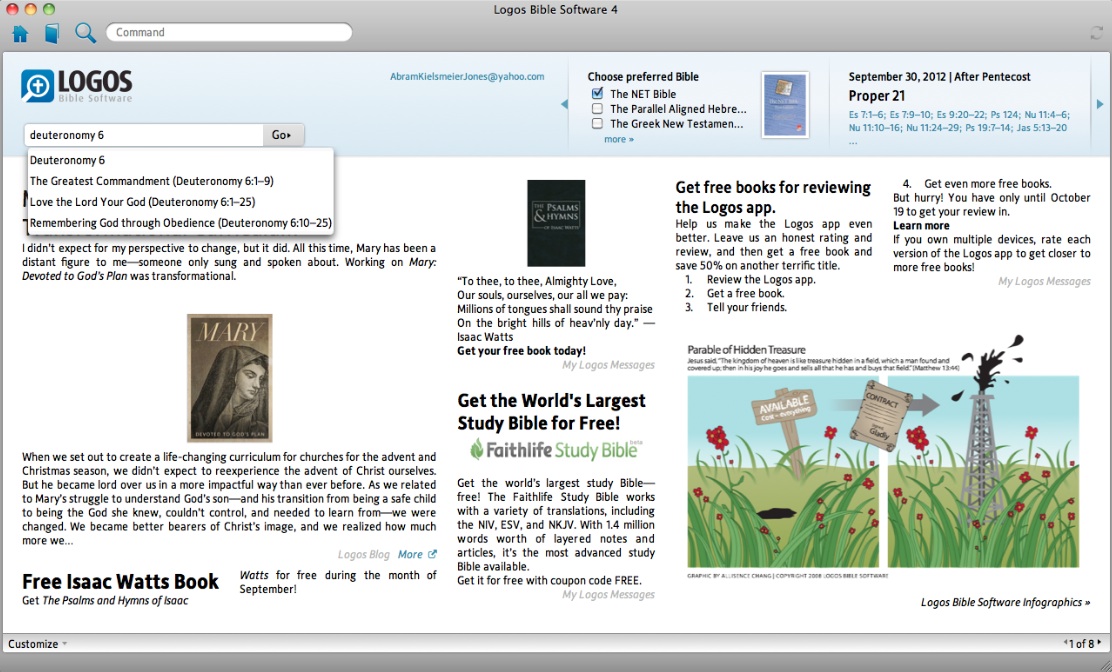
From the home page I begin to type in Deuteronomy 6, and a nice drop-down auto-complete feature comes up (a smart search engine!). Everything you see below in the home page can be changed and customized, as I noted here.

Selecting “The Greatest Commandment (Deuteronomy 6:1-9),” this screen then comes up (along with other tabs I already had open, not shown here). Click for larger if need be.

There are multiple collapsable and expandable sections from which I can choose. Most helpful are the “cross references” that pop up. Below that are “parallel passages,” which highlighted for me a resource I didn’t even realize Logos 4 had: Old Testament Quotations and Allusions in the New Testament (you know I love that!).

There’s more, too–a quick gathering of and hyperlinks to pertinent people, places, and “biblical things”; “media resources,” such as this one shown at right; a compare versions tool… and more. There are some things I won’t necessarily use, like the Graceway Media graphics (which take you to an external site, where it looks like you have to pay to download). But that’s no biggie–there’s an “x” I can click on so that won’t show in future Passage Guides. It’s all highly customizable, a consistent strength of Logos.

The Passage Guide saves me time and highlights resources and references throughout Logos 4 that users may not even be aware exist. I’m a fan and can easily envision using this in preparing messages and Bible studies.

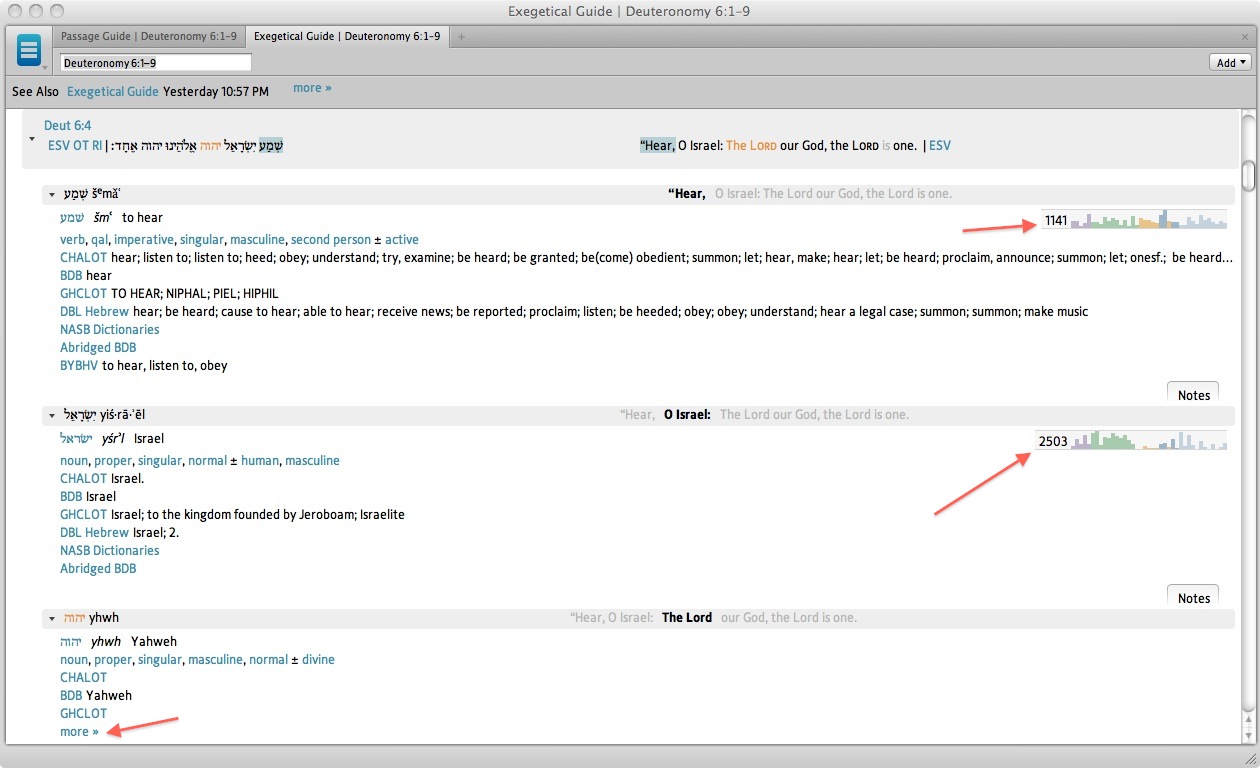
The Exegetical Guide has a really similar layout. The categories here, however, tend to be more focused at the word, clause, sentence, and verse level, such as: textual apparatuses (if you have any in your Logos), grammars, visualizations, and word-by-word analysis. This latter feature is cool–it shows you parsing for every word, as well as its definitions in multiple dictionaries/lexica at the same time. See here:

In the image below (another part of the Exegetical Guide), the top two arrows show you the colorful word distribution results throughout the various biblical books; the bottom arrow shows you how you can click on “more” for a given word (click for larger):

The Exegetical Guide and the Passage Guide are winners. They pull a lot together in one easy-to-get-to place, and they do it quickly. Nicely done.

Thanks to Logos for the review copy of Logos 4 with the Original Languages Library included. For the review copy I am giving my honest impressions of the program in a multi-part review. This has been part 4. See part 1 here, part 2 here, and part 3 here.

The Original Languages Library in Logos 4

How is Logos 4 for study of biblical languages?

Typically when I think about Bible software and original languages, three important areas come to mind:

  • The Hebrew Old Testament
  • The Greek New Testament
  • The Greek Old Testament, or, the Septuagint

I’ve already written about the Septuagint in Logos here. What about the Hebrew OT and Greek NT?

For Hebrew study there is the BHS Hebrew Bible with (WIVU) morphological analysis. I mentioned in my last post that the Information tab can be brought up to give lexical and morphological analysis of any word. Also, the bottom gray border area of Logos updates with morphological analysis as you move over a word. So you can instantly parse and analyze the Hebrew as you go.

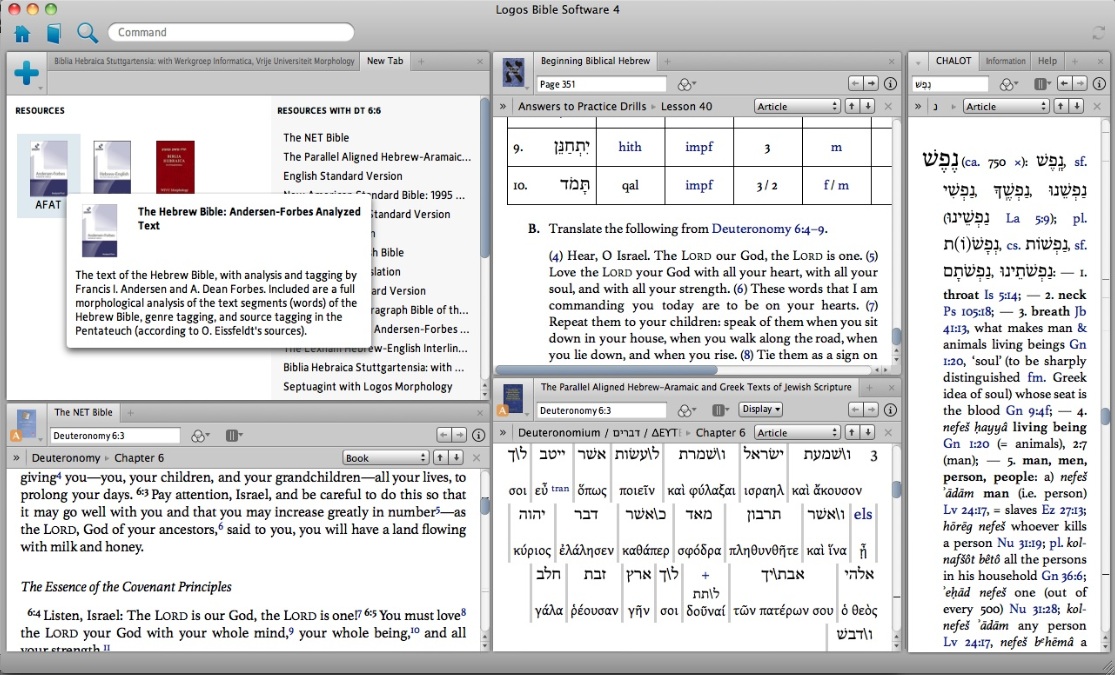
My go-to Hebrew lexicon is part of this base package: Concise Hebrew and Aramaic Lexicon of the Old Testament by Holladay (based on HALOT). And Landes’s ever-helpful Building Your Biblical Hebrew Vocabulary is included. There are some grammars like Futato and Gesenius. You can open all of these as stand-alone windows, or integrate them into what you’re doing in a given text. Here’s a Hebrew Bible layout I’m using at the moment (click for larger):

You can see in the top left area that I’ve got BHS open in the leftmost tab–what you’re seeing in the shot above is what happens when you seek to open a new tab. I like that it suggests resources that address the verse that’s already open. You can also mouse over a resource for a handy pop-up window with description. The above pop-up window is for the Andersen-Forbes Analyzed Text, which gives even more insight into the Hebrew text than just the BHS with WIVU morphological analysis.

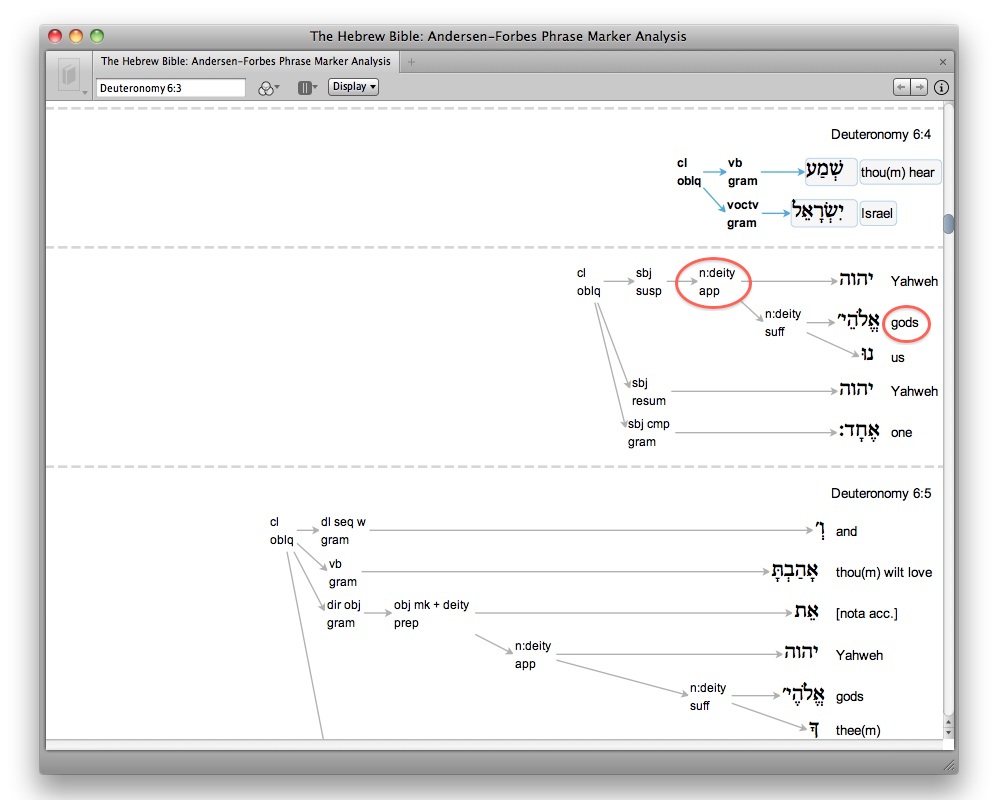
One highlight of the Hebrew resources available in this package is the Andersen-Forbes Phrase Marker Analysis. See here for a good description of the “seven layers of syntax information” included. (That’s better than a seven-layer burrito!) Here’s a screenshot:

And more here from Logos:

The Analyzed Text contains morphological and lexical analysis, similar to that found in the above editions of the Hebrew Bible, but also analyzes features such as genre and semantic domains. The Phrase Marker Analysis, however, goes beyond the word level and shows how phrases and clauses function together, in essence diagramming the entire Hebrew Bible with Syntax information. There is a database that allows the user to search the Hebrew bible based on these Syntax structures, and a glossary resource that defines all the terms used in the Analyzed Text and the Phrase Marker Analysis. This package represents a new trend in computerized biblical studies – the ability to work with syntax, not just morphology, when studying the Bible.

I was a little unclear as to why the English translation (on the far right in the shot above) was so wooden in this resource–and “thou wilt” struck me as out of place. Also odd (in this verse) is the English translation “gods” (circled above) when it is in apposition to Yahweh, and the idea is clearly of one God.

But that barely takes away from the impressiveness of the Phrase Marker Analysis. It’s unique to Logos, and packs quite a punch. Grammar nerds rejoice! (As I have.)

When it comes to the Greek New Testament, all the basic stuff is there–the NA27 and UBS4 with morphology (apparatus sold separately), Westcott and Hort, the Byzantine textform of the GNT, the Louw-Nida lexicon, a concise Greek-English dictionary, both a harmony and synopsis for the Gospels (not Aland’s in this package, and nothing in Greek, but decent nonetheless), a great vocabulary guide, and so on. UPDATE: You can, in fact, view the Gospel synopsis in Greek, just by opening the synopsis tool and changing the versions, as below (click image for larger):

But get this. The Original Languages Library comes with the digitized 10-volume Theological Dictionary of the New Testament. I couldn’t believe this at first and thought surely it was the abridged version. Nope. It’s the full thing–“Big Kittel.” It’s fun to use as a digital resource, too. One saves time not having to look things up, and all the abbreviations are hyperlinked, so that if you just move your cursor over them, you see quickly what they stand for. Same thing with verse references:

This resource in print is $400 (retail is something like $700). Once I realized its inclusion, the $415.95 sticker price for the Original Languages Library made more sense. Comparable packages in other Bible software are cheaper, but none of them include TDNT. I’m amazed Logos can include it in this base package, but glad that they do.

As for English translations, the Original Languages Library includes these, among others:

  • English Standard Version (ESV)
  • King James Version (KJV)
  • Lexham English Bible (NT)
  • The NET Bible (my personal favorite at the moment)
  • New American Standard Bible (NASB)
  • New Revised Standard Version (NRSV)

There is also a variety of (reverse) interlinear Bibles. I personally don’t use these much, but they could be helpful to others. The Tov/Polak Hebrew-Greek Parallel Aligned Bible, however–presented in interlinear format–is great. (More about that here.)

The Original Languages Library packs in quite a bit. With the exception of perhaps an English translation of the Septuagint, all you need for original language study is here. The Andersen-Forbes resources for the Hebrew OT, the TDNT for the Greek NT, and the Tov/Polak aligned Hebrew-Greek OT are all wonderful inclusions and fantastic resources.

How is Logos 4 for study of biblical languages? It’s great.

Thanks to Logos for the review copy of Logos 4 with the Original Languages Library included. For the review copy I am giving my honest impressions of the program in a multi-part review. This has been part 3. See part 1 here and part 2 here.

Enter in: One good reason to study how the New Testament uses the Old Testament

I’m reading the book shown at right for a seminary class I’m taking. The class is called “The Old Testament in the New.” Its syllabus is here (pdf).

I’ll offer a review of Beale’s Handbook on the New Testament Use of the Old Testament later, but for now, this:

The aim of this chapter [3], and indeed of this entire handbook, is to obtain a better understanding of the way the NT is related to the OT at just those points where the New refers to the Old. The ultimate purpose in this exercise is more clearly to hear and apprehend the living word of the living God (cf. Acts 7:38), so that we may encounter God increasingly and know him more deeply, and so think and do those things that honor God.

He notes that he realizes “that this purpose is not shared by all in the academic guild,” but I believe that if the biblical authors meant for their writings to be read in a “participatory mood,” we actually do some injustice to the text when we don’t read them that way.