My (Mixed) Review of Maria Semple’s Today Will Be Different

today-will-be-different-semple


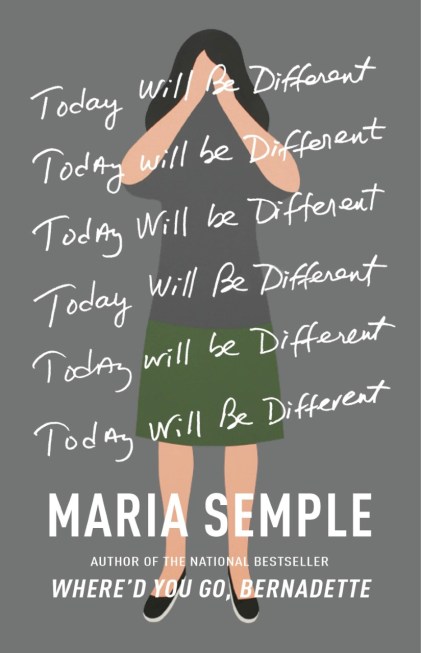
I’ve got a review of Maria Semple’s Today Will Be Different over at Englewood Review of Books. An excerpt of the review:

Eleanor Flood’s day is about to be different—but not in the proactive way she had committed to. Today she wants to be her “best self,” because “the other way wasn’t working” (7).

A writer and illustrator, Eleanor lives in Seattle with her eight-year-old son Timby (Timby?), a forgotten and forgettable dog Yo-Yo, and her husband Joe, well-loved hand surgeon to the Seattle Seahawks.

The review continues here.

From the Creator of Captain Underpants: Dog Man

Our children don’t need any encouragement in the area of scatalogical humor, but here we all have been anyway, laughing through the pages of Dav Pilkey’s new Dog Man. (Pilkey of Captain Underpants fame.) That is to say–this book would not be something to read to your four-year-old daughter. Unless, uh, she had two older brothers and was already unfazed by such humor.

Case in point:


one-day-this-happened


in-my-office-now


Dog Man, as Pilkey tells it, is the creation of George Beard and Harold Hutchins, two comic-writing friends whose teacher, Ms. Construde, clearly does not appreciate their “disruptive activity in my classroom.” All my kids love it, of course.

The premise itself is a little more violent than I would have liked for my (or any) kids: Dog Man is born when the evil cat Petey blows up Officer Knight and his dog Greg:

Doctor: I’m sorry Greg, but your body is dying. and your head is dying too, cop.

Officer: Rats! I sure hate my dying head!

But just when all seemed lost…

Nurse Lady: Hey! Why don’t we sew Greg’s head onto cop’s body?

Doctor: Good idea, nurse lady! You’re a genius!

Here “a brand-new crime-fighting sensation was unleashed.”

Dog Man the character is about what you would expect from somebody who is half man, half dog. He battles Petey, then Robo Chief, and then a giant, walking Philly cheesesteak mascot in chapter 4, “Weenie Wars: The Franks Awaken.” This last chapter was probably the funniest and best part of the book. Sample lines:

OH look! Little baby hot dogs are starting a revolution!!!!

We’re not little babies! we’re regular sized!

(Their subsequent claim to be “gangsta” will go over kids’ heads and seems to unfortunately engage in cultural appropriation.)

A fun feature that comes up at several points is the “Flip-O-Rama,” where you can create a little bit of animation by quickly flipping between pages. At this moment I’m looking at the book’s warning: “Remember—Flip it, Don’t Rip it!!!!!!”, which happens to be right next to a newly made rip in our edition. Oh, well.

The section in the back of the book with “How 2 Draw” different characters is icing on the cake.

For how inexpensive the book is, I was pleasantly surprised to see a sewn binding. The colors are vibrant and the lettering is what you would expect from Dav-Pilkey-as-two-kids-writing-a-comic. It inspired my own kids to write their own. (Details forthcoming, or maybe we’ll just try for a book deal.)

If you’re trying to avoid scatological humor, don’t get this book. If you’ve maybe slacked a little with your standards for your kids in that regard, they’ll probably love Dog Man.

You can find the book at Scholastic’s page here. It’s also available at Amazon here. Dav Pilkey’s got his own site, too.


Thanks to Scholastic for the review copy, given with no expectation as to the content of the review.

Mamoko: A World Where Kids Read to the Grown-Ups

mamoko-3000


Some of the best book gifts our oldest child has received have been Maps and Animalium from Big Picture Press, an imprint of Candlewick.

Our kids have also spent many collective minutes and hours poring over two books from The World of Mamoko series: The World of Mamoko in the Year 3000 and The World of Mamoko in the Time of Dragons.

The premise of Mamoko is simple: “Use your eyes!” to “follow the adventures” of more than two dozen different characters through seven detailed spreads that span two pages each. The books are hardback, like giant board books, so they’ll last us a long time. The target age range is 5-8 years old, but my four-year-old (who can’t yet read) really enjoys looking at the pictures, too.

Here’s a spread from World of Mamoko in the Time of Dragons:


mamoko-in-the-time-of-dragons


It’s lots of fun. There are short descriptions of each character that help in knowing what to look for. For example, a pink elephant (holding a hammer?) is Othello Smith:

OTHELLO SMITH is feeling bummed out. What is the cause of his distress?

The book is pretty funny. And it’s big enough that, like the Where’s Waldo? books, two people can easily look for characters and their antics at the same time.

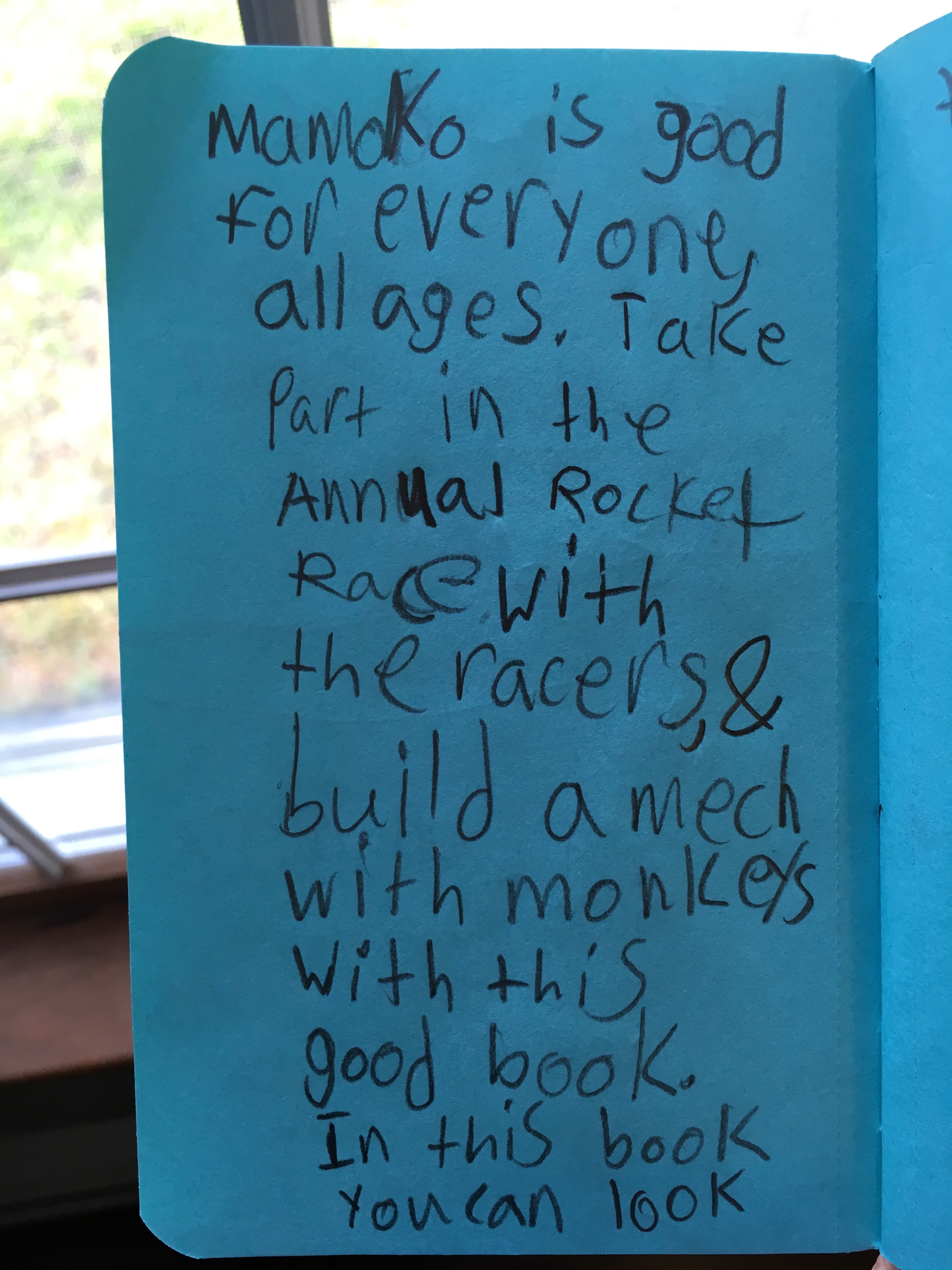
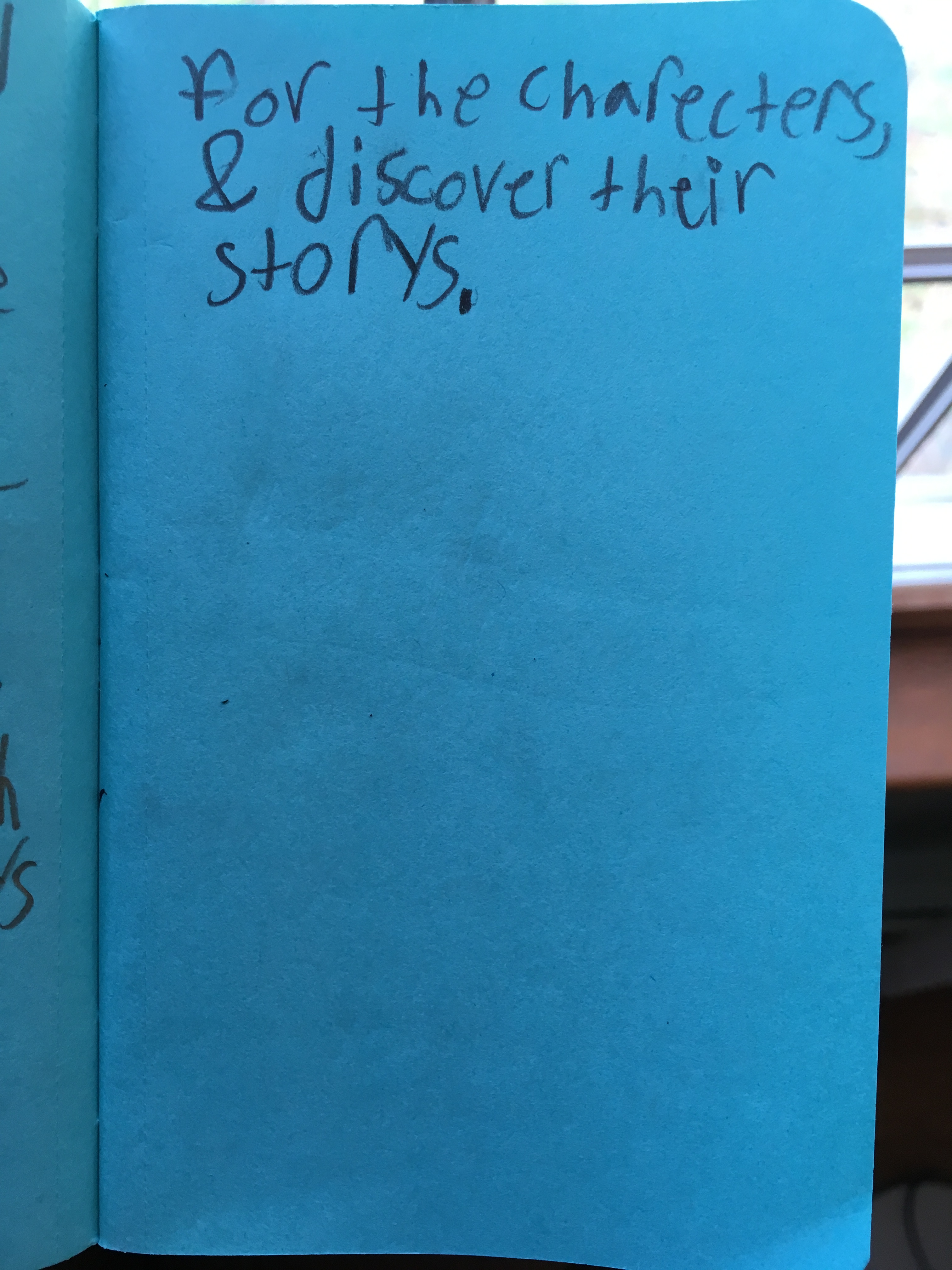
But I told Candlewick my kids would help me review these two books, and a promise is a promise, so… here are my nine-year-old’s review notes from The World of Mamoko in the Year 3000:


mamoko-3000-1


mamoko-3000-2


mamoko-3000-3


And here’s his short take on The World of Mamoko in the Time of Dragons:


mamoko-dragons


You can find all three Mamoko titles at Candlewick’s page here. They’re also available at Amazon here.


Thanks to Candlewick Press for the review copies, given with no expectation as to the content of the review.

The Freedom Simply to Begin (First Draft Co.)

When creating something—whether writing, sketching, jotting lyrics, or laying out a plan for a new project—getting started is often half the battle. To feel the freedom simply to begin—to make a first draft—makes the work possible.

Any writing teacher or art instructor will tell you that good creative work begins not with a finished product, but with a draft. That may seem obvious, but lots of folks involved in creative pursuits forget that the first goal of putting something down to paper should be, well, to put something down to paper. It need not be a finished product; in fact, in all but the rarest bursts of inspiration, it’s the working over the initial insight or burst of effort that leads to a refined or compelling outcome. As Ernest Hemingway put it, in a dictum variously attributed to others, “Easy writing makes hard reading.” It’s the constant, if not obsessive commitment to drafting and revising and redrafting that leads to strong work.

That’s one reason I like the name of the company that produces this journal, which suggests that what happens in the pages of its product will be a starting place, a beginning. “We started First Draft Co. with a passion to build tools and experiences that inspire creativity,” the web site announces.


front-cover


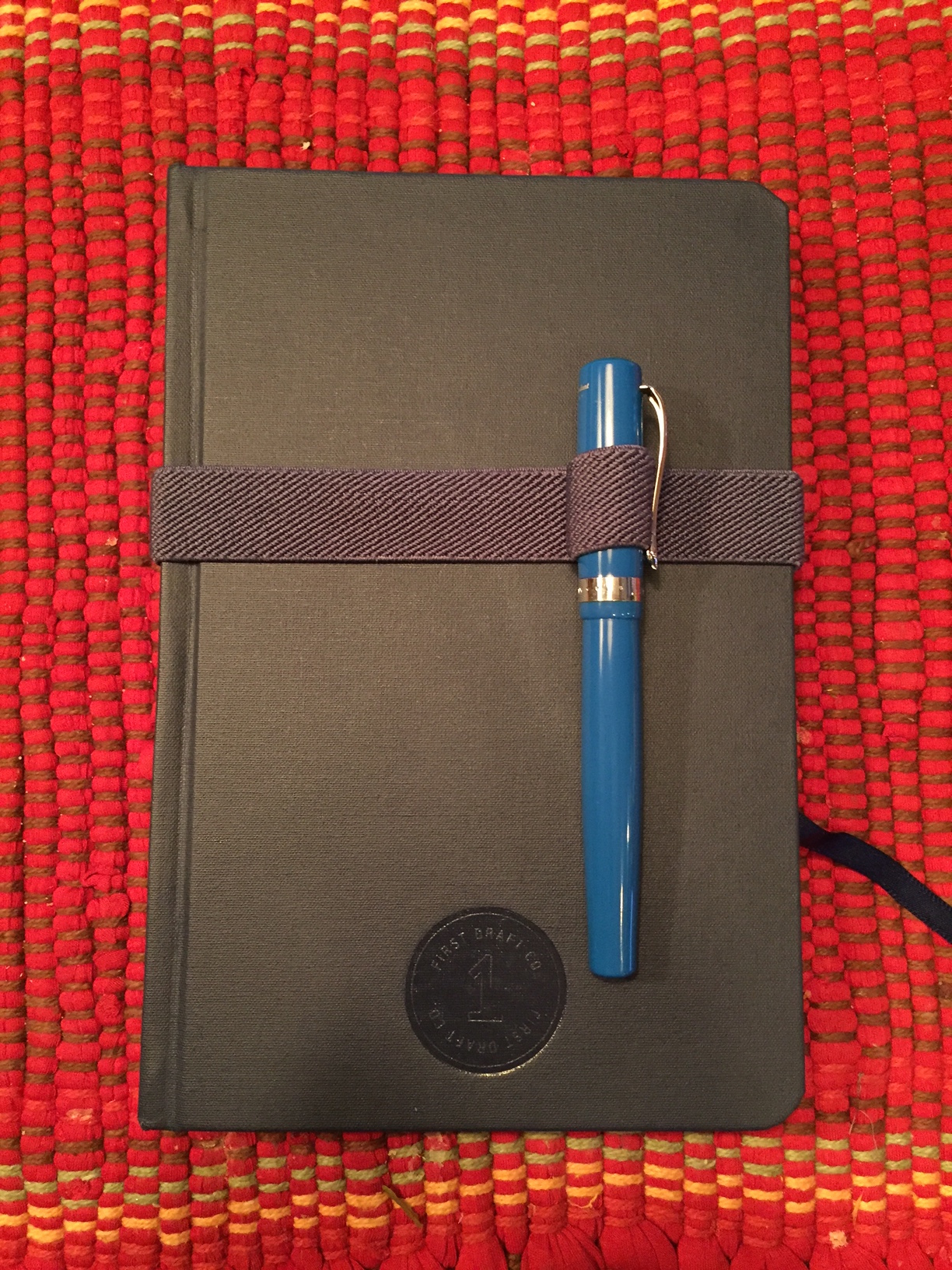
The blank book provided for this review looks impressive from first glance. But it also has a solid feel. The hardcover boards, covered with library buckram, give heft, and make the book feel like more than a sketchpad or casual notebook. The satiny place ribbon also conveys something classy and useful, making it easy to resume work once the journal has been put away.


open-inside


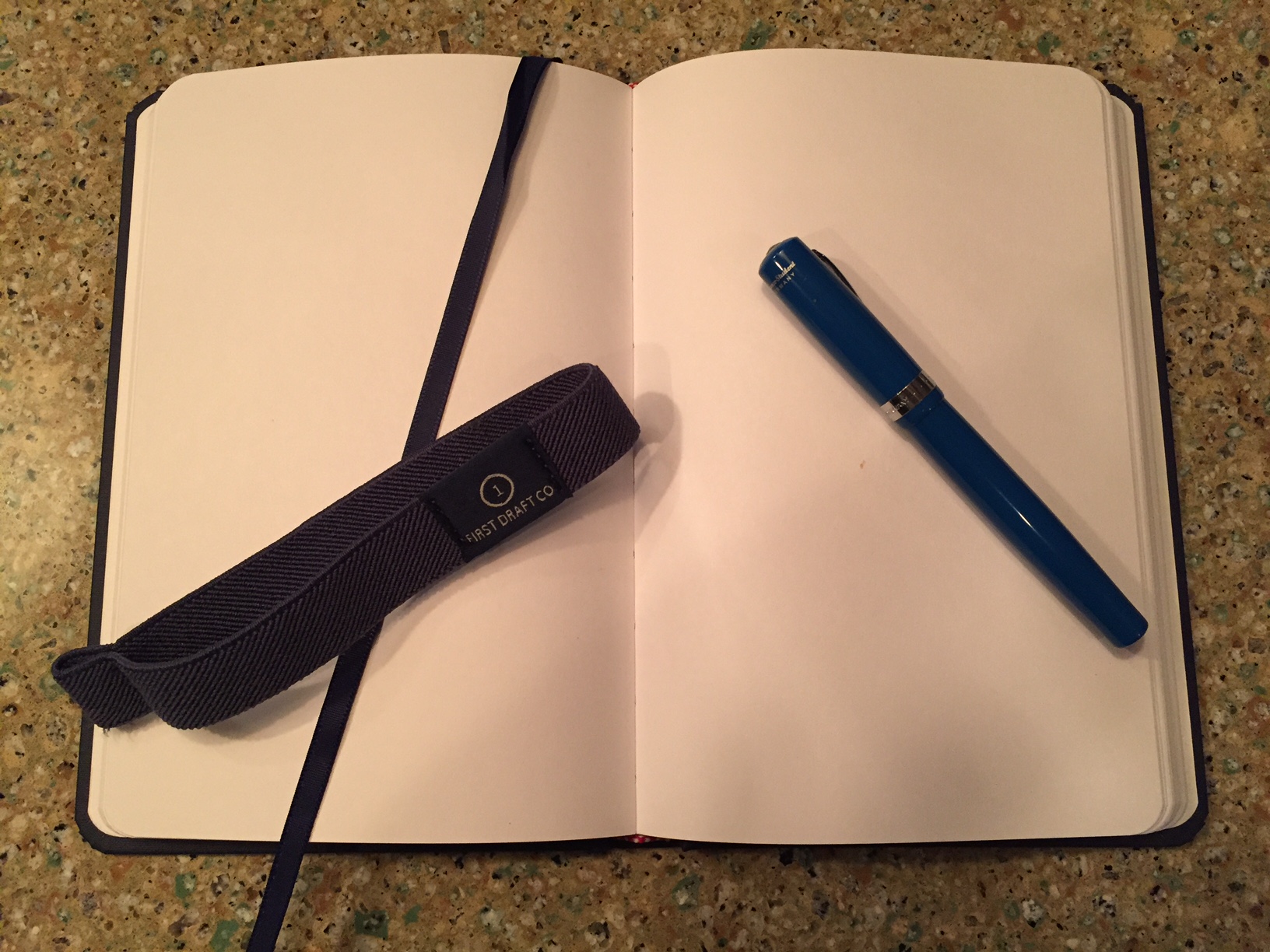
The pages are blank—no lines or dots—leaving the creator ultimate freedom. The elastic cloth band holds the pages and cover together. Slipping it off takes a couple of seconds but that need to perform a ritual act allows for a moment or two or reflection, allowing a pause for gathering one’s thoughts, perhaps one’s scattered presence for the promising task at hand.


with-pen


Some specs:

  • 104 gsm bright white paper (fountain pen-friendly, smooth, makes for a top-notch writing experience)
  • Smyth Sewn binding (yes! lays flat easily)
  • sustainably sourced paper
  • 224 pages (you won’t need a new one any time soon)
  •  5.5” by 8.25”
  • Made in the U.S.A.

You can find the First Draft Co. notebook (together with the Blackwing pencils and gorgeous desk gear they offer) here.


–Reviewed by author and guest blogger Timothy Jones


Thanks to the kind folks at First Draft Co. for the notebook for review, provided without any expectation as to the content of this write-up.

Jonah: Baylor Handbook on the Hebrew Text


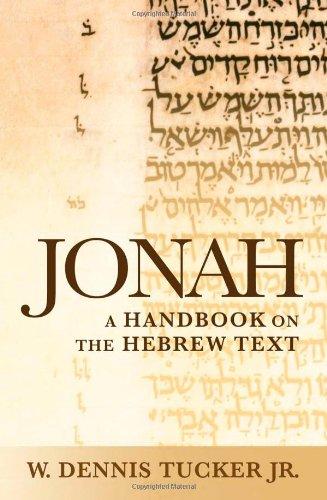
A couple of Advents ago I preached on Jonah. There is no lack of good resources on the book, even ones that treat the Hebrew text itself. But the Baylor handbook offers a somewhat unique perspective, analyzing the words and phrases of the Hebrew text, as well as reading it through a discourse analysis lens:

This approach begins by observing that within Biblical Hebrew texts a number of types or “discourses” can be identified. Each type has a particular function that is readily evident. Narrative discourse relates the events of a story (Gen 8). Predictive discourse speaks of an event in advance of its occurrence (I Sam 10:2s7). Hortatory discourse is meant to exhort someone to act in a particular manner (Job 2:9). Procedural discourse tells someone either how to do something or how something was done (Gen 27:1-4). And expository/descriptive discourse is meant to explain something or make a statement (2 Sam 12:7). (3)

The Jonah handbook is short and compact. The formatting is easy to follow. First there is an English translation, passage-by-passage. Then the Hebrew text is reprinted verse-by-verse (making this an all-in-one-place reading aid). After that is “an analysis of that clause as a whole, with comments related to the function of the clause, its discourse type, and related syntactic matters” (9). Finally, there are word-by-word or phrase-by-phrase comments.

Overall, I appreciated the handbook: I read it cover to cover. The grammatical comments are helpful at multiple turns. For example, here is the text of Jonah 3:8

וְיִתְכַּסּ֣וּ שַׂקִּ֗ים הָֽאָדָם֙ וְהַבְּהֵמָ֔ה וְיִקְרְא֥וּ אֶל־אֱלֹהִ֖ים בְּחָזְקָ֑ה וְיָשֻׁ֗בוּ אִ֚ישׁ מִדַּרְכּ֣וֹ הָֽרָעָ֔ה וּמִן־הֶחָמָ֖ס אֲשֶׁ֥ר בְּכַפֵּיהֶֽם

For וּמִן־הֶחָמָ֖ס, W. Dennis Tucker, Jr. writes:

When a preposition governs more than one object, the preposition will typically be repeated before each object. The waw copulative + מִן signals the continuation of the prepositional phrase.

Here’s a representative comment using discourse analysis, coming at Jonah 3:10:

A qatal in a dependent clause provides background information in the relative past (i.e., past in comparison to the mainline). This is often expressed in translation through the use of a pluperfect (Longacre, 82).

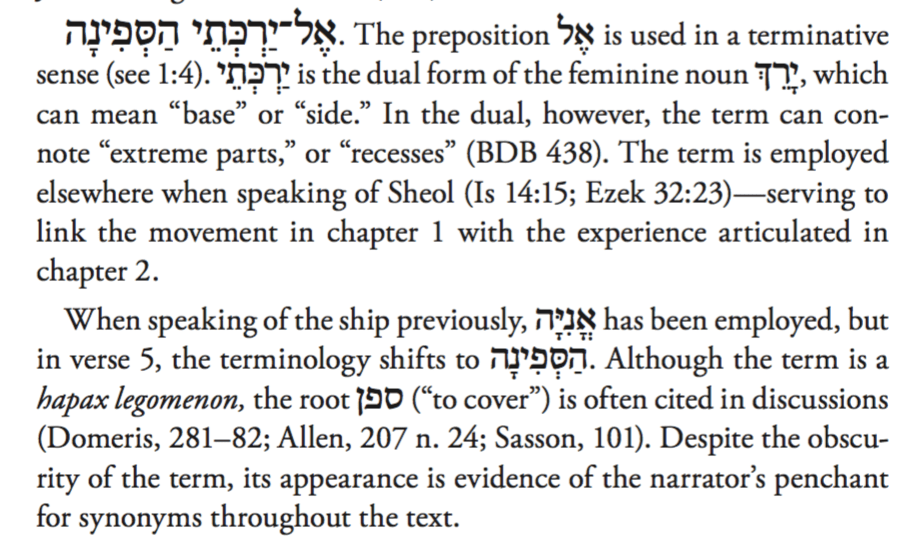
These two paragraphs from Jonah 1:5 give a good sense of the depth and utility of the comments:

The target audience is the student who is “making the move from introductory grammar to biblical text” (1). Given that, a surprising number of terms (irrealis, factitive, prosopopeia, diegetic, and more) go unlisted in the 28-term Glossary. And the discourse analysis is too much at times, as in this difficult paragraph:

Typically in narrative discourse, the negation of any verb is understood as irrealis scene setting and appears at the lowest level on the discourse profile scheme. The negation of a verb stops the forward progress of the narrative by indicating what is not the case. Longacre, however, has suggested that in certain contexts a negation may be termed a “momentous negation” because it is critical in advancing the narrative line forward (82). In these rare occurrences, the verb form is understood as a second-rank construction (similar to the X + qatal), in effect actually serving to move the narrative along. The events and dialog in chapter 4 are predicated, in part, on the momentous negation that occurs at the end of 3:10. The object of the verb is absent due to ellipsis.

Typos in the book are surprisingly frequent, especially occurring in the English translations. The book sets out to provide lexical forms for every verb in Jonah but omits them in a number of instances, leaving the reader without needed help at times. And the Malachi handbook has a “word chart” which I have hoped to see in other volumes, but haven’t. (Baylor published the Malachi volume after Jonah.)

On the plus side, Tucker commented more than I expected on the style of the author of Jonah—this helped me better understand the Hebrew in context. And there are more comments with exegetical and even preaching payoff than one might expect from a series that the editors intend to serve as a sort of prequel to a commentary.

If you’re reading through Jonah in Hebrew, will you want this handbook? Despite what I see as some shortcomings, yes. The best commentary on Jonah is probably this one, which covers Hebrew well, but in its transliterated form. So if you’re going to go deep with the Hebrew of Jonah, Tucker’s handbook is a nice companion—and much of his discourse analysis is clear, even if the reader needs to reference his introductory comments (and external sources) a few times along the way.

The handbook is available through Amazon (here) and the publisher (here).


Thanks to Baylor University Press for the review copy—sent to me with no expectation as to my reivew’s content.

The Rhodia Webbie for Long-Range Planning (by Hand!)

Back before the days of advanced task management apps, I rocked a Franklin Covey 7 Habits of Highly Effective People planner. It had everything. Insert pages for contact information (before we kept that all in our phones), daily layouts for schedules and to-do items, and a section in the back for values planning and writing out my personal mission statement.

Task tracking for me is significantly easier on a device, since I can see what I have to do (and check it off) from just about anywhere. But hashing out the bigger picture life stuff doesn’t seem to quite fit in OmniFocus or 2Do.

So for long-range planning and goal setting, I’ve gone back to paper.

I now have as many dedicated-use notebooks as I have to-do apps—a liability transferred to merely a different medium—but a notebook just for “the 30,000-foot view” has been helpful. Here’s what I’ve been using—the black Rhodia Webbie:


rhodia-webbie-0


As you can see, it looks much like the hardcover, 5″ x 8.25″ Moleskine. But the Webbie (a.k.a., Webnotebook) is better, not least because it’s got 90 gsm Clairefontaine “brushed vellum paper,” which seems to be made for fountain pens. (Moleskine, by contrast, is not fountain pen-friendly.)

Much like its counterpart, the Webbie has a hard and smooth leatherette cover. I’m not in love with the cover, but I’ve grown accustomed to it and it is fine. The notebook is bound shut with an elastic wrap-around strap. This offers a nice way to store a pen with the notebook, in fact.


rhodia-webbie-1


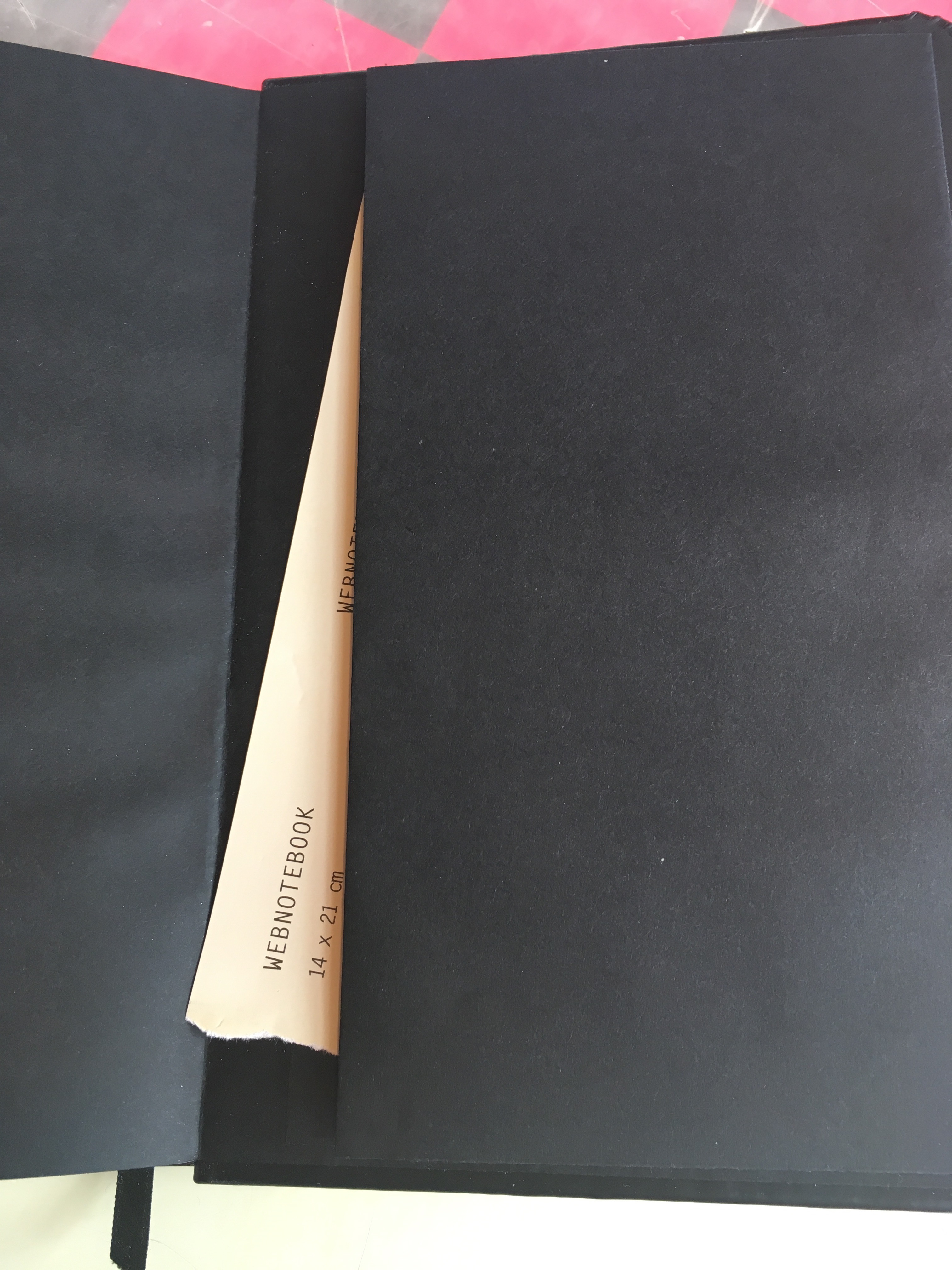
There’s an expandable back pocket, so you can keep papers, receipts, photos, etc. with the Webbie.


rhodia-webbie-2


An 8.5” x 11” piece of paper, folded in half, just barely fits inside the notebook, though its edges come out a bit. No matter—this is not a notebook with U.S. dimensions! It’s A5, which is as tall as the Moleskine, but wider, which I find more natural for extended writing.

It does remarkably well with a fountain pen. The smooth paper feels wonderful, and provides no feathering or bleeding of ink. For that matter, there’s hardly any show-through.


rhodia-webbie-3


rhodia-webbie-4


My one complaint about the Webbie (besides the fact that my text editor keeps wanting to auto-correct it to Rhoda Debbie) is that the ribbon marker feels too short. It just barely extends out of the notebook, about an inch or less.

Other than that, the Webbie is as good an all-purpose notebook as I’ve written in. And it’s working great for me to replace the role those 7 Habits planning pages once played. There’s plenty of room on a page to do some serious writing, note-taking, brainstorming, or drawing, but the size still makes it portable enough to go anywhere. In terms of specs, look, feel, and quality, the LEUCHTTURM1917 notebook is quite similar, though the Webbie is a bit slimmer and has slightly fewer pages.

With 192 pages of paper (96 sheets), the Webbie ought to last its users for at least a couple months before they need a new one.

You can find the Webbie here or here.


Thanks to the kind folks at Rhodia for the notebook for review, provided without any expectation as to the content of my write-up.

To Change the World (James D. Hunter): A Brief Review and Critique

James Davison Hunter makes helpful contributions to the discussion of how Christians should orient themselves toward the world and its need for improvement. His idea of “faithful presence” is a good one, if not especially novel. The idea’s rootedness in the faithful presence of God in Christ offers a theologically sound and relatable paradigm. Because of God’s love for and presence with us, any Christian, whether walking in the so-called halls of power or not, can exercise faithful presence.

Hunter offers a robust view of faithful presence as “the exercise of leadership in all spheres and all levels of life and activity” (260). One thinks of the oft-quoted Abraham Kuyper: “There is not a square inch in the whole domain of our human existence over which Christ… does not cry, ‘Mine!'”

to-change-the-worldHunter sees the need for faithful presence to bring about both individual and institutional change, as it “generates relationships and institutions that are fundamentally covenantal in character, the ends of which are the fostering of meaning, purpose, truth” (263, my emphasis). Further, Hunter writes, “Culture is intrinsically dialectical” (34). His drawing on the Hegelian dialectic allows him to articulate a Christian relation to the world that avoids extremes: “Christians are called to relate to the world within a dialectic of affirmation and antithesis” (231).

The author spends more time than the reader might like in debunking other people’s ideas as to how to make the world a better place. This is a noble enough endeavor, but one wonders: On what authority does he offer his critiques? He begins, “I contend that the dominant ways of thinking about culture and cultural change are flawed, for they are based on both specious social science and problematic theology” (5). (That’s a big claim to have to defend.) He continues with broad, sweeping statements like, “Cultures change from the top down, rarely if ever from the bottom up,” (41) and, “Change of this nature [i.e., cultural change] can only come from the top down” (42).

Evidence, however, seems to be in short supply. One does not have to wade deep into the history of the African American civil rights movement, for example, to find figures who effected change from the bottom up. No doubt Martin Luther King, Jr. found support from “the top” in Lyndon B. Johnson, but King led a movement of the people, many of whom (King included) did not have positional power in the society they changed.

And to take a current example, there is the Black Lives Matter movement. While its long-term impact remains to be seen—and while the movement itself may not always speak with one voice—one would be hard-pressed to suggest that this “grassroots political mobilization” (42) has not “penetrate[d] the structure of our imagination, our frameworks of knowledge and discussion, the perception of everyday reality” (42). Already the Black Lives Matter movement can claim victory in that there is a greater societal awareness of race-motivated police brutality, as well as police departments taking increasingly deliberate measures (body cameras, and so on) to prevent it.

I do appreciate Hunter’s giving “priority to what is right in front of us–the community, the neighborhood, and the city, and the people of which these are constituted” (253). But in some ways his “faithful presence” still reads just a little as, “Just try harder… this way is sure to work!”

Of course he is right in saying, “Christians have failed to understand the nature of the world they want to change and failed even more to understand how it actually changes” (99). But the reader rightly wonders: what makes Hunter immune? In short, while Hunter’s larger framework has much to commend it, his work seems to lack attention to important details—and fails to convince that all other visions of world change that preceded him are faulty.


Book info: Publisher’s Page (OUP) // Amazon


Thanks to Oxford University Press for sending me a review copy, which—I assume will be evident—did not influence my attempts at objectivity in assessing the book.

Review and Reflection: Greek for Preachers

Greek for Preachers (Chalice Press, 2002) divides into three primary parts. Part 1 is “The Preliminaries,” where authors Joseph M. Webb and Robert Kysar suggest initial tools for preachers who want to use Greek. Part 2 offers “Ten Principles for Uncovering Greek Meaning,” which makes up the majority of the book. Part 3 focuses on “Using the Greek Text in Sermon Preparation,” and is a hands-on application of the principles the authors have taught in the second part. The book’s aim is simple: “to bring the Greek text of the New Testament within reach of anyone who wishes to explore its riches” (x). The authors want preachers who have lost their Greek (or not had any) to find the language “both usable and exciting” for use in sermon preparation (7).


Part 1: “The Preliminaries”


I worried a bit when I saw “uncovering Greek meaning” as the title for Part 2. Somewhere along the way I learned that Greek is not just a language to decode, as if there could be one-to-one equivalents for everything, with “hidden gems” available to ones with secret inside knowledge. But the authors are balanced here. In the Preface they say, “We do not believe there is anything intrinsically magic or even necessarily sacred about the original language of the New Testament, even though we both assert the importance of biblical languages for the Christian tradition” (ix). This approach resonates with me, especially as they go on to affirm, “But, judiciously and frugally handled, the joys of the Greek language of our New Testament are as bright as newly cut diamonds sitting in a store window waiting for someone to pick them up and share them with others” (7).

The first part focuses primarily on introducing the preacher to two tools: a Greek-English interlinear and an analytical lexicon. From there the authors go over the Greek alphabet, syllabification, pronunciation, and helpful immersion in a few practice texts. (The Greek font in this book looks good and is readable.) It is also in this first part that the authors introduce their approach to words and meaning, one that I am fully on board with: “[W]e should never assume that a word is used in the exact same way in different passages. The context in which a word is used is more important than how another writer in a different document might use the same word…” (5). This, in fact, has preaching implications for me, because I can make points like this in my sermons without even bringing “the underlying Greek” into the picture.


Part 2: “Ten Principles for Uncovering Greek Meaning”


Part 2 is the heart of the book. The authors give ten principles around specific grammatical features. Concepts they explore include: articles (and how their presence or absence adjusts meaning), verbs, participles, infinitives, cases, and more. There are lots of examples from the Greek New Testament, including possible sermon angles to derive from interpreting the Greek grammar. There’s a wealth of interaction with the Greek text for the reader to work through. There are charts, glosses, and plenty of material that any Greek reader will benefit from reviewing.

A highlight of the second part for me was the authors’ good distinction between grammatical gender and what they call human gender (also called social gender). They would support, for example, not using the generic “man” in English translations where the Greek has ἄνθρωπος. I am similarly deliberate in reading from the pulpit gender-accurate translations whenever I can.

While most of the instruction in this section is consistent with what I’ve learned from various grammars and exegesis courses at Gordon-Conwell (and reading Greek regularly since), there are a couple of surprising hermeneutical moves that I didn’t think were on firm footing.

For example, here is John 1:1:

Ἐν ἀρχῇ ἦν ὁ λόγος, καὶ ὁ λόγος ἦν πρὸς τὸν θεόν, καὶ θεὸς ἦν ὁ λόγος.

The authors say, “Look for the articles, especially the ones associated with God” (39). With the last part of the verse (θεὸς ἦν ὁ λόγος), the authors rightly point out that ὁ λόγος becomes the subject because of the article. So, “the Word was God.” However, they go on to explore “the nature of the articular nouns as they differ from the anarthrous nouns “(39), considering that the anarthrous θεὸς could simply mean something less specific like “God-like.” They approach the translation with humility, but unfortunately conclude, “Theologically, it raises the issue of whether or not the text means that God and the ‘word’ are identical” (39). Though it’s tempting to criticize this interpretation on account of what sounds like heterodoxy, Greek grammar alone (at least I thought!) settles the issue, that, “the Word was God” (and not just God-like). I can recall at least two Greek professors at GCTS making a similar point that the anarthrous θεὸς should not be interpreted in the way the authors explore.
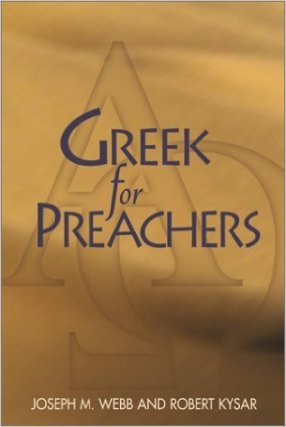
greek-for-preachersAlso a curious was the interpretation of participles in the Great Commission of Matthew 28:19-20. The authors point out the three participles in those two verses, the first of which is aorist. “But the aorist participle,” they say, “that begins the sentence gives the idea of ‘going’ before it mentions the command to ‘make learners.’ Those who are addressed in this passage are already going” (65). As Roy Ciampa (from a 2008 Every Thought Captive blog post called, “As You Go, Make Disciples?“) and others have argued, that aorist participle is actually a participle of attendance circumstance, and it simply has the force of an imperative: nothing more, nothing less.

How does this interaction impact my own preaching, beyond my desire to critically engage with anything I read for my ministry development?

The authors model humility in how they approach the Greek, even when I disagree with them. I want to follow suit here.

On the other hand, some of their Greek-based hermeneutical moves seem like classic anecdotes of “what not to do” when moving from Greek New Testament to interpretation to pulpit. One wants to be careful not to make too much of subtle grammatical points that may reflect merely on what wording the author felt like using at the time of writing. As with the John 21 example where John and Peter dance between two different Greek words for love, a given author could simply be using a rhetorical flourish, and not intending us to derive any meaning more than that the author writes with creative style. (John 21 seems less clear-cut to me, though, than the examples above.)


Part 3: “Using the Greek Text in Sermon Preparation”


In the third part, “Using the Greek Text in Sermon Preparation,” the authors move the process into the pulpit. They list seven steps, each of which is easy enough to implement. And they have a stance on commentaries that I really appreciate, even as I’m aware of the discipline required: “We suggest that you use commentaries to learn what others have said about the passage but not necessarily to learn what you should say” (172). Great advice. I also resonated with their explanation of a topical sermon, where “the text gives you entry into an extensive issue that reaches beyond the text itself” (163).

The book closes with two full sample sermons using Greek, the first of which was a really interesting (and helpful) take on “submission” (as mutual) in Ephesians 5.


Concluding Assessment


Greek beginners will want to turn to Part 1 right away, although I’ve had it drilled into me that interlinears are bad. I think they have their place, but a preacher who really wants to learn Greek might better avoid them and use a footnoted Reader’s Greek New Testament instead. The authors suggest that pastors actively using Greek can profitably skim Part 2 as a refresher–it can be consulted later as a reference–and cut right to Part 3 for the meat of using Greek in preaching.

I appreciate the desire of this book. On the one hand, the authors are right on when they say,

“A little learning is a dangerous thing.” Novices in the Greek New Testament are in danger of slipping into the same mold. Greek is not a cure-all for biblical interpretation nor the key that unlocks truth. It is only one more tool to help us (176).

On the other hand, I really like the idea of teaching pastors the basics of Greek so that they can begin to get their feet wet with word studies.

Again, the drawback to using this book is that readers need enough Greek already to be able to discern what the authors are doing with John 1:1 and Matthew 28:19-20. The humility they model is admirable, though, and the majority of the other examples don’t make the same kind of questionable (in my opinion) conclusions those ones do.

For me, I try to use Greek as much as possible in my study. I’m reading through the Greek New Testament this year with a friend, and we’re taking (and sharing) notes as we go. I often find that insights from our conversations about the Greek text make their way into my sermons. So I wholeheartedly affirm with the authors that the integration of Greek reading and sermon preparation is a beautiful thing. Reading Greek for Preachers compels me to re-double my efforts in turning over the Greek (or Hebrew) text as an essential part of sermon preparation.

Greek for Preachers is at Amazon here, and at Chalice Press here.


Thanks to Chalice Press for sending me a review copy, which—I trust will be evident—did not influence my attempts at objectivity in assessing the book.