The Writing Life (Annie Dillard)


I have just become aware of Annie Dillard’s funny and smart little book, The Writing Life. She perfectly captures the ebb and flow–the exhilaration and desperation–that awaits any writer who is serious about putting life to paper.

I’ve only read one chapter so far, but look how it begins:

When you write, you lay out a line of words. The line of words is a miner’s pick, a woodcarver’s gouge, a surgeon’s probe. You wield it, and it digs a path you follow. Soon you find yourself deep in new territory. Is it a dead end, or have you located the real subject? You will know tomorrow, or this time next year.

If it is this way for Annie Dillard, I have hope as a writer, too.

Dillard knows the paradoxes of writing, and will help the writer to not feel insane, if only by acknowledging the (hopefully temporary) insanity of all who try to write a book:

Writing every book, the writer must solve two problems: Can it be done? and, Can I do it? Every book has an intrinsic impossibility, which its writer discovers as his first excitement dwindles. The problem is structural; it is insoluble; it is why no one can ever write this book. Complex stories, essays, and poems have this problem, too–the prohibitive structural defect the writer wishes he had never noticed. He writes it in spite of that. He finds ways to minimize the difficulty; he strengthens other virtues; he cantilevers the whole narrative out into thin air, and it holds. And if it can be done, then he can do it, and only he. For there is nothing in the material for this book that suggests to anyone but him alone its possibilities for meaning and feeling.

One more:

Write as if you were dying. At the same time, assume you write for an audience consisting solely of terminal patients. That is, after all, the case. What would you begin writing if you knew you would die soon? What could you say to a dying person that would not enrage by its triviality?

If this piques your interest, Brain Pickings did a lengthier post about this miraculously true book here.

I Love to Run vs. I Love to NOT Run

I Hate Running


I have fallen off the wagon a bit these last 10 days or so with regard to running. Nothing to be proud of, I know. Today I realized something frustrating (but true):

I love not going for a run.

It feels good to not have to wake up super-early to exercise, or figure out how I’m going to schedule a jog in a day with multiple other demands.

But then I went for a run today, and remembered:

I love going for a run.

Ah, these blasted competing values. I get caught in the crossfire every time!


I Love Running


But I do love running, even though I also love not running, and that feeling–as long as I can keep remembering it–will get me out there again in the next day or two.

A Short Review of Bill Mallonee’s “Winnowing”

This review of a Bill Mallonee record transcends the genre of music review. Beautiful, compelling, moving. A more than fitting piece for my first time pushing that little “Reblog” button that WordPress offers.

kellydeanjolley's avatarQuantum Est In Rebus Inane

…[T]he apt analogy of the declining year, with declining happiness, and the images of youth and hope, and spring, all gone together… Jane Austen, Persuasion

I have been listening to Bill Mallonee for a long time. He is one of the most challenging and rewarding songwriters alive. He has crafted song after song, each representing some portion of his steady, integrated-and-integrating vision of things. That vision is complicated, prismatic; it has been salted with fire over years, burning away everything self-indulgent or unrealizable in it. What remains now is a vision that demands comparison with the visions of great religious and literary work: the Wisdom books of the Old Testament, and James of the New; the essays of Montaigne; Samuel Johnson’s “The Vanity of Human Wishes” and Rasselas; Eliot’s Four Quartets. Mallonee’s themes are best captured by phrases borrowed from Johnson: the hunger of the imagination…

View original post 997 more words

Fall 2014 New Releases from Zondervan Academic

Zondervan Academic

Zondervan Academic (I’ve reviewed a bunch of their stuff) has some interesting new releases coming this fall. I’m particularly interested in:

I’m especially looking to the Mark volume of the ZECNT series.

The Zondervan Academic Website is here. Their Fall 2014 catalog is here.

And the Winner Is…

iWerkz Keyboard Folded

Congratulations to Rick Mansfield, winner of the MyWerkz foldable Bluetooth keyboard. I used a random number generator to select the winner. Way to go, Rick, and enjoy! (P.S. See his nifty blog here.)

I’ll post my review of the keyboard soon. Until then, see my gathered tech gear posts here. Thanks to all who entered and shared. 

Septuagint Studies Soirée #1

septuaginta

As soon as I announced the first-ever Septuagint Studies Soirée (and here it is!), J.K. Gayle responded with “Breast God: women in the male literary imagination of Genesis 49.” Find his post here. In it he writes about how the Greek translators of Genesis 49 rendered God’s Hebrew title Shaddai… or, rather, didn’t:

Then I recall what the Septuagint translators did with Shaddai in Genesis 49. They were men, weren’t they? Yes, breasts are mentioned, and womb. These motherly wifely womanly female images are in the Hebraic Hellene. And absence, margin, lack is there.

James Dowden offered further lexical analysis (I loved the detail) with a response here. These two gents are fine thinkers. And they are, indeed, gents. Gayle makes a point to recognize this in his WOMBman’s Bible blog, with a post in which he asks whether the Septuagint itself might not be some sort of soirée. I always need to spend some time with Gayle to really plumb the depths of his insights, but it’s time well spent. A sampling:

In many fascinating ways, this act of translating into Hellene opens up the text. It opens the text up into the debates over how Greek males (such as Alexander’s teacher Aristotle) may control the Greek language for elite educated men of the Academy. The language control was to exclude not only women but also sophists, rhetoricians, ancient epic poets, more contemporary poets, colonists such as those in Soli who committed “solecisms” in writing, and BarBarians who spoke in foreign barbarisms.

Read more Gayle here.

Along similar lexical lines, Suzanne McCarthy (Gayle blogs with her at BLT) tackled “another pesky Hebrew gender question” via Hebrew, Latin, English, and, of course, Greek. McCarthy also wrote about Adam’s nose (rendered “face,” but should it be?) here.

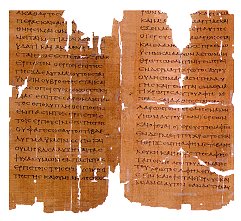
LXX Leviticus. Source: The Schøyen Collection

Jim West complained about Septuagint-o-mania (has he read the New Testament? has he read BLT blog???) but then posted a bunch of LXX-related links not long after (phew–he has read his NT, at least).

In two of the more substantive Septuagint posts this month, Nijay Gupta (who has impeccable taste in seminaries) wrote about the importance of the Septuagint (with an eye to pastors, among others). Part 1 is here. His Part 2 looks more closely at the Apocrypha. (“There is ample evidence to show that Jesus, Paul, James, and others certainly were acquainted with the Apocrypha and probably positively influenced by texts like Wisdom of Solomon and Sirach.”) His part 2 concludes with the promise of more to come.

Speaking of which, Jessica Parks was posting some great stuff on LXX Susanna earlier in the summer, so keep an eye out for anything LXX-related she may post in the future. She is now posting on Cataclysmic blog.

Brian LePort posted a good bit on the Septuagint in August (and before). He wrote about exegeting the Septuagint (with attention to its literary context) and even theologizing from it!

James McGrath looked to the Septuagint of Isaiah while reading Philippians 2.

This pre-dates August, but Blog of the Twelve posted a few LXX-related resources for consideration. And while we’re still dipping (but only briefly) back into July, Brian Davidson wrote about Matthew as a new Genesis.

Books

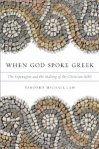
TML bookT. Michael Law’s When God Spoke Greek: The Septuagint and the Making of the Christian Bible went on tour. A multi-stop tour. Find all the posts gathered here at Near Emmaus. Oxford University Press, First Things, and Near Emmaus interviewed him.

Larry Hurtado mentioned that a book he co-edited with Paul L. Owen is now in (affordable) paperback. It’s called “Who Is This Son of Man?” The Latest Scholarship on a Puzzling Expression of the Historical Jesus, found here.

News

The International Organization for Septuagint and Cognate Studies held its International Congress in Munich in early August. Here are all the paper abstracts (pdf); here is the program (pdf).

Not-Blogs

These are not blogs proper, and not terribly active of late, but still worth checking out are this B-Greek forum (link malfunctioning at time of posting) and this Yahoo! group for LXX. The IOSCS (mentioned above) has a great page with some news and announcements here.

Feel free to leave more August 2013 LXX links of interest in the comments.

Accordance 10.2 is live

Accordance10

Accordance Bible Software, which I have reviewed at length here, has just come out with a new dot release, Accordance 10.2. There are quite a few nifty additions, which users of Accordance 10 will likely appreciate. (The improvements will also make for a better experience for new users.)

The details of all the new features are here. As a frequenter of the Accordance forums, I appreciate that at least a few of the improvements correspond to user requests.

If you’re a Mac user, you can demo Accordance free here. It’s free here for iPhone and iPad (with a few free texts, too). And it’s in beta for Windows right now, soon to be released.

Not as Literal as You Think? A Review of One Bible, Many Versions

One Bible Many Versions

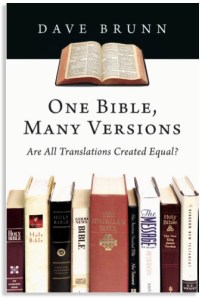
“Are literal versions really literal?” So asks Dave Brunn in One Bible, Many Versions: Are All Translations Created Equal? Brunn is a missionary and educator with extensive Bible translation experience. Noting that the Bible is “virtually silent” on “the issue of translation theory,” he seeks in his book to answer questions like:

  • “How literal should a Bible translation be?”
  • “What makes a translation of the Scriptures faithful and accurate?”
  • “What is the significance of the original form and the original meaning?”

He examines versions as diverse as the Message, the New Living Translation, the New International Version, the English Standard Version, and quite a few others. He lists examples on both the word level and the sentence level to show that “every ‘literal’ version frequently sets aside its own standards of literalness and word-for-word translation,” when slavish literalism would compromise meaning in the target language. For example, the New American Standard Bible–hailed as one of the most literal English translations–takes Genesis 4:1 (Hebrew: [Adam] knew [Eve]) and translates knew as had relations with. This accurately captures the meaning of Gen. 4:1, but it is not word-for-word.

So, too, with the ESV: Mark 9:3’s “no cloth refiner on earth” becomes “no one on earth” (among many, many examples Brunn gives).

At issue here is the relationship between form and meaning. He writes:

The form includes the letters, words, phrases, sentences, paragraphs, and so on. The meaning consists of the concepts or thoughts associated with each of the forms. Both elements are essential in all communication. …[I]t could be hard to argue that one is more important than the other.

To translate, Brunn points out, is to necessarily change the form. The only way to keep the form of Hebrew or Greek is to leave the text in Hebrew or Greek. There is no such thing as “consistent formal equivalence” between “any two languages on earth.” Brunn (rightly, in my view) suggests that it is okay (even necessary) “to set aside form in order to preserve meaning,” but that one should not sacrifice meaning for the sake of preserving form. Besides, he points out, no translation (not even the most “literal” one) sacrifices meaning every time for the sake of formal, word-for-word equivalence.

Brunn drives his point home especially well by making reference to other languages. Perhaps folks argue about literalness in English translations because of English’s linguistic/familial relationship to Greek. But what about non-Indo-European languages, Brunn asks? “As long as the debate about Bible translation stays within the realm of English translation, the tendency will be to oversimplify some of the issues,” he writes. “I believe that many well-meaning Christians have unwittingly made English the ultimate standard.” His examples of translation challenges going from English to Lamogai (the language into which he worked with others to translate the New Testament) reinforce his idea that word-for-word equivalence is simply not possible across languages. (Lamogai, for example, uses gender-neutral terms to refer to siblings, whereas Greek and English do not.)

The translations that people fight over have more in common than we may first realize. Brunn calls for unity among Christians when it comes to what translations we use. “If we set any two English Bible versions side by side,” he says, “We could easily find hundreds of instances where each version has the potential of strengthening and enhancing the other.” (Indeed, there are even times when less “literal” versions like the NIV or NLT seem to stay closer to the original languages at the word level than versions like the ESV or NASB.)

Knowledge of Hebrew and Greek is not needed to profitably use One Bible, Many Versions, though Brunn does have footnotes for “readers who are already knowledgeable in translation issues.” His numerous charts clearly show the difference between form and meaning in multiple translations.

Brunn gives good guidelines for Bible readers and translators alike, as they seek to discern what translations to use and how to think about translation theoretically. Especially in the second half, the book felt a little repetitive–I didn’t think Brunn needed as many examples to make his point that literal translations don’t consistently adhere to their own standards. Though perhaps those who need more convincing will appreciate the extensive charts.

What I was most impressed by was Brunn’s obvious high regard for Scripture, together with a pastoral sense of how to navigate the so-called Bible translation debates. In addition to these, the care with which he analyzed translations and compared them to each other made it easy to follow (and agree with) him. Whether you’re interested in Bible translation or exploring the differences between various versions, One Bible, Many Versions is an engaging and informative guide.

Brunn has a Website here; the book’s site is here.

Thanks to IVP for the review copy. You can find the book on Amazon here, and its IVP product page here.