“So we made a rule: no overdubs”

A new Gungor book and album released yesterday. Michael Gungor writes:

I was actually writing about all of these ideas about art and how it should be more human, soulish and vulnerable while we were on tour, recording the album that was released yesterday. And I was faced with a decision. As I listened to the recordings of the evenings, there was a raw energy about them that I really liked. But I also heard our humanness. I heard little things that I knew we could easily “fix” with a few overdubs. There were moments where we could have inserted crowd samples to make the crowd sound even more excited and pumped up. But I was right in the middle of writing this book that is addressing how our most popular art continues to become more and more plastic and less human, and I just couldn’t do it. I felt like I needed to let the recordings stay as live and authentic as possible.  So we made a rule: no overdubs.

Read the whole thing here.

N.T. Wright on learning Greek, and a review of A Reader’s Hebrew and Greek Bible by Zondervan

I met N.T. Wright briefly in January at a worship symposium and asked him how to improve my Greek. He said, “Read the text, read the text, read the text.”

He told me to really get the feel of the language. Don’t think of Greek just as a code for English; get into the Greek itself. I asked him about reading with a diglot, but he encouraged me to check the English translation only after reading an entire Greek paragraph, and then, only as necessary.

The same holds true with Hebrew. Read the text, read the text, read the text. Reading it out loud is even better, and better still is trying to speak it to others.
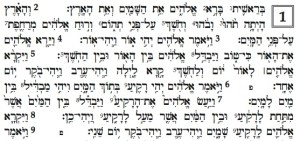
Zondervan has published what is to my knowledge the only “reader’s” edition of the Hebrew Bible. It’s a masterpiece. The font is clear, sized perfectly, and easy to read (see at right, and click to enlarge). It uses the Leningrad Codex. It has no textual apparatus (which could be a distraction in a “reader’s edition”), but instead footnotes rarely occurring vocabulary. Not counting proper nouns, editors Philip Brown and Bryan Smith footnote all words that occur less than 100 times in the Hebrew Bible. Here they give “glosses,” which give the reader the basic meaning of the word. Aramaic words that occur less than 25 times are listed in the footnotes in the page on which they occur.

For readers who blank on a word that occurs, say, 150 times in the Hebrew Bible, a glossary at the back will allow them to look up even additional words.

Brown used HALOT and BDB to write the glosses. The bottom of the page looks like this (click for larger):

Note in #s 2, 7, and 8 that there is also listed what the verb stem is for a given use. What makes this feature especially easy to use is the bolding of the words before their glosses.

The only thing to critique in the Hebrew reader’s edition is that proper nouns, which are to appear in grey font since they’re not footnoted, occasionally go missed. Brown has posted an errata list here, many of which have been fixed in recent printings.

For a preview of the Hebrew reader’s edition, see here (PDF) and here (PDF).

Zondervan’s Greek reader’s New Testament has not met with such universal acclaim. It’s a good resource to have on hand, to be sure, but in my view it’s not as well executed as the Hebrew reader’s Bible.

Rather than being based on the scholarly editions of the NA27 or UBS4, the text is “the eclectic text that underpins the Today’s New International Version.” The scholars who produced the TNIV, in other words, made different textual decisions in some instances than did the editors of the “Standard Text” of the NA27/UBS4. Where this is the case, a limited textual apparatus notes it. While this could be problematic for textual criticism, the text is not vastly different from the standard one, and is certainly fine for reading.

As with the Hebrew reader’s edition, the Greek reader’s Bible footnotes and explains words that occur less than 30 times in the Greek New Testament. One unfortunate decision is that, unlike the Hebrew, the Greek footnotes do not have the glossed word in bold. This makes navigating the footnotes more cumbersome:

Font is perhaps a personal preference. While Philip Brown did a magnificent job of typesetting the Hebrew, the Greek font leaves something to be desired. It’s not the easiest Greek font I’ve read. It’s not unreadable as fonts go, but it’s thin. I got used to it after a while, so it’s not unmanageable, but the font in the UBS Greek Reader’s New Testament is easier to read. The latter also puts the footnoted glosses into two columns, which makes referencing them quicker.

Not long ago Zondervan combined the Hebrew and the Greek into one mammoth, leather-bound Reader’s Hebrew and Greek Bible. The volume is large (but how could it not be?) and impressive. It’s constructed well. The binding is sewn (rejoice!), so it will last for a while.

This combination carries with it the great advantage that its user has both the Hebrew and the Greek Bibles under one cover. Now I just have to carry one geeky Bible to church rather than two! Huge benefit.

Another nice thing about this edition is that with Hebrew going from right to left and Greek from left to right, the Greek New Testament starts at the “front” and the Hebrew Bible starts at the “back,” just as both would be in their separate volumes.

The introduction to each half explains well how the text is laid out, the footnoting of the vocabulary, and so on. All the glory of Brown’s Hebrew edition is there, and the less-than-ideal Greek font is there in the Greek portion. One thing to add in appreciation of the Greek part, however, is that Old Testament quotations appear in bold, with their references listed at the bottom of the page. The eight pages of color maps between the two sections are a nice bonus, too.

The construction of the two Bibles combined is executed quite well. I’m happy to only have to take one original language Bible with me to church now.

Thanks to Zondervan for the review copy of A Reader’s Hebrew and Greek Bible. They provided me with one in the hopes of my reviewing it on my blog, but with no expectation as to the content of the review. Find Zondervan’s product page here.

New President for Princeton Seminary

Princeton Seminary has just announced a new President, Reverend Dr. M. Craig Barnes:

The Board of Trustees of Princeton Theological Seminary is pleased to announce the unanimous election of the Reverend Dr. M. Craig Barnes as its seventh president, and as professor of pastoral ministry.  Barnes, a 1981 Master of Divinity graduate of Princeton, has also served as a trustee of the Seminary. Dr. Barnes currently serves as the Robert Meneilly Professor of Pastoral Ministry and Leadership at Pittsburgh Theological Seminary and pastor of the 1,100-member Shadyside Presbyterian Church in Pittsburgh.

Here is the announcement in full.

BHS, the Göttingen Septuagint, and other critical editions: a basic orientation to what they are

Image source: http://www.usc.edu/ (click on image for more details)

Most students of the Hebrew Bible who read Hebrew know of the premier scholarly edition, the Biblia Hebraica Stuttgartensia (BHS, here on Amazon).  The BHS is now being updated by the BHQ (Q=Quinta), about which you can read more here. Both the BHS and BHQ are “diplomatic” editions of the text, which means that they reproduce a single “best” manuscript, the Leningrad Codex, in their cases. The footer in each page contains a critical apparatus, which lists variant readings from other manuscripts and versions that the editors have deemed to be of importance for getting even closer to the “original” (now often being called the “earliest attainable text”). In some cases, the editors may wish to show where another manuscript or version differs from the Leningrad Codex; the critical apparatus is where they do it.

There are two other similar projects underway for the Hebrew Bible. One is the Hebrew University Bible Project, also a diplomatic edition, but unlike BHS and BHQ, based on the Aleppo Codex. The HUB includes a more extensive critical apparatus than BHS, so that readers can see more textual variants.

The other scholarly edition of the Hebrew Bible is the Oxford Hebrew Bible Project, “a new critical edition of the Hebrew Bible featuring a critical text and extensive text-critical introduction and commentary.” Though the BHQ contains commentary, too, the OHB differs in being an “eclectic” text, meaning that, as R.S. Hendel says (quoted in Tov),

The practical goal for the OHB is to approximate in its critical text the textual “archetype,” by which I mean the earliest inferable textual state.

Though the textual apparatuses of the BHS/BHQ and HUB can theoretically aid the reader in approximating the textual “archetype,” the text of the OHB offers that approximation rather than reproducing an actual manuscript (as the diplomatic editions do). Hence, the OHB is an “eclectic” edition. (So, too, are the two major scholarly editions of the Greek New Testament, the NA27 and UBS4.)

The Septuagint–the Greek translation of these Jewish Scriptures–has various scholarly editions, too.

On its Website the International Organization for Septuagint and Cognate Studies (IOSCS) has a great primer on the various editions of the Septuagint. Below, “OG” stands for “Old Greek.” They write:

The creation and propagation of a critical text of the LXX/OG has been a basic concern in modern scholarship. The two great text editions begun in the early 20th century are the Cambridge Septuagint and the Göttingen Septuagint, each with a “minor edition” (editio minor) and a “major edition” (editio maior). For Cambridge this means respectively H. B. Swete, The Old Testament in Greek (1909-1922) and the so-called “Larger Cambridge Septuagint” by A. E. Brooke, N. McLean, (and H. St. John Thackeray) (1906-). For Göttingen it denotes respectively Alfred Rahlfs’s Handausgabe (1935) and the “Larger Göttingen Septuagint” (1931-). Though Rahlfs (editio minor) can be called a semi-critical edition, the Göttingen Septuaginta (editio maior) presents a fully critical text, as described below.

Beginning Septuagint students are likely to own just “Rahlfs” (the Handausgabe mentioned above). But those who want to do more detailed text work with the Septuagint want more than the mini-apparatus in that edition.

Between Accordance (here) and Logos (here), nearly everything listed in the above quotation is available in electronic form. Accordance has Rahlfs’s Apparatus, parts of the larger Göttingen edition, and both the smaller (Swete) and most of what is currently available in the larger Cambridge Septuagint. Logos has all the volumes of Göttingen that have been completed to date.

There is more here about the scholarly versions of the Septuagint, including a volume-by-volume listing of both the Cambridge and Göttingen projects.

I have been fortunate to receive a review copy of BHS and BHQ Hebrew Bible editions from Accordance, as well as the existing volumes of the Göttingen Septuagint from Logos. I’ll be reviewing each in the coming weeks.

UPDATE: My review of BHS in Accordance is here. My BHQ review is here. Part 1 of a short primer on using the Göttingen Septuagint is here.

Free PDF sample of Sustainable Youth Ministry Study Guide

Youth Ministry Architects has posted a sample .pdf of Sustainable Youth Ministry: The Study Guide, which I wrote as a resource for using Mark Devries’s Sustainable Youth Ministry. I’ve posted in more detail about the study guide here. Click here (PDF) or on the image above for a sample of the study guide.

Logos 4: a quick note about a portable library

Ah, the age-old debate about how one should build a library: print or digital?

Okay, it’s not really that old of a debate. But it’s one I’ve gone back and forth on. I own the major lexicon for the Greek New Testament in digital edition. Same thing with the major lexicon for the Hebrew Bible. (They’re both huge.) But I went a bit overboard with the LEH lexicon for the Septuagint: I have it in print, in Logos, in Accordance, and in BibleWorks! (I only had to pay for the print edition, though.)

I’m taking a great class on the use of the Old Testament in the New. Most of the texts we use for the class list multiple biblical references, but don’t write out the verses. Take this example from Richard N. Longenecker’s Biblical Exegesis in the Apostolic Period:

V. Quotations occurring in John alone, with introductory formulae:

35. John 6:45 (Isa 54:13; Jer 31:33).
36. John 7:38 (Isa 12:3; 43:19–20; 44:3; 58:11).
37. John 10:34 (Ps 82:6 [LXX = 81:6]).
38. John 13:18 (Ps 41:9 [MT = 41:10; LXX = 40:10]).
39. John 15:25 (Ps 35:19 [LXX = 34:19]; 69:4 [MT = 69:5; LXX = 68:5]).

That’s a lot to look up! Especially flipping back and forth between Hebrew, Greek, and English versions.

In the Logos 4 edition of the book, however, all those texts are hyperlinked, so that I simply have to mouse over them to have a pop-up window display the verses in my preferred version. This is a great time saver, and I much prefer to read a book like this with such an easy way to look at the verses it’s referencing. I can also set up my windows and tabs in Logos to have multiple Bibles/versions open, too, while I read through a book.

I know print is better on my eyes than a screen is, so there’s still that. But the hyperlinking system in Logos makes buying books from them a desirable option–and they have a wide selection.

I also know that my bookshelves at home are beyond full, so my wife will likely appreciate digital additions to my library rather than more books in the living room….

This is a bit of an excursus in my Logos 4 review, though I purchased the Logos edition of the book above. See part 1 of my Logos 4 review here, part 2 here, part 3 here, and part 4 here.

BibleWorks 9 now runs natively on Macs

Big news from BibleWorks today. BibleWorks 9 now runs natively on a Mac. And there’s a free way Mac users who own BibleWorks 9 can do it. Read all about it here.

I’m looking forward to taking it for a spin.

See links to all six parts of my BibleWorks 9 review here.

UPDATE 10/4/12: Shoot! It’s no longer going to be available for free, and at the moment (10/4/12), it’s not available at all:

10/4/2012: Due to licensing restrictions, it turns out that we will have to offer the BibleWorks 9 Mac Public Preview through our webstore. We’re sorry for the inconvenience, but if you check back here early next week, we should have it available again!

Hopefully this gets ironed out soon. I’d love to use BibleWorks on a Mac.

UPDATE 2, 10/4/12: See here.

Leslie C. Allen’s Liturgy of Grief for under $5 (ebook)

Leslie C. Allen’s Liturgy of Grief is under $5 this month in ebook form. It’s here on Amazon ($4.99) and here on CBD ($3.99). It’s a good deal for a great “pastoral commentary” on Lamentations.

I reviewed the book this summer, as well as interviewed the author.