
We sent five student worship leaders to the Calvin Worship Symposium this year. Here is the Symposium recap from Calvin. You can watch the final communion service here.

Weekly Greekly Lectionary Confectionery
If your church uses a fixed Sunday lectionary, I found a great blog for you this week. Looking at the Greek (and English translation) of the Gospel reading each week, Left Behind and Loving It is a help to preachers (and parishioners) who want to explore the text in depth.
The Greek is there, but knowledge of it certainly isn’t required to make use of the site. Posts come early in the week, too–no “Saturday specials” here!
Share this:
This just happened (cute baby alert)


New Mark Kozelek track (Sun Kil Moon+Album Leaf)

Like the rest of the entire human race, I have trouble waiting for things I want. I especially have trouble waiting for new music I know has been recorded but not yet released to said human race. This morning I checked the Caldo Verde Records site in hopes of hearing some new Mark Kozelek. I was not disappointed.
If you click on the image above you can listen to a new track from the Koz’s collaboration with The Album Leaf. (Language warning for last portion of song: much as I love the man’s music and most of his words, there are the occasional, less-than-edifying lyrics.)
I reacted here to the idea of a Sun Kil Moon collaboration with The Album Leaf. I like this track better than the first (to which I linked in my earlier post). Still not much by way of guitar, but that will come with Koz’s February release of a covers album.
This new track had me going until the end (see comment on lyrics above). I’ll try to post a cute baby picture later as recompense.
Share this:

Review of Zondervan’s Theologian Trading Cards
They’re a real thing, and they’re the best conversation starter I’ve brought into my office in a long time.

Creator Norman Jeune III came up with the idea of Theologian Trading Cards in seminary. It’s a good one. I remember, as a kid, memorizing and quoting statistics and quizzing friends with the back of baseball cards. I could tell you how many home runs and runs batted in Andrew Dawson of the Chicago Cubs had had for the last five years. It’s a good size for a learning tool.
The product description from Zondervan reads:
Patterned after the all-American baseball card, Theologian Trading Cards provide essential information about the major teachers, leaders, and trouble-makers throughout the history of the Church. At a glance you will have access to information regarding 288 important figures in church history, including when and where they lived, their contribution to the church, and enduring significance.
Jeune has organized the cards into 15 teams, each grouped by chronological or historical or theological commonality. The “Orthodoxy Dodgers” (great name) are the church’s heretics. Marcion (85-160), for example, “created his own canon [of Scripture], exlcuding the Old Testament and introducing numerous edits, compilations, and omissions to the New Testament.” The “St. James Padres” team consists of early church fathers: Ambrose, Augustine, Cyril, Justin, and so on.
The cards aren’t really “trading cards,” since there’s no trading to be done–you can only buy it as a complete set. But they’re just as fun as the baseball cards I collected as a kid… well, if you think theology is fun. (Which, of course, it is!) Jeune introduces a creative medium in a field that can be challenging for students. There are a lot of facts, figures, and beliefs to keep straight in a basic church history course.
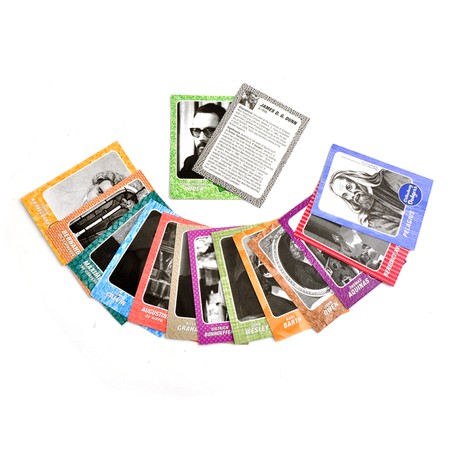
The front of the card consists of a photo (except where none is available; see below), the name of the figure, and his or her team. The back of each card has dates and two sections: biographical and significance. Of course it would be impossible to cover everything (even all the significant things) in each figure’s life on just the back of a card. But Jeune does a good job of hitting the main points.
And the cards are fun. I don’t think I’ve ever had anything on my office coffee table picked up as much as these cards. Folks want to leaf through and see who’s there, what is written about them, etc. I’d imagine that they aid exam preparation, too. The handy size makes them easy to stuff in backpack, or put a small stack in a purse for on-the-go quizzing.
Of course a set like this is prone to criticism–which figures Jeune includes, which ones he doesn’t, how much detail he includes, what detail he leaves out. There is somewhat decent representation of more than just white males–users of this set will find cards for Amy Carmichael, Elisabeth Schüssler Fiorenza, Rosemary Radford Ruether, Teresa of Avila… though still one wants for more. There is James Cone, but no MLK? Julian of Norwich, but no Perpetua? This must be impossible to get right in a set like this, but those omissions are noticeable. I’m holding out for a “booster pack” to add to the set.
Another quibble I have is that while each of the 15 teams has a checklist, there is no comprehensive checklist for the set. Even if spread out over a few cards, it would be useful to be able to quickly see all the persons that Jeune includes in the set. (Perhaps he will upload a list online in the future? If so, I’ll post here.)
 A distraction in the set is the number of cards that have a blank silhouette with a question mark on it. For these the publisher was not able to procure an image. There is a good reason for this, and it’s worth reading Jeune’s explanation here. All the same, an original sketch, however basic, would have been preferred. (Remember those Facebook friends who joined but didn’t add a profile pic for months? It looks like that, only with the super-imposed question mark.)
The idea of Theologian Trading Cards is a great one, though. The cards aim to be “a fun way to learn church history and theology.” They are that, but I hope future editions or additional sets/booster packs will be more thorough in covering all the areas and players in church history and theology. Until then, this is still a set worth having. Jeune’s layout makes it easy to fill in the gaps in one’s knowledge of church history and theologians.
Thanks to Zondervan for the opportunity to review the cards gratis. Find the cards here at Amazon or at their Zondervan product page. See here for a few sample cards.
Share this:

A Prayer for Difference amidst Unity, and Unity amidst Difference

Does race matter? Is ethnicity important? How do cultural backgrounds affect our everyday lives?
This week at Gordon College we have a special emphasis week, BEYOND COLORBLIND:
BEYOND COLORBLIND is a focus week to help start new conversations about race and culture on campus. We hope the lectures and discussions help us consider how our racial and cultural identities and experiences shape our views of ourselves, others, and God.
You can watch the first large group session of the week (chapel) here. Richard Twiss was the main speaker. It’s well worth your time.
Two weeks ago I shared a prayer for the first day of school. Today I’m sharing the congregational prayer we prayed in unison this morning in chapel. This came after the passing of the peace.
God, lover of all people,
Creator of all nations,
We praise you for all that you have made.Thank you for the rich mosaic that is the body of Christ.
Thank you for difference amidst unity,
for unity amidst difference.Give us a spirit of understanding and appreciation of each other.
Help us to see your image clearly in those around us.Bless us now as we gather,
and may we declare your praises with our whole lives,
through our risen Lord Jesus.
Amen.
Find out more about the week here.
Share this:

Greek Isaiah in a Year, Week 9=Isaiah 10:5-10:29

This week in Greek Isaiah in a Year covers Isaiah 10:5-29.
Here is the schedule and text for Monday through Friday, using again the text from R.R. Ottley’s Book of Isaiah According to the Septuagint. (As always, Ottley is here on Amazon, here in Logos, and here as a free, downloadable pdf in the public domain.) The full reading plan for our group is here (pdf).
Monday, January 28: Isa 10:5-9
5 Οὐαὶ Ἀσσυρίοις, ἡ ῥάβδος τοῦ θυμοῦ μου καὶ ὀργῆς ἐν ταῖς χερσὶν αὐτῶν. 6 τὴν ὀργήν μου εἰς ἔθνος ἄνομον ἀποστέλλω, καὶ τῷ ἐμῷ λαῷ συντάξω τοῦ ποιῆσαι σκῦλα καὶ προνομήν, καὶ καταπατεῖν τὰς πόλεις καὶ θεῖναι αὐτὰς εἰς κονιορτόν. 7 αὐτὸς δὲ οὐχ οὕτως ἐνεθυμήθη, καὶ τῇ ψυχῇ οὐχ οὕτως λελόγισται· ἀλλὰ ἀπαλλάξει ὁ νοῦς αὐτοῦ, καὶ τοῦ ἐξολεθρεῦσαι ἔθνη οὐκ ὀλίγα. 8 καὶ ἐὰν εἴπωσιν αὐτῷ Σὺ μόνος εἶ ἄρχων, 9 καὶ ἐρεῖ Οὐκ ἔλαβον τὴν χώραν τὴν ἐπάνω Βαβυλῶνος καὶ Χαλαννή, οὗ ὁ πύργος ᾠκοδομήθη; καὶ ἔλαβον Ἀραβείαν καὶ Δαμασκὸν καὶ Σαμάρειαν·
Tuesday, January 29: Isa 10:10-14
10 ὃν τρόπον ταύτας ἔλαβον ἐν τῇ χειρί μου, καὶ πάσας τὰς χώρας λήμψομαι. ὀλολύξατε, τὰ γλυπτὰ ἐν Ἰερουσαλὴμ καὶ ἐν Σαμαρείᾳ· 11 ὃν τρόπον γὰρ ἐποίησα Σαμαρείᾳ καὶ τοῖς χειροποιήτοις <αὐτῆς,> οὕτως ποιήσω καὶ Ἰερουσαλὴμ καὶ τοῖς εἰδώλοις αὐτῆς. 12 Καὶ ἔσται ὅταν συντελέσῃ Κύριος πάντα ποιῶν ἐν τῷ ὄρει Σιὼν καὶ ἐν Ἰερουσαλήμ, ἐπάξει ἐπὶ τὸν νοῦν τὸν μέγαν, τὸν ἄρχοντα τῶν Ἀσσυρίων, καὶ ἐπὶ τὸ ὕψος τῆς δόξης τῶν ὀφθαλμῶν αὐτοῦ. 13 εἶπεν γὰρ Τῇ ἰσχύι ποιήσω, καὶ <τῇ σοφίᾳ τῆς συνέσεως> ἀφελῶ ὅρια ἐθνῶν, καὶ τὴν ἰσχὺν αὐτῶν προνομεύσω· 14 καὶ σείσω πόλεις κατοικουμένας, καὶ τὴν οἰκουμένην ὅλην καταλήμψομαι τῇ χειρί μου ὡς νοσσιάν, καὶ ὡς καταλελιμμένα ὠὰ ἀρῶ· καὶ οὐκ ἔστιν ὃς διαφεύξεταί με ἢ ἀντείπῃ μοι.
Wednesday, January 30: Isa 10:15-19
15 Μὴ δοξασθήσεται ἀξίνη ἄνευ τοῦ κόπτοντος ἐν αὐτῇ; ἢ ὑψωθήσεται πρίων ἄνευ τοῦ ἕλκοντος αὐτόν; ὡσαύτως ἐάν τις ἄρῃ ῥάβδον ἢ ξύλον, καὶ οὐχ οὕτως; 16 ἀλλὰ ἀποστελεῖ Κύριος σαβαὼθ εἰς τὴν σὴν τιμὴν ἀτιμίαν, καὶ εἰς τὴν σὴν δόξαν πῦρ καιόμενον καυθήσεται· 17 καὶ ἔσται τὸ φῶς τοῦ Ἰσραὴλ ὡς πῦρ, καὶ ἁγιάσει αὐτὸ ἐν πυρὶ καιομένῳ, καὶ φάγεται ὡσεὶ χόρτον τὴν ὕλην. 18 τῇ ἡμέρᾳ ἐκείνῃ ἀποσβεσθήσεται τὰ ὄρη καὶ οἱ δρυμοὶ καὶ οἱ βουνοί, καὶ καταφάγεται ἀπὸ ψυχῆς ἕως σαρκῶν· καὶ ἔσται ὁ φεύγων ὡς ὁ φεύγων ἀπὸ φλογὸς καιομένης· 19 καὶ οἱ καταλειφθέντες ἀπʼ αὐτῶν ἔσονται ἀριθμός, καὶ παιδίον γράψει αὐτούς.
Thursday, January 31: Isa 10:20-24
20 Καὶ ἔσται ἐν τῇ ἡμέρᾳ ἐκείνῃ οὐκέτι προστεθήσεται τὸ καταλειφθὲν Ἰσραήλ, καὶ οἱ σωθέντες τοῦ Ἰακὼβ οὐκέτι μὴ πεποιθότες ὦσιν ἐπὶ τοὺς ἀδικήσαντας αὐτούς, ἀλλʼ ἔσονται πεποιθότες ἐπὶ τὸν θεὸν τὸν ἅγιον τοῦ Ἰσραὴλ τῇ ἀληθείᾳ. 21 καὶ ἔσται τὸ καταλειφθὲν τοῦ Ἰακὼβ ἐπὶ θεὸν ἰσχύοντα. 22 καὶ ἐὰν γένηται ὁ λαὸς Ἰσραὴλ ὡς ἡ ἄμμος τῆς θαλάσσης, τὸ κατάλειμμα σωθήσεται· λόγον γὰρ συντελῶν καὶ συντέμνων ἐν δικαιοσύνῃ, 23 ὅτι λόγον συντετμημένον ποιήσει ὁ θεὸς ἐν τῇ οἰκουμένῃ ὅλῃ. 24 Διὰ τοῦτο τάδε λέγει Κύριος ὁ θεὸς σαβαώθ Μὴ φοβοῦ, ὁ λαός μου, οἱ κατοικοῦντες ἐν Σιών, ἀπὸ Ἀσσυρίων, ὅτι ἐν ῥάβδῳ πατάξει σε· πληγὴν γὰρ ἐπάγω ἐπὶ σέ, τοῦ ἰδεῖν ὁδὸν Αἰγύπτου.
Friday, February 1: Isa 10:25-29
25 ἔτι γὰρ μικρὸν καὶ παύσεται ἡ ὀργή, ὁ δὲ θυμός μου ἐπὶ τὴν βουλὴν αὐτῶν· 26 καὶ ἐπεγερεῖ ὁ θεὸς ἐπʼ αὐτοὺς κατὰ τὴν πληγὴν τὴν Μαδιὰμ ἐν τόπῳ θλίψεως, καὶ ὁ θυμὸς αὐτοῦ τῇ ὁδῷ τῇ κατὰ θάλασσαν, εἰς τὴν ὁδὸν τὴν κατʼ Αἴγυπτον. 27 καὶ ἔσται ἐν τῇ ἡμέρᾳ ἐκείνῃ ἀφαιρεθήσεται ὁ φόβος αὐτοῦ ἀπὸ σοῦ, καὶ ὁ ζυγὸς αὐτοῦ ἀπὸ τοῦ ὤμου σου, καὶ καταφθαρήσεται ὁ ζυγὸς ἀπὸ τῶν ὤμων ὑμῶν. 28 ἥξει γὰρ εἰς τὴν πόλιν Ἀγγαί, 29 καὶ παρελεύσεται εἰς Μαγεδδώ, καὶ ἐν Μαχμὰς θήσει τὰ σκεύη αὐτοῦ· καὶ παρελεύσεται φάραγγα καὶ ἥξει εἰς Ἀγγαί, φόβος λήμψεται Ῥαμὰ πόλιν Σαούλ. φεύξεται ….
See here for more resources and links to texts for Greek Isaiah. Here are previous weeks’ readings: Week 1 / Week 2 / Week 3 / Week 4 / Week 5 / Week 6 / Week 7 / Week 8
And here are the Week 9 readings above, but in pdf form.
Share this:

Jesus Makes a Pun in the Synagogue

Jesus makes a pun in Luke 4. I’m not the first one to notice this, but it stood out to me as I read my way through Luke 4:14-21 this past week. I’m preaching on the passage at my church tomorrow.
Jesus enters the synagogue at his hometown of Nazareth in Galilee and opens the Isaiah scroll to Isaiah 61. In the NIV, the Luke passage reads as follows:
The scroll of the prophet Isaiah was handed to him. Unrolling it, he found the place where it is written:
The Spirit of the Lord is on me,
because he has anointed me
to preach good news to the poor.
He has sent me to proclaim freedom for the prisoners
and recovery of sight for the blind,
to release the oppressed, to proclaim the year of the Lord’s favor.
But a few verses later (v. 24) Jesus tells the people, “No prophet is accepted in his hometown.” (They tried then to throw him off a cliff.)
The play on words Jesus uses is not readily evident in most translations, but Jesus uses the same word for favor (“year of the Lord’s favor“) as he does for accepted (“no prophet is accepted“). It’s a rare enough Greek word Luke uses, that I can only conclude it’s deliberate–this is the only passage in all the Gospels to use this word. (For Hellenophiles who read this blog, the word is δεκτός.)
The translations aren’t necessarily wrong to obscure the fact that it’s the same word in each verse. After all, context determines meaning, so even this same word carries different nuances the two times it’s used.
But the irony is that in this year of the Lord’s favor, which Jesus notes later in the passage begins “today,” even his hometown will not accept him. There is no acceptance (δεκτός) of this favor (δεκτός).
And before we rush to point backwards at the hard-heartedness of 1st century Nazareth, perhaps we easily enough realize those ways in which we fail to accept the favor that God would lavish on us. May Jesus give us sight where we do not see all that he comes to offer us.
Share this:

3 More Romans Monographs to Check Out
To add to the three books I mentioned in yesterday’s post, here are three more books about Romans I’ve enjoyed using the last couple months, with sample quotes.
Benjamin Schließer, Abraham’s Faith in Romans 4: Paul’s Concept of Faith in Light of the History of Reception of Genesis 15:6. (Tübingen: Mohr Siebeck, 2007.)
The foregoing overview of the interpretation of Gen 15:6 in Jewish theology has yielded a wide array of results and by no means a straightforward line of development in the way how the authors conceived of Abraham’s faith and God’s judgment on it.
Krister Stendahl, Final Account: Paul’s Letter to the Romans. (Minneapolis: Fortress, 1995.) (I reviewed Stendhal here.)
Consequently, Romans is central to our understanding of Paul, not because of its doctrine of justification, but because the doctrine of justification is here in its original and authentic setting: as an argument for the status of Paul’s Gentile converts on the model of Abraham (Romans 4).
Gerhard H. Visscher, Romans 4 and the New Perspective on Paul: Faith Embraces the Promise. (New York: Peter Lang, 2009.) Here is Visscher’s outline of Romans 4:
Rom. 4:3-8: Paul’s First Argument from Genesis 15:6
Rom. 4:9-12: Second Argument from Genesis 15:6: Faith, Circumcision, and Gentiles
Rom. 4:13-22: Third Argument from Genesis 15:6
Rom. 4:23-25: Fourth Argument from Genesis 15:6: “For us also…”
Share this:

3 Great Off-the-Beaten Path Books about Romans
 Over the past couple of months I’ve spent a good deal of time in Romans 4. The more I study Paul’s magnum opus, the more amazed I am by all that he packed in and the way he did it.
In my reading and writing on Romans, I’ve come across some great monographs. Here are three, with a sample quote from each. I’ll do three more tomorrow.
Pablo T. Gadenz, Called from the Jews and from the Gentiles: Pauline Ecclesiology in Romans 9-11. (Tübingen: Mohr Siebeck, 2009.)
In sum, Christians in the Church, stemming from Jewish and Gentile origins, can rejoice together in the salvation available by faith in Christ to all without distinction. “Rejoice, O nations, with his people!” (Rom 15:10). With humility, they can marvel at God’s plan for Israel, of which the Gentile-Christians in particular are beneficiaries. “O the depth of the riches and wisdom and knowledge of God! How inscrutable are his judgments and how unsearchable his ways!” (Rom 11:33) (p. 328)
Israel Kamudzandu, Abraham As Spiritual Ancestor: A Postcolonial Zimbabwean Reading of Romans 4. (Leiden: Brill, 2010.)
In Romans 4, Paul elevates Abraham as an ancestor of a new Israel, which includes Jews and Gentiles. …In this new situation, Paul gives a new meaning to the Torah as an integrator of all nations of the world. (p. 98)
Philip Francis Esler, Conflict and Identity in Romans. (Minneapolis: Fortress, 2009.) I love this assessment. Before reading Esler, this is just how I had begun to understood Paul’s use of Abraham in Romans 4. Though he expresses it more eloquently than I could:
Above all, [the account of Abraham in Romans 4] carries forward Paul’s aim of recategorizing Judean and non-Judean Christ-followers in Rome into the new ingroup identity and does so by mobilizing collective memories to explain how both subgroups claim ancestry from Abraham in the same way—righteousness credited to them through faith. Abraham thus becomes the prototype of the new identity, portrayed by Paul in a manner peculiar to the needs of this communication and in the face of many rival construals of this patriarch that were possible in the ongoing processing of the past to serve the needs of the present. (p. 194)
Three more recommendations tomorrow.

 Words on the Word