Bible translators stand at the intersection of the biblical world and their own, with the task of communicating an ancient text in a contemporary language. The Greek translator of Isaiah provides interesting examples of the issues and problems this task presents. For instance, he sometimes substituted the more familiar names of local Greek deities in place of the long-forgotten names of pagan Semitic deities being denounced. Is it “right” to substitute contemporary terms that would clearly communicate the message to the readers in place of ancient terms and idioms that would be accurate but meaningless? Where do accuracy and clarity meet in “getting it right”?
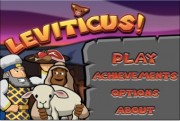
Sharpen your knife and your priestly reflexes: are you ready for the Ultimate Rule Book? Leviticus!
Play the role of a busy priest working to keep God happy by sacrificing choice offerings of sheep, goats, and bulls with frantic speed and slicing precision. Combo your actions and the rewards get BIBLICAL!
Three sacrificial services a day, seven days a week. Can YOU make it to Shabbat? Download Leviticus! and start swiping to find out!
That’s the real description of this real iPhone and iPad app: Leviticus! It sounds like Fruit Ninja meets the Hebrew Bible.
I don’t think Leviticus can be wholly reduced to a rule book (it is also all about covenant), and I don’t think sacrifices are best described as just an attempt to “keep God happy,” but there is a lot of detail in Leviticus that most of us struggle through when (if) we read it.
Here’s a screen shot. Not for the weak of stomach, though neither is Leviticus the book:
Titled Leviticus!, the game, as its title suggests, is both irreverent and deeply faithful to the source text—all that business about doves and cows and purity is right there in the book. But whereas Leviticus is too thick with rules to make for a very compelling read, it’s perfect when played.
As irreverent as this game first seemed to me, it may actually help one better understand the book. At least, that’s one of its purposes, according to the creator:
And education is at the heart of [Sarah] Lefton’s efforts. The game, she hopes, will do more than just amuse. “We brought something to very visual life that’s normally left on the page,” she said, “and that a lot of people just never study.” Believing that Jewish literacy and digital literacy make for excellent bedfellows—learning how to code and create applications that, in turn, are designed to enhance Jewish education and engagement—she now has future plans that involve not only the production of more games like Leviticus!, but also workshops teaching students and educators how to create their own Jewish-themed software.
The app is free, and found here. I don’t have an iPhone or iPad, so if anyone reading this downloads and tries it, I’d love to hear more about what you think. And it’s not April 1, so, as far as I know, the app is real.
Here is the schedule and text for Monday through Friday, using again the text from R.R. Ottley’s Book of Isaiah According to the Septuagint. Ottley is also here in Logos (reviewed here) and here as a free, downloadable pdf in the public domain. The full reading plan for our group is here (pdf).
This week in Greek Isaiah in a Year covers Isaiah 14:28-16:10. I’ve been behind off and on the last few weeks, but am caught up now. It’s amazing how even five verses a day can be a challenge to keep up with.
Here is the schedule and text for Monday through Friday, using again the text from R.R. Ottley’s Book of Isaiah According to the Septuagint (pictured at left; click on image to go to Amazon product page). Ottley is also here in Logos (I reviewed that edition here) and here as a free, downloadable pdf in the public domain. The full reading plan for our group is here (pdf).
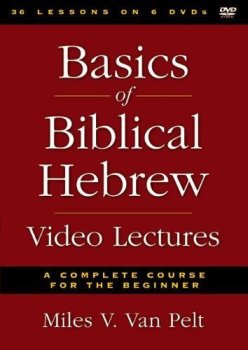
Miles Van Pelt keeps turning out the hits. Through Zondervan he has published resources that fill a gap in original language learning in biblical studies. I’ve reviewed (with approval) his Biblical Hebrew: A Compact Guide, his Basics of Biblical Aramaic, and have been grateful in my Göttingen Septuagint primer to link to a short two-page abbreviations sheet he produced for that critical edition of the Septuagint.
The DVDs work “chapter by chapter, section by section” through Pratico and Van Pelt’s Basics of Biblical Hebrew grammar textbook. The videos are “the basic content in lecture form for the grammar.” Here’s how Van Pelt recommends using the DVDs:
Each DVD chapter corresponds to a chapter in the textbook. The DVDs come with a pdf file that includes summary charts. Throughout the lectures Van Pelt refers to these charts and the screen moves to them as he is speaking.
There is nothing particularly novel or revolutionary in the videos that is not already covered to some degree in the textbook. But especially for a student who is making her or his way through the book alone, the video lectures serve to reinforce the material in a new medium. Even a student taking a course with a live lecturer could benefit from watching these alongside the class.
Van Pelt is a solid lecturer. If not overly exciting, he communicates concepts clearly. For just about anyone making their way through the grammar, it will be easy to follow these lectures.
He offers good study tips in the introduction, and continues to encourage learners throughout the 36 lectures. My favorite tip: “Begin reading your Hebrew Bible as soon as possible,” and, “Take that Bible with you everywhere.” I remember that often in my first year of Hebrew (I used the Van Pelt and Pratico text), I wanted to just be able to read the Hebrew Bible. There are examples throughout the grammar from the Bible, but learning charts and paradigms first can be tedious. This is perhaps a necessary tedium.
Or is it? Some people disagree that paradigm memorization outside the context of a text or conversation is ideal pedagogy for language learning. (Look at how babies acquire language, after all, the argument goes–by hearing, talking, etc., not by memorizing grammatical rules.) Even dead or ancient languages should be taught as “living languages,” proponents say. So some Hebrew textbooks encourage instead a text-based inductive approach.
Van Pelt at one point in the lectures says, “Languages are meant to be accessed and decoded in your mind,” though “decoding” is something a language learner ought to try to move away from as quickly as possible, as she or he seeks fluency. And an early strong verb paradigm has Van Pelt saying, “You must memorize this paradigm, like a ROBOT!”
Hebrew and other languages have been taught this way for a long time, and some language learners may not mind it. I, for example, find paradigm memorization tedious, but not overly difficult. If I have an end goal firmly in mind–reading the Hebrew Bible–I have motivation to repeatedly go over verb conjugations.
But I don’t think this approach will work for everyone, and the potential viewer of these videos should understand that Van Pelt takes a paradigm-memorizing approach to learning Hebrew, with not much inductive learning or interaction with the biblical text. (I think of my high school Spanish teacher, who would not answer classroom questions asked in English, but would simply say, “¡EnEspañol, por favor!”)
Van Pelt and Pratico’s materials use verbal diagnostics. Paradigm charts show in red what the unique prefixes and suffixes and vowels are for each verbal stem, so that it is not just rote memorization of multiple verbs. The diagnostics are a time-saving feature in this sense. As here:
For those interested in verbal theory, Van Pelt uses perfect (“completed action”) and imperfect (“incomplete action”) nomenclature to describe verbs.
The lectures are well-produced and alternate between views of charts like the one above, real-time writing (like a dry-erase board), and Van Pelt speaking. The clarity of the lectures is a strong point, as they reinforce the material in the textbook well.
If a student is already assigned the Pratico and Van Pelt text, he or she should seriously consider using the lectures as an additional study aid, if one is needed. If a student or professor has a choice as to which text to use for learning Hebrew, though, it is worth considering (either in addition or instead) other “living language”/inductive approaches. Randall Buth’s Living Biblical Hebrew or John H. Dobson’s Learn Biblical Hebreware two possible texts.
Chapter 1 of the lectures is here, if you want to get a flavor of the lectures (it’s just over an hour):
Thanks to Zondervan for the review copy. You can find the Basics of Biblical Hebrew Video Lectures here at Amazon. The Zondervan product page is here.
Wash away all my iniquity and cleanse me from my sin. Psalm 51:2
The heading of Psalm 51 gives its setting: “When the prophet Nathan came to [David] after David had committed adultery with Bathsheba.” The Hebrew text is more explicit in its description of David’s adulterous act in the Psalm heading. David had had sex with another man’s wife—and then had him killed in battle.
The French philosopher Jacques Derrida could have found himself at home in this Psalm. Derrida might point out that for David to follow up his sins with a plea for God to “wash away all [his] iniquity” is to ask the impossible. (For Derrida, as John Caputo puts it, the impossible is “something that exceeds the horizon of foreseeability and expectation.”)
In this sense David asks for the impossible. The affair with Bathsheba was sordid enough, but he also called Bathsheba’s husband, Uriah, back from battle to sleep with her in the hopes that no one would know David made her pregnant. When this plan failed, David oversaw military orders that sent Uriah to an unjust death. How audacious is David to ask for forgiveness from these sins that so “displeased the Lord” (2 Samuel 11:27)? Doesn’t David make an impossible request?
Caputo, in a somewhat Christianizing read of Derrida, writes, “[H]ope is truly hope when it has been pushed up against the impossible and everything looks hopeless.” All must have looked hopeless to David, who wrote, “My sin is always before me” (51:3). Yet he held out hope in God, praying, “Restore to me the joy of your salvation and grant me a willing spirit, to sustain me” (51:12).
With God the impossible is possible. We can be forgiven for even the unspeakable sins of our past. Some Psalms later David writes, “Praise the Lord, my soul… who forgives all your sins and heals all your diseases” (103:3).
Don’t we often feel “pushed up against the impossible”? Don’t we sometimes look at our sins, only to see that “everything looks hopeless”? And yet, “As far as the east is from the west, so far has he removed our transgressions from us” (103:12).
God exceeds the foreseeable. He transcends our expectations. He does not visit upon us the punishment that our sins deserve. David’s impossible request for forgiveness is possible, because God is the God of the impossible.
The above is a reflection I wrote for the Gordon College Lenten Devotional, “The Hope Before Us.” You can access a pdf of the whole devotional here.
$369.95 for the Göttingen Septuagint in Logos Bible Software. It’s on sale for International Septuagint Day, all day Friday (midnight to midnight). If you click here, it adds to your cart, and you can purchase from there–whether you already have the academic discount or not. Marked down from $700.
I reviewed the Göttingen Septuagint in Logos here. Its product page is here.
Göttingen. Not just a city in Germany, but a word that instills awe and fear in the hearts of every student of the Septuagint who must eventually consult the set of Old Greek editions by that name.
Okay, that’s maybe a bit dramatic. I do suspect, however, that if one finds it challenging to learn how to read the leading critical edition of the Hebrew Bible–the Biblia Hebraica Stuttgartensia or BHS–the Göttingen Septuagint will prove even more difficult to decipher.
Not impossible, though.
In celebration of International Septuagint Day Friday, here I review the Göttingen Septuagint in Logos Bible Software. The full name is Septuaginta: Vetus Testamentum Graecum Auctoritate Academiae Scientiarum Gottingensis editum. It’s published by Vandenhoeck & Ruprecht in Göttingen, Germany. The Göttingen Septuagint has published over 20 volumes covering some 40 biblical books (counting the minor prophets as 12). Publication of additional volumes, while slow-going, is in progress.
The typical contents of a volume include:
The introduction (“Einleitung”)
The reconstructed Greek critical text (“Der kritische Text”)
The Source List (“Kopfleiste”) (not every Göttingen volume has this)
The First Critical Apparatus (“Apparat I”)
The Second Critical Apparatus (“Apparat II”)
In two previous posts I wrote a primer on how to read and understand the Göttingen Septuagint. In part 1 I wrote about the reconstructed Greek critical text and the source list (full post is here). In part 2 I explained how to understand the first critical apparatus, here. Each of those posts contains additional explication of Göttingen, so the one who is new to it may want to pause here to read more there. Having written at length about numbers 2-4 above, a future post will cover 1 (the introduction) and 5 (the second critical apparatus).
Logos is the only Bible software that has available all of the published volumes of the Göttingen Septuagint. Though Logos offers the set in 67 volumes, that corresponds to the 24 existing print volumes. This includes the 2004 Supplementum, which offers a “list of Greek manuscripts of the Old Testament,” sorted by date, region, writing material, and more, and which also cross-references various editors’ classifications of manuscripts against each other, so that differing systems can easily be compared.
There is, of course, the question of which Bible software to use in general. I’ve written about issues like layout, functionality, cost, and so on here, which includes both praises and critiques of Logos, Accordance, and BibleWorks. So what about Göttingen in Logos?
From what I’ve seen, the text of Göttingen in Logos is the most accurate digital text available. I am aware of others who have found typos in Göttingen for Logos, but based on a verse-by-verse read of Isaiah 1-11, I found just one error in Logos compared to the print text. The Accordance text of Göttingen for Isaiah, by contrast, had 14 spelling mistakes, misplaced words, or wrong inflections in that same span. This was a surprise to me, since Accordance aims to produce “research-grade” texts, a goal which sometimes means their texts take longer to complete than other software companies. (Accordance currently has some, but not all, of the Göttingen volumes that exist in print.) As of right now, as far as the actual critical text of Göttingen, Logos seems to be the best bet for consistent correspondence to the print text.
It’s easy to set up the critical text and both apparatuses in three separate areas in Logos, syncing them to scroll together. One can also easily add a tab with an English translation, Hebrew Masoretic text, and more, so as to use Göttingen in conjunction with other resources. Here’s how I use Göttingen in Logos (click for larger):
Assuming you have other versions of the Septuagint available in Logos (Rahlfs, Swete, etc.) you can use the Text Comparison feature (top right in the shot above) to see where the critical text of Göttingen differs from another Septuagint text. I’ve found this to be a useful and time-saving feature. (One can do the same with the Compare tool in Accordance, though there’s an unresolved issue with that tool that impacts use of Göttingen. [UPDATE: It’s now resolved.] Accordance’s comparison tool is, however, a bit more versatile with its “List Text Differences” feature.)
You can use the critical text as any other text in Logos–double-click on a word to look it up in a lexicon (I have LEH open at bottom center above), right-click to do a variety of other searches, word study, etc. It doesn’t take long to see how many times the Göttingen text uses a given word.
As to the critical apparatuses, you can mouse over blue hyperlinked abbreviations to find out what they stand for. Or you can have an Information window open, as here (click to enlarge):
The apparatus abbreviates Latin and German, which is what the Information tab shows. (The Göttingen introductions are in German.) Miles Van Pelt’s short chart (in English) is helpful with the Latin (pdf here). And there is an English translation of the Pentateuch introductions available here (with Exodus being the most complete one). But there is no mechanism in Logos to translate the German or to decipher the apparatus. Accordance is the same here, and neither Logos nor Accordance offer a German-English dictionary, so one couldn’t even link to that. The general academic assumption, of course, is that by the time someone is using Göttingen in their study of the Septuagint, they are already learning (or have learned) German. (Ah, but academic assumptions….) I’m not sure it’s fair to fault Logos (or Accordance) for this lack, but a German-English dictionary as a future module would help a lot of users.
Speaking of the introduction, the introductions to each volume are nicely laid out with plenty of hyperlinks for easy reference:
You’ll have to know German to get very far in the introduction, but note the link above to English translations for some of the introductions. Also, though one ought not to rely too much on it, Google Translate takes the user surprisingly far if she or he simply copies from Logos and pastes here.
One thing lacking in the Logos Göttingen is the Kopfleiste (Source List). Not every print volume has it, but the five Pentateuch volumes, Ruth, Esther, and others do. Accordance, by contrast, includes this feature for the Göttingen volumes that have it. The Kopfleiste makes the most sense in a print edition (since it is a list of manuscripts cited on a given page), but someone doing serious textual research using Göttingen in Logos would still feel its lack. No word yet from Logos on if/when that will come available.
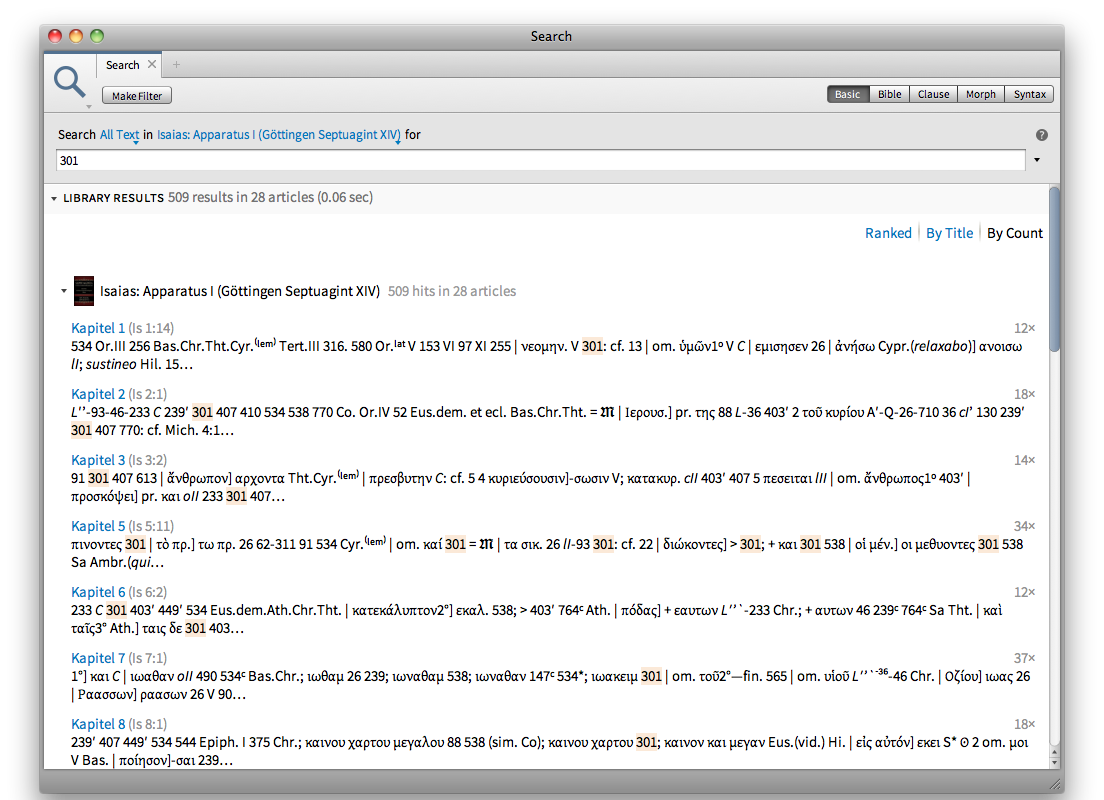
What about searching the apparatuses? Less than ideal here, though not unmanageable. If I want to see every time the First Critical Apparatus in Isaiah cites the Minuscule manuscript 301, I right click to “Search this resource,” but the results are grouped as follows (click to enlarge):
To my knowledge it is not possible to expand these results in this screen (pane) to see every use of MS 301, which is what I really want to be able to do. (If I am mistaken and find a way, I’ll post here again.) The shortcut command+F (in Mac) or control+F (in Windows) is an alternate way to search a text in Logos. The apparatuses are searchable using this keyboard shortcut; in this case all the instances of MS 301 are highlighted as you scroll through the apparatus, so you can still see all its occurrences.
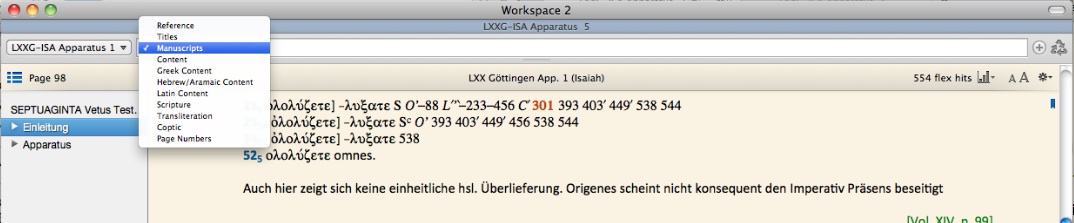
Accordance, by contrast, offers multiple ways of searching an apparatus: by references, titles, manuscripts (most helpful), Hebrew, Greek, or Latin content, and more. This makes Accordance’s apparatuses really usable and easy to navigate in multiple ways.
The price for the Logos Göttingen is a bargain. I mean, $700 is not cheap, but considering that the same sum would get you just a few volumes of the print edition, it’s a great deal. The academic program gives you a significant discount in this case, too.
By the way, a tip for using Göttingen efficiently in Logos: Brian Davidson of LXXI has a neat way to set up a Logos layout to include multiple Göttingen books. (They list in the Logos library all as separate volumes, not as one Septuagint.) His suggestion (here) is a good way to go.
All in all, the Logos Göttingen is a worthwhile investment, especially if you primarily want Göttingen for the critical text itself, and for the chance to compare it with other Septuagint editions. The lack of a Kopfleiste is not an immense loss, but the inability to search apparatuses by multiple search fields (and with expandable results) is a drawback. So the potential purchaser will just have to consider what his or her needs are. Accordance nails it in apparatus searching, but their critical text in Isaiah had more mistakes than one who needs an accurate text would like.
Logos has a fully digitized Göttingen Septuagint, so if you need access to everything that exists in print, know that this is the only Bible software where you can get it. Accordance continues production on their volumes and, as far as I know, will see the project through to completion. (Though see here and here, a project of Computer Assisted Tools for Septuagint Studies.)
In Logos it’s convenient to be able to scroll through all of the Göttingen Septuagint with additional resources open and a click away. The electronic availability (and affordability) of Göttingen is a significant step forward in text criticism and Septuagint studies.
Many thanks to Logos Bible Software for the review copy of the Göttingen Septuagint, given to me for the purposes of review, but with no expectation as to the content of my review. Accordance provided me with their Göttingen Isaiah for purposes of comparison.
First things first: Friday is International Septuagint Day. I’ll post again more then. This week in Greek Isaiah in a Year covers Isaiah 10:30 through the end of Isaiah 12 (a six-verse chapter). Friday we celebrate International Septuagint Day by reading a whole chapter of the Old Greek of Isaiah.
Here is the schedule and text for Monday through Friday, using again the text from R.R. Ottley’s Book of Isaiah According to the Septuagint. (As always, Ottley is here on Amazon, here in Logos, and here as a free, downloadable pdf in the public domain.) The full reading plan for our group is here (pdf).
If your church uses a fixed Sunday lectionary, I found a great blog for you this week. Looking at the Greek (and English translation) of the Gospel reading each week, Left Behind and Loving It is a help to preachers (and parishioners) who want to explore the text in depth.
The Greek is there, but knowledge of it certainly isn’t required to make use of the site. Posts come early in the week, too–no “Saturday specials” here!















 Words on the Word