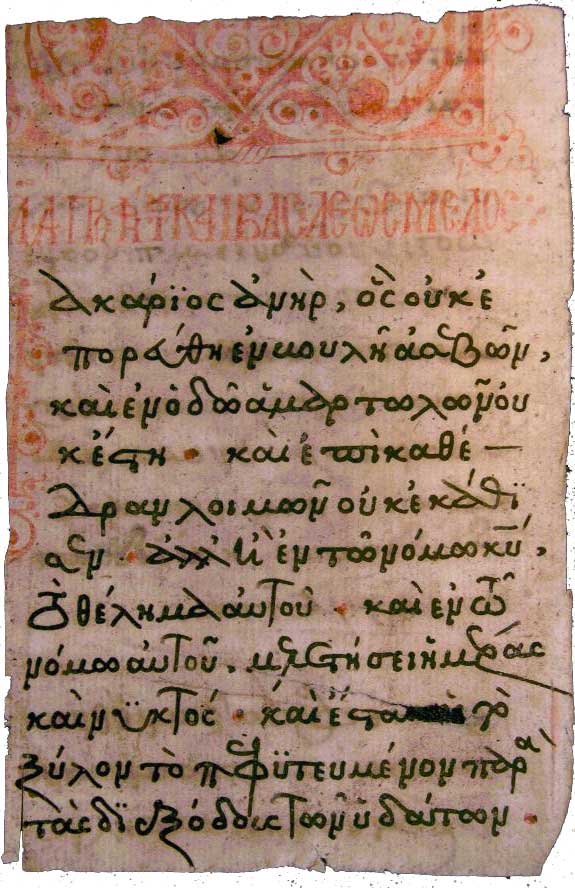
Greek Isaiah in a Year, Weeks 37 and 38 (Isa 44:21-46:13)

Isaiah prophet

Some beautiful verses kick off this week in Greek Isaiah in a Year:

Remember this, Jacob, and Israel, for thou art my servant; I formed thee for my servant, and thou, Israel, forget not me. For behold, I have blotted out thy transgressions as a cloud, and thy sins as darkness; turn thou to me, and I will redeem thee.

This week and next week in Greek Isaiah in a Year will cover Isaiah 44:21-46:13. Here are the readings for each day:

08/12/13   Isa 44:21–24
08/13/13   Isa 44:25–28
08/14/13   Isa 45:1–4
08/15/13   Isa 45:5-9
08/16/13   Isa 45:10-13

08/19/13   Isa 45:14–19
08/20/13   Isa 45:20–22
08/21/13   Isa 45:23–25
08/22/13   Isa 46:1–6
08/23/13   Isa 46:7–13

Below is the text from R.R. Ottley’s Book of Isaiah According to the Septuagint, first in Greek, then with his English translation. Ottley is also here in Logos (reviewed here) and here as a free, downloadable pdf in the public domain. The full reading plan for our group is here (pdf).

See here for more resources and links to texts for Greek Isaiah.

21 Μνήσθητι ταῦτα, Ἰακὼβ καὶ Ἰσραήλ, ὅτι παῖς μου εἶ σύ· ἔπλασά σε παῖδά μου, καὶ σύ, Ἰσραήλ, μὴ ἐπιλανθάνου μου. 22 ἰδοὺ γὰρ ἀπήλειψα ὡς νεφέλην τὰς ἀνομίας σου, καὶ ὡς γνόφον τὰς ἁμαρτίας σου· ἐπιστράφητι πρὸς μέ, καὶ λυτρώσομαί σε. 23 εὐφράνθητε, οὐρανοί, ὅτι ἠλέησεν ὁ θεὸς τὸν Ἰσραήλ· σαλπίσατε, θεμέλια τῆς γῆς, βοήσατε ὄρη εὐφροσύνην, οἱ βουνοὶ καὶ πάντα τὰ ξύλα τὰ ἐν αὐτοῖς, ὅτι ἠλέησεν ὁ θεὸς τὸν Ἰακώβ, καὶ Ἰσραὴλ δοξασθήσεται. 24 Οὕτως λέγει Κύριος ὁ λυτρώμενός σε καὶ πλάσσων σε ἐκ κοιλίας Ἐγὼ Κύριος ὁ συντελῶν ταῦτα, ἐξέτεινα τὸν οὐρανὸν μόνος, καὶ ἐστερέωσα τὴν γῆν. 25 τίς ἕτερος διεσκέδασεν σημεῖα ἐγγαστριμύθων καὶ μαντίας ἀπὸ καρδίας, ἀποστρέφων φρονίμους εἰς τὰ ὀπίσω καὶ τὴν βουλὴν αὐτῶν μωρεύων, 26 καὶ ἱστῶν ῥήματα παίδων αὐτοῦ, καὶ τὴν βουλὴν τῶν ἀγγέλων αὐτοῦ ἀληθεύων; ὁ λέγων Ἰερουσαλήμ Κατοικηθήσῃ, καὶ ταῖς πόλεσιν τῆς Ἰουδαίας Οἰκοδομηθήσεσθε, καὶ τὰ ἔρημα αὐτῆς ἀνατελεῖ· 27 ὁ λέγων τῇ ἀβύσσῳ Ἐρημωθήσῃ, καὶ τοὺς ποταμούς σου ξηρανῶ· 28 ὁ λέγων Κύρῳ φρονεῖν, καὶ Πάντα τὰ θελήματά μου ποίησει· ὁ λέγων Ἰερουσαλήμ Οἰκοδομηθήσῃ, καὶ τὸν οἶκον τὸν ἅγιόν μου θεμελιώσω.

45 1 Οὕτως λέγει Κύριος ὁ θεὸς τῷ χριστῷ μου Κύρῳ, οὗ ἐκράτησα τῆς δεξιᾶς, ἐπακοῦσαι ἔμπροσθεν αὐτοῦ ἔθνη, καὶ ἰσχὺν βασιλέων διαρρήξω, ἀνοίξω ἔμπροσθεν αὐτοῦ θύρας, καὶ πόλεις οὐ συγκλεισθήσονται 2 Ἐγὼ ἔμπροσθεν αὐτοῦ πορεύσομαι καὶ ὄρη ὁμαλιῶ, θύρας χαλκᾶς συντρίψω καὶ μοχλοὺς σιδηροῦς συγκλάσω, 3 καὶ δώσω σοι θησαυροὺς σκοτινοὺς ἀποκρύφους, <ἀοράτους> ἀνοίξω σοι, ἵνα γνώσῃ ὅτι ἐγὼ Κύριος ὁ θεὸς ὁ καλῶν τὸ ὄνομά σου, θεὸς Ἰσραήλ. 4 ἕνεκεν Ἰακὼβ τοῦ παιδός μου καὶ Ἰσραὴλ τοῦ ἐκλεκτοῦ μου ἐγὼ καλέσω σε τῷ ὀνόματί μου καὶ προσδέξομαί σε· σὺ δὲ οὐκ ἔγνως με. 5 ὅτι ἐγὼ Κύριος ὁ θεός, καὶ οὐκ ἔστιν ἔτι πλὴν ἐμοῦ θεός· καὶ οὐκ ᾔδεισαν με, 6 ἵνα γνὡσιν οἱ ἀπὸ ἀνατολῶν ἡλίου καὶ οἱ ἀπὸ δυσμῶν ὅτι οὐκ ἔστιν πλὴν ἐμοῦ, καὶ ὅτι ἐγὼ Κύριος ὁ θεός, καὶ οὐκ ἔστιν ἔτι, 7 ἐγὼ ὁ κατασκευάσας φῶς καὶ ποιήσας σκότος, ὁ ποιῶν εἰρήνην καὶ κτίζων κακά· ἐγὼ Κύριος ὁ θεὸς ὁ ποιῶν ταῦτα πάντα. 8 εὐφρανθήτω ὁ οὐρανὸς ἄνωθεν, καὶ αἱ νεφέλαι ῥαινέτωσαν δικαιοσύνην· ἀνατειλάτω ἡ γῆ καὶ βλαστησάτω ἔλεος, καὶ δικαιοσύνη ἀνατειλάτω ἅμα· ἐγῶ εἰμι Κύριος ὁ κτίσας σε. 9 Ποῖον βέλτιον κατεσκεύασα ὡς πηλὸν κεραμέως; μὴ ὁ ἀροτριῶν ἀροτριάσει τὴν γῆν; μὴ ἐρεῖ ὁ πηλὸς τῷ κεραμεῖ Τί ποιεῖς, ὅτι οὐκ ἐργάζῃ οὐδὲ ἔχεις χεῖρας; 10 ὁ λέγων τῷ πατρί Τί γεννήσεις; καὶ τῇ μητρί Τί ὠδινήσεις; 11 ὅτι οὕτως λέγει Κύριος ὁ θεὸς ὁ ἅγιος Ἰσραὴλ ὁ ποιήσας τὰ ἐπερχόμενα Ἐρωτήσατέ με περὶ τῶν υἱῶν μου καὶ περὶ τῶν θυγατέρων μου, καὶ περὶ τῶν ἔργων τῶν χειρῶν μου ἐντείλασθέ μοι. 12 ἐγὼ ἐποίησα γῆν καὶ ἄνθρωπον ἐπʼ αὐτῆς, ἐγὼ τῇ χειρί μου ἐστερέωσα τὸν οὐρανόν, ἐγὼ πᾶσι τοῖς ἄστροις ἐνετειλάμην. 13 ἐγὼ ἤγειρα αὐτὸν μετὰ δικαιοσύνης, καὶ πᾶσαι αἱ ὁδοὶ αὐτοῦ εὐθεῖαι· αὐτὸς οἰκοδομήσει τὴν πόλιν μου, καὶ τὴν αἰχμαλωσίαν τοῦ λαοῦ μου ἐπιστρέψει, οὐ μετὰ λύτρων οὐδὲ μετὰ δώρων, εἶπεν Κύριος σαβαώθ. 14 Οὕτως λέγει Κύριος σαβαώθ Ἐκοπίασεν Αἴγυπτος, καὶ ἐμπορία Αἰθιόπων, καὶ οἱ Σεβωεὶμ ἄνδρες ὑψηλοὶ ἐπὶ σὲ διαβήσονται, καὶ σοὶ ἔσονται δοῦλοι καὶ ὀπίσω σου ἀκολουθήσουσιν δεδεμένοι χειροπέδαις, καὶ προσκυνήσουσίν σοι, καὶ ἐν σοὶ προσεύξονται· ὅτι ἐν σοὶ ὁ θεός ἐστιν, καὶ ἐροῦσιν Οὐκ ἔστιν ὁ θεὸς πλὴν σοῦ. 15 σὺ γὰρ εἶ θεός, καὶ οὐκ ᾔδειμεν, ὁ θεὸς τοῦ Ἰσραὴλ σωτήρ. 16 αἰσχυνθήσονται καὶ ἐντραπήσονται πάντες οἱ ἀντικείμενοι αὐτῷ, καὶ πορεύσονται ἐν αἰσχύνῃ. ἐγκαινίζεσθε πρὸς μέ, νῆσοι. 17 Ἰσραὴλ σώζεται ὑπὸ Κυρίου σωτηρίαν αἰώνιον· οὐκ αἰσχυνθήσονται οὐδὲ μὴ ἐντραπῶσιν ἕως τοῦ αἰῶνος. 18 Οὕτως λέγει Κύριος ὁ ποιήσας τὸν οὐρανόν, οὗτος ὁ θεὸς ὁ καταδείξας τὴν γῆν καὶ ποιήσας αὐτήν, αὐτὸς διώρισεν αὐτήν, οὐκ εἰς κενὸν ἐποίησεν αὐτήν, ἀλλὰ κατοικεῖσθαι, Ἐγώ εἰμι, καὶ οὐκ ἔστιν ἔτι. 19 οὐκ ἐν κρυφῇ λελάληκα οὐδὲ ἐν τόπῳ γῆς σκοτινῷ· οὐκ εἶπα τῷ σπέρματι Ἰακώβ Μάταιον ζητήσατε· ἐγώ εἰμι ἐγώ εἰμι λαλῶν δικαιοσύνην καὶ ἀναγγέλλων ἀλήθειαν. 20 συνάχθητε καὶ ἥκετε, βουλεύσασθε ἅμα, οἱ σωζόμενοι ἀπὸ τῶν ἐθνῶν. οὐκ ἔγνωσαν οἱ αἴροντες τὸ ξύλον γλύμμα αὐτῶν, καὶ προσευχόμενοι ὡς πρὸς θεοὺς οἳ οὐ σώζουσιν. 21 εἰ ἀναγγέλλουσιν, ἐγγισάτωσαν, ἵνα γνῶμεν ἅμα τίς ἀκουστὰ ἐποίησεν ταῦτα ἀπʼ ἀρχῆς· τότε ἀνηγγέλη ὑμῖν Ἐγὼ ὁ θεός, καὶ οὐκ ἔστιν ἄλλος πλὴν ἐμοῦ, δίκαιος καὶ σωτήρ, οὐκ ἔστιν παρὲξ ἐμοῦ. 22 ἐπιστράφητε πρός με καὶ σωθήσεσθε, οἱ ἀπʼ ἐσχάτου τῆς γῆς· ἐγώ εἰμι ὁ θεός, καὶ οὐκ ἔστιν ἄλλος [πλὴν ἐμοῦ, δίκαιος καὶ σωτήρ, οὐκ ἔστιν παρὲξ ἐμοῦ]. 23 κατʼ ἐμαυτοῦ ὀμνύω, εἰ μὴν ἐξελεύσεται ἐκ τοῦ στόματός μου δικαιοσύνη, οἱ λόγοι μου οὐκ ἀποστραφήσονται, ὅτι ἐμοὶ κάμψει πᾶν γόνυ, καὶ ἐξομολογήσεται πᾶσα γλῶσσα τῷ θεῷ, 24 λέγων Δικαιοσύνη καὶ δόξα πρὸς αὐτὸν ἥξουσιν, καὶ αἰσχυνθήσονται πάντες οἱ ἀφορίζοντες αὐτούς· 25 ἀπὸ Κυρίου δικαιωθήσονται, καὶ ἐν τῷ θεῷ ἐνδοξασθήσονται καὶ πᾶν τὸ σπέρμα τῶν υἱῶν Ἰσραήλ.

46 1 Ἔπεσε Βήλ, συνετρίβη Δαγών, ἐγένετο τὰ γλυπτὰ αὐτῶν εἰς θηρία καὶ κτήνη· αἴρετε αὐτὰ καταδεδεμένα ὡς φορτίον κοπιῶντι, 2 καὶ πεινῶντι καὶ ἐκλελυμένῳ, οὐκ ἰσχύοντι ἅμα, οἳ οὐ μὴ δύνωνται σωθῆναι ἀπὸ πολέμου, αὐτοὶ δὲ αἰχμάλωτοι ἤχθησαν. 3 Ἀκούσατέ μου, οἶκος τοῦ Ἰακώβ, καὶ πᾶν τὸ κατάλοιπον τοῦ Ἰσραήλ, οἱ αἰρόμενοι ἐκ κοιλίας καὶ παιδευόμενοι ἀπὸ παιδίου· 4 ἕως γήρους ἐγώ εἰμι, καὶ ἕως ἂν καταγηράσητε ἐγώ εἰμι, ἐγὼ ἀνέχομαι ὑμῶν, ἐγὼ ἐποίησα καὶ ἐγὼ ἀνήσω, ἐγὼ ἀναλήμψομαι καὶ σώσω ὑμᾶς. 5 τίνι με ὡμοιώσατε; ἴδετε, τεχνάσασθε, οἱ πλανώμενοι, 6 οἱ συμβαλλόμενοι χρυσίον ἐκ μαρσίππου καὶ ἀργύριον ἐν ζυγῷ· στήσουσιν ἐν σταθμῷ καὶ μισθωσάμενοι χρυσοχόον ἐποίησαν χειροποίητα, καὶ κύψαντες προσκυνοῦσιν αὐτό. 7 αἴρουσιν αὐτὸ ἐπὶ τῶν ὤμων καὶ πορεύονται· ἐὰν θῶσιν αὐτό, ἐπὶ τοῦ τόπου αὐτοῦ μένει, οὐ μὴ κινηθῇ· καὶ ὃς ἂν βοήσῃ πρὸς αὐτόν, οὐ μὴ ἀκούσῃ, ἀπὸ κακῶν οὐ μὴ σώσει αὐτόν. 8 Μνήσθητε ταῦτα καὶ στενάξατε, μετανοήσατε, οἱ πεπλανημένοι, ἐπιστρέψατε τῇ καρδίᾳ, 9 καὶ μνήσθητε τὰ πρότερα ἀπὸ τοῦ αἰῶνος, ὅτι ἐγώ εἰμι ὁ θεὸς καὶ οὐκ ἔστιν ἔτι πλὴν ἐμοῦ, 10 ἀναγγέλλων πρότερον τὰ ἔσχατα πρὶν αὐτὰ γενέσθαι, καὶ ἅμα συνετελέσθη· καὶ εἶπα Πᾶσά μου ἡ βουλὴ στήσεται, καὶ πάντα ὅσα βεβούλευμαι ποιήσω· 11 καλῶν ἀπʼ ἀνατολῶν πετεινὸν καὶ ἀπὸ γῆς πόρρωθεν περὶ ὧν βεβούλευμαι, ἐλάλησα καὶ ἤγαγον, ἔκτισα καὶ ἐποίησα, ἤγαγον αὐτὸν καὶ εὐόδωσα τὴν ὁδὸν αὐτοῦ. 12 ἀκούσατέ μου, οἱ ἀπολωλεκότες τὴν καρδίαν, οἱ μακρὰν ἀπὸ τῆς δικαιοσύνης. 13 ἤγγισα τὴν δικαιοσύνην μου, καὶ τὴν σωτηρίαν τὴν παρʼ ἐμοῦ οὐ βραδυνῶ. δέδωκα ἐν Σιὼν σωτηρίαν τῷ Ἰσραὴλ εἰς δόξασμα.

21 Remember this, Jacob, and Israel, for thou art my servant; I formed thee for my servant, and thou, Israel, forget not me.

22 For behold, I have blotted out thy transgressions as a cloud, and thy sins as darkness; turn thou to me, and I will redeem thee.

23 Rejoice, ye heavens, for God hath had mercy upon Israel: sound the trumpet, ye foundations of the earth; shout, ye mountains, in joy, ye hills, and all the trees upon them; for the Lord hath had mercy on Jacob, and Israel shall be glorified.

24 Thus saith the Lord, that redeemeth thee, and formeth thee from the womb, I am the Lord, that accomplish this; I alone stretched out the heaven, and established the earth.

25 Who else scattered the signs of ventriloquists, and divinations from the heart? turning wise men backward, and making foolish their counsel?

26 And establishing the words of his servants, and making true the counsel of his messengers? he that saith to Jerusalem, Thou shalt be inhabited, and to the cities of Judah, Ye shall be built; and her desolate places shall arise:

27 That saith to the deep, Thou shalt be made desolate, and I will dry up thy rivers:

28 That biddeth Cyrus be wise, and saith, He shall perform all my desires; that saith to Jerusalem, Thou shalt be built, and I will lay the foundation of my holy house.

45 1 Thus saith the Lord God to my anointed, Cyrus, on whose right hand I have taken hold, for nations to submit before him; and I will shatter the strength of kings, I will open doors before him, and cities shall not be shut:

2 I will go before him, and will level mountains, will break down doors of brass, and will snap asunder bolts of iron:

3 And I will give thee treasures of darkness, I will open to thee hidden treasures unseen, that thou mayest learn that I am the Lord that call thy name, the God of Israel.

4 For my servant Jacob’s sake, and Israel’s, whom I have chosen, I will call thee by thy name, and will receive thee; but thou knewest not me.

5 For I am the Lord God, and there is no other God beside me; and they knew me not.

6 That they from the rising of the sun, and they from the going down thereof may learn, that there is none beside me; and that I am the Lord God, and there is none other,

7 I, that establish light, and make darkness, that make peace, and create evils: I am the Lord God that doeth all these things.

8 Let the heaven from above rejoice, and let the clouds shower down righteousness: let the earth bring forth and make mercy to spring up, and let righteousness spring up together. I am the Lord that created thee.

9 What better things have I set up, as clay of the potter? shall the ploughman plough the earth? shall the clay say to the potter, What doest thou, for thou workest not, neither hast hands?

10 He that saith to the father, What wilt thou beget? or to the mother, Wherewith wilt thou travail?

11 For thus saith the Lord God, the Holy One of Israel, that maketh the things to come; Ask ye me concerning my sons and concerning my daughters, and concerning the works of my hands give me a charge.

12 I made the earth, and man upon it; I with my hand established the heaven, I commanded all the stars.

13 I raised him up with righteousness, and all his ways shall bestraight; he shall build my city, and shall turn the captivity of my people, not with ransom, nor with gifts, saith the Lord of Hosts.

14 Thus saith the Lord of Hosts, Egypt is weary, and the merchandise of the Ethiopians: and the men of Saba, men of lofty stature, shall pass over unto thee, and shall be slaves unto thee, and shall follow behind thee, bound with manacles, and worship before thee, and in thee shall they pray: for in thee is God, and they shall say, There is no God beside thee.

15 For thou art God, and we knew it not, O God of Israel, Saviour.

16 All they that resist him shall be ashamed, and turned backward, and shall walk in shame. Be ye made new toward me, ye isles.

17 Israel is being saved by the Lord with an everlasting salvation; they shall not be ashamed, nor be turned backward for ever.

18 Thus saith the Lord, that made the heaven:—he is the God that showed forth the earth and made it, he himself set its bounds; he made it not for a void, but to be inhabited: I am, and there is none beside.

19 I have not spoken in secret, nor in a dark place of the earth; I said not to the seed of Jacob, Seek ye a vain thing; I am, I am one that speaketh righteousness, and declareth truth.

20 Be gathered together, and come ye, take counsel together, ye that are being saved from among the nations. They had not learnt, they that lift up the wood, their graving, and pray as to gods that save not.

21 If they do declare it, let them draw near, that they may learn together, who made these things to be heard, from the beginning: then was it declared unto you, I am God, and there is none other but me; righteous and a saviour, there is none except me.

22 Turn ye to me, and ye shall be saved, ye that are from the end of the earth; I am God, and there is none other.

23 By myself I swear, that righteousness shall go forth from my mouth; my words shall not be turned back; that unto me shall every knee bow, and every tongue shall swear by God,

24 Saying, Righteousness and glory shall come unto him, and all they that separate themselves shall be ashamed.

25 From the Lord shall men be justified, and in God shall all the seed of the children of Israel be glorified.

46 1Fallen is Bel, crushed into pieces is Dagon: their graven images were for wild beasts, and beasts of burden; lift them up bound as a load for one that is weary and hungry,

2 And enfeebled, without strength also; who shall not be able to be saved from war, but themselves were led captive.

3 Hear ye me, house of Jacob, and all the remnant of Israel, that are carried from the womb, and reared up from a child.

4 Until old age I am, and until ye grow old, I am; I bear with you, I made you, and I will let you go free, I will take you up, and will save you.

5 To whom have ye likened me? See ye, deal cunningly, ye that are led astray:

6 Ye that contribute gold out of a bag, and silver by balance: they will set it in a scale, and when they have hired a goldsmith, they make works of their hands, and bow down, and worship them.

7 They lift it upon the shoulders, and walk; and if they set it down, it remaineth in his place, it shall not stir; and whosoever calleth unto him, he shall not hear, he shall not save him from evils.

8 Remember this, and lament; repent, ye that have gone astray, turn with your heart.

9 And remember the former things from eternity; for I am God, and there is none beside me:

10 Declaring the last things before they come to pass, and therewith they are fulfilled; and I said, All my counsel shall stand, and all that I have counselled will I do.

11 Calling a fowl of the air from the East, and from a land afar off them concerning whom I have counselled; I spake, and led him, I created and made, I led him, and made his way plain:

12 Hearken to me, ye that have lost your heart, ye that are far from righteousness.

13 I have brought near my righteousness, and the salvation that cometh from me will I not delay: I have given salvation in Zion to Israel for a glorifying.

Charts on the Life, Letters, and Theology of Paul, reviewed

Charts on Paul

I’ve written a good deal about Paul since starting this blog last summer. I have been particularly fascinated by his use of the Old Testament, an interest that really grew through a great class I took last fall: Use of the Old Testament in the New, taught by Dr. Roy E. Ciampa.

Lars Kierspel has contributed a volume on Paul to the Kregel Charts of the Bible series. (I reviewed Hebrews in that series here.) “Given the nature of the apostle’s life and letters,” Kierspel writes, “This book is not for the lazy reader.” The charts, even though they are perhaps easier to grasp visually than prose text, “demand every ounce of intellectual and creative energy to avoid consuming them as biographical and theological fragments.”

As with the Hebrews volume, the charts in Paul are of varying lengths. Some are a single page (#42, “Formal Structural Components of Paul’s Letters”) while others are several pages long (#54, “Key Words in Romans” and #71, “Similarities between the Pastoral Epistles”). All contain additional information in the “Chart Comments” section at the back of the book, which is more than 40 pages. (It’s this section that helps the charts pack a much more powerful punch than one might expect.)

The book has four parts:

A. Paul’s Background and Context
B. Paul’s Life and Ministry
C. Paul’s Letters
D. Paul’s Theological Concepts

The book begins well with a chart on “Roman Emperors Before and During Paul’s Life and Ministry.” The comments section notes, “While Paul might not have seen any of the Roman emperors in person, the chart shows that their decisions and ideas impacted the apostle’s ministry both positively and negatively.” His chart #7 on “First-Century Judaisms: Different Groups” rightly suggests that during Paul’s time, there was not one monolithic Judaism, but rather multiple Judaisms, though they did share “common characteristics” (chart #8) like monotheism, circumcision, etc.

Kierspel gives at least a “Snapshot” chart for every one of Paul’s letters. This makes it a great reference for preachers going through a book of Paul’s, as I recently did with Galatians. Chart #77 has a list of “Key Texts and Their Interpretations” (which is really not a chart so much as it is prose text) that surveys all of Paul’s letters in three pages. When preaching on the fruit of the Spirit recently, I found Kierspel’s “Vices” and “Virtues” charts (which used both English and Greek) to be particularly helpful.

The author is balanced in addressing disputed issues in Paul, such as authorship of various letters, or Paul’s view on women in ministry. So his chart #19 (“Paul’s Coworkers”) and #104 (“Women: Equal and Subordinate to Men”) and #105 (“Women in Ministry”) highlight various viewpoints and where the reader can go to research more. The 32-page bibliography at the back of the book is impressive, though there are (probably inevitably) some omissions (Stendahl, for example).

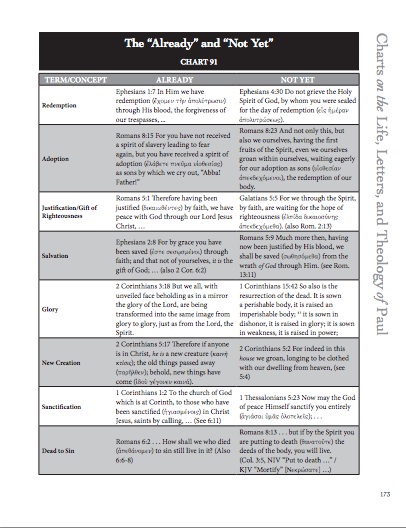
Here’s a sample chart:

chart 173

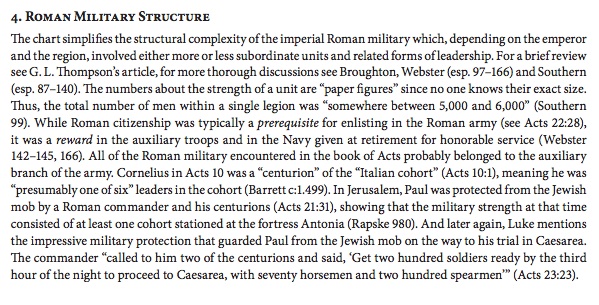
And here is a comments section, from the back of the book:

Comments Chart 4

As with the Hebrews charts book, there is no accompanying CD-ROM or digital content. This felt like a missing piece. For a teacher to make use of a chart in class, she or he would have to copy from the book or scan it in to project on a screen. It ought not to be too difficult for future printings/editions to come so equipped. A professor could circumvent this issue and just require the whole book for each student in a given course, which would make sense for an introductory course on Paul.

There were a few formatting errors sprinkled throughout the book. Also, for a “charts” book, it’s pretty text-heavy. But I didn’t find that made it any less valuable a reference for me.

One would benefit by reading the charts book straight through, as it serves as a good introductory overview to Paul’s ministry, writings, and theology. But it also serves well (and perhaps better) as a reference tool that students, pastors, and professors all will appreciate having. Kierspel makes information and insight on Paul easy to access and digest. This one is now on my short list of initial references for study of Paul.

Kregel sent me a copy of the book for review. Its product page is here, and it’s on Amazon here. The Table of Contents (which lists all the included charts) is here (pdf); read an excerpt here (pdf).

Announcing the Septuagint Studies Soirée

septuagint psalm 1

You know the Biblical Studies Carnival, right? It’s a link-lovefest of the biblioblogosphere. I hosted one in January.

Blogger and personality Jim West (lots of personality) is offering his own rogue carnival each month. This was particularly good on August 1, when an only slightly more official carnival did not post because no one volunteered to cover July.

Of the upcoming September 1 rogue carnival, in his call for submissions, Jim says:

* Interesting topics include just about everything related to Biblical studies except the LXX. These days you can’t go to the bathroom without someone opening the stall door and shoving a LXX or a book about the LXX in your face. Sure, it’s a great text, but everywhere? All the time? In the words of Jesus ‘life is more than the belly and the greek translation of the Hebrew Bible. Therefore do not concern yourself with it to the exclusion of everything else. Let him who has ears to hear, hear’. Accordingly, in obedience to Jesus, the August carnival (posting 1 September) will be a LXX free zone.

LXX-free zone? You’d have to leave your Bible on the shelf for that to obtain!

But it inspired me to do something that I think is perhaps long overdue–institute a Septuagint-themed carnival of my own.

Each month I will highlight the best of the Web when it comes to Septuagint studies. I’m calling it…

Septuagint Studies Soirée

I know of four Septuagint-related blogs:

The International Organization for Septuagint and Cognate Studies (IOSCS) has a nice news page here, too, with links to plenty of resources.

There may be other LXX bloggers that I don’t know about… which is why I’m calling on you, dear reader, to please alert me to good posts that have to do with the Septuagint/Old Greek translations of the Hebrew Scriptures.

Comment right here to let me know of something that should be in the first Septuagint Studies Soirée. I’ll post as soon as I’ve got a good dose of links.

Greek Isaiah in a Year, Weeks 35 and 36 (Isa 42:22-44:20)

Prophet Isaiah

This week and next week in Greek Isaiah in a Year will cover Isaiah 42:22-44:20. Here are the readings for each day:

07/29/13   Isa 42:22–25
07/30/13   Isa 43:1–6
07/31/13   Isa 43:7–11
08/01/13   Isa 43:12–16
08/02/13   Isa 43:17–22

08/05/13   Isa 43:23–28
08/06/13   Isa 44:1–5
08/07/13   Isa 44:6–8
08/08/13   Isa 44:9–14
08/09/13   Isa 44:15–20

Below is the text from R.R. Ottley’s Book of Isaiah According to the Septuagint, first in Greek, then with his English translation. Ottley is also here in Logos (reviewed here) and here as a free, downloadable pdf in the public domain. The full reading plan for our group is here (pdf).

See here for more resources and links to texts for Greek Isaiah.

22 καὶ ἴδον, καὶ ἐγένετο ὁ λαὸς πεπρονομευμένος καὶ διηρπασμένος· ἡ γὰρ παγὶς ἐν τοῖς ταμιείοις πανταχοῦ, καὶ ἐν οἴκοις ἅμα, ὅπου ἔκρυψαν αὐτούς, ἐγένοντο εἰς προνομήν· καὶ οὐκ ἦν ὁ ἐξαιρούμενος ἅρπαγμα, καὶ οὐκ ἦν ὁ λέγων Ἀπόδος. 23 τίς ἐν ὑμῖν ὃς ἐνωτιεῖται ταῦτα; εἰσακούσεται εἰς τὰ ἐπερχόμενα. 24 τίς ἔδωκεν εἰς διαρπαγὴν Ἰακώβ, καὶ Ἰσραὴλ τοῖς προνομεύουσιν αὐτόν; οὐχὶ ὁ θεὸς ᾧ ἡμάρτοσαν αὐτῷ, καὶ οὐκ ἐβούλοντο ἐν ταῖς ὁδοῖς αὐτοῦ πορεύεσθαι οὐδὲ ἀκούειν τοῦ νόμου αὐτοῦ; 25 καὶ ἐπήγαγεν ἐπʼ αὐτοὺς ὀργὴν θυμοῦ αὐτοῦ, καὶ κατίσχυσεν ἐπʼ αὐτοὺς πόλεμος, καὶ οἱ συμφλέγοντες αὐτοὺς κύκλῳ, καὶ οὐκ ἔγνωσαν ἕκαστος αὐτῶν οὐδὲ ἔθεντο ἐπὶ ψυχήν.

43 1 Καὶ νῦν οὕτως λέγει Κύριος ὁ θεός, ὁ ποιήσας σε Ἰακώβ, ὁ πλάσας σε Ἰσραήλ Μὴ φοβοῦ, ὅτι ἐλυτρωσάμην σε· ἐκάλεσά σε τὸ ὄνομά σου, ἐμὸς εἶ σύ. 2 καὶ ἐὰν διαβαίνῃς διʼ ὕδατος, μετὰ σοῦ εἰμι, καὶ ποταμοὶ οὐ συγκλύσουσίν σε· καὶ ἐὰν διέλθῃς διὰ πυρὸς, οὐ μὴ κατακαυθῇς, φλὸξ οὐ κατακαύσει σε. 3 ὅτι ἐγὼ Κύριος ὁ θεός σου, ὁ ἅγιος Ἰσραήλ, ὁ σώζων σε· ἐποίησά σου ἄλλαγμα Αἴγυπτον καὶ Αἰθιοπίαν, καὶ Σοήνην ὑπὲρ σοῦ. 4 ἀφʼ οὗ ἔντιμος ἐγένου ἐναντίον μου, ἐδοξάσθης κἀγώ σε ἠγάπησα, καὶ δώσω ἀνθρώπους πολλοὺς ὑπὲρ σοῦ καὶ ἄρχοντας ὑπὲρ τῆς κεφαλῆς σου. 5 μὴ φοβοῦ, ὅτι μετὰ σοῦ εἰμι· ἀπὸ ἀνατολῶν ἄξω τὸ σπέρμα σου, καὶ ἀπὸ δυσμῶν συνάξω σε.6 ἐρῶ τῷ βορρᾷ Ἄγε, καὶ τῷ λιβί Μὴ κώλυε· ἄγε τοὺς υἱούς μου ἀπὸ γῆς πόρρωθεν, καὶ τὰς θυγατέρας μου ἀπʼ ἄκρων τῆς γῆς, 7 πάντας ὅσοι ἐπικέκληνται τῷ ὀνόματί μου. ἐν γὰρ τῇ δόξῃ μου κατεσκεύασα αὐτὸν καὶ ἔπλασα καὶ ἐποίησα αὐτόν, 8 καὶ ἐξήγαγον λαὸν τυφλόν, καὶ ὀφθαλμοί εἰσιν ὡσαύτως τυφλοί, καὶ κωφοὶ ὦτα ἔχοντες. 9 πάντα τὰ ἔθνη συνήχθησαν ἅμα, καὶ συναχθήσονται ἄρχοντες ἐξ αὐτῶν· τίς ἀναγγελεῖ ταῦτα; ἢ τὰ ἐξ ἀρχῆς τίς ἀναγγελεῖ ὑμῖν; ἀγαγέτωσαν τοὺς μάρτυρας αὐτῶν καὶ δικαιωθήτωσαν, καὶ εἰπάτωσαν ἀληθῆ, καὶ ἀκουσάτωσαν. 10 γένεσθέ μοι μάρτυρες, κἀγὼ μάρτυς, λέγει Κύριος ὁ θεός, καὶ ὁ παῖς ὃν ἐξελεξάμην, ἵνα γνῶτε καὶ πιστεύσητέ μοι, καί συνῆτε ὅτι ἐγώ εἰμι· ἔμπροσθέν μου οὐκ ἐγένετο ἄλλος θεός, καὶ μετʼ ἐμὲ οὐκ ἔσται. 11 ἐγὼ ὁ θεός, καὶ οὐκ ἔστιν παρὲξ ἐμοῦ σώζων. 12 ἀνήγγειλα καὶ ἔσωσα, ὠνείδισα καὶ οὐκ ἦν ἐν ὑμῖν ἀλλότριος· ὑμεῖς ἐμοὶ μάρτυρες, κἀγὼ μάρτυς, λέγει Κύριος ὁ θεός· 13 ἔτι ἀπʼ ἀρχῆς, καὶ οὐκ ἔστιν ὁ ἐκ τῶν χειρῶν μου ἐξαιρούμενος· ποιήσω, καὶ τίς ἀποστρέψει αὐτό;

14 Οὕτως λέγει Κύριος ὁ θεὸς ὁ λυτρούμενος ὑμᾶς, ὁ ἅγιος Ἰσραήλ Ἕνεκεν ὑμῶν ἀποστελῶ εἰς Βαβυλῶνα καὶ ἐπεγερῶ πάντας φεύγοντας, καὶ Χαλδαῖοι ἐν πλοίοις δεηθήσονται. 15 ἐγὼ Κύριος ὁ θεὸς ὁ ἅγιος ὑμῶν, ὁ καταδείξας Ἰσραὴλ βασιλέα ὑμῶν. 16 οὕτως λέγει Κύριος ὁ διδοὺς ὁδὸν ἐν θαλάσσῃ καὶ ἐν ὕδατι ἰσχυρῷ τρίβον, 17 ὁ ἐξάγων ἅρματα καὶ ἵππον καὶ ὄχλον ἰσχυρόν· ἀλλὰ ἐκοιμήθησαν καὶ οὐκ ἀναστήσονται, ἐσβέσθησαν ὡς λίνον ἐσβεσμένον. 18 <Μὴ> μνημονεύετε τὰ πρῶτα, καὶ τὰ ἀρχαῖα μὴ συλλογίζεσθε· 19 ἰδοῦ ποιῶ καινὰ ἃ νῦν ἀνατελεῖ, καὶ γνώσεσθε αὐτά. καὶ ποιήσω ἐν τῇ ἐρήμῳ ὁδὸν καὶ ἐν τῇ ἀνύδρῳ ποταμούς· 20 εὐλογήσει με τὰ θηρία τοῦ ἀγροῦ, σειρῆνες καὶ θυγατέρες στρουθῶν, ὅτι ἔδωκα ἐν τῇ ἐρήμῳ ὕδωρ καὶ ποταμοὺς ἐν τῇ ἀνύδρῳ, ποτιῶ τὸ γένος μου τὸ ἐκλεκτόν, 21 λαόν μου ὃν περιεποιησάμην τὰς ἀρετάς μου διηγεῖσθαι. 22 οὐ νῦν ἐκάλεσά σε, Ἰακώβ, οὐ κοπιᾶσαί σε ἐποίησα, Ἰσραήλ· 23 οὐκ ἐμοὶ πρόβατα τῆς ὁλοκαρπώσεώς σου, οὐδὲ ἐν ταῖς θυσίαις σου ἐδόξασάς με, οὐδὲ ἐδούλευσας ἐν ταῖς θυσίαις σου, οὐδὲ ἔγκοπον ἐποίησά σε ἐν λιβάνῳ, 24 οὐδὲ ἐκτήσω μοι ἀργυρίου θυμίαμα, οὐδὲ στέαρ τῶν θυσιῶν σου ἐπεθύμησα, ἀλλὰ ἐν ταῖς ἁμαρτίαις σου καὶ ἐν ταῖς ἀδικίαις σου προέστην σου. 25 ἐγώ εἰμι ἐγώ εἰμι ὁ ἑξαλείφων τὰς ἀνομίας σου, καὶ οὐ μὴ μνησθήσομαι [τὰς ἀδικίας σου]. 26 σὺ δὲ μνήσθητι καὶ κριθῶμεν· λέγε σὺ τὰς ἀνομίας σου πρῶτος, ἵνα δικαιωθῇς. 27 οἱ πατέρες ὑμῶν πρῶτοι καὶ οἱ ἄρχοντες αὐτῶν ἠνόμησαν εἰς ἐμέ, 28 καὶ ἐμίαναν οἱ ἄρχοντες τὰ ἅγιά μου· καὶ ἔδωκα ἀπολέσαι Ἰακώβ, καὶ Ἰσραὴλ εἰς ὀνειδισμόν.

44 1 Νῦν δὲ ἄκουσον, παῖς μου Ἰακώβ, καὶ Ἰσραὴλ ὃν ἐξελεξάμην, 2 οὕτως λέγει Κύριος ὁ θεὸς ὁ ποιήσας σε, καὶ ὁ πλάσας σε ἐκ κοιλίας Ἔτι βοηθηθήσῃ· μὴ φοβοῦ, παῖς μου Ἰακώβ, καὶ ὁ ἠγαπημένος Ἰσραὴλ ὃν ἐξελεξάμην. 3 ὅτι ἐγὼ δώσω ὕδωρ ἐν δίψει τοῖς πορευομένοις ἐν ἀνύδρῳ, ἐπιθήσω τὸ πνεῦμά μου ἐπὶ τὸ σπέρμα σου, καὶ τὰς εὐλογίας μου ἐπὶ τὰ τέκνα σου, 4 καὶ ἀνατελοῦσιν ὡσεὶ χόρτος ἀνὰ μέσον ὕδατος, καὶ ὡς ἰτέα ἐπὶ παραρέον ὕδωρ. 5 οὗτος ἐρεῖ Τοῦ θεοῦ εἰμι, καὶ οὗτος ἐρεῖ ἐπὶ τῷ ὀνόματι Ἰακώβ, καὶ ἕτερος ἐπιγράφει Τοῦ θεοῦ εἰμι, ἐπὶ τῷ ὀνόματι Ἰσραήλ.

6 Οὕτως λέγει ὁ θεὸς ὁ βασιλεὺς τοῦ Ἰσραὴλ ὁ ῥυσάμενος αὐτόν, θεὸς σαβαώθ Ἐγὼ πρῶτος καὶ ἐγὼ μετὰ ταῦτα, πλῆν ἐμοῦ οὐκ ἔστιν θεός. 7 τίς ὥσπερ ἐγώ; στήτω, καλεσάτω, καὶ ἑτοιμασάτω μοι ἀφʼ οὗ ἐποίησα ἄνθρωπον εἰς τὸν αἰῶνα, καὶ τὰ ἐπερχόμενα πρὸ τοῦ ἐλθεῖν ἀναγγειλάτωσαν ὑμῖν. 8 μὴ παρακαλύπτεσθε· οὐκ ἀπʼ ἀρχῆς ἠνωτίσασθε, καὶ ἀπήγγειλα ὑμῖν; μάρτυρες ὑμεῖς ἐστε εἰ ἔστιν θεὸς πλὴν ἐμοῦ· καὶ οὐκ ἦσαν τότε. 9 οἱ πλάσσοντες καὶ γλύφοντες πάντες μάταιοι, οἱ ποιοῦντες τὰ καταθύμια αὐτῶν ἃ οὐκ ὠφελήσει αὐτούς· ἀλλὰ αἰσχυνθήσονται. 10 πάντες οἱ πλάσσοντες θεὸν καὶ γλύφοντες ἀνωφελῆ, 11 καὶ πάντες ὅθεν ἐγένοντο ἐξηράνθησαν, καὶ κωφοὶ ἀπὸ ἀνθρώπων· συναχθήτωσαν πάντες καὶ στήσονται ἅμα, ἐντραπήτωσαν καὶ αἰσχυνθήτωσαν ἅμα. 12 ὅτι ὤξυνεν τέκτων σίδηρον, σκεπάρνῳ εἰργάσατο αὐτὸ καὶ ἐν τερέτρῳ ἔτρησεν αὐτό, εἰργάσατο αὐτὸ ἐν τῷ βραχίονι τῆς ἰσχύος αὐτοῦ· καὶ πεινάσει, καὶ ἀσθενήσει, καὶ οὐ μὴ πίῃ ὕδωρ. 13 ἐκλεξάμενος τέκτων ξύλον ἔστησεν αὐτὸ ἐν μέτρῳ, καὶ ἐν κόλλῃ ἐρύθμισεν αὐτό, ἐποίησεν αὐτὸ ὡς μορφὴν ἀνδρὸς καὶ ὡς ὡραιότητα ἀνθρώπου, στῆσαι αὐτὸ ἐν οἴκῳ, 14 [ὃ] ἔκοψεν ξύλον ἐκ τοῦ δρυμοῦ, ὃ ἐφύτευσεν Κύριος, καὶ ὑετὸς ἐμήκυνεν, 15 ἵνα ᾖ ἀνθρώποις εἰς καῦσιν· καὶ λαβὼν ἀπʼ αὐτοῦ ἐθερμάνθη, καὶ καύσαντες ἔπεψαν ἄρτους ἐπʼ αὐτοῦ· τὸ δὲ λοιπὸν εἰργάσατο εἰς θεούς, καὶ προσκυνοῦσιν αὐτούς. 16 οὗ τὸ ἥμισυ αὐτοῦ κατέκαυσεν ἐν πυρί, καὶ καύσαντες ἔπεψαν ἄρτους ἐπʼ αὐτῶν, καὶ ἐπʼ αὐτοῦ κρέας ὀπτήσας ἔφαγεν καὶ ἐνεπλήσθη, καὶ θερμανθεὶς εἶπεν Ἡδύ μοι ὅτι ἐθερμάνθην καὶ ἴδον πῦρ. 17 τὸ δὲ λοιπὸν ἐποίησεν θεὸν γλυπτόν, καὶ προσκυνεῖ αὐτῷ καὶ προσεύχεται λέγων Ἐξελοῦ με, ὅτι θεός μου εἶ σύ. 18 οὐκ ἔγνωσαν φρονῆσαι, ὅτι ἀπημαυρώθησαν τοῦ βλέπειν τοῖς ὀφθαλμοις αὐτῶν καὶ τοῦ νοῆσαι τῇ καρδίᾳ αὐτῶν.19 καὶ οὐκ ἐλογίσατο τῇ καρδίᾳ οὐδὲ ἀνελογίσατο ἐν τῇ ψυχῇ αὐτοῦ οὐδὲ ἔγνω τῇ φρονήσει ὅτι τὸ ἥμισυ αὐτοῦ κατέκαυσεν ἐν πυρί, καὶ ἔπεψεν ἐπὶ τῶν ἀνθράκων αὐτοῦ ἄρτους, καὶ ὀπτήσας κρέας ἔφαγεν, καὶ τὸ λοιπὸν αὐτοῦ εἰς βδέλυγμα ἐποίησεν καὶ προσκυνοῦσιν αὐτῷ. 20 γνῶτε ὅτι σποδὸς ἡ καρδία αὐτῶν, καὶ πλανῶνται, καὶ οὐδεὶς δύναται ἐξελέσθαι τὴν ψυχὴν αὐτοῦ· ἴδετε, οὐκ ἐρεῖτε ὅτι Ψεῦδος ἐν τῇ δεξιᾷ μου.

22 And I saw, and the people was plundered and spoiled; for the snare is in treasuries everywhere, and in houses together; where they hid themselves, they became a prey; and there was none that set free a prey, and there was none that said, Restore.

23 Who is there among you that will give ear to this? he shall hearken, for the time to come.

24 Who gave Jacob for a prey, and Israel to them that plunder him? Is it not God, before whom they sinned, and they would not walk in his ways, nor hear his law?

25 And he brought upon them the fury of his wrath, and war overpowered them, and they that set them on fire round about, and they understood not, each of them, neither laid it to heart.

43 1 And now thus saith the Lord God, who created thee, O Jacob, he that formed thee, O Israel. Fear not, for I have redeemed thee; I have called thee by thy name, thou art mine.

2 Though thou pass through water, I am with thee, and rivers shall not overwhelm thee; though thou go through fire, thou shalt not be burned, flame shall not burn thee up.

3 For I am the Lord thy God, the Holy One of Israel, thy Saviour; I have made Egypt and Ethiopia thy ransom, and set Syene in thy stead.

4 Since thou hast become precious in my sight, thou hast been glorified, and I have loved thee; and I will give many men on behalf of thee, and rulers for thy head.

5 Fear not, for I am with thee; I will bring thy seed from the East, and will gather thee from the West:

6 I will say to the North, Bring (them); and to the South, Keep not back: bring my sons from a land afar off, and my daughters from the ends of the earth,

7 All that have been called by my name. For in my glory have I established him, and formed (him), and made him,

8 And I led forth a blind people, and their eyes are likewise blind, and they are deaf, though they have ears.

9 All the nations are gathered together, and rulers shall be gathered from among them; who shall declare these things? or who shall declare to you what was from the beginning? let them bring their witnesses, and let them be approved, and let them speak truth, and let them hear.

10 Be ye witnesses to me, and I am witness, saith the Lord God, and the servant whom I have chosen out; that ye may learn, and believe me, and understand that I am; before me there came no other God, and after me there shall be none.

11 I am God, and beside me there is no Saviour.

12 I declared, and I saved, I reproached, and there was no stranger among you; ye are my witnesses, and I am witness, saith the Lord God,

13 Even from the beginning, and there is none that delivereth out of my hands: I will do it, and who shall turn it back?

14 Thus saith the Lord God who redeemeth you, the Holy One of Israel: For your sakes will I send to Babylon, and will rouse up all that flee, and the Chaldaeans shall be bound in stocks.

15 I am the Lord God, your holy one, he that shewed forth Israel your king.

16 Thus saith the Lord, that giveth a way in the sea, and a path in the mighty water,

17 He that bringeth forth chariots, and horse, and a mighty throng; but they have lain down, and shall not arise, they are quenched as flax that is quenched:

18 Remember ye <not> the first things, and consider not the things of old.

19 Behold, I do new things which shall now arise, and ye shall learn them: and I will make a path in the desert, and rivers in the waterless land:

20 The beasts of the field shall praise me, owls, and the daughters of ostriches; because I have given water in the desert, and rivers in the waterless land, I will give my chosen race to drink,

21 My people, whom I have preserved to set forth my excellences.

22 Not now have I called thee, Jacob, nor made thee weary, Israel:

23 No sheep have I of thy offering, nor didst thou glorify me in thy sacrifices, nor serve in thy sacrifices; nor have I wearied thee with frankincense,

24 Neither didst thou buy for me incense for silver, nor did I desire the fat of thy offerings; but in thy sins and in thine unrighteousness I stood before thee.

25 I am, I am he that blotteth out thy transgressions, and will not remember thine unrighteousnesses.

26 But do thou remember, and let us be judged; tell thou first thy transgressions, that thou mayest be justified.

27 Our fathers first, and their rulers transgressed against me:

28 And the rulers defiled my holy things; and I gave Jacob over to destroy (him), and Israel for a reproach.

44 1 But now hear, Jacob my servant, and Israel, whom I chose(out).

2 Thus said the Lord God who made thee, and he that formed thee from the womb, Thou shalt yet be helped: fear not, my servant Jacob, and my beloved Israel whom I chose out;

3 For I will give water in thirst to them that walk in a waterless place; I will put my Spirit upon thy seed, and my blessings upon thy children,

4 And they shall rise up as grass among water, and as a willow by the side of a flowing water.

5 This one shall say, I am God’s, and this shall speak in the name of Jacob; and another writeth, I am God’s; upon the name of Israel.

6 Thus saith God, the King of Israel, and his deliverer, God of Hosts; I am first, and I am hereafter; except me there is no God.

7 Who is as I am? let him stand, let him call, and make ready for me, since I made man for everlasting; and let them declare to you the coming things before they come.

8 Hide not yourselves; did ye not give ear from the beginning, and I declared it to you? ye are witnesses, whether there be a God beside me; and they were not, at that time.

9 They that mould images, and that grave, are all of them vain; they that make their own delights, which shall not help them; but they shall be ashamed,

10 All they that mould a god, and grave unprofitable things:

11 And all are withered from whence they sprang, and (are) dumb from among men; let them all be gathered together, and they shall stand together, let them be turned backward and be ashamed together.

12 For the craftsman sharpeneth iron, with an adze he fashioneth it, and boreth it with a gimlet, worketh it with the arm of his strength; and he shall be hungry, and shall be faint, and lot drink water:

13 The craftsman, when he hath chosen a piece of wood, setteth it up by measure, and fitteth it together with glue; he maketh it like the form of a great man, and like the goodliness of man, to set it up in a house:

14 He cutteth wood out of the forest which the Lord planted, and the rain made it to grow,

15 That it may be for men for burning; and he taketh thereof, and is warmed; and they burn it, and bake loaves upon it; and the rest he maketh into gods, and they worship them.

16 Whereof he burneth half in the fire (and they burn them, and bake loaves upon them), and roasteth meat upon it, and eateth, and is filled: and when he is warmed, he saith, Sweet is it to me that I am warmed, and have seen fire.

17 But the rest of it he maketh a graven god, and worshippeth it, and prayeth to it, saying, Deliver me, for thou art my god.

18 They have not learnt to have understanding, for they are darkened, from seeing with their eyes, and understanding with their heart.

19 And he considereth not in his heart, nor pondereth in his soul, nor perceiveth with his understanding, that he hath burned half thereof in the fire, and baked loaves upon the ashes thereof, and roasted meat, and eaten; and made the rest of it into an abomination, and they worship it.

20 Learn ye that their heart is ashes, and they wander out of the way, and no one can deliver his soul; see, ye will not say, There is a lie in my right hand.


Zondervan’s NIV Greek and English New Testament, reviewed

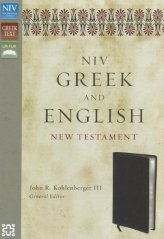
Zondervan GNTZondervan continues to publish great resources for learning and using Biblical Greek and Hebrew. I reviewed their Greek and Hebrew Reader’s Bible here. Now they have published a “diglot,” a Bible with two languages side-by-side, on facing pages, for the New Testament.

This is also known as a “parallel Bible,” so that the reader can easily see both the Greek and English side-by-side. It’s not an interlinear Bible, though (English interspersed line-by-line with Greek), so you can easily just read all English or all Greek any time you want to. Both the Greek and English section headings are the same (in English), which makes it easy to stay on track when reading through. Each page is single column format.

The Greek text is not the scholarly NA27 or NA28 critical edition. Rather, it is the Greek text that the NIV translators agreed on as the textual basis for translation. The few times (and there aren’t a ton of instances) when this Greek text differs from the NA27, footnotes provide additional information.

Greek font preference can be subjective, but I find this one pleasing and easy to read:

Greek English

The italics are for an Old Testament quotation.

The leather/Italian Duo-Tone version has a single ribbon for marking one’s place. Its feel is pleasant and flexible, yet durable. It’s a well-made Bible.

I wondered when reading whether not having the critical Nestle-Aland Greek in front of me would be a problem, but (a) the differences are minor and (b) if one’s goal is just to read Greek (not do textual criticism), whether or not one has Nestle-Aland is not hugely important. Besides that, there are possibly places where the NIV translators have made a better textual choice than the NA folks! (We’ll find out when we get to see all the original “autographs” in heaven, I suppose.)

There is also a 146-page Greek to English dictionary included at the back (Mounce Concise) which has word frequency information, a short gloss/definition, and verse references where words are used. It’s basic, but a good dictionary, especially for quick look-ups when doing daily reading.

One advantage to this diglot over other diglots (RSV and NET versions) is that the Greek is always on the left-hand page and the English is always on the right-hand page. In these other two diglots (perhaps for ease of printing?) it changes every two pages, so that this left-hand page is Greek, this other left-hand page is English. It’s a small thing, but it makes it easier to use.

As for the English version employed, this is the 2011 NIV, the update to both the 1984 NIV (New International Version) and the 2001/2005 TNIV (Today’s New International Version). Much ink (and many bytes) have been spilled over the differences between these three and the controversy surrounding the TNIV. (Much ado about not-much, in my opinion.) The TNIV opted to be more gender-inclusive than the 1984 NIV in how it translated masculine Greek words, so “brothers” would be “brothers and sisters.” If Paul clearly has men and women in view (he often does), “brothers and sisters” is the best way to translate the masculine Greek noun. But this gender inclusivity (I prefer “gender accuracy”) displeased some, and so now the TNIV is off the shelf (as is the old NIV) with the NIV (2011) in its stead.

The 2011 NIV seems to either lean more toward the TNIV or to split the difference on gender. For example, take Galatians 1:11 in the three versions:

NIV (1984): “I want you to know, brothers, that the gospel I preached is not something that man made up.”
TNIV: “I want you to know, brothers and sisters, that the gospel I preached is not of human origin.”
NIV (2011): “I want you to know, brothers and sisters, that the gospel I preached is not of human origin.”

Here are Galatians 1:1-2. Note how the new NIV matches neither of its predecessors.

NIV (1984): “Paul, an apostle—sent not from men nor by man, but by Jesus Christ and God the Father, who raised him from the dead—and all the brothers with me….”
TNIV: “Paul, an apostle—sent not with a human commission nor by human authority, but by Jesus Christ and God the Father, who raised him from the dead—and all the brothers and sisters with me….”
NIV (2011): “Paul, an apostle—sent not from men nor by a man, but by Jesus Christ and God the Father, who raised him from the dead—and all the brothers and sisters with me….”

Rodney Decker has a thorough (and I mean thoroughreview of the new NIV here.

Although I never had the pleasure of seeing a TNIV-Greek diglot (I don’t think Zondervan published one?), this one is the next best thing. Especially for preachers and students and Greek-learners who want to stay close to the NIV, this diglot is yet another great language resource from Zondervan.

Thanks to Zondervan for the review copy. See a sample file here (pdf). You can find purchasing information about the book at Amazon or at its Zondervan product page.

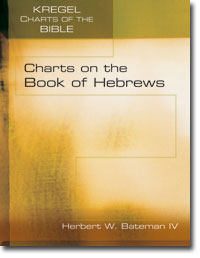
Charts on the Book of Hebrews, Reviewed

charts on Hebrews

Hebrews can be a hard book to grasp. Whether in Greek or English (or any other language), the development of the book’s logic–especially early on–requires careful attention. One hears about Jesus’ priesthood, which makes the most sense when examined against the backdrop of the Old Testament priesthood and sacrificial system. Angels and Moses and Aaron all make appearances, which are central to what the author of Hebrews says about Jesus. And then there is Melchizedek to reckon with!

Herbert W. Bateman IV, then, has a great idea in wanting to offer “information about Hebrews succinctly in visual format for today’s student and congregant.” He does this (effectively) with a book of charts, consisting in four major parts:

  • Part 1: Introductory Considerations In Hebrews
  • Part 2: Old Testament and Second Temple Influences In Hebrews
  • Part 3: Theology In Hebrews
  • Part 4: Exegetical Matters in Hebrews

Some charts are just one page (#87, “Positions on the Warning Passages in Hebrews”) or a few pages (#34, “Old Testament People Named in Hebrews”), while others are longer–nearly 10 pages of “Major Textual Issues in Hebrews” (#97) and nearly 20 pages of the (Greek) words that are unique to Hebrews (#103 and #104, listed both alphabetically and by chapter, respectively).

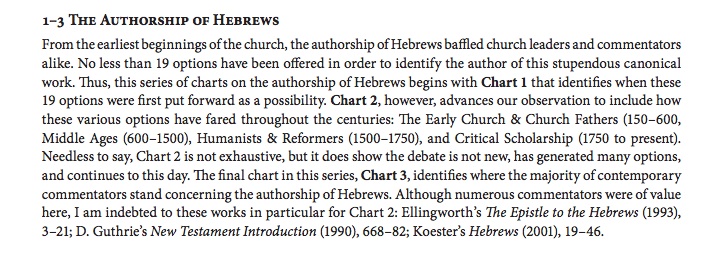
There is not much that this book leaves uncovered. Bateman covers the authorship and dating and genre questions thoroughly and succinctly. There are also helpful summaries of how various Hebrews commentaries have understood different aspects of the book. He explains and diagrams the tabernacle in the Old Testament, comparing it with its description in Hebrews (charts #35-#38).

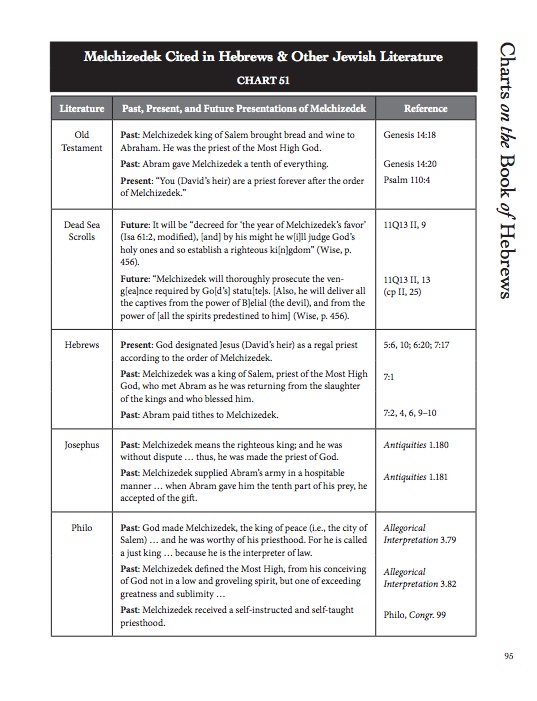
Five pages on the not-well-known Melchizedek examine that figure in both biblical and extra-biblical context (Josephus, Dead Sea Scrolls, etc.). The theology charts found in the third part of Bateman’s book could easily be used in a congregational setting, especially the “Portraits of God” (#56) and Jesus (#57) in Hebrews. The final section looks in detail at Hebrews through interpretive, textual, rhetorical, and lexical lenses.

The “Chart Comments” at the back of the book add even more to the already substantive charts. A dozen-page bibliography concludes the work.

Here’s a sample chart:

Melchizedek

And you can see here some comments on the first three charts, from the back of the book:

Chart Comments

It’s remarkable how much ground Bateman covers in this appealing, visually organized medium. Seminary classroom teachers or church Sunday school teachers could make great use of these charts.

The one downside to this book, however, is that there is no accompanying CD-ROM or digital content. For a teacher to use a chart, she or he would have to copy from the book or scan in a chart for use in a class Powerpoint. A clean .jpg or .pdf file from the publisher would have eased this process for the user of this book. Hopefully future editions will come so equipped.

Though these charts are produced with a group in mind, any individual (with whatever level of knowledge about Hebrews) could benefit from using the charts for private or small group study. Even though these are charts, this is also the kind of book one could just sit down and go through. Bateman has provided a top-notch resource for an important biblical book.

Kregel sent me a copy of the book for review. Its product page is here, and it’s on Amazon here. The Table of Contents (which lists all the included charts) is here (pdf); read an excerpt here (pdf).

Why You Need the Septuagint

It’s not uncommon for people to ask: why the Septuagint? (That comes right after: What is it?)  Why bother with the Greek Septuagint when we have the Old Testament in Hebrew, in which it was first written? English translations of the Bible in most churches use the Hebrew text as a base, anyway.

Before giving my top 10 reasons why, here are a couple ways to access the Septuagint (often abbreviated LXX after the tradition of the 70(+2) who were said to have translated it). This site has the whole Septuagint in Greek with an English translation. And here‘s a good, up-to-date English translation of the whole thing. (For hard copies, the standard complete Greek text is the Rahlfs Septuagint, and a recent English translation is the NETS.)

Here are 10 good reasons to pay attention to the Septuagint:

10. It helps us read Scripture in new, fresh ways.

9. You get to use fun words like Septuagint, intertextuality, collate, tradent, and urtext. Though I cannot bring myself to use the academy-preferred pronunciation of SEP-twa-jent. Sep-TOO-a-jent, thank you.

8. The New Testament writers often used and quoted a version of Scripture that aligns with the Septuagint. (See here for more about this.)

7. For students of Greek, the LXX is a good way to challenge oneself in Greek beyond the New Testament. There is a fuller and deeper vocabulary in the Septuagint that helps Greek students grow in their knowledge of the language.

6. The Septuagint was translated from a set of Hebrew texts that are centuries earlier than the Hebrew text underlying most English Old Testaments. This helps us get closer to the “original” text.

5. There are books that, while additional to the Protestant canon, still shed light on life. (I’m looking at you, Wisdom of Solomon!)

4. The Odes. This is a collection of texts appended to the end of the Psalms. It compiles some beautiful prayers found in the Old Testament (and apocryphal books). A few of these are in the Book of Common Prayer’s Morning Prayer canticles.

3. It connects us to the broad sweep of history in the Church. This was not only the Bible of the New Testament writers (in many though not all instances); it was the Bible of the Greek-speaking early church.

2. Books like 1 Maccabees, especially, fill out the intertestamental gap between Malachi and Matthew. Reading Maccabees can help us better understand a Jewish expectation of a conquering Messiah who would expel oppressive Roman rule.

1. Jesus used it.*

*Note: this is perhaps an oversimplification. Jesus spoke Aramaic and knew and used the Hebrew Bible. But we can at least say that the Gospel writers sometimes quote Jesus (in Greek) using a Septuagint text that differs from the Hebrew/proto-Masoretic Text. Some say this means just the Gospel writers themselves–not Jesus–used the Septuagint in such cases. But there are at least a few cases where it seems clear that Jesus is using a text closer to the Septuagint than to the Hebrew Bible.

Stanley Porter defends (here) the idea that Jesus taught (at least at times) in Greek.

Saturday I’ll be posting my part of a book blog tour of Timothy Michael Law‘s When God Spoke Greek: The Septuagint and the Making of the Christian Bible.

The above is adapted from (and more nuanced than) a post I wrote last summer.

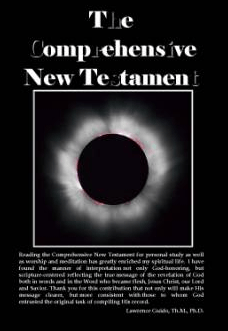
The Comprehensive New Testament, a Review

Screen Shot 2013-07-23 at 11.41.20 AM

I don’t really think there is such a thing as a “literal” translation of the Hebrew or Greek Bible. Too much is lost when going from any one language to another to be able to claim literalism. As Dave Brunn points out, to translate is to necessarily change the form. The only way one could keep the form of Hebrew or Greek is to leave the text in Hebrew or Greek.

The Comprehensive New Testament claims to be “the most accurate translation of the Nestle-Aland 27th edition Greek New Testament ever produced” (Preface, i), which first struck me as a rather grandiose claim. However, the editors of that work seem to agree with Brunn in saying that “no translation can perfectly reproduce the simplicity and beauty of the original words” (i). Their claim to accuracy is not a claim regarding their original English translation of the Greek New Testament. Rather, it means that they use the Greek of the NA27 as their underlying text. Other translations may begin with that as a base, but will make textual decisions that means their underlying Greek is not identical to the NA27.

There are four primary features to The Comprehensive New Testament:

1. It is “standardized to the Greek New Testament text of the Nestle-Aland 27th edition and the United Bible Societies 4th edition.”

Why this edition of the Greek text? Editors T.E. Clontz and J. Clontz note the Protestant and Catholic agreement on the text tradition (“Alexandrian”) of the NA27 as the basis for English translations of the New Testament.

The editors seem to agree with the idea that no translation is truly literal, yet they still want to “translate the right words–and not words created by scribal mistakes or editorial changes” (i). I agree with them that the “words given through the apostles deserve our best efforts in return.”

One should still be clear, though, that even if the NA27 represents the best manuscript tradition, we don’t have the original autographs. I do believe we probably have something very close to that, but it certainly doesn’t threaten my high view of Scripture to think that there might have been a few “scribal mistakes or editorial changes” between the time of writing and the earliest manuscripts we have access to. The editors aren’t claiming access to the autographs, though, just to the NA27.

There is now a 28th edition of the Nestle-Aland text, with a few changes made from the NA27. How does this come into play? Of course, The Comprehensive NT was published before the NA28 by about 5 years, but it does raise a question for possible future editions of this volume. (I.e., did the NA27 have the wrong text? Does the NA28 have it right now? etc.)

All of these are minor quibbles, though, and no textual variants seem to make major theological differences to our faith. Indeed, the editors note that “throughout the 15,000 variations translated in this New Testament, we find the same message, and the same gospel” (i). Agreed.

The reader of this volume should understand, however, that even using the NA27 at all times doesn’t remove textual ambiguity. For example, in Galatians 1:2 Paul uses the Greek ἀδελφοὶ to describe those “who are with me.” This post is not the place to engage seriously the issues surrounding translation and gender, but given the amount of female ministry companions Paul generally had, the translation found in the NIV (2011) of “brothers and sisters” is almost certainly the more accurate translation. (In Greek, a masculine plural noun like adelphoi could be all males or a mixed group of males and females.) The editors have retained the underlying Greek, but have translated it in a way that not all will agree with.

Also, to take another example, in Romans 16:7, there is debate around whether Paul names Junia (female) or Junias (male) as an apostle. The prevailing scholarly theory is that he has Junia (female) in mind, but the Greek word itself is not conclusive, since he uses the accusative case Ἰουνιᾶν, which itself could be male or female.  EDIT/UPDATE 7/24/13: Earlier printings of NA27 did indeed have Ἰουνιᾶν (male), but as of 1998, printings now contain the unequivocally female Ἰουνίαν (Junia).  The Comprehensive NT has “Junias” (male) in translation. It’s impossible to prove with 100% certainty one view over the other, but even with a solid base of the NA27 at every turn, there are still ambiguities to be resolved in translation.

2. The Comprehensive NT contains “complete textual variant mapping.”

The editors encourage and facilitate the use of multiple translations when studying the Bible. To this end they offer “complete textual variant mapping” so one can easily see what other translations have for given words and verses. The preface says this is “something that no other translation offers” (i.e., “footnotes for translations beyond our own”). That’s not entirely true, as the NA27/NET diglot offers the same feature (see here).

It’s a useful and time-saving feature, though… a sort of compendium of English translations.

The Junia example above (Romans 16:7) notes the many translations that have Junia over Junias (NESV, HCS, KJV, etc.). They ascribe “Junias” (male) to the Alexandrian tradition while saying that “Junia” (female) is from the Byzantine tradition. Unless I’m missing something, it’s not quite this simple, as the NA27 itself can easily be understood as referring to a Junia. Here it’s not a question of text tradition, but rather of interpretation and translation.

The notes don’t contain rationale for the translation of the New Testament, but they don’t purport to, either.

3. It scores high on a readability scale, only requiring “a sixth grade reading level.”

I don’t doubt the high score, but the presence of words like “behold” and “begotten” (in John 3:16) and “hallowed” (in the Lord’s Prayer) stood out to me as something that a sixth grader would probably need to ask about. The New Living Translation, by comparison, has “one and only” for John 3:16 and “may your name be kept holy” instead of “hallowed be your name” in Luke 11. These latter translations, I think, are better suited to a younger age group and reading level. This translation is not abnormally wooden, though, as some “literalistic” translations (e.g., the NASB) can be. I’m just not sure I’d fill a middle school youth room full of these Bibles (intriguing cover image notwithstanding!).

4. There are nearly 300 pages of “references for the Dead Sea Scrolls, Philo, Josephus, Nag Hammadi Library, Pseudepigrapha, Apocrypha, Plato, Egyptian Book of the Dead, Talmud, Old Testament, Patristic Writings, Dhammapada, Tacitus, Epic of Gilgamesh.”

Many of these pages also include excerpted text from the above.

This is the best feature of this book, in my opinion. Anyone who wants to thoroughly research the early Christian and early Jewish literature that has to do with a given New Testament verse will save loads of time by referring to the reference list.

From Genesis and Jubilees and Sirach on Abraham in Romans 4 to a juicy quote by Papias that claims Matthew “composed the oracles in the Hebrew language,” this section is a great scholar’s companion. The preface provides a concise and helpful overview of the texts covered (e.g., Pseudepigrapha: “claim various Old Testament individuals as authors”).

Accordance Bible Software has released The Comprehensive NT, and one can see the advantage to using a hyperlinked, electronic version of these references (see here). As one reviewer noted, having this extensive list of cross-references will save many a trip to a theological library.

Whatever my critiques above regarding the translation itself, the hundreds of pages of cross-references alone make purchasing the less than $20 book an easy decision. I know of no other single work that gathers so many references in one place, sorting them by New Testament verse. It’s a great starting point for research papers or in-depth Bible studies that want to take into account other extra-biblical writings.

Find out more about The Comprehensive New Testament here or here. Thanks to Cornerstone Publications for the review copy. The translation and cross-references are also available in Accordance Bible Software, here.

Free book in Logos Bible Software this month

Expositor's GNT vol 5

This month (for the next week) Logos Bible Software is offering volume 5 of The Expositor’s Greek Testament for free. You can find it here.

From the Logos site:

The Expositor’s Greek Testament ranks among the most important commentaries on the Greek text of the New Testament from the 19th century, drawing from the scholarship of twenty contributors under the editorship of William Robertson Nicoll. In addition to the Greek text, this massive reference work contains textual, literary, and grammatical commentary on nearly every Greek word in the entire New Testament. The Expositor’s Greek Testament also includes lengthy introductions to each of the books in the New Testament, surveying the literary and interpretive history, along with an introduction to the historical context of each book and an extensive bibliography.

This particular volume covers 1-2 Peter, 1-3 John, Jude, and Revelation.

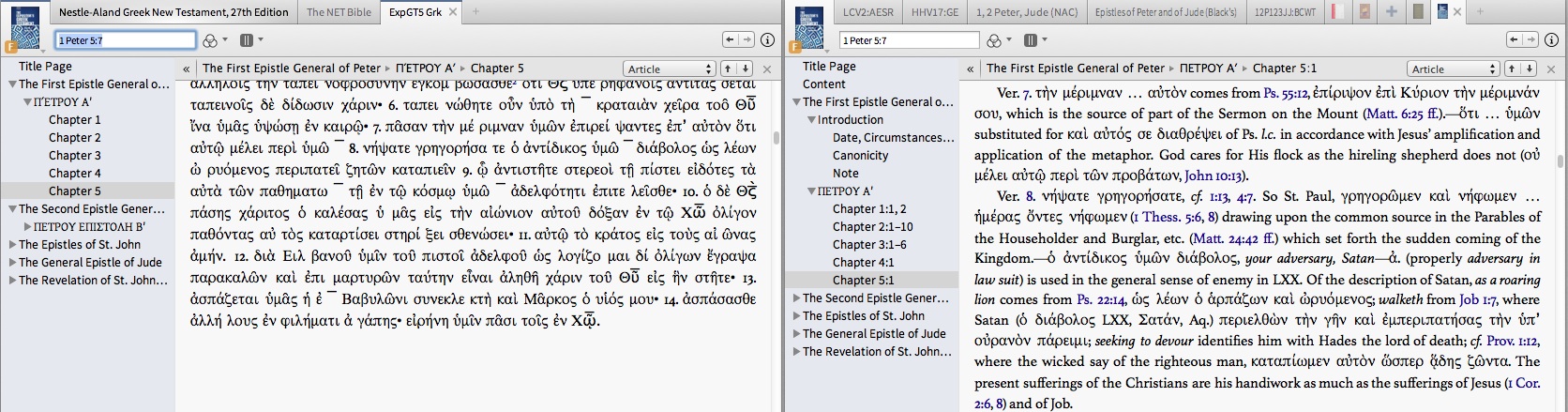
The free volume actually installs as two modules–one is the Greek text for the books above, the other is a commentary on the Greek text (including full book introductions and verse-by-verse, word-by-word comments). Here’s a screen shot of what it looks like when open to 1 Peter 5:7 (click on image to enlarge):

Screen shot

Everything is hyperlinked and searchable, and ties in with the rest of one’s Logos library.

Greek Isaiah in a Year, Weeks 33 and 34 (Isa 41:1-42:21)

Prophet Isaiah

This week and next week in Greek Isaiah in a Year will cover Isaiah 41:1-42:21. Here are the readings for each day:

07/15/13   Isa 41:1–5
07/16/13   Isa 41:6–10
07/17/13   Isa 41:11–15
07/18/13   Isa 41:16–20
07/19/13   Isa 41:21–24

07/22/13   Isa 41:25–29
07/23/13   Isa 42:1–4
07/24/13   Isa 42:5–9
07/25/13   Isa 42:10–17
07/26/13   Isa 42:18–21

Below is the text from R.R. Ottley’s Book of Isaiah According to the Septuagint, first in Greek, then with his English translation. Ottley is also here in Logos (reviewed here) and here as a free, downloadable pdf in the public domain. The full reading plan for our group is here (pdf).

See here for more resources and links to texts for Greek Isaiah.

41 1 Ἐγκαινίζεσθε πρὸς μέ, νῆσοι, οἱ γὰρ ἄρχοντες ἀλλάξουσιν ἰσχύν· ἐγγισάτωσαν καὶ λαλησάτωσαν ἅμα, τότε κρίσεις ἀναγγειλάτωσαν. 2 τίς ἐξήγειρεν ἀπὸ ἀνατολῶν δικαιοσύνην, ἐκάλεσεν αὐτὴν κατὰ πόδας αὐτοῦ, πορεύσεται· δώσει ἐναντίον ἐθνῶν, καὶ βασιλεῖς ἐκστήσει· καὶ δώσει εἰς γῆν τὰς μαχαίρας αὐτῶν, καὶ ὡς φρύγανα ἐξωσμένα τὰ τόξα αὐτῶν· 3 καὶ διώξεται αὐτούς, καὶ διελεύσεται ἐν εἰρήνῃ ἡ ὁδὸς τῶν ποδῶν αὐτοῦ. 4 τίς ἐνήργησεν καὶ ἐποίησεν ταῦτα; ἐκάλεσεν αὐτὴν ὁ καλῶν αὐτὴν ἀπὸ γενεῶν ἀρχῆς· ἐγὼ θεὸς πρῶτος, καὶ εἰς τὰ ἐπερχόμενα ἐγώ εἰμι. 5 εἴδοσαν ἔθνη καὶ ἐφοβήθησαν, τὰ ἄκρα τῆς γῆς ἤγγισαν καὶ ἤλθοσαν ἅμα, 6 κρίνων ἕκαστος τῷ πλησίον καὶ τῷ ἀδελφῷ βοηθῆσαι, καὶ ἐρεῖ 7 Ἴσχυσεν ἀνὴρ τέκτων, καὶ χαλκεὺς τύπτων σφύρῃ, ἅμα ἐλαύνων· τότε μὲν ἐρεῖ Σύμβλημα καλόν ἐστιν, ἰσχύρωσαν αὐτὰ ἐν ἥλοις· θήσουσιν αὐτὰ καὶ οὐ κινηθήσονται. 8 Σὺ δέ, Ἰσραήλ, παῖς μου Ἰακὼβ ὃν ἐξελεξάμην, σπέρμα Ἀβραὰμ ὃν ἠγάπησα· 9 οὗ ἀντελαβόμην ἀπʼ ἄκρων τῆς γῆς, καὶ ἐκ τῶν σκοπιῶν αὐτῆς ἐκάλεσά σε καὶ εἶπά σοι Παῖς μου εἶ, ἐξελεξάμην σε καὶ οὐκ ἐγκατέλιπόν σε. 10 μὴ φοβοῦ, μετὰ σοῦ γάρ εἰμι· μὴ πλανῶ, ἐγὼ γάρ εἰμι ὁ θεός σου ὁ ἐνισχύσας σε, καὶ ἐβοήθησά σοι καὶ ἠσφαλισάμην σε τῇ δεξιᾷ τῇ δικαίᾳ μου. 11 ἰδοὺ αἰσχυνθήσονται καὶ ἐντραπήσονται πάντες οἱ ἀντικείμενοί σοι, ἔσονται γὰρ ὡς οὐκ ὄντες, καὶ ἀπολοῦνται πάντες οἱ ἀντίδικοί σου. 12 ζητήσεις αὐτούς, καὶ οὐ μὴ εὕρῃς τοὺς ἀνθρώπους οἱ παροινήσουσιν εἰς σέ· ἔσονται γὰρ ὡς οὐκ ὄντες, καὶ οὐκ ἔσονται οἱ ἀντιπολεμοῦντές σε. 13 ὅτι ἐγὼ ὁ θεὸς ὁ κρατῶν τῆς δεξιᾶς σου, ὁ λέγων σοι Μὴ φοβοῦ, 14 Ἰακώβ, ὀλιγοστὸς Ἰσραήλ· ἐγὼ ἐβοήθησά σοι, λέγει ὁ θεὸς ὁ λυτρούμενός σε Ἰσραήλ. 15 ἰδοὺ ἐποίησά σε ὡς τροχοὺς ἁμάξης ἀλοῶντας καινοὺς πριστοειδεῖς, καὶ ἀλοήσεις ὄρη, καὶ λεπτυνεῖς βουνούς, καὶ ὡς χοῦν θήσεις, 16 καὶ λικμήσεις, καὶ ἄνεμος λήμψεται αὐτούς, καὶ καταιγὶς διασπερεῖ αὐτούς. σὺ δὲ εὐφρανθήσῃ ἐν τοῖς ἁγίοις Ἰσραήλ, 17 καὶ ἀγαλλιάσονται οἱ πτωχοὶ καὶ οἱ ἐνδεεῖς. ζητήσουσιν γὰρ ὕδωρ καὶ οὐκ ἔσται, ἡ γλῶσσα αὐτῶν ἀπὸ τῆς δίψης ἐξηράνθη· ἐγὼ Κύριος ὁ θεός, ἐγὼ ἐπακούσομαι ὁ θεὸς Ἰσραήλ, καὶ οὐκ ἐγκαταλείψω αὐτούς, 18 ἀλλὰ ἀνοίξω ἐπὶ τῶν ὀρέων ποταμοὺς καὶ ἐν μέσῳ πεδίων πηγάς, ποιήσω τὴν ἔρημον εἰς ἕλη, καὶ τὴν διψῶσαν γῆν ἐν ὑδραγωγοῖς, 19 θήσω εἰς τὴν ἄνυδρον γῆν κέδρον καὶ πύξον, καὶ μυρσίνην καὶ κυπάρισσον καὶ λεύκην· 20 ἵνα ἴδωσιν καὶ γνῶσιν καὶ ἐννοηθῶσιν καὶ ἐπιστῶνται ἅμα ὅτι χεὶρ Κυρίου ἐποίησεν ταῦτα πάντα, καὶ ὁ ἅγιος τοῦ Ἰσραὴλ κατέδειξεν. 21 Ἐγγίζει ἡ κρίσις ὑμῶν, λέγει Κύριος ὁ θεός· ἤγγισαν αἱ βουλαὶ ὑμῶν, λέγει ὁ βασιλεὺς Ἰακώβ. 22 ἐγγισάτωσαν καὶ ἀναγγειλάτωσαν ὑμῖν ἃ συμβήσεται, ἢ τὰ πρότερα τίνα ἦν εἴπατε, καὶ ἐπιστήσομεν τὸν νοῦν, καὶ γνωσόμεθα τί τὰ ἔσχατα, καὶ τὰ ἐπερχόμενα εἴπατε ἡμῖν. 23 ἀναγγείλατε τὰ ἐπερχόμενα ἐπʼ ἐσχάτου, καὶ γνωσόμεθα ὅτι θεοί ἐστε. εὖ ποιήσατε καὶ κακώσατε, καὶ θαυμασόμεθα, 24 ὅτι πόθεν ἐστὲ ὑμεῖς, καὶ πόθεν ἡ ἐργασία ὑμῶν; ἐκ γῆς· βδέλυγμα ἐξελέξαντο ὑμᾶς. 25 ἐγὼ ἤγειρα τὸν ἀπὸ βορρᾶ καὶ τὸν ἀπʼ ἡλίου ἀνατολῶν, κληθήσονται τῷ ὀνόματί μου· ἐρχέσθωσαν ἄρχοντες, καὶ ὡς πηλὸς κεραμέως, καὶ ὡς κεραμεὺς καταπατῶν τὸν πηλόν, οὕτως καταπατηθήσεσθε. 26 τίς γὰρ ἀναγγελεῖ τὰ ἐξ ἀρχῆς, ἵνα γνῶμεν, καὶ τὰ ἔμπροσθεν, καὶ ἐροῦμεν ὅτι ἀληθῆ ἐστιν; οὐκ ἔστιν ὁ προλέγων, οὐδʼ ἀκούων τοὺς λόγους ὑμῶν. 27 ἀρχὴν Σιὼν δώσω, καὶ Ἰερουσαλὴμ παρακαλέσω ἐν ὁδῷ. 28 ἀπὸ γὰρ τῶν ἐθνῶν ἰδοὺ οὐθείς, ἀπὸ τῶν εἰδώλων αὐτῶν οὐκ ἦν ὁ ἀναγγέλλων· καὶ ἐὰν ἐρωτήσω αὐτοὺς πόθεν ἐστέ, οὐ μὴ ἀποκριθῶσίν μοι. 29 εἰσὶν γὰρ οἱ ποιοῦντες ὑμᾶς, καὶ μάτην οἱ πλανῶντες ὑμᾶς.

42 1 Ἰακὼβ ὁ παῖς μου, ἀντιλήμψομαι αὐτοῦ· Ἰσραὴλ ὁ ἐκλεκτός μου, προσεδέξατο αὐτὸν ἡ ψυχή μου· ἔδωκα τὸ πνεῦμά μου ἐπʼ αὐτόν, κρίσιν τοῖς ἔθνεσιν ἐξοίσει· 2 οὐ κράξεται οὐδὲ ἀνήσει, οὐδὲ ἀκουσθήσεται ἔξω ἡ φωνὴ αὐτοῦ. 3 κάλαμον συντεθλασμένον οὐ συντρίψει, καὶ λίνον καπνιζόμενον οὐ σβέσει, ἀλλὰ εἰς ἀλήθειαν ἐξοίσει κρίσιν. 4 ἀναλάμψει καὶ οὐ θραυσθήσεται, ἕως ἂν θῇ ἐπὶ τῆς γῆς κρίσιν· καὶ ἐπὶ τῷ ὀνόματι αὐτοῦ ἔθνη ἐλπιοῦσιν. 5 οὕτως λέγει Κύριος ὁ θεὸς ὁ ποιήσας τὸν οὐρανὸν καὶ πήξας αὐτόν, ὁ στερεώσας τὴν γῆν καὶ τὰ ἐν αὐτῇ, καὶ δοὺς πνοὴν τῷ λαῷ τῷ ἐπʼ αὐτῆς καὶ πνεῦμα τοῖς πατοῦσιν αὐτήν. 6 ἐγὼ Κύριος ὁ θεὸς ἐκάλεσά σε ἐν δικαιοσύνῃ, καὶ κρατήσω τῆς χειρός σου καὶ ἐνισχύσω σε, καὶ ἔδωκά σε εἰς διαθήκην γένους, εἰς φῶς ἐθνῶν, 7 ἀνοῖξαι ὀφθαλμοὺς τυφλῶν, ἐξαγαγεῖν ἐκ δεσμῶν δεδεμένους καὶ ἐξ οἴκου φυλακῆς καθημένους ἐν σκότει. 8 ἐγὼ Κύριος ὁ θεός, τοῦτό μού ἐστιν τὸ ὄνομα, τὴν δόξαν μου ἑτέρῳ οὐ δώσω, οὐδὲ τὰς ἀρετάς μου τοῖς γλυπτοῖς. 9 τὰ ἀπʼ ἀρχῆς ἰδοὺ ἥκασιν, καὶ καινὰ ἐγὼ ἀναγγελῶ, καὶ πρὸ τοῦ ἀνατεῖλαι ἐδηλώθη ὑμῖν. 10 Ὑμνήσατε τῷ κυρίῳ ὕμνον καινόν· ἡ ἀρχὴ αὐτοῦ, δοξάζετε τὸ ὄνομα αὐτοῦ ἐπʼ ἄκρου τῆς γῆς, οἱ καταβαίνοντες εἰς τὴν θάλασσαν καὶ πλέοντες αὐτήν, αἱ νῆσοι καὶ οἱ κατοικοῦντες αὐτάς. 11 εὐφράνθητι, ἔρημος καὶ αἱ κῶμαι αὐτῆς, ἐπαύλεις καὶ οἱ κατοικοῦντες Κηδάρ. εὐφρανθήσονται οἱ κατοικοῦντες πέτραν, ἐπʼ ἄκρων τῶν ὀρέων 12 δώσουσιν τῷ θεῷ δόξαν, τὰς ἀρετὰς αὐτοῦ ἐν ταῖς νήσοις ἀναγγελοῦσιν. 13 Κύριος ὁ θεὸς τῶν δυνάμεων ἐξελεύσεται καὶ συντρίψει πόλεμον, ἐπεγερεῖ ζῆλον καὶ βοήσεται ἐπὶ τοὺς ἐχθροὺς αὐτοῦ μετὰ ἰσχύος. 14 ἐσιώπησα, μὴ καὶ ἀεὶ σιωπήσομαι καὶ ἀνέξομαι; ἐκαρτέρησα ὡς ἡ τίκτουσα, ἐκστήσω καὶ ξηρανῶ ἅμα. 15 καὶ θήσω ποταμοὺς εἰς νήσους, καὶ ἕλη ξηρανῶ. 16 καὶ ἄξω τυφλοὺς ἐν ὁδῷ ᾗ οὐκ ἔγνωσαν, καὶ τρίβους οὓς οὐκ ᾔδεισαν πατῆσαι ποιήσω αὐτούς· ποιήσω αὐτοῖς τὸ σκότος εἰς φῶς, καὶ τὰ σκολιὰ εἰς εὐθεῖαν. ταῦτα τὰ ῥήματα ἃ ποιήσω, καὶ οὐκ ἐγκαταλείψω αὐτούς· 17 αὐτοὶ δὲ ἀπεστράφησαν εἰς τὰ ὀπίσω. αἰσχύνθητε αἰσχύνην, οἱ πεποιθότες ἐπὶ τοῖς γλυπτοῖς, οἱ λέγοντες τοῖς χωνευτοῖς Ὑμεῖς ἐστε θεοὶ ἡμῶν. 18 Οἱ κωφοί, ἀκούσατε, καὶ οἱ τυφλοί, ἀναβλέψατε ἰδεῖν. 19 καὶ τίς τυφλὸς ἀλλʼ ἢ οἱ παῖδές μου, καὶ κωφοὶ ἀλλʼ ἢ οἱ κυριεύοντες αὐτῶν; καὶ ἐτυφλώθησαν οἱ δοῦλοι τοῦ θεοῦ. 20 ἴδετε πλεονάκις, καὶ οὐκ ἐφυλάξασθε· ἠνοιγμένα τὰ ὦτα, καὶ οὐκ ἠκούσατε. 21 Κύριος ὁ θεὸς ἐβουλεύσατο ἵνα δικαιωθῇ καὶ μεγαλύνῃ αἴνεσιν.

41 1 Be made new toward me, ye islands: for the rulers shall renew their strength: let them draw near, and let them speak together, then let them proclaim judgments.

2 Who roused up righteousness from the rising of the sun, called it to his feet, it shall go forth? he shall set it before nations, and shall astonish kings; and he shall lay their swords upon the earth, and their bows as brushwood that is cast forth.

3 And he shall pursue them, and the way of his feet shall pass over in peace.

4 Who hath wrought and done these things? he called it, that called it from the beginning of generations; I, even God, am the first, and unto the times to come, I am.

5 The nations saw, and were afraid, the ends of the earth drew near, and came together,

6 Deciding everyone to help his neighbour and his brother, and he shall say,

7 The craftsman is strong, and the smith smiting with a hammer, beating withal; then will he say, The joining is good, they have made them strong with nails; they will set them in place, and they shall not be moved.

8 But thou, Israel, art my servant, Jacob whom I have chosen, the seed of Abraham whom I loved:

9 On whom I took hold from the ends of the earth, and called thee from the watch towers thereof, and said to thee, Thou art my servant; I have chosen thee, and not forsaken thee.

10 Fear not, for I am with thee; be not dismayed, for I am thy God that strengtheneth thee; and I have helped thee, and have saved thee from falling by my just right hand.

11 Behold, all they that resist thee shall be ashamed and turned backward; for they shall be as though they were not, and all thy adversaries shall perish.

12 Thou shalt seek them, and shalt not find the men who shall evil intreat thee; for they shall be as though they were not, and they that war against thee shall cease to be.

13 For I am God, that hold fast thy right hand, that say to thee, Fear not,

14 O Jacob, thou little Israel; I have helped thee, saith the God that ransometh thee, Israel.

15 Behold, I make thee as wheels of a cart, that thresh out; new, with teeth like a saw; and thou shalt thresh the mountains, and beat small the hills, and shalt make them as dust.

16 And thou shalt winnow them, and a wind shall take them, and a tempest shall scatter them. But thou shalt rejoice among the holy things of Israel.

17 And the poor and the needy shall triumph. For they shall seek water, and there shall be none; their tongue is dried up with thirst. I the Lord God, I the God of Israel will hear, and will not forsake them.

18 But I will open rivers upon the mountains, and fountains in the midst of the plains; I will make the wilderness into pools, and the thirsty land into watercourses.

19 I will plant in the waterless land cedar and box, and myrtle and cypress, and white poplar;

20 That they may see, and learn, and understand, and know together that the hand of the Lord hath done all this, and the Holy One of Israel hath shown it forth.

21 Your judgment draweth near, saith the Lord God; your counsels have drawn near, saith the King of Jacob.

22 Let them draw near, and declare unto you what shall come to pass; or tell ye of the former things, what they were, and we will apply our thoughts, and perceive what the last things be: and tell us the things that are coming.

23 Declare the things that are coming at the last, and we shall perceive that ye are gods: do good, and do evil, and we will wonder.

24 For whence are ye, and whence is your working? from the earth. As an abomination have they chosen you.

25 I have raised up him from the north, and him from the rising of the sun; they shall be called by my name; let rulers come, and like clay of a potter, and like a potter treading clay, so shall ye be trodden down.

26 For who shall proclaim the things from the beginning, that we may learn them? or the former things, and we shall say that they are true? there is none that foretelleth, nor any that heareth your words.

27 I will give rule to Zion, and will comfort Jerusalem in the way.

28 For from the nations, behold, no man; and from among their idols there was none that declared aught, and if I ask of them, Whence are ye? they will not answer me.

29 For they are those that make you, and vain are they that lead you astray.

42 1 Jacob is my servant, on him will I take hold; Israel is my chosen, my soul hath received him; I have put my spirit upon him, he shall bring forth judgment for the nations.

2 He shall not cry out, nor send forth his voice, nor shall his voice be heard without.

3 A bruised reed shall he not crush, and smoking flax shall he not quench, but shall bring forth judgment unto truth.

4 He shall shine out, and shall not be shattered, until he have set judgment upon the earth; and in his name shall nations hope.

5 Thus saith the Lord, the God who made the heaven and fixed it, who established the earth and the things therein, and gave breath to the people upon it, and spirit to them that tread thereon,

6 I the Lord God have called thee in righteousness, and will hold fast thine hand, and will strengthen thee, and have given thee for a covenant of a race, for a light of nations.

7 To open blind men’s eyes, to lead out from bonds them that are bound, and men that sit in darkness out of a prison house.

8 I am the Lord God: this is my name; my glory will I not give to another, nor my excellences to the graven images.

9 The things from of old, behold, they are come; and new things do I proclaim, and before they sprang up they were made plain to you.

10 Sing unto the Lord a new song; it is his dominion; glorify his name at the end of the earth, ye that go down unto the sea and sail upon it: the isles, and the inhabitants thereof.

11 Be glad, O wilderness and the villages thereof; ye lodges, and the inhabitants of Kedar. They that dwell in a rock shall be glad, upon the tops of the mountains.

12 They shall give glory to God, they shall proclaim his excellences in the isles.

13 The Lord, the God of powers, shall come forth, and shall break war in pieces: he shall stir up jealousy, and shall shout against his enemies with might.

14 I have been silent: shall I be silent even for ever, and hold my peace? I endured, as she that travaileth; I will amaze, and I will dry up together.

15 And I will turn rivers into islands, and will dry up pools.

16 And I will lead blind men by a way that they had not learnt, and will make them to tread paths which they knew not; I will make their darkness into light, and the crooked things into a straight path; these are the things which I will do, and will not forsake them.

17 But they turned away backward. Be utterly ashamed, ye hat trust in the graven images; that say to the molten images, Ye are our gods.

18 Hear, ye deaf; and look up, ye blind, and see.

19 And who is blind, but my servants? and deaf, but they that are lords over them? and the slaves of God are blinded.

20 Full oft have ye seen, and taken not heed; your ears are opened, and ye heard not.

21 The Lord God took counsel, that he might be justified, and might magnify praise.