Review and Reflection: Greek for Preachers

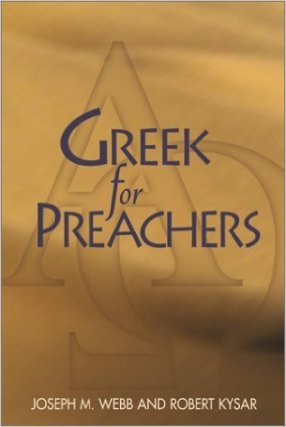
Greek for Preachers (Chalice Press, 2002) divides into three primary parts. Part 1 is “The Preliminaries,” where authors Joseph M. Webb and Robert Kysar suggest initial tools for preachers who want to use Greek. Part 2 offers “Ten Principles for Uncovering Greek Meaning,” which makes up the majority of the book. Part 3 focuses on “Using the Greek Text in Sermon Preparation,” and is a hands-on application of the principles the authors have taught in the second part. The book’s aim is simple: “to bring the Greek text of the New Testament within reach of anyone who wishes to explore its riches” (x). The authors want preachers who have lost their Greek (or not had any) to find the language “both usable and exciting” for use in sermon preparation (7).


Part 1: “The Preliminaries”


I worried a bit when I saw “uncovering Greek meaning” as the title for Part 2. Somewhere along the way I learned that Greek is not just a language to decode, as if there could be one-to-one equivalents for everything, with “hidden gems” available to ones with secret inside knowledge. But the authors are balanced here. In the Preface they say, “We do not believe there is anything intrinsically magic or even necessarily sacred about the original language of the New Testament, even though we both assert the importance of biblical languages for the Christian tradition” (ix). This approach resonates with me, especially as they go on to affirm, “But, judiciously and frugally handled, the joys of the Greek language of our New Testament are as bright as newly cut diamonds sitting in a store window waiting for someone to pick them up and share them with others” (7).

The first part focuses primarily on introducing the preacher to two tools: a Greek-English interlinear and an analytical lexicon. From there the authors go over the Greek alphabet, syllabification, pronunciation, and helpful immersion in a few practice texts. (The Greek font in this book looks good and is readable.) It is also in this first part that the authors introduce their approach to words and meaning, one that I am fully on board with: “[W]e should never assume that a word is used in the exact same way in different passages. The context in which a word is used is more important than how another writer in a different document might use the same word…” (5). This, in fact, has preaching implications for me, because I can make points like this in my sermons without even bringing “the underlying Greek” into the picture.


Part 2: “Ten Principles for Uncovering Greek Meaning”


Part 2 is the heart of the book. The authors give ten principles around specific grammatical features. Concepts they explore include: articles (and how their presence or absence adjusts meaning), verbs, participles, infinitives, cases, and more. There are lots of examples from the Greek New Testament, including possible sermon angles to derive from interpreting the Greek grammar. There’s a wealth of interaction with the Greek text for the reader to work through. There are charts, glosses, and plenty of material that any Greek reader will benefit from reviewing.

A highlight of the second part for me was the authors’ good distinction between grammatical gender and what they call human gender (also called social gender). They would support, for example, not using the generic “man” in English translations where the Greek has ἄνθρωπος. I am similarly deliberate in reading from the pulpit gender-accurate translations whenever I can.

While most of the instruction in this section is consistent with what I’ve learned from various grammars and exegesis courses at Gordon-Conwell (and reading Greek regularly since), there are a couple of surprising hermeneutical moves that I didn’t think were on firm footing.

For example, here is John 1:1:

Ἐν ἀρχῇ ἦν ὁ λόγος, καὶ ὁ λόγος ἦν πρὸς τὸν θεόν, καὶ θεὸς ἦν ὁ λόγος.

The authors say, “Look for the articles, especially the ones associated with God” (39). With the last part of the verse (θεὸς ἦν ὁ λόγος), the authors rightly point out that ὁ λόγος becomes the subject because of the article. So, “the Word was God.” However, they go on to explore “the nature of the articular nouns as they differ from the anarthrous nouns “(39), considering that the anarthrous θεὸς could simply mean something less specific like “God-like.” They approach the translation with humility, but unfortunately conclude, “Theologically, it raises the issue of whether or not the text means that God and the ‘word’ are identical” (39). Though it’s tempting to criticize this interpretation on account of what sounds like heterodoxy, Greek grammar alone (at least I thought!) settles the issue, that, “the Word was God” (and not just God-like). I can recall at least two Greek professors at GCTS making a similar point that the anarthrous θεὸς should not be interpreted in the way the authors explore.
greek-for-preachersAlso a curious was the interpretation of participles in the Great Commission of Matthew 28:19-20. The authors point out the three participles in those two verses, the first of which is aorist. “But the aorist participle,” they say, “that begins the sentence gives the idea of ‘going’ before it mentions the command to ‘make learners.’ Those who are addressed in this passage are already going” (65). As Roy Ciampa (from a 2008 Every Thought Captive blog post called, “As You Go, Make Disciples?“) and others have argued, that aorist participle is actually a participle of attendance circumstance, and it simply has the force of an imperative: nothing more, nothing less.

How does this interaction impact my own preaching, beyond my desire to critically engage with anything I read for my ministry development?

The authors model humility in how they approach the Greek, even when I disagree with them. I want to follow suit here.

On the other hand, some of their Greek-based hermeneutical moves seem like classic anecdotes of “what not to do” when moving from Greek New Testament to interpretation to pulpit. One wants to be careful not to make too much of subtle grammatical points that may reflect merely on what wording the author felt like using at the time of writing. As with the John 21 example where John and Peter dance between two different Greek words for love, a given author could simply be using a rhetorical flourish, and not intending us to derive any meaning more than that the author writes with creative style. (John 21 seems less clear-cut to me, though, than the examples above.)


Part 3: “Using the Greek Text in Sermon Preparation”


In the third part, “Using the Greek Text in Sermon Preparation,” the authors move the process into the pulpit. They list seven steps, each of which is easy enough to implement. And they have a stance on commentaries that I really appreciate, even as I’m aware of the discipline required: “We suggest that you use commentaries to learn what others have said about the passage but not necessarily to learn what you should say” (172). Great advice. I also resonated with their explanation of a topical sermon, where “the text gives you entry into an extensive issue that reaches beyond the text itself” (163).

The book closes with two full sample sermons using Greek, the first of which was a really interesting (and helpful) take on “submission” (as mutual) in Ephesians 5.


Concluding Assessment


Greek beginners will want to turn to Part 1 right away, although I’ve had it drilled into me that interlinears are bad. I think they have their place, but a preacher who really wants to learn Greek might better avoid them and use a footnoted Reader’s Greek New Testament instead. The authors suggest that pastors actively using Greek can profitably skim Part 2 as a refresher–it can be consulted later as a reference–and cut right to Part 3 for the meat of using Greek in preaching.

I appreciate the desire of this book. On the one hand, the authors are right on when they say,

“A little learning is a dangerous thing.” Novices in the Greek New Testament are in danger of slipping into the same mold. Greek is not a cure-all for biblical interpretation nor the key that unlocks truth. It is only one more tool to help us (176).

On the other hand, I really like the idea of teaching pastors the basics of Greek so that they can begin to get their feet wet with word studies.

Again, the drawback to using this book is that readers need enough Greek already to be able to discern what the authors are doing with John 1:1 and Matthew 28:19-20. The humility they model is admirable, though, and the majority of the other examples don’t make the same kind of questionable (in my opinion) conclusions those ones do.

For me, I try to use Greek as much as possible in my study. I’m reading through the Greek New Testament this year with a friend, and we’re taking (and sharing) notes as we go. I often find that insights from our conversations about the Greek text make their way into my sermons. So I wholeheartedly affirm with the authors that the integration of Greek reading and sermon preparation is a beautiful thing. Reading Greek for Preachers compels me to re-double my efforts in turning over the Greek (or Hebrew) text as an essential part of sermon preparation.

Greek for Preachers is at Amazon here, and at Chalice Press here.


Thanks to Chalice Press for sending me a review copy, which—I trust will be evident—did not influence my attempts at objectivity in assessing the book.

IVP’s 5-Volume Ancient Christian Doctrine in Accordance, On Sale this Week

Ancient Christian Doctrine


This week Accordance Bible Software has put their five-volume Ancient Christian Doctrine (IVP) on sale for $129 (normally $199). Ancient Christian Doctrine is a full-blown compendium of early church commentary on the Nicene Creed. I write more about the resource here.

If you’re teaching or preaching on the Creed, this is possibly the best resource to start with. (And, of course, it’s likely available for free in print at your local theological library.)

The related Ancient Christian Commentary on Scripture (covering the entire OT and NT) is also included in the sale.

Here‘s the link to find Ancient Christian Doctrine at Accordance.


This week’s blog sponsor is MailButler, the feature set you always wished your Mac Mail had (and that I’m glad mine does). Find out more about it here or download and try it free here.


It’s Prohibitively Expensive, But…

Brill LXX


…the Brill Septuagint Commentary Series is nearing availability on Logos Bible Software.

Here is how Brill describes its series:

This multi-volume series fills a significant gap in biblical studies by providing a literary commentary on the Greek text of the Septuagint. The Septuagint is widely recognized as one of the most important interpretations of the Old Testament and one of the most important sources for New Testament study. Whereas there has been much attention devoted to the two testaments, with numerous commentary series having been written, the Septuagint has been virtually neglected as a set of primary texts used by Jewish and Christian religious communities in the Greco-Roman world.

All 13 published titles will be released in late July through Logos, now available for the steep pre-order price of $1,773.99. It’s a good time to consult your local theological library. All the same, I’m encouraged to see the expanding availability of electronic resources for Septuagint studies.

Find out more here.

Structure of Ephesians 2:1-10: The Center Is Not What I First Thought

In the past when I’ve preached on Ephesians 2:1-10, I’ve gone straight for the gold of Ephesians 2:8-10:

For it is by grace you have been saved, through faith—and this not from yourselves, it is the gift of God—not by works, so that no one can boast. For we are God’s workmanship, created in Christ Jesus to do good works, which God prepared in advance for us to do.

The first seven verses have just felt like an opening band that–while good–wasn’t necessarily what I had come to see.

I see the passage differently now, having spent a good deal of time trying to understand Paul’s flow.

Here’s the passage from the 1984 NIV, followed by the passage in Greek:

Eph 2:1       As for you, you were dead in your transgressions and sins, 2 in which you used to live when you followed the ways of this world and of the ruler of the kingdom of the air, the spirit who is now at work in those who are disobedient. 3 All of us also lived among them at one time, gratifying the cravings of our sinful nature and following its desires and thoughts. Like the rest, we were by nature objects of wrath. 4 But because of his great love for us, God, who is rich in mercy, 5 made us alive with Christ even when we were dead in transgressions—it is by grace you have been saved. 6 And God raised us up with Christ and seated us with him in the heavenly realms in Christ Jesus, 7 in order that in the coming ages he might show the incomparable riches of his grace, expressed in his kindness to us in Christ Jesus. 8 For it is by grace you have been saved, through faith—and this not from yourselves, it is the gift of God— 9 not by works, so that no one can boast. 10 For we are God’s workmanship, created in Christ Jesus to do good works, which God prepared in advance for us to do.

Eph 2:1     Καὶ ὑμᾶς ὄντας νεκροὺς τοῖς παραπτώμασιν καὶ ταῖς ἁμαρτίαις ὑμῶν, 2 ἐν αἷς ποτε περιεπατήσατε κατὰ τὸν αἰῶνα τοῦ κόσμου τούτου, κατὰ τὸν ἄρχοντα τῆς ἐξουσίας τοῦ ἀέρος, τοῦ πνεύματος τοῦ νῦν ἐνεργοῦντος ἐν τοῖς υἱοῖς τῆς ἀπειθείας· 3 ἐν οἷς καὶ ἡμεῖς πάντες ἀνεστράφημέν ποτε ἐν ταῖς ἐπιθυμίαις τῆς σαρκὸς ἡμῶν ποιοῦντες τὰ θελήματα τῆς σαρκὸς καὶ τῶν διανοιῶν, καὶ ἤμεθα τέκνα φύσει ὀργῆς ὡς καὶ οἱ λοιποί· 4 ὁ δὲ θεὸς πλούσιος ὢν ἐν ἐλέει, διὰ τὴν πολλὴν ἀγάπην αὐτοῦ ἣν ἠγάπησεν ἡμᾶς, 5 καὶ ὄντας ἡμᾶς νεκροὺς τοῖς παραπτώμασιν συνεζωοποίησεν τῷ Χριστῷ, _ χάριτί ἐστε σεσῳσμένοι _ 6 καὶ συνήγειρεν καὶ συνεκάθισεν ἐν τοῖς ἐπουρανίοις ἐν Χριστῷ Ἰησοῦ, 7 ἵνα ἐνδείξηται ἐν τοῖς αἰῶσιν τοῖς ἐπερχομένοις τὸ ὑπερβάλλον πλοῦτος τῆς χάριτος αὐτοῦ ἐν χρηστότητι ἐφ᾿ ἡμᾶς ἐν Χριστῷ Ἰησοῦ. 8 Τῇ γὰρ χάριτί ἐστε σεσῳσμένοι διὰ πίστεως· καὶ τοῦτο οὐκ ἐξ ὑμῶν, θεοῦ τὸ δῶρον· 9 οὐκ ἐξ ἔργων, ἵνα μή τις καυχήσηται. 10 αὐτοῦ γάρ ἐσμεν ποίημα, κτισθέντες ἐν Χριστῷ Ἰησοῦ ἐπὶ ἔργοις ἀγαθοῖς οἷς προητοίμασεν ὁ θεὸς, ἵνα ἐν αὐτοῖς περιπατήσωμεν.

Assuming 2:1 is the beginning of a new sentence (Καὶ ὑμᾶς ὄντας νεκροὺς τοῖς παραπτώμασιν καὶ ταῖς ἁμαρτίαις ὑμῶν), there is not a clear indicative verb in a non-subordinate clause really anywhere in sight, at least not until an indicative verb of ἤμεθα (“we were”) in 2:3 (και ἤμεθα τέκνα φύσει ὀργῆς ὡς καὶ οἱ λοιποί). (Though I confess I’m not sure why this is preceded by καὶ if it’s not a participle.)

So 2:3’s ἤμεθα is the first indicative verb in the whole passage not in a subordinate clause. 2:1 (“You, being dead…”=participle) leads to 2:3b’s “we were children of wrath” (and notice Paul’s subtle shift in 2:3a from “you” as sinner to “we” as sinners). This wrath is the outcome one would anticipate.

Then there is a construction with a participle in 2:4a, similar to how the chapter began: ὁ δὲ θεὸς πλούσιος ὢν ἐν ἐλέει–“God, being rich in mercy”=participle. This is a grammatical (and theological) balance to “you, being dead.”

Paul is about to expand on this nice contrast, but first he interrupts with this recapitulation in Ephesians 2:5a: καὶ ὄντας ἡμᾶς νεκροὺς  τοῖς παραπτώμασιν (and you, being dead in transgressions). It is nearly identical wording to how the passage started, forming an inclusio with 2:1. (Just in case we missed it the first time, that we were dead in sin!)

Now there is the continuation of θεὸς ὢν–completed with a main verb to grammatically match but theologically and narratively replace the “we were children of wrath.” It is the high point of the passage, the phrase that holds the whole passage together. It has the three main verbs the listener/reader will have been waiting for since the participle of 2:1.

συνεζωοποίησεν τῷ Χριστῷ

God made us alive in Christ!

Then the rest of the passage is the unfolding (2:6 gives two more main verbs: he raised us and seated us with Christ) and purpose (2:7) and reiteration with implications (2:8-9) of συνεζωοποίησεν τῷ Χριστῷ.

I take 2:10 and its ἐν Χριστῷ Ἰησοῦ, then, to be the “application” section of this passage.

Interestingly enough, read this way, the ever-popular 2:8-9 are not the main point of the passage, at least not on their own. They need to be understood in light of God’s specific actions of making us alive in Christ (συνεζωοποίησεν τῷ Χριστῷ), raising us (συνήγειρεν) and seating us in the heavenly realms in Christ (συνεκάθισεν ἐν τοῖς ἐπουρανίοις ἐν Χριστῷ Ἰησοῦ).

The technical commentaries confirm this way of reading the passage, namely, that the structural and grammatical center is 2:5-6, describing the three-fold action of God in making us alive, raising us, and seating us.

It’s a nuance, to be sure, and it doesn’t take away from the power of 2:8-10. But it does mean my preaching focus tomorrow will be on the three-fold action of God, and how we understand that as his saving grace, to be received by faith.

Discovering the Septuagint: A Guided Reader (Jobes) Is Now Available

Discovering the LXX


For Greek reading I’ve been so knee-deep in Ephesians that I haven’t been much in the Septuagint of late. That will change with the release of Karen Jobes’s Discovering the Septuagint: A Guided Reader, just published by Kregel Academic. I have known about this for a long time, so am happy to see it released into the wild! I think a lot of folks will benefit from it, especially those ready to freshen things up or go a step deeper in Greek learning.

While it’s available for pre-order from Amazon, it’s shipping now from Kregel, so what are you waiting for?

Guess What? Ephesians 1:15-23 is Also One Sentence in Greek: Trying a Mind Map

Just when I thought my sermon preparation was moving away from loooong Pauline sentences, Ephesians 1:15-23 offers another–a single sentence stretches across those nine verses. (See here on Ephesians 1:3-14 as one sentence and where I started my exegesis.)

This week I thought I’d see if I could wed my need to visually outline the text with my deep appreciation for mind mapping.

The result was that I got a significant step closer to understanding the focus of Paul’s prayer for Ephesian Christians. This is in rough form (and will be revised still), but here’s how I used the app MindNode to lay out the passage (click/tap to enlarge):


AKJ Mind Map Sentence Flow


It’s coming together!

At Last: Muraoka’s Syntax of Septuagint Greek

Muraoka Syntax of LXX Greek


At last, an up-to-date, full-on Septuagint grammar: Muraoka’s Syntax of Septuagint Greek.

I mean, just take a look at the Table of Contents! Thank you, T. Muraoka, for writing it.

It is undoubtedly worth every penny, though it does cost many pennies, as you might expect.

Here’s what the publisher says about it:

This is the first ever comprehensive analysis of the morphosyntax and syntax of Septuagint Greek. The work is based on the most up-to-date editions of the Septuagint. The so-called Antiochene version of Samuel, Kings, and Chronicles as well as Judges has been studied. Though this is a synchronic grammar, and though not systematic, comparison with Classical Greek, the Greek of contemporary literature of the Hellenistic-Roman period, papyri and epigraphical data, and New Testament Greek has often been undertaken. Even when analysing translated documents of the Septuagint, the perspective is basically that of its readers. However, attempts were made to determine in what ways and to what extent the structure of the Semitic source languages may have influenced the selection of this or that particular construction by translators. At many places it is demonstrated and illustrated how an analysis of the morphosyntax and syntax can illuminate our general interpretation of the Septuagint text.

Here it is at Peeters Publishers. Here‘s the Amazon page.

Ephesians 1:3-14 is One Sentence in Greek: Where to Start

Ephesians 1:3-14 is a single sentence in Greek. It has more than 200 words. How does a preacher even begin!

Well, to start, I isolated the indicative verbs, which is as simple as typing

[VERB Indicative]

into the search entry bar in Accordance software. I wanted to start there because I thought indicative verbs (as opposed to the participles) would be the best place to begin breaking down the flow of Paul’s argument.

Then I cross-highlighted the verbs in an English translation in parallel (though I had done my own translation, too) so I could see them in both languages. The result was this (click/tap to enlarge):


Ephesians 1.1-14 Indicative Verbs


From there, you guessed it, a three-point outline emerged, which shaped my sermon on this beautiful passage. I found that the indicative verbs themselves coalesce pretty nicely into three main points.

I’m preaching on the passage tomorrow–great stuff, and much more to share, but just this simple search (with, of course, instantaneous results) has been essential in guiding my exegesis and preparation.

A Greek Word for the Twitter Age: σπερμολογος (spermologos)

Here’s a fun Greek word: σπερμολογος (spermologos). It appears only one time in the Greek New Testament, and nowhere in the Septuagint. Here it is in its context, Acts 17:18:

τινες δε και των Επικουρειων και Στοικων φιλοσοφων συνεβαλλον αυτω, και τινες ελεγον· τι αν θελοι ο σπερμολογος ουτος λεγειν; οι δε· ξενων δαιμονιων δοκει καταγγελευς ειναι, οτι τον Ιησουν και την αναστασιν ευηγγελιζετο.

A group of Epicurean and Stoic philosophers began to debate with [Paul]. Some of them asked, “What is this babbler trying to say?” Others remarked, “He seems to be advocating foreign gods.” They said this because Paul was preaching the good news about Jesus and the resurrection.

The NIV 2011 (above), NRSV, and KJV all translate σπερμολογος (spermologos) as “babbler.” HCSB has “pseduo-intellectual.” NASB has “idle babbler.” NET has “foolish babbler.” Not to be outdone, the Message offers, “What an airhead!”

Context determines meaning, which makes a word like this tricky, since it has no other uses in the Bible. The LSJ lexicon notes its use in, among other classic works, the play Birds by Aristophanes, where it refers to birds picking up seeds. In the 1st century B.C. history of Dionysius of Halicarnassus, σπερμολογος  describes a “frivolous” person. For the noun form LSJ offers, “one who picks up and retails scraps of knowledge, an idle babbler, gossip.”

BDAG has this: “in pejorative imagery of persons whose communication lacks sophistication and seems to pick up scraps of information here and there.” I also like its gloss of “scrapmonger”! In the part of the entry that covers the Acts verse, it says, “Engl. synonyms include ‘gossip’, ‘babbler’, ‘chatterer’; but these terms miss the imagery of unsystematic gathering.

Also helpful is Louw-Nida’s Greek-English Lexicon of the New Testament Based on Semantic Domains:

one who acquires bits and pieces of relatively extraneous information and proceeds to pass them on with pretense and show.

And then this gem, from the same source:

The term σπερμολογος is semantically complex in that it combines two quite distinct phases of activity: (1) the acquiring of information and (2) the passing on of such information. Because of the complex semantic structure of σπερμολογος, it may be best in some languages to render it as ‘one who learns lots of trivial things and wants to tell everyone about his knowledge,’ but in most languages there is a perfectly appropriate idiom for ‘a pseudo-intellectual who insists on spouting off.’

The implications for an easy-to-access information age are obvious–how much of the Internet is gathering information like seed and passing it on, without stopping to research and truly evaluate it?

We could pontificate, but back to Acts–this is what some Athenian philosophers called Paul: a σπερμολογος. The parenthetical statement in Acts 17:21, however, makes this the height of irony:

Αθηναιοι δε παντες και οι επιδημουντες ξενοι εις ουδεν ετερον ηυκαιρουν η λεγειν τι η ακουειν τι καινοτερον.

(All the Athenians and the foreigners who lived there spent their time doing nothing but talking about and listening to the latest ideas.)

Did you catch it? Louw-Nida says a σπερμολογος engages in “two quite distinct phases of activity: (1) the acquiring of information and (2) the passing on of such information.” Acts 17:21 says the Athenians themselves (who leveled the σπερμολογος charge against Paul) spent all their time in two phases of activity: talking (#2 above) and listening (#1) to “the latest ideas.”

Moral of the story: check yourself before you call someone a σπερμολογος.

Feb. 8: Happy International Septuagint Day!

International Septuagint Day


Today, February 8, is International Septuagint Day. Happy LXX Day! So read yerself some Septuagint today, in Greek or English.

A few more links to explore: