Logos 4 Review: The Septuagint

I enjoy reading the Septuagint in Greek (as best I can), and I enjoy using Bible software programs to do it. In this post I offer part 2 of my Logos 4 review (part 1 is here), focusing on the Septuagint in Logos.

Here is what the Original Languages Library has by way of Septuagint resources:

  • Septuagint with Logos Morphology (Rahlfs-Hanhart)
  • A Greek-English Lexicon of the Septuagint (Lust/Eynikel/Hauspie)
  • An Intermediate Greek-English Lexicon (Liddell/Scott)
  • The Parallel Aligned Hebrew–Aramaic and Greek Texts of Jewish Scripture (Logos product page here)
  • The BHS Hebrew Bible with WIVU morphological analysis (as well as other Hebrew-related resources)

As far as texts go, the standard base is there (Rahlfs). And there’s instant morphological analysis so you can hover over a word to see its parsing right away. The LEX Septuagint lexicon is my personal go-to, and adding the Liddell-Scott abridgement is an especially nice touch. Students can do decent lexical analysis of words in their Septuagint-specific context.

The best part is the inclusion of the Parallel Aligned Hebrew-Aramaic and Greek Texts of Jewish Scripture. Here’s what Logos says:

Prof. Tov’s Parallel shows how the Hebrew and Aramaic line up against the Greek text on a word-by-word basis, but it does far more. In places where the Greek text doesn’t follow the Masoretic reading, Dr. Tov has provided a reconstruction of what the Hebrew or Aramaic text that the Greek translators were looking at might have been. In addition to these theoretical reconstructions, this database includes copious notes on the translation techniques used by the Septuagint translators, making this work a rather specialized commentary on the text. Did the Greek translators change the word order for grammatical or stylistic reasons? Did they change the voice of a verb from passive to active? Did they use a genitive absolute to translate an infinitive absolute? These types of observations are exhaustively noted in the alignment.

Dig this:

It’s a really nice feature, and presented especially well in Logos.

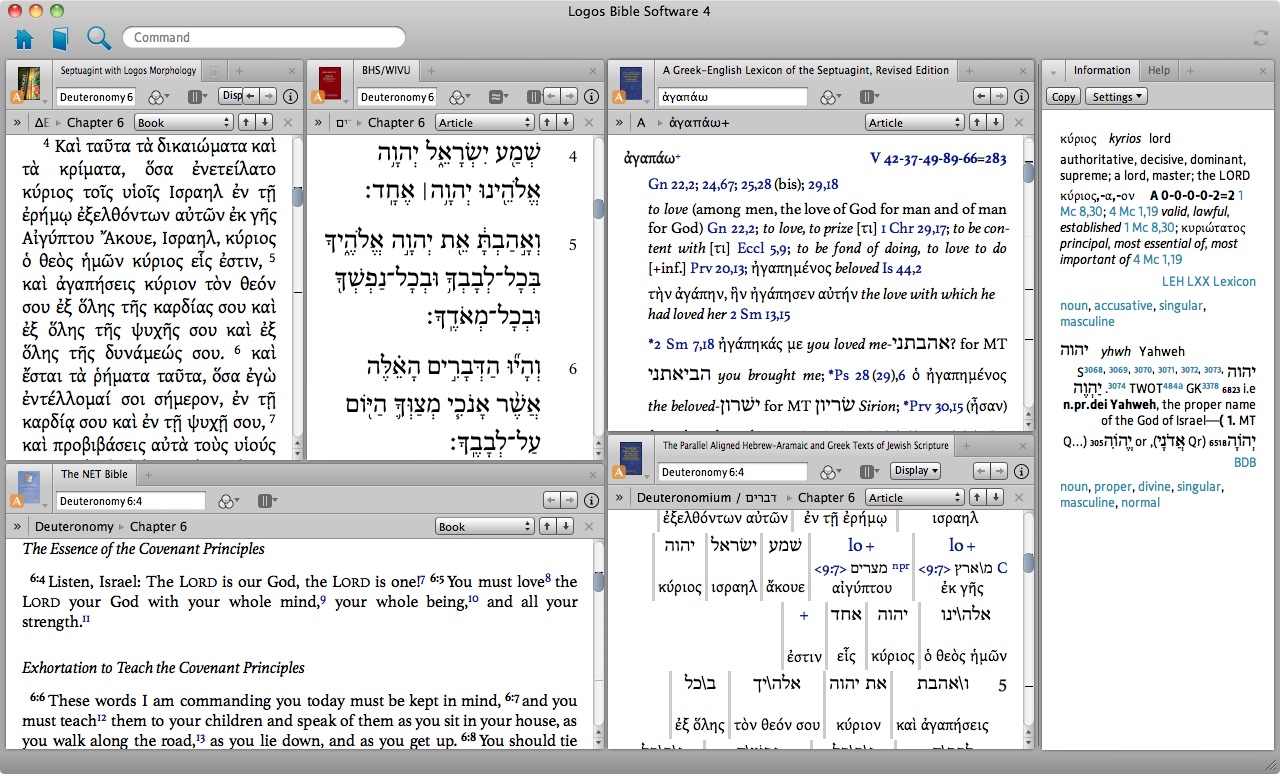
With all of the above in use, here’s what my Septuagint layout looks like in Logos 4 (click to enlarge):

That’s six resources open at once, each of which is plenty visible! And moving around which tabs go where, re-sizing, opening “in a floating window,” and saving the layout is easy.

The little orange A next to each resource icon/image is a “Link Set.” By clicking on the icon/image of the resource, I can assign it a letter in a Link Set, which then means each of the tabs and resources updates as any one of them moves ahead. So if I move ahead through the Greek LXX, the Hebrew MT follows, as does the NET Bible, as does the MT/LXX Parallel. Nice.

It was easy enough to figure out how to make LEH my default lexicon (“prioritize” it, in Logos parlance). Now double clicking on any Greek word opens up the corresponding entry in that lexicon.

The Information tab at the right in the screen shot above gives lexical and morphological analysis of any word. And something that’s not present in the image above: the bottom gray portion of Logos (just under the bottom left tab) also updates with morphological analysis as you move over a word. That part of the screen updates faster than the Information tab, which has just a slight delay in displaying new information.

One thing that stands out as a possible oversight is that there is no English translation of the Septuagint bundled with the Original Languages Library. In other major Bible software programs for a comparable price and package level, there is at least one English translation of the Septuagint, so Logos is unique here. (Logos does have Brenton’s English translation available, though you have to purchase it in addition to this package to use it.)

The MT-LXX Parallel, the two solid LXX-related lexica, and the customizability of the layout are standouts when it comes to using the Septuagint in Logos 4. One other thing worth mentioning is the availability of the Göttingen Septuagint and apparatus in Logos. It’s an add-on module that’s not cheap, but its price for how much it offers is hard to beat anywhere, digitally or in print. There are other Septuagint resources that Logos has digitized, too, that would be good additions to a digital library.

Thanks to Logos for the review copy of Logos 4 with the Original Languages Library included. For the review copy I will be giving my honest impressions of the program in a multi-part review. The couple Amazon links in this post are Amazon Affiliate links.

Review: Accordance 10’s Commentary on the New Testament Use of the Old Testament, by Beale and Carson (part 2 of 2: the content)

Commentary on the New Testament Use of the Old Testament, edited by G.K. Beale and D.A. Carson, is available as an add-on module in Accordance 10. In the first part of my review of the module, I focused on Accordance’s presentation of the commentary. Here I review the content of the commentary itself, but still with a close eye on how I’ve experienced it in Accordance.

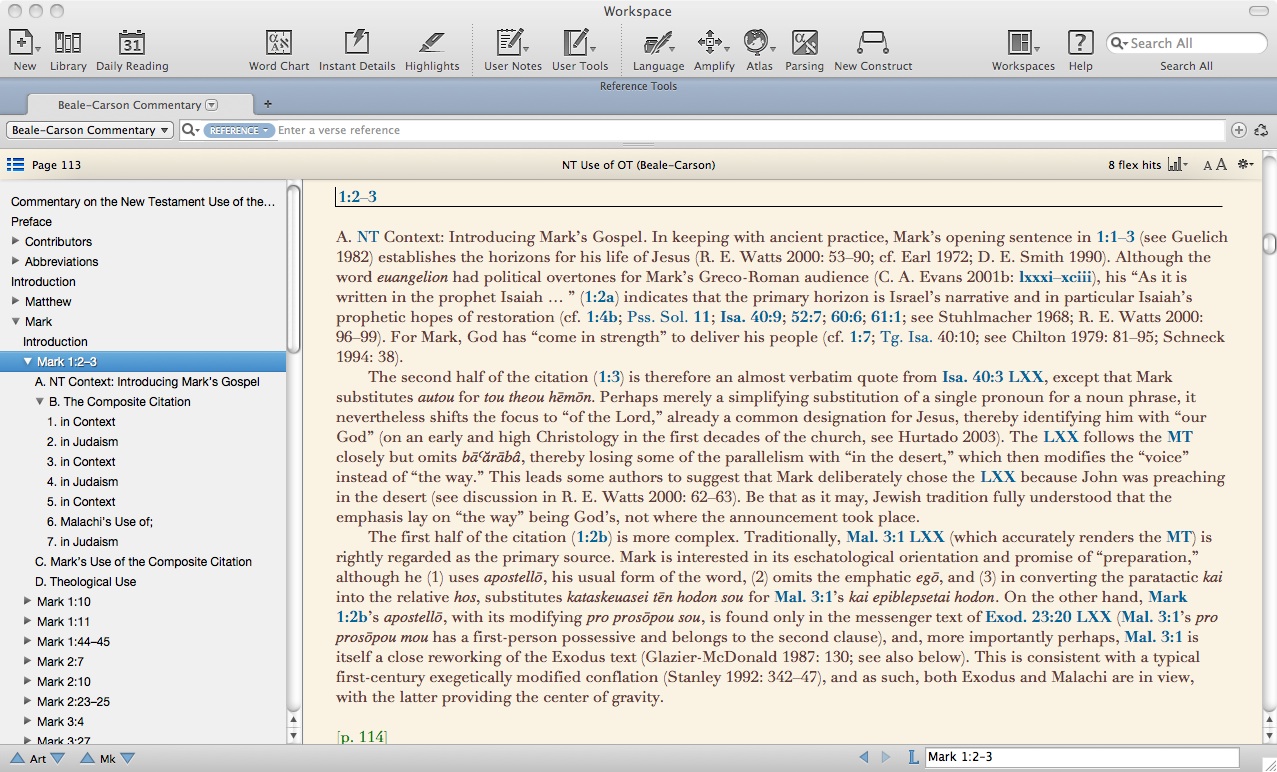
I mentioned in my last post that for reading this commentary straight through (e.g., if I want to spend some time absorbing the introduction to any given book), I can easily detach it from a given workspace where it has shown up as a “Reference Tool.” I also noted that navigating through the various headings and sub-headings of the commentary is very easy, as Accordance lays it out.

To quickly view hyperlinks you can do a “Popover” for Instant Details by holding a click on a hyperlink or by pressing option-click. Or, as I’ve begun doing since my last post, you can just have the Instant Details always open. This way I can quickly read the text of a verse that is merely referenced in the commentary, and not lose my place in the body of the commentary.

Highlighting is also mercifully easy, so that my commentary currently looks like this:

One thing to appreciate about the content of the commentary right off the bat is that it succeeds in its hope that

Readers will be helped to think through how a particular NT book or writer habitually uses the OT; they will be stimulated to see how certain OT passages and themes keep recurring in the various NT corpora.

Take D.A. Carson’s introduction to 1 Peter, for example:

The OT is cited or alluded to in 1 Peter in rich profusion. In a handful of instances quotations are introduced by formulae: dioti gegraptai, “wherefore it is written” (1:16, citing Lev. 19:2), dioti periechei en graphē, “wherefore it stands in Scripture” (2:6–8, citing Isa. 28:16; Ps. 118:22; Isa. 8:14), or, more simply, by dioti, “wherefore” (1:24–25a, citing Isa. 40:6–8) or by gar, “for” (3:10–12, citing Ps. 34:13–17). About twenty quotations are sufficiently lengthy and specific that there is little doubt regarding their specific OT provenance. For a book of only five short chapters, there is a remarkable record of quotation. Yet the quotations tell only a small part of the story, for 1 Peter is also laced with allusions to the OT.

Andreas J. Köstenberger’s introduction to John is remarkably thorough in this regard, containing (among other things!) a table of introductory formulas John used for OT quotations, a comparison between how John uses a given OT text and how other NT writers use it, how John’s quotations relate to potentially underlying Hebrew and Greek texts, and so on.

As noted above, there are several ways I can easily use Instant Details to look up each of the verses mentioned in the commentary, without losing my place in the main body. Note that the commentary uses transliteration for Greek and Hebrew throughout. For those who are not huge fans of transliteration (myself included), this is offset by the ease with which I can look up any of those verses in Accordance in the original texts, right alongside the commentary.

In the below screen shot I have the GNT-T text at bottom left tied to the Beale-Carson Commentary. This is simple to set up with a right click on the tab, then going to “Tab Ties.” This means that as I advance through 1 Peter, for example, the GNT-T text follows me. In the instance below, I have the parallel NET open, so that a Greek-English diglot follows me through the commentary. In the “Context” zone at the right I have the Hebrew Masoretic Text and the Old Greek (LXX) open with my favorite corresponding English translations (NET and NETS) below.

One thing I sort of stumbled on that is really neat. Besides clicking on a hyperlinked verse in the text (to show me that single verse in the Context zone), command-clikcing on a hyperlinked verse gives me all the verses in my commentary’s paragraph that are hyperlinked. Note the “Verse 1 of 12” below, and how Isaiah 8:14 is right below Leviticus 19:2 in my LXX. What a nice feature!

Okay. Back to the content of the commentary itself. The introductions to each NT book, then, do well to orient the reader to trends in how that particular writer interacts with the OT text. The list of contributors is impressive–see it here. The commentary seeks to analyze not only instances where the NT quotes the OT, but also “all probable allusions” as well.

Generally speaking, each citation or allusion in question is organized around these facets:

  • The New Testament context: “the topic of discussion, the flow of thought, and, where relevant, the literary structure, genre, and rhetoric of the passage”
  • The Old Testament context of the source of the quotation or allusion–already things get interesting here, because NT writers do seem to feel free to recontextualize or resituate OT passages…
  • How early Judaism literature understood the given OT text. Even when there is little evidence of citation in early Judaism, there is still explanation. Köstenberger, for example, on John 2:17 briefly discusses the Jewish valuing of zeal, drawing on Phinehas, the Maccabees, and the Qumran community.
  • Textual issues, e.g., changes in verb tense from the LXX to the NT, and explorations of what text (proto-MT, LXX, etc.) or texts might inform the NT author’s quotation, including good discussion of textual variants (in the MT, LXX, and GNT!)
  • “How the NT is using or appealing to the OT,” i.e., are they so steeped in the OT that its language comes out naturally and not as a deliberate quotation? Does the NT writer have fulfilled prophecy in view? Etc.
  • The “theological use” of the OT by the NT writer

This last category ties much of the other content together. For example, on the theological use of Mark 1:2-3, Rick E. Watts says, “As such, eschatologically, in Jesus Isaiah’s long-delayed new-exodus deliverance of Israel has begun in Malachi’s great and terrible day of the Lord (Mal. 4:5).” Watts is dense here, but delightfully so, in my opinion. He develops these themes further–especially that of the new exodus–throughout his analysis on Mark.

I mentioned in my last post that you can search this module in a dozen different ways. The search bar is similar to Google, in that you can search English content by a single word, but also by a phrase in quotation marks, so that that exact phrase comes up in your search. Unfortunately the “Greek Content” and “Hebrew Content” searches (which search using Greek and Hebrew letters) are not available in this module, but that’s no fault of Accordance’s, since the commentary uses transliteration.

Fortunately, “Transliteration” is a search option, so you can easily look up how the commentary treats a given Greek or Hebrew word. Searching hilastērion, I see that all seven of its uses in the commentary are at Romans 3:25.

There were a few times when I wanted to go deeper into a passage than the commentary allowed. For example, Paul’s citation of Malachi in Romans 9:13 has, “Jacob I loved, but Esau I hated.” It’s hard to imagine anyone using a commentary who doesn’t want at least a little explanation of “hated” here. The commentary, to be fair, does have, “This choice of Jacob meant the rejection of Esau,” but doesn’t connect this rejection with the verb “hate.”

This just means that Beale and Carson’s commentary won’t be the only place I turn for in-depth study of a passage, but all my seminary professors say don’t use just one commentary anyway! Not a major loss here. The book is already huge (though not on a computer, thankfully), and attempts to be only “reasonably comprehensive” (which it very much is), not exhaustively so.

Besides that, it took me about three seconds to find in Accordance the NET Bible note on Malachi 1:3:

The context indicates this is technical covenant vocabulary in which “love” and “hate” are synonymous with “choose” and “reject” respectively (see Deut 7:8; Jer 31:3; Hos 3:1; 9:15; 11:1).

This commentary is what we book reviewers like to call a monumental achievement. It sits in the carrel of many a student in my seminary’s library. For good reason. And Accordance has done a magnificent job if seamlessly integrating a rich and multi-facted commentary into its software. This is a five star commentary with five star integration into Accordance 10.

Beale and Carson say in their introduction:

If this volume helps some scholars and preachers to think more coherently about the Bible and teach “the whole counsel of God” with greater understanding, depth, reverence, and edification for fellow believers, contributors and editors alike will happily conclude that the thousands of hours invested in this book were a very small price to pay.

After consulting the original biblical texts, this commentary will always be the first place I turn when I am looking to better understand (and share with others) how the New Testament uses the Old. I am grateful for those “thousands of hours invested in this book.”

Thank you to Accordance for providing me with a copy of the Beale/Carson commentary module for review. Scroll through for all six parts of my Accordance 10 review here.

Logos 4 Review: Install and Initial Impressions

I am a first-time user of Logos Bible software. I’ve used other Bible software programs before, on both a PC and a Mac, but here I will review Logos 4 in a series of posts. Today: the installation process and my initial impressions.

For those of you curious about specs, I’m running Logos 4 on Mac OSX (10.8.1) with a recent memory upgrade (4GB of 1067 MHz DDR3) and 2GHz Intel Core 2 Duo. It’s a three-plus-year-old machine, but in good condition and with decent speed.

Having downloaded Logos 4 to my machine, I signed in to read, “Preparing to download: This may take a while.” Fortunately that part didn’t take that long–under two minutes. “Downloading resources” then followed:

Five minutes later it was just at 6%. Six minutes after that, 14%. But it’s 3.53 GB. The Original Languages Library is big, and I had a few other freebies in my account already. Within 45 minutes all was downloaded. Good time, I thought. Then it went into “Preparing your library: This may take a while…”

But that only took 15 minutes. Just over an hour–start to finish–is pretty good for installing a program of this size and power. What I will want to keep an eye out for is how long it takes to start the program on a daily basis each time I want to use it.

Everything in the installation happens online. There are no DVDs to insert–just create a Logos account, sign in, and Logos knows what to download for you to get you up-to-date. The one log-in works across multiple computers. I’ve got Logos on my Mac right now, but I can just as easily put it on my PC, too. (!) As far as I’m aware, Logos 4 is the only major Bible software that works natively in both the PC and Mac platforms. (BibleWorks at one time had a Mac version under development but has since scrapped it; Mac’s Accordance is coming to Windows in 2013.)

After completing the installation process, the next morning I opened Logos 4. With just two (inactive) Web browsers open, it took about two minutes from the time I clicked the Logos icon to the time it was ready to go. This does seem a longish time (in computer time!) for a program to start. I came to this home screen:

I like being able to see what resources of mine were “updated,” and the “enter passage or topic” search bar is easy to spot right away. As much as I love John Owen, I wasn’t a huge fan of what looked and felt like ads greeting me as I opened this Bible software. This is the program default, but it’s easy to change:

Then, the second time I booted the program up, it was ready to go in less than 45 seconds. Much better.

This morning I received a notification that an update for Logos 4 was ready to be installed. This came automatically. Already I think I am noticing a real strength of this program–how automated everything is with regard to updates, library maintenance, etc.

As a someone whose church uses the lectionary, I especially appreciate being able to see the readings for this Sunday (and “Proper 18”) in the top right of the home screen.

Now for an initial search in that “enter passage or topic” box. Let’s go with Deuteronomy 6:4-9. And… wow. A wealth of information comes up (click for larger):

I can’t wait to use the Andersen-Forbes Phrase Marker Analysis for the Hebrew Bible. It’s exclusive to Logos. (See Logos blog from some time ago on it here and links to tutorial videos here.)

On the left I’ve got a “Passage Guide,” with some of what it pulls up displayed above, and another tab called “Exegetical Guide,” which gives me more detailed information about grammar, visualizations, word-for-word analysis, etc. There are plenty of windows and tabs open, which are easy to move around and re-arrange as I desire.

Getting Logos 4 and the Original Languages library set up was an easy install process. I’m glad for everything taking place so easily over an Internet connection, and I’m hoping that the time it takes to start the program up each time is not much. Time will tell how long the “This may take a while…” screen will actually take each time I use Logos. But with all the tools available above, and many more besides, it looks like I’ll be able to do quite a bit with Logos 4.

Thanks to Logos for the review copy of Logos 4 with the Original Languages Library included. For the review copy I will be giving my honest impressions of the program in a multi-part review.

The Gospel According to Isaiah 53, reviewed

Isaiah 53 is one of the clearest prophecies of Jesus the Messiah in the Hebrew Scriptures. This chapter has changed the lives of thousands of people–both Jews and Gentiles–who have read the text and believed in the One who fulfilled these prophecies in glorious detail.

Thus begins Mitch Glaser’s Introduction in The Gospel According to Isaiah 53: Encountering the Suffering Servant in Jewish and Christian Theology (affiliate link). In three parts the book expounds how the prophecies of Isaiah 53 relate to and are ultimately fulfilled in the person of Jesus. (The full passage the book treats is Isaiah 52:13-Isaiah 53.)

The first section, a sort of exegetical prelude, discusses “Christian interpretations” and “Jewish interpretations” of Isaiah 53. The second section is a biblical theology of Isaiah 53 (with particular attention to its use throughout Scripture). The third and concluding section speaks to “Isaiah 53 and Practical Theology,” with an emphasis on how to preach the passage, both from the pulpit and in conversation.

The book is “designed to enable pastors and lay leaders to deepen their understanding of Isaiah 53 and to better equip the saints for ministry among the Jewish people.”

The first thing I noticed about the book is that it’s just as much an apologetic for Jesus-as-suffering-servant as it is an academic study of Isaiah 53. It’s not that it lacks academic substance, though. This is a meaty book, and pleasingly so.

Regarding the book’s explicitly evangelistic intent–there may be some who are uncomfortable with the description of Chosen People Ministries’ “Isaiah 53 Campaign” (including 75,000 postcards to Jewish homes and 40,000 voice blasts=robo-calls?). I’ll admit that I question the potential efficacy of pre-recorded phone messages for reaching anyone with the Gospel (though God can use anything!). But see blogger Joel Watts for his helpful (refreshing!) take on the blending of the academic and evangelistic enterprises, especially in the context of this book.

You can find a full list of contributors in the table of contents here (pdf). A few names to highlight are Walter C. Kaiser Jr., Darrell L. Bock (one of the co-editors), Craig A. Evans, and Donald R. Sunukjian. I particularly appreciated the book’s treatment of the New Testament use of Isaiah 53. The chapter by Michael J. Wilkins lists the quotations of Isaiah 53 in the NT and additional allusions to it in the Gospels. (He makes a key point, that Jesus himself understood “his mission and death in the light of Isaiah 53.”) Darrell Bock goes in depth with a comparison of the Greek and Hebrew texts of Isaiah 53:7-8, highlighting its use in Acts 8 where Philip explains the passage to the Ethiopian eunuch.

Something to critique in this book is that there were a few generalizations of Jews that I found to be unfair, particularly in the chapter “Using Isaiah 53 in Jewish Evangelism.” Mitch Glaser writes:

I think I can safely say that, in the United States, most Jewish people would recognize Isaiah as the first name of a professional athlete sooner than they would recognize the prophet of biblical literature.

Granted, he is operating from the assumption that “most Jewish people are not Lubavitch, Hasidic, or Orthodox,” but still…. What was more surprising to me: “Most Jewish people do not understand or believe in biblical prophecy” and, “Most Jewish people do not believe in sin.” Glaser does (only later) qualify these with, “We must note that all of the above does not apply to those who hold to traditional Jewish theological positions,” but he would have been better off saying something like “many secular or ethnic but non-religious Jews…” or at least supporting his statements with statistics from surveys rather than anecdotal evidence. Glaser himself is a converted Jew who has a compelling conversion story, but I still found those characterizations to be frustrating. I wonder how helpful such statements could be in advancing an evangelistic cause in conversation with another Jew.

This next thing to highlight may seem a small point to some, but as someone seeking to keep my Hebrew and Greek going, I appreciated the actual Hebrew and Greek fonts throughout the book (i.e., not just transliteration), which are clear and easy to read. I did think, however, about an intended audience of “pastors and lay leaders” who may have desired transliteration, too. (All Hebrew and Greek is translated into English.)

Darrell Bock’s conclusion summarizes all the essays of the book, with key quotations. Having this there was a big help in piecing everything together again. The Gospel According to Isaiah 53 will not be far from my reach in coming months and years. I expect I will often reference this compendium of biblical scholarship on a vital text. My hesitations about the characterizations of Jews above notwithstanding, there is a good deal here that can be useful for Christian-Jewish conversations about the Suffering Servant.

I received a free copy of The Gospel According to Isaiah 53 with the only expectations of providing an (unbiased and honest) review on this blog. Its publisher’s product page is here. It’s on Amazon here (affiliate link).

Exegetical Guide to the Greek New Testament: Colossians and Philemon, reviewed

Getting from participles to preaching, from grammar to Good News proclamation, can be a challenge to preachers and teachers when working with the biblical text. But if there is theology in those prepositions, as seminary professors have often noted, careful attention to the morphology and syntax of the text can be key in preparing to expound God’s Word with God’s people.

B&H Academic’s Exegetical Guide to the Greek New Testament “aims to close that gap between stranded student (or former student) and daunting text and to bridge that gulf between morphological analysis and exegesis.” As a volume in a projected set of 20 volumes, Murray J. Harris’s Colossians and Philemon “seeks to provide in a single volume all the necessary information for basic understanding of the Greek text and to afford suggestions for more detailed study.” Similar to the Baylor Handbook series, the Exegetical Guide is not a “full-scale” commentary. This affords the author more opportunity to comment on the original language of the biblical text.

Both Colossians and Philemon in this volume contain a brief but sufficient Introduction. It treats authorship (Harris defends Pauline authorship based on Colossians’ similarity to Philemon, which is more generally accepted as Pauline); date (he puts the two letters at 60-61); occasion and purpose; includes an outline of the letter; and makes commentary recommendations.

Each paragraph of the biblical text has the following features in the commentary:

  • A structural analysis of the Greek. This is in sentence flow style–not sentence diagramming; Harris says the former is “a simple exercise in literary physiology–showing how the grammatical and conceptual parts of a paragraph are arranged and related”
  • Commentary on each phrase in the Greek, which ranges from morphological analysis to syntax to lexical analysis (great helps for word studies in this book!) to textual variants. Much of the Greek ends up translated into English in each passage of the commentary
  • “For Further Study,” a bibliography arranged by topic, e.g., “Prayer in Paul” (1:9-12), “The Will of God” (1:9), etc.
  • “Homiletical Suggestions,” not uncommonly more than one for a given passage

In addition, at the end of each letter there is a full English translation of that letter and an “expanded paraphrase” of the Greek. Colossians 3:12-14 in Harris’s translation, for example, reads:

Therefore, as God’s chosen people, who are holy and loved by him, put on heartfelt compassion [σπλάγχνα οἰκτιρμοῦ], kindness, humility, gentleness, and patience. You are to bear with one another, and if anyone has a grievance against someone else, you are to forgive one another. Just as the Lord forgave you, so you also must forgive.

The expanded paraphrase reads, “So, then, since you are God’s chosen people, his elect, dedicated to his service and the objects of his special love….”

The structural analysis, in my view, is the best feature of this densely packed and rich commentary. For example, in his analysis of Colossians 3:1-4, Harris visually shows “Christ” (in Greek) lined up in five different instances, so that he can easily show, “Christ is a central theme of the paragraph (there are five explicit references to him in the four verses).” Just reading the Greek straight through, this may not be as obvious as it is when Harris shows it visually and comments on it.

Harris gives great attention to individual words and phrases within verses. He mentions the major Greek grammars: “Blass-Debrunner-Funk, Robertson, Turner, and Zerwick,” as well as BDAG, the Anchor Bible Dictionary, and other such standard references. Just to give one example, on 1:15 Harris writes:

The ‘firstborn’ was either the eldest child in a family or a person of preeminent rank. The use of this term to describe the Davidic king in Ps 88:28 (LXX) (=Ps 89:27 EVV), ‘I will also appoint him my firstborn (πρωτότοκον), the most exalted of the kings of the earth,’ indicates that it can denote supremacy in rank as well as priority in time.

The sermon suggestions are really just suggestions for the body of a sermon; though they are in outline form, they are not complete sermon outlines. And some of the included outlines (“Wrestling in Prayer” from 2:1-2) will preach better than others (“Introductory Greeting” from Philemon 1-3). Yet anything homiletical like this is more than some Greek-focused, exegetical series offer, and the homiletical suggestions–if not always sufficient in themselves–still make for a good point of departure for the preacher. In fact, Harris only intends “to provide some of the raw materials for sermon preparation.”

The “Glossary of Grammatical and Rhetorical Terms” is one of the best such glossaries I’ve seen in a book like this. It occasionally uses examples from Colossians and Philemon themselves, which is a nice touch.

This Exegetical Guide to the Greek New Testament is a great companion to the Greek text. Harris is sensitive yet incisive, and always thorough. It’s hard to imagine a better guide for the grammatical analysis of Colossians and Philemon in Greek. I look forward to future volumes in this series. (A James volume is coming soon.)

Thanks to B&H Academic for the free review copy of the book. I was under no obligation to provide a positive review. The book’s product page is here (B&H), or see it here (Amazon).

Review: Accordance 10’s Commentary on the New Testament Use of the Old Testament, by Beale and Carson (part 1 of 2: the module)

Baker Academic has made its way to Accordance 10 Bible Software. The first offering is Commentary on the New Testament Use of the Old Testament, edited by G.K. Beale and D.A. Carson. Here I review it, with this first part of the review covering Accordance’s version of it.

One nice thing about Accordance’s setup is that I can use Commentary on the NT Use of the OT just as any other Accordance tool (for the below and all images in this post, click or open in new tab for larger):

Or I can right-click on the tab to “detach it,” so that it’s its own workspace. For reading through a good deal of text at once, this is ideal. One other great feature, as you’ll see in the left sidebar below, is how easy it is to navigate through all the sections and sub-sections of the book:

But what about how I’d actually need to use this resource? To really make sense of it, I’d need the Hebrew MT, Greek LXX, possibly English translations of each, and the Greek NT all open and easy to view. Combining that kind of layout with the hyperlinking in Accordance’s version of this commentary would be sweet. Wonderfully… it’s possible. Check this out:

For a resource that can be had in print for under $40, it seems like paying nearly $60 for the Accordance module could only be justified if the electronic version could do things the print version can’t. The electronic version can, indeed, do some unique things. (See the image above.) Especially for a commentary like this with lots of cross-references and constant movement between Greek, Hebrew, and other versions, being able to see multiple versions at once–together with the commentary–is a huge benefit. It saves time and allows me to better grasp how NT writers used OT texts by seeing a quotation alongside its original context.

The Instant Details (which I happen to have closed above to maximize screen space for different versions) show whatever hyperlink you hover over–this gives you yet another window for text display, and is particularly useful for, say, quickly seeing a longer passage in English. Things did get a little buggy when I opened the Instant Details the first time, but I assume that was because of how many windows I had open (not the module itself, necessarily):

I was able to get rid of the jumbling on the top right by closing and re-opening the Instant Details. See now below:

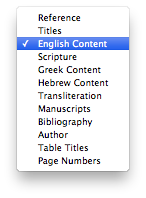
One really nice feature about Accordance’s Beale and Carson commentary module is how many ways you can search it. Accordance then tells you how many hits come up for your search, and using the “move down one mark” arrow keys, you can easily move through the results. You can even see the “real” (i.e., print) page numbers! Look again at that image at right–that’s 12 different ways you can search Beale/Carson. Pretty handy.

Most folks interested in Commentary on the New Testament Use of the Old Testament likely know of its solid reputation and are perhaps now merely trying to decide between a print and electronic version. (In a second post I’ll review the content of the commentary.) If you use Bible software regularly already, I think it is well worth the extra cost to own Accordance’s module. It’s facile to get around, hyperlinked nicely, easy to line up with original language texts, highly searchable, and quite readable as a detachable resource. I, for one, am really glad to have this module on my computer.

Thank you to Accordance for providing me with a copy of the Beale/Carson commentary module for review. Scroll through for all six parts of my Accordance 10 review here.

UPDATE: Read the rest of my review of Beale/Carson here.

More Bells and Whistles in Accordance 10 (final installment of my review)

Here are a few more bells and whistles in Accordance 10. These are to add to the bells and whistles I mentioned yesterday.

    1. The Context Slider  

I’m in James. Wondering about wisdom.

So I right click on “wisdom” to search for the word in the rest of the Bible. I get the following results:

Great for a word search. I can scroll through the results, seeing one verse at a time–every verse containing “wisdom.” Note that next to the context slider it says there are 202 verses displayed. The frequency count for “wisdom,” though, is toward the top right of the image above, just under the search bar–212 flex hits. (I wrote more about Flex Search here.)

But what if I want to see each of those uses in context, without having to open up a bunch of new windows? Easy, I just slide the context slider one notch to the right:

Note that while my “212 flex hits” stay the same, there are now 546 verses listed. This means a bit more context is listed for each occurrence. Moving the context slider to 3, I get even more context for each use of “wisdom”:

The Context Slider goes all the way to the right for the setting “A,” which shows me all the uses of “wisdom” still marked in red, but with the context of the entire Bible surrounding it:

As you can imagine, being able to see the word search results with varying degrees of context makes for fruitful word studies.

2. Constructs

This feature looks a little more complicated, at least on first glance. But it’s well worth spending the time to figure out how to use it, because of all that it can do.

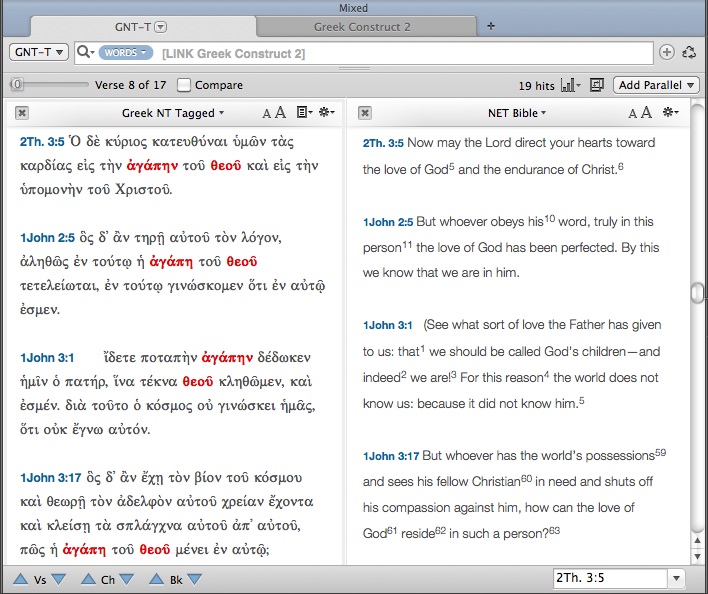
Accordance Constructs are a graphical interface that allow for more complicated searches… you know, things like, “How many times do the words God and love appear in the New Testament within seven words of each other… in Greek?” Setting up this search using the Construct feature looks like this and takes a very short time to do:

Clicking on Search at bottom right, I get the following results:

But that’s a lot of Greek to wade through. If I need an English translation, clicking on “Add Parallel” above gives me the same results, translated:

There is much more the Construct search can do–but this gives an idea of its potential utility. More from Accordance on Constructs can be found in their help files here.

3. Modules

Accordance sells a number of add-on modules. Though I have not used them, two that look to be particularly useful are a bundle for Hebrew text criticism (including the BHS text and apparatus, and new BHQ volumes with apparatus) and some volumes of the critical Göttingen text of the Septuagint (e.g., here and here). Accordance also offers add-ons of various commentaries, including the NIGTC series, NICNT, the JPS Torah Commentary, and quite a few more. Though there are certainly strong opinions in the biblical studies community as to whether one should own commentaries as physical books or as 1s and 0s, Accordance makes the latter possible with modules that integrate with the rest of the program.

———————————————————————————————-

I’ve really enjoyed learning and reviewing Accordance 10 this last week. It’s a great program. I love being able to use Bible software that is native to a Mac, and a really good software at that. Accordance can do a lot. I think what has impressed me the most has been how customizable all the panes, zones, tabs, etc. are, without sacrificing any quality. Already in the last week I’ve been able to use Accordance to speed up some tasks in both my studies and my ministry.

For ease of reference, here are all the parts of my review of Accordance 10, which this post (#6) completes.

Part 1: In which I finally try out Accordance Bible Software for Mac (new version 10!)
Part 2: 4 Cool Features in Accordance 10
Part 3: 3 Powerful Ways to Search in Accordance 10
Part 4: The Original Languages Collection in Accordance 10 meets Septuagint Sunday
Part 5: Accordance 10: Bells and Whistles

Coming soon: Review of Beale and Carson’s Commentary on the New Testament Use of the Old Testament add-on module.

I received a free copy of Accordance 10 for review. There were no expectations placed on me as to the nature (or length!) of my review, whether positive or negative.

Accordance 10: Bells and Whistles

I recently read somewhere in the Accordance Forums that an early Accordance user from the 1990s said the product should come with a warning that it may cause sleepless nights! As I’ve reviewed Accordance 10 (as a long-time Mac user but new Accordance user), I’ve already seen the wisdom in that suggestion. It’s hard to put down. Accordance is actually a really fun program to use: sleek, pleasing, productive, and really easy to customize as I’ve gotten the hang of how to move things around.

The four parts of my Accordance 10 review so far are here, here, here, and here. Specifically I’ve been reviewing the Original Languages CollectionUPDATE: final part, part 6 of my review, is here: “More Bells and Whistles.”
Now that I’m getting more comfortable with the program, I want to post about some bells and whistles in Accordance 10. These are features that really make the program stand out.

1. Instant Details: more than I thought

That Accordance has instant parsing details is great, but to be expected of any Bible software program.

Image from Accordance’s features page

But here are two cool bells and whistles about the Instant Details.

Instant Details already parse whatever word you hover over. But this same area can also be used to just as quickly give you information from a given tool that is tied to a biblical text. If you hold down ⌘ (the command key) while you hover over a word, the Instant Details will give you the information from the first tool related to the text. So you can see your top lexicon’s entry for that word, for example. Or if you hover over a verse number and press , you get the information from the first reference tool you have. For example, hovering over a verse reference and pressing the command key gives me this in my Instant Details (click on image for larger):

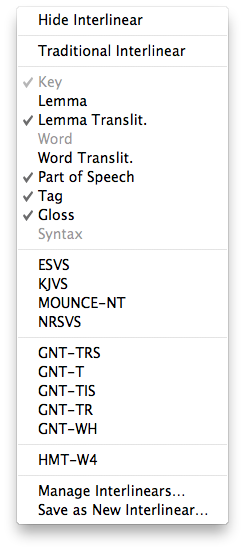
One other sweet feature about the Instant Details is that you can arrange the order of how parsing elements occur. This accounts for those who will come to Accordance having learned under any number of different grammars and systems. You can drag and drop elements to put them in the order you desire:

A nice touch.

2. Interlinears: however you want them

Having been trained at a seminary that prizes original languages, I am a little biased against interlinears for those who are really seeking to learn the language. (I find the “burn your interlinear” mantra I’ve heard from some quarters a little excessive, though.) Realistically, however, some exposure to biblical languages is better than none, and there are surely users who will want to make use of an interlinear. Greek and Hebrew texts come with interlinear English translation and word parsing as the default, but you can easily turn it off and back on again as needed. See the options at left, where you can set up exactly what you want to show in your interlinear. Here’s what the interlinear feature looks like with the options at left checked (click for larger):

3. It is so, so fast

When I first started using Accordance, I’d open it and then go to Safari or some other program to wait for it to load. But what I quickly realized is that I didn’t actually have to. This thing is up and running fast. I had Accordance set up so that four different workspaces would come up upon opening the program (NT, Hebrew OT, LXX, and a “Search all” workspace I created). Everything was ready to go in 8 seconds. That’s a lot of workspaces to have open fast!

Then when I opened Accordance such that it only needed to load two workspaces, that time dwindled to 5 seconds. Don’t bother surfing the Internet while you wait for Accordance to load. It’s ready to work when you are.  Searches on words are immediate, and the Instant Details give you the details, well… instantly.

Part 6 of my Accordance review will be my final review of the program itself. In that I’ll look at a few more bells and whistles: the Construct search and the context slider. After that I expect to be able to review an add-on module. Stay tuned!

I received a free copy of Accordance 10 for review. There were no expectations placed on me as to the nature of my review, whether positive or negative.

The Original Languages Collection in Accordance 10 meets Septuagint Sunday

Here I look closely at a “workspace” I’ve set up in Accordance 10 to study the Septuagint.

This series of reviews has been made possible by my having received a review copy of Accordance 10, Original Languages Collection. I have not been asked or expected to provide a positive review–just an honest one. See the first three parts of my review here (installation and setup), here (4 cool features), and here (3 powerful ways to search). UPDATE: Here is part 5, “Bells and Whistles.” UPDATE 2: part 6, “More Bells and Whistles.”

Here’s what my Septuagint workspace looks like (click for larger):

I’ve got three texts open–the Hebrew on the left, the Greek in the middle, and the English on the right. These each come with the Original Languages Collection. With hyperlinks to Accordance’s product info page, they are:

As I mentioned in a previous post, the NETS, while not perfect, is the best English translation of the Septuagint on the market. I have been really glad to be able to access it. The Original Languages Collection also includes the older and still helpful Brenton English translation of the Septuagint.

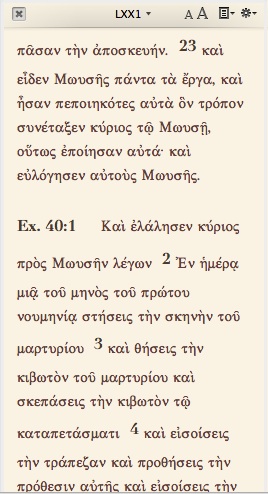
By going to “Set Text Plane Display” (available easily by right clicking from within a pane, or from Accordance’s “Display” menu, or by the shortcut T), you can change the theme/color of the individual text. If you wanted the LXX to stand out, for example, you could change it to the “Vintage” theme which makes it a nice, pleasing yellow, as in the picture at right. In fact, I’ve changed the colors on my Greek Tools (the LEH Lexicon) and Reference Tools (The IVP New Bible Commentary)–just so they stand apart a bit more as references. Being a long-time user and now reviewer of BibleWorks, I have been fine with the keep it simple but powerful philosophy. However, it really is a nice touch–especially if you’re looking at a screen for a long time–to be able to customize themes and colors.

Here are a few neat things I can do with the Septuagint setup above:

  • Triple-clicking on a verse reference automatically pulls up the accompanying text in the IVP commentary. This would be of slightly limited value for books that are in the Septuagint but not the Protestant canon that commentary covers. But…
  • …I can open up Conybeare and Stock’s Septuagint Grammar right next to the LEH lexicon
  • Triple-clicking on a word automatically displays the entry for that word in the lexicon

There are other ways to do searches without triple-clicking (for example, Amplify, which I discuss here), but triple-clicking is the quickest way I’ve found so far.

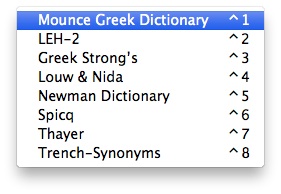
At this point I did run into a little bit of difficulty. Mounce’s Greek Dictionary is set as the default Greek lexicon. And triple-clicking always goes to the default lexicon, i.e., whatever is first in the list.

Working with the LXX, I wanted the LEH lexicon to be the one a triple-click would look up. But Mounce comes by default in the first position. So even with the LEH open, triple-clicks would look up in Mounce. 15 minutes searching through menus, icons, and Preferences and 10 more minutes in Accordance’s help section gave me no solution. Finally I turned to the Accordance Forums and–voila!–my answer. Not an immediately intuitive way forward, but I was grateful for the help.

That done, I now have my LXX workspace just how I like it.

Speaking of help, Accordance has multiple sources of support, from active user forums (in which Accordance staff participate) to extensive help files. The podcasts are good, too (index here). Because the layout/interface change from Accordance 9 to 10 was pretty significant, I looking forward to hopefully seeing updated podcasts for 10 that reflect this. Right now there is this episode on Accordance 10.

I have a Greek New Testament workspace set up similarly. The Original Languages Collection has the Greek dictionaries/lexicons you can see above–Mounce works well for the NT, and I love that it has word frequency counts. (Although you can easily get this and more from Accordance for any given word.) As far as I can tell, I have to change the default Greek dictionary back to Mounce when I’m in my NT workspace, if I want triple-clicking on a word to lead there.

For my Hebrew Bible study, the Original Languages Collection gives me the Hebrew MT (mentioned above) and these solid lexicons:

The Original Languages Collection also comes with Ross’s Hebrew Grammar.

The Concise Dictionary of Classical Hebrew (Concise DCH) is a relatively new publication. Its inclusion is a highlight of this package. From Accordance’s product page:

This Dictionary (CDCH) is an abridgment of the 8-volume Dictionary of Classical Hebrew (DCH), the first volume of which appeared in 1993. The DCH was the first dictionary of the Classical Hebrew language ever to be published. Unlike other dictionaries of the ancient Hebrew language, which cover only the texts of the Hebrew Bible, either exclusively or principally, DCH records the language of all texts written in Hebrew from the earliest times down to the end of the second century CE. That is to say, it includes not only the words used in the Hebrew Bible, but also those found in the Hebrew Book of Ben Sira (Ecclesiasticus), the Dead Sea Scrolls, and all the ancient Hebrew inscriptions.

Previous versions of Accordance had tiered-levels within individual collections, so that the Library collection still had intro, standard, and premier. So, too, with the Scholar’s collection: intro, standard, and premier. I found this time-consuming to navigate whenever I’d look at Accordance 9 on their Website, so the simplification in Accordance 10 (there is no tiering in the Original Languages Collection) is a huge improvement. It streamlines the decision-making process for those looking to get into Accordance.

The Original Languages Collection, as the Accordance site notes, has resources close to a $2,000 print retail value. That’s not a padded figure reflecting already electronically free public domain resources, either. I am impressed with the $299.99 price tag on this collection.

And I’m especially impressed that I can have all I currently need to use for text-based Septuagint research in one place. Two thumbs up for this collection.

3 Powerful Ways to Search in Accordance 10

Here are three powerful and creative ways that Accordance 10 allows you to search through its texts and resources. Add these three cool features to the four I highlighted earlier: analytics, the customizable toolbar, the magnify feature, and the one-volume IVP commentary and one-volume Eerdmans dictionary that come with the Starter Collection and higher.

1. Flex Search

Here is how Accordance’s site describes Flex Search, new in Accordance 10:

Flex Search is a new feature of Accordance 10 that finds variations of the words and phrases you search for. Specifically, Flex Search will find all inflected forms of verbs and all singular and plural forms of nouns. This mode also allows words to occur out of order or to have other words in between them.

If I wonder, for example, whether “Jesus wept” might have some other verses similar to it, I type in “jesus weep” in the search bar, make sure it’s set to “Flex Search,” then enter. You can see that in the results below, even though I searched with “weep,” Flex Search brought up results with any inflection of “to weep” (wept, weeping, weep). Just under the search bar is shown the statistic “18 flex hits.” Click on the image below or open in a new tab to view larger:

Order doesn’t matter here: “weep jesus” gives me the same results as “jesus weep.” You can even combine an Exact Search with a Flex Search by placing the term you want to search exactly in brackets. This is a good move for those of us who use Google frequently, where something like a Flex Search can happen somewhat intuitively.

This option is available only in the English versions–there is no Flex Search option for Hebrew or Greek texts, for example.

 2. Amplify

From the site again:

Accordance offers a highly efficient form of searching known as amplifying, which allows you to search for any word or phrase just by selecting it in the text you are reading and then clicking the Amplify icon in the toolbar. For example, if you are reading about the Ten Commandments in Exodus 34:28 you can amplify to a dictionary article on the topic by selecting the phrase “Ten Commandments” in the Bible text, clicking on the amplify icon in the toolbar, and then choosing the desired dictionary. You can also triple-click on any word to quickly amplify to your default dictionary or lexicon. This method of searching is much faster than opening a new module and manually typing in your search.

Using this feature has taken me a little bit of time to figure out, but now that I have I’m really enjoying it.

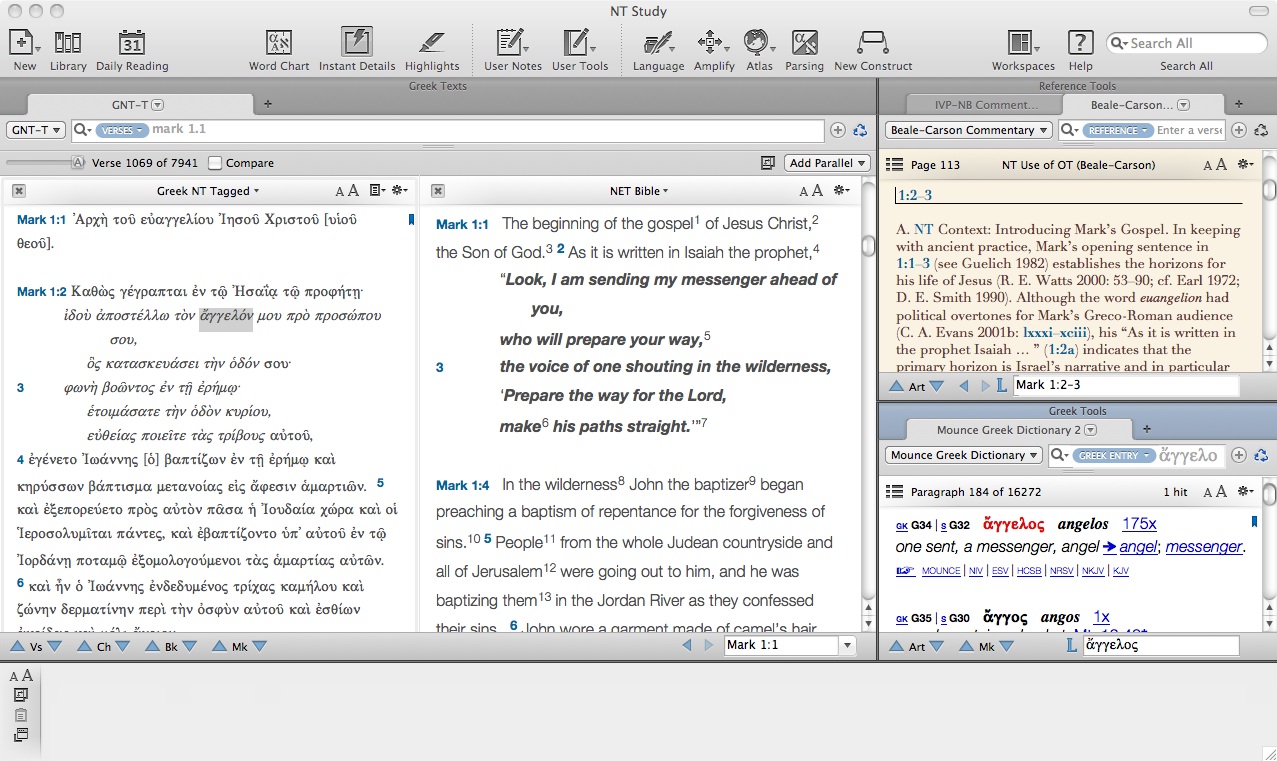
In Mark 1 below, I double-clicked on “wilderness” to highlight it and then went to the Amplify icon in the customizable toolbar up top:

Then a whole range of options is available to me. I can look up “wilderness” in English tools and find the definition in the Eerdmans dictionary. And the triple-click option is neat, too–by triple-clicking on a selected word, you look it up in your default dictionary or lexicon.

I can think of one possible way for a future update to improve the Amplify function (I know, I know! this one just came out). I was using Accordance with two Workspaces open: Accordance’s “NT Study” and my own “Hebrew Bible.” When I tried to look up an English word from the Hebrew Bible Workspace in the Eerdmans Dictionary, it moved me over to the NT Study Workspace where Eerdmans was already open. As a result I lost my initial place and had to go back to the “Hebrew Bible” Workspace.

There may be a good explanation for this and an easy way to prevent it from happening that I just don’t know about (if I find one out, I’ll post an update here). But it would have been nice to just have the Amplify search open the dictionary in my same Workspace. UPDATE: It’s an easy fix in the Preferences section. I just had to check “Confine amplify to the same workspace.”

Workspaces, by the way, are a great way to stay organized and working on multiple projects at the same time in Accordance.

3. Search All

The word “Trinity” does not appear in the Bible. But what if I want to see what biblical resources say about the Trinity, and where in the Bible they see the various interrelating persons of the Trinity? The “Search All” bar at the top right of Accordane allows the user to search all of Accordance’s resources by word (or even by Scripture reference). The screen shot below shows in the left sidebar the resources that returned a hit. You can see that Accordance gives me all the times “Trinity” appears in the NET Bible notes! That’s quite useful.

You can also use the “Search All” bar to access images.

There are a few more things I want to cover in my Accordance 10 review, but to those of you reading–are there any features you’d like me to comment on? Or questions you have about the program and its features, how it all works together? I’d be happy to try to take these up in future posts. Feel free to leave me a comment if so.

This series of reviews is made possible by my having received a review copy of Accordance 10, Original Languages Collection. I have not been asked or expected to provide a positive review–just an honest one. Part 1 of my review of Accordance 10 is here, and part 2 is hereUPDATE: Here is part 4, a review of the Original Languages Collection. UPDATE 2: Here is part 5, “Bells and Whistles.” UPDATE 3: part 6, “More Bells and Whistles.”