This post is a giveaway of three months of Todoist Premium. First, some background.
While OmniFocus has been a constant task-tracking companion for the last two years, a couple of unacknowledged and then acknowledged-but-still-unfixed bugs have been just vexing enough to send me back to other productivity apps.
I mass exported all my data from OmniFocus to 2Do (easily the best aesthetic of any task tracking app), which has been my new go-to.
However, the pull of Todoist is strong. (See my review from fall 2015 here.) I can, for example, write:
Take out the trash every Thursday at 4 #church
And it uses natural language input to set up the time (and a recurring task, no less) and project.
No need to manually go through my projects or a date and time picker. It’s fast.
Todoist Premium adds more features: labels (which are tags, essentially), filters (which are saved searches that can help you sort your tasks in really neat ways), and a lot more.
My “Todoist Karma” (I know, cheesy… but I like having a continually rising score to track my productivity) got high enough that Todoist sent me a free code for three months of Premium. They also sent me a code to give away.
Here’s how you can get that second code.
I’ll randomly select a recipient from the comments below. For one entry, simply answer the question, “What app or system are you using now to track tasks and projects?” For a second entry, share a link to this post on Facebook or Twitter (or whatever the kids are using these days), and come back here to the comments to tell me you did. I’ll announce the winner on Saturday, March 25.
I got this great advice in my inbox the other day from Laura Vanderkam:
If you dislike a particular task, time it.
Yea, verily. She explains:
While knowing that unloading the dishwasher takes you 6 minutes won’t get this chore of your plate, it will make it seem like less of a burden.
It’s funny that this is her example, because this (the kitchen) is really the ONE place where I’ve practiced this tactic already, and it really does help.
And when you do dishes for 25 minutes (because there are so many), your sense of accomplishment will be all the greater!
Well, one can get tired of seeing the same “Update YNAB” task every day. Or the same “Study Greek” reminder. Habits and tasks aren’t the same per se.
This may be splitting hairs, but since getting past my initial skepticism, I’ve been using one habit tracker or another for much of the fall. The interface of Streaks is unparalleled, and Productive makes a cool sound when you complete a habit.
Habit List, on the other hand, is the most powerful and customizable of the three.
Options Galore
Habit List takes the cake in what it allows you to do with regard to scheduling your habits. Every potential use I imagined I could accomplish with the app.
You can set up a habit with just about any frequency imaginable, whether certain days or x times per week, and set a reminder. If I want to work out three times a week, I can set up a habit for that, without it having to be the same three days in a given week.
I came to Habit List from another app and could easily backdate edit my habits-in-progress so I didn’t have to start at zero just because I was using a new app. This was unexpected and a great touch.
This also means that if you are completing the habit but forget to track it for a few days, you can easily make the manual adjustment in Habit List.
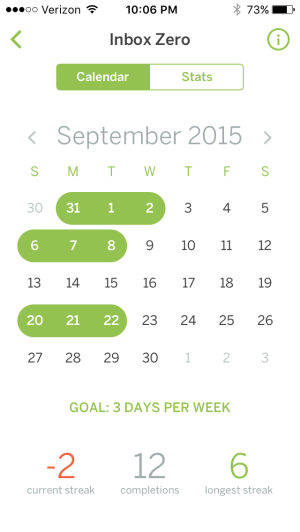
You can view stats for individual habits, presented in a variety of ways:
There is no limit (at least that I could find) to the number of habits you can track. So, sure, why not go ahead and add, “Take out trash Friday mornings”?
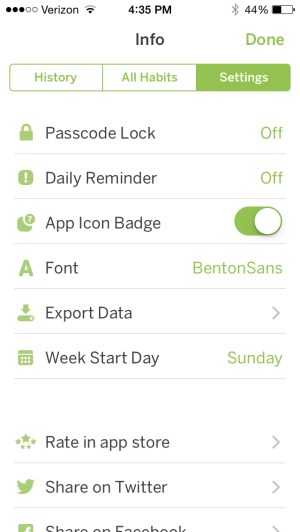
Here is a look at more app settings:
For Future Updates?
Marking the completion of habits in Habit List feels very much like crossing off a list. The interface is exactly that. You swipe your finger across a habit to signify you’ve done it. No filled-in circles, no animations, no sounds. This will be fine for many, but there may also be more aesthetically pleasing user interface options for future updates to explore–whether color changes, distinct habit icons, etc.
Maybe this is draconian or just Pavlovian on my part, but I found myself wanting more from the UI that would give me a sense of satisfaction when crossing off a habit. (I know… what do you want, people cheering??? Well….)
Final Words and Where to Get the App
TL;DR: Habit List doesn’t quite have the pretty layout of some other similar apps. But it has the most functionality of any habit tracking app I’ve tried. There are no limits on what you can track, as well as a great degree of flexibility. If you’re serious about tracking some specific habits and don’t mind a minimalist layout, you may have found your app.
The video is of professional quality. You don’t even really think about this as you watch, which is a good thing. It is just David Sparks, his OmniFocus (Mac and iOS, excellent explanations, and you.
Sparks covers all of the basics, and then some. You get in-depth tutorials on how to use Due Dates (sparingly!) or Defer Dates, navigating your way through Projects, what Contexts are and how to use them, keeping your Inbox clear, integrating OF with other workflows like email and TextExpander, and much more. From Capture to Review, the Field Guide has it covered.
There are two nice touches that I especially appreciated:
Sparks is funny. You see him working on a project called Flat Earth Manifesto in the video. But he avoids the pitfall that some tech writers get into, which is being overly cute or annoyingly glib. He uses humor perfectly.
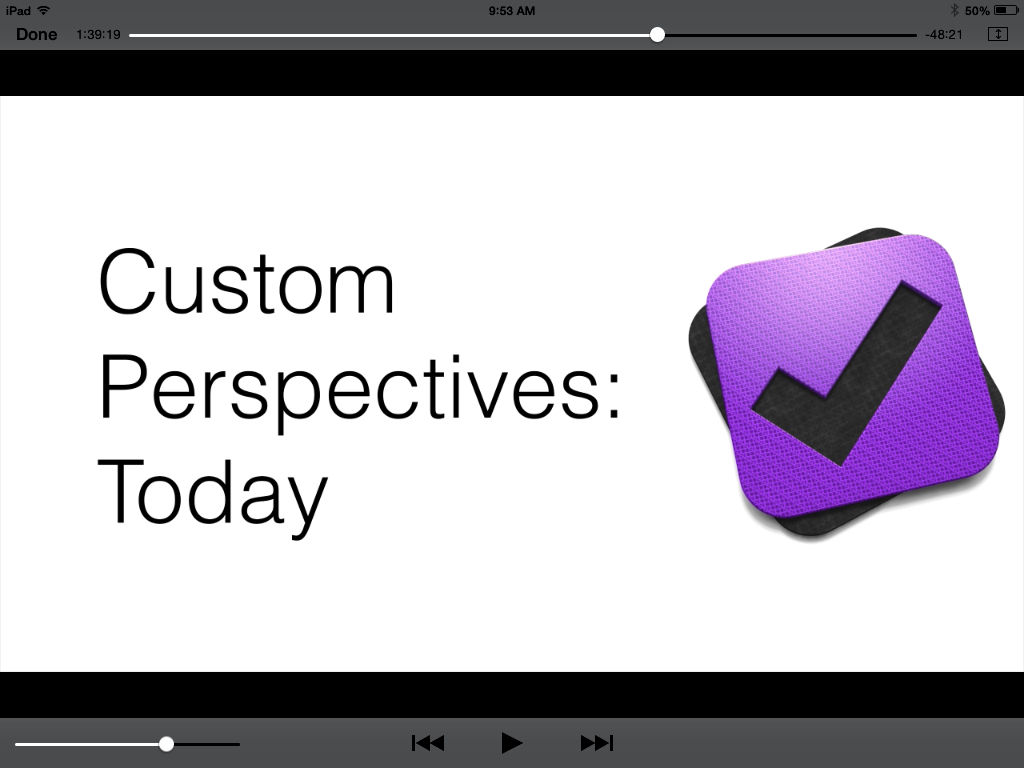
He shows you some of his unique Custom Perspectives in OF. This alone may be worth the price of the field guide. I have already copied his settings that he shows to set up my own Perspectives like his. Even though I have been using the app for a good while now, and consider myself fairly proficient with it, my productivity with OmniFocus has definitely increased since adding these Perspectives.
As you can see in the above shot, you can navigate by chapter, and scroll through all of them to see a sort of Table of Contents of the whole Field Guide.
Here is a short clip so you can get a feel for the approach and content.
Learning OmniFocus is an investment of time. Some people will balk at spending money to learn how to use the software they already spent good money on. But for $10, with well over two hours of top-notch content, the serious OmniFocus user should get to this field guide as soon as possible. Easily 5/5 stars.
A new breed of task management app seems to be proliferating in the App Store as of late: the habit tracker.
The idea behind a habit-building app is not just to help you cross things off your list, but to actually build the kinds of repetitive practices you’d like to be a part of your everyday life.
Streaks is one such app, and perhaps the one with the most aesthetically pleasing presentation.
What I Like About Streaks
The first thing to appreciate about Streaks is its layout:
You can change colors from the default orange to 11 other options:
As you complete (or miss) habits, the app makes it easy to access statistics from the main screen with just a tap. Check this out:
The reminders are customizable, so they can be as obtrusive or unobtrusive as you want them to be, depending on what you need to get your habits in place:
Checking off habits is satisfying. You just hold down the circle till it fills in:
If you missed a day, Streaks knows it:
There are a ton of habit icons from which to choose, and they look better than any I’ve seen in other comparable apps (some of which are just icon-less lists):
Setting up habits is quite easy:
What I Found Lacking
Probably the biggest miss in the app is that there is no way to adjust a habit you forgot to check off more than one day ago. If you missed marking a habit yesterday, you’re all set, but you can’t check off habits you completed two days ago but didn’t note. I lost some streaks this way (at least within the app) when I was on vacation last month. I was completing habits, but not on my phone as often as usual; there’s no way to adjust to get your statistics to reflect such a reality.
I would love for future updates to Streaks to include some sort of sound when you fill in a habit circle. This is just personal preference, though.
Streaks maxes out at six habits that you can be tracking at a time. The developers have a reason for this–it’s hard to maintain more habits than that on a regular basis, but the limitation does not allow for as great user control as some other apps do.
One other lack: you can’t make a habit to do something, say, three times a week, without also having to specify the days. So I can have “Exercise” three times a week, but only if I assign days (Monday, Wednesday, and Friday)–I couldn’t set it up for any three days.
Final Words and Where to Get the App
Limitations notwithstanding, Streaks is easily one of the three best habit-tracking apps for iOS. It’s clearly designed with the user experience in mind, which makes charting habits through this app fun. As long as you can stay on top of tracking your practices each day, Streaks is a worthy aid in helping establish regular life patterns.
It’s Friday, so hopefully you’re winding down a bit and thinking about how to relax rather than how to be more productive–so file this away for Monday (or read it now if you work weekends).
Here are two resources–one paid and one free–to help stay on top of email and tasks.
1. Dispatch App
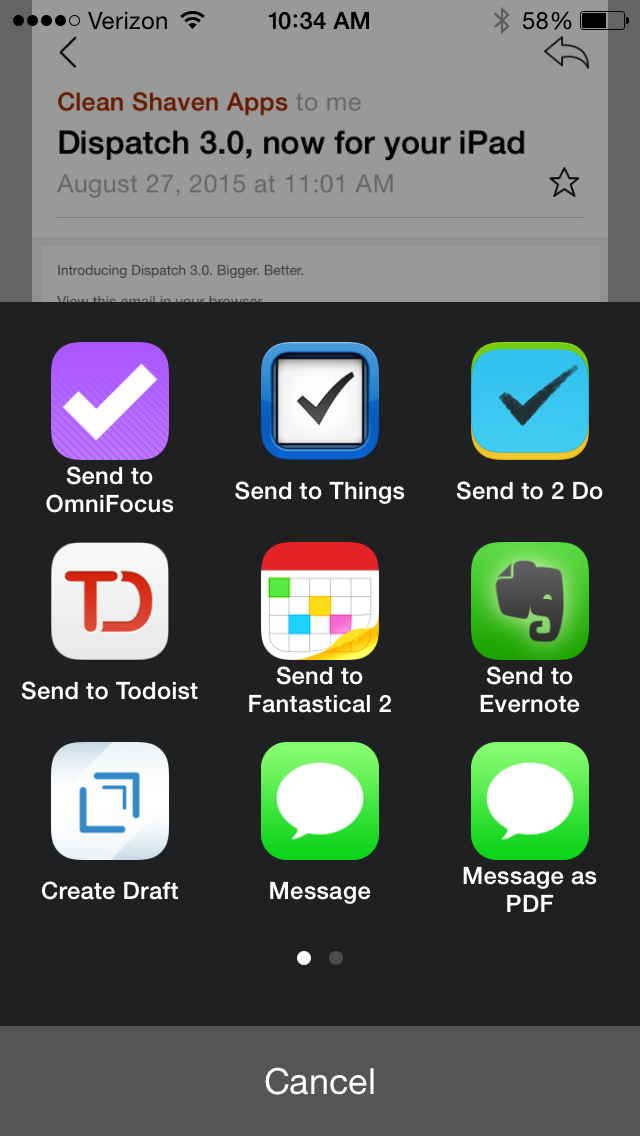
I’ve never understood the logic of apps that allow you to “snooze” email. Handle it once and move on, I think. Emails are often calendar appointments or tasks in disguise, and our Inboxes are no place to be keeping tasks. Inbox Zero is elusive (though see here), so an app that helps you get your Inbox messages into tasks quickly is appreciated. This is the goal of Dispatch app, newly available on iPad. Check it out here.
2. Free Podcasts from GTD
You might also check out free podcasts from David Allen‘s Getting Things Done:
Our GTD podcasts are here to support you at every stage of your GTD practice. You will hear interviews with people from all walks of life about their journey with GTD, from beginners to those who have been at it for years. The podcasts include personal and professional stories, as well as practical tips about GTD systems for desktop and mobile, using apps and paper. Start listening now and you’ll be well on your way to stress-free productivity.
First things first–who is even doing design for Cultured Code’s app Things? Because that design team is the best in the biz. The two images in this post show as much.
Yesterday Cultured Code announced a significant improvement to how Things syncs data across devices. Once again, they’re ahead of the pack in this regard. From their blog announcement:
Shortly after Things Cloud launched, we released a feature called Local Push. It makes sync instantaneous as long as Things is open on your devices (and they’re on the same local network). But of course the app is often closed on your mobile device—so it won’t receive the push, and won’t be in sync until you manually launch the app later.
Today’s new version of Things Cloud solves this problem by sending your devices a push from the cloud (regardless of what network they’re connected to). This means that most of the time you’re in sync even before you launch the app.
And then they give you this sweet visual representation:
… which is quite nicely explained in full at their blog. Read the whole thing here.
And be on the lookout for Things 3. I’ll do my best to cover it here once it releases.
I’m pretty tied to the Apple ecosphere of apps when it comes to productivity: OmniFocus, Drafts, MindNode, Ulysses, etc. Three major exceptions are Scrivener, Evernote, and Accordance. But otherwise–whether this has happened consciously or not–most of the apps I use regularly are Mac-only.
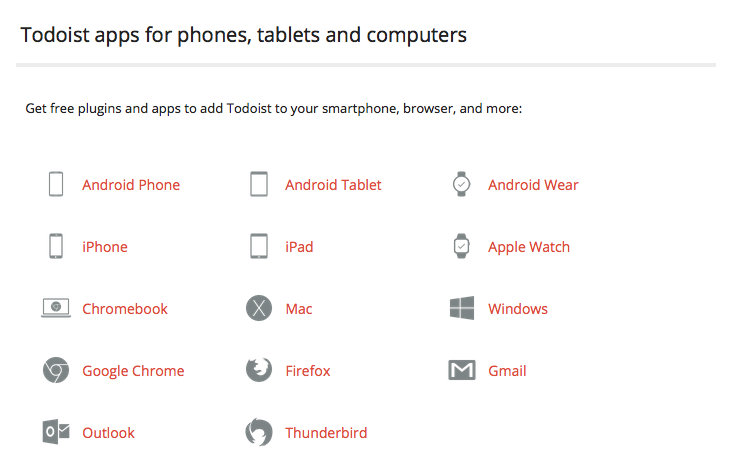
Todoist is the rare task management app that is available on every platform. And I mean every platform. It even has a Web-based interface, if you don’t want to have to fire up the app on your computer:
Not only that, it integrates with just about everything. This itself is reason to consider Todoist as a primary task management app.
In this post, I review Todoist Premium, considering at the end whether it could, for me, replace OmniFocus.
Here’s a short video from the makers of Todoist, which offers a quick overview:
What’s Awesome about Todoist
First, what’s awesome about Todoist.
1. It looks good. Really good.
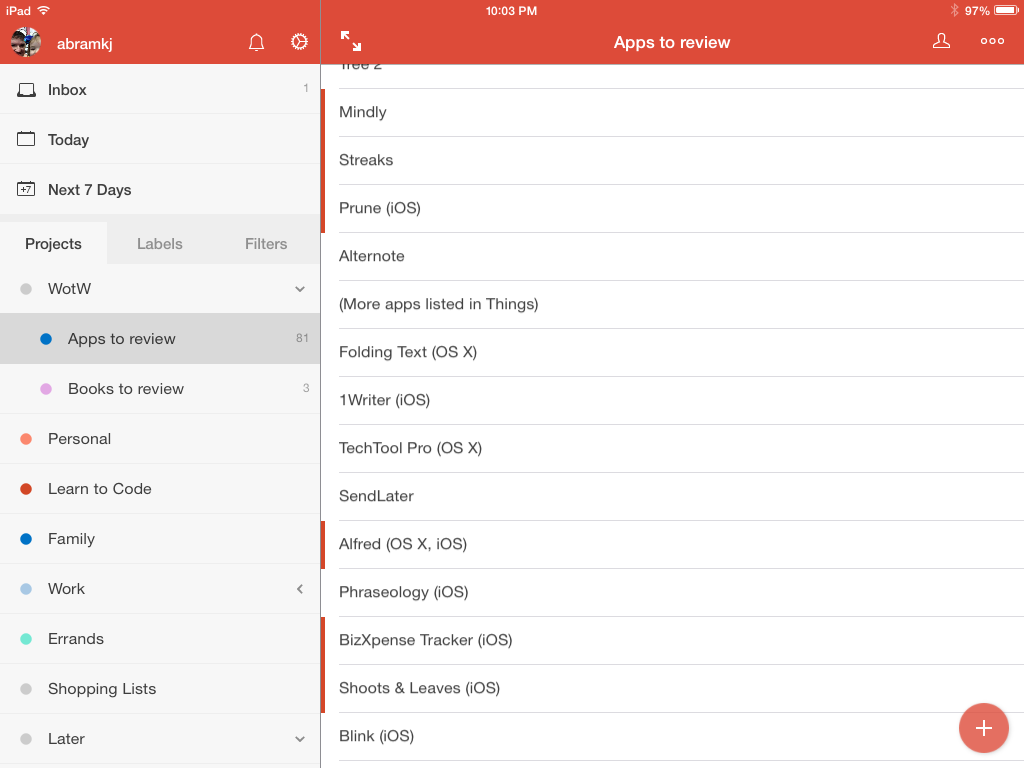
Here it is in landscape mode on an iPad mini:
At first I thought it was overly simple, sort of blasé. But the more I’ve used Todoist, the more I appreciate the layout. No clutter, easy to read, pleasing to the eyes. (And you can tweak the color scheme, too.)
2. The sync: It Just Works.
Todoist’s sync across devices is natural and fast. It’s much more like Things than (previous versions of) OmniFocus. I don’t even really think about it, which is what you hope would be true. No manual anything required.
3. Todoist is everywhere (almost).
It’s the most ubiquitous and app-integrated task management app on the market. Look, it’s even in my Firefox browser!
Click to enlarge image
There’s a Gmail plug-in, too. This, unfortunately, is only available with Chrome–which is too much of a CPU hog for me. But it looks good.
Todoist doesn’t offer a Mac Mail plug-in, but as you’ll see below, you can email a task right into a Todoist project, so that’s not a big deal.
4. Labels and Filters
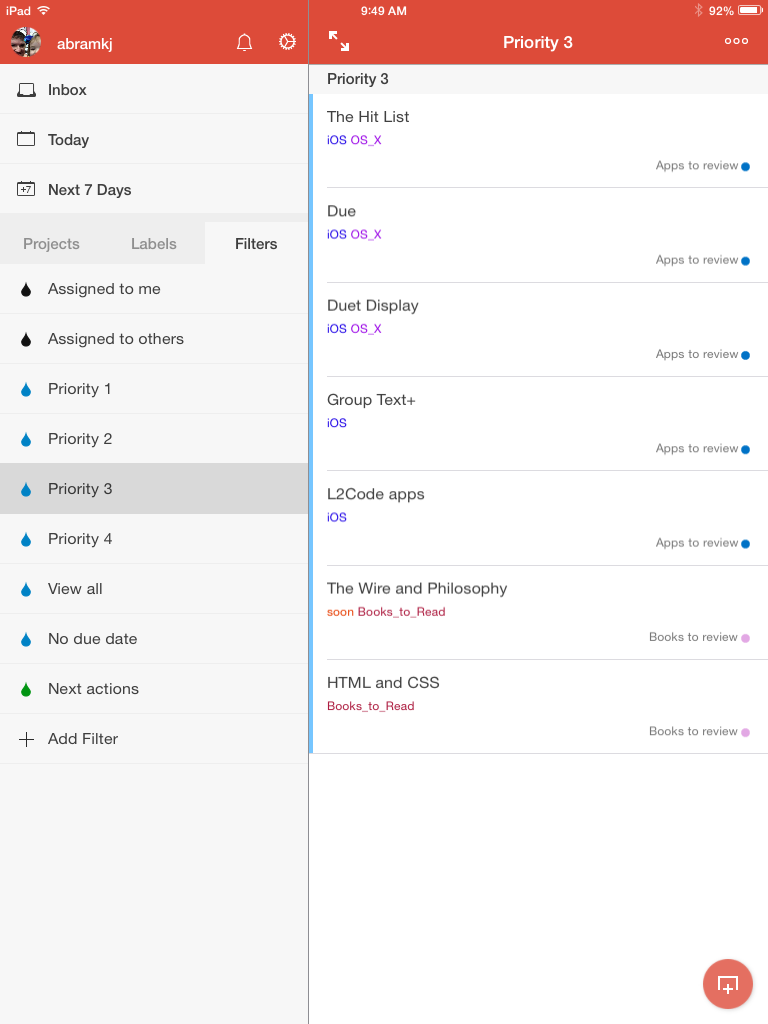
I don’t know Todoist like I know OmniFocus, but Labels and Filters would appear to be the app’s heart and soul. Sure, there’s an Inbox you can use for GTD-style capture (from anywhere). Yeah, you can set up different Projects for organizing your tasks. But Labels allow you to assign contexts and anything else you like to your tasks (expected task duration?). Then you can filter your tasks by Labels or priority or any other saved search:
Annoying is the fact that when you create a new Label, if there are two words or more, Todoist automatically inserts an underscore. So one label of mine is now “Waiting_For.” I’m sure I’ll get used to it, but it feels a little AOL-ish.
I’m sure there are Label and Filter ninja reading this post, and there’s much more to say about them–Todoist can do quite a bit here. So check out this page and this page for more.
5. Easy task input
Todoist understands natural language, so entering tasks intuitively is no problem. It’s easy to enter tasks in rapid-fire fashion, too, so you can do a brain dump well with Todoist.
6. Email reminders
Todoist assigns an email address to a Project of your choice, so I can email tasks (or forward actionable emails) directly to my Inbox. This is a must-have for me in a task management app. You can include attachments, too.
Speaking of email… you can also have Todoist email you reminders of your tasks. At first I thought this was redundant (well… it is). But even though I’m seeing the same task twice (maybe a GTD no-no?), I have found the added reminder helpful.
What I Don’t Particularly Like about Todoist
1. The Premium, subscription-based model
Of course. It would be ridiculous to expect a sophisticated app with task notes, attachments, email reminders, fast sync, etc. to be free. There is a free Todoist, but it’s limited. Here’s some of what is in Premium, which is about $29/year:
But I’ve never liked subscription-based models. Sure, if you work for a big company that’s paying for it, I can see it working. But what users otherwise want to pay $150 to use the app for the next five years? Other apps with one-time purchases end up being cheaper. If you don’t have Premium, or let it expire, you can no longer add notes or attachments to your tasks–serious GTDers (and other task management obsessives) will need Premium.
2. The interface is not so customizable.
You can change your start screen, but not on iOS, that I could find. You’re pretty tied in to the layout Todoist gives you.
3. For GTDers: No weekly review option
My weekly review–a built-in feature of OmniFocus–is what allows me to set due dates sparingly, a key practice for effective project and task management. Todoist’s Karma is fun, but feels gimmicky. And their GTD page has suggestions for something like a weekly review (it would be easy enough to set up a recurring task for it, employing Filters and Labels as needed), but I have gotten so used to OmniFocus’s Review function that not having one already in the app is tough. But it won’t be a deal breaker for a lot of folks.
Concluding Evaluation
If I were to stop using Apple products tomorrow, I’d get Todoist up and running right away.
How does Todoist Premium rate with apps like OmniFocus and 2Do and Things? It’s right up there, and maybe—given its cross-functionality and fast sync—the best of the batch. But the subscription model is just something I can’t latch on to. Some will have no problem with this.
When I set out to write this review, I was planning to conclude it with, “Yet another app falls short of OmniFocus….” But Todoist really doesn’t. Sure, OF beats it in some regards, but Todoist outperforms OmniFocus in other key areas.
So if you’re one of those handful of disaffected OF users, or if, heaven forbid, you’re not keeping track of your commitments in writing at all–and if you have $30/year to spend–Todoist Premium might just be your new, sole task management app.
Thanks to the fine folks at Doist, the makers of Todoist, for giving me 6 months of Todoist Premium so I could write this review. See my other AppTastic Tuesday reviews here.
Drafts is the only app that lives in my dock on both iPad and iPhone. I was skeptical before I reviewed it. Now I use it more the Phone “app” on my phone.
Best of all is the customizable keyboard, from which you can trigger a bunch of actions to perform on the text in your draft: send as Message, Email, make into OmniFocus list, send to Evernote journal, make into a mind map, etc., etc., amen.
Here’s how part of mine looks:
If you use your iOS device (iPhone or iPad) to boost your organization and productivity, this is an essential app. You can, for example, do this amazing thing and this even more amazing thing.
Best of all, it’s now 30% off for a Back to School sale. I’ve never seen it cheaper.
















 Words on the Word