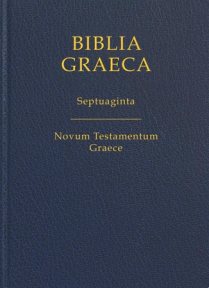
The Bible You Would Have Brought to Your 3rd Century Church Service

LXX NA28

Look at that! It’s an all-Greek Bible. Just like the one Jesus carried around! Okay, not quite, but it is very good to see the Greek Septuagint and the Greek New Testament together under one cover. Augustine would be pleased:

For Greek aficionados—a 2-in-1 resource that’s designed specifically for extensive research, textual criticism, and other academic endeavors. Featuring both the Rahlfs-Hanhart Septuagint (Greek translation of the Hebrew Old Testament) and the 28th edition of the Nestle-Aland Novum Testamentum Graece, this user-friendly tool includes critical apparatus, cross-references, and more. 3216 pages, hardcover from German Bible Society.

What It Looks Like

It’s a mere three pounds (in weight, not price). Amazon lists its dimensions as 7.5 x 5.7 x 2.8 inches.

This impressive edition is two previously published Greek texts put together in one cover. It’s obviously thicker than the Septuagint alone, and just a little bigger in length and width. Here are the two side by side: the Septuagint alone on the right, and its “upgrade” version (with GNT) on the left:
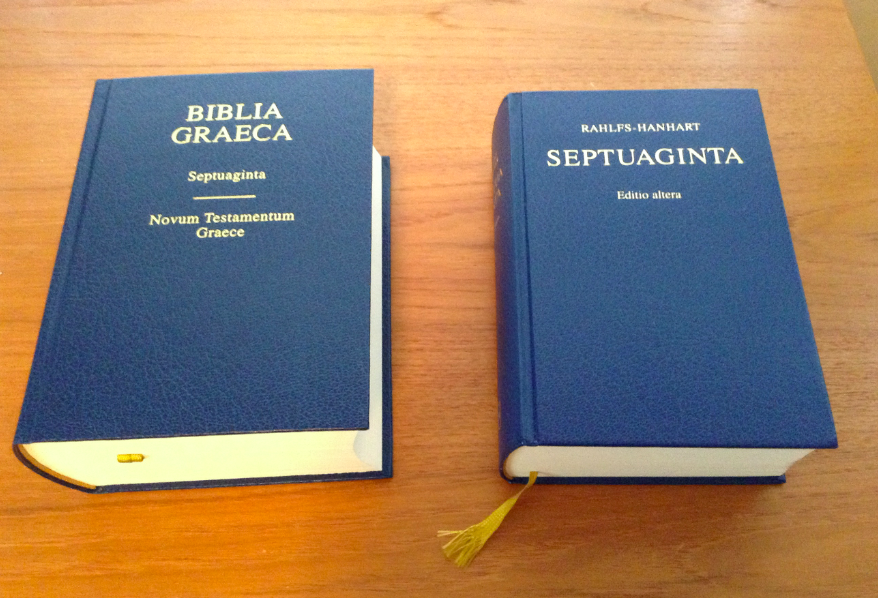
v. 1.0 and v. 2.0
v. 1.0 (at right) and v. 2.0 (at left)

Before receiving the volume, I was concerned that its 3,000+ pages would defeat Alfred Rahlfs’s initial intention to have a Handausgabe (i.e., a manual and portable edition). Indeed, Hanhart’s “Introductory Remarks to the Revised Edition” translate Handausgabe as “pocket-edition,” which this is decidedly not. (It would fit nicely in a purse or man-purse, though.) That said, the addition of the Greek New Testament really does not add a lot of bulk, as Rahlfs-Hanhart was already more than 2,000 pages. Biblia Graeca is still a (fairly) portable edition, though, if not literally pocket-sized. The sewn binding and hard cover appear that they will hold up under regular use. Here are v. 1.0 (LXX only) and v. 2.0 (LXX+GNT) stacked on top of each other:

The Two Stacked Up

You can barely make it out from the above photo, but the LXX/GNT combo comes (wisely) with two ribbon markers. Was it a coincidence that mine were both placed at the beginning of Odes? I think not.

The Greek Typesetting/Font

Rahlfs has not been re-typeset, so its Greek font is not as crisp or readable as that of the New Testament portion. Compare:
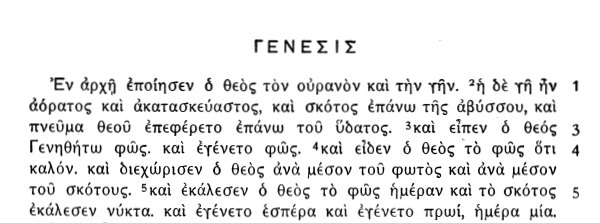
Genesis 1:1-5
Genesis 1:1-5, from publisher’s pdf sample

Here now is the Greek in the New Testament portion, which is clear and crisp:
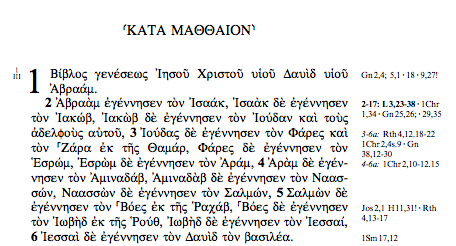
Matt 1.1-6 GNT
Matthew 1:1-6, from publisher’s pdf sample

After reading enough Septuagint, one does get used to the Rahlfs font. It’s not too bad.

Always a concern with Bibles this big is that the requisite thin pages will mean bleed-through of text from the reverse side. This is noticeable to a degree here, but not in a way that negatively affects reading:
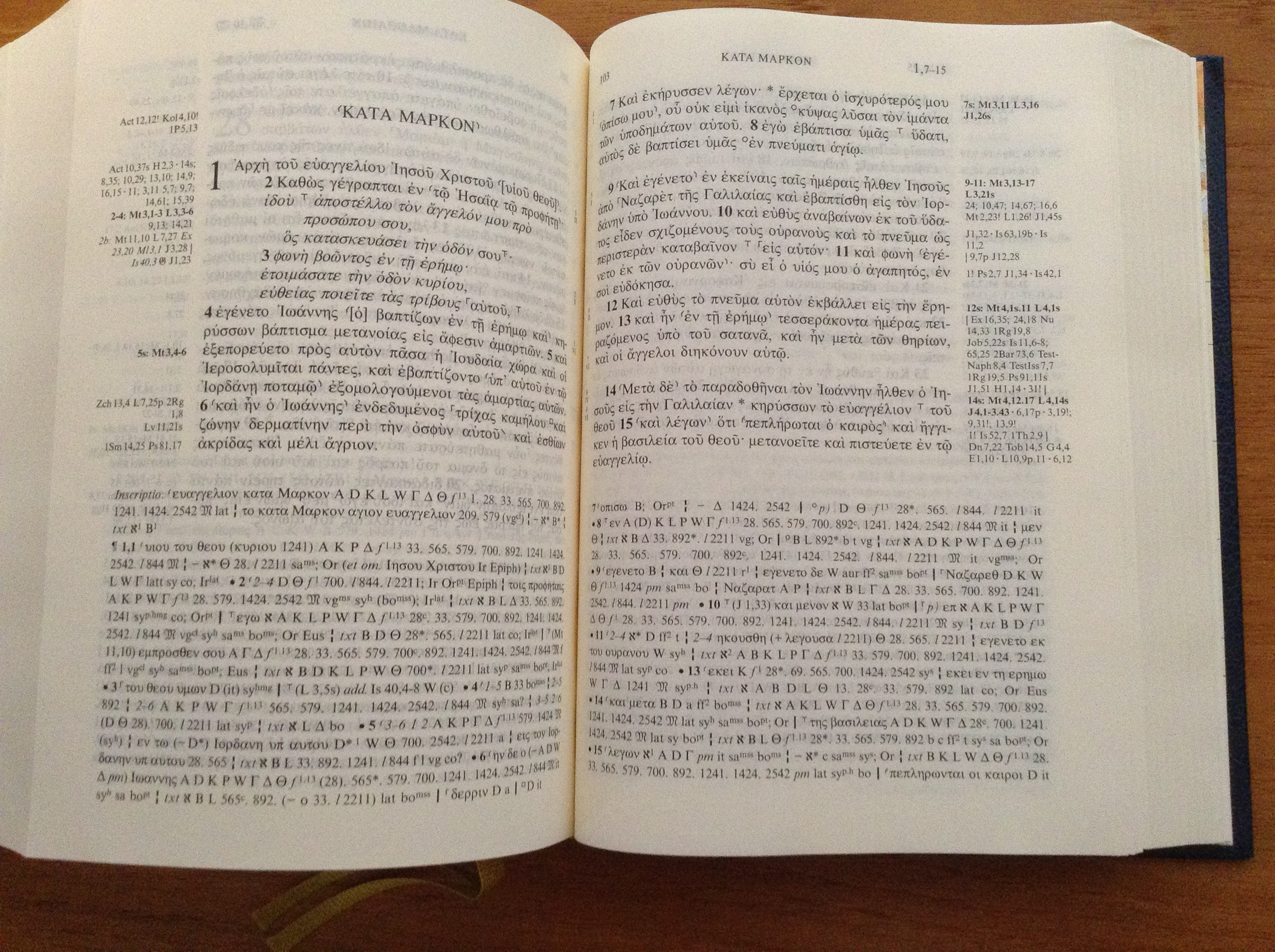
Mark 1
Mark 1

Rahlfs-Hanhart (Septuaginta)

The Rahlfs-Hanhart edition is not the go-to for extensive text-critical research that the Göttingen editions are, where they are present (on which, see my posts here and here on using Göttingen). Rahlfs is still useful, though, because it contains an entire Septuagint text, whereas Göttingen (published as individual volumes) does not.

It is probably the best starting place for readers of the Septuagint, even with its deliberately more limited apparatus. It is best thought of as a “semi-critical edition,” as noted here. Rahlfs “reconstructs” the text using, primarily, Codex Vaticanus (B), Codex Sinaiticus (S or א), and Codex Alexandrinus (A), a methodology that the revisor, Robert Hanhart, honors. Here is the apparatus for the first page, covering Genesis 1:1-14. This is a funny case, because of how much of Genesis is missing in B, so Genesis 1-46:28 up through the Greek word ηρωων is just based on A here. The rest (from πολιν in 46:28 to the end, chapter 50) take into account B and A.

Rahlfs Apparatus Gen. 1.1-14

Preceding the actual text and apparatus are Hanhart’s 2005 “Introductory Remarks to the Revised Edition” in German, English, and Greek. Then in German, English, Latin, and Greek follow three more sections: (1) Rahlfs’s “Editor’s Preface,” (2) an illuminating 10-page essay, “History of the Septuagint Text”, and (3) Explanation of Symbols. Everything you need to get started reading the Septuagint (minus the Greek lessons) is here.

Nestle-Aland 28th Edition (Novum Testamentum Graece)

What about the updated NA28? In short:

The long-awaited 28th edition of the Novum Testamentum Graece has now been published. Once again the editors thoroughly examined the critical apparatus and they introduced more than 30 textual changes in the Catholic Letters, reflecting recent comprehensive collations. With the intent to make this book more user-friendly, the editors also revised the introductions and provided more explanations in English. This concise edition of the Greek New Testament, which has now grown to 1,000 pages, will continue to play a leading role in academic teaching and scholarly exegesis.

The NA28 has its own snazzy site here. (What a day we live in, when a Greek Bible gets its own Website! Its writers would be amazed.) Recent text-critical work on the New Testament has led to revisions in the Catholic Letters, but not elsewhere. So the Gospels and Pauline epistles, for example, retain the same text as the NA27. However, there are changes that affect the whole edition, as the publisher points out:

  • Newly discovered Papyri listed
  • Distinction between consistently cited witnesses of the first and second order abandoned
  • Apparatus notes systematically checked
  • Imprecise notes abandoned
  • Previously concatenated notes now cited separately
  • Inserted Latin texts reduced and translated
  • References thoroughly revised

As for the textual differences themselves, those are explained and listed here. There are more details to be digested about the new NA28 edition. I can do no better than to refer you to the writings/reviews of Larry Hurtado, Rick BrannanDaniel Wallace, and Peter Williams.

All the quick-reference inserts you need to make sense of symbols and abbreviations are included:

The 3 inserts

Concluding Thoughts: Sell All You Have?

The product page for the beautiful Biblia Graeca is here for CBD, here at the German Bible Society, here at Hendrickson, and here for Amazon. And, best yet, you can look at a sample of the book here. If it’s just the text (and not the apparatuses) that you’re interested in, you can read the NA28 online here and the Rahlfs-Hanhart Septuagint here.

Rahlfs wrote in his preface that he sought to “provide ministers and students with a reliable edition of the Septuagint at a moderate price.” If you click the links above, you will see that this is not “a moderate price.” It’s significantly cheaper to buy the same critical editions of each Testament under separate cover.

But there are at least two major advantages to putting them together. First, when the New Testament writers quoted Scripture, they predominantly did so in a form that is closer to what we have now in a Septuagint text. Comparing a quotation (in Greek) with its source (in Greek) is facilitated by this edition. Second, that this edition exists is an important symbolic statement. Lovers of the Septuagint are fond of affirming that it was the Bible of the early Church. If that is so, why can we not have one, too? Now we can, printed and bound in a way that would shock the pre-printing press world that first heard all these Scriptures together when gathered for worship.

Professor Ferdinand Hitzig has often been quoted saying, “Gentlemen!” (and today, he would say, “Ladies!” too) “Have you a Septuagint? If not, sell all you have, and buy a Septuagint.”

In true biblical storytelling fashion, he is using hyperbole to communicate his point. But for those who are so inclined and able, if selling a few things to get a Septuagint is a good idea, how much more might someone like Hitzig encourage them to sell a few things for the Biblia Graeca?

Christians believe that the Septuagint has come to full fruition through the New Testament.

So it only makes sense to be binding the two together.

Many thanks to Hendrickson for the privilege of reviewing this fine work. A copy came my way for review, but with no expectation as to the nature of my review, except that it be honest.

Teach the Text Commentary Series: Romans, reviewed

First things first: Do we really need another commentary series? This video from Baker Publishing offers an (affirmative) answer, as it introduces the new Teach the Text Commentary Series:

I agree. As I’ve worked through the Romans volume in the Teach the Text (TTT) series, by C. Marvin Pate, I’ve appreciated the way it balances “the best of biblical scholarship” with the actual end product of the sermon in view. TTT has a fantastic accompanying Website.

TTTBaker has summarized the layout of the commentary well here. Each text unit (or passage) is “six pages of focused commentary,” consisting of the following:

“Big Idea” at the head of each passage. This is not to be confused with “big idea” preaching, as this commentary’s “big idea” tends to stay within the world and era of the biblical text.

A “Key Themes” sidebar. This expands a bit on the “big idea” in bullet-point format to draw out key points from a given passage.

“Understanding the Text.” This is the meat of the commentary, and covers literary context, outline and structure, historical background, theology, and interpretation.

“Teaching the Text.” Here Pate offers guidance in how one could preach and/or teach the text, with an eye specifically to application. Pate suggests what sermons/sermon topics come to mind for him in a given passage. More technical or scholarly commentaries tend not to include this step.

“Illustrating the Text.” This feels like the added bonus section. Having a topic in mind is just a first step. Culling from history, literature, art, the social sciences, and more, Pate gives ideas for how the preacher or teacher could help make the sermon or lesson come alive via illustration.

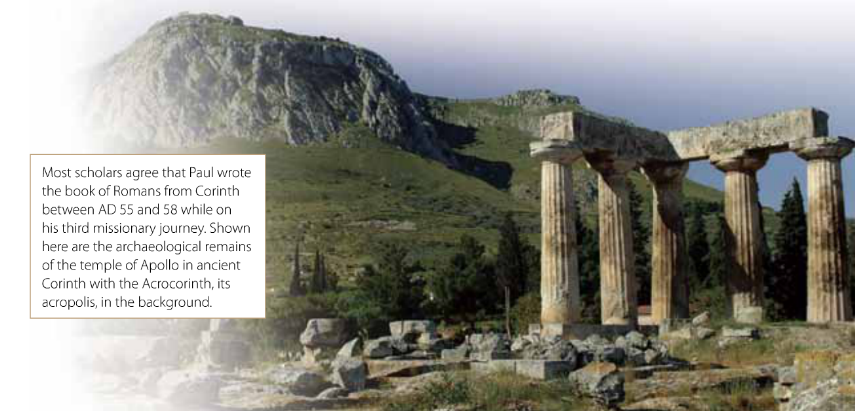
The full-color photographs throughout the text are of high quality, and help connect the reader visually to the ancient world.

From the commentary: Corinth, where Paul wrote Romans

There are also “Additional Insights” throughout the commentary, that more fully develop themes like “The Backgrounds of Christian Baptism,” “Faith and Law in Paul,” and others.

Pate’s 15-page introduction to Romans covers Paul’s world(s), letters, theology, composition, Romans in history, date and place of writing, recipients, theme, purpose, and genre. He writes:

Paul therefore writes Romans to defend his gospel of the grace of God through Christ by arguing that it is rooted in the Old Testament (Rom. 2-5), providing the disclaimer that it is not antinomian in ethic (God’s grace is not a license to sin [so Rom. 6-8]), and holding out a future for Israel (Rom. 9-11).

Not all will agree with Pate’s view of “Romans as Paul’s official doctrinal statement,” but, then again, many will. I was wishing the introduction had given more attention to Paul’s theme of a justification by faith that is decidedly pan-ethnic. Pate does talk about “the end-time conversion of the nations,” but there is also a sense in which Paul is interested in multiethnic justification (where all are saved by faith, whether Jew or Gentile) now. Fortunately the body of the commentary does address this theme in places (e.g., in Rom. 3:21-26–“So Paul’s point is that God offers justification equitably to all”).

Roman empire map
From the commentary: map of the Roman Empire

Pate is able to interpret from multiple vantage points, synthesizing material across centuries that will benefit preachers in their sermon preparation. He moves from lexical analysis (Greek is transliterated) to 1st century historical background to practical theology in a fairly seamless manner. The illustrations are on point, too. He points out, for example, in Romans 13:13-14, that Augustine’s conversion story included meditation on these verses. The same unit includes an illustration involving Jean Valjean and Les Mis. Movie illustrations and hymn quotations are particularly present throughout, though preachers will also want to use their own, original illustrations, too.

The series claims to be “an essential commentary for pastors.” If and as pastoral budgets permit, I’d echo the sentiment and recommend this series as a worthy bookshelf addition.

More TTT volumes are on the way, including a posthumous Luke volume by the blessed R.T. France. Lord willing, as I continue to preach through Luke, I’ll review France’s volume in the future. A full-color pdf sample of Romans (including the introduction and first passage) is here.

Thanks to Baker Publishing for the review copy of Romans. Its Baker product page is here, and it is for sale at Amazon here.

Colossians and Philemon (Zondervan ECNT), reviewed

col phil zecntI got an ad in the mail the other day for a new commentary series that claimed to avoid all the weaknesses of previous commentary series while building on their strengths. (!)

With how many good “old” commentaries there are, I think commentary users should critically examine new series, and certainly not take claims like the above too seriously. (Every commentary set has weaknesses.)

That said–Zondervan’s new Exegetical Commentary on the New Testament series is a real winner. It adds important elements to the mix that are not present in previously published commentaries. As a preacher with a scholarly interest in Scripture, I find this series to cover many bases well. It would be good for a student, professor, preacher, or even someone who didn’t know Greek and wanted to go more deeply into a given book.

I’ve (favorably) reviewed James and Luke in the same ZECNT series. Like the rest of the series, Colossians and Philemon includes the following for each passage of Scripture:

  • The full Greek text of Colossians and Philemon, verse by verse
  • The author’s English translation
    • First, passage by passage in the graphical layout
    • Second, verse by verse next to the Greek
  • The broader “Literary Context” of each passage (within the larger book)
  • An outline of the passage in its surrounding context
  • The Main Idea (this is a great focus point for preachers)
  • Structure
  • A more detailed “Exegetical Outline”
  • “Explanation of the Text,” which includes the Greek and English mentioned above, as well as the commentary proper
  • “Theology in Application” concludes each passage

The fact that the commentary has within it all the Greek and English of the two books under examination means you can take the single book (and no other) with you for thorough study of Colossians and Philemon.

Author David W. Pao makes frequent use of Greek throughout the commentary, but a non-Greek reader would also make profitable use of his comments.

Colossians has a 16-page introduction and 8-page bibliography; Philemon’s introduction is 13 pages, its bibliography 4. A “theology” section of 13 and 9 pages, respectively, concludes each book.

Regarding authorship of Colossians, Pao writes, “Among the various possibilities, to consider Paul as the author of Colossians is still the best hypothesis on which our reading can be constructed.” Like Murray J. Harris, Pao deduces this due to the various parallels (e.g., the opening greeting sections) between Colossians and Philemon, which is almost universally accepted as Pauline. He dates both letters to 60-62 AD, being written by Paul during his Roman imprisonment.

Pao is a good writer, too. This is from the introduction to Colossians, on its significance:

This letter that addresses a congregation challenged by a form of syncretism has significant contemporary application in a society in which the “virtues” of pluralism and tolerance are exalted as most important. Instead of simply pointing out the errors of the various practices and beliefs promoted by the false teachers, Paul begins and ends with an intense focus on Christ as the foundation of the believers’ existence. As a result, one finds powerful theoretical and practical outworkings of a robust Christology. In this letter, the readers encounter a detailed portrayal of the unique identity and final authority of Christ, and this portrayal enriches the high Christology found elsewhere in Paul’s letters.

This  slightly longer excerpt on Col. 3:3 shows how adeptly Pao blends lexical study with historical background in a way that incorporates today’s Christian settings… all from an appreciated doxological posture:

That this life “is hidden with Christ” is significant in a number of ways. First, the verb “to hide” (κρύπτω) can signify close association (cf. Luke 13:21), and this meaning is certainly present in light of Paul’s identification of Christ as “your life” (ἡ ζωὴ ὑμῶν). To be “hidden with Christ” reaffirms the believers’ participation in Christ’s death and resurrection as they anticipate the final consummation of God’s salvific act at the end of time.

Second, to be “hidden with Christ” necessarily implies the security that one finds in Christ. The following verse explains the purpose of this hiddenness as it guarantees the final participation of believers in the revelation of God’s glory. This security from the evil powers is also implied in the reference to their dying with Christ, an act that points to the freedom of the threats posed by the opposing spiritual powers (2:20).

Third, in light of 2:3, where Paul asserts that in Christ “all the treasures of wisdom and knowledge are hidden,” Paul is here affirming that the lives of believers are also contained in Christ. This may serve a polemical purpose as Paul argues against those who continuously seek to get access to the heavenly mysteries. Paul’s response is that believers are already hidden with all the treasures in Christ. The sufficiency of Christ cannot be challenged, and to seek for these treasures elsewhere is to betray the true gospel. 

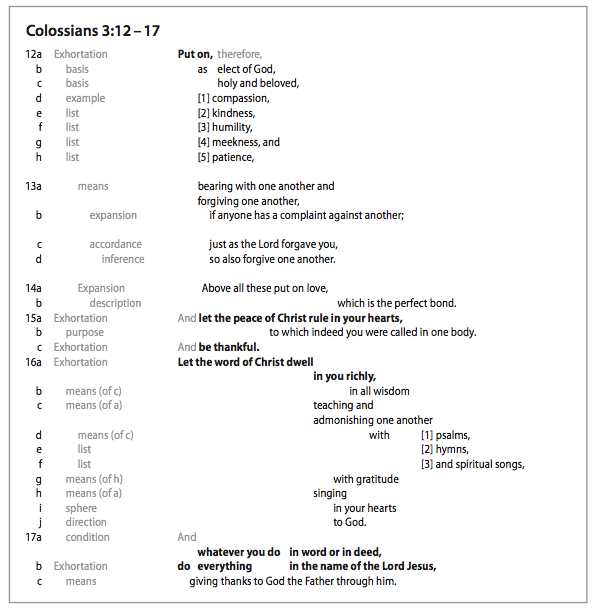
Out of all of the above features, the graphical layout is my favorite in this series and in this volume. It’s what makes the ZECNT something I’ll always reach for when preaching on a given passage–and early on in the process, too. Here’s what it looks like:

Col. 3:12-17
Col. 3:12-17

The main clauses are in bold, and subordinate clauses are indented under them. It’s easy to see, at a glance, how all the parts of a sentence and paragraph relate. The words in gray at left describe the function of each line (exhortation, expansion, etc.).

Pao is a refreshingly enjoyable writer who knows this terrain very well. Preaching or teaching from Colossians/Philemon (or even studying in depth on one’s own or with others) would be greatly enhanced by use of his commentary.

I am grateful to Zondervan for the gratis review copy of this commentary, which was offered to me in exchange for an unbiased review. You can find the book on Amazon here. The Zondervan product page is here. See a pdf sample of the book here.

The NA28 Greek NT in Olive Tree’s Bible Study App: Initial Impressions, on a Mac

Which Bible software program should I buy? My answer to that question continues to be the most-visited post at Words on the Word. In it I offer a comparative review of BibleWorks (9), Logos (4 and 5), and Accordance (10).

A fourth popular Bible study software is by Olive Tree. Their “Bible Study App” works in the following platforms:

iPad
iPhone
Mac on Lion
Windows 8
Windows Desktop
Android

I’ve installed the app on a Mac and an iPad, and have received the NA28 Greek New Testament to review. In a short series of posts, I’ll report on the Bible Study App, and how it allows users to interact with the NA28 text and critical apparatus. Here I review the Mac version, using a MacBook laptop.

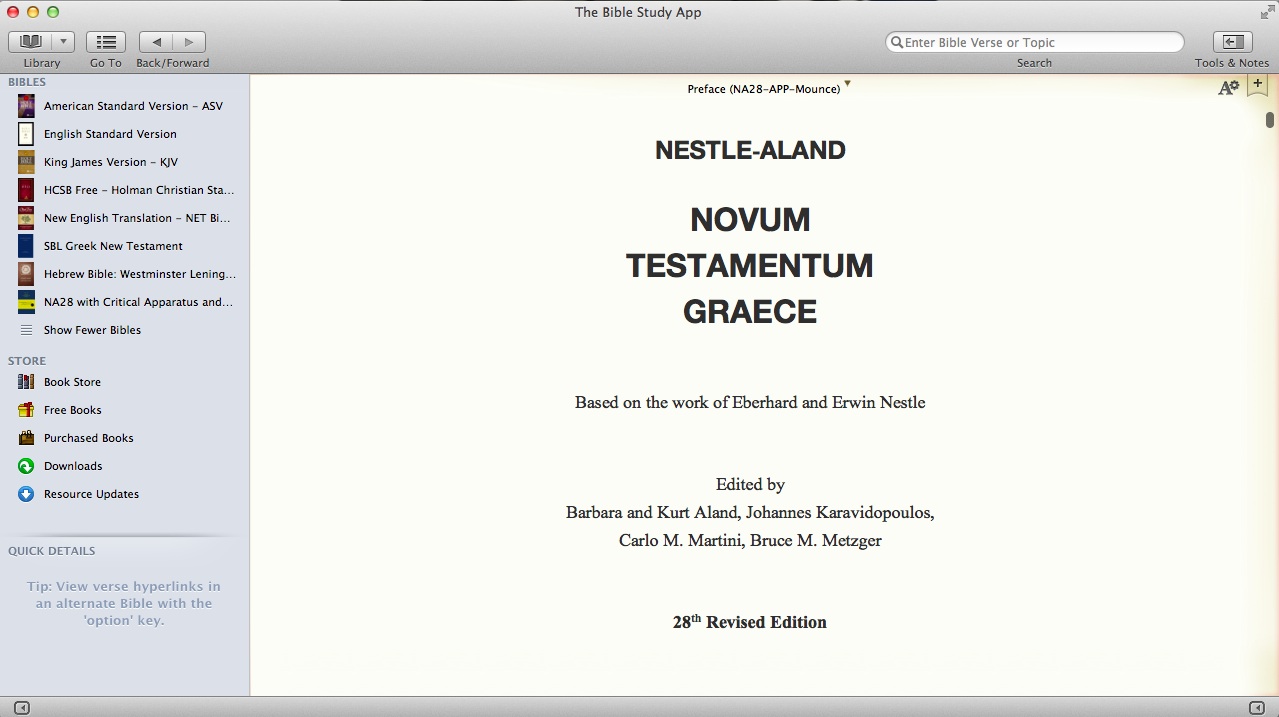
My opening screen, when I open the NA28 from my Library, looks like this (click to enlarge):

Opening Screen

The interface of the left sidebar resembles that of the Mac Finder windows. In addition the sidebar affords immediate (in-app) access to the Olive Tree store. Once you click on “Book Store,” you see a screen that slightly resembles the iTunes store:

Store

You can hide the sidebar and hide or customize the toolbar on top.

By clicking on the “Tools & Notes” icon on the top right (from the first screen shot above), I can open a second window (Olive Tree calls this “the split window”):

Split Window

I have several options at the top of the split window: Resource Guide, Notes, etc.

With the NA28 open, I quickly found four ways to navigate to a given verse–each of the three shown below, as well as a right-click option to select a verse.

Go To

For the NA28 with apparatus, I open the text in the left window and the apparatus in the right. Clicking on a word or hovering over it will show its morphological information (i.e., parsing and gloss) either through a pop-up menu (when clicking) or through the “Quick Details” at bottom left in the shot below (when hovering):

morphology info

Getting right to work within the program (with just the occasional reference to help files and a quick start guide) was easy enough. I didn’t find getting the two windows side-by-side to be as quickly intuitive as I would have liked, but I don’t know yet whether that’s a weakness in the program or just my newness to it. The interface is clean and visually appealing. I’ve already been impressed with all that’s available in the Olive Tree store.

More to come. In the meantime, Olive Tree has a blog post of their own on using the NA28 here.

Thanks to Olive Tree for the NA28 with Critical Apparatus, Mounce Parsings, and Concise Dictionary for the purposes of this blog review. You can find that product here

Charts on the Life, Letters, and Theology of Paul, reviewed

Charts on Paul

I’ve written a good deal about Paul since starting this blog last summer. I have been particularly fascinated by his use of the Old Testament, an interest that really grew through a great class I took last fall: Use of the Old Testament in the New, taught by Dr. Roy E. Ciampa.

Lars Kierspel has contributed a volume on Paul to the Kregel Charts of the Bible series. (I reviewed Hebrews in that series here.) “Given the nature of the apostle’s life and letters,” Kierspel writes, “This book is not for the lazy reader.” The charts, even though they are perhaps easier to grasp visually than prose text, “demand every ounce of intellectual and creative energy to avoid consuming them as biographical and theological fragments.”

As with the Hebrews volume, the charts in Paul are of varying lengths. Some are a single page (#42, “Formal Structural Components of Paul’s Letters”) while others are several pages long (#54, “Key Words in Romans” and #71, “Similarities between the Pastoral Epistles”). All contain additional information in the “Chart Comments” section at the back of the book, which is more than 40 pages. (It’s this section that helps the charts pack a much more powerful punch than one might expect.)

The book has four parts:

A. Paul’s Background and Context
B. Paul’s Life and Ministry
C. Paul’s Letters
D. Paul’s Theological Concepts

The book begins well with a chart on “Roman Emperors Before and During Paul’s Life and Ministry.” The comments section notes, “While Paul might not have seen any of the Roman emperors in person, the chart shows that their decisions and ideas impacted the apostle’s ministry both positively and negatively.” His chart #7 on “First-Century Judaisms: Different Groups” rightly suggests that during Paul’s time, there was not one monolithic Judaism, but rather multiple Judaisms, though they did share “common characteristics” (chart #8) like monotheism, circumcision, etc.

Kierspel gives at least a “Snapshot” chart for every one of Paul’s letters. This makes it a great reference for preachers going through a book of Paul’s, as I recently did with Galatians. Chart #77 has a list of “Key Texts and Their Interpretations” (which is really not a chart so much as it is prose text) that surveys all of Paul’s letters in three pages. When preaching on the fruit of the Spirit recently, I found Kierspel’s “Vices” and “Virtues” charts (which used both English and Greek) to be particularly helpful.

The author is balanced in addressing disputed issues in Paul, such as authorship of various letters, or Paul’s view on women in ministry. So his chart #19 (“Paul’s Coworkers”) and #104 (“Women: Equal and Subordinate to Men”) and #105 (“Women in Ministry”) highlight various viewpoints and where the reader can go to research more. The 32-page bibliography at the back of the book is impressive, though there are (probably inevitably) some omissions (Stendahl, for example).

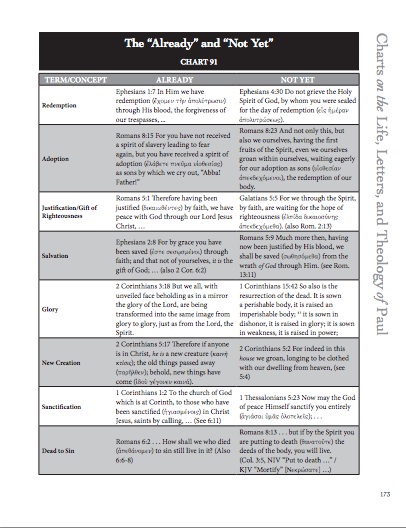
Here’s a sample chart:

chart 173

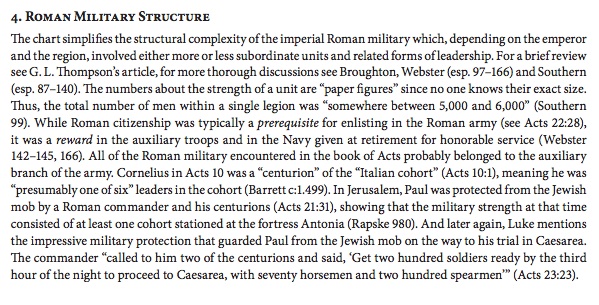
And here is a comments section, from the back of the book:

Comments Chart 4

As with the Hebrews charts book, there is no accompanying CD-ROM or digital content. This felt like a missing piece. For a teacher to make use of a chart in class, she or he would have to copy from the book or scan it in to project on a screen. It ought not to be too difficult for future printings/editions to come so equipped. A professor could circumvent this issue and just require the whole book for each student in a given course, which would make sense for an introductory course on Paul.

There were a few formatting errors sprinkled throughout the book. Also, for a “charts” book, it’s pretty text-heavy. But I didn’t find that made it any less valuable a reference for me.

One would benefit by reading the charts book straight through, as it serves as a good introductory overview to Paul’s ministry, writings, and theology. But it also serves well (and perhaps better) as a reference tool that students, pastors, and professors all will appreciate having. Kierspel makes information and insight on Paul easy to access and digest. This one is now on my short list of initial references for study of Paul.

Kregel sent me a copy of the book for review. Its product page is here, and it’s on Amazon here. The Table of Contents (which lists all the included charts) is here (pdf); read an excerpt here (pdf).

4 Biblical Studies eBooks on Sale for Less than $3

Right now there are four good-to-own biblical studies books on sale for less than $3 (and two of these are less than $2).

fee and stuart

How to Read the Bible for All Its Worth (Fee and Stuart), $1.99 on Kindle (here). I’ve read this, though it’s been some time now. Solid book.

Evans DSS

Holman QuickSource Guide to the Dead Sea Scrolls (Craig A. Evans), $2.99 on Kindle (here). I just got this–haven’t read it yet, but flipping through, it looks like a great introduction to the Dead Sea Scrolls.

Surprised By Hope

Surprised by Hope: Rethinking Heaven, the Resurrection, and the Mission of the Church (N.T. Wright), $1.99 on Kindle (here) and iBooks (here). I haven’t read this (I know! I need to get on it) but several folks have highly recommended it to me.

Kruse Romans

Paul’s Letter to the Romans (Pillar Commentary Series), Colin G. Kruse, $2.99 on Kindle (here). The couple times I’ve used this have led me to think this is a good resource.

(This blog participates in the Amazon Associates Program, so any purchase from Amazon that comes from a link on this site sends a small percentage of the purchase price to upkeep and maintenance for Words on the Word.)

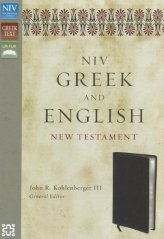
Zondervan’s NIV Greek and English New Testament, reviewed

Zondervan GNTZondervan continues to publish great resources for learning and using Biblical Greek and Hebrew. I reviewed their Greek and Hebrew Reader’s Bible here. Now they have published a “diglot,” a Bible with two languages side-by-side, on facing pages, for the New Testament.

This is also known as a “parallel Bible,” so that the reader can easily see both the Greek and English side-by-side. It’s not an interlinear Bible, though (English interspersed line-by-line with Greek), so you can easily just read all English or all Greek any time you want to. Both the Greek and English section headings are the same (in English), which makes it easy to stay on track when reading through. Each page is single column format.

The Greek text is not the scholarly NA27 or NA28 critical edition. Rather, it is the Greek text that the NIV translators agreed on as the textual basis for translation. The few times (and there aren’t a ton of instances) when this Greek text differs from the NA27, footnotes provide additional information.

Greek font preference can be subjective, but I find this one pleasing and easy to read:

Greek English

The italics are for an Old Testament quotation.

The leather/Italian Duo-Tone version has a single ribbon for marking one’s place. Its feel is pleasant and flexible, yet durable. It’s a well-made Bible.

I wondered when reading whether not having the critical Nestle-Aland Greek in front of me would be a problem, but (a) the differences are minor and (b) if one’s goal is just to read Greek (not do textual criticism), whether or not one has Nestle-Aland is not hugely important. Besides that, there are possibly places where the NIV translators have made a better textual choice than the NA folks! (We’ll find out when we get to see all the original “autographs” in heaven, I suppose.)

There is also a 146-page Greek to English dictionary included at the back (Mounce Concise) which has word frequency information, a short gloss/definition, and verse references where words are used. It’s basic, but a good dictionary, especially for quick look-ups when doing daily reading.

One advantage to this diglot over other diglots (RSV and NET versions) is that the Greek is always on the left-hand page and the English is always on the right-hand page. In these other two diglots (perhaps for ease of printing?) it changes every two pages, so that this left-hand page is Greek, this other left-hand page is English. It’s a small thing, but it makes it easier to use.

As for the English version employed, this is the 2011 NIV, the update to both the 1984 NIV (New International Version) and the 2001/2005 TNIV (Today’s New International Version). Much ink (and many bytes) have been spilled over the differences between these three and the controversy surrounding the TNIV. (Much ado about not-much, in my opinion.) The TNIV opted to be more gender-inclusive than the 1984 NIV in how it translated masculine Greek words, so “brothers” would be “brothers and sisters.” If Paul clearly has men and women in view (he often does), “brothers and sisters” is the best way to translate the masculine Greek noun. But this gender inclusivity (I prefer “gender accuracy”) displeased some, and so now the TNIV is off the shelf (as is the old NIV) with the NIV (2011) in its stead.

The 2011 NIV seems to either lean more toward the TNIV or to split the difference on gender. For example, take Galatians 1:11 in the three versions:

NIV (1984): “I want you to know, brothers, that the gospel I preached is not something that man made up.”
TNIV: “I want you to know, brothers and sisters, that the gospel I preached is not of human origin.”
NIV (2011): “I want you to know, brothers and sisters, that the gospel I preached is not of human origin.”

Here are Galatians 1:1-2. Note how the new NIV matches neither of its predecessors.

NIV (1984): “Paul, an apostle—sent not from men nor by man, but by Jesus Christ and God the Father, who raised him from the dead—and all the brothers with me….”
TNIV: “Paul, an apostle—sent not with a human commission nor by human authority, but by Jesus Christ and God the Father, who raised him from the dead—and all the brothers and sisters with me….”
NIV (2011): “Paul, an apostle—sent not from men nor by a man, but by Jesus Christ and God the Father, who raised him from the dead—and all the brothers and sisters with me….”

Rodney Decker has a thorough (and I mean thoroughreview of the new NIV here.

Although I never had the pleasure of seeing a TNIV-Greek diglot (I don’t think Zondervan published one?), this one is the next best thing. Especially for preachers and students and Greek-learners who want to stay close to the NIV, this diglot is yet another great language resource from Zondervan.

Thanks to Zondervan for the review copy. See a sample file here (pdf). You can find purchasing information about the book at Amazon or at its Zondervan product page.

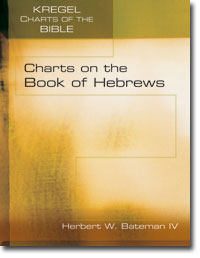
Charts on the Book of Hebrews, Reviewed

charts on Hebrews

Hebrews can be a hard book to grasp. Whether in Greek or English (or any other language), the development of the book’s logic–especially early on–requires careful attention. One hears about Jesus’ priesthood, which makes the most sense when examined against the backdrop of the Old Testament priesthood and sacrificial system. Angels and Moses and Aaron all make appearances, which are central to what the author of Hebrews says about Jesus. And then there is Melchizedek to reckon with!

Herbert W. Bateman IV, then, has a great idea in wanting to offer “information about Hebrews succinctly in visual format for today’s student and congregant.” He does this (effectively) with a book of charts, consisting in four major parts:

  • Part 1: Introductory Considerations In Hebrews
  • Part 2: Old Testament and Second Temple Influences In Hebrews
  • Part 3: Theology In Hebrews
  • Part 4: Exegetical Matters in Hebrews

Some charts are just one page (#87, “Positions on the Warning Passages in Hebrews”) or a few pages (#34, “Old Testament People Named in Hebrews”), while others are longer–nearly 10 pages of “Major Textual Issues in Hebrews” (#97) and nearly 20 pages of the (Greek) words that are unique to Hebrews (#103 and #104, listed both alphabetically and by chapter, respectively).

There is not much that this book leaves uncovered. Bateman covers the authorship and dating and genre questions thoroughly and succinctly. There are also helpful summaries of how various Hebrews commentaries have understood different aspects of the book. He explains and diagrams the tabernacle in the Old Testament, comparing it with its description in Hebrews (charts #35-#38).

Five pages on the not-well-known Melchizedek examine that figure in both biblical and extra-biblical context (Josephus, Dead Sea Scrolls, etc.). The theology charts found in the third part of Bateman’s book could easily be used in a congregational setting, especially the “Portraits of God” (#56) and Jesus (#57) in Hebrews. The final section looks in detail at Hebrews through interpretive, textual, rhetorical, and lexical lenses.

The “Chart Comments” at the back of the book add even more to the already substantive charts. A dozen-page bibliography concludes the work.

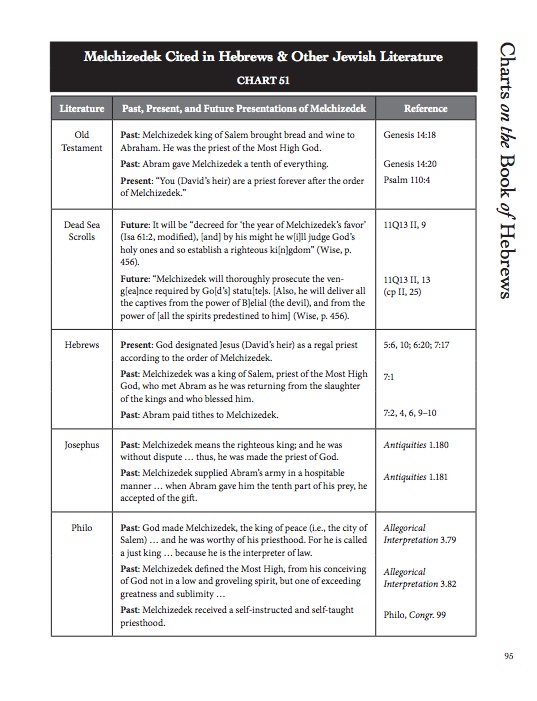
Here’s a sample chart:

Melchizedek

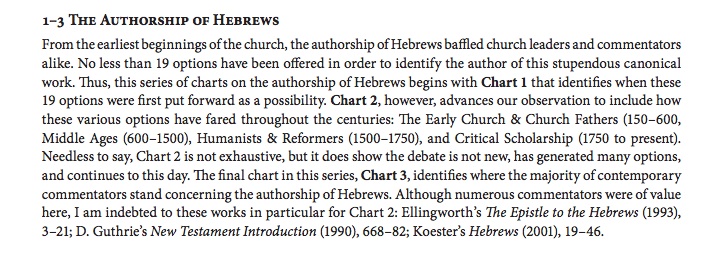
And you can see here some comments on the first three charts, from the back of the book:

Chart Comments

It’s remarkable how much ground Bateman covers in this appealing, visually organized medium. Seminary classroom teachers or church Sunday school teachers could make great use of these charts.

The one downside to this book, however, is that there is no accompanying CD-ROM or digital content. For a teacher to use a chart, she or he would have to copy from the book or scan in a chart for use in a class Powerpoint. A clean .jpg or .pdf file from the publisher would have eased this process for the user of this book. Hopefully future editions will come so equipped.

Though these charts are produced with a group in mind, any individual (with whatever level of knowledge about Hebrews) could benefit from using the charts for private or small group study. Even though these are charts, this is also the kind of book one could just sit down and go through. Bateman has provided a top-notch resource for an important biblical book.

Kregel sent me a copy of the book for review. Its product page is here, and it’s on Amazon here. The Table of Contents (which lists all the included charts) is here (pdf); read an excerpt here (pdf).

The Comprehensive New Testament, a Review

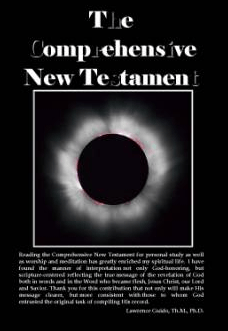
Screen Shot 2013-07-23 at 11.41.20 AM

I don’t really think there is such a thing as a “literal” translation of the Hebrew or Greek Bible. Too much is lost when going from any one language to another to be able to claim literalism. As Dave Brunn points out, to translate is to necessarily change the form. The only way one could keep the form of Hebrew or Greek is to leave the text in Hebrew or Greek.

The Comprehensive New Testament claims to be “the most accurate translation of the Nestle-Aland 27th edition Greek New Testament ever produced” (Preface, i), which first struck me as a rather grandiose claim. However, the editors of that work seem to agree with Brunn in saying that “no translation can perfectly reproduce the simplicity and beauty of the original words” (i). Their claim to accuracy is not a claim regarding their original English translation of the Greek New Testament. Rather, it means that they use the Greek of the NA27 as their underlying text. Other translations may begin with that as a base, but will make textual decisions that means their underlying Greek is not identical to the NA27.

There are four primary features to The Comprehensive New Testament:

1. It is “standardized to the Greek New Testament text of the Nestle-Aland 27th edition and the United Bible Societies 4th edition.”

Why this edition of the Greek text? Editors T.E. Clontz and J. Clontz note the Protestant and Catholic agreement on the text tradition (“Alexandrian”) of the NA27 as the basis for English translations of the New Testament.

The editors seem to agree with the idea that no translation is truly literal, yet they still want to “translate the right words–and not words created by scribal mistakes or editorial changes” (i). I agree with them that the “words given through the apostles deserve our best efforts in return.”

One should still be clear, though, that even if the NA27 represents the best manuscript tradition, we don’t have the original autographs. I do believe we probably have something very close to that, but it certainly doesn’t threaten my high view of Scripture to think that there might have been a few “scribal mistakes or editorial changes” between the time of writing and the earliest manuscripts we have access to. The editors aren’t claiming access to the autographs, though, just to the NA27.

There is now a 28th edition of the Nestle-Aland text, with a few changes made from the NA27. How does this come into play? Of course, The Comprehensive NT was published before the NA28 by about 5 years, but it does raise a question for possible future editions of this volume. (I.e., did the NA27 have the wrong text? Does the NA28 have it right now? etc.)

All of these are minor quibbles, though, and no textual variants seem to make major theological differences to our faith. Indeed, the editors note that “throughout the 15,000 variations translated in this New Testament, we find the same message, and the same gospel” (i). Agreed.

The reader of this volume should understand, however, that even using the NA27 at all times doesn’t remove textual ambiguity. For example, in Galatians 1:2 Paul uses the Greek ἀδελφοὶ to describe those “who are with me.” This post is not the place to engage seriously the issues surrounding translation and gender, but given the amount of female ministry companions Paul generally had, the translation found in the NIV (2011) of “brothers and sisters” is almost certainly the more accurate translation. (In Greek, a masculine plural noun like adelphoi could be all males or a mixed group of males and females.) The editors have retained the underlying Greek, but have translated it in a way that not all will agree with.

Also, to take another example, in Romans 16:7, there is debate around whether Paul names Junia (female) or Junias (male) as an apostle. The prevailing scholarly theory is that he has Junia (female) in mind, but the Greek word itself is not conclusive, since he uses the accusative case Ἰουνιᾶν, which itself could be male or female.  EDIT/UPDATE 7/24/13: Earlier printings of NA27 did indeed have Ἰουνιᾶν (male), but as of 1998, printings now contain the unequivocally female Ἰουνίαν (Junia).  The Comprehensive NT has “Junias” (male) in translation. It’s impossible to prove with 100% certainty one view over the other, but even with a solid base of the NA27 at every turn, there are still ambiguities to be resolved in translation.

2. The Comprehensive NT contains “complete textual variant mapping.”

The editors encourage and facilitate the use of multiple translations when studying the Bible. To this end they offer “complete textual variant mapping” so one can easily see what other translations have for given words and verses. The preface says this is “something that no other translation offers” (i.e., “footnotes for translations beyond our own”). That’s not entirely true, as the NA27/NET diglot offers the same feature (see here).

It’s a useful and time-saving feature, though… a sort of compendium of English translations.

The Junia example above (Romans 16:7) notes the many translations that have Junia over Junias (NESV, HCS, KJV, etc.). They ascribe “Junias” (male) to the Alexandrian tradition while saying that “Junia” (female) is from the Byzantine tradition. Unless I’m missing something, it’s not quite this simple, as the NA27 itself can easily be understood as referring to a Junia. Here it’s not a question of text tradition, but rather of interpretation and translation.

The notes don’t contain rationale for the translation of the New Testament, but they don’t purport to, either.

3. It scores high on a readability scale, only requiring “a sixth grade reading level.”

I don’t doubt the high score, but the presence of words like “behold” and “begotten” (in John 3:16) and “hallowed” (in the Lord’s Prayer) stood out to me as something that a sixth grader would probably need to ask about. The New Living Translation, by comparison, has “one and only” for John 3:16 and “may your name be kept holy” instead of “hallowed be your name” in Luke 11. These latter translations, I think, are better suited to a younger age group and reading level. This translation is not abnormally wooden, though, as some “literalistic” translations (e.g., the NASB) can be. I’m just not sure I’d fill a middle school youth room full of these Bibles (intriguing cover image notwithstanding!).

4. There are nearly 300 pages of “references for the Dead Sea Scrolls, Philo, Josephus, Nag Hammadi Library, Pseudepigrapha, Apocrypha, Plato, Egyptian Book of the Dead, Talmud, Old Testament, Patristic Writings, Dhammapada, Tacitus, Epic of Gilgamesh.”

Many of these pages also include excerpted text from the above.

This is the best feature of this book, in my opinion. Anyone who wants to thoroughly research the early Christian and early Jewish literature that has to do with a given New Testament verse will save loads of time by referring to the reference list.

From Genesis and Jubilees and Sirach on Abraham in Romans 4 to a juicy quote by Papias that claims Matthew “composed the oracles in the Hebrew language,” this section is a great scholar’s companion. The preface provides a concise and helpful overview of the texts covered (e.g., Pseudepigrapha: “claim various Old Testament individuals as authors”).

Accordance Bible Software has released The Comprehensive NT, and one can see the advantage to using a hyperlinked, electronic version of these references (see here). As one reviewer noted, having this extensive list of cross-references will save many a trip to a theological library.

Whatever my critiques above regarding the translation itself, the hundreds of pages of cross-references alone make purchasing the less than $20 book an easy decision. I know of no other single work that gathers so many references in one place, sorting them by New Testament verse. It’s a great starting point for research papers or in-depth Bible studies that want to take into account other extra-biblical writings.

Find out more about The Comprehensive New Testament here or here. Thanks to Cornerstone Publications for the review copy. The translation and cross-references are also available in Accordance Bible Software, here.

Free book in Logos Bible Software this month

Expositor's GNT vol 5

This month (for the next week) Logos Bible Software is offering volume 5 of The Expositor’s Greek Testament for free. You can find it here.

From the Logos site:

The Expositor’s Greek Testament ranks among the most important commentaries on the Greek text of the New Testament from the 19th century, drawing from the scholarship of twenty contributors under the editorship of William Robertson Nicoll. In addition to the Greek text, this massive reference work contains textual, literary, and grammatical commentary on nearly every Greek word in the entire New Testament. The Expositor’s Greek Testament also includes lengthy introductions to each of the books in the New Testament, surveying the literary and interpretive history, along with an introduction to the historical context of each book and an extensive bibliography.

This particular volume covers 1-2 Peter, 1-3 John, Jude, and Revelation.

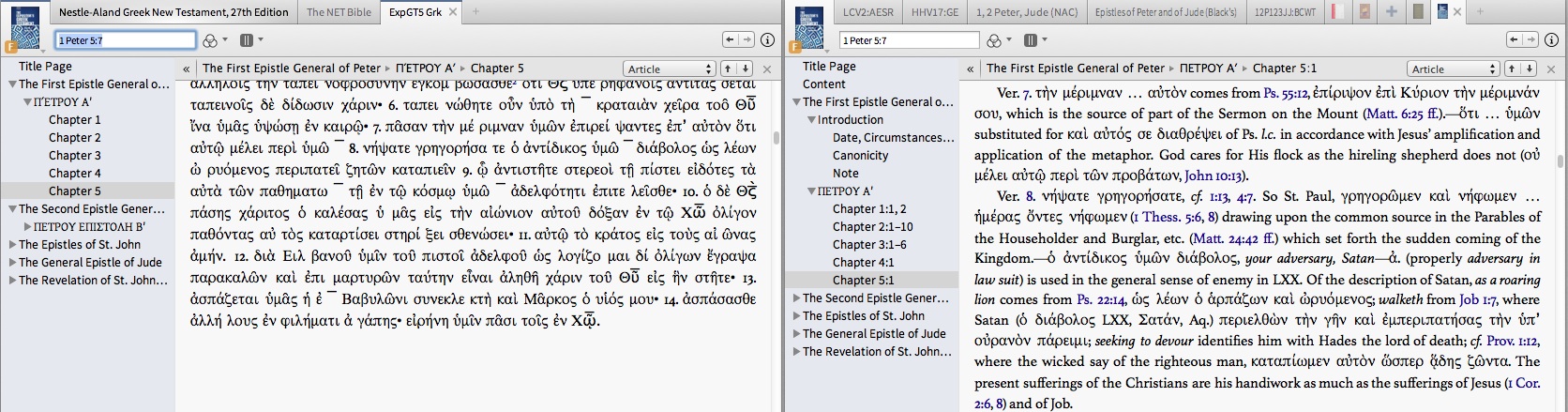
The free volume actually installs as two modules–one is the Greek text for the books above, the other is a commentary on the Greek text (including full book introductions and verse-by-verse, word-by-word comments). Here’s a screen shot of what it looks like when open to 1 Peter 5:7 (click on image to enlarge):

Screen shot

Everything is hyperlinked and searchable, and ties in with the rest of one’s Logos library.