Day One is easily the best app for keeping a journal or life log–if you’re going to do it in a 1s and 0s environment, rather than on paper.
In this post I briefly review Day One. I’ll leave for another time the question of whether journaling by hand or by phone/tablet/computer is preferable. Okay, actually… I’ll answer that now: better to do it by hand, because… reasons. But Day One has photo capability, so it has served as a nice digital repository for me to chronicle my kids’ growing up, without having to post it on Facebook, etc.
Day One offers sync via iCloud, Dropbox, or their own sync service, so you can keep everything together on iPhone, iPad, and Mac.
I really like the layout, which allows you (much like in this blog, for example), to combine headings, text, and photos. Check out this sample entry on Day One for Mac:
You can even add an entry right from the menu bar, so that you can write down that brilliant insight before you forget it.
Your entries could be text, a (single) photo with text, location-based entries (that also pull in the weather automatically), meeting notes, day debriefs, etc. Each entry is automatically time-stamped. The possibilities are pretty robust, and folks use Day One in lots of different ways. The tags feature especially enables this, as you could use the built-in tagging system to sort by “journal,” “family,” “song lyrics,” “insights,” “questions,” and more.
My first question is–to the extent I use Day One as a sort of photo-journal (especially of the family), will having my info in a proprietary format some day cause issues? That’s always a possibility with software (score one for physical journals and photo albums), but Day One allows for PDF export, so you don’t really have to worry here.
You can also set a reminder so that Day One reminds you each day to write:
It looks and works really well on iPhone and iPad too.
If you want to try the app and really put it to use, Shawn Blanc has written a pretty thorough ebook: Day One in Depth.
You can find Day One for iOS here; the OS X app is here.
Also… if you want to wait a few days… Day One 2 releases this Thursday. I haven’t used the new app, but beta users seem to love it. You can check out what’s new in the FAQs here.
Thanks to the makers of Day One for the review copy of the app on Mac, given to me for this review but with no expectation as to its content.
I have mixed feelings about Logos marketing–some criticisms expressed here–but I still do, at least for now, participate in an affiliate program of theirs. This helps, among other things, to pay for some of this blog’s minimal expenses and has even in the past funded seminary coursework.
I have no intention to shill, but I do want to share for interested readers that the rate of 15% off any base package in Logos is changing as of tomorrow (12:00 a.m. PST) to 10% off. So if you’re thinking of upgrading, you can do it for cheaper today than tomorrow. If you don’t have money to do it, don’t sweat, pour yourself a cup of tea, and read this post instead. If you do purchase, Logos feeds a percentage of the purchase back to me. If you’re interested, you just order a base package (new or upgrade) through this Logos landing page.
Or use the promo code ABRAMKJ6 when you check out with a base package in your Logos cart. My review of Logos 6 is here.
I just finished two systematic theology courses this semester. Phew! One resource that was really helpful to be able to reach for was Intervarsity Press’s 5-Volume Ancient Christian Doctrine.
It’s similar to the 29-volume Ancient Christian Commentary on Scripture set–like ACCS, Ancient Christian Doctrine compiles primary sources from early church theologians as a running commentary. ACD, however, is a full-blown compendium of commentary on the Nicene Creed.
It was an excellent resource, too, for helping me think through this last week’s sermon in my church’s Advent preaching series: “Who is This Jesus We Are Waiting For?”
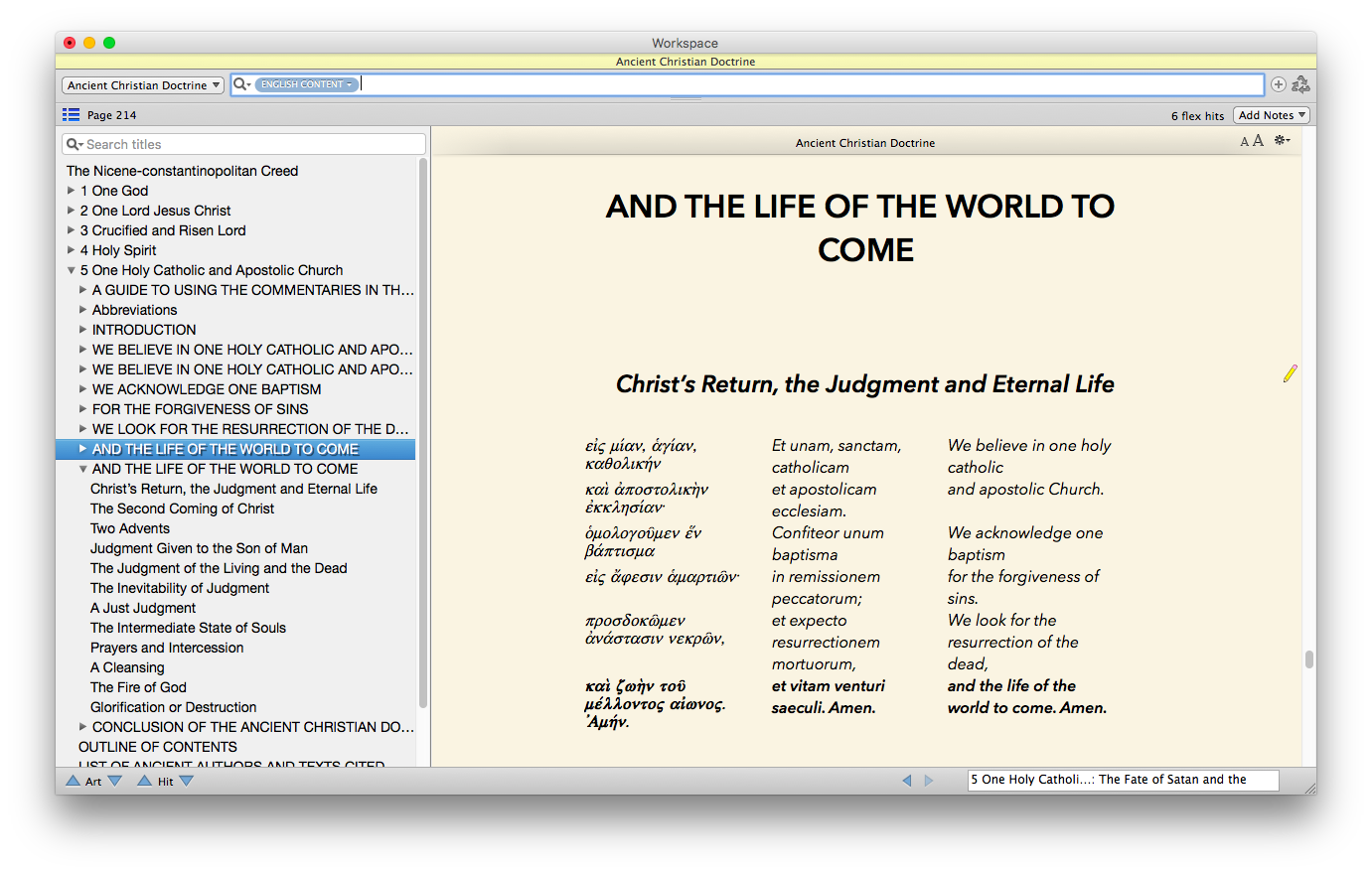
I skipped ahead in my research to the Creed’s final phrase, “…the life of the world to come.” Here’s what you see at the beginning of the section in the Accordance edition I’ve been using:
Click to enlarge image
You get the Creed in Greek, Latin, and English. Then, as you can see in the sidebar Table of Contents at the left, there is the commentary on that phrase–categorized helpfully in the volumes into sections like, “Two Advents” and, “The Intermediate State of Souls.”
Here was a powerful piece from Tertullian from that section:
We affirm that, as there are two conditions demonstrated by the prophets to belong to Christ, so these two conditions presignified the same number of advents. One of the advents, and that being the first, was to be in lowliness when he had to be led as a sheep to be slain as a victim and to be as a lamb dumb before the shearer, not opening his mouth, and not fair to look on. For, says the prophet, we have announced concerning him, “He is like a tender plant, like a root out of a thirsty ground; he has no form nor comeliness; and we beheld him, and he was without beauty: his form was disfigured,” “marred more than the sons of men; a man stricken with sorrows, and knowing how to bear our infirmity,” “placed by the Father as a stone of stumbling and a rock of offense,” “made by him a little lower than the angels,” declaring himself to be “a worm and not a man, a reproach of men, and despised of the people.” Now these signs of degradation suit his first coming quite well, just as the tokens of his majesty do his second advent when he will no longer remain “a stone of stumbling and a rock of offense” but after his rejection become “the chief cornerstone,” accepted and elevated to the top place of the temple, even his church, being that very stone in Daniel, cut out of the mountain that was to strike and crush the image of the secular kingdom. Of this advent the same prophet says, “Behold, one like the Son of man came with the clouds of heaven, and came to the Ancient of days; and they brought him before him, and dominion and glory were given to him as well as a kingdom so that all people, nations, and languages should serve him. His dominion is an everlasting dominion, which will not pass away; and his kingdom is that which will not be destroyed.”
I’ve gotten this resource in Accordance so I can preview it at some of my upcoming Accordance Webinars, the schedule for which is soon to be posted. And I’ve also found it quite helpful in writing pieces of theology and sermon preparation.
Let me leave you with this inspiration from Hilary of Poitiers:
He is born as man, while remaining God: this is in contradiction of our natural understanding. That he should remain God, though born as man, does not contradict our natural hope. For the birth of a higher nature into a lower state gives us confidence that a lower nature can be born into a higher condition.
See my other Accordance posts (there are many) gathered here.
PopClip appears when you select text with your mouse on your Mac. Instantly copy & paste, and access actions like search, spelling, dictionary and over 100 more.
PopClip is basically a Mac version of the iOS share sheet, which you can quickly get at just by selecting text. It looks like this:
What’s Awesome About PopClip
Its very existence is awesome. This short page shows you the extensions with which the app ships–fairly basic, though still helpful, ones.
But it’s all the Actions you can add to it that make it so great. Here are but a few, shown in the menu bar at right, where you can also rearrange the order to customize the appearance.
A few of my favorite things I can do with a single click:
select the title of a book from a syllabus and find it on Amazon
do the same thing on ebay
And then there’s some cool power-user stuff, too:
change selected text to all caps, all lowercase, or sentence case
calculate a string of numbers (i.e. 4*9+7 magically changes to 43 when I select it and click on the = sign in PopClip)
count characters and words in a selection (especially helpful for when I’m using OmniOutliner, which doesn’t have a built in word count feature)
That’s just the tip of the iceberg. Here are all the extensions you can add to your own PopClip, a process which is fast and easy.
There are some customizations, too. You can have PopClip not appear in certain apps of your choosing. You can change the size of its pop-up menu. And you can have it start up at login.
A Single Drawback
Just one: you cannot currently sync your added extensions between computers. So if you use two computers, you’ll have to configure evertyhing twice.
How to Get It
PopClip will fill in the gaps of many of your favorite apps by letting you quickly get information into them. It will save you time with things like its spell check, word count, and running a Google or Amazon or Etsy search on selected text. It can even automatically shorten Web links and randomly re-order selected lines of text.
PopClip is easily worth its $6.99. Find it on the Mac App Store here.
Thanks to the good folks at Pilot Moon for the review copy of PopClip, given to me for this review but with no expectation as to its content.
I haven’t posted about this in a while, but you can get 15% off any base package in Logos 6 through Words on the Word. If you order a base package through this Logos landing page, Logos feeds a percentage back to me, which I use to support the work of Words on the Word. So if you’re going to buy a base package anyway…
…check it out here, or just use the promo code ABRAMKJ6 when you check out with a base package in your Logos cart. My review of Logos 6 is here.
There won’t be flying cars, but the next best thing: today at 1:00 p.m. (EST) I’ll be leading a free Accordance Webinar covering basic Greek word study and setting up Workspaces. You can sign up here to join in. See the rest of Accordance’s upcoming Webinars here.
Ever wonder how to do intermediate and advanced Greek searches and set up some high-octane Greek Workspaces in Accordance? Yesterday I led a Webinar on that very topic.
Here is the .pdf handout of what I covered, which includes some links to helpful resources. And Accordance allows you to share Workspaces with others, so if you want any of the Workspaces mentioned in the .pdf (notation is WS), just let me know in the comments or reach me here and I’ll set you up!
This Wednesday I am leading a brand new Accordance Bible Software webinar: Key Resources for your Accordance Library. As I say in the webinar description, the session will:
• be appropriate for all levels: from beginner to advanced
• be interactive, with opportunities to ask questions as Abram is presenting
• offer an overview of what is available in the Accordance Web store, and how it is organized
• provide a hands-on demo of some resources in Accordance
Really looking forward to this one. Sign up info is here.
iA Writer is a popular plain-text, Markdown writing app. Perhaps its most salient feature is its simplicity, which it achieves without sacrificing quality. I may be making you fine readers read too many writing and productivity app reviews, so for this one, I’ll just send you the relevant links so you can check out more.
Here‘s iA’s write-up of the app, with lots of details and links. Here it is in the Mac Store, and here it is in the iOS App Store. (They even have an Android version!)
I’ve made no secret of my love of Jewish Publication Society’s works. The JPS Torah Commentaries have greatly enhanced my reading of the first five books of the Bible. I have particularly appreciated the seamless blend of critical scholarship and devotional posture that series offers.
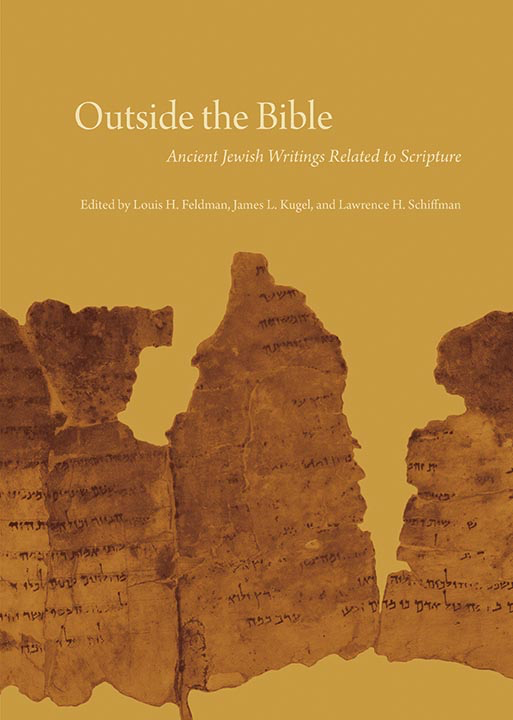
In 2013 JPS published a massive, three-volume set, Outside the Bible:Ancient Jewish Writings Related to Scripture. The print edition has 3,302 pages. Accordance is the only Bible software program to have made the electronic edition available; it releases today.
Outside the Bible (hereafter referred to as OTB) covers an impressive array of Jewish extrabiblical texts from the 6th century B.C. to the 2nd century A.D. The texts in OTB are ones that were “for various reasons, taken off the official Jewish bookshelf.”
************
The editors of Outside the Bible are Louis H. Feldman, James L. Kugel, and Lawrence H. Schiffman. The skilled lineup of contributors includes: Harold W. Attridge, David E. Aune, John J. Collins, David A. deSilva, Michael V. Fox, Emanuel Tov, Benjamin G. Wright III, and many others.
Broadly speaking, the editors and contributors treat writings from the following groupings:
The Septuagint
The Apocrypha and Pseudepigrapha
Philo
Josephus
Dead Sea Scrolls
OTB begins with some of the best, most succinct introductory material you can find on each corpus. Emanuel Tov, for example, gets right to the heart (using few words) of the potentially vexing concept of LXX translation technique:
When trying to analyze the Hebrew and Aramaic words, the translators could not resort to tools such as dictionaries or other sources of lexical information; they had to rely on their living knowledge of these languages and on exegetic traditions relating to words and contexts. … By the same token, the identification of difficult words was often guided by the context. Such a procedure frequently was little more than guesswork, especially in the case of rare and unique Hebrew words.
Practically speaking the reader finds explanatory comments like this one (from 1 Samuel 2) throughout OTB:
*there is none holy besides you Cf. the MT: “There is no rock like our God.” As elsewhere in the LXX, the translator avoids the description of God as a “rock,” possibly because he did not like the comparison of God to a stone, and instead stresses his holiness as in the first part of the verse.
When it comes to the texts themselves, here is how OTB is organized:
Each text in Outside the Bible is preceded by a brief introduction that gives a summary of its contents, a history of its composition and transmission, its significance for Jewish (and sometimes Christian) history and biblical interpretation, and a guide to reading that highlights specific issues for understanding the text. A short list of additional readings points the interested reader to more detailed or focused treatments of the text.
You can see the Table of Contents here, via Accordance Mobile:
Included in OTB is an entire commentary on 1 Maccabees and 2 Maccabees, among other texts. Here is David A. deSilva, offering the reader of OTB guidance for working through 4 Maccabees:
The author gives two important cues concerning how to read his work. First, he asks us to read it as an essay that offers both argumentation and exemplary evidence for the proposition that the religiously trained mind can gain the upper hand over all the contrary forces within us and outside us that drag us away from doing what we know to be best before God. Second, he invites us to join him in admiring the outstanding achievements of nine Jewish martyrs, whose courageous and praiseworthy example rivals that of the heroes of any other culture or tradition and can encourage us to hold fast to virtue in our lesser contests.
I could multiply examples of how OTB strikes an excellent balance of brevity and substance. One could open the pages of OTB, having never heard of the Damascus Document–or any of more than 150 other texts–and walk away with a solid understanding of that writing’s legal and theological teachings.
OTB has a nice focus not only on the extrabiblical texts as such; it also addresses their import for biblical interpretation. Further, the editors and contributors are careful to point out how these non-canonical texts function as windows into the culture and beliefs of Judaism in the Second Temple period.
And the interplay OTB highlights between Judaism and Christianity is fascinating:
Philo’s writings had practically no influence on Judaism as it developed after the destruction of the Temple in 70 CE and the disastrous Jewish revolt in Egypt in 115–117 CE. … On the other hand his writings were warmly embraced by early Christian thinkers, who saw in him a kindred spirit. They were attracted to his use of the Greek Bible and the allegorical method, as well as to doctrines such as the transcendence of God, the creation of the cosmos, the Logos, and providence.
Anyone wanting to further chase down what OTB has to say about Christianity can perform a search to instantaneously pull up all the instances of “Christian,” “Christianity,” or even, “Christ.” (The search to use is simply Christ* in the English Content search field in Accordance.)
…which leads to why Outside the Bible is a resource especially suited for the Accordance format.
************
One obvious reason a person would want to consider the Accordance module (and not just the print edition) is the portability factor. JPS books tend to be bound beautifully and constructed well, so there’s nothing to complain about in their aesthetics. But you can’t really take 3,300 pages of awesomeness to the library, coffee shop, or office with you, at least not easily. Keeping OTB on a laptop, iPad, and/or iPhone is appealing.
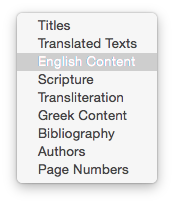
Another benefit to OTB on Accordance is the extensive system of tagging and hyperlinking the developers have used. For one, you can adjust the search field to search OTB in all of the following ways:
For another, where there is commentary on the texts, the Accordance module allows you to view it simply by hovering over a hyperlink. Causing my mouse to rest on an asterisk shown in the text of the Prayer of Manasseh calls up the corresponding commentary in the Instant Details at the bottom of the screen:
(click to enlarge image)
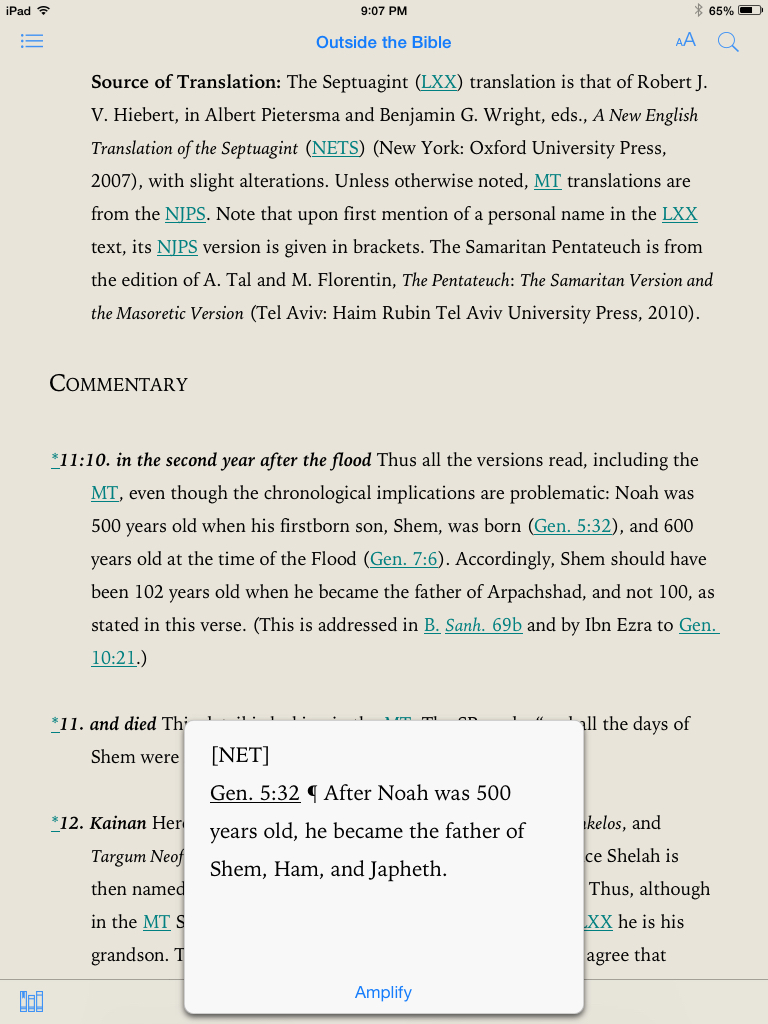
Hyperlinked content is, of course, just a tap away on the iPad:
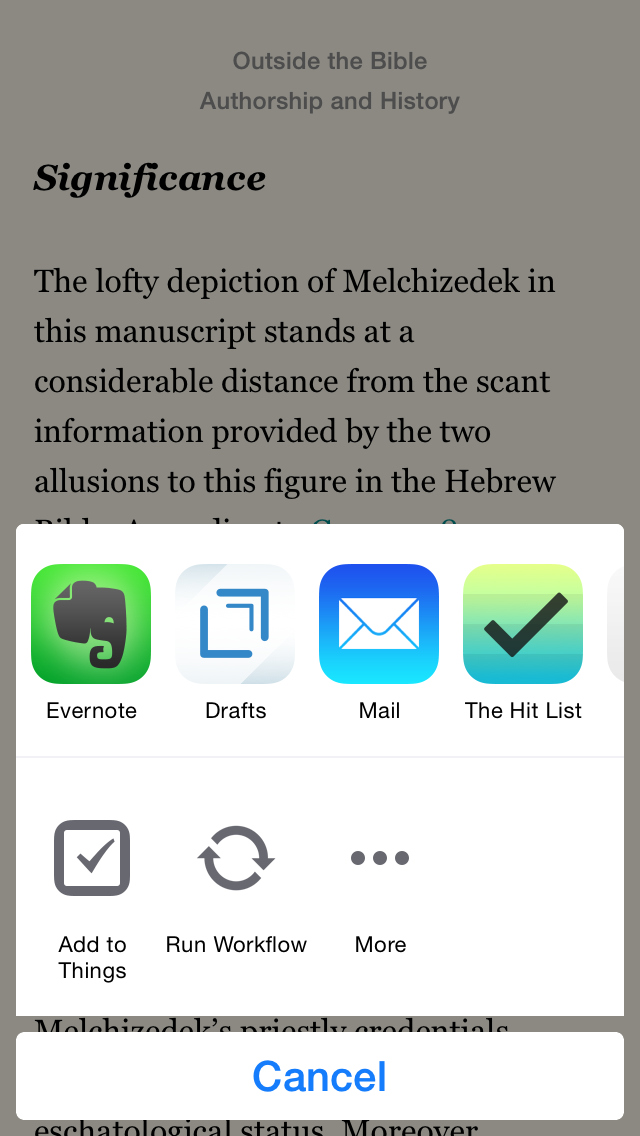
You can search just certain sections of OTB for a given word. You can highlight, take notes, and even share text via the share sheets in iOS–maybe you want to send some selected wording to Evernote or Drafts as part of your research. Just a few taps get me from 11QMelch (Melchizedek) into Drafts, a primary hub for my iOS research:
Using the share sheet, one could email information to oneself or others, or even share on social media. (And what says “rewritten Bible” better than Facebook and Twitter, amirite?)
************
Treat yourself to a perusal of the Table of Contents and some material on Jubilees (which interacts with Genesis) by following this link to a PDF excerpt. And, by all means, do go check out this majestic resource in Accordance here. Students, professors, and pastors… Jews, Christians, and agnostics–all who can access Outside the Bible are indebted to its editors and contributors for a thorough and engaging resource.
Thanks to Accordance for the review copy of Outside the Bible in Accordance 11. See my other Accordance posts (there are many) gathered here.







 But it’s all the Actions you can add to it that make it so great. Here are but a few, shown in the menu bar at right, where you can also rearrange the order to customize the appearance.









 Words on the Word