One obvious advantage to the book is its portability. It’s less than 400 pages and easy to carry around in a satchel… though since receiving it, I’ve kept it on my desk with a few other works I reference a lot.
What sorts of “theological terms” does this dictionary cover? The publisher’s product page notes:
This second edition of The Westminster Dictionary of Theological Terms provides a comprehensive guide to nearly 7,000 theological terms—1,000 more terms than the first edition. McKim’s succinct definitions cover a broad range of theological studies and related disciplines: contemporary theologies, biblical studies, church history, ethics, feminist theology, global theologies, hermeneutics, liberation theology, liturgy, ministry, philosophy, philosophy of religion, postcolonial theology, social sciences, spiritually, worship, and Protestant, Reformed, and Roman Catholic theologies.
There is also a short annotated bibliography, list of works consulted, and set of abbreviations at the back of the book. The “Major Topics and Distinctive Terms and Concepts” section at the beginning gives the reader a framework of overarching topics into which the dictionary’s terms will fit. (E.g., “Bible,” “theology,” “worship,” “ethics and moral theology,” and so on.)
McKim himself has overseen much larger dictionaries. An initial point of skepticism for me was whether a theological dictionary this small and short could still be substantive. Definitions are somewhere in the 15-75 word range, depending on the term.
Yet as a quick-reference guide, it does well. Consider McKim’s definition of feminist criticism:
A critical approach to reading the Bible that focuses on the political, social, and economic rights of women. Diverse goals and methods are employed, with a common recognition that all texts are gendered. This implies not only that they reflect sexual differences between males and females, but also that they involve power. Feminist criticism seeks to make clear culturally based presuppositions found in texts.
Here’s another example, the entry for “agrapha,” a term one finds shortly after delving into studies of the Gospels:
(Gr. “unwritten sayings”) Sayings attributed to Jesus that circulated as traditions during the period of the early church. Also those sayings attributed to Jesus found outside the canonical Gospels.
The reader will also find terms like “Griesbach hypothesis,” “haggadah,” “Muratorian Canon,” perspectivalism,” “cuneiform,” “body-soul dualism,” “Trisagion,” “interiority,” “rechte Lehre” (German for “right teaching on doctrine”), and many more.
McKim’s goal was to provide a “wider, synthetic work that gives short, identifying definitions over a more comprehensive range of theological disciplines,” as opposed to something more “specialized” and “extensive.” The beginning theological students that McKim seeks to reach will find such a dictionary an especially useful entry point into the large and growing world of biblical and theological studies. McKim seeks to be more “broad” than “deep”; in this he succeeds, but the definitions are still plenty substantive to be useful to students at various stages.
The annotated bibliography is just five pages and glosses over important works (e.g., the commentaries section lists Anchor but omits Hermeneia). It does include a good page on Web-based resources for theological studies. The abbreviations include a couple pages of textual criticism abbreviations (including Latin), which will save the new reader of the Hebrew Bible from having to look most terms up elsewhere.
One feature I felt to be missing was a lengthier set of introductory essays on the nature and methods of theological study. I’m assuming Dr. McKim didn’t include this because it might exceed the intended scope of the work, but perhaps future editions could include–as many dictionaries do–at least two or three introductory essays to further orient the reader to theological study.
I’ve had the dictionary at my desk all summer, and each time I’ve looked up a word or phrase, I’ve found what I was looking for (with the exception of dereliction or “cry of dereliction”).
Especially for its price and accessibility, The Westminster Dictionary of Theological Terms is an excellent starting point for seminary students or for pastors who want to stay up-to-date on theological terminology.
Many thanks to WJK Press for the review copy, given to me with no expectation as to the content of my review. You can find the dictionary here on Amazon (affiliate link), or here at WJK Press.
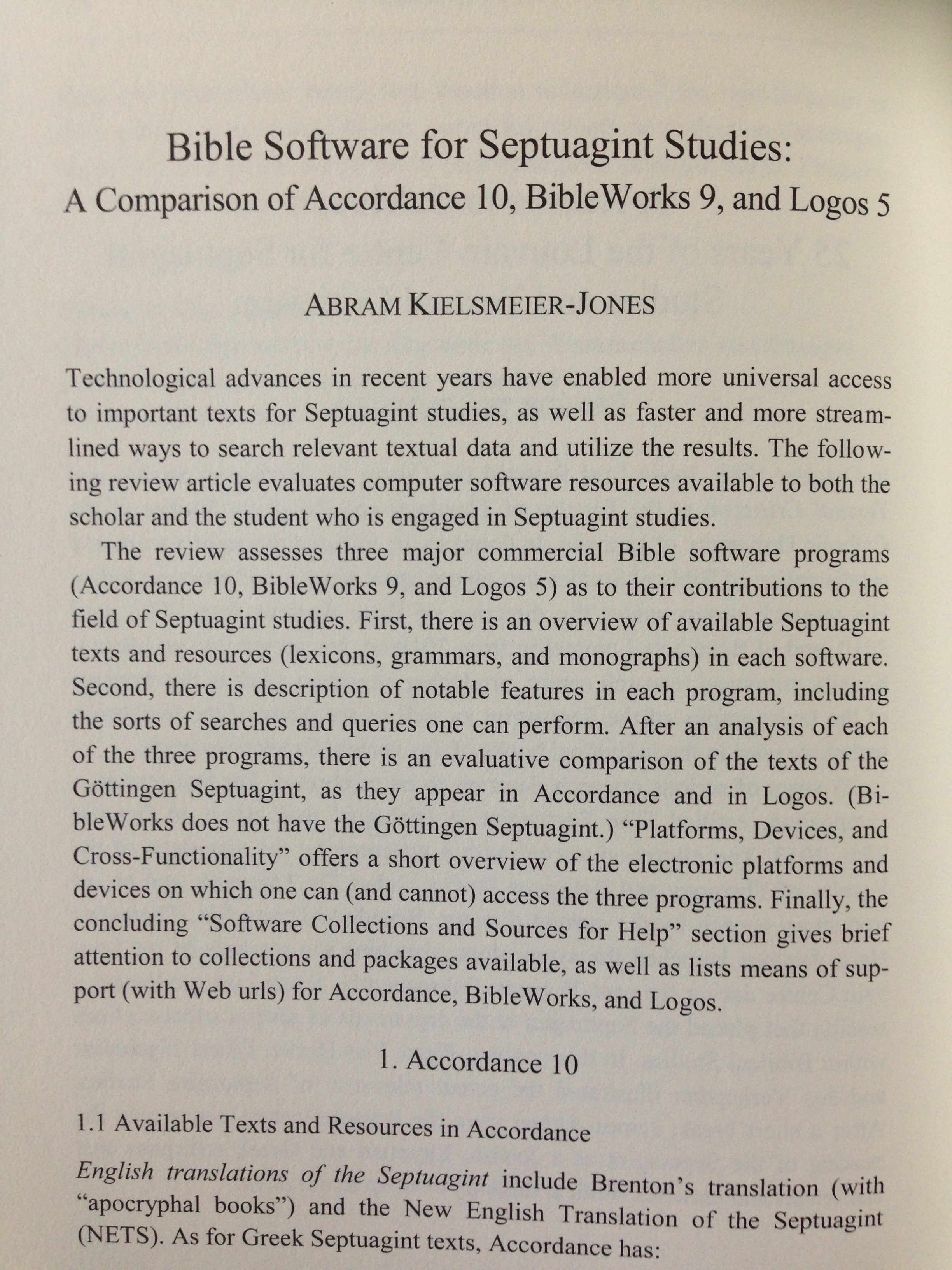
I’ve just come home to the new Journal of Septuagint and Cognate Studies (JSCS) in my mailbox. This volume (vol. 47, 2014) publishes an extensive comparative review I wrote of Bible software programs for Septuagint studies. In the review I consider and evaluate Accordance 10, BibleWorks 9, and Logos 5.
I’m excited to see it in press! Here are the journal cover, the contents, and the first page of the review. You can subscribe to JSCS at this link.
Especially since Eerdmans has a large number of resources in production right now at Logos Bible Software, I’ve started paying more attention to Logos’s Pre-Publication program.
Logos puts titles into “Pre-Pub” to help gauge user interest in various resources. When users pre-order a resource, that helps to cover the cost of production. If/when enough users pre-order, the title goes into development and the user gets it at the discounted pre-pub price when it “ships” (i.e., when it is completed).
Here is a short description from Logos’s Pre-Pub About page:
Prices start low and increase over time so the sooner you pre-order, the less you pay. We don’t charge you until your pre-order is ready, and we’ll send you a reminder email a few weeks before. If you decide you don’t want the resource anymore, you can cancel your pre-order at any time.
Here is a compilation of the newest Pre-Pub titles. (This one from Oxford University Press is pricey but looks good; here is When God Spoke Greek, which had enough pre-pub orders that it’s already under development and will probably ship within a month.)
Here is the Pre-Pub list sorted by Progress or “ship date,” so you can see which ones are almost ready to go–with the pre-order discount still applying, at least for now. There’s a bunch of Eerdmans stuff that will go out on August 6, including this collection that looks especially useful to pastors, including the book that is pictured above.
Here’s a short overview video of how Pre-Pub in Logos works:
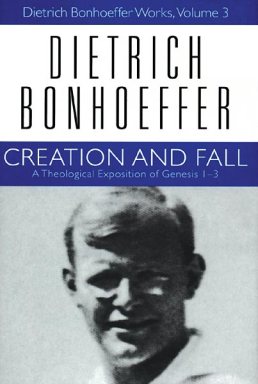
You may have read Bonhoeffer on the Sermon on the Mount, but did you know that he has a compelling and inspiring set of published lectures of Genesis 1-3, too?
for whom the terms “God spoke” and “it became so” are identical.
In Creation and Fall this idea reaches fuller expression:
That God creates by speaking means that in God the thought, the name, and the work are in their created reality one. What we must understand, therefore, is that the word does not have ‘effects’; instead, God’s word is already the work. What in us breaks hopelessly asunder–the word of command and what takes place–is for God indissolubly one. With God the imperative is the indicative.
This month Logos Bible Software offers Creation and Fall for free. I haven’t read the whole thing, but what I have read has helped even familiar chapters of Scripture come alive in new ways. Highly recommended.
You can find Creation and Fall for Logos here. As part of the same promotion, Logos is also offering Bonhoeffer’s Fiction from Tegel Prisonfor $0.99.
If you’re not already set up with Logos, feel free to message me here, and I’ll tell you how to do it.
Scrivener is 50% off at the Mac App Store right now. Not sure how long this sale will last, but it’s now $22.99, which is well worth the value Scrivener looks to provide, especially to writers. I posted about writing a paper with Scrivener here. The link to the sale in the App Store is here. (HT: Brian Renshaw for pointing it out!)
During my first few minutes using Scrivener 2, I kept thinking the most apt comparison was “word processor on steroids.” But that’s not quite accurate. For one, there are no negative side effects here—save for the commitment the user will have to put in to learn a flexible, layered, and impressive program. And Scrivener is about as far from a word processor as LeBron James is now from Miami.
How Quickly Could I Get Started? (In About 40 Minutes)
I had a paper due this weekend for a grad school class I’m taking. I wanted to use Scrivener to write it, since I thought it would simplify the process. Yes, Scrivener processes words, but it’s really a program for writing project management. Its product page says:
Enter Scrivener: a word processor and project management tool that stays with you from that first, unformed idea all the way through to the final draft. Outline and structure your ideas, take notes, view research alongside your writing and compose the constituent pieces of your text in isolation or in context. Scrivener won’t tell you how to write—it just makes all the tools you have scattered around your desk available in one application, leaving you free to focus on the words.
Scrivener is fast and easy to install. When you open it for the first time, you see an interactive tutorial you can work through:
But it says it will take “couple of hours if you go through it thoroughly,” and I needed to get started sooner than that on the paper. (I’ll go through the whole tutorial as soon as I can; it’s really well done.)
There are also tutorial videos here. A lot of them. I’ll admit to being somewhat overwhelmed at first. Scrivener is, after all, the kind of program you need to spend at least a little time to learn how to use, even if you’re already relatively computer-savvy. But it promises to be time well spent.
As an experiment, I decided to watch the ten-minute overview (the first video at the link above, “An Introduction to Scrivener”) to see if it was enough to get me “up and running as quickly as possible,” as the video description suggested. I had never used Scrivener before this month.
Sure enough—10 minutes later (plus another 30 minutes or so searching the forums, help files, and user manual) I was up and running, using Scrivener for the first time to complete a grad school writing assignment.
Writing a Paper More Efficiently
The paper I was writing requires multiple sections and is a topic I’d written about before. I also had some readings to integrate into the paper. And, of course, I wanted to keep the syllabus and specific requirements in front of me as I wrote.
So, after opening a preset template based on the Chicago Manual of Style, I got my project ready. Here’s what it looks like in Scrivener. To you Scrivener power users: this is a pretty basic setup, and I’m still learning what all I can do. To you who are not familiar with Scrivener: I’ll note below what each of the portions of the screenshot is. (Click on image to enlarge.)
The leftmost column is the Binder. This looks a bit like a Mac’s Finder folders. Here is where I laid out my paper. The preset template took care of the “Title Page” and “Works Cited” formatting; I just had to fill them in. I outlined the “Main Content.” Underneath that is “Research,” a set of .pdfs and other files I dragged in. Instead of switching between Preview, Word, and multiple windows in multiple programs, I could access everything I needed from the “Binder,” once I put it there. This meant that once I took a few minutes to set up the project, I only needed this one app open to complete the writing assignment, start to finish.
The “Ideas” section in the Binder, by the way, allows you to do a virtual version of creating notecards, for later rearrangement and integration into the paper.
The middle panes (the largest ones) comprise the Editor, which is where I wrote the paper. One really cool thing about this is you can have it all be one big pane, or you can open two panes at once. In the above screenshot, I’m writing my paper in the top editor pane and accessing a previous writing for reference in the bottom pane.
At right is the Inspector. This is versatile and can be used to select one of six different sub-panes. In the view above I have open a short synopsis of the section I’m writing (here I copied from the assignment so I knew what I was supposed to be writing), as well as some general Project Notes I wanted to keep before me for each section of the paper.
After I had written the paper, I selected Compile from the File menu, and Scrivener gave me a myriad of easy-to-navigate options for how I wanted to export my paper into a word processor for final formatting. I exported it to Word and only had to do a very few tweaks to have my paper come out properly formatted–including the footnotes.
More to Follow
Literature & Latte kindly supplied me with a license of Scrivener for the purposes of review. There is much, much more to the program than what I have outlined above, and I’ll write more later. I came to Scrivener this week just wondering if I could learn its basics fast enough to use it right away to write a paper, and in a way that would save me time compared to my normal workflow. This was very much the case when I had finished. I only wish I had known about the program much sooner in my graduate studies!
Want to check it out? (I recommend it.) Here you can download a free trial, for Mac or Windows. (It’s a generous trial period, too.) You can read more about Scrivener’s features here.
One of many cool things about Carta’s Sacred Bridge atlas is its use of original/source languages.
For example, when The Sacred Bridge (TSB) cites Eusebius’s Onomasticon (a 4th century list of Bible place names), it does so both in its original Greek and in English translation.
This, of course, got me to wondering about Eusebius in Greek. Using The Sacred Bridge in Accordance, I can easily pull up all the times TSB cites Eusebius (more on this later).
Then I wanted to know where to find more Onomasticon in Greek.
After a short hunt, I found this digital edition of the Onomasticon in Greek. I thought I would pass it on in case anyone else using the atlas in English wanted to be able to access the Greek.
Eusebius’s Onomasticon (in English translation, and with English translation of Jerome’s Latin translation/expansion of Eusebius) is here in Accordance, here on Carta’s site, and here at Eisenbrauns, Carta’s North American distributor.
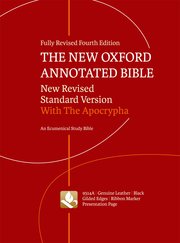
On the top of my bookshelf at home sits an old, falling-apart, heavily marked-up edition of The New Oxford Annotated Bible. So it has been with anticipation and appreciation that I’ve been able to use the The New Oxford Annotated Bible in its most current, 4th edition.
What the Annotated Bible Is
The Bible text in The New Oxford Annotated Bible is the New Revised Standard Version (NRSV). I’ve always appreciated this translation’s blend of readability and fidelity to the original languages.
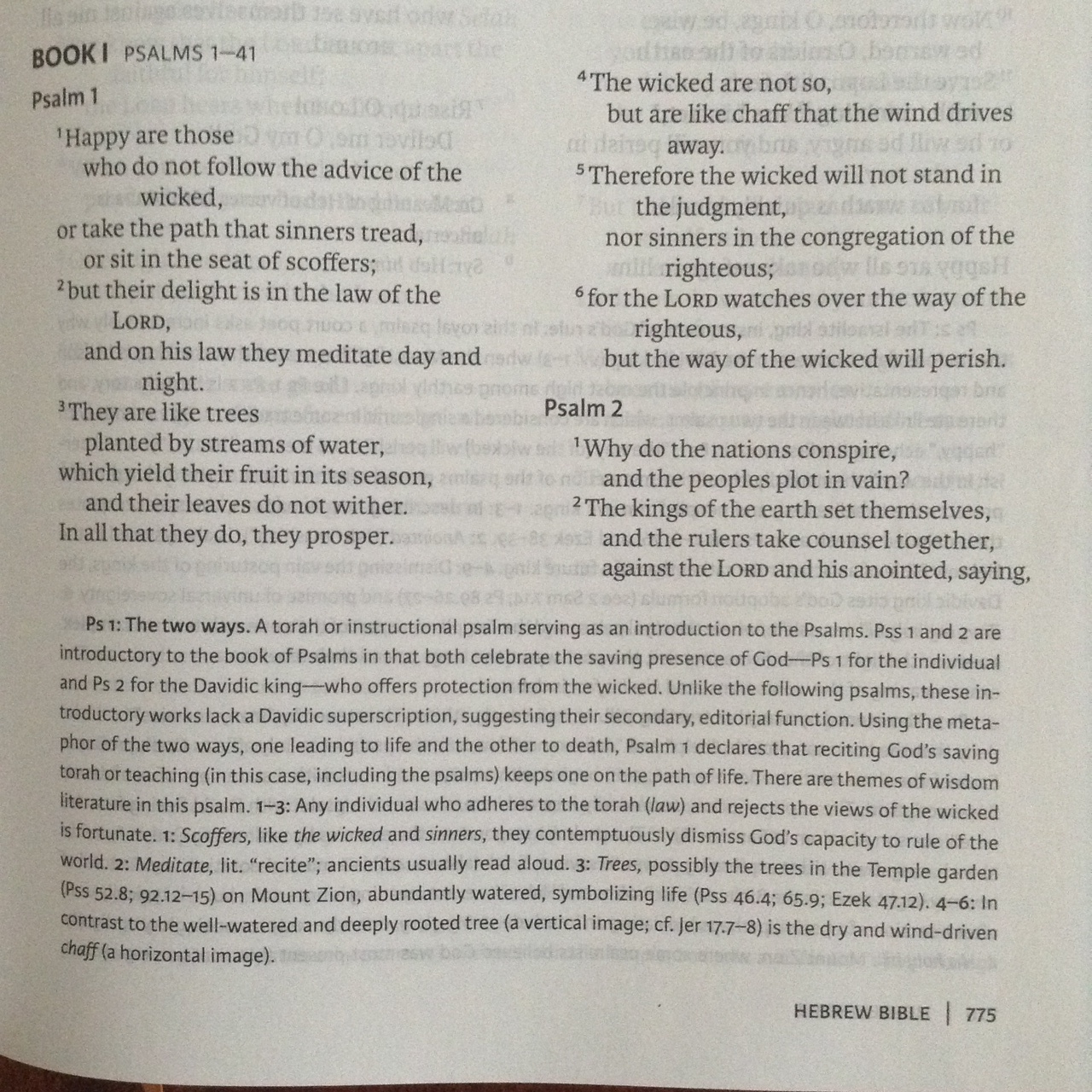
Each biblical book receives a short introduction, covering topics like authorship, date of composition, literary structure, and interpretive helps for reading. (The “guide to reading” that precedes most books is especially helpful when doing a book study or reading through a whole book of the Bible.) The biblical text itself appears in a clear, uncluttered font, with the study notes appearing at the bottom of the page. The brief but illuminating notes address each passage of the text (as a passage), and then comment more specifically on individual verses, terms and words.
Here is Psalm 1 with study notes:
Psalm 1
The title page bills this as “An Ecumenical Study Bible.” Its balance in this regard is, indeed, fair. The Editors’ Preface reads:
We recognize that no single interpretation or approach is sufficient for informed reading of these ancient texts, and have aimed at inclusivity of interpretive strategies.
The editors and contributors have succesfully met this aim. The introduction to Colossians, for example, does not make a heavy-handed assessment one way or the author as to Pauline authorship, but lays out the different views (with support) so the reader can decide. I appreciated this.
At the end of the Bible are some “General Essays,” covering topics at considerable length, such as:
The Canons of the Bible
Translation of the Bible into English
The Persian and Hellenistic Periods
The Geography of the Bible
and more. Also included are a glossary, concordance, 14 color maps, and other study helps.
“With the Apocrypha”
One thing that sets this study Bible apart from others is its inclusion of the Apocrypha. Not only is the text included, but its contributors are top in their field: John J. Collins (3 Maccabees), Lester Grabbe (Wisdom of Solomon), Amy-Jill Levine (Additions to Daniel, Tobit), and David A. deSilva (4 Maccabees), to name just a few. The introductory articles are clear and concise, yet contain the sort of information most users of this Bible will be looking for. For example, after a section on “Definitions” of terms like “Apocrypha” and “deuterocanonical,” the introduction to the Apocryphal section has “The Roman Catholic, Orthodox, and Protestant Canons of the Old Testament.” The comparison chart in that part of the introduction is especially useful, so readers can see “which religious communities accept [the Apocryphal/Deuterocanonical books] as scripture.”
In Mattathias’s speech on his deathbed in 1 Maccabees, to explore just one passage, the explanatory note for 1 Maccabees 2:49-70 simply reads:
Jacob (Gen 49), Moses (Deut 33), and Samuel (1 Sam 12) utter similar speeches; compare also the praises of famous men in Sir 44-50.
The biblical characters that Mattathias extols (Abraham, Joseph, Phinehas, Joshua, and so on) have accompanying biblical references in the study notes so readers can explore their stories further. It’s, of course, not nearly as in-depth as a commentary would be, but neither does it intend to be. It covers the basics well, and addresses most initial questions readers would have of the text.
Construction and Aesthetics
The leather-bound edition (what I am considering for review) is a well-constructed Bible. Despite its weight–to be expected of a Study Bible–it is a pleasure to hold and read. And to smell. Its gilded edges and two ribbon markers give it a classic feel. Its sewn binding and leather cover mean that it lays flat anywhere you have it open, even at Genesis 1:
Laying Flat at Genesis 1 (click to enlarge)
The pages are a bit thin, though this may be inevitable. (A delicate balance in Bible production is how thick the pages can be without weighing down an already bulky Bible). I was aware of bleed-through but not really distracted by it as I read. Note, too, the book name tabs in the image above, which help readers to quickly get to a desired spot.
Three Ways I’ve Used the Annotated Bible
There have been three primary ways in which I’ve made use of the Annotated Bible. One is for personal, devotional reading. In this context I have found the book introductions and notes to be just enough to answer my top-of-mind questions, but not so much that I was distracted from a focus on the text itself.
Second, this is the Bible I had in my hands while leading a small group Bible study last Lent on the Sermon on the Mount. Again, I found that most of our questions of the text were addressed in the notes by succinct, summary statements. And the NRSV was a good version for group reading.
Third, I’ve found the introductions and essays to be helpful in teaching and preaching preparation.
You can find the Bible here at Amazon and here at OUP’s site.
Many thanks to Oxford University Press for a copy of this beautiful Bible to review. They provided it with no expectation as to the nature of my review, except that I be honest.
The one kind of blog post I’ve deliberately avoided till now is the “In the Mail” post. I have my reasons for this, but that’s not the point of this post. I simply wanted to say that the book I received in the mail the other day might be the first one that caused me to say, “Whoa,” when I opened to the front inside cover.
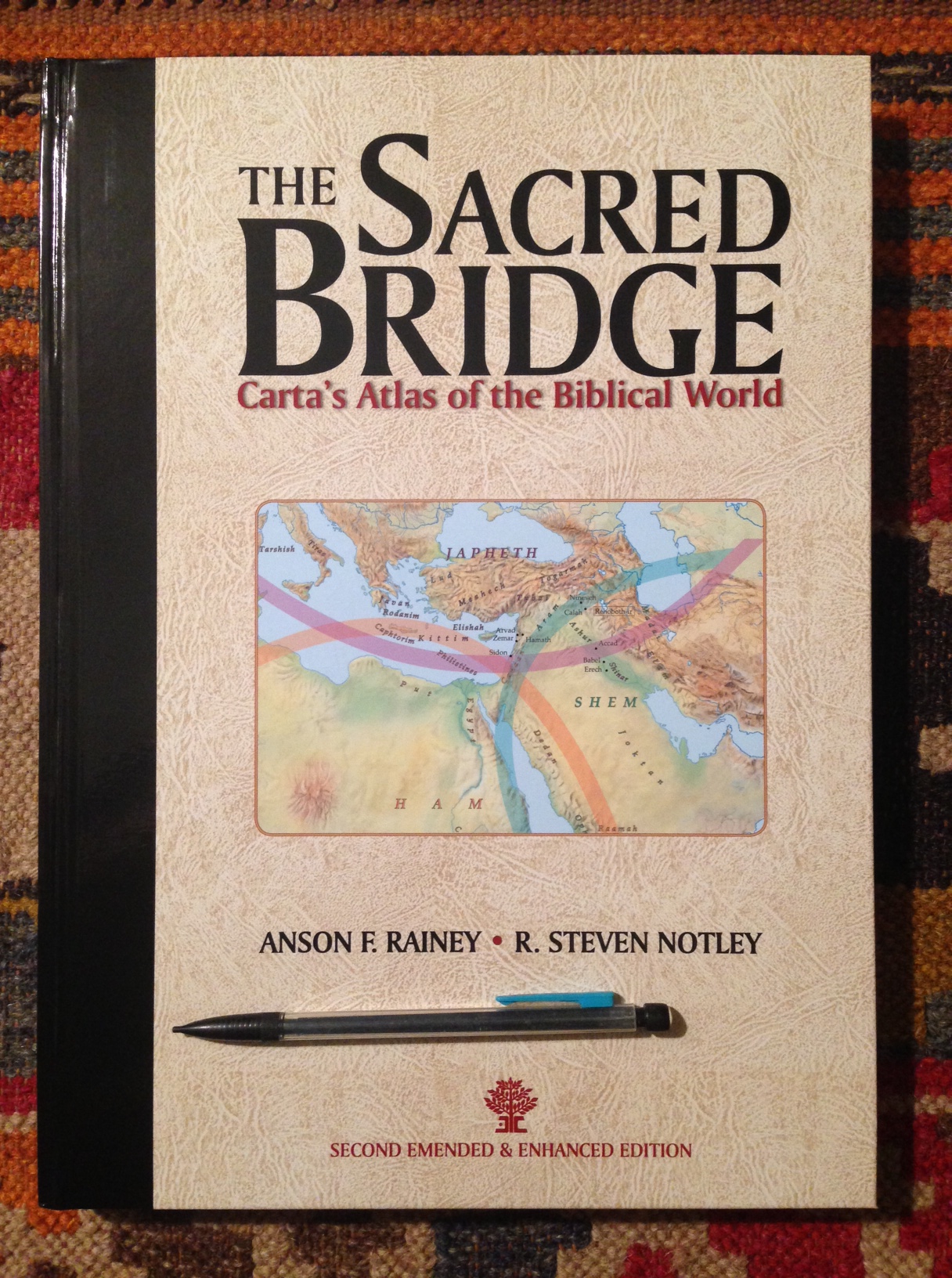
For future review I’ve received The Sacred Bridge: Carta’s Atlas of the Biblical World. This is the “Second Emended & Enhanced Edition” (copyright 2014). Here it is:
Carta Jerusalem, its publisher, describes the atlas in this way:
The Sacred Bridge will be the Bible Atlas of Record and Standard Work for the coming decades. Exhaustive in scope and rich in detail, with its comprehensive documentation of the Near Eastern Background to Biblical History, this latest Bible Atlas from Carta is one more stepping stone on the way to the study and understanding of the Holy Scriptures.
And:
This is the first Atlas to adopt the modern approach to the study of the Levant as a geographical/historical entity. Emphasis throughout the current work is on the ancient written sources – every ancient passage is interpreted firsthand, from its native language. Archaeological evidence has been taken into account whenever it is relevant.
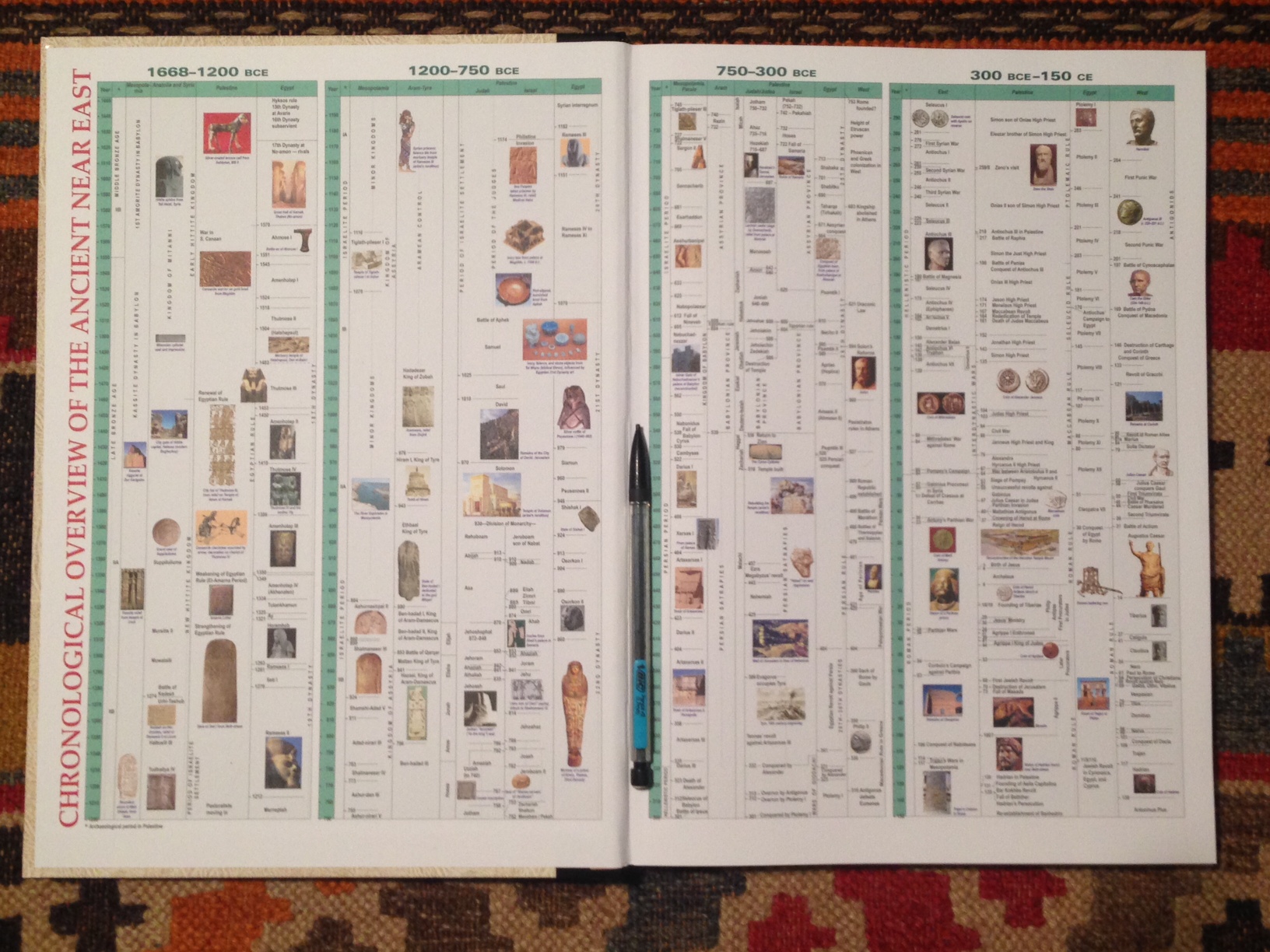
Here is what’s inside the cover. You won’t be able to see much detail in the image (click image or open in new tab for larger), but it will give you an idea of the kind of thoroughness that seems to exist throughout the atlas. And that’s before you even get to the atlas itself.
I’m looking forward to digging in. It’s a beautiful, massive atlas, with a lot of text and full-color images packed into its large pages. The binding appears to be sewn, so it will last a long time. Here’s the product page for more information. You can also find the atlas here through Eisenbrauns, its North American distributor. More to follow.












 Words on the Word
