New Mark Kozelek (Sun Kil Moon) & Jimmy LaValle (Album Leaf): STREAM

kozelek lavalle

Click here to hear a full stream of the new Mark Kozelek (Sun Kil Moon) and Jimmy LaValle album, Perils from the Sea.

I’ve been waiting for this collaboration for a quite some time. It already has one positive review. Three songs in, and the Koz’s precious nylon-string guitar is nowhere to be found.

Logos 5: Gold package, reviewed (part 2)

Logos 5

Logos 5 has been on the market for a few months now. How is it holding up?

I reviewed Logos 5 in several parts when it first came out last fall, looking especially at the Silver package. Those reviews are all compiled here.

Since then I’ve been using the Gold base package, which I began to review here. If you’re new to Logos and/or this blog, reading through the posts above all apply in review of Logos Gold. To summarize a bit, Silver and Gold base packages both have:

  • Features like Bible Facts, Passage Guide, Bible Word Study, Exegetical Guide, Sermon Starter Guide, Timeline, and more
  • Clause Search–about which I wrote more here
  • The New American Commentary set
  • The Pulpit Commentary set
  • Greek and English Apostolic Fathers
  • A new English translation of the Septuagint, The Lexham English Septuagint
  • A lot more

The Gold base package adds to Silver:

The full contents of Gold can be seen here, in comparison with the other packages.

In this concluding part of my Gold review, I want to look at some of the above features: one feature in-depth, and a couple others briefly.

Bible Sense Lexicon

Morris Proctor describes the Bible Sense Lexicon (BSL, hereafter) in this way:

The primary purpose of this feature is to present the range of possible meanings for Hebrew and Greek lemmas and then suggest precise contextual definitions for them as they appear in verses.

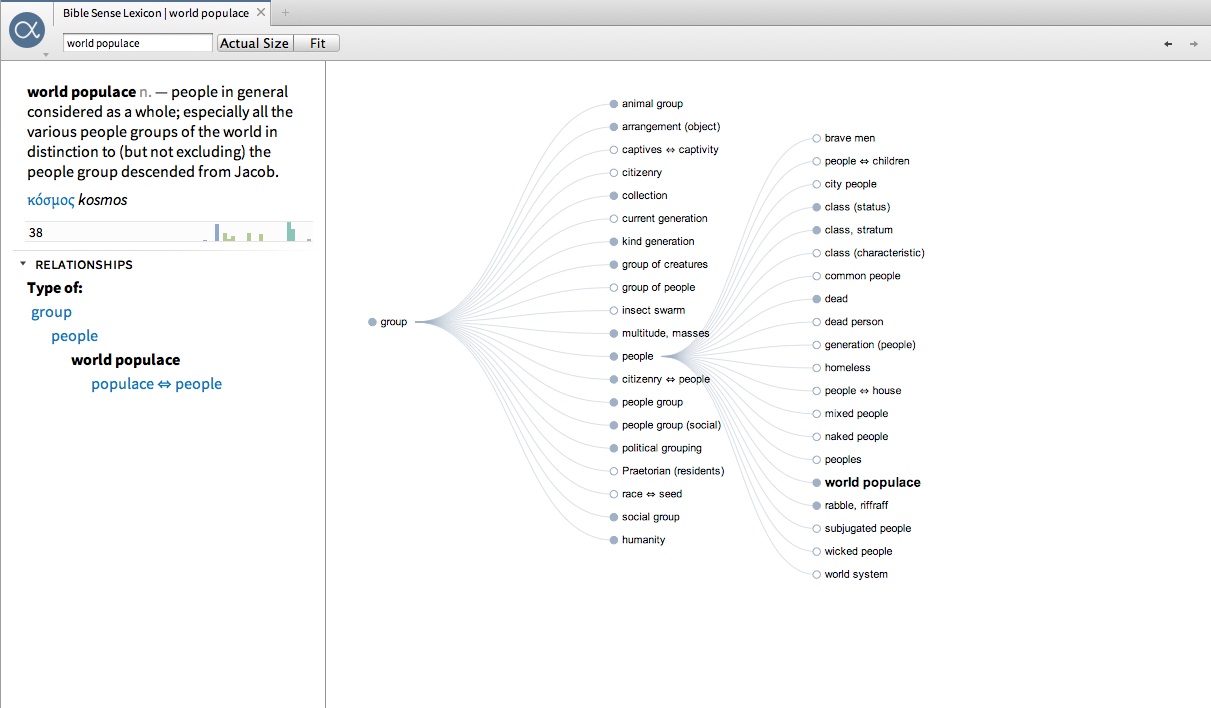
For example, the Bible Sense Lexicon shows that kosmos may have 12 different meanings, but in John 3:16 it refers to the world populace or people on the earth.

The BSL at the moment works just with nouns. There are several ways to access it. By right-clicking on kosmos (inflected as κόσμον) in John 3:16, the menu shows me that the “sense” is “world populace.” From there I can go directly to the BSL entry for this word, which gives its meaning (as determined by the team at Logos) in context. Here’s what the entry looks like (open in new tab or window to see larger):

BSL

The “sense” of kosmos is “world populace,” which is further defined at upper left: “people in general considered as a whole….” The number and bars underneath that show how that specific sense (not word) is distributed across books of the Bible. Mousing over it, one notes that “world populace” for kosmos occurs 22 times in John. The little bar graph is good for quick-reference, but it’s pretty small, and you can’t really click from it to any other information directly.

Proctor uses the image of “orchard with trees bearing branches” to describe the BSL. In this case, if you click on “group” in blue font (a “branch”), you are moved back to the “orchard” of “entity,” and its “tree” of “abstraction.” It is under entity | abstraction that the “branch” of group | people | world populace fits (to use Proctor’s analogy). As you move through various levels of the BSL in this way, the forward and back arrows at top right in the image above help you find your place.

In the branch system in the middle of the image, hovering over any word shows a pop-up with further information. Clicking on a filled-in blue circle expands the branch at that point.

One other way to use the Bible Sense Lexicon (which is properly called a “data set” in Logos) is to open it from the “Tools” menu in Logos. Doing that allows the user to look up any word, regardless of what passage may already be open. Typing in “g:kosmos” (“g” for “Greek”) shows the following 11 senses (as determined by Logos) in a drop-down menu:
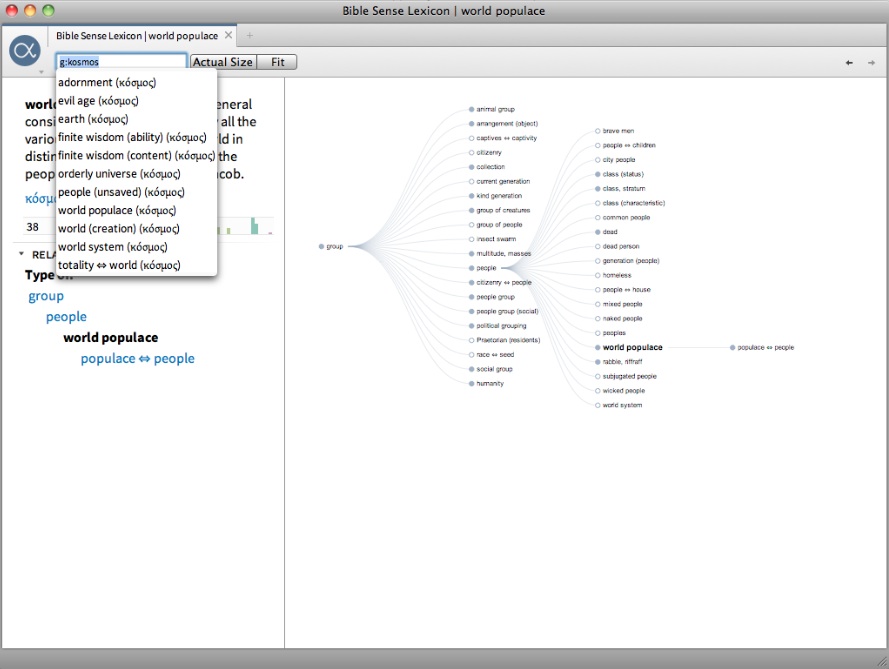
BSL_2

One could more fully explore kosmos by going through each of the senses, one-by-one.

There’s more to the BSL than what I’ve highlighted here. Watch the video at this page (and read the rest of the page’s text) for a quick but substantive overview from Logos. There is a detailed and really helpful Logos wiki page on the BSL, too.

The Bible Sense Lexicon is comparable in some ways to Louw & Nida’s Greek-English Lexicon of the New Testament Based on Semantic Domains. Context determines meaning of words, and the BSL works from that premise. There is right now no easy way to find a list of passages that use a word in the given sense you are looking at, as noted here. This and the fact that the BSL only has nouns for now are areas that need improvement. Louw & Nida, by contrast (also available in Logos), covers other parts of speech.

The Bible Sense Lexicon is available in the Gold package and up (or by using a crossgrade option).

Exegetical Summaries

Exegetical SummariesThis is a great commentary set for careful study of words, phrases, and verses. The Logos product page has this description: “The 24-volume Exegetical Summaries Series asks important exegetical and interpretive questions—phrase-by-phrase—and summarizes and organizes the content from every major Bible commentary and dozens of lexicons.”

A difficult phrase from Romans 1:17, for example, receives this treatment in the commentary (pdf), with lexical and exegetical options laid out. The pdf doesn’t show it, but in Logos the abbreviations and verses references are hyperlinked.

For sermon prep or research papers, the Exegetical Summaries Series could be a good starting point.

UBS Handbooks

UBS OTThese handbooks (OT and NT) are geared specifically toward translators, though any serious Bible student will appreciate them. The handbooks often discuss the decisions that various translations made for a given Hebrew or Greek word. A note on “Bethlehem Ephrathah” in Micah 5:2, for example, reads as follows:

Ephrathah is a term added perhaps to distinguish David’s Bethlehem from other towns or villages bearing the same name. Probably Ephrathah is a name for the district in which Bethlehem was located. It comes from the name of Ephrath, one of the clans which made up the tribe of Judah (Ruth 1:2). David’s family were members of this clan (1 Sam 17:12). It is probably best to translate Bethlehem Ephrathah as the name of the town. If this seems too long for a name in some languages, then it is all right to translate as “Bethlehem in the region (or district) of Ephrathah” (see NEB).

Whether one knows biblical languages or not, the level of detail in these verse-by-verse handbooks helps the user to more fully understand what is going on in the biblical text at any juncture.

Concluding Thoughts

My personal experience with Logos 5 (which was also true of Logos 4) is that it handles and operates more smoothly on a PC than on a Mac. More often than I’ve liked, I’ve found myself waiting for the spinning rainbow pinwheel after entering a search query or scrolling down through a resource. The speed issue is not really present on a PC, though. Having fewer tabs open on a Mac makes for fluid operation, but Logos on PC is the way to go for complex, involved operations with multiple resources open at once.

One strength Logos currently has over any other Bible software is how it syncs across computers and devices. Everything I do and save in my PC version of Logos will be right as I left it when I open it up on a Mac. Its cloud capabilities are tops.

I’ve reviewed individual resources in Logos, as well. You can find many of those by going through Words on the Word, if you are so inclined. One of Logos’s strengths is in the massive resource library it makes available. Much as I love the printed book, the convenience of accessing multiple biblical texts and commentaries from just about anywhere feels like nothing short of a 21st century luxury.

Thanks to Logos for the gratis review copy of Gold, given me with the sole expectation that I review it honestly here on my blog. Kudos are due again to MP Seminars, whose “What’s New” manual helped me more quickly apprehend the Bible Sense Lexicon.

Gary Burge’s Jesus and the Jewish Festivals, reviewed

Jesus and the Jewish Festivals

In college I thought my friend Chad was really cool (he was) for climbing on top of college buildings late at night and shouting the Shema at the top of his lungs… until he was corralled by Public Safety.

Sh’ma Yisrael: Adonai Eloheinu, Adonai echad!

I learned my first Hebrew in Gary Burge’s Christian Thought class my senior year in college. He had us reciting the Shema (Deut. 6:4-5) in no time. We’d stand and say it out loud at the beginning of class: Sh’ma Yisrael: Adonai Eloheinu, Adonai echad! (Hear, Israel: the Lord our God, the Lord is one!)

I was never quite as bold as Chad with my recitation of the Shema, but it’s stayed with me these past 11 years since taking Dr. Burge’s class.

Burge’s writing in Jesus and the Jewish Festivals is just as good as his teaching in the classroom. Burge, a Professor of New Testament at Wheaton College and Graduate School, focuses especially on the Gospel of John as he looks at Jesus and the Sabbath (ch. 2), the Passover (ch. 3), Tabernacles (ch. 4), Hannukah (ch. 5) and Jesus’ last Passover (ch. 6). Chapter 1 explores “the festivals of Judaism” more generally, while the final chapter (7) looks at what early Christians did with these Jewish festivals.

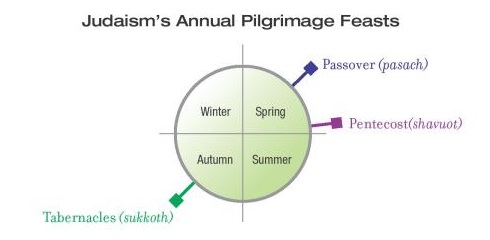
As Burge puts it, Judaism had three “great pilgrimage festivals”:

Burge_Pilgrimage Feasts

These three festivals

were based not only on the agricultural rhythms of the year, but also they served to tell the story of Israel’s salvation. Israel was rescued from Egypt (Passover, Pesach), Israel met God at Mount Sinai (Pentecost, Shavuot), and then Israel wandered in the wilderness (Tabernacles, Sukkoth). (122)

The chapters cover the original Jewish context of the festivals, Jesus’ relation to each, and then what faith looks like through the lens of that festival–both for Jews then and (especially) for Christians now.

As with other books in the Ancient Context, Ancient Faith series, Jesus and the Jewish Festivals is printed on glossy paper and full of high-quality, color illustrations. It’s like a guide book in that regard. I don’t know whether it was Burge or an editor or both, but the photographs and charts throughout the book are expertly placed and reinforce the text at just about every turn. For example, this image appears in conjunction with Burge’s description of the Passover:

Burge_Passover

As Burge recounts John 6 and the feeding of the 5,000, he notes that “Passover themes were swirling around almost every aspect of the story” (60). Further, Jesus “is the manna from God’s treasury for which Israel has been waiting. He had been sent by God as manna descended in the wilderness” (63). Then, there is always application to people of faith today: “Therefore celebrating Passover is not only knowing about what happened yesterday–though this is important–it is also about knowing the God who desires to feed us now” (65). I have always appreciated this way of approaching biblical studies with a doxological posture.

Another thing I appreciated about Jesus and the Jewish Festivals is the ease with which Burge uncovers layers of meaning in the Gospels, showing how Jesus related to the major themes of Jewish festivals. I found my own gratitude for Jesus’ sacrifice, for example, greatly enhanced by the author’s description of Jesus’ last Passover. As Burge puts it: “If we understand these festivals and their symbolism, then suddenly we understand the more profound things about Jesus and his work” (31, italics original). The color illustrations make Burge’s explanations even more vivid.

My critiques of the book are few and minor. At times there is what seems to be just a wee bit of speculation on the part of the author as he explores symbolism in John. For example, he says, “But I am convinced that Jesus wanted to die during the Festival of Passover because of the profound meaning it would convey with regard to his sacrifice” (102). Burge doesn’t further elaborate, and this seems a difficult (though not impossible) claim to support.

Jesus and the Jewish Festivals would be aided by a Scripture and subject index at the back of the book. I also found myself wanting more explanation of the Jewish calendar. Page 26 has a nice figure that shows all the months of the calendar of Judaism (together with various festivals noted), but a little more about its construction would have even further undergirded Burge’s tour of the festivals.

I really enjoyed reading Jesus and the Jewish Festivals. Not only did I find my knowledge and understanding of the Jewish festivals refreshed and expanded; I also grew in my appreciation of Jesus and his work due to the connections Burge made. This seems to have been an intention of this book, and in this regard, it is quite successful. Anyone who wants to better grasp Jesus’ words and work in the Gospels, whether pastor or parishioner, scholar or student, would do well to work her or his way through Burge’s short volume.

Thanks to Zondervan for the review copy. Jesus and the Jewish Festivals is on Amazon here. Its product page is at Zondervan’s site here.

Review of IVP’s Dictionary of the Old Testament: Pentateuch (final part 3)

IVP OT Dictionary Pentateuch

I’ve been spending some time the last few weeks with InterVarsity Press’s Dictionary of the Old Testament: Pentateuch in Logos Bible Software. You can read part 1 of my review here and part 2 here; those help provide context for this third and final part to the review.

In this post I summarize and briefly interact with three more articles: “Warfare,” “Book of Genesis,” and “Haran.” Then I offer my concluding thoughts.

Warfare

A.C. Emery’s article explores “the conduct of warfare found in the Pentateuch, as well as instructions provided for the waging of warfare in Israel” (877). He notes, “Conflict is a common event recorded within the OT” (877), even if the student of ancient warfare tactics may not find much in the Pentateuch. To wit: “With rare exception the battle is described more for the divine intervention than for its technical conduct, which is the particular interest of this article” (878-9). God himself is described “as a warrior” (877) in the Pentateuch.

Emery looks at common Hebrew words that the Pentateuch uses to describe warfare and battles, with qārab (“draw near”) being the most common. He explores Pentateuchal “battle accounts” (879), from Abraham in Genesis 14 to Amalek in Exodus 17 and the “Canaanite king of Arad” and Og, king of Bashan, in Numbers 21-25 (879-80). There are “various instructions with regard to activities related to warfare” (880), including “the need to be… emotionally and religiously prepared for the dangers of combat” and the mechanics of negotiations and siege warfare (880). Emery’s final section examines the ethical difficulty that warfare poses.

Surprisingly, Emery does not in his ethics section mention the difficult Deuteronomy 7:2 with its “show them no mercy” command. He also has an article in the dictionary (“ḤĒREM”) that covers that passage, but his treatment of warfare ethics in “Warfare” was briefer than I would have liked. But, as with the rest of the dictionary, the few-page article still offers a decent jumping-off point for further research, even if it’s not a one-stop shop.

Book of Genesis

The entry on the book of Genesis examines the book with special reference to structure, plot, and theology (350). L.A. Turner’s key assumption is: “Genesis is a narrative book, and its theology is conveyed through features such as its structure, plot and characterization, rather than through set pieces of divine promulgation, as in legal or prophetic texts” (356).

Regarding structure, though there are varying theories, most agree that “Genesis is composed of two distinct blocks of unequal size” (350). The first runs roughly through Genesis 11 or the first few verses of Genesis 12 and is about humanity generally. Genesis 12 onward picks up the story of Abraham. The “main sections” in Genesis, according to Turner, are “the Abraham story (Gen 11:27–25:18), the Jacob story (Gen 25:19–37:1) and the story of Jacob’s family (Gen 37:2–50:26)” (350). The Hebrew word tôlĕdôt (genealogy) is a structural marker throughout Genesis.

The plot of Genesis has “progressive complexity” (352), moving from early human history to complex characters and families by the end of the book. “Divine promises and blessings” constitute “the book’s central core” (353) for Turner, and set the stage for the rest of the Bible (358). Regarding theology, he notes the tension “between divine sovereignty (as exemplified in the genealogies) and human free will (as demonstrated in the narratives)” (357).

I wanted to be sure to review a longer article in the dictionary. I was unexpectedly riveted as Turner walked through Genesis (10 pages in print). I found his contention that the book’s structure has theological import to be particularly compelling.

Haran

“Haran” in English could refer either to a place or to a person, though the spelling is different between each word in Hebrew (379). Both the place and the person are in Genesis 11:27-32, so M.W. Chavalas treats them together (379).

Haran the place is where Abraham lived after leaving Ur and before departing for Canaan (379). He also sought a wife for Isaac there, and Jacob found Rachel and Leah there, too. Similar to Ur, Haran centered on lunar worship. Haran is located in what today is southeastern Turkey. There is “only a small amount of archaeological evidence…for the city, and even less for patriarchal times” (379). It seems to have been inhabited already well before Abraham’s time, perhaps by some 20,000 people (379). Chavalas notes its likely founding “as a merchant outpost by the Sumerian city of Ur in the late third millennium B.C.” (379).

Haran the person has “very little biblical or extrabiblical information” recorded about him. He was Terah’s son, Lot’s father, and Abram’s brother. It was Haran’s death at Ur that led Lot to go to Haran with Abram. Haran also had two daughters, Iscah and Milcah.

The more I research Abraham and the Pentateuch, the more I realize how important Lot was to him. His desire to bear a family perhaps through Lot seems to be what led to his rescue of Lot in Genesis 14.  Several dictionary articles point this out nicely. Chavalas covers Haran fairly thoroughly in a short amount of space (just two or three print pages).

**********

I hope Logos will update the dictionary so that the sidebar Table of Contents can expand to include all the article sub-points. Another thing that would make the product better is an easier way to find out about contributors from within an article. Having their names hyperlinked with their biographical information would be nice. As it is, one has to move between the article and the separate “Contributors” section to find out more about each author. [EDIT: Author names have hyperlinks in the Accordance production of this module.]

The Logos edition of the IVP Dictionary of the Old Testament: Pentateuch is overall a good module. Being able to have it open to both Hebrew and English biblical texts saves considerable time compared to using the print edition. The Dictionary is a solid first place to go on issues, themes, and people in the Pentateuch.

The Dictionary is on Amazon here (in print) and at Logos here. My thanks to Logos for the review copy.  Read part 1 of my review here and part 2 here.

The Handy Guide to New Testament Greek, reviewed

Handy Guide to GNT

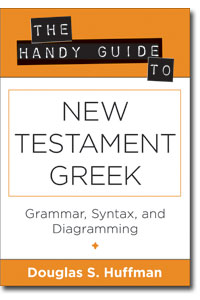
Recently my Greek reading has improved due to spending regular time refreshing my memory on verb paradigms, rules of syntax, and so on. The tool I’ve been using is Douglas S. Huffman’s Handy Guide to New Testament Greek (Kregel, 2012). Huffman’s Handy Guide consists of three parts:

  1. Grammar (“Greek Grammar Reminder: With Enough English to Be Manageable”)
  2. Syntax (“Greek Syntax Summaries: With a Few Helps to Be Memorable”)
  3. Diagramming (“Phrase Diagramming: With Enough Results to Be Motivating”)

“A Select Bibliography” concludes the guide and points beginning, intermediate, and advanced Greek readers to grammar texts, reading resources, diagramming helps, and more.

Handy Guide to New Testament Greek joins a number of similar little books already on the market for reviewing and retaining Koine Greek. There is Biblical Greek: A Compact Guide, a helpful and portable distillation of Mounce’s popular grammar. One might also consider Dale Russell Bowne’s Paradigms and Principal Parts for the Greek New Testament, Paul Fullmer and Robert H. Smith’s Greek at a Glance, and even the back of Kubo’s Reader’s Lexicon for its solid summary of Greek grammar with paradigm charts.

How does Huffman’s offering differ? Unlike Paradigms and Principal Parts or Greek at a Glance, the Handy Guide consists of more than simply verb paradigms or noun declension charts. It includes those, but with accompanying explanation along the way. In this regard it is similar to Mounce’s Compact Guide.

Different from Mounce, however, is the lack of any vocabulary-related helps in Huffman. It’s hard to imagine someone wanting a “handy guide” to “New Testament Greek” who doesn’t also want some treatment of vocabulary, which Mounce’s guide accomplishes nicely with its included brief lexicon. Huffman does include information about how words are formed, in his chart on comparative and superlative adjectives, for example:

Huffman Guide sample

But vocabulary is otherwise absent from the guide.

Part 1, “Greek Grammar Reminder,” covers everything from accents and breathing marks to nouns, adjectives, adverbs, and verb declensions. (Verb paradigm charts take up the majority of part 1.)

Huffman’s “Verb Usage Guide” (from part 2) contains a refreshing amount of detail on Greek verbs for such a short guide. For example, he lists 20 categories of participles followed by a “Participle Usage Identification Guide” to help readers of Greek texts determine what kind of participle is at hand. Part 2 also explains noun case usage. His explanations of nominative, genitive, dative, accusative, and vocative cases are short, clear, and include plenty of examples with Scripture references.

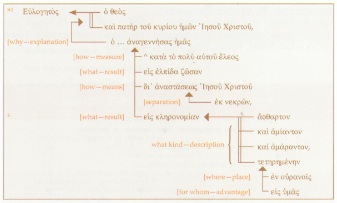
Where Huffman is really unique (and what makes this guide desirable especially for a second-year Greek student or pastor) is in his part 3 on diagramming. He briefly treats “technical diagramming” (the kind some of us had to do for English in 5th grade–showing syntactical relationships at the word level) and arcing, then moves into a rich, 22-page description of “phrase diagramming,” which looks like this:

Huffman, p. 103 (1 Peter 1:3-4)

The goal of this kind of diagramming is “to grasp the writer’s general flow of thought and argument, which he has expressed in particular words and sentences” (85). Huffman’s eight steps to phrase diagramming explain the process so that even a beginner can understand it well. His “Special & Problem Issues” section is the icing on the cake of part 3.

The guide is truly “handy”; it fits nicely together with a Greek New Testament, so one can keep it close at hand. The color-coding in the paradigms is done well, so that verb endings stand out for an easy refresher course.

An unfortunate and fairly noticeable drawback to this guide, in my view, is in the layout and color scheme. The orange theme, as attractive as it looks on the cover (pictured above), gets to be an eyesore after looking at more than a page or two. It’s too bright to read comfortably, and there are charts with at least four different shades of orange.

When there is Greek in black font (in grammatical category explanations), it looks great. But the Greek in the charts in orange has a fuzzy or slightly blurry, pixelated appearance. There are also quite a few charts that are in landscape orientation (rather than the default portrait orientation), so that the reader has to flip the book sideways. That alone would not be a huge deal, but the orange was distracting to me.

Hopefully there will be demand for future printings, and hopefully future printings will make the layout and fonts more useable. And despite the omission of vocabulary, this guide has great content. Resources on sentence and phrase diagramming for Greek are few and far between, but Huffman’s guide covers that territory well, and having that coupled with quick-reference charts will help just about anyone seeking to retain and improve their biblical Greek.

Kregel sent me a copy of the book for review. Its product page is here, and it’s on Amazon here. The Table of Contents are here (pdf); read an excerpt here (pdf).

(Part 2) Review of IVP’s Dictionary of the Old Testament: Pentateuch

IVP OT Dictionary Pentateuch

Sarah, Melchizedek, and the language of the Pentateuch. Last week I reviewed the articles on each of those topics in InterVarsity Press’s Dictionary of the Old Testament: Pentateuch in Logos Bible Software.

Here’s what the IVP page says about the dictionary in its book description:

The Dictionary of the Old Testament: Pentateuch is the first in a four-volume series covering the text of the Old Testament. Following in the tradition of the four award-winning IVP dictionaries focused on the New Testament and its background, this encyclopedic work is characterized by close attention to the text of the Old Testament and the ongoing conversation of contemporary scholarship. In exploring the major themes and issues of the Pentateuch, editors T. Desmond Alexander and David W.Baker, with an international and expert group of scholars, inform and challenge through authoritative overviews, detailed examinations and new insights from the world of the ancient Near East.

My first review contains an initial evaluation of the dictionary specifically in Logos Bible Software; you can read that here. In this post I summarize and briefly interact with three more articles: “Terah,” “Lot,” and “Ur.”

Terah

Terah was Abram’s father and Lot’s grandfather. He also fathered Nahor and Haran. M.W. Chavalas notes that Terah was “the family head,” since “all of the material in Genesis 11:27-25:11 is prefaced by the statement, ‘This is the family history of Terah’” (829). Chavalas considers Terah in three parts: the etymology of his name, his time in the city of Ur, and “Terah and Later Traditions.”

Chavalas considers several options for the meaning and linguistic source of “Terah,” but concludes, “An understanding of the etymology of the name Terah has proved to be difficult” (829). It does seem to have “associations with a place name in northern Mesopotamia” (830) and perhaps some associations with lunar worship (though perhaps not). Similarly, Ur, from which Terah comes, has been difficult to pinpoint. Chavalas places it in southern Mesopotamia. Chavalas finally considers the challenge that Acts 7:4 and Philo pose regarding chronology and location.

Chavalas manages to cover most of the essential territory on Terah in a short space. There is not much biblical material on Terah, but this article contains an overview of it all. There is little content in the “Terah and Later Traditions” section, and the article’s bibliography does not point to more resources to explore Abram’s father, for example, in rabbinical tradition. Detailed research on Terah would have to be supplemented with other resources.

Lot

Lot was Terah’s grandson and Abram’s nephew. J.I. Lawlor notes that Lot traveled with his grandfather Terah from Ur to Haran because his own father has died (556).

Lawlor primarily takes a literary and narrative approach to understanding Lot’s place in the Abram/Abraham material. He notes “two ‘paired sets’” of Lot material that “have been integrated, one set in each half of the Abraham story” (556). The author/compiler of Genesis does this, Lawlor notes, to “suggest and hold open the possibility of Lot as Abraham’s heir” (556), later dismissing the possibility as Isaac becomes heir (557).

Genesis 14:17-24 marks Abram’s encounter with Melchizedek, occasioned because Abram had gone to battle due to the Mesopotamian kings’ kidnapping of Lot. Abram rescued Lot in Gen. 14, then rescued him again, in a way, by interceding on behalf of Sodom and Gomorrah in Gen. 18-19 (557-8).

Due to an incestuous drunken encounter with his daughters, Lot gave rise to two groups of people, the Moabites and Ammonites, which Lawlor briefly discusses.

Lawlor’s most helpful contribution is in his situating of Lot in the larger flow of Genesis 12-19, where Lot serves as a possible answer to the question, Who will be an heir to Abram and Sarai? His reading of the “two paired sets” of Lot material is illuminating.

Ur

Like Chavalas in the “Terah” article, Osborne locates Ur in southern Mesopotamia as one of its “oldest and most famous” cities (875). Today the two-millenia old city of Ur is “modern Tell al-Muqayyar, located on the Euphrates in southern Mesopotamia” (875). Osborne looks at the archaeology of Ur as well as its place in patriarchal times.

Based on an early 20th century exploration of the tell (hill/remains) where Ur once was, archaeologists think that Ur was “not…one of the most extensive cities of its time” (875), with a population of just under 25,000. Ur was a center of lunar worship in Mesopotamia, as was Haran, where Terah would go from Ur (875). Tomb excavations have shown a wealthy city, which “was most probably derived from its lucrative involvement in trade along the Gulf” (876). Osborne also explores the debate over the birthplace of Abraham, whether it was northern or southern Mesopotamia (he favors the latter). He notes that the Genesis text does not say why Terah and his family left Ur.

Archaeology is not my primary interest within biblical studies, but Osborne introduces the basic archaeological finds to the reader in a short space, and does a good job of it. The bibliography at the end of the article offers titles for further reading.

**********

My impression of the dictionary continues to be positive. At the same time it is becoming clear to me that it is not comprehensive in the subjects it treats. So researchers, exegetes, writers, and teachers will want to consider using it alongside other resources. However, its ability to summarize much detail in a succinct way is a strong point of the dictionary.

I’ll do at least one other installment in my review of Dictionary of the Old Testament: Pentateuch, and include some concluding thoughts there. See the first part of my review here.

The Dictionary is on Amazon here (in print) and at Logos here. My thanks to Logos for the review copy.

Review of IVP’s Dictionary of the Old Testament: Pentateuch (Logos edition)

IVP OT Dictionary Pentateuch

Over the next few weeks I’ll be reviewing IVP’s Dictionary of the Old Testament: Pentateuch in Logos Bible Software. I’ll look at a few dictionary articles in each post, commenting on the content of each, as well as on the dictionary’s presentation in Logos.

I’ve reviewed Logos 4 and 5, looking at several packages and additional resources. Find those reviews collected here.

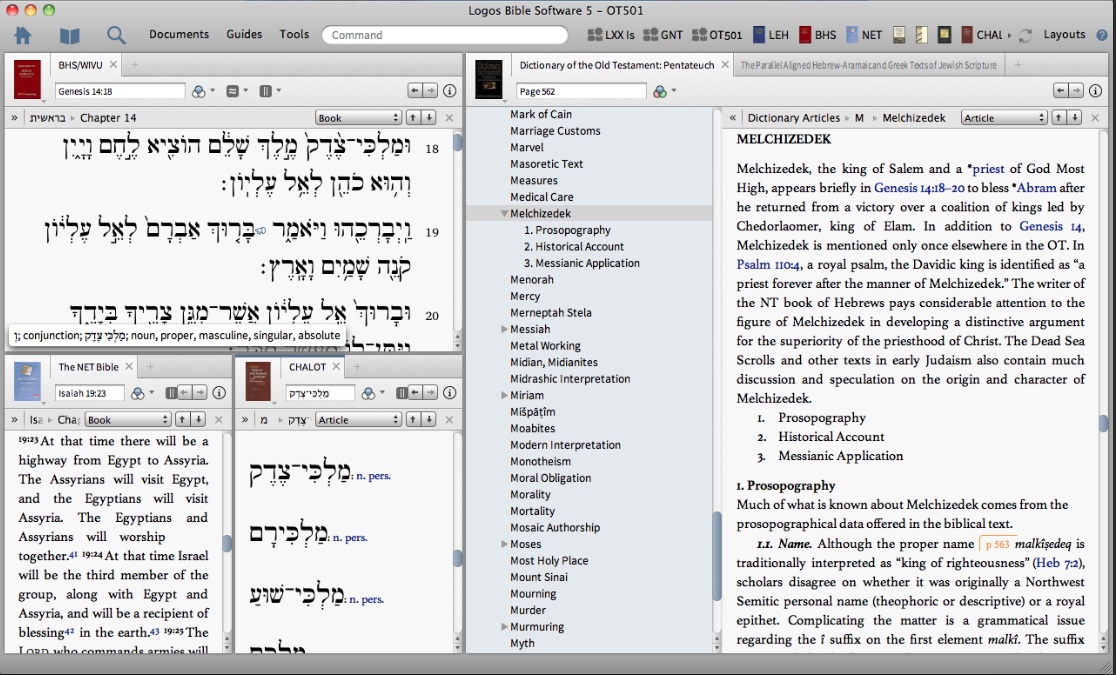
The dictionary is easy to lay out in Logos with other accompanying resources. Here I have it next to the Hebrew text with English translation and a Hebrew lexicon (click to enlarge):

IVP OT Dictionary Logos

As with all of Logos’s resources, you can hover over hyperlinked words (see “Heb 7:2” above) to see the Scripture without leaving that tab.

One solid feature so far (true of Logos resources in general): being able to use the shortcut command (Mac) or control (PC) + F to quickly find words in the entries.

One thing to critique so far: the items in the Table of Contents don’t expand to all the subpoints. In the shot above, for example, you can see that “1. Prosopography” under Melchizedek has “1.1. Name” in the entry, but not in the left sidebar Table of Contents. This makes navigating through multiple layers of detail a bit more cumbersome. (By contrast, the Accordance version of this module looks like it has the triangle that continues to expand, here.)

What about content of the dictionary itself? In this installment, I summarize and review three articles: “Sarah,” “Melchizedek,” and “Language of the Pentateuch.”

Sarah

R.G. Branch notes that Sarah and other “matriarchs of God’s people” are “equally significant” compared to the “widely recognized Israelite patriarchs” (733). Chief among these is Sarah. Even if there is not the amount of biblical material about Sarah that there is about Abraham, she remains a “pivotal character” in Genesis (733).

Branch divides the “Sarah” entry into two parts: “Sarah in the Ancestral Narratives” and “Sarah in the Later Tradition.”

In the first part Branch notes that Sarah, about 10 years younger than Abraham, is “the first matriarch of the biblical text” (733). Her childlessness in Genesis 11:30 is a key characteristic. Her first mention in that passage describes her barrenness, which “sets the tone for the stories about them that follow” (733). Sarai and Sarah (her name after God changed it in Genesis 17) both mean “princess” or “chieftainess.” Genesis records several threats to the possibility of Abraham and Sarah bearing offspring, not the least of which is two stories (in Genesis 12 and 20, which Branch understands as two separate incidents) of “marital deception,” where Abraham claims Sarah as his sister (734).

“In both cases,” Branch notes, “Abram feared for his life because of his wife’s great beauty” (734). It is this beauty that is the focus of the second part of the article, “Sarah in Later Tradition.” Branch cites various Jewish sources that extol Sarah for her immense beauty. She is also said to have been “surrounded” by miracles (735).

Branch gives a good, basic summary of biblical and Jewish rabbinic material about Sarah (as well as her importance for understanding Elizabeth in the New Testament), with citations that the reader can follow up for more.

Key statement from this article is: “Many of the issues in the stories about the couple can be understood as their struggle to come to terms with God’s promises of land, offspring, greatness and blessings” (734).

Melchizedek

Scripture contains very few references to the mysterious figure of Melchizedek. S.J. Andrews recounts Abram’s encounter with Melchizedek in Genesis 14:18-20, which Psalm 110 (noted as a “royal Psalm”) cites. Andrews also does well in noting the book of Hebrews’ understanding and interpretation of Melchizedek.

In “Prosopography” Andrews notes the complications that arise in trying to understand the name malkîṣedeq. Hebrews reads it as “king of righteousness,” but Andrews notes scholarly disagreement on “whether it was originally a Northwest Semitic personal name (theophoric or descriptive) or a royal epithet” (563). Therefore, “The name could mean either ‘(my) Malk/Melek is just’ or ‘Ṣedeq is my king’” (563). Either way, Genesis calls him “king of Salem,” which could be Jerusalem, or just mean, “king of peace,” as in Hebrews 7:2.

The “Historical Account” section of the article delves more into the story of Abram’s victory of kings and subsequent exchange with Melchizedek, where the latter gives the former bread and wine and a blessing, and the former appears to tithe to the latter.

In the final section, “Messianic Application,” Andrews explores various possibilities for the appearance of Melchizedek, what it meant, possible connection to a Messiah, and so on.

Andrews says, “The Qumran text 11QMelch portrays Melchizedek as an archangelic figure like Michael” (564), but he could have perhaps gone into more depth about the Qumran understanding of Melchizedek. However, his basic overview serves as a solid starting point for understanding the Melchizedek figure in biblical tradition.

Language of the Pentateuch

R.S. Hess’s “Language of the Pentateuch” article consist of three sections: “A discussion of the history of languages in and around Palestine during the third and second millennia b.c., a consideration of the grammar and style of the Pentateuch’s language in comparison with Classical Hebrew, and a study of those linguistic elements within the Pentateuch that might relate it to the period in which the narratives and events recorded in Genesis through Deuteronomy claim to have taken place” (491).

He offers a survey of Pentateuchal chronology, marking the date of the exodus as “sometime between the fifteenth century b.c and the end of the thirteenth century b.c.” (492), part of the Late Bronze Age. The Hebrew language is part of a family of West or Northwest Semitic dialects. There are not immense differences between the language of the Pentateuch and the language of (presumably) later Old Testament texts, but Hess does point out research around some “distinctive elements found in the Pentateuch that might set it apart from the grammar of the remainder of biblical Hebrew” (493), though these are few. Hess holds to an “early date” for at least the initial writing of the Pentateuch.

This particular article was a bit dry at times, but the level of detail is still to be appreciated.

So far my overall impression of the dictionary is positive. I will write more about it later. UPDATE: Part 2 is here.

The Dictionary is on Amazon here (in print) and at Logos here. My thanks to Logos for the review copy.

Five Kids’ Magazines We Enjoy

Here are five children’s magazines we particularly enjoy reading to our two-year-old and five-year-old:

High Five

5. High Five

“My First Hidden Pictures” and “That’s Silly!” are two favorite features of the magazine. It says it’s for ages 2 to 6, but it’s hard to imagine any two-year-old tracking with it. Better for slightly older kids.

Ranger Rick Jr

4. Ranger Rick, Jr.

It comes from the National Wildlife Federation. Given our five-year-old’s penchant for all things animal kingdom, this one is a hit. Today we learned from the April 2013 issue that giant tortoises can live to be 150 years old. Whoa.

ladybug

3. Ladybug

From the Cricket Magazine Group, Ladybug is the next age level up from Babybug (see below). Max and Kate are a fun ongoing storyline each month. Our five-year-old transitioned to this a year or more ago when he was getting too old for Babybug.

click magazine

2. Click

The awesomeness of this magazine caught us all unaware–I’d never heard of it before a grandparent-sponsored subscription began arriving in the mail. The March 2013 issue theme is “The deep blue sea.” Our five-year-old did the “make a fish” project on his own right away, with some scissors and glue. The magazine’s “Ocean Zones” section this month introduced us to the sunlight zone, the twilight zone, and the midnight zone, each of which support interesting and diverse kinds of life.

I just found out that Click is part of the same family as Ladybug and as…

babybug

1. Babybug

Babybug is really sweet. It is “for babies who love to be read to and for the adults who love to read to them.” (It’s good for toddlers, too.) Kim and Carrots is a favorite each month, and always seems to be appropriately themed for the time of year. Simple yet engaging illustrations go with memorable and fun-to-read poetry. No part of the magazine is more than three pages, so not a long attention span is required. It’s not uncommon for us to ask our two-year-old to pick some books to read, and for him to come to us with three Babybugs.

(It’s also not uncommon for me to walk in to the living room from the back of the house and see my five-year-old curled up on the couch with a New Yorker.)

How about any of you who regularly read to children? What magazines do you recommend?

Review of Basics of Biblical Hebrew: Video Lectures

Miles Van Pelt keeps turning out the hits. Through Zondervan he has published resources that fill a gap in original language learning in biblical studies. I’ve reviewed (with approval) his Biblical Hebrew: A Compact Guide, his Basics of Biblical Aramaic, and have been grateful in my Göttingen Septuagint primer to link to a short two-page abbreviations sheet he produced for that critical edition of the Septuagint.

This fall Zondervan released Basics of Biblical Hebrew: Video Lectures.

The DVDs work “chapter by chapter, section by section” through Pratico and Van Pelt’s Basics of Biblical Hebrew grammar textbook. The videos are “the basic content in lecture form for the grammar.” Here’s how Van Pelt recommends using the DVDs:

  1. Read the chapter of Basics for Biblical Hebrew “for simple content overview.”
  2. Watch the lectures.
  3. Go back to the printed chapter and memorize the relevant information (vocabulary, paradigms, charts, grammar).
  4. Complete the workbook exercises.
  5. Check your answers.

Each DVD chapter corresponds to a chapter in the textbook. The DVDs come with a pdf file that includes summary charts. Throughout the lectures Van Pelt refers to these charts and the screen moves to them as he is speaking.

There is nothing particularly novel or revolutionary in the videos that is not already covered to some degree in the textbook. But especially for a student who is making her or his way through the book alone, the video lectures serve to reinforce the material in a new medium. Even a student taking a course with a live lecturer could benefit from watching these alongside the class.

Van Pelt is a solid lecturer. If not overly exciting, he communicates concepts clearly. For just about anyone making their way through the grammar, it will be easy to follow these lectures.

He offers good study tips in the introduction, and continues to encourage learners throughout the 36 lectures. My favorite tip: “Begin reading your Hebrew Bible as soon as possible,” and, “Take that Bible with you everywhere.” I remember that often in my first year of Hebrew (I used the Van Pelt and Pratico text), I wanted to just be able to read the Hebrew Bible. There are examples throughout the grammar from the Bible, but learning charts and paradigms first can be tedious. This is perhaps a necessary tedium.

Or is it? Some people disagree that paradigm memorization outside the context of a text or conversation is ideal pedagogy for language learning. (Look at how babies acquire language, after all, the argument goes–by hearing, talking, etc., not by memorizing grammatical rules.) Even dead or ancient languages should be taught as “living languages,” proponents say. So some Hebrew textbooks encourage instead a text-based inductive approach.

Van Pelt at one point in the lectures says, “Languages are meant to be accessed and decoded in your mind,” though “decoding” is something a language learner ought to try to move away from as quickly as possible, as she or he seeks fluency. And an early strong verb paradigm has Van Pelt saying, “You must memorize this paradigm, like a ROBOT!”

Hebrew and other languages have been taught this way for a long time, and some language learners may not mind it. I, for example, find paradigm memorization tedious, but not overly difficult. If I have an end goal firmly in mind–reading the Hebrew Bible–I have motivation to repeatedly go over verb conjugations.

But I don’t think this approach will work for everyone, and the potential viewer of these videos should understand that Van Pelt takes a paradigm-memorizing approach to learning Hebrew, with not much inductive learning or interaction with the biblical text. (I think of my high school Spanish teacher, who would not answer classroom questions asked in English, but would simply say, “¡En Español, por favor!”)

Van Pelt and Pratico’s materials use verbal diagnostics. Paradigm charts show in red what the unique prefixes and suffixes and vowels are for each verbal stem, so that it is not just rote memorization of multiple verbs. The diagnostics are a time-saving feature in this sense. As here:

Diagnostics

For those interested in verbal theory, Van Pelt uses perfect (“completed action”) and imperfect (“incomplete action”) nomenclature to describe verbs.

The lectures are well-produced and alternate between views of charts like the one above, real-time writing (like a dry-erase board), and Van Pelt speaking. The clarity of the lectures is a strong point, as they reinforce the material in the textbook well.

If a student is already assigned the Pratico and Van Pelt text, he or she should seriously consider using the lectures as an additional study aid, if one is needed. If a student or professor has a choice as to which text to use for learning Hebrew, though, it is worth considering (either in addition or instead) other “living language”/inductive approaches. Randall Buth’s Living Biblical Hebrew or John H. Dobson’s Learn Biblical Hebrew are two possible texts.

Chapter 1 of the lectures is here, if you want to get a flavor of the lectures (it’s just over an hour):

Thanks to Zondervan for the review copy. You can find the Basics of Biblical Hebrew Video Lectures here at Amazon. The Zondervan product page is here.

New Phoenix Single (STREAM): Entertainment

phoenix bankrupt

It’s been a long time since the last Phoenix record, but today they premiered their new single, Entertainment:

This follows on a tantalizing one minute clip from the new album:

I love the one minute clip; still making my mind up about the single. But I can’t wait for this record to come out in April.