Christian Apologetics: free book giveaway

One good giveaway deserves another.

The other day I noted that Zondervan has just put out a primary source compendium called Christian Apologetics: An Anthology of Primary Sources, edited by Khaldoun A. Sweis and Chad V. Meister.

I have an extra copy to give away (not my review copy). It’s a good resource to have on the shelf, and I know I’ll be turning to it in the future for the work and ministry I do in a college setting.

I reviewed the book here.

I will choose a winner at random. To enter the drawing, simply comment on this blog post with your greetings, thoughts about apologetics, favorite philosopher/theologian, etc. I will accept entries through Monday afternoon, with 3pm EST being the cutoff.

Then if you link to this post on your Facebook, Twitter, blog, etc., come back here to tell me in the comments section that you did, and you’ll receive a second entry. I will announce the winner just before 5pm EST Monday.

Christian Apologetics: a review

I still remember, as a 16-year-old, sitting down at my parents’ computer, hearing the dial tone, and logging on to AOL. I would do this often, not just to check the new technological miracle known as e-mail, but also to go into chat rooms (remember those?) and seek to share my faith with others online.

I made similar efforts at my high school, starting conversations when appropriate and generally just trying to be ready to speak intelligently and compellingly about my Christian faith.

This handbook by Peter Kreeft was a constant reference guide for me. I went on to major in philosophy at a Christian undergraduate school, where I took, among others, classes on the philosophy of religion, St. Augustine, and more. Readings in the Philosophy of Religion became a new resource to which I often turned. I had begun having philosophical and existential questions of my own by that point, ones that I experienced on a profound and at times troubling level.

I’ve always had an interest in the intellectual underpinnings of my Christian faith. And I’ve often been aware that what appear to be intellectual questions or questions of “the head,” are sometimes–when one digs deeper–questions of “the heart,” as well. Since college days, then, I’ve been a bit more cautious than I was as a 16-year-old in an AOL chat room about just how effective “apologetics” can be.

Zondervan has just put out a primary source compendium called Christian Apologetics: An Anthology of Primary Sources, edited by Khaldoun A. Sweis and Chad V. Meister.

There are 54 selections divided into 11 parts, which you can see listed here (PDF) in the table of contents. Christian Apologetics begins with some methodological considerations in part 1, then moves right into various arguments for the existence of God–cosmological, teleological, ontological, moral, the argument from religious experience, and so on. From there the book narrows to more specific topics like the Trinity, the incarnation, miracles, the resurrection, the problem of evil, and more.

Christian Apologetics claims to be “a sampling of some of the best works written by Christian apologists throughout the centuries,” offering “a snapshot of Christian apologetics at its best across the spectrum of time and culture.”

The essays in this volume certainly are some of the best in apologetics. There is Paul at the Areopagus in Acts 17, Aquinas on the cosmological argument for God’s existence, Anselm and Plantinga with the ontological argument for God, Pascal’s wager, Teresa of Avila on experiencing God, Anselm on the incarnation, Swinburne on miracles, John Hick’s “Soul Making Theodicy,” Augustine on free will, and Marilyn McCord Adams on horrendous evil and the goodness of God. Each of these essays is a classic and makes a valuable contribution to the area of apologetics.

The book spans “the spectrum of time” fairly well, with a higher concentration of 20th century writers. Just a couple of the contributors are women, and the overwhelming majority hail from Western contexts–this latter an admission of the book, but a weakness all the same.

A particularly pleasant surprise to me was the inclusion of an an article by R.T. France, in which he makes the case for the historical reliability of the Gospels, which must, he argues, be understood in their proper literary context as “highly selective” records of Jesus’ life with “only a loose chronological framework.” This is not due to deficiency of the Gospels; rather, it is how the Gospel writers intended to write:

The four canonical gospels will not answer all the questions we would like to ask about the founder of Christianity; but, sensitively interpreted, they do give us a rounded portrait of a Jesus who is sufficiently integrated into what we know of first-century Jewish culture to carry historical conviction, but at the same time sufficiently remarkable and distinctive to account for the growth of a new and potentially world-wide religious movement out of his life and teaching.

As I read I appreciated a statement in the book’s general introduction:

But arguments and evidences do not of themselves bring someone into new life in Christ. Here the work of the Holy Spirit is central, and we must be willing to surrender to his leading and his truth and his goodness if we are to truly dwell with the Lord.

I hadn’t yet learned this in the AOL chat rooms, but I’ve long since been convinced of it. So I had hoped to hear more in this book about the role of the Holy Spirit in apologetics. There is a short (one paragraph) treatment by James K. Beilby in chapter 3 that asks, “What is the role of the Holy Spirit in apologetics?” He rightly (in my view) sees it as “not a zero-sum game.” The apologist should be “significantly involved” yet “still hold that the Holy Spirit will determine the effectiveness of our efforts.”

Though the Holy Spirit receives treatment in the section on the Trinity (by Origen, Aquinas, the Creeds, and Thomas V. Morris) and on the Bible (Calvin and canonization), there is never more than Beilby’s paragraph treatment about the role of the Holy Spirit in the project of apologetics. Cogent though Beilby is, I would think “a snapshot of Christian apologetics at its best” should make more mention of something like the Wesleyan view of prevenient grace or even the notion that the Holy Spirit witnesses to a person’s heart before an apologist does. Only the former can enable the latter. Christian Apologetics is not without the exploration of other methodological considerations; I just would have liked to have seen more of this one.

Several other possible areas for improvement in a future edition could be more on faith and reason and how the two interrelate, as well as arguments for the existence of God that take into account and respond to the varous assertions made by the “new atheism” (anemic though it is).

All in all, though, this is a strong work, and I’m happy for it to sit alongside my old college text, Readings in the Philosophy of Religion. Zondervan’s Christian Apologetics is a worthy, if basic, reference guide. I expect it will serve apologists well.

Thanks to Zondervan for the review copy, which I was given for the purposes of review, though without any expectations as to the nature of my review. Find the book at Amazon here (affiliate link) or at Zondervan’s product page for the book.

Paul and the Old Testament

There are over 100 explicit quotations of Scripture in Paul’s letters and at least double that number of allusions. However, what is potentially more useful than just citing Paul’s answers to first-century questions is to study how Paul interpreted Scripture, and that is the theme of this book. (1)

This summer I reviewed the third volume of a de facto trilogy by Steve Moyise. In that same series is Paul and Scripture: Studying the New Testament Use of the Old Testament (click on book cover image to see at Amazon). In 160 packed pages Moyise surveys Paul’s use of the Hebrew Bible/Septuagint.

Moyise’s approach is a thematic one, rather than book-by-book. This helps the reader focus on how Paul treated the same topic across his various letters.

The author begins with an introduction to Paul, his “conversion” experience, his missionary activity, and a wonderful problematizing of the issue: because Paul was familiar with Greek, Hebrew, and Aramaic versions of Scripture, “[W]hen Paul introduces a phrase or sentence with an introductory formula (IF) such as ‘it is written’, we have to ask ourselves which version of the Scriptures he has in mind” (10). For Paul “would not have had our concept of ‘Bible’, a bound volume of 66 books (for Protestants) residing on his bookshelf” (10).

Moyise keeps his and the reader’s eye on this issue throughout Paul and Scripture. He explores how Paul used:

  • “The figure of Adam” and creation accounts (with Christ as a Second Adam)
  • The story of Abraham, including a brief but helpful look at “Abraham in Jewish tradition”
  • Moses–“an ambiguous figure for Paul. He speaks to God face to face, but his use of a veil is interpreted as a lack of openness” (59)
  • The law. This was perhaps the most interesting section of the book, as Moyise surveyed not only Paul’s use of Scripture, but how modern theologians have tried to make sense of what looks on first glance like conflicting statements about the law. This section is what led me to write:

I don’t even mind that at the moment I’m a bit perplexed by how Paul could both praise the law as being from God yet also refer to it as a “the ministry that brought death.”

  • The prophets–both to develop a theology of Israel and the Gentiles, and to provide instructions for how the Christian community should live
  • The Psalms, Proverbs, and Job

The final chapter is a more detailed survey dealing with “modern approaches to Paul’s use of Scripture,” which Moyise divides into “an intertextual approach,” “a narrative approach,” and “a rhetorical approach” (111 ff.).

Appendices include a focus on Paul’s quotations from Isaiah, an index of Paul’s quotations of Scripture, and pertinent excerpts from the Dead Sea Scrolls.

As with The Later New Testament Writings and Scripture, the book is accessible to a non-scholar or non-specialist in this field, though it will require some work. Due to the book’s brevity, and what I assume was Moyise’s desire to still cover all the proper territory, the book is dense. This means that even a short volume like this will be a great reference to me for some time, as I seek to better understand the ways in which Paul used the Old Testament, and the ways in which Christians have tried to make sense of that use for some 2,000 years, especially recently.

The gray shaded boxes throughout explain key concepts such as the Septuagint, Origen’s Hexapla, Greek grammar, the Dead Sea Scrolls, and so on. As with Moyise’s other book, one does not need to know Greek or Hebrew to read Paul and Scripture, but he does not hesitate to use transliterated Greek to aid his explanation.

I have begun to appreciate Moyise’s even-handedness in presenting various viewpoints and interpretations. Even when discussing potentially controversial aspects of Paul (which books Paul authored, the “New Perspective,” or the idea of some that Paul actually exhibited “contradictory” and inconsistent views of the law), Moyise is fair and presents the various views in a way that the reader is left to consider them for herself or himself. (And the reader knows where to go to find more.)

One thing that seems rare in a work like this is that Moyise generally writes out a Scripture he is citing, rather than just placing a slew of references in parentheses for the reader to slowly work through. This latter method is not all bad, but Moyise’s quotation or summation of the references he cites makes for a smooth read.

I found helpful Moyise’s employment of “an eclectic view, using whatever methods or approaches were helpful for understanding the particular quotation” (111). Moyise doesn’t conclusively answer all the questions that arise when studying Paul’s use of Scripture, nor does he seek to. He hopes “that this book has both laid a foundation and stimulated an interest to go on and read further” (125), a mission he very much has accomplished (at least in this reader) with Paul and Scripture.

Thank you to Baker Academic for providing me with a review copy of the book. See its product page at Baker here.

BHS module in Accordance 10, reviewed

Oddly enough, the biggest challenge for me in my Hebrew exegesis classes was not to do with the Hebrew language itself. Instead, learning how to decipher the abbreviations and sigla in the “critical apparatus” of a scholarly Hebrew Bible stretched me most.

I recently wrote a brief introduction to the available scholarly editions of the Hebrew Jewish Scriptures (“Old Testament”), the Greek Jewish Scriptures (“Septuagint”), and the Greek New Testament, with most of the emphasis on that post falling on the Hebrew Bible:

Most students of the Hebrew Bible who read Hebrew know of the premier scholarly edition, the Biblia Hebraica Stuttgartensia (BHS, here on Amazon).  The BHS is now being updated by the BHQ (Q=Quinta), about which you can read more here. Both the BHS and BHQ are “diplomatic” editions of the text, which means that they reproduce a single “best” manuscript, the Leningrad Codex, in their cases. The footer in each page contains a critical apparatus, which lists variant readings from other manuscripts and versions that the editors have deemed to be of importance for getting even closer to the “original” (now often being called the “earliest attainable text”). In some cases, the editors may wish to show where another manuscript or version differs from the Leningrad Codex; the critical apparatus is where they do it.

However, the BHS editors show manuscript and version differences in their critical apparatus through the use of abbreviated Latin. Even those who know Latin will have to learn the abbreviations, and those who don’t know Latin will have an even harder time trying to decipher the apparatus.

Having figured out my way around the print edition of the BHS, and having reviewed Accordance 10, I have been eager to use the BHS module in Accordance. Here I review it.

The Original Languages base package in Accordance comes with HMT-W4, which gives the user access to the Groves-Wheeler Westminster Hebrew Morphology 4.16. This text reflects additional and ongoing corrections to the Leningrad Codex. Accordance says HMT-W4 is “almost identical” to the BHS text.

But for the user who wants not just the text but the apparatus, an add-on module is needed. If you already have HMT-W4 or BHS-W4 for your Hebrew Bible in Accordance, you can save money and buy the apparatus by itself. It’s just $50, which is a good deal. (Note: there are no Masora–Masoretic marginalia–included in the module; it’s just the apparatus at the bottom of the page.)  If you have Accordance and don’t already have a Hebrew text, you could buy this package, where BHS-T is the “complete text of the Hebrew Bible, following the Biblia Hebraica Stuttgartensia, with the Groves-Wheeler Westminster Hebrew Morphology 4.14. This module includes vowel pointing, cantillation marks, and lemma and grammatical tagging information for each word in the text.”

In any of these Hebrew texts in Accordance, there is instant parsing easily available as you go through the text.

BHS with apparatus in Accordance significantly streamlines study and use of the critical apparatus. Accordance makes it easy to do textual criticism without carrying the heavy BHS around. I really appreciate being able to access the BHS critical apparatus on my laptop, and in a way that is integrated well into the Accordance program. The layout is good, the feel is intuitive, and the windows are easy to set up. Here’s how I have Accordance set up to use the critical apparatus with the Hebrew text and Old Greek in view (click to enlarge):

There’s the BHS critical apparatus, right under the text. Anything in blue in that window is hyperlinked and will display something in the Instant Details window. If I want to know what “pc Mss” means in the apparatus, I see it unabbreviated in the Instant Details just by mousing over the blue text. (If you don’t need the abbreviations expanded, you can also hover over the superscript letters in the BHS-T text, and the corresponding content from the apparatus pops up.)

Using the layout above you can quickly see what an abbreviation in the apparatus stands for in Latin, but this is not translated into English. In the above example, it’s obvious that “manuscripti” for “Mss” means manuscripts–no Latin knowledge is needed to understand that Latin word. But what is “pauci”? Those with good vocabulary may be able to recall that a paucity of something is a small number, a lack, so “pauci” here means few.

But not all Latin in the apparatus is that easy. I would like to have seen this module provide a translation from Latin into English.  This is probably my only complaint about this module. I believe this is not unique to Accordance and has more to do with how the German Bible Society may have offered the licensing for the apparatus. All the same, getting from abbreviated Latin to unabbreviated Latin, while nice, may not be enough for the beginning text critic.

Some good news, though. There are two workarounds to be able to translate the apparatus contents from Latin to English. First, there is Google Translate, which I understand has improved its accuracy over the last few years. Here is the link for Google Translate from Latin to English. Simply copy Latin from Accordance into the query box in Google translate, and you’ll have your English. “prb l c” in the apparatus becomes, “probabiliter lege(ndum) cum” in Instant Details, which Google gives me as, “probably read with.”

A yet easier way to get to English is possible within Accordance itself, and it’s quite smooth, thanks to the good programming and easy layout of the software. Dr. Hans Peter Rüger’s well-known “English Key to the Latin Words, Abbreviations, and the Symbols of BIBLIA HEBRAICA STUTTGARTENSIA” is available in Accordance.

Note that in the bottom right zone, my far right tab (behind the open one) is this “BHS Latin Key.” I can easy look up an abbreviation in that tab’s search bar. It’s also simple to just right click the abbreviated word in the apparatus and “Look up” in “Dictionary” to quickly access the English/Latin key.

As far as the BHS apparatus itself, BHS remains the scholarly standard. BHQ is beginning to update/replace it, and there are other scholarly projects underway. The BHS apparatus is not exhaustive, nor could it be. But it does offer a good representation of variant readings from different versions (e.g., the Latin Vulgate, the Greek LXX, the Syriac Peshitta, Aramaic Targums, etc.) and different manuscripts (whether a specific Old Greek manuscript or just the general “Mss” for “manuscripts”).

There are different editors for different portions of the BHS, and some are less cautious than others in suggesting textual emendations. In the Minor Prophets, for example, editor Karl Elliger seems to have no trouble writing “prp”=”propositum”=”it has been proposed” when he wants to suggest an alternate reading. Sometimes this means that someone else has proposed what Elliger is footnoting; other times it’s just his suggestion, and not always with textual/manuscript evidence accompanying the suggestion. So the user of BHS should not use the critical apparatus, well… uncritically.

An especially neat feature that wowed me is that I can open up the apparatus and search by content to study all 2,146 times the Latin abbreviation “prp” occurs in the BHS apparatus. You can even search the apparatus for its Hebrew and Greek contents. Curious how often ποῦ finds its way into the apparatus? A simple search shows its four occurrences.

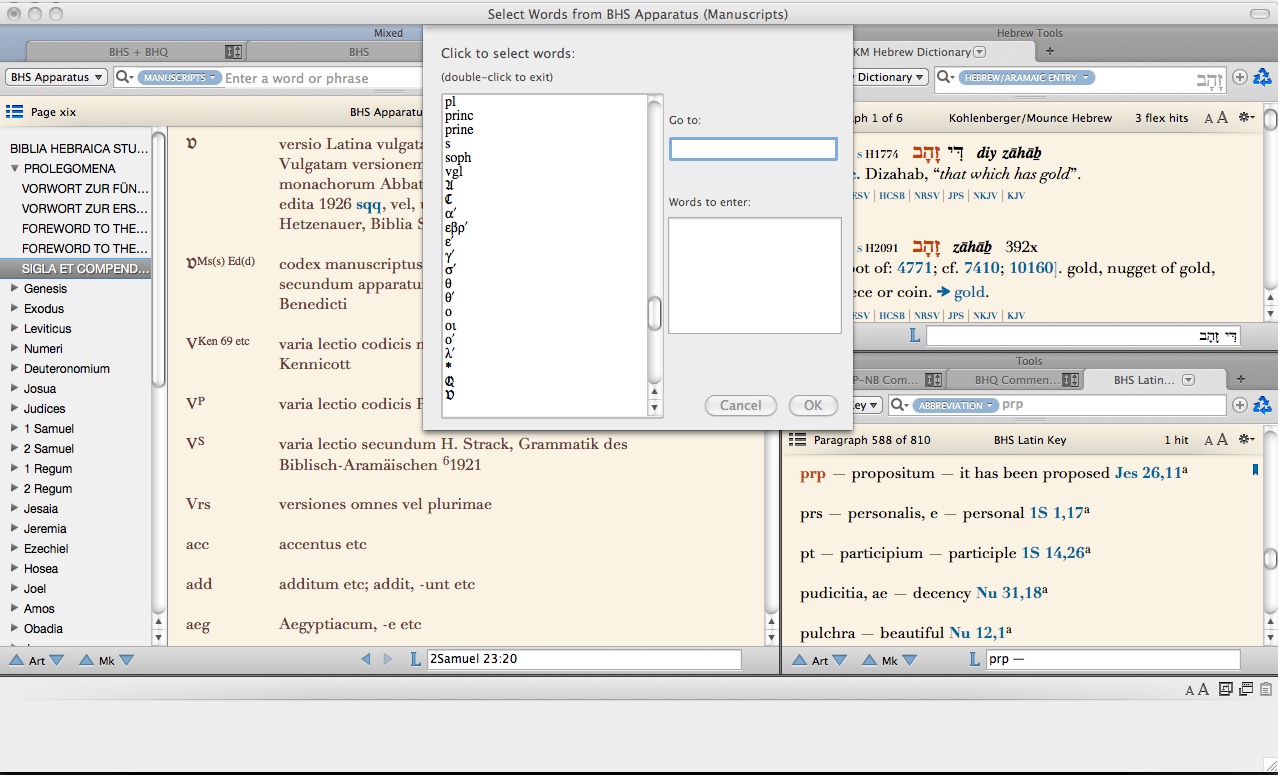
And you can search the apparatus by manuscripts mentioned. Change the search bar to “manuscripts,” then right click in the bar and select “Enter Word…” and you get this:

It’s a great way to be able to interact with the apparatus, much of which simply isn’t possible in print.

Bonus: Accordance offers an excellent, succinct explanation of critical editions here, with emphasis on the critical editions available in Accordance. If you’re interested in BHS in Accordance, you’ll want to read it.

If you do text criticism in the Hebrew Bible and have the money to spare, Accordance’s BHS apparatus is well worth getting, though most users will want to make sure they also have the “BHS Latin Key,” too. All in all, it’s a well-executed and seamlessly-integrated module.

Thank you to Accordance for providing me with a copy of the BHS and BHQ modules for review. See all the parts of my Accordance 10 review (including the Beale/Carson commentary module) here. I will review the BHQ separately in the future.

N.T. Wright on learning Greek, and a review of A Reader’s Hebrew and Greek Bible by Zondervan

I met N.T. Wright briefly in January at a worship symposium and asked him how to improve my Greek. He said, “Read the text, read the text, read the text.”

He told me to really get the feel of the language. Don’t think of Greek just as a code for English; get into the Greek itself. I asked him about reading with a diglot, but he encouraged me to check the English translation only after reading an entire Greek paragraph, and then, only as necessary.

The same holds true with Hebrew. Read the text, read the text, read the text. Reading it out loud is even better, and better still is trying to speak it to others.

Zondervan has published what is to my knowledge the only “reader’s” edition of the Hebrew Bible. It’s a masterpiece. The font is clear, sized perfectly, and easy to read (see at right, and click to enlarge). It uses the Leningrad Codex. It has no textual apparatus (which could be a distraction in a “reader’s edition”), but instead footnotes rarely occurring vocabulary. Not counting proper nouns, editors Philip Brown and Bryan Smith footnote all words that occur less than 100 times in the Hebrew Bible. Here they give “glosses,” which give the reader the basic meaning of the word. Aramaic words that occur less than 25 times are listed in the footnotes in the page on which they occur.

For readers who blank on a word that occurs, say, 150 times in the Hebrew Bible, a glossary at the back will allow them to look up even additional words.

Brown used HALOT and BDB to write the glosses. The bottom of the page looks like this (click for larger):

Note in #s 2, 7, and 8 that there is also listed what the verb stem is for a given use. What makes this feature especially easy to use is the bolding of the words before their glosses.

The only thing to critique in the Hebrew reader’s edition is that proper nouns, which are to appear in grey font since they’re not footnoted, occasionally go missed. Brown has posted an errata list here, many of which have been fixed in recent printings.

For a preview of the Hebrew reader’s edition, see here (PDF) and here (PDF).

Zondervan’s Greek reader’s New Testament has not met with such universal acclaim. It’s a good resource to have on hand, to be sure, but in my view it’s not as well executed as the Hebrew reader’s Bible.

Rather than being based on the scholarly editions of the NA27 or UBS4, the text is “the eclectic text that underpins the Today’s New International Version.” The scholars who produced the TNIV, in other words, made different textual decisions in some instances than did the editors of the “Standard Text” of the NA27/UBS4. Where this is the case, a limited textual apparatus notes it. While this could be problematic for textual criticism, the text is not vastly different from the standard one, and is certainly fine for reading.

As with the Hebrew reader’s edition, the Greek reader’s Bible footnotes and explains words that occur less than 30 times in the Greek New Testament. One unfortunate decision is that, unlike the Hebrew, the Greek footnotes do not have the glossed word in bold. This makes navigating the footnotes more cumbersome:

Font is perhaps a personal preference. While Philip Brown did a magnificent job of typesetting the Hebrew, the Greek font leaves something to be desired. It’s not the easiest Greek font I’ve read. It’s not unreadable as fonts go, but it’s thin. I got used to it after a while, so it’s not unmanageable, but the font in the UBS Greek Reader’s New Testament is easier to read. The latter also puts the footnoted glosses into two columns, which makes referencing them quicker.

Not long ago Zondervan combined the Hebrew and the Greek into one mammoth, leather-bound Reader’s Hebrew and Greek Bible. The volume is large (but how could it not be?) and impressive. It’s constructed well. The binding is sewn (rejoice!), so it will last for a while.

This combination carries with it the great advantage that its user has both the Hebrew and the Greek Bibles under one cover. Now I just have to carry one geeky Bible to church rather than two! Huge benefit.

Another nice thing about this edition is that with Hebrew going from right to left and Greek from left to right, the Greek New Testament starts at the “front” and the Hebrew Bible starts at the “back,” just as both would be in their separate volumes.

The introduction to each half explains well how the text is laid out, the footnoting of the vocabulary, and so on. All the glory of Brown’s Hebrew edition is there, and the less-than-ideal Greek font is there in the Greek portion. One thing to add in appreciation of the Greek part, however, is that Old Testament quotations appear in bold, with their references listed at the bottom of the page. The eight pages of color maps between the two sections are a nice bonus, too.

The construction of the two Bibles combined is executed quite well. I’m happy to only have to take one original language Bible with me to church now.

Thanks to Zondervan for the review copy of A Reader’s Hebrew and Greek Bible. They provided me with one in the hopes of my reviewing it on my blog, but with no expectation as to the content of the review. Find Zondervan’s product page here.

BHS, the Göttingen Septuagint, and other critical editions: a basic orientation to what they are

Image source: http://www.usc.edu/ (click on image for more details)

Most students of the Hebrew Bible who read Hebrew know of the premier scholarly edition, the Biblia Hebraica Stuttgartensia (BHS, here on Amazon).  The BHS is now being updated by the BHQ (Q=Quinta), about which you can read more here. Both the BHS and BHQ are “diplomatic” editions of the text, which means that they reproduce a single “best” manuscript, the Leningrad Codex, in their cases. The footer in each page contains a critical apparatus, which lists variant readings from other manuscripts and versions that the editors have deemed to be of importance for getting even closer to the “original” (now often being called the “earliest attainable text”). In some cases, the editors may wish to show where another manuscript or version differs from the Leningrad Codex; the critical apparatus is where they do it.

There are two other similar projects underway for the Hebrew Bible. One is the Hebrew University Bible Project, also a diplomatic edition, but unlike BHS and BHQ, based on the Aleppo Codex. The HUB includes a more extensive critical apparatus than BHS, so that readers can see more textual variants.

The other scholarly edition of the Hebrew Bible is the Oxford Hebrew Bible Project, “a new critical edition of the Hebrew Bible featuring a critical text and extensive text-critical introduction and commentary.” Though the BHQ contains commentary, too, the OHB differs in being an “eclectic” text, meaning that, as R.S. Hendel says (quoted in Tov),

The practical goal for the OHB is to approximate in its critical text the textual “archetype,” by which I mean the earliest inferable textual state.

Though the textual apparatuses of the BHS/BHQ and HUB can theoretically aid the reader in approximating the textual “archetype,” the text of the OHB offers that approximation rather than reproducing an actual manuscript (as the diplomatic editions do). Hence, the OHB is an “eclectic” edition. (So, too, are the two major scholarly editions of the Greek New Testament, the NA27 and UBS4.)

The Septuagint–the Greek translation of these Jewish Scriptures–has various scholarly editions, too.

On its Website the International Organization for Septuagint and Cognate Studies (IOSCS) has a great primer on the various editions of the Septuagint. Below, “OG” stands for “Old Greek.” They write:

The creation and propagation of a critical text of the LXX/OG has been a basic concern in modern scholarship. The two great text editions begun in the early 20th century are the Cambridge Septuagint and the Göttingen Septuagint, each with a “minor edition” (editio minor) and a “major edition” (editio maior). For Cambridge this means respectively H. B. Swete, The Old Testament in Greek (1909-1922) and the so-called “Larger Cambridge Septuagint” by A. E. Brooke, N. McLean, (and H. St. John Thackeray) (1906-). For Göttingen it denotes respectively Alfred Rahlfs’s Handausgabe (1935) and the “Larger Göttingen Septuagint” (1931-). Though Rahlfs (editio minor) can be called a semi-critical edition, the Göttingen Septuaginta (editio maior) presents a fully critical text, as described below.

Beginning Septuagint students are likely to own just “Rahlfs” (the Handausgabe mentioned above). But those who want to do more detailed text work with the Septuagint want more than the mini-apparatus in that edition.

Between Accordance (here) and Logos (here), nearly everything listed in the above quotation is available in electronic form. Accordance has Rahlfs’s Apparatus, parts of the larger Göttingen edition, and both the smaller (Swete) and most of what is currently available in the larger Cambridge Septuagint. Logos has all the volumes of Göttingen that have been completed to date.

There is more here about the scholarly versions of the Septuagint, including a volume-by-volume listing of both the Cambridge and Göttingen projects.

I have been fortunate to receive a review copy of BHS and BHQ Hebrew Bible editions from Accordance, as well as the existing volumes of the Göttingen Septuagint from Logos. I’ll be reviewing each in the coming weeks.

UPDATE: My review of BHS in Accordance is here. My BHQ review is here. Part 1 of a short primer on using the Göttingen Septuagint is here.

Logos 4: a quick note about a portable library

Ah, the age-old debate about how one should build a library: print or digital?

Okay, it’s not really that old of a debate. But it’s one I’ve gone back and forth on. I own the major lexicon for the Greek New Testament in digital edition. Same thing with the major lexicon for the Hebrew Bible. (They’re both huge.) But I went a bit overboard with the LEH lexicon for the Septuagint: I have it in print, in Logos, in Accordance, and in BibleWorks! (I only had to pay for the print edition, though.)

I’m taking a great class on the use of the Old Testament in the New. Most of the texts we use for the class list multiple biblical references, but don’t write out the verses. Take this example from Richard N. Longenecker’s Biblical Exegesis in the Apostolic Period:

V. Quotations occurring in John alone, with introductory formulae:

35. John 6:45 (Isa 54:13; Jer 31:33).
36. John 7:38 (Isa 12:3; 43:19–20; 44:3; 58:11).
37. John 10:34 (Ps 82:6 [LXX = 81:6]).
38. John 13:18 (Ps 41:9 [MT = 41:10; LXX = 40:10]).
39. John 15:25 (Ps 35:19 [LXX = 34:19]; 69:4 [MT = 69:5; LXX = 68:5]).

That’s a lot to look up! Especially flipping back and forth between Hebrew, Greek, and English versions.

In the Logos 4 edition of the book, however, all those texts are hyperlinked, so that I simply have to mouse over them to have a pop-up window display the verses in my preferred version. This is a great time saver, and I much prefer to read a book like this with such an easy way to look at the verses it’s referencing. I can also set up my windows and tabs in Logos to have multiple Bibles/versions open, too, while I read through a book.

I know print is better on my eyes than a screen is, so there’s still that. But the hyperlinking system in Logos makes buying books from them a desirable option–and they have a wide selection.

I also know that my bookshelves at home are beyond full, so my wife will likely appreciate digital additions to my library rather than more books in the living room….

This is a bit of an excursus in my Logos 4 review, though I purchased the Logos edition of the book above. See part 1 of my Logos 4 review here, part 2 here, part 3 here, and part 4 here.

BibleWorks 9 now runs natively on Macs

Big news from BibleWorks today. BibleWorks 9 now runs natively on a Mac. And there’s a free way Mac users who own BibleWorks 9 can do it. Read all about it here.

I’m looking forward to taking it for a spin.

See links to all six parts of my BibleWorks 9 review here.

UPDATE 10/4/12: Shoot! It’s no longer going to be available for free, and at the moment (10/4/12), it’s not available at all:

10/4/2012: Due to licensing restrictions, it turns out that we will have to offer the BibleWorks 9 Mac Public Preview through our webstore. We’re sorry for the inconvenience, but if you check back here early next week, we should have it available again!

Hopefully this gets ironed out soon. I’d love to use BibleWorks on a Mac.

UPDATE 2, 10/4/12: See here.

Using the Exegetical Guide and Passage Guide in Logos 4

Logos 4 offers an “Exegetical Guide” and a “Passage Guide” for any verse(s) a user is studying. These features’ utility lies primarily in how Logos compiles and presents the various resources in the program. A couple times in the last year or two when I was trying out Logos on a seminary library computer, I had trouble seeing the use in the Exegetical Guide and the Passage Guide. Can’t I just find that stuff all myself, I thought?

Now I’ve had a chance to use both at greater length. Here’s what I think about them.

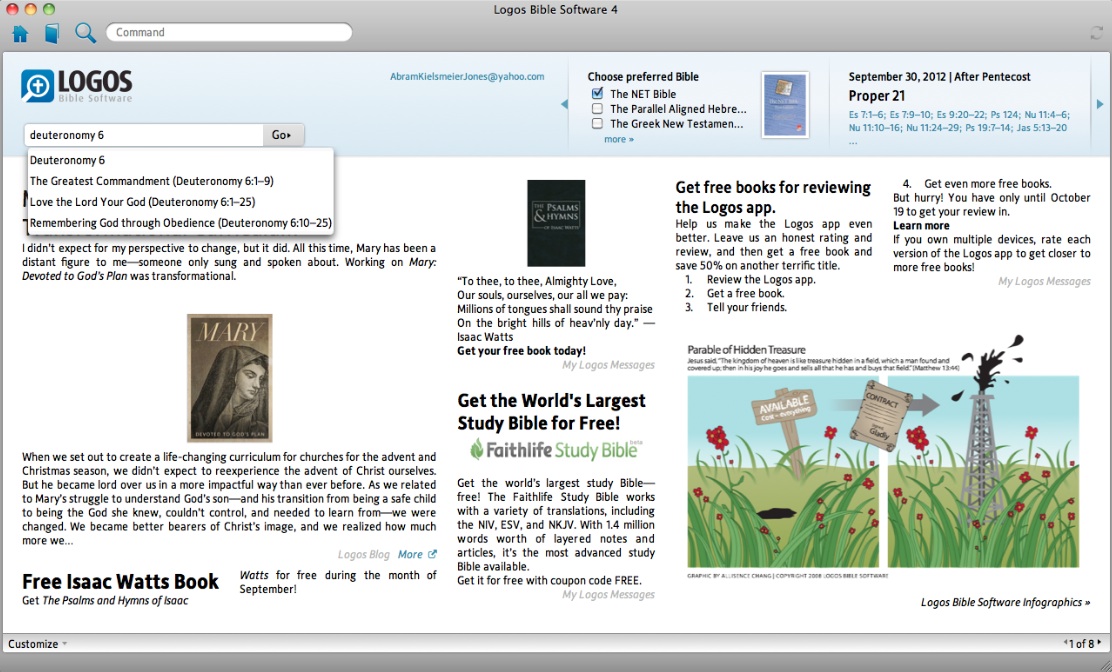
From the home page I begin to type in Deuteronomy 6, and a nice drop-down auto-complete feature comes up (a smart search engine!). Everything you see below in the home page can be changed and customized, as I noted here.

Selecting “The Greatest Commandment (Deuteronomy 6:1-9),” this screen then comes up (along with other tabs I already had open, not shown here). Click for larger if need be.

There are multiple collapsable and expandable sections from which I can choose. Most helpful are the “cross references” that pop up. Below that are “parallel passages,” which highlighted for me a resource I didn’t even realize Logos 4 had: Old Testament Quotations and Allusions in the New Testament (you know I love that!).

There’s more, too–a quick gathering of and hyperlinks to pertinent people, places, and “biblical things”; “media resources,” such as this one shown at right; a compare versions tool… and more. There are some things I won’t necessarily use, like the Graceway Media graphics (which take you to an external site, where it looks like you have to pay to download). But that’s no biggie–there’s an “x” I can click on so that won’t show in future Passage Guides. It’s all highly customizable, a consistent strength of Logos.

The Passage Guide saves me time and highlights resources and references throughout Logos 4 that users may not even be aware exist. I’m a fan and can easily envision using this in preparing messages and Bible studies.

The Exegetical Guide has a really similar layout. The categories here, however, tend to be more focused at the word, clause, sentence, and verse level, such as: textual apparatuses (if you have any in your Logos), grammars, visualizations, and word-by-word analysis. This latter feature is cool–it shows you parsing for every word, as well as its definitions in multiple dictionaries/lexica at the same time. See here:

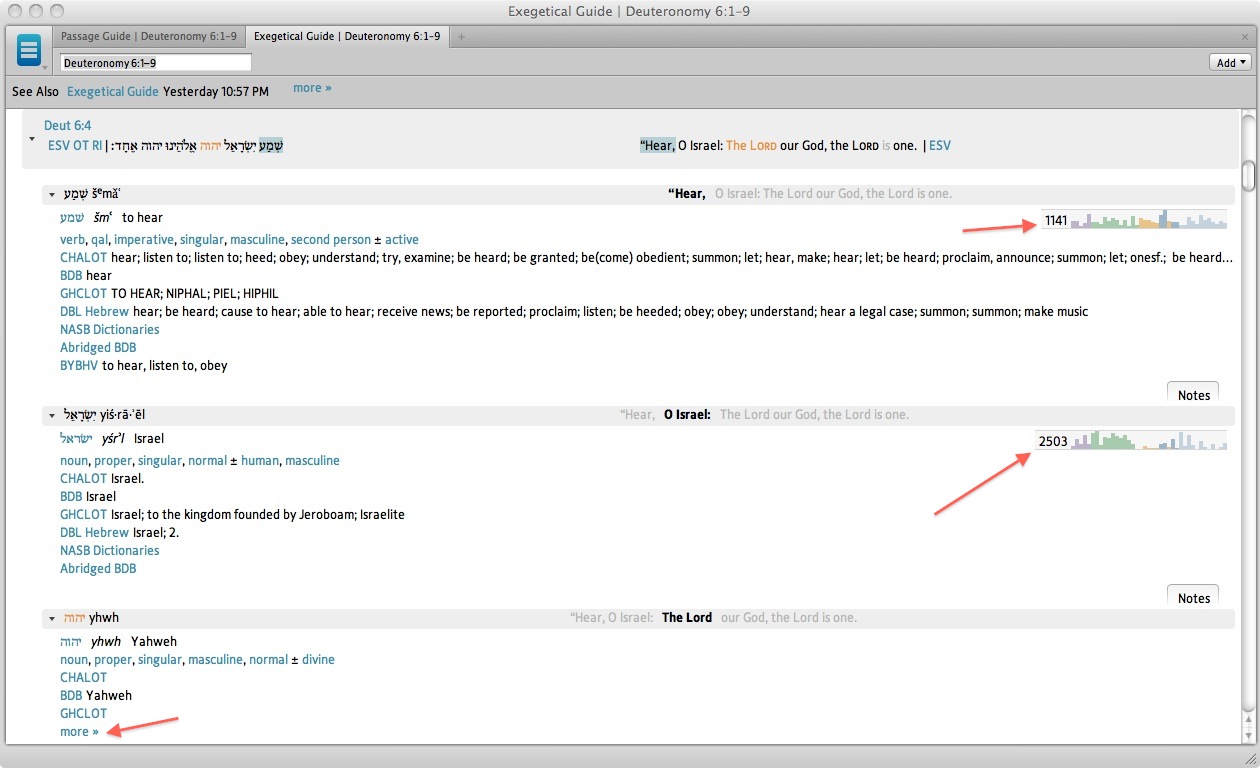
In the image below (another part of the Exegetical Guide), the top two arrows show you the colorful word distribution results throughout the various biblical books; the bottom arrow shows you how you can click on “more” for a given word (click for larger):

The Exegetical Guide and the Passage Guide are winners. They pull a lot together in one easy-to-get-to place, and they do it quickly. Nicely done.

Thanks to Logos for the review copy of Logos 4 with the Original Languages Library included. For the review copy I am giving my honest impressions of the program in a multi-part review. This has been part 4. See part 1 here, part 2 here, and part 3 here.

Guest post: Robbie Pruitt on A.W. Tozer

Magnificent Monograph Monday this week features a guest blogger, Robbie Pruitt. I have guest posted on his blog (My Two Mites) before, and today he posts here. It’s a review of Knowledge of the Holy by A.W. Tozer. Robbie is a gifted youth minister, teacher, poet, reader, writer, and friend.

Nothing is more important than a right understanding of God, or “thinking rightly about God.”  In Knowledge of the HolyA.W. Tozer states, “The Church has surrendered her once lofty concept of God and has substituted for it one so low, so ignoble, as to be utterly unworthy of thinking, worshipping men.”  Tozer is addressing idol worship that many fall into by thinking wrongly about God.

It is into this reality that Tozer speaks in Knowledge of the Holy, which is an excellent study of the attributes of God. (See pdf of book here.)  Tozer describes in detail the importance of thinking rightly about God, going so far as asserting, “What comes into our minds when we think about God is the most important thing about us.”  When it comes to our thinking about God, everything is at stake.  We must think deeply and accurately about God if we are to know Him and worship Him rightly and truthfully.

According to Tozer, when we think about God, we are using the language and the concepts that our finite minds can grapple with.  Our understanding of God is limited, as God is infinite and we are finite.  We are also unaware of the fullness of God as there are attributes we have not had revealed to us yet, and which we do not currently have the capacity to comprehend.  Tozer says, “We learn by using what we already know as a bridge, over which we pass to the unknown. It is not possible for the mind to crash suddenly past the familiar into the totally unfamiliar.”

While Tozer is acutely aware of the magnitude of his subject, God, he is not deterred from writing a most excellent reflection on the attributes of God that we can understand and contemplate.  An attribute, simply stated by Tozer, is “whatever may be correctly ascribed to God.”  While there is ample evidence to conclude that what we do not know about God is vast, there is so much about God’s character and nature that we can accurately know.  To begin with, we can know His attributes, and we can ascribe these attributes to Him with confidence.

In thinking about the enormity of God, Tozer is quick to warn against idolatry and thinking wrongly about God.  He says, “To think of creature and Creator as alike in essential being is to rob God of most of His attributes and reduce Him to the status of a creature.”  We must not think of God in “human” terms, though we are using human brains and creation and are reasoning, to contemplate the essence of God.  In thinking of God we must proceed cautiously, reverently and prayerfully, in faith and in love, as we rest in God’s divine revelation to us.

If we are not cautious, the dangers are clear.  We can think of something less than God and find ourselves in idolatry, worshipping something less than God.  Tozer says, “If we insist upon trying to imagine Him, we end with an idol, made not with hands but with thoughts; and an idol of the mind is as offensive to God as an idol of the hand.”  The other danger in thinking about God is attempting to manipulate, control, or manage God, which essentially places us above God as “god.”  Tozer describes this phenomenon this way: “Left to ourselves we tend immediately to reduce God to manageable terms.  We want to get Him where we can use Him, or at least know where He is when we need Him.”

We must look to God with great anticipation and appreciation of God’s revelation to us.  It is adequate.  God has revealed Himself to us and God is knowable.  God, in His great love and mercy, has revealed Himself to us in His son Jesus and we can know Him in faith and in love.  Tozer asserts, “In Christ and by Christ, God effects complete self-disclosure, although He shows Himself not to reason but to faith and love. Faith is an organ of knowledge, and love an organ of experience.”   We can know God and we can experience God.  This revelation of God is a great mercy to us and is a gift to us in Jesus Christ, through His Holy Spirit, which leads us into all truth.

As Tozer says so eloquently, “For while the name of God is secret and His essential nature incomprehensible, He in condescending love has by revelation declared certain things to be true of Himself.”  These truths of God are, indeed, His attributes, and we can know them and study them.  Knowledge of the Holy is a great tool for this study as we seek to come to know the eternal, magnificent, and indescribable God that we seek to worship rightly.

An attribute study is a great way to come to know God more deeply and is a great way to explore the richness of the Scriptures in a more non-linear approach.  Knowledge of the Holy covers some essential thoughts and attributes of God, as well as doctrines, that every Christian should think about.  As Tozer rightly points out, “The study of the attributes of God, far from being dull and heavy, may for the enlightened Christian be a sweet and absorbing spiritual exercise. To the soul that is athirst for God, nothing could be more delightful.”  As we seek God and seek to have our thirsts for Him quenched, this book, in addition to Scripture, prayer, and community, is a great place to start.

A thorough reading of Knowledge of the Holy highlights so many truths about God.  We are plunged into the depths of God’s character and nature and are left in a state of awe and worship in the presence of an awesome God.  While we will spend a lifetime and an eternity seeking to know God completely and to worship Him rightly, we can know God and worship Him now.  To quote Tozer one last time, “To our questions God has provided answers; not all the answers, certainly, but enough to satisfy our intellects and ravish our hearts. These answers He has provided in nature, in the Scriptures, and in the person of His Son.”  How marvelous it is to wonder at His greatness and to think rightly about our God!