Here is the schedule and text for Monday through Friday, using again the text from R.R. Ottley’s Book of Isaiah According to the Septuagint. Ottley is also here in Logos (reviewed here) and here as a free, downloadable pdf in the public domain. The full reading plan for our group is here (pdf).
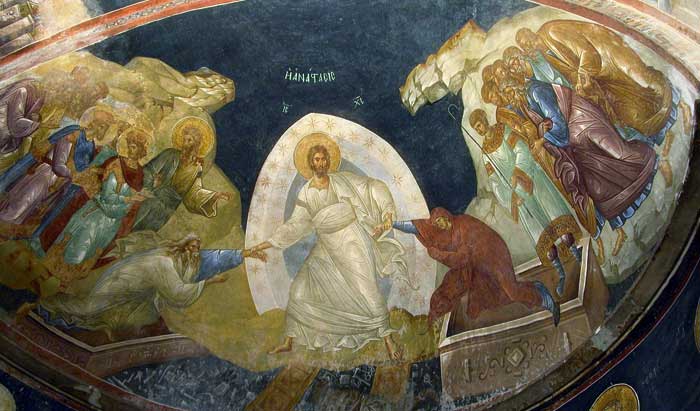
I’ve been admiring the above piece all week in anticipation of Easter. (Click to enlarge) It’s from Chora Church in Istanbul. The Greek is ἡ ἀνάστασις, in all capital letters=the resurrection. The letters just above Jesus are the Greek abbreviation for Jesus Christ.
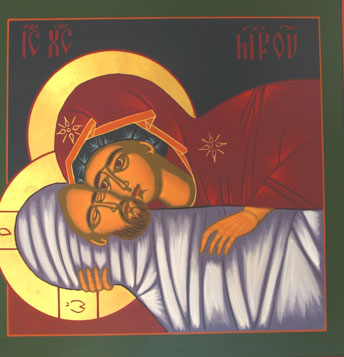
Two blogs I read posted a similar icon this morning. I love how Jesus (Life) is touching Adam and Eve (death), pulling them out of their graves, from death to resurrection.
All day I’ve been trying to meditate on what Jesus’ disciples must have been feeling on the day between Good Friday and Easter.
Wait–before you go further, if you don’t think it’s too cheesy, listen to this while you read the rest of the post:
Saturday.
Many Western Christians know how to observe Good Friday and Easter. On Good Friday we call to mind our sins, the last words of Jesus on the cross, the shock and despair his followers experienced… and we try to imagine his suffering, entering in to that as best as we are able.
And then Easter is the party of all parties, when we declare the defeat of death: “Jesus Christ is no longer dead!”
Alleluia! Christ is risen! The Lord is risen indeed! Alleluia!
But what about Saturday? The disciples didn’t have an “Easter” to look forward to. Jesus was done for, as far as they knew. He was really dead. When he did appear to the apostles, they were terrified and thought they were looking at a ghost. They weren’t even hopeful for resurrection–it hadn’t crossed their mind as an option.
So what some Orthodox call “Bright Saturday” was anything but bright for Jesus’ first followers. It was probably horrible. Awful Saturday. They felt as empty as the tomb was about to be. It was a Sabbath day, too, so they didn’t have any work to distract them. They were quiet. Or maybe they wailed loudly. Phillip Glass (the music you may have clicked on, above) makes a good soundtrack for trying to imagine the emptiness of that day.
In the loss of a loved one, the day of the beloved’s death is painful, and then there’s something about the second day that can be even more painful. The initial shock may begin to give way (but probably not really); reality sets in a little bit more. No, that wasn’t a bad dream–I’m still here, and my loved one really is… gone. Maybe the second day–Saturday–was even more difficult for the disciples than Friday.
At one point today I was thinking about the liminal nature of Saturday in Holy Week: it’s an often unnoticed, unmarked day that is situated between death (Good Friday) and life (Resurrection Sunday). How should I feel? Sad? Penitential? Happy? Pre-happy? Expectant? All or none of the above?
My church tradition has an Easter Vigil service on Saturday night, but just this simple offering for a Holy Saturday liturgy. We “await with him” and “rise with him” in that service’s Collect. This calls to mind Psalm 30:5, which says, “Weeping may stay for the night, but rejoicing comes in the morning.” Our Holy/Bright/Liminal Saturday is a short day, since we know of Resurrection Sunday’s shouts of acclamation and loud Alleluias.
But Saturday for the disciples was not liminal. It was not thought of as perched between death and life. That day and those men and women felt firmly ensconced in the grips of death. The closing anthem in the short Book of Common Prayer liturgy above begins, “In the midst of life we are in death….”
“We are in death.” Death Saturday. Awful Saturday.
Jesus’ followers had no clue what–or Who–was just around the corner….
Via Patheos, a beautiful Easter reflection from pastor and blogger Kara Root:
I need the Resurrection because my sister is sick and can’t afford insurance, because I’ve told a weeping Haitian mom, “No, I can’t take your son home with me.” because I’ve been rushed off a Jerusalem street so a robot could blow up a bag that could’ve blown up us. because I’ve exploded in rage and watched their tiny faces cloud with hurt. because evil is pervasive and I participate. I need the Resurrection because it promises that in the end all wrongs are made right. Death loses. Hope triumphs. And Life and Love Prevail.
Over the next few weeks I’ll be reviewing IVP’s Dictionary of the Old Testament: Pentateuch in Logos Bible Software. I’ll look at a few dictionary articles in each post, commenting on the content of each, as well as on the dictionary’s presentation in Logos.
I’ve reviewed Logos 4 and 5, looking at several packages and additional resources. Find those reviews collected here.
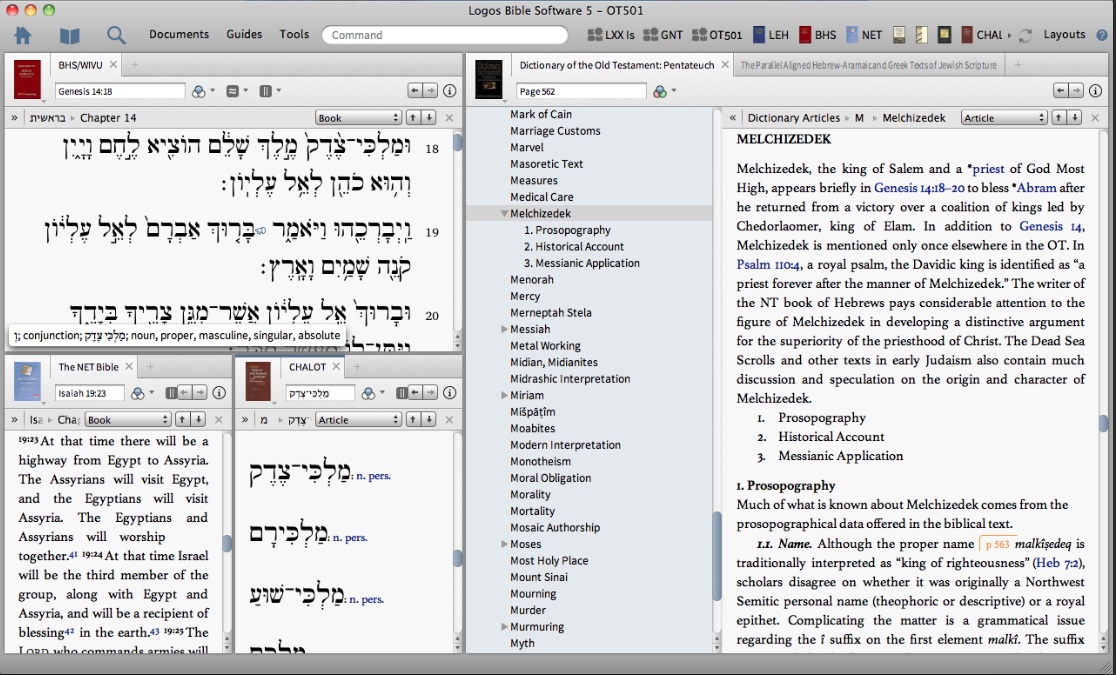
The dictionary is easy to lay out in Logos with other accompanying resources. Here I have it next to the Hebrew text with English translation and a Hebrew lexicon (click to enlarge):
As with all of Logos’s resources, you can hover over hyperlinked words (see “Heb 7:2” above) to see the Scripture without leaving that tab.
One solid feature so far (true of Logos resources in general): being able to use the shortcut command (Mac) or control (PC) + F to quickly find words in the entries.
One thing to critique so far: the items in the Table of Contents don’t expand to all the subpoints. In the shot above, for example, you can see that “1. Prosopography” under Melchizedek has “1.1. Name” in the entry, but not in the left sidebar Table of Contents. This makes navigating through multiple layers of detail a bit more cumbersome. (By contrast, the Accordance version of this module looks like it has the triangle that continues to expand, here.)
What about content of the dictionary itself? In this installment, I summarize and review three articles: “Sarah,” “Melchizedek,” and “Language of the Pentateuch.”
Sarah
R.G. Branch notes that Sarah and other “matriarchs of God’s people” are “equally significant” compared to the “widely recognized Israelite patriarchs” (733). Chief among these is Sarah. Even if there is not the amount of biblical material about Sarah that there is about Abraham, she remains a “pivotal character” in Genesis (733).
Branch divides the “Sarah” entry into two parts: “Sarah in the Ancestral Narratives” and “Sarah in the Later Tradition.”
In the first part Branch notes that Sarah, about 10 years younger than Abraham, is “the first matriarch of the biblical text” (733). Her childlessness in Genesis 11:30 is a key characteristic. Her first mention in that passage describes her barrenness, which “sets the tone for the stories about them that follow” (733). Sarai and Sarah (her name after God changed it in Genesis 17) both mean “princess” or “chieftainess.” Genesis records several threats to the possibility of Abraham and Sarah bearing offspring, not the least of which is two stories (in Genesis 12 and 20, which Branch understands as two separate incidents) of “marital deception,” where Abraham claims Sarah as his sister (734).
“In both cases,” Branch notes, “Abram feared for his life because of his wife’s great beauty” (734). It is this beauty that is the focus of the second part of the article, “Sarah in Later Tradition.” Branch cites various Jewish sources that extol Sarah for her immense beauty. She is also said to have been “surrounded” by miracles (735).
Branch gives a good, basic summary of biblical and Jewish rabbinic material about Sarah (as well as her importance for understanding Elizabeth in the New Testament), with citations that the reader can follow up for more.
Key statement from this article is: “Many of the issues in the stories about the couple can be understood as their struggle to come to terms with God’s promises of land, offspring, greatness and blessings” (734).
Melchizedek
Scripture contains very few references to the mysterious figure of Melchizedek. S.J. Andrews recounts Abram’s encounter with Melchizedek in Genesis 14:18-20, which Psalm 110 (noted as a “royal Psalm”) cites. Andrews also does well in noting the book of Hebrews’ understanding and interpretation of Melchizedek.
In “Prosopography” Andrews notes the complications that arise in trying to understand the name malkîṣedeq. Hebrews reads it as “king of righteousness,” but Andrews notes scholarly disagreement on “whether it was originally a Northwest Semitic personal name (theophoric or descriptive) or a royal epithet” (563). Therefore, “The name could mean either ‘(my) Malk/Melek is just’ or ‘Ṣedeq is my king’” (563). Either way, Genesis calls him “king of Salem,” which could be Jerusalem, or just mean, “king of peace,” as in Hebrews 7:2.
The “Historical Account” section of the article delves more into the story of Abram’s victory of kings and subsequent exchange with Melchizedek, where the latter gives the former bread and wine and a blessing, and the former appears to tithe to the latter.
In the final section, “Messianic Application,” Andrews explores various possibilities for the appearance of Melchizedek, what it meant, possible connection to a Messiah, and so on.
Andrews says, “The Qumran text 11QMelch portrays Melchizedek as an archangelic figure like Michael” (564), but he could have perhaps gone into more depth about the Qumran understanding of Melchizedek. However, his basic overview serves as a solid starting point for understanding the Melchizedek figure in biblical tradition.
Language of the Pentateuch
R.S. Hess’s “Language of the Pentateuch” article consist of three sections: “A discussion of the history of languages in and around Palestine during the third and second millennia b.c., a consideration of the grammar and style of the Pentateuch’s language in comparison with Classical Hebrew, and a study of those linguistic elements within the Pentateuch that might relate it to the period in which the narratives and events recorded in Genesis through Deuteronomy claim to have taken place” (491).
He offers a survey of Pentateuchal chronology, marking the date of the exodus as “sometime between the fifteenth century b.c and the end of the thirteenth century b.c.” (492), part of the Late Bronze Age. The Hebrew language is part of a family of West or Northwest Semitic dialects. There are not immense differences between the language of the Pentateuch and the language of (presumably) later Old Testament texts, but Hess does point out research around some “distinctive elements found in the Pentateuch that might set it apart from the grammar of the remainder of biblical Hebrew” (493), though these are few. Hess holds to an “early date” for at least the initial writing of the Pentateuch.
This particular article was a bit dry at times, but the level of detail is still to be appreciated.
So far my overall impression of the dictionary is positive. I will write more about it later. UPDATE: Part 2 is here.
The Dictionary is on Amazon here (in print) and at Logos here. My thanks to Logos for the review copy.
Here is the schedule and text for Monday through Friday, using again the text from R.R. Ottley’s Book of Isaiah According to the Septuagint. Ottley is also here in Logos (reviewed here) and here as a free, downloadable pdf in the public domain. The full reading plan for our group is here (pdf).
This week in Greek Isaiah in a Year covers Isaiah 20 and 21–two full chapters! And this time, I’m including an English translation–one that is in the public domain by R.R. Ottley.
Here is the schedule and text for Monday through Friday, using again the text from Ottley’s Book of Isaiah According to the Septuagint. Ottley is also here in Logos (reviewed here) and here as a free, downloadable pdf in the public domain. The full reading plan for our group is here (pdf).
20 1 In the year when Tartan came to Azotus, when he was sent by Sargon king of the Assyrians, and warred against Azotus and took it,
2 Then spake the Lord to Isaiah, saying, Go, and take off the sackcloth from thy loins, and loose thy shoes from thy feet, and so do, walking naked and barefoot.
3 And the Lord said, Like as my servant Isaiah hath walked naked and barefoot, three years there shall be signs and wonders to the Egyptians and Ethiopians.
4 For thus shall the king of the Assyrians lead away the captivity of Egypt and of the Ethiopians, young men and old men, naked and barefoot, uncovered, the shame of Egypt.
5 And the Egyptians shall be ashamed and discomfited concerning the Ethiopians, upon whom the Egyptians had trusted, for they were their glory.
6 And they that dwell in this isle shall say, Behold, we had trusted to flee unto them for help, who could not be saved from the king of the Assyrians; and how shall we be saved?
21 1 As a tempest passeth through the desert, coming from a desert, from the land. Fearful
2 is the vision, and hard, that was proclaimed to me. He that setteth at nought doth set at nought, and he that transgresseth doth transgress.
The Elamites are upon me, and the envoys of the Persians are coming against me. Now will I mourn, and will comfort myself.
3 Therefore are my loins filled with faintness, and pangs have taken hold of me, as her that travaileth; I did wrong, so as not to hear, I laboured earnestly so as not to see.
4 My heart wandereth, and my transgression overwhelmeth me; my soul turneth to fear.
5 Prepare the table, drink, eat; stand up, ye rulers, and prepare shields.
6 For thus saith the Lord to me, Go, set thee a watchman, and whatsoever thou seest, tell it.
7 And I saw two mounted horsemen, one mounted an an ass, and one mounted on a camel. Hear with diligent hearing,
8 And call Uriah to the watch tower of the Lord. And he said, I have stood continually by day, and over the camp I stood the whole night,
9 And behold, he himself cometh, mounted on a two-horse chariot. And he answered and said, Babylon is fallen: and all her mages and the works of her hands are crushed into the earth.
10 Hear, ye that are left, and are in anguish, hear what I have heard from the Lord of Hosts: the God of Israel hath proclaimed it to us.
The vision of Idumæa.
11 To me ye call from Seir, Watch ye (the) battlements.
12 I watch at morning, and through the night; if thou inquire, inquire, and dwell beside me.
13 In the forest shalt thou lie down at evening, in the way of Dedan.
14 Bring water to the thirsty to meet him, ye that dwell in the and of Teman; meet ye with loaves them that flee,
15 Because of the multitude of them that flee, and because of the multitude of them that wander, and because of the multitude of the sword, and because of the multitude of the bows that are bent, and because of the multitude of them that are fallen in the war.
16 For thus said the Lord to me, Yet a year, as the year of an hireling, the glory of the sons of Kedar shall fail,
17 And the remnant of the bows of the strong sons of Kedar shall be few; for the Lord, the God of Israel, hath spoken.
See here for more resources and links to texts for Greek Isaiah.
And here are the Week 16 readings above, but in pdf form.
Here is the schedule and text for Monday through Friday, using again the text from R.R. Ottley’s Book of Isaiah According to the Septuagint. Ottley is also here in Logos (reviewed here) and here as a free, downloadable pdf in the public domain. The full reading plan for our group is here (pdf).
Bible translators stand at the intersection of the biblical world and their own, with the task of communicating an ancient text in a contemporary language. The Greek translator of Isaiah provides interesting examples of the issues and problems this task presents. For instance, he sometimes substituted the more familiar names of local Greek deities in place of the long-forgotten names of pagan Semitic deities being denounced. Is it “right” to substitute contemporary terms that would clearly communicate the message to the readers in place of ancient terms and idioms that would be accurate but meaningless? Where do accuracy and clarity meet in “getting it right”?
Sharpen your knife and your priestly reflexes: are you ready for the Ultimate Rule Book? Leviticus!
Play the role of a busy priest working to keep God happy by sacrificing choice offerings of sheep, goats, and bulls with frantic speed and slicing precision. Combo your actions and the rewards get BIBLICAL!
Three sacrificial services a day, seven days a week. Can YOU make it to Shabbat? Download Leviticus! and start swiping to find out!
That’s the real description of this real iPhone and iPad app: Leviticus! It sounds like Fruit Ninja meets the Hebrew Bible.
I don’t think Leviticus can be wholly reduced to a rule book (it is also all about covenant), and I don’t think sacrifices are best described as just an attempt to “keep God happy,” but there is a lot of detail in Leviticus that most of us struggle through when (if) we read it.
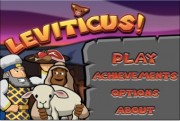
Here’s a screen shot. Not for the weak of stomach, though neither is Leviticus the book:
Titled Leviticus!, the game, as its title suggests, is both irreverent and deeply faithful to the source text—all that business about doves and cows and purity is right there in the book. But whereas Leviticus is too thick with rules to make for a very compelling read, it’s perfect when played.
As irreverent as this game first seemed to me, it may actually help one better understand the book. At least, that’s one of its purposes, according to the creator:
And education is at the heart of [Sarah] Lefton’s efforts. The game, she hopes, will do more than just amuse. “We brought something to very visual life that’s normally left on the page,” she said, “and that a lot of people just never study.” Believing that Jewish literacy and digital literacy make for excellent bedfellows—learning how to code and create applications that, in turn, are designed to enhance Jewish education and engagement—she now has future plans that involve not only the production of more games like Leviticus!, but also workshops teaching students and educators how to create their own Jewish-themed software.
The app is free, and found here. I don’t have an iPhone or iPad, so if anyone reading this downloads and tries it, I’d love to hear more about what you think. And it’s not April 1, so, as far as I know, the app is real.











 Words on the Word
