Last week we received a kindness in the mail from a new friend in Israel–F.F. Bruce’s Bible History Atlas.
My 7-year-old son, who had been looking forward to receiving it, came home from school and smiled widely when I had him open it.
He ran outside to share the good news with his younger siblings, who were running around with sticks and dressed up as a spaceman and ladybug, respectively. He was excited.
His first excited question to me when he came back into the house was, “Where is the battle page?” We have again been reading about the Maccabees recently in The Sacred Bridge (though, of course, I had to for now edit out the forced circumcision portion of that narrative!), so he was eager to find the Maccabees and Hasmonean era in Bruce’s atlas, which we were easily and quickly able to locate.
The atlas covers all of biblical history–both Testaments and everything in between.
The kind folks at Carta publish the Bruce atlas, as well as The Sacred Bridge. Their product page for Bible History Atlas (one of many fine atlases they offer) is here.
Listening to Copeland’s new album Ixora, you wonder if Aaron Marsh is making a promise to you. It has been six years, after all, since the re-united band’s last album, You Are My Sunshine.
I can make you feel young again
I can make you feel nothing at all for the years
that led you here.
Now all your tears that have fallen will never show.
I can make you feel young again.
I felt young(er) as soon as Copeland announced their reunion. The last time I saw them in concert was three children ago. Yet their first released single, “Ordinary,” speaks of embracing the mundaneness and routines that come with growing older:
Since you came along my days are ordinary.
We laugh just like yesterday,
and I kiss you like the day before,
and I hold you just like ordinary.
Perhaps when the day is new,
we’ll find tomorrow is just ordinary too.
That track is all swoony vocals and Marsh’s delicate piano playing. The band tantalizingly released a video clip of them rocking out in the studio, paired with the audio of the reflective “Ordinary.”
Then came “Disjointed,” a second single. It’s got the more familiar feel of Copeland’s Eat, Sleep, Repeat, and the band feels totally on their game here. On Ixora it’s track 2 after the gentle opener of “Have I Always Loved You?” It’s Copeland at their best–electric guitars, hypnotically beautiful piano, strings, tight bass, and drums with carefully produced tone.
By the time the band released the third track, “Erase,” I felt again like the teenager who used to wait impatiently for new albums that were sure to alter the course of my destiny forever:
Everything about “Erase” is perfect. The build, the band entrance, the string swells, the groove, the production. It is one of the best five Copeland songs ever. “Ever I was searching, endless all these days,” Marsh croons in his sweet falsetto. Even if you’re too tired to feel young again, you’ll yearn with Marsh for days “you can’t erase.”
By the time I came to the full album, I might have been hoping for too much. My first few listens left me wanting more of the transcendent moments of “Erase” and “Disjointed,” and less of the production decisions that led to the lead guitar tone at 0:34 of “I Can Make You Feel Young Again.” It calls to mind the first guitar notes of Sarah McLachlan’s “Sweet Surrender” much more than anything you’d expect from Copeland. (Though I do love “Sweet Surrender.”) The song “Lavender” felt more like it could have been a Peter Gabriel cover on Copeland’s Know Nothing Stays the Same. And “Chiromancer” has been for me the rarest of Copeland tracks that I’m likely to skip on future listens.
But maybe those are just the kind of inevitable “ordinary” moments that Marsh sings about. Ixora has grown on me, after all, even as an unremarkable daily routine can become comforting.
And there are other standout tracks besides “Erase” and “Disjointed.” What I really love about the opening track, “Have I Always Loved You?”, is that the band eases in, instrument-by-instrument, as if they’re coming back from behind the stage one-by-one to play an encore an adoring audience didn’t think they’d actually get.
Is this Copeland’s best album to date? I still think Eat, Sleep, Repeat holds that title. Ixora has some of the unevenness that I thought characterized You Are My Sunshine, but this album holds together better. And I will probably listen to it another 20 times next week, too.
Copeland is an inspiring band; they bring the listener up with them into moments of transcendence in a way that few other bands in their genre do. I’m thrilled that they’re back together, and hope that Ixora is just the beginning of many more Copeland albums to come. 8.5/10.
You can get Ixora on iTunes and Amazon this coming Tuesday. Thanks to Big Picture Media for the pre-release stream so I could review the album before my iTunes pre-order arrives.
You can stream also stream Copeland’s Ixora on Spotify here:
Before Prof. Rodney Decker passed, he finished writing his Koine Greek Grammar, with which I’m already impressed–having just begun working through the Appendixes!
One other last (and sure-to-be lasting) contribution to the world of Greek readers is his two-volume commentary on the Greek text of Mark, from Baylor University Press. It is part of the Baylor Handbook on the Greek Text, which I’ve reviewed (Luke) here.
The two-volume set came in the mail today, courtesy of Baylor. Decker’s Koine Greek Reader is the best resource of its kind. His scholarship was always careful and engaging. These Baylor books–about which I will post again in the future–look like about the first thing you’d want to have by your side when reading through Mark.
Is The Sacred Bridgethe best Bible atlas ever? To be fair, people consult atlases for different purposes. But for the one–academic or otherwise–who wants to dig deeply into the historical geography of the biblical world, what’s the best resource available?
I believe the reviewer should evaluate a work according to its merits in relation to the aims of the work. It would not be fair, for example, to criticize a popular commentary for not being technical enough, nor to criticize a work explicitly focusing on the Greek text of a biblical book for not including enough historical background.
So it is perhaps a bit odd that I come to a review of The Sacred Bridge: Carta’s Atlas of the Biblical World (hereafter, TSB) with the question: Is it the best Bible atlas ever? It does not explicitly claim it is, nor self-consciously attempt to be. However, some copy by its publisher, Carta Jerusalem, does read, in part:
The Sacred Bridge will be the Bible Atlas of Record and Standard Work for the coming decades. Exhaustive in scope and rich in detail, with its comprehensive documentation of the Near Eastern Background to Biblical History, this latest Bible Atlas from Carta is one more stepping stone on the way to the study and understanding of the Holy Scriptures.
TSB‘s reputation precedes it. Readers of this blog know that I’m a daily user of Accordance Bible Software. It was from the Accordance User Forums that I first learned about The Sacred Bridge. Almost every mention hailed it as the best, most comprehensive Bible atlas there is. So, naturally, I was eager to test that claim for myself.
In this post I review Carta’s impressive atlas. SPOILER ALERT: The answer to my “Is it the best?” question is… yes.
Such a monumental work deserves an attentive and thorough review, which I offer here as best I can. This will not be a short review, but my aim is for anyone reading it to be able to decide whether to add TSB to their own personal arsenal of resources for reading and study. The review will follow this outline:
Orientation to Orienteering with TSB: What are the ways one can (begin to) use the atlas? I suggest four.
TSB‘s Construction, Layout, and Text: How is the presentation and typesetting in the atlas?
Maps, Images, and Tables: Are the images of high quality? Are they easy to read?
Case Study: The Sacred Bridge on The Holy Gospels: I interact more closely with an individual chapter, Chapter 22: “Historical Geography of the Gospels.”
The Younger Sibling of TSB: Here I point out and briefly comment on Carta’sNew Century Handbook and Atlas of the Bible, which is essentially a condensation of (or, set of selections from) The Sacred Bridge.
A Few Points of Critique: Though this atlas would be difficult to make much better, I offer a few minor suggestions.
Excursus: My Seven-Year-Old Son Loved It: This is true–I have a picture to prove it.
1. Orientation to Orienteering with TSB
A. The Jump-Right-In Method
One way to begin using The Sacred Bridge is to do what I did when I first received it: open it up and start flipping through it.
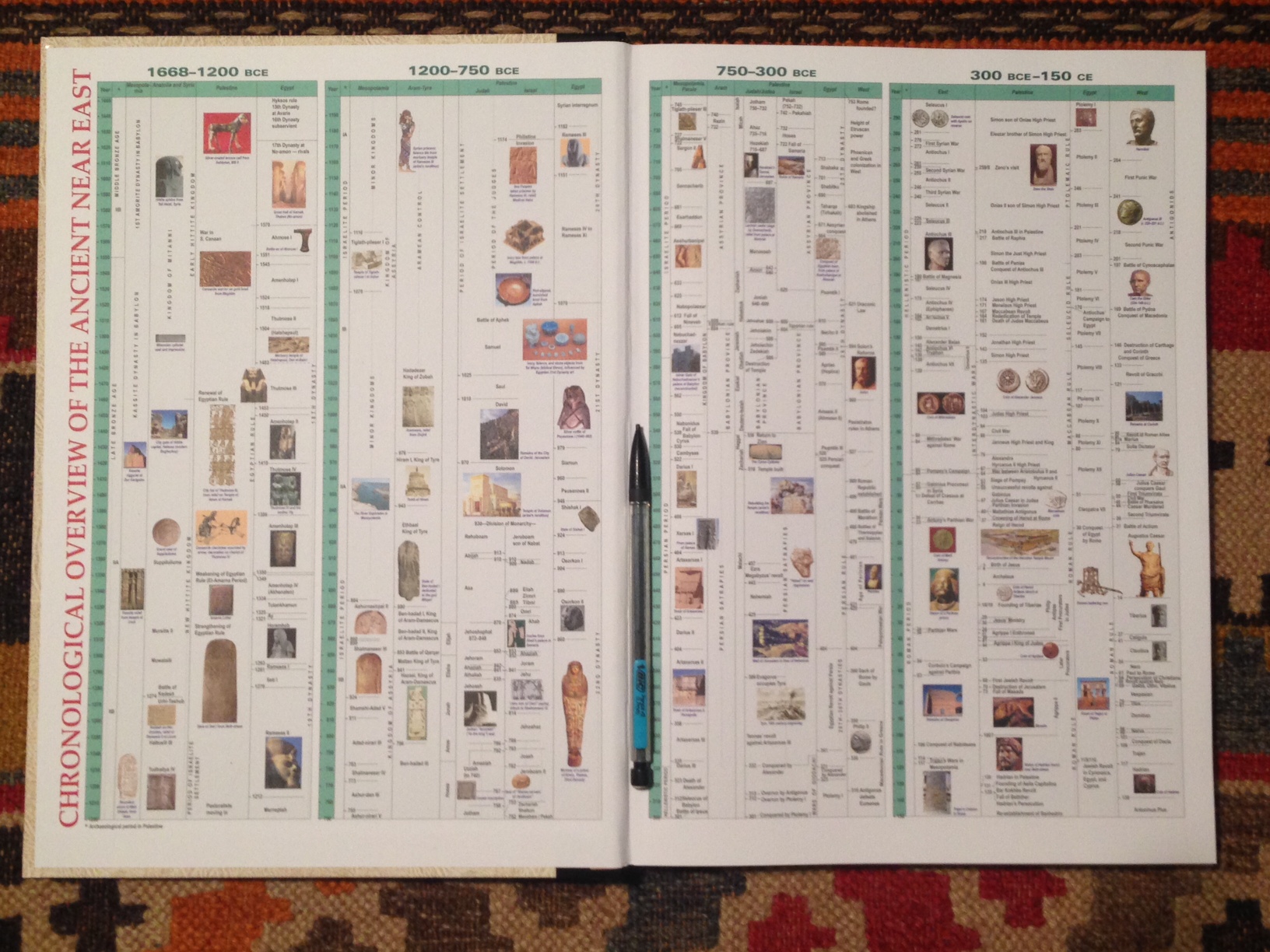
This impressive, detailed timeline greets the reader inside the front and back covers (“Chronological Overview of the Ancient Near East”):
You probably won’t be able to see much detail in the image above, but it’s legible when you’ve got it in front of you.
The Table of Contents are worth perusing, available from Carta here (PDF) or from Eisenbrauns (the North American distributor of TSB) by clicking through from the product page. One immediately notices that the atlas covers from the fourth millennium BCE through the Bar Kochba Revolt (132-135 CE).
Given my interest in Septuagint studies and Maccabees, I opened right away to Chapter 18: “The Hasmonean Struggle for Independence (167-142 BCE).” It begins:
The response to Antiochus IV’s Hellenizing campaign was quick and forceful. The writings of Josephus and 1 Maccabees recount that Mattathias son of John, a priest and leader in the village of Modiin (el-Midya; Eus. Onom. 132:16; Notley and Safrai 2005:126 n. 703) near Lydda, was one of the first offered an opportunity to submit to the king’s edict (Ant. 12:265–271).
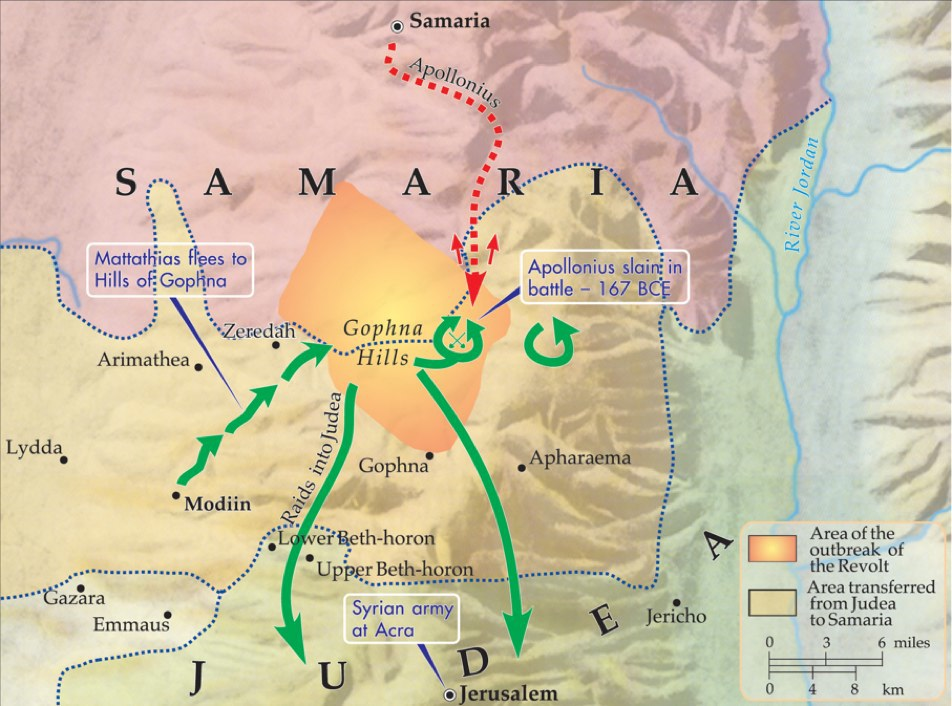
There is also this map, “The beginnings of the Hasmonean revolt, 167 BCE”:
And then, with the battle map in view, “The Early Battles” walks the reader through the battles mentioned in 1 Maccabees 3 and 4 (Gophna, Beth-horon, Emmaus, and Beth-zur), after which subsequent sections follow the Maccabean campaigns of 1 Macc. 5 and following. This particular chapter in TSB reads like a detailed and page-turning military history:
Jonathan’s political position was tenuous. His allies were dead, and the figure he had earlier opposed was now seated on the throne in Antioch. The high priest moved to take advantage of the political diversions in Syria and attacked the Citadel in Jerusalem. Perhaps, he assumed that Demetrius II would follow his father’s pledge to empty the bastion of the Seleucid garrison and turn it over to the high priest (1 Macc 10:32)—an offer his benefactor Alexander never matched. It seems that the son of Demetrius likewise thought it better to maintain a military presence in the Citadel and demanded the Hasmonean cease his hostilities.
B. The Read-the-Introductory-Material Method
Chapter 1, “Dimensions and Disciplines,” informs the reader what kind of book The Sacred Bridge is:
This is not meant to be a textbook in geography, not even biblical geography. It is an attempt to view the geographical setting through the eyes of the ancient inhabitants. It concentrates on the terms and places that have enjoyed their attention; it seeks to define them in terms of their ancient understanding.
In pursuit of this aim, the atlas draws on “every available documentary source, Egyptian, Akkadian, Moabite, Phoenician, Greek, Latin, Arabic, etc., that may provide geographical details and perspective.” Though the first chapter is dense and technical, it alerts the reader to the various kinds of sciences (ecology, hydrology, and so on) that constitute physical geography, as well as covers disciplines like historical philology and “grammatical analysis of ancient Semitic toponyms” (!).
Then, true to the goal of describing places “in terms of their ancient understanding,” the second chapter is short, readable, and informative, titled, “The Ancient World View.” It focuses especially on the economy and commerce of the ancient world.
Chapter 3, “The Land Bridge,” describes the Levant, demarcating just what land the “Sacred Bridge” refers to: “the eastern Mediterranean littoral (with somewhat more emphasis on the southern part).” The phrase “Sacred Bridge,” funnily enough, is only used in the title of this book.
C. The Is-This-Place-Name-from-This-Bible-Verse-Here? Method
Numbers 33:49 reads:
They camped by the Jordan from Beth-jeshimoth as far as Abel-shittim in the plains of Moab.
Where is Abel-shittim? I can look it up in the index to see the pages on which it occurs.
On page 124 I read, in part:
Abel-shittim is the same as Shittim (Num 25:1); its location was east of the Jordan and north of the Dead Sea.
Then follows a description of its two proposed sites. I find full-color maps with Abel-shittim clearly marked on pages 123, 125, and 137.
Elsewhere TSB notes Abel-shittim as one of a group of “names derived from some local plant or fruit.”
Remarkably, the index lists page numbers not just where a place name occurs in the text, but also where it occurs in a map. Mizpah and Memshath, for example, are both listed as occurring on page 239, but one cannot find them in the text. Rather, they are in the map. I was impressed to see the index keyed to both text and images.
D. The Get-It-in-Accordance Method
You can do a lot of helpful specific searches of TSB in Accordance. For example, when TSB cites Eusebius’s Onomasticon (a 4th century atlas), it has Onom. in parentheses as a citation. By selecting the search field of “Content” in Accordance and typing in “Onom”, I can find every time TSB cites the Onomasticon. Searching “Onomasticon” using the same field shows me all the times that it is mentioned by name in the body of the text. Then searching “Onom <OR> Onomasticon” (without the quotation marks) shows me results for both of the above searches. Very cool! Also praiseworthy is the fact that TSB cites Eusebius both in its original Greek and in English translation. TSB is, indeed, a rich atlas. Accordance makes searching it fast, useful, and–dare I say–fun.
There is perhaps one advantage to the print edition over the Accordance edition: the index mentioned above is not included as such in Accordance, and searches for place names in Accordance do not return results for where the place occurs within an image. However, this small loss is outweighed by the versatility and quickness (and multiple ways) with which one can navigate TSB in Accordance.
2. TSB‘s Construction, Layout, and Text
TSB emphasizes “the ancient written sources.” The authors write in their foreword:
In each case we attempted to interpret every ancient passage firsthand, from the native language. Anything less than this fails to meet the high standards of original research.
Though the authors’ frequent citation of and interaction with original languages are themselves impressive (Greek and Hebrew are only the beginning), just as impressive are the typographical requirements that such a standard implies. The original language fonts are color-coded for easy viewing, sized well, crisp, and highly readable. There is also, of course, the challenge of setting images, maps, and figures alongside copious text. If there were an Academy Award for typesetting, The Sacred Bridge would be a runaway Oscar winner. Any given page would make it in to the Typesetting Hall of Fame on the first ballot. Sound hyperbolic? Check this out (open in a new tab, then click to zoom in):
The layout and construction of the book (which has sewn binding, of course) are a work of impressive mastery.
TSB is not only the best Bible atlas there is, it’s also one of the most beautiful and impressive books I’ve opened. (Its dimensions are 9.25′ x 13′, or 24 x 33 cm. If future generations judge our generation by content and presentation of The Sacred Bridge, we will be deemed to have been an exceptional one.
If there’s anything to critique about the text and layout, it’s that there’s a lot of material on each three-columned page. But with such clean, readable fonts (that really only feel a bit small in each Excursus section), reading TSB for long periods of time is just fine.
As to this second edition’s having been “Emended & Enhanced,” some of the differences in the new edition are noted here at Todd Bolen’s fine blog.
3. Maps, Images, and Tables
The maps and images are of high quality and easy to read. They work well together with the text to help the reader understand, visualize, and situate ancient places in their historical and geographical contexts.
There is even Excursus 6.1 (“The Topographical List of Thutmose III”), a multi-page, 119-item table, including hieroglyphics. It looks great in print, and Accordance presents it nicely, too.
You can both read on and look above in this post to see some of the maps of TSB. Carta has deserved its reputation as a producer of excellent, detailed maps. Not only the place names but also the travel routes and event annotations kept me spending quite a few minutes at a time with any individual map, fully engaged and fascinated by its content.
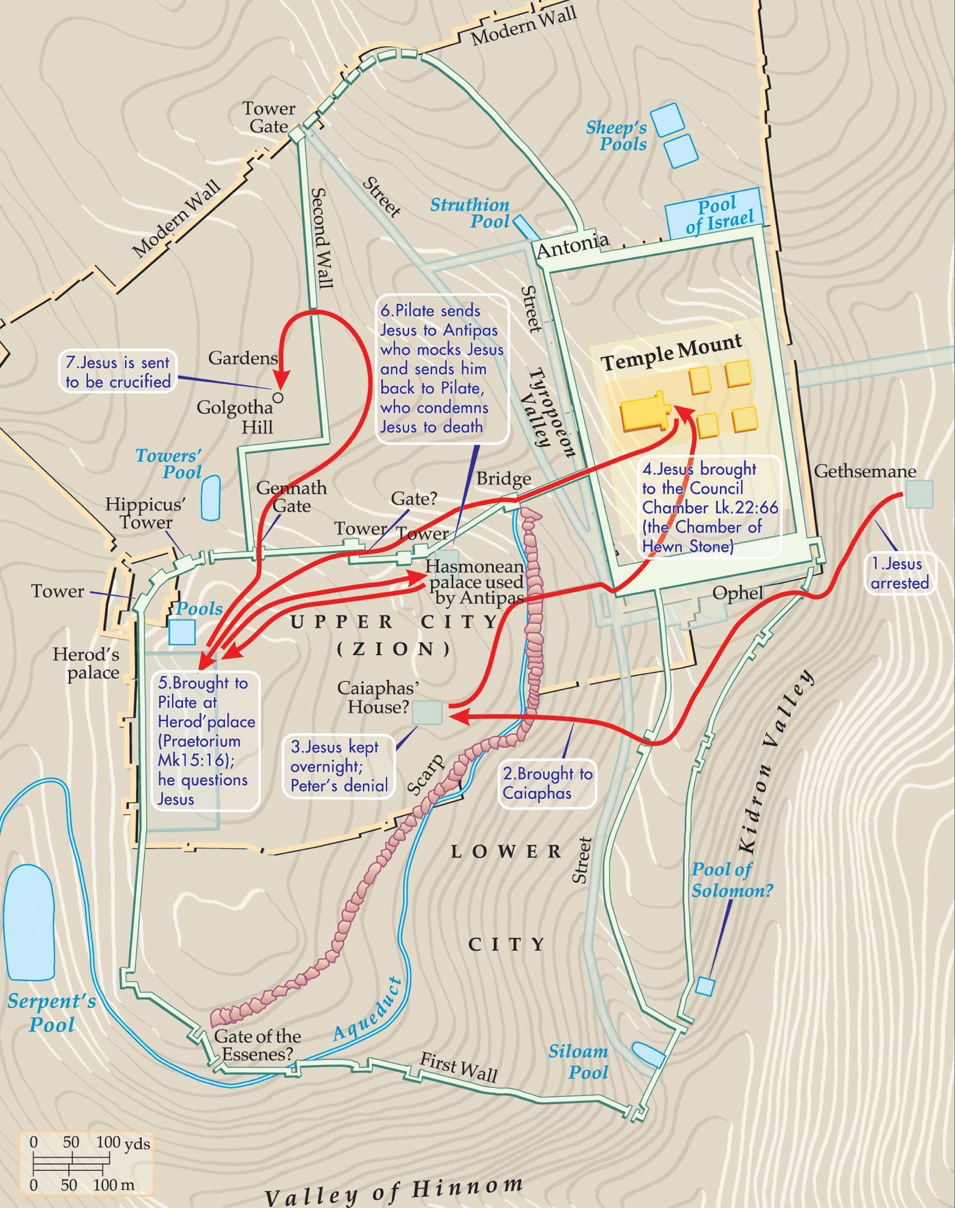
This one is a current favorite:
TSB Caption: The arrest, interrogation and execution of Jesus
4. Case Study: The Sacred Bridge on The Holy Gospels
The thoroughness of The Sacred Bridge is evident throughout the atlas. In chapter 22, “Historical Geography of the Gospels,” R. Steven Notley looks at “significant events that may benefit from a historical and geographical reading of the text.” He points out: “In many instances the location and nature of the recorded sites have been lost in time.” But “modern archaeology together with a careful reading of the ancient witnesses” (especially Josephus in this chapter) give him a basis from which to elucidate the assumed geographical setting of the Gospel writers.
Here are the sections of the chapter on the Gospels:
The Birth of Jesus and the Flight into Egypt
The Geographical Setting for the Ministry of John and the Baptism of Jesus
From Nazareth to Capernaum
The Sea of Galilee: Development of an Early Christian Toponym
The First-century Environs of the Sea of Galilee
Literary and Geographical Contours of “The Great Omission”
The Last Days of Jesus
From the Empty Tomb to the Road to Emmaus
Excursus 22.1: Jesus and the Myth of an Essene Quarter in Jerusalem
This single chapter is some 30,000 words.
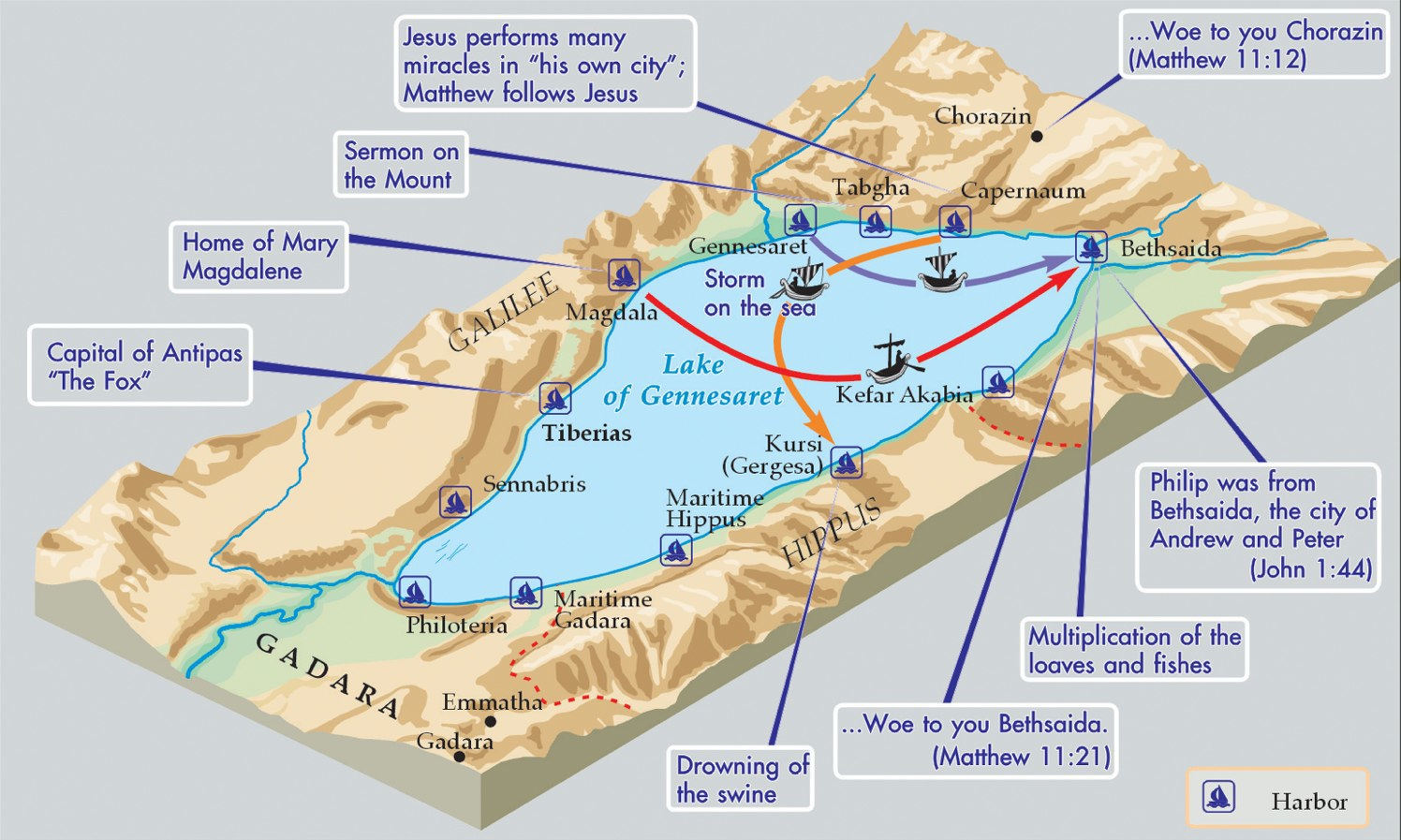
The most immediately useful part of the chapter was the 3-D map of the Lake of Gennesaret, also known as the Sea of Galilee. The map is followed in the text by descriptions of Tiberias, Capernaum, and the now elusive-to-locate Bethsaida. Here is the map, which you can click or open in a new tab/window to enlarge:
Around the Lake of Gennesaret (Sea of Galilee) (Carta’s caption)
And then there is the section, “The Sea of Galilee: Development of an Early Christian Toponym.” For as familiar as “the Sea of Galilee” is to the Christian lexicon, that place name only occurs, Notley rightly points out, in these verses: Matthew 4:18, 15:29; Mark 1:16, 3:7, 7:31; John 6:1. He convincingly notes:
The uncommon nature of this toponym is indicated in the Fourth Gospel by the Evangelist’s need to further define it with an additional genitive more familiar to his readers: “After this Jesus went to the other side of the Sea of Galilee [which is the Sea] of Tiberias” (Jn 6:1).
What then follows is an analysis of the references of Josephus, Pliny, and Maccabees to this lake. Notley’s command of Hebrew, Greek, Latin, and Aramaic help him to unpack for the reader, among other things, why this lake is called a “sea” (haven’t you always wondered?):
We are still left with the unusual application of the term θαλασσα by Matthew, Mark and John to the Lake of Gennesar, and the related question of the origins for the Christian toponym η θαλασσα της Γαλιλαιας (Mt 4:18, 15:29; Mk 1:16, 7:31; Jn 6:1). The name ים כנרת (Sea of Chinnereth) for the lake occurs three times in the Hebrew Scriptures (Num 34:11; Josh 12:3, 13:27) and is rendered by the Septuagint θαλασσα Χενερεθ (or Χεναρα).
But Notley is not convinced that Matthew, Mark, and John drew inspiration just from the Septuagint’s rendering of the Hebrew ים as θαλασσα.
Instead, the genesis for the Christian toponym may be indicated by Matthew’s scriptural citation immediately prior to his first use of the Sea of Galilee.
This uniquely “Christian toponym” of “the Sea of Galilee” has to do with how Matthew appropriated Isaiah 9:1:
Isaiah’s intentions notwithstanding, Matthew took advantage of the Septuagint’s rendering of the common noun גָּלִיל to read Galilee. Further, the Evangelist collapsed three widely divergent points of geographical reference to a single topos—the region around Capernaum that served as the locus for Jesus’ ministry.
And:
Drawing upon the Septuagintal vocabulary of Isaiah 9:1 (Θαλασσα and Γαλιλαια), the early Church created a new toponym that provided an elliptical allusion to Isaiah’s prophecy and underscored the biblical significance of the locus of Jesus’ ministry. If our observation is correct, we can now understand how the term Θαλασσα —which in the Septuagint’s translation of Isaiah initially spoke of the Mediterranean Sea—was transferred to another body of water, namely the Lake of Gennesar.
I appreciated Notley’s tentativeness in his conclusion (“If our observation is correct”). If the reader does not agree, she or he will still find Notley’s reasoning and detailed exposition compelling, even if a re-reading or two of his argument might be warranted. (And this is just one section of one chapter of The Sacred Bridge! The book is truly a gold mine.)
That’s not even to mention “The Last Days of Jesus,” a section in this same chapter that compellingly describes Jesus’ final journey to Jerusalem, culminating in his arrest and crucifixion. It is from this section that the graphic in my section 3 above comes.
5. The Younger Sibling of TSB
The Sacred Bridge is dense, technical, and not cheap. It’s worth its price ($120 retail, a little less at Amazon), but what about another way of accessing much of the same information and maps? TSB has a younger sibling, Carta’sNew Century Handbook and Atlas of the Bible (CNCHBAB).
CNCHBAB is less concerned than The Sacred Bridge is with “citing all available historical sources in their original languages.” The absence of such citations in “in their original script” is a main way in which the smaller Handbook differs from TSB.
Carta’s New Century Handbook and Atlas of the Bible is shorter, too. It omits almost all of the Excursuses of TSB, as well as omits a few whole chapters. The publisher describes it as “a select rather than a condensed version.” In “Historical Geography of the Gospels,” for example, TSB‘s detailed and technical (yet fascinating) section, “The Search for Bethsaida,” is left out altogether.
CNCHBAB is more accessible and cheaper (by about half) than The Sacred Bridge. There are entire sections in the Handbook and Atlas that appear verbatim as in The Sacred Bridge. This is good in terms of getting at the content of the latter, though not all potentially unfamiliar terminology has been explained or eliminated in the Handbook and Atlas:
The final phase of Herod’s palace in Jericho was the largest and most ornate. Concrete walls were faced with Roman-style plastering, opus reticulatum and opus quadratum, perhaps indicating the direct involvement of Roman builders and architects in the construction.
All the same, an advanced undergraduate course in religion or biblical studies could–with the guidance of the professor, as needed–make quite good use of Carta’s New Century Handbook and Atlas of the Bible for a textbook. For that matter, a seminary course could use it well, though any sort of doctoral studies–especially in archaeology or biblical geography–would call for use of the full Sacred Bridge.
6. A Few Points of Critique
My primary point of critique in using the print edition is that there is no Scripture reference index. It seems to me that one of the ways a person would come to the atlas is with a biblical verse or passage in mind, and want to find right away what TSB has on a passage under consideration. TSB in Accordance obviates the need for such an index, since one can use the Scripture search field to search the atlas by reference.
And this lack is not insurmountable in the print edition, as one can turn to the index to find any place names of interest in a particular passage. Besides, TSB covers so much primary literature, and deliberately seeks to address “every available documentary source,” such that to be true to its aim, a Scripture index would have to also be accompanied by other primary source indices. Given how many sources TSB cites, I understand the omission.
But, as noted in 1.C above, the index in TSB is well-produced, even without a Scripture index per se.
It would be unfair to fault an atlas with an academic audience for frequent use of technical terminology, so I point it out not as a critique, necessarily, but the reader should be advised of the need to know (or look up) words such as: steppe, opus reticulatum, legerdemain, sartorial, toparchy, etc. The occasional sentence, jargon aside, is lengthy and potentially difficult to follow on first read. But the overall style is readable and engaging.
7. EXCURSUS: My Seven-Year-Old Son Loved It
Bonus: TSB made for a good 20 minutes of bedtime reading with my seven-year-old son, shortly after I first received the atlas. (We’ve returned to it since then, too.) He knows the Hebrew alphabet and a little bit of Hebrew, and his Jewish friend at school had told him all about the Maccabees, so he loved looking and reading through the atlas with me! “Cool!” and “Wow!” were his most oft-used descriptors. Here he is:
Is TSB the Best Bible Atlas ever? Yes, without question. Is it worth the price? Yes, certainly.
When it comes to biblical cartography and historical geography, it doesn’t get any better, more thorough, or more interesting than The Sacred Bridge.
Here is TSB‘s product page for more information. You can also find the atlas here through Eisenbrauns, its North American distributor. Accordance has it available electronically, as well.
TSB‘s younger sibling, Carta’sNew Century Handbook and Atlas of the Bible, is here (Amazon), here (Carta), here (Eisenbrauns), or here (Accordance).
Many, many thanks to the fine folks at Carta and Eisenbrauns who set me up with a copy of TSB to review, both in print and Accordance. The publisher at Carta is one of the nicest and most interesting people with whom I’ve corresponded since starting Words on the Word more than two years ago.
There are a lot of upgrade options. The upgrade process has not been as clear as it could be. But I think I’ve figured it out–and I was a beta tester! So if it hasn’t been clear to me, my hunch is that’s true for others, too.
In case it’s helpful to anyone else, here’s a short post on how to get Logos 6.
1. Free, Bare Bones, Later
On February 3, 2015, Faithlife (umbrella company for Logos) will make its Logos 6 engine free. It won’t have the datasets (mentioned below), nor the Interactives (see here), but I believe it will have basic improvements like the Search Everything and notes upgrades.
2. Crossgrade: Keep Your Current Library, Get Some (or All) of the New Features
Check out Logos 6’s new features here. I mentioned in my review of Logos 6 that the Interactives are, I think, the best part.
There are three crossgrade levels, and they’re pricier than you’d expect. They’re all noted and compared here. Crossgrades don’t give you new books, but they get you the Logos 6 engine (i.e., software), as well as its new features, interactive resources, media, and datasets. (I’m especially impressed at the moment by the Propositional Flow Outline.) As one of Logos’s pages puts it: “The crossgrade packages allow you to power your existing library with the new Logos 6 features.”
3. Base Package: Buy a Bigger Library, Get Some (or All) of the New Features
This is where it gets confusing. You can buy a Base Package–and previous purchases count toward your customized dynamic pricing–that gives you new texts, books, etc. and that gives you some or all (depending on the Base Package level) of the datasets, media, and interactive resources.
So if you bought Logos 5 Gold, Logos 6 Gold will cost you money, but not nearly as much as if you’re buying for the first time. Logos 6 Gold supplies you with all the new datasets and features, as well as some new books and commentaries.
For Base Packages you can choose from Starter, Bronze, Silver, Gold, all the way up through the Collector’s Edition. If you buy Bronze, for example, you get new books and some of the new datasets and interactive resources in Logos 6, but not all.
Making your decision more potentially difficult is that Logos offers denomination-based base packages at various levels.
UPDATE: Get 15% off base packages here, or use the promo code ABRAMKJ6 when you checkout with a base package in your Logos cart.
Logos 5 had what was acknowledged by the company to be an unclear rollout and upgrade process. The Logos 6 rollout has been better, but still could have been clearer (and should be simpler, perhaps with less options?).
The best single, succinct summary Logos has published on upgrading can be found here.
I never did get the 2048 tile. I’ve beaten the last boss on Sky Force, but there are still parts of the game I haven’t unlocked.
While I’ve found lots of ways to use the mobile iOS device productively (I’m looking especially at you, OmniFocus), I have also been on the lookout for good diversions.
Enter Threes.
The obvious comparison is to 2048, but this game has more character. The numbers, for example, have names:
Say Hello to Threejay
If you look closely at the 6 and the 3 on the bottom row, you can see they’ve got little faces, too. And–the best part of the game–they make sounds and talk to you when you move them around to add them together: “Hi!”, “Hello!”, “Hey, guys!”, “Okay,” “Sup?”, etc. Sometimes a tile might even growl at you. (Right now my three kids are laughing at the sound effects and repeating them while my wife plays. I need to finish this post and get back to the game!)
The 1 tile can only be added to the 2 tile, and vice versa.
Tiles with numbers 3 and up each combine with the same number (3 with 3, 6 with 6, 12 with 12, etc.).
The game offers a really simple, quick tutorial to get you started.
Here’s what a board-in-progress looks like:
Being able to see the next tile (by color–at the top of the screen) is a nice advantage.
There’s a good sense of humor throughout the game (already noted above). Even the “Clear Scores” option says, “This will clear the data but not the memories.”
And you get confetti when it tallies up your final score, after you are out of moves:
It’s fun for the whole family, kids to adults. 2048 was free, but this is easily worth the $1.99, which gets you the app both on iPhone and iPad. Find it here.
Thanks to the maker of Threes for giving me a download for the review.
May Prof. Rodney Decker rest in peace. One of his final contributions (gifts) to the Greek-learning community was this exciting new grammar, which I just received in the mail from Baker Academic yesterday:
Here is the description from Baker’s site:
This in-depth yet student-friendly introduction to Koine Greek provides a full grounding in Greek grammar, while starting to build skill in the use of exegetical tools. The approach, informed by twenty-five years of classroom teaching, emphasizes reading Greek for comprehension as opposed to merely translating it. The workbook is integrated into the textbook, enabling students to encounter real examples as they learn each new concept. The book covers not only New Testament Greek but also the wider range of Bible-related Greek (LXX and other Koine texts). It introduces students to reference tools for biblical Greek, includes tips on learning, and is supplemented by robust web-based resources through Baker Academic’s Textbook eSources, offering course help for professors and study aids for students.
Looks great! After a quick flip through, what stands out most is that the vocabulary lists at the end of each chapter include frequency counts for both the New Testament and the Septuagint.
Logos 6 sports a number of new features. Here are my favorite ones so far. Click on any image or open in a new tab to see it larger.
1. Interactives
This is the most impressive part of Logos 6, in my view.
I would have loved to have the interactive “Psalms Form and Structure” when preaching through the Psalms this past summer. You can click on any of the Psalm bubbles above to get a structural outline and more information. As you can see in the left sidebar, you can sort the Psalms visually by genre (really helpful), attribution (author), and more. Out of all the Interactives, this one is my favorite: visually appealing and really practical. There’s also an Interactive for the Proverbs.
Searching your Logos library for “type:Interactive” pulls up all the Interactive resources in Logos 6. Here are a few more worth highlighting:
Bible Outline Browser: for any given Bible passage, it shows you any Bible text outlines in your library, so you can compare various ways of dividing the text.
Morphology Charts: if you’re looking at a Hebrew or Greek Bible text, you can click to see all the biblical uses of a given lemma in its various forms, and with frequency. A great feature for language learning.
Text Converter: it takes any Greek or Hebrew you put in and automatically translates it for you. As much as I try to use Greek and Hebrew, I’m still not very good at writing or reading them in their transliterated forms. This is a really handy resource. P.S. Handy tip of the day: You can already transliterate online, via Logos, free.
Hebrew Cantillation Structural Diagrams (!): uses the cantillation marks in the Hebrew Bible “as a clue to the structure” to turn the passage into a “hierarchical flow diagram.”
Here’s Logos’s video of the Psalms Form and Structure:
2. Factbook
It’s not the CIA, and it’s not Facebook, although it does sort of function like an amalgamation of the two (in a good way).
Factbook looks and feels like one of the Guides (Exegetical or Passage) Logos has, and updates what in Logos 5 was called Bible Facts.
Basically any noun (people, places, things, Bible books, events, etc.) pulls up a corresponding Factbook panel. If I’m researching Isaac, for example, typing “Isaac” into Factbook will pull up multiple collapsible hyperlinked sections where I can learn more about him: events in which he’s involved, resources in my library in which he appears (that I can click on for more), even a nifty “Referred to as” sub-section, so I can find all his mentions as “my son,” which is important for understanding Genesis 22, for example.
3. Search Everything
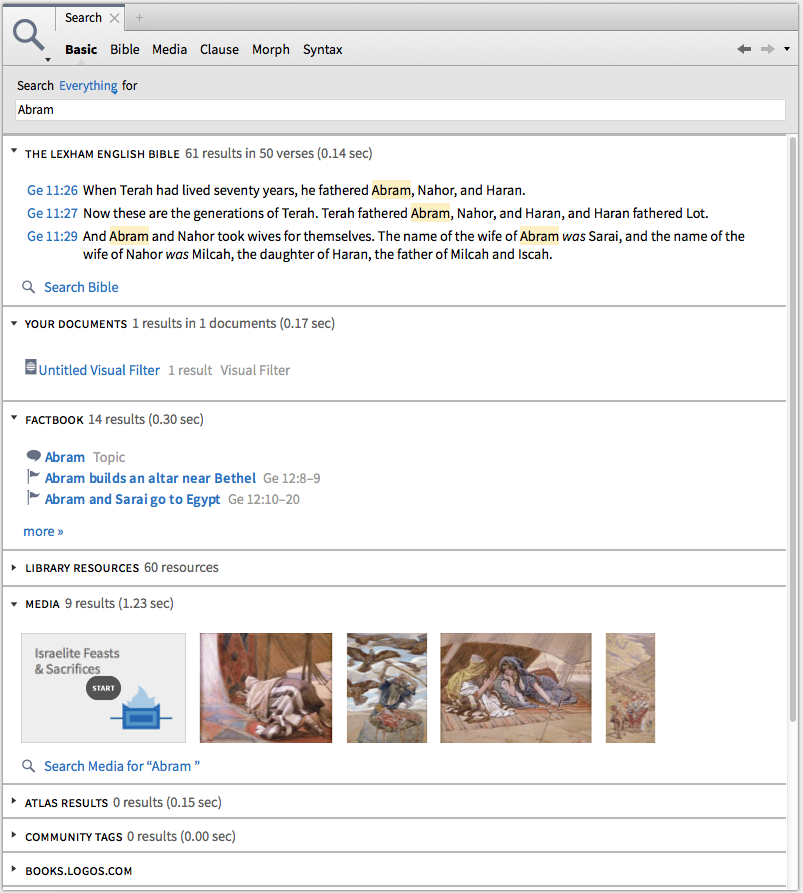
You can search across Bibles and commentaries and resources. Here are hit results, all of which are hyperlinked and can be explored for more, when I search everything for Abram:
The new Inline Search feature (watch it in action here) is pretty cool, too.
4. Ancient Literature / Cultural Concepts
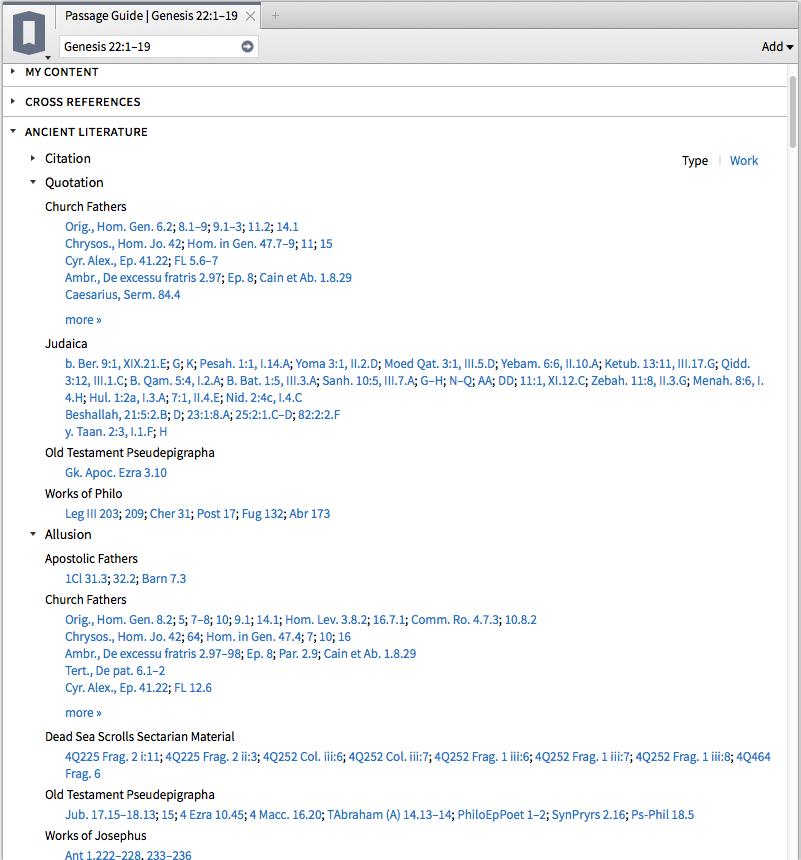
These are two new sections that can be accessed in the Guides (Passage Guide, Exegetical Guide, and Sermon Starter Guide is how I’ve gotten them). Have a look, and note that Ancient Literature is even sub-divided into Quotations, Allusions, and more:
and:
Need for Speed
I run Logos 6 on an early 2008 iMac, but with a hard drive that’s been replaced in the last year. As a point of comparison, Accordance runs well on the same machine and returns search results quickly.
Logos’s lack of comparative speed on a Mac (even newer ones) improved between Logos 4 and 5. And you can see that the search times in the Search Everything query above are quite fast and impressive. However, it’s not uncommon even in Logos 6 for what I would consider a simple search to take 3 to 5 seconds (or more) to return results. The frequent Indexing and “Preparing Your Library” messages on startup are a pain that I really hope Logos pays attention to improving (or eliminating), especially for Mac users.
I do understand from the Logos forums that PC users and those with Solid State Drives see faster performance, but I would use Logos more often if it had consistently faster overall performance.
Interactives for Sermon Preparation
All that said, the Interactives alone (which are not sluggish) make Logos 6 worth the price of the upgrade. Sure, you can Google “Israelite Feasts and Sacrifices” and hope for the best. Or you can open the Interactive in Logos and see (and sort) this:
And this:
How to Get Logos 6
Check out Logos 6 here, and use the promo code ABRAMKJ6 when you checkout with for 15% off base packages.
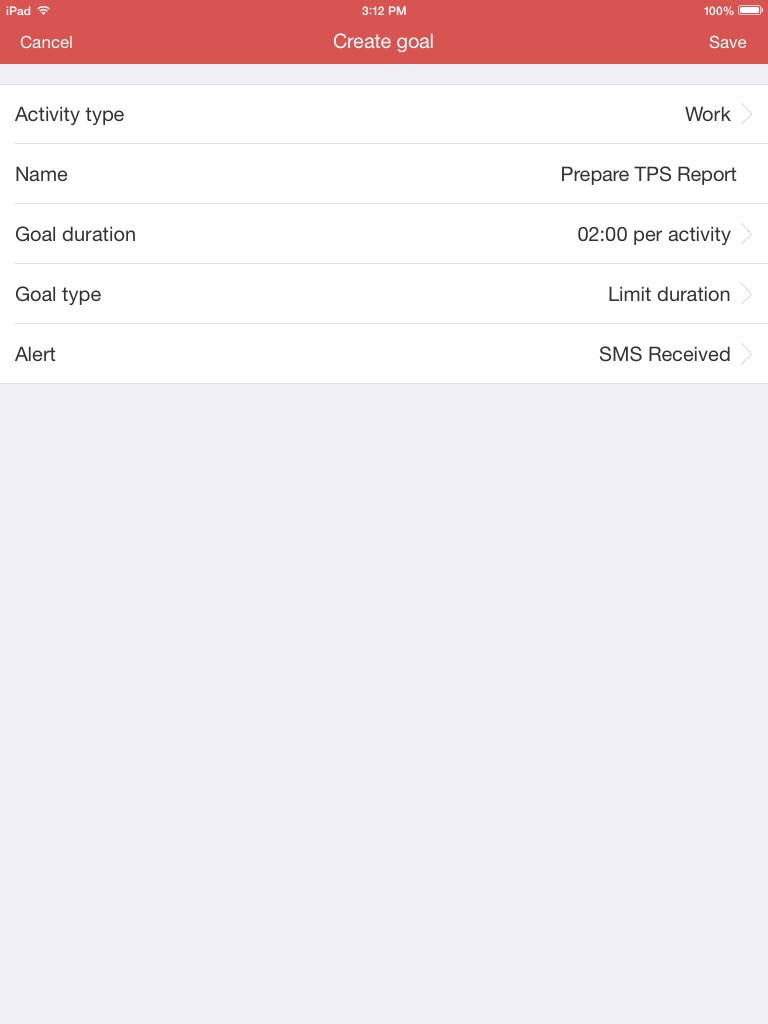
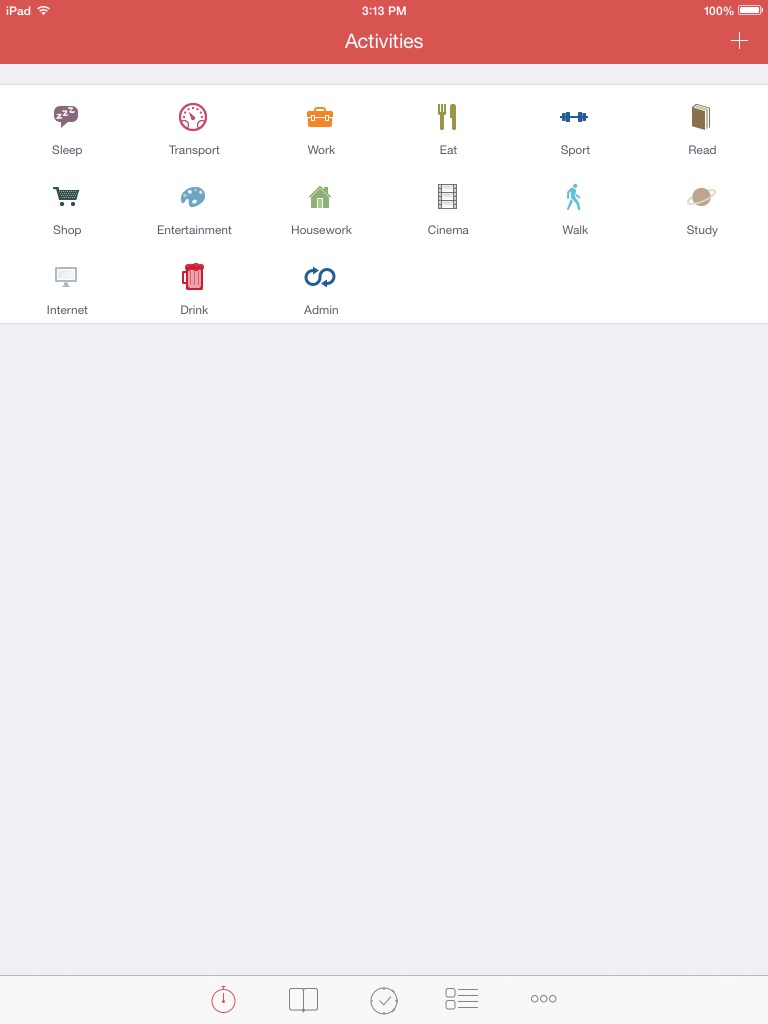
A solid time-tracking app for iPad and iPhone–aTimeLogger 2–is free for a limited time.
I’ve made some use of Hours (iPhone only), OfficeTime (iOS and OSX), and StopWatch Plus (OSX). Expect a report back. For now, you can download aTimeLogger, since it’s free at the moment, and see what you think.
Here is a list of features from the developer’s write-up:
– easy and intuitive interface
– goals
– pause/resume activities
– groups
– simultaneous activities (enable them in Settings)
– many statistics available in form of graphs and pie charts
– reports in different formats (CSV and HTML)
– backup and restore
– a huge number of icons for activity types and ability to upload custom icons
– the best support 🙂
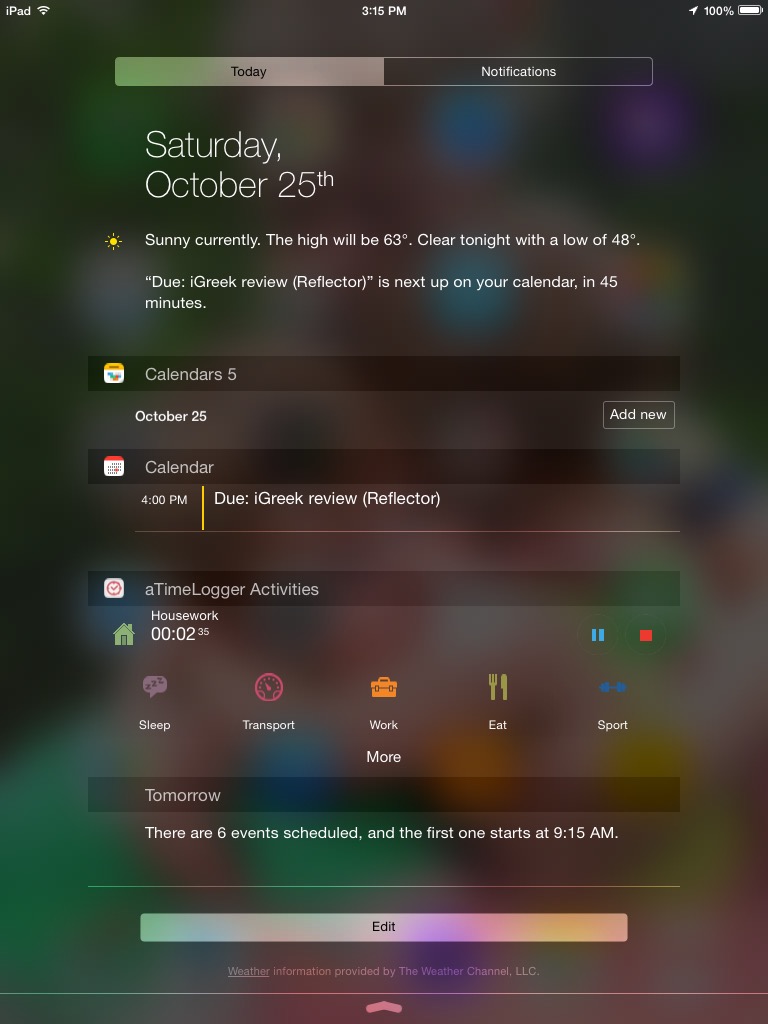
The layout is clean and the app fairly easy to figure out how to use. With iOS 8 aTimeLogger 2 introduced widgets so that you can just swipe down on your screen (without unlocking it) to update your time logs.

 Last week we received a kindness in the mail from a new friend in Israel–F.F. Bruce’s Bible History Atlas.











 Words on the Word