When God Spoke Greek (Upcoming Book Blog Tour)

TML book

In July I’ll be joining a group of bloggers in reviewing Timothy Michael Law‘s forthcoming When God Spoke Greek: The Septuagint and the Making of the Christian Bible.

Brian LePort at Near Emmaus is hosting. Here is the schedule for the tour:

BRIAN LePORT (Friday, July 19th)
Introducing the blog tour

JOEL WATTS (Sunday, July 21st, http://unsettledchristianity.com/)
1 Why this Book?
2 When the World Became Greek

ANDREW KING (Tuesday, July 23rd, http://blogofthetwelve.wordpress.com/)
3 Was There a Bible before the Bible?
4 The First Bible Translators

KRISTA DALTON (Thursday, July 25th, http://kristadalton.com/blog/)
5 Gog and his Not-so-Merry Grasshoppers
6 Bird Droppings, Stoned Elephants, and Exploding Dragons

ABRAM K-J (Saturday, July 27th, https://abramkj.com/)
7 E Pluribus Unum
8 The Septuagint behind the New Testament

JESSICA PARKS (Monday, July 29th, http://facingthejabberwock.wordpress.com/)
9 The Septuagint in the New Testament
10 The New Old Testament

AMANDA MacINNIS (Wednesday, July 31st, http://cheesewearingtheology.com/)
11 God’s Word for the Church
12 The Man of Steel and the Man who Worshipped the Sun

JAMES McGRATH (Friday, August 2nd, http://www.patheos.com/blogs/exploringourmatrix/)
13 The Man with the Burning Hand vs. the Man with the Honeyed Sword
14 A Postscript

There still (shocking!) aren’t that many books about the Septuagint, so I’m sure this will be a welcome addition. Law writes on his blog, “I shall not rest until there is a Septuagint in the hand of every woman, man, girl and boy.”

I think he’s kidding (but not sure about this), but TML loves his LXX. I’m looking forward to being part of the review. More to follow here.

Seven Events that Shaped the New Testament World, reviewed

PrintWhat was the world–or, better, what were the worlds–in which early Christians lived?

Seven Events that Shaped the New Testament World answers that question by highlighting seven key “events” in the seven or so centuries surrounding Jesus. Here, from the table of contents, is what the book covers:

1. The Death of Alexander the Great (323 BCE)
2. The Process of Translating Hebrew Scriptures into Greek (ca. 250 BCE)
3. The Rededication of the Jerusalem Temple (164 BCE)
4. The Roman Occupation of Judea (63 BCE)
5. The Crucifixion of Jesus (ca. 30 CE)
6. The Writing of the New Testament Texts (ca. 50-ca. 130 CE)
7. The Process of “Closing” the New Testament Canon (397 CE)


Author Warren Carter uses each of the seven “as entry points, as launching pads, to talk about these significant and larger realities.” As one reviewer (whom I read before I read this book) pointed out, these events are not all “events,” per se. Events 2, 6, and 7 above are extended processes. Similarly (as the same reviewer also noted), the writing of the New Testament and the closing of its canon didn’t shape the NT world; they emerged from it.

That’s perhaps just a technicality, though. Carter seeks to be “transparently selective,” using “each event as a focal point for larger cultural dynamics and sociohistorical realities” of New Testament times.

Here is author Warren Carter introducing his book:


Carter’s analysis of how historical events shape culture–and how that should influence how we read and understand the New Testament–is incisive and engaging. Early on he writes, “Hellenistic culture did not suddenly replace all other cultures but entangled itself with local cultures to create multicultural worlds.” Given my interest in the Septuagint, I really appreciated his take on that Greek translation as “a way to negotiate a multicultural world.” He deftly explains to readers the intersection between Jewish, Greek, and Roman cultures.

Photographs, sidebars, and occasional footnotes contribute to the level of detail Carter provides. And yet his tone is conversational, and his narrative re-tellings engaging. Last summer I wrote about how I wanted to see Mark Wahlberg or Matt Damon in a film adaptation of 1 Maccabees. Carter’s narrative (ch. 3, “The Rededication of the Jerusalem Temple (164 BCE)”) is nearly as engaging as such a movie would be. In addition to telling the narrative, he has a sidebar on “identity markers” that unpacks the role played by boundaries of identity in Jewish and other religious traditions. His explanation of the difference between 1 Maccabees and 2 Maccabees was easy to follow and illuminating.

The conversational tone at times was a little too conversational for me. There is frequent reference to “the early Jesus movement,” when “early Christianity” would have sufficed. So, too, “Jesus-followers” could just have been called “Christians,” which I would have found less distracting. Of course, a biblical scholar will note that any of these terms are “problematic,” but the more conventional ones would have made for a smoother read, in my view. And I could have done without reference to early Christians as “reading with Jesus-glasses on” and statements like, “Only bad boys were crucified in Rome’s world,” not to mention the description of Alexander the Great as “a macho man, an action figure.”

I also thought that his emphasis on cultural backdrops was occasionally too strong. For example, comparing Jesus to Alexander, he writes, “In many ways, this presentation of Jesus as the man with great power who rules everything imitates and competes with the presentation of manliness that we have seen with Alexander, the world conqueror.” To speak about Jesus in terms of degrees of “manliness” is perhaps a category mistake. Carter’s mention of Philippians 2 and Jesus’ self-emptying is spot on, of course–I’m just not sure that Paul has imperial powers and the social construction of “manliness” in mind when he writes to Philippi.

Theologically conservative/evangelical readers will bristle a little bit at Carter’s statement about the New Testament that readers today “need to discern when to read against the grain” when it comes to groups that the NT seems to exclude. I don’t read Paul and the NT as “not always gracious to women,” as Carter does, and don’t think he somehow needs to be explained away in this manner. Of course, not all who read this review will agree with me either!

Those criticisms being present, Carter succeeds in the book’s aim: “The seven chapters of this book provide an orientation to some important aspects of the early Jesus movement and the New Testament. Reading it will enlighten you about the beginnings of the Christian movement and help your understanding of the New Testament.”

Though I did not agree with Carter on all his assessments, his description of seven key “events” (as well which events he chose to highlight) has enhanced my understanding of and appreciation for the context into which Jesus came and in which the church was born. As long as one reads critically (as one should always do), Carter provides a wealth of helpful information that is accessible to just about any student of the Bible.

Thanks to Baker and NetGalley for the e-galley to review. The book is on Amazon here. Its Baker product page is here. You can download a sample pdf of the book here. There is also a helpful interview with Carter here.

Not as Literal as You Think? A Review of One Bible, Many Versions

One Bible Many Versions

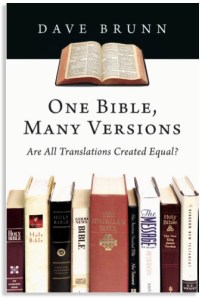
“Are literal versions really literal?” So asks Dave Brunn in One Bible, Many Versions: Are All Translations Created Equal? Brunn is a missionary and educator with extensive Bible translation experience. Noting that the Bible is “virtually silent” on “the issue of translation theory,” he seeks in his book to answer questions like:

  • “How literal should a Bible translation be?”
  • “What makes a translation of the Scriptures faithful and accurate?”
  • “What is the significance of the original form and the original meaning?”

He examines versions as diverse as the Message, the New Living Translation, the New International Version, the English Standard Version, and quite a few others. He lists examples on both the word level and the sentence level to show that “every ‘literal’ version frequently sets aside its own standards of literalness and word-for-word translation,” when slavish literalism would compromise meaning in the target language. For example, the New American Standard Bible–hailed as one of the most literal English translations–takes Genesis 4:1 (Hebrew: [Adam] knew [Eve]) and translates knew as had relations with. This accurately captures the meaning of Gen. 4:1, but it is not word-for-word.

So, too, with the ESV: Mark 9:3’s “no cloth refiner on earth” becomes “no one on earth” (among many, many examples Brunn gives).

At issue here is the relationship between form and meaning. He writes:

The form includes the letters, words, phrases, sentences, paragraphs, and so on. The meaning consists of the concepts or thoughts associated with each of the forms. Both elements are essential in all communication. …[I]t could be hard to argue that one is more important than the other.

To translate, Brunn points out, is to necessarily change the form. The only way to keep the form of Hebrew or Greek is to leave the text in Hebrew or Greek. There is no such thing as “consistent formal equivalence” between “any two languages on earth.” Brunn (rightly, in my view) suggests that it is okay (even necessary) “to set aside form in order to preserve meaning,” but that one should not sacrifice meaning for the sake of preserving form. Besides, he points out, no translation (not even the most “literal” one) sacrifices meaning every time for the sake of formal, word-for-word equivalence.

Brunn drives his point home especially well by making reference to other languages. Perhaps folks argue about literalness in English translations because of English’s linguistic/familial relationship to Greek. But what about non-Indo-European languages, Brunn asks? “As long as the debate about Bible translation stays within the realm of English translation, the tendency will be to oversimplify some of the issues,” he writes. “I believe that many well-meaning Christians have unwittingly made English the ultimate standard.” His examples of translation challenges going from English to Lamogai (the language into which he worked with others to translate the New Testament) reinforce his idea that word-for-word equivalence is simply not possible across languages. (Lamogai, for example, uses gender-neutral terms to refer to siblings, whereas Greek and English do not.)

The translations that people fight over have more in common than we may first realize. Brunn calls for unity among Christians when it comes to what translations we use. “If we set any two English Bible versions side by side,” he says, “We could easily find hundreds of instances where each version has the potential of strengthening and enhancing the other.” (Indeed, there are even times when less “literal” versions like the NIV or NLT seem to stay closer to the original languages at the word level than versions like the ESV or NASB.)

Knowledge of Hebrew and Greek is not needed to profitably use One Bible, Many Versions, though Brunn does have footnotes for “readers who are already knowledgeable in translation issues.” His numerous charts clearly show the difference between form and meaning in multiple translations.

Brunn gives good guidelines for Bible readers and translators alike, as they seek to discern what translations to use and how to think about translation theoretically. Especially in the second half, the book felt a little repetitive–I didn’t think Brunn needed as many examples to make his point that literal translations don’t consistently adhere to their own standards. Though perhaps those who need more convincing will appreciate the extensive charts.

What I was most impressed by was Brunn’s obvious high regard for Scripture, together with a pastoral sense of how to navigate the so-called Bible translation debates. In addition to these, the care with which he analyzed translations and compared them to each other made it easy to follow (and agree with) him. Whether you’re interested in Bible translation or exploring the differences between various versions, One Bible, Many Versions is an engaging and informative guide.

Brunn has a Website here; the book’s site is here.

Thanks to IVP for the review copy. You can find the book on Amazon here, and its IVP product page here.

The Honest Toddler: A Book Review

Being a parent is very simple. There is no reason for you to constantly go to other adults who do not know your toddler for advice or conspiring. What happens at home stays at home. …When it comes to being a good parent, the most important resources are the words that come out of your child’s amazing mouth. If your child is too young to speak, guess accurately on the first try.

–Honest Toddler

Honest Toddler, under the supervision of mom Bunmi Laditan, has now added a full-length book to a popular and cathartic Twitter feed, Facebook page, and blog/Website. I’ve posted quite a bit about HT at Words on the Word already.

Real-life Honest Toddler is a girl, but HT is “asexual,” which makes the whole thing more universal.

And now, s/he has written a parenting guide. The chapter titles alone produce enough laughs to make the book worth the price:

  • Chapter 1: “Why Did You Do That?”: The Ins and Outs of Toddler Behavior and How to Leave It Alone
  • Chapter 5: Sleep: Weaning Yourself Off It
  • Chapter 18: Potty Training Simplified/Eliminated

Bunmi has tapped into the psyches of Every Parent because HT, in all the quirky specifics of his/her behavior, is Every Toddler. (“Give a toddler a rag and a spray bottle, and your house will be sparkling before you know it. First it will be soaking, and your mobile phone may have water damage, but after a thorough wipe-down, the results will please you.”)

This Child’s Guide to Parenting is thorough–HT includes everything from media recommendations (music, books, TV) to hygiene (“leave well enough alone”), from restaurant behavior to grandmas and grandpas (“you should learn as much as possible from your child’s grandparents”). Interspersed between chapters are letters from parents to HT and homework assignments (sample: “Visit the toy store and get all the things. Next, go to a field. Run until nightfall”).

The Honest Toddler is hilarious, brilliantly written, and often pointed in its humor (see: HT’s disdain for Pinterest). I was impressed by how much this little toddler had to say. Although, now that I think about it, my toddlers have always had a lot to say.

The open parent who reads this book will be perhaps re-conditioned: temper tantrums are just “loud responses,” toddler ignoring is simply “selective acknowledgement,” and whining is “a legitimate form of speech.”

Honest Toddler, for all his/her impossible demands (duh), has some great advice. Facebook, for example: “Toddlers are tired of hearing Facebook notifications during story time. We’re sick of having to sit in parked cars, fully strapped in, while you make sure you get the last word on a virtual dispute with an acquaintance. This website is a distraction. Log off. Permanently.” 

Communication: “Did you know that there are more than four hundred different meanings for ‘no’ in Toddler English?” (with a sample chart). Packing for vacation: “There’s no such thing as minimalism when it comes to packing for a trip with small children.”

Readers of HT’s blog, FB, and Twitter feed will recognize some material here (the “toddler-approved recipes” and physics breakdown of car napping), but not much. This is 256 pages of sheer, highly original, creative genius.

There are occasional moments of dark-ish humor (“There’s nothing special about a child [i.e., infant] who can’t go anywhere without a blanket over her legs”), but, then again, this was written by a toddler.

And, HT, if you’re reading: make sure your mom lets you watch Daniel Tiger’s Neighborhood. You’ll like it way better than Caillou.

If you’re a parent of a toddler or know one, The Honest Toddler is essential reading, if only to relax and laugh enough to keep one’s head in the game of toddler parenting. (If you’re interested in the possibility of a free copy, I’m giving one away here.)

I have to stop now; my own two-year-old just woke up to join us in watching the late-night basketball game and blogging, and now is requesting–you guessed it–Daniel Tiger and some water.

Many thanks to Scribner (imprint of Simon & Schuster) for the review copy, given to me for the purposes of an honest review. Find the book’s product page here. It’s on Amazon here.

And thanks especially to Bunmi/HT for making me a better parent. Or at least a parent who is able to laugh a little bit more and cry a little bit less as I raise my little ones.

New Mark Kozelek (Sun Kil Moon) & Jimmy LaValle (Album Leaf): STREAM

kozelek lavalle

Click here to hear a full stream of the new Mark Kozelek (Sun Kil Moon) and Jimmy LaValle album, Perils from the Sea.

I’ve been waiting for this collaboration for a quite some time. It already has one positive review. Three songs in, and the Koz’s precious nylon-string guitar is nowhere to be found.

Logos 5: Gold package, reviewed (part 2)

Logos 5

Logos 5 has been on the market for a few months now. How is it holding up?

I reviewed Logos 5 in several parts when it first came out last fall, looking especially at the Silver package. Those reviews are all compiled here.

Since then I’ve been using the Gold base package, which I began to review here. If you’re new to Logos and/or this blog, reading through the posts above all apply in review of Logos Gold. To summarize a bit, Silver and Gold base packages both have:

  • Features like Bible Facts, Passage Guide, Bible Word Study, Exegetical Guide, Sermon Starter Guide, Timeline, and more
  • Clause Search–about which I wrote more here
  • The New American Commentary set
  • The Pulpit Commentary set
  • Greek and English Apostolic Fathers
  • A new English translation of the Septuagint, The Lexham English Septuagint
  • A lot more

The Gold base package adds to Silver:

The full contents of Gold can be seen here, in comparison with the other packages.

In this concluding part of my Gold review, I want to look at some of the above features: one feature in-depth, and a couple others briefly.

Bible Sense Lexicon

Morris Proctor describes the Bible Sense Lexicon (BSL, hereafter) in this way:

The primary purpose of this feature is to present the range of possible meanings for Hebrew and Greek lemmas and then suggest precise contextual definitions for them as they appear in verses.

For example, the Bible Sense Lexicon shows that kosmos may have 12 different meanings, but in John 3:16 it refers to the world populace or people on the earth.

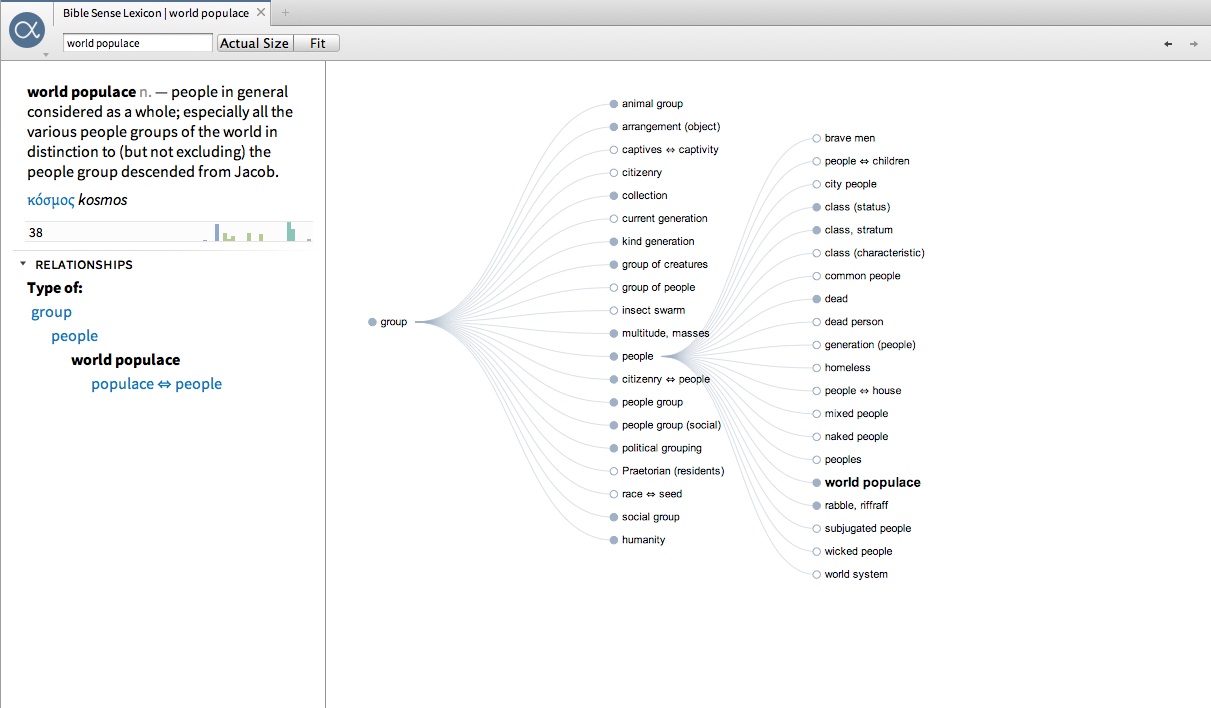
The BSL at the moment works just with nouns. There are several ways to access it. By right-clicking on kosmos (inflected as κόσμον) in John 3:16, the menu shows me that the “sense” is “world populace.” From there I can go directly to the BSL entry for this word, which gives its meaning (as determined by the team at Logos) in context. Here’s what the entry looks like (open in new tab or window to see larger):

BSL

The “sense” of kosmos is “world populace,” which is further defined at upper left: “people in general considered as a whole….” The number and bars underneath that show how that specific sense (not word) is distributed across books of the Bible. Mousing over it, one notes that “world populace” for kosmos occurs 22 times in John. The little bar graph is good for quick-reference, but it’s pretty small, and you can’t really click from it to any other information directly.

Proctor uses the image of “orchard with trees bearing branches” to describe the BSL. In this case, if you click on “group” in blue font (a “branch”), you are moved back to the “orchard” of “entity,” and its “tree” of “abstraction.” It is under entity | abstraction that the “branch” of group | people | world populace fits (to use Proctor’s analogy). As you move through various levels of the BSL in this way, the forward and back arrows at top right in the image above help you find your place.

In the branch system in the middle of the image, hovering over any word shows a pop-up with further information. Clicking on a filled-in blue circle expands the branch at that point.

One other way to use the Bible Sense Lexicon (which is properly called a “data set” in Logos) is to open it from the “Tools” menu in Logos. Doing that allows the user to look up any word, regardless of what passage may already be open. Typing in “g:kosmos” (“g” for “Greek”) shows the following 11 senses (as determined by Logos) in a drop-down menu:
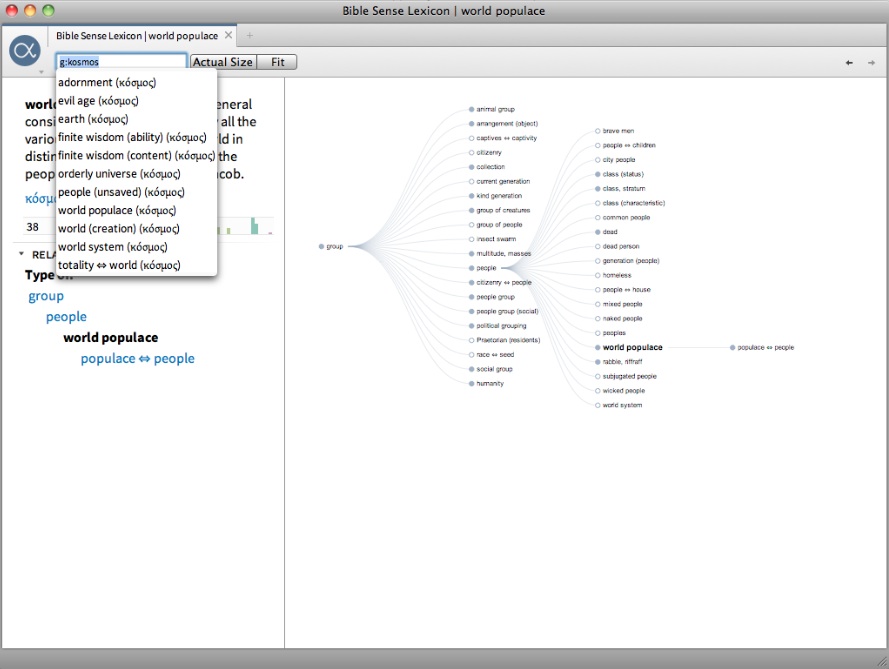
BSL_2

One could more fully explore kosmos by going through each of the senses, one-by-one.

There’s more to the BSL than what I’ve highlighted here. Watch the video at this page (and read the rest of the page’s text) for a quick but substantive overview from Logos. There is a detailed and really helpful Logos wiki page on the BSL, too.

The Bible Sense Lexicon is comparable in some ways to Louw & Nida’s Greek-English Lexicon of the New Testament Based on Semantic Domains. Context determines meaning of words, and the BSL works from that premise. There is right now no easy way to find a list of passages that use a word in the given sense you are looking at, as noted here. This and the fact that the BSL only has nouns for now are areas that need improvement. Louw & Nida, by contrast (also available in Logos), covers other parts of speech.

The Bible Sense Lexicon is available in the Gold package and up (or by using a crossgrade option).

Exegetical Summaries

Exegetical SummariesThis is a great commentary set for careful study of words, phrases, and verses. The Logos product page has this description: “The 24-volume Exegetical Summaries Series asks important exegetical and interpretive questions—phrase-by-phrase—and summarizes and organizes the content from every major Bible commentary and dozens of lexicons.”

A difficult phrase from Romans 1:17, for example, receives this treatment in the commentary (pdf), with lexical and exegetical options laid out. The pdf doesn’t show it, but in Logos the abbreviations and verses references are hyperlinked.

For sermon prep or research papers, the Exegetical Summaries Series could be a good starting point.

UBS Handbooks

UBS OTThese handbooks (OT and NT) are geared specifically toward translators, though any serious Bible student will appreciate them. The handbooks often discuss the decisions that various translations made for a given Hebrew or Greek word. A note on “Bethlehem Ephrathah” in Micah 5:2, for example, reads as follows:

Ephrathah is a term added perhaps to distinguish David’s Bethlehem from other towns or villages bearing the same name. Probably Ephrathah is a name for the district in which Bethlehem was located. It comes from the name of Ephrath, one of the clans which made up the tribe of Judah (Ruth 1:2). David’s family were members of this clan (1 Sam 17:12). It is probably best to translate Bethlehem Ephrathah as the name of the town. If this seems too long for a name in some languages, then it is all right to translate as “Bethlehem in the region (or district) of Ephrathah” (see NEB).

Whether one knows biblical languages or not, the level of detail in these verse-by-verse handbooks helps the user to more fully understand what is going on in the biblical text at any juncture.

Concluding Thoughts

My personal experience with Logos 5 (which was also true of Logos 4) is that it handles and operates more smoothly on a PC than on a Mac. More often than I’ve liked, I’ve found myself waiting for the spinning rainbow pinwheel after entering a search query or scrolling down through a resource. The speed issue is not really present on a PC, though. Having fewer tabs open on a Mac makes for fluid operation, but Logos on PC is the way to go for complex, involved operations with multiple resources open at once.

One strength Logos currently has over any other Bible software is how it syncs across computers and devices. Everything I do and save in my PC version of Logos will be right as I left it when I open it up on a Mac. Its cloud capabilities are tops.

I’ve reviewed individual resources in Logos, as well. You can find many of those by going through Words on the Word, if you are so inclined. One of Logos’s strengths is in the massive resource library it makes available. Much as I love the printed book, the convenience of accessing multiple biblical texts and commentaries from just about anywhere feels like nothing short of a 21st century luxury.

Thanks to Logos for the gratis review copy of Gold, given me with the sole expectation that I review it honestly here on my blog. Kudos are due again to MP Seminars, whose “What’s New” manual helped me more quickly apprehend the Bible Sense Lexicon.

Gary Burge’s Jesus and the Jewish Festivals, reviewed

Jesus and the Jewish Festivals

In college I thought my friend Chad was really cool (he was) for climbing on top of college buildings late at night and shouting the Shema at the top of his lungs… until he was corralled by Public Safety.

Sh’ma Yisrael: Adonai Eloheinu, Adonai echad!

I learned my first Hebrew in Gary Burge’s Christian Thought class my senior year in college. He had us reciting the Shema (Deut. 6:4-5) in no time. We’d stand and say it out loud at the beginning of class: Sh’ma Yisrael: Adonai Eloheinu, Adonai echad! (Hear, Israel: the Lord our God, the Lord is one!)

I was never quite as bold as Chad with my recitation of the Shema, but it’s stayed with me these past 11 years since taking Dr. Burge’s class.

Burge’s writing in Jesus and the Jewish Festivals is just as good as his teaching in the classroom. Burge, a Professor of New Testament at Wheaton College and Graduate School, focuses especially on the Gospel of John as he looks at Jesus and the Sabbath (ch. 2), the Passover (ch. 3), Tabernacles (ch. 4), Hannukah (ch. 5) and Jesus’ last Passover (ch. 6). Chapter 1 explores “the festivals of Judaism” more generally, while the final chapter (7) looks at what early Christians did with these Jewish festivals.

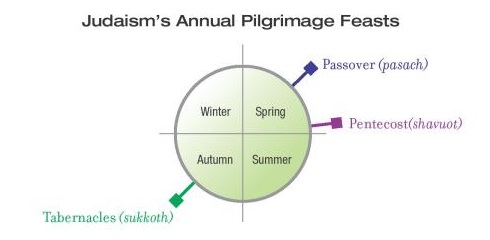
As Burge puts it, Judaism had three “great pilgrimage festivals”:

Burge_Pilgrimage Feasts

These three festivals

were based not only on the agricultural rhythms of the year, but also they served to tell the story of Israel’s salvation. Israel was rescued from Egypt (Passover, Pesach), Israel met God at Mount Sinai (Pentecost, Shavuot), and then Israel wandered in the wilderness (Tabernacles, Sukkoth). (122)

The chapters cover the original Jewish context of the festivals, Jesus’ relation to each, and then what faith looks like through the lens of that festival–both for Jews then and (especially) for Christians now.

As with other books in the Ancient Context, Ancient Faith series, Jesus and the Jewish Festivals is printed on glossy paper and full of high-quality, color illustrations. It’s like a guide book in that regard. I don’t know whether it was Burge or an editor or both, but the photographs and charts throughout the book are expertly placed and reinforce the text at just about every turn. For example, this image appears in conjunction with Burge’s description of the Passover:

Burge_Passover

As Burge recounts John 6 and the feeding of the 5,000, he notes that “Passover themes were swirling around almost every aspect of the story” (60). Further, Jesus “is the manna from God’s treasury for which Israel has been waiting. He had been sent by God as manna descended in the wilderness” (63). Then, there is always application to people of faith today: “Therefore celebrating Passover is not only knowing about what happened yesterday–though this is important–it is also about knowing the God who desires to feed us now” (65). I have always appreciated this way of approaching biblical studies with a doxological posture.

Another thing I appreciated about Jesus and the Jewish Festivals is the ease with which Burge uncovers layers of meaning in the Gospels, showing how Jesus related to the major themes of Jewish festivals. I found my own gratitude for Jesus’ sacrifice, for example, greatly enhanced by the author’s description of Jesus’ last Passover. As Burge puts it: “If we understand these festivals and their symbolism, then suddenly we understand the more profound things about Jesus and his work” (31, italics original). The color illustrations make Burge’s explanations even more vivid.

My critiques of the book are few and minor. At times there is what seems to be just a wee bit of speculation on the part of the author as he explores symbolism in John. For example, he says, “But I am convinced that Jesus wanted to die during the Festival of Passover because of the profound meaning it would convey with regard to his sacrifice” (102). Burge doesn’t further elaborate, and this seems a difficult (though not impossible) claim to support.

Jesus and the Jewish Festivals would be aided by a Scripture and subject index at the back of the book. I also found myself wanting more explanation of the Jewish calendar. Page 26 has a nice figure that shows all the months of the calendar of Judaism (together with various festivals noted), but a little more about its construction would have even further undergirded Burge’s tour of the festivals.

I really enjoyed reading Jesus and the Jewish Festivals. Not only did I find my knowledge and understanding of the Jewish festivals refreshed and expanded; I also grew in my appreciation of Jesus and his work due to the connections Burge made. This seems to have been an intention of this book, and in this regard, it is quite successful. Anyone who wants to better grasp Jesus’ words and work in the Gospels, whether pastor or parishioner, scholar or student, would do well to work her or his way through Burge’s short volume.

Thanks to Zondervan for the review copy. Jesus and the Jewish Festivals is on Amazon here. Its product page is at Zondervan’s site here.

Review of IVP’s Dictionary of the Old Testament: Pentateuch (final part 3)

IVP OT Dictionary Pentateuch

I’ve been spending some time the last few weeks with InterVarsity Press’s Dictionary of the Old Testament: Pentateuch in Logos Bible Software. You can read part 1 of my review here and part 2 here; those help provide context for this third and final part to the review.

In this post I summarize and briefly interact with three more articles: “Warfare,” “Book of Genesis,” and “Haran.” Then I offer my concluding thoughts.

Warfare

A.C. Emery’s article explores “the conduct of warfare found in the Pentateuch, as well as instructions provided for the waging of warfare in Israel” (877). He notes, “Conflict is a common event recorded within the OT” (877), even if the student of ancient warfare tactics may not find much in the Pentateuch. To wit: “With rare exception the battle is described more for the divine intervention than for its technical conduct, which is the particular interest of this article” (878-9). God himself is described “as a warrior” (877) in the Pentateuch.

Emery looks at common Hebrew words that the Pentateuch uses to describe warfare and battles, with qārab (“draw near”) being the most common. He explores Pentateuchal “battle accounts” (879), from Abraham in Genesis 14 to Amalek in Exodus 17 and the “Canaanite king of Arad” and Og, king of Bashan, in Numbers 21-25 (879-80). There are “various instructions with regard to activities related to warfare” (880), including “the need to be… emotionally and religiously prepared for the dangers of combat” and the mechanics of negotiations and siege warfare (880). Emery’s final section examines the ethical difficulty that warfare poses.

Surprisingly, Emery does not in his ethics section mention the difficult Deuteronomy 7:2 with its “show them no mercy” command. He also has an article in the dictionary (“ḤĒREM”) that covers that passage, but his treatment of warfare ethics in “Warfare” was briefer than I would have liked. But, as with the rest of the dictionary, the few-page article still offers a decent jumping-off point for further research, even if it’s not a one-stop shop.

Book of Genesis

The entry on the book of Genesis examines the book with special reference to structure, plot, and theology (350). L.A. Turner’s key assumption is: “Genesis is a narrative book, and its theology is conveyed through features such as its structure, plot and characterization, rather than through set pieces of divine promulgation, as in legal or prophetic texts” (356).

Regarding structure, though there are varying theories, most agree that “Genesis is composed of two distinct blocks of unequal size” (350). The first runs roughly through Genesis 11 or the first few verses of Genesis 12 and is about humanity generally. Genesis 12 onward picks up the story of Abraham. The “main sections” in Genesis, according to Turner, are “the Abraham story (Gen 11:27–25:18), the Jacob story (Gen 25:19–37:1) and the story of Jacob’s family (Gen 37:2–50:26)” (350). The Hebrew word tôlĕdôt (genealogy) is a structural marker throughout Genesis.

The plot of Genesis has “progressive complexity” (352), moving from early human history to complex characters and families by the end of the book. “Divine promises and blessings” constitute “the book’s central core” (353) for Turner, and set the stage for the rest of the Bible (358). Regarding theology, he notes the tension “between divine sovereignty (as exemplified in the genealogies) and human free will (as demonstrated in the narratives)” (357).

I wanted to be sure to review a longer article in the dictionary. I was unexpectedly riveted as Turner walked through Genesis (10 pages in print). I found his contention that the book’s structure has theological import to be particularly compelling.

Haran

“Haran” in English could refer either to a place or to a person, though the spelling is different between each word in Hebrew (379). Both the place and the person are in Genesis 11:27-32, so M.W. Chavalas treats them together (379).

Haran the place is where Abraham lived after leaving Ur and before departing for Canaan (379). He also sought a wife for Isaac there, and Jacob found Rachel and Leah there, too. Similar to Ur, Haran centered on lunar worship. Haran is located in what today is southeastern Turkey. There is “only a small amount of archaeological evidence…for the city, and even less for patriarchal times” (379). It seems to have been inhabited already well before Abraham’s time, perhaps by some 20,000 people (379). Chavalas notes its likely founding “as a merchant outpost by the Sumerian city of Ur in the late third millennium B.C.” (379).

Haran the person has “very little biblical or extrabiblical information” recorded about him. He was Terah’s son, Lot’s father, and Abram’s brother. It was Haran’s death at Ur that led Lot to go to Haran with Abram. Haran also had two daughters, Iscah and Milcah.

The more I research Abraham and the Pentateuch, the more I realize how important Lot was to him. His desire to bear a family perhaps through Lot seems to be what led to his rescue of Lot in Genesis 14.  Several dictionary articles point this out nicely. Chavalas covers Haran fairly thoroughly in a short amount of space (just two or three print pages).

**********

I hope Logos will update the dictionary so that the sidebar Table of Contents can expand to include all the article sub-points. Another thing that would make the product better is an easier way to find out about contributors from within an article. Having their names hyperlinked with their biographical information would be nice. As it is, one has to move between the article and the separate “Contributors” section to find out more about each author. [EDIT: Author names have hyperlinks in the Accordance production of this module.]

The Logos edition of the IVP Dictionary of the Old Testament: Pentateuch is overall a good module. Being able to have it open to both Hebrew and English biblical texts saves considerable time compared to using the print edition. The Dictionary is a solid first place to go on issues, themes, and people in the Pentateuch.

The Dictionary is on Amazon here (in print) and at Logos here. My thanks to Logos for the review copy.  Read part 1 of my review here and part 2 here.

The Handy Guide to New Testament Greek, reviewed

Handy Guide to GNT

Recently my Greek reading has improved due to spending regular time refreshing my memory on verb paradigms, rules of syntax, and so on. The tool I’ve been using is Douglas S. Huffman’s Handy Guide to New Testament Greek (Kregel, 2012). Huffman’s Handy Guide consists of three parts:

  1. Grammar (“Greek Grammar Reminder: With Enough English to Be Manageable”)
  2. Syntax (“Greek Syntax Summaries: With a Few Helps to Be Memorable”)
  3. Diagramming (“Phrase Diagramming: With Enough Results to Be Motivating”)

“A Select Bibliography” concludes the guide and points beginning, intermediate, and advanced Greek readers to grammar texts, reading resources, diagramming helps, and more.

Handy Guide to New Testament Greek joins a number of similar little books already on the market for reviewing and retaining Koine Greek. There is Biblical Greek: A Compact Guide, a helpful and portable distillation of Mounce’s popular grammar. One might also consider Dale Russell Bowne’s Paradigms and Principal Parts for the Greek New Testament, Paul Fullmer and Robert H. Smith’s Greek at a Glance, and even the back of Kubo’s Reader’s Lexicon for its solid summary of Greek grammar with paradigm charts.

How does Huffman’s offering differ? Unlike Paradigms and Principal Parts or Greek at a Glance, the Handy Guide consists of more than simply verb paradigms or noun declension charts. It includes those, but with accompanying explanation along the way. In this regard it is similar to Mounce’s Compact Guide.

Different from Mounce, however, is the lack of any vocabulary-related helps in Huffman. It’s hard to imagine someone wanting a “handy guide” to “New Testament Greek” who doesn’t also want some treatment of vocabulary, which Mounce’s guide accomplishes nicely with its included brief lexicon. Huffman does include information about how words are formed, in his chart on comparative and superlative adjectives, for example:

Huffman Guide sample

But vocabulary is otherwise absent from the guide.

Part 1, “Greek Grammar Reminder,” covers everything from accents and breathing marks to nouns, adjectives, adverbs, and verb declensions. (Verb paradigm charts take up the majority of part 1.)

Huffman’s “Verb Usage Guide” (from part 2) contains a refreshing amount of detail on Greek verbs for such a short guide. For example, he lists 20 categories of participles followed by a “Participle Usage Identification Guide” to help readers of Greek texts determine what kind of participle is at hand. Part 2 also explains noun case usage. His explanations of nominative, genitive, dative, accusative, and vocative cases are short, clear, and include plenty of examples with Scripture references.

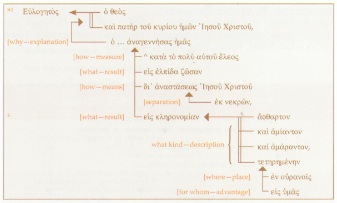
Where Huffman is really unique (and what makes this guide desirable especially for a second-year Greek student or pastor) is in his part 3 on diagramming. He briefly treats “technical diagramming” (the kind some of us had to do for English in 5th grade–showing syntactical relationships at the word level) and arcing, then moves into a rich, 22-page description of “phrase diagramming,” which looks like this:

Huffman, p. 103 (1 Peter 1:3-4)

The goal of this kind of diagramming is “to grasp the writer’s general flow of thought and argument, which he has expressed in particular words and sentences” (85). Huffman’s eight steps to phrase diagramming explain the process so that even a beginner can understand it well. His “Special & Problem Issues” section is the icing on the cake of part 3.

The guide is truly “handy”; it fits nicely together with a Greek New Testament, so one can keep it close at hand. The color-coding in the paradigms is done well, so that verb endings stand out for an easy refresher course.

An unfortunate and fairly noticeable drawback to this guide, in my view, is in the layout and color scheme. The orange theme, as attractive as it looks on the cover (pictured above), gets to be an eyesore after looking at more than a page or two. It’s too bright to read comfortably, and there are charts with at least four different shades of orange.

When there is Greek in black font (in grammatical category explanations), it looks great. But the Greek in the charts in orange has a fuzzy or slightly blurry, pixelated appearance. There are also quite a few charts that are in landscape orientation (rather than the default portrait orientation), so that the reader has to flip the book sideways. That alone would not be a huge deal, but the orange was distracting to me.

Hopefully there will be demand for future printings, and hopefully future printings will make the layout and fonts more useable. And despite the omission of vocabulary, this guide has great content. Resources on sentence and phrase diagramming for Greek are few and far between, but Huffman’s guide covers that territory well, and having that coupled with quick-reference charts will help just about anyone seeking to retain and improve their biblical Greek.

Kregel sent me a copy of the book for review. Its product page is here, and it’s on Amazon here. The Table of Contents are here (pdf); read an excerpt here (pdf).

(Part 2) Review of IVP’s Dictionary of the Old Testament: Pentateuch

IVP OT Dictionary Pentateuch

Sarah, Melchizedek, and the language of the Pentateuch. Last week I reviewed the articles on each of those topics in InterVarsity Press’s Dictionary of the Old Testament: Pentateuch in Logos Bible Software.

Here’s what the IVP page says about the dictionary in its book description:

The Dictionary of the Old Testament: Pentateuch is the first in a four-volume series covering the text of the Old Testament. Following in the tradition of the four award-winning IVP dictionaries focused on the New Testament and its background, this encyclopedic work is characterized by close attention to the text of the Old Testament and the ongoing conversation of contemporary scholarship. In exploring the major themes and issues of the Pentateuch, editors T. Desmond Alexander and David W.Baker, with an international and expert group of scholars, inform and challenge through authoritative overviews, detailed examinations and new insights from the world of the ancient Near East.

My first review contains an initial evaluation of the dictionary specifically in Logos Bible Software; you can read that here. In this post I summarize and briefly interact with three more articles: “Terah,” “Lot,” and “Ur.”

Terah

Terah was Abram’s father and Lot’s grandfather. He also fathered Nahor and Haran. M.W. Chavalas notes that Terah was “the family head,” since “all of the material in Genesis 11:27-25:11 is prefaced by the statement, ‘This is the family history of Terah’” (829). Chavalas considers Terah in three parts: the etymology of his name, his time in the city of Ur, and “Terah and Later Traditions.”

Chavalas considers several options for the meaning and linguistic source of “Terah,” but concludes, “An understanding of the etymology of the name Terah has proved to be difficult” (829). It does seem to have “associations with a place name in northern Mesopotamia” (830) and perhaps some associations with lunar worship (though perhaps not). Similarly, Ur, from which Terah comes, has been difficult to pinpoint. Chavalas places it in southern Mesopotamia. Chavalas finally considers the challenge that Acts 7:4 and Philo pose regarding chronology and location.

Chavalas manages to cover most of the essential territory on Terah in a short space. There is not much biblical material on Terah, but this article contains an overview of it all. There is little content in the “Terah and Later Traditions” section, and the article’s bibliography does not point to more resources to explore Abram’s father, for example, in rabbinical tradition. Detailed research on Terah would have to be supplemented with other resources.

Lot

Lot was Terah’s grandson and Abram’s nephew. J.I. Lawlor notes that Lot traveled with his grandfather Terah from Ur to Haran because his own father has died (556).

Lawlor primarily takes a literary and narrative approach to understanding Lot’s place in the Abram/Abraham material. He notes “two ‘paired sets’” of Lot material that “have been integrated, one set in each half of the Abraham story” (556). The author/compiler of Genesis does this, Lawlor notes, to “suggest and hold open the possibility of Lot as Abraham’s heir” (556), later dismissing the possibility as Isaac becomes heir (557).

Genesis 14:17-24 marks Abram’s encounter with Melchizedek, occasioned because Abram had gone to battle due to the Mesopotamian kings’ kidnapping of Lot. Abram rescued Lot in Gen. 14, then rescued him again, in a way, by interceding on behalf of Sodom and Gomorrah in Gen. 18-19 (557-8).

Due to an incestuous drunken encounter with his daughters, Lot gave rise to two groups of people, the Moabites and Ammonites, which Lawlor briefly discusses.

Lawlor’s most helpful contribution is in his situating of Lot in the larger flow of Genesis 12-19, where Lot serves as a possible answer to the question, Who will be an heir to Abram and Sarai? His reading of the “two paired sets” of Lot material is illuminating.

Ur

Like Chavalas in the “Terah” article, Osborne locates Ur in southern Mesopotamia as one of its “oldest and most famous” cities (875). Today the two-millenia old city of Ur is “modern Tell al-Muqayyar, located on the Euphrates in southern Mesopotamia” (875). Osborne looks at the archaeology of Ur as well as its place in patriarchal times.

Based on an early 20th century exploration of the tell (hill/remains) where Ur once was, archaeologists think that Ur was “not…one of the most extensive cities of its time” (875), with a population of just under 25,000. Ur was a center of lunar worship in Mesopotamia, as was Haran, where Terah would go from Ur (875). Tomb excavations have shown a wealthy city, which “was most probably derived from its lucrative involvement in trade along the Gulf” (876). Osborne also explores the debate over the birthplace of Abraham, whether it was northern or southern Mesopotamia (he favors the latter). He notes that the Genesis text does not say why Terah and his family left Ur.

Archaeology is not my primary interest within biblical studies, but Osborne introduces the basic archaeological finds to the reader in a short space, and does a good job of it. The bibliography at the end of the article offers titles for further reading.

**********

My impression of the dictionary continues to be positive. At the same time it is becoming clear to me that it is not comprehensive in the subjects it treats. So researchers, exegetes, writers, and teachers will want to consider using it alongside other resources. However, its ability to summarize much detail in a succinct way is a strong point of the dictionary.

I’ll do at least one other installment in my review of Dictionary of the Old Testament: Pentateuch, and include some concluding thoughts there. See the first part of my review here.

The Dictionary is on Amazon here (in print) and at Logos here. My thanks to Logos for the review copy.