I’ve just recently learned about The Blog of the Twelve. Based on what I’ve seen so far, it’s recommended reading, especially for folks with an interest in the Minor Prophets.
The usefulness of this book can hardly be stated for those seeking to rightly handle the Scripture, whether student, pastor, or laity. Beale’s clear writing style, in addition to the uncharacteristic conciseness of the book, makes the method accessible to a wide audience. Furthermore, Beale, while emphasizing the indispensable value of learning the biblical languages, formats the book in such a way that those not familiar with Hebrew and Greek are able to profit just as well from the work.
We are now in Week 5 of Greek Isaiah in a Year. Below is the schedule and text for Monday through Friday, using the text from R.R. Ottley’s Book of Isaiah According to the Septuagint. (Ottley is here on Amazon, here in Logos, and here as a free, downloadable pdf, since it’s public domain.) The full reading plan for our group is here (pdf).
We’re here; we blog about the Bible; get used to it.
Charles Spurgeon is reported to have said, “If you have to give a carnival to get people to come to church, then you will have to keep giving carnivals to keep them coming back.”
And so we who blog in the fields of academic biblical studies and theology keep giving carnivals.
So let Words on the Word be among the first to wish you and yours a Happy New Year! Let’s welcome the year ahead with a recap of what went on in the so-called biblioblogosphere in December 2012.
Newtown, Connecticut, December 14
On December 14 there was the horrible news of a shooter who killed 26 other people at an elementary school in Newtown, CT, 20 of them young children. Peter Enns shared some thoughts from an unsettled state. Jim West wrote about it quite a bit and excoriated the NRA.
With the generous lead support of the Leon Levy Foundation and additional generous support of the Arcadia Fund, the Israel Antiquities Authority and Google joined forces to develop the most advanced imaging and web technologies to bring to the web hundreds of Dead Sea Scrolls images as well as specially developed supporting resources in a user-friendly platform intended for the public, students and scholars alike.
A number of bloggers wrote about this, not a few of whom Jim McGrath links to.
That wasn’t all that went online in December. Evangelical Textual Criticism notes quiteafewothermanuscriptsthatare now online. (As proven by the fact that every word of that last phrase is its own hyperlink.) Charles Halton of awilum.com highlights the availability of A. Leo Oppenheim’s Ancient Mesopotamia as a free pdf. Readers of this carnival may also like to take some time with ASOR’s weekly archaeology roundups in December, here, here, and here.
Septuagint
December saw a plethora of posts about παρθένος/עלמה in Isaiah 7:14, and Matthew’s use of that verse. Here is T.M. Law, saying that Greek Isaiah’s use of παρθένος for עלמה is not without precedent in the LXX (“The Greek translator of Isaiah used a perfectly acceptable rendering for עלמה.”). Here’s the Jesus Creed on the virgin birth. Krista Dalton notes, “[T]he author of Matthew is not saying that Isaiah was envisioning the birth of Jesus.” Kevin Brown of Diglotting posts here about it. And, looking at hermeneutics more generally, Brian LePort suggested three paradigms to use in studying the virgin birth.
J.K. Gayle at The WOMBman’s Bible (“An Outsider’s Perspective on the Hebrew Males’ Hellene Book”) posted reflections from Greek Isaiah not 1, not 2, not 3, not 4, not 5, not 6, but 7 times in December. Set aside some time and read them all.
Codex Sinaiticus dropped in price to just under $200 at CBD this month–a facsimile edition, that is. Theophrastus of BLT notes it here. He will later lament (which I, too, lament) that Oxford University Press no longer prints their wonderful Comparative Psalter. And while we’re on those Ψαλμοὶ, did their Greek translator(s) have Aristotle and Greek rhetoric in mind?
Anthony Le Donne is taking on the Wikipedia entry on “Historical Jesus” (best biblioblog comment of the month: here). James Tabor asked how December 25 got to be the day we observe Jesus’ birthday (with more thoughts here). Mark Goodacre produced a Christmas NT Pod in which he “explores the differences between the Birth Narratives in Matt. 1-2 and Luke 1-2 and asks how this can be the case if Luke is familiar with Matthew.” The Sacred Page produced a podcast on “the first Christmas.” For a fresh translation of Luke 1:34-38 (with the Greek reproduced beneath the English), see “She spoke yet-Miriam did.” Daniel Street even gave us some Christmas songs in Greek!
Anglican minister Rach Marszalek calls for nuance in discussions on the Trinity, as well as an appreciation of “the perichoretic beauty” of the Same. Read her “Eternal functional subordination and ontological equality?” here. While we’re on Anglicans, Brian LePort asks whether he needs a Bishop?
Gaudete Theology offers a feminist reading of “the bride of Christ” language. (“The image of the Bride of Christ needn’t be viewed only through the patriarchal perception of woman’s nature as inherently passive, docile, compliant, and receptive.”) Alice C. Linsley at Just Genesis would, I think, agree that the image and office of priest should also not be viewed through a patriarchal lens. She says, “Luther Was Wrong About the Priesthood.”
And, finally, may I offer thanks to Amanda at Cheesewearing Theology for this excellent December 2012 theology roundup? She covers yet more territory in theology than I have already covered here. If you’re disappointed that this carnival is about over, spend time reading the posts she collects.
Ευχαριστω/תודה/Thank you
Thanks for coming, and keep coming back! I blog regularly, so feel free to follow/subscribe by going back up to the right sidebar of the blog.
There’s something that has seemed appropriate about beginning to read through Isaiah during Advent. At a pace of roughly five verses each weekday, I’ve been reading through Greek Isaiah in a Year with a sizeable group of folks on Facebook.
Tomorrow (Monday) is the start week 4. Below is the schedule and text for Monday through Friday, using the text from R.R. Ottley’s Book of Isaiah According to the Septuagint. (Ottley is here on Amazon, here in Logos, and here as a free, downloadable pdf, since it’s public domain.) The full reading plan for our group is here (pdf).
Also, this last week I reviewed Ottley’s work in Logos. You can read more about that here. And now, the readings. At the end of this post I’m including a link to a pdf of the schedule and text for the week, as well, at the request of one of the group members.
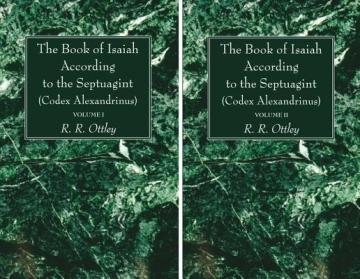
I’ve been using R.R. Ottley’s Book of Isaiah According to the Septuagint as I participate in Greek Isaiah in Year.
The two-volume work is available in print through Wipf & Stock here on Amazon. Or you can download the whole thing here for free as a .pdf, since it’s in the public domain. This will be sufficient for many folks who want to check out this work.
Logos Bible Software also has an edition of Ottley’s work (here), a three-volume Works of Richard R. Ottley. In addition to Book of Isaiah According to the Septuagint, the Logos bundle includes his Handbook to the Septuagint. That work is also free and in the public domain (get it here).
For the kind of close reading I’ve been doing with the Greek Isaiah group, having these texts integrated with the rest of Logos has been quite convenient and a big time-saver.
Volume 1 of Ottley’s Isaiah work has:
Introduction
Early History of the Septuagint
Text of the LXX in Isaiah
Methods of Rendering
Differences between the LXX and the Hebrew
List of Manuscripts containing Isaiah in Greek
Parallel Translations
The introduction briefly addresses issues of dating, as well as the various editions of the Greek (the Hexapla, etc.). The “Text of the LXX in Isaiah” section treats in more detail the Greek manuscripts, as well as later translations like the Syro-Hexaplar and Old Latin, which were made from the Greek. Ottley notes that Codex Vaticanus (B) “falls below its usual standard” and is “a worse representative of the LXX than usual,” being “inferior to other extant manuscripts.” Throughout these two volumes, then, he pursues “the question of securing the best available text.”
“Methods of Rendering” in the Introduction compares Septuagint Greek to New Testament Greek (finding “in it much resemblance”), yet Ottley also notes that Septuagint translators saught to keep “various Semitic idioms, and a dim reflection of Semitic arrangement and style.” These are not especially earth-shattering insights for the student of the Septuagint today, but Ottley does provide a helpful tour of the Greek grammar of Isaiah in introductory fashion. He also relates the Greek to the Hebrew it translated:
[The LXX translators] seem to have selected the aorist as the best equivalent for the Hebrew perfect, and the future for the Hebrew imperfect, and used them, when the context did not absolutely forbid, to represent rather than to translate these forms.
As far as differences between the Greek and the Hebrew, Ottley notes omissions, additions (scholars now, I believe, prefer to speak of “minuses” and “pluses,” since “omissions”/”additions” can prejudice the discussion), paraphrases, differences in syntax, and more. He includes a lengthy list of references in illustration of each kind of difference.
The rest of volume 1 is taken up with Ottley’s “Parallel Translations,” where he presents his English translations of the Hebrew and of the Greek side-by-side on different pages. Each page includes several translation footnotes.
Here is where the Logos edition becomes especially handy. Using the Text Comparison tool, I can easily see how Ottley’s English translation of the Greek compares with his English translation of the Hebrew, to get a feel for how the two underlying texts differ:
Even with a free .pdf of the work available in the public domain, being able to use Logos’s tools to interact with the text makes it worth having.
Volume 2, then, contains Ottley’s own presentation of Greek Isaiah, with Codex Alexandrinus (A) as “the basis for the Greek text here printed.” As with the Göttingen edition of the Septuagint, Ottley has a critical apparatus at the bottom of the page that notes variants. His is not quite as exhaustive as Göttingen, but neither does it lack detail. In the print edition, following the Greek text are some nearly 300 pages of notes on Greek Isaiah.
And in Logos, one can view all of Ottley’s work on Isaiah at once, together with the Hebrew text and various lexicons (not included with this module). For reading Ottley’s Greek text of Isaiah, I have the Greek scrolling with the critical apparatus and the notes and translation, so that I can simultaneously see all that Ottley has about a given verse. As here:
Note: in the image above I actually have the Göttingen text open, with Ottley right behind it in another tab. For reading through Isaiah, I like to still have a morphologically tagged text going; Ottley is not so tagged. But you can sync everything together so that you barely notice that.
It’s not impossible, of course, to flip back and forth between the pages of a print version, or to scroll back and forth through a free .pdf. But Ottley’s Book of Isaiah According to the Septuagint integrates seamlessly with the rest of Logos. And when reading his Handbook to the Septuagint, any verses or abbreviations are hyperlinked so that you can mouse over them as you read and pop-ups will display with the relevant information.
This three-volume set in Logos is very well done, and easily does things that neither a print copy nor a .pdf can do. Being able to see all of Ottley’s work on a single verse at a glance–as well as compare it with other LXX texts using the Text Comparison tool–is the true highlight of this resource.
The three volume Works of Richard R. Ottley in Logos can be found here. My thanks to Logos for the review copy, provided for the purposes of this review but not with any expectation as to its content. Ottley in Logos has also been a great help to me as the group administrator of Greek Isaiah in a Year.
I wondered tonight whether this week’s Greek Isaiah readings might have something to say to the recent school shooting in Connecticut. Indeed, here is Isaiah 2:17-19 (my translation from the Greek):
Then every person will be brought low,
and the haughtiness of humanity will collapse,
and the Lord alone will be exalted in that day.
And they will hide everything that is made by hand,
as they bring them into caves
and into the clefts of rocks
and into the holes of the earth,
from before the fear of the Lord
and from the glory of his strength,
when he rises up to strike the earth.
The word for that which is made by hand (τὰ χειροποίητα) refers to idols. But as I read this I couldn’t help but think of the promise from Psalm 46:
He makes wars cease
to the ends of the earth.
He breaks the bow and shatters the spear;
he burns the shields with fire.
…bows, spears, and shields, of course, all being made by hand. I suggested here that a 21st century way of reading that verse could be something like, “He crushes guns and diffuses bombs, he destroys human weapons of destruction.”
One day either we or God himself will bring all our weapons of destruction–indeed, all our evil inclinations–into “caves” and “into the clefts of rocks and into the holes of the earth,” as we recoil at the glory of God’s strength. He will make wars cease; he will end all senseless violence; he will crush evil and wipe it away from the face of the earth.
Lord, as we mourn in the meantime, please hasten that day.
We’re through two weeks of Greek Isaiah in a Year. The Facebook group continues to grow–now 175 readers. Anyone can still join. And some are reading apart from the Facebook group, too.
Tomorrow (Monday) begins week 3. Below is the schedule and text for Monday through Friday, using the text from R.R. Ottley’s Book of Isaiah According to the Septuagint. (Ottley is here on Amazon, here in Logos, and here as a free, downloadable pdf, since it’s public domain.) The full reading plan is here (pdf).
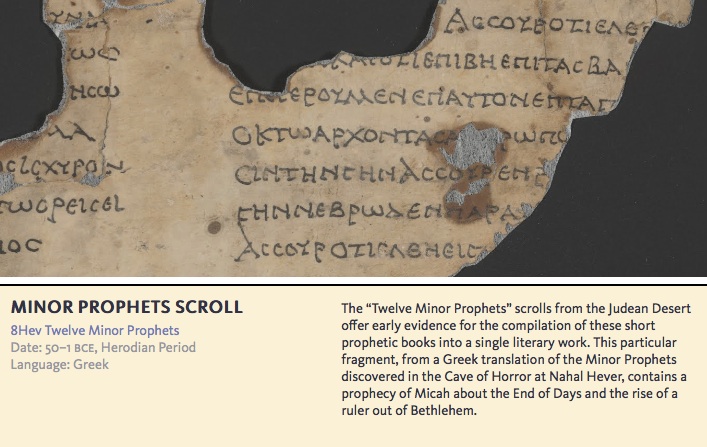
Isaiah 2:2-4 shares much in common with Micah 4:1-3. But who quoted whom?
Isaiah and Micah both prophesied in the 8th century B.C. Their prophetic oracles were delivered in Hebrew, and the Greek below is translated from that. But because I’m doing Greek Isaiah in a Year right now, I’ll confine my comments to the Greek text. Of course a more thorough examination of these two passages needs to consider the Hebrew, too.
Isaiah is in black and on top below. Micah is in red and on bottom.
The general ordering of phrases/concepts and the flow of the oracle is the same in each
The Isaiah and Micah passages differ thus:
Preceding this passage in Isaiah (actually part of the same passage in Isaiah, though not reprinted above) is a superscription. Isaiah 2:1 says, Ὁ λόγος ὁ γενόμενος παρὰ κυρίου πρὸς Ησαιαν υἱὸν Αμως περὶ τῆς Ιουδαίας καὶ περὶ Ιερουσαλημ (“The word which came from the Lord to Isaiah, son of Amos, concerning Judah and Jerusalem”)
(Micah lacks any such superscription)
There is minor variation in the prepositions; e.g., Micah has ἐπ᾽ ἐσχάτων τῶν ἡμερῶν where Isaiah has ἐν ταῖς ἐσχάταις ἡμέραις
Different synonyms are used for the same idea; e.g., “swords” in Micah is ῥομφαίας but in Isaiah is μαχαίρας. And μετεωρισθήσεται in Micah is ὑψωθήσεται in Isaiah
Isaiah has the emphatic πάντα τὰ ἔθνη in 2:2 (though this just follows the Hebrew, where this is not in the Hebrew in Micah)
Other than this phrase, Micah seems more expansive
What follows/concludes the oracle is different in each
If Micah is original, the changes between the two texts could just be stylistic and poetic variation. One author I read on this passage suggests that inverted quotations (e.g., the variations between λαός and ἔθνος) are deliberate and purposely show that a passage at hand is being quoted. If this oracle originates with Micah, then perhaps Isaiah 2:5 differs so much from Micah 4:4-7 because Isaiah used just what he needed, then made the application in his own way with, “And now, house of Jacob, let us walk in the light of the Lord.”
But if this is true, then why Isaiah 2:1? I’m not the first to notice this, but couldn’t “The word of the Lord which came to Isaiah” be perceived as Isaiah claiming the oracle as originally his own?
In the end it’s impossible to be sure. My best guess is that this is some kind of shared liturgical material that the people would have been familiar with–not just a once-delivered oracle. Each prophet used it, I suspect, for his own purposes, as God guided. Where or with whom did the oracle originate? As Origen said regarding the author of the book of Hebrews… God only knows!
Tomorrow (Tuesday) I have the final exam in my class, Use of the Old Testament in the New. That can only mean one thing, and that is that it’s time for this:
We had an active set of discussions during the first week of Greek Isaiah in a Year. We’re now up to 163 members in the Facebook group, which anyone can still join. A few folks have blogged about their reading, too (links forthcoming). Scroll through the Facebook group to see the kinds of things we’re talking about. Lots of great questions and comments already.
Tomorrow (Monday) begins week 2. Below is the schedule and text for the week, using again R.R. Ottley’s Book of Isaiah According to the Septuagint. (Find Ottley here on Amazon, here in Logos, and here as a free, downloadable pdf, since it’s public domain.)
Note that this week has a light day, with just two verses on Tuesday.

 I’ve just recently learned about The Blog of the Twelve. Based on what I’ve seen so far, it’s recommended reading, especially for folks with an interest in the Minor Prophets.


 Scot McKnight lists the “Jesus Creed Books of the Year”
 Speaking of Greek Isaiah… more than 150 of us are reading through


 There’s something that has seemed appropriate about beginning to read through Isaiah during Advent. At a pace of roughly five verses each weekday, I’ve been reading through


 Words on the Word