Sun Kil Moon + Album Leaf=???

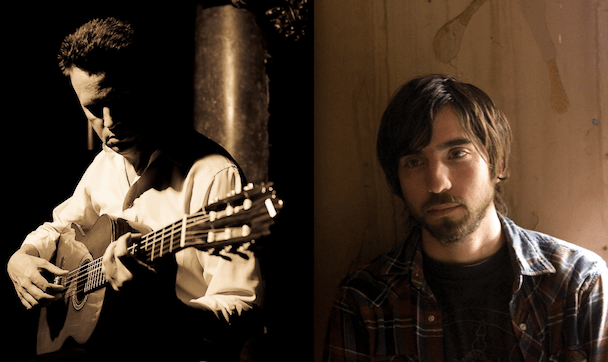
Image via Stereogum. Koz is not actually playing that guitar, though.

Though I inexplicably have not yet shared on this blog about my abiding love for the music of Mark Kozelek (of Red House Painters and Sun Kil Moon), let me rectify that right now.

The current Mark Kozelek news is that he’s joined with The Album Leaf to record a new album, due out in–well, not soon enough for us fanatics.

From the Caldo Verde Records site:

‘Perils From The Sea’ is the debut collaboration by The Album Leaf’s multi-instrumentalist Jimmy LaValle and Sun Kil Moon singer Mark Kozelek. The project began on Sept 11, 2011, when Kozelek, a fan and acquaintance of LaValle, asked Jimmy to co-write a song. LaValle, a long time admirer of Kozelek’s work, said yes, and the track ‘What Happened To My Brother’ came together quickly. Pleased with the results, the two agreed to record an entire album. Kozelek and LaValle continued to work together over the following year, until ‘Perils From The Sea’ was completed. For the album LaValle chose a more minimalist approach to the music than The Album Leaf’s large sonic soundscapes. The lyrics to the song, ‘You Missed My Heart’, Kozelek says were inspired by a nightmare he had in an Ontario hotel room. Kozelek’s story-telling narratives playing against LaValle’s hypnotic synth sounds and drums beats should come as a pleasant surprise to fans, and should serve as a great introduction to those previously unacquainted with these prolific and acclaimed artists. “Sun Kil Moon & The Album Leaf” will play their debut concert at UE Festival, Dordecht, Holland May 11, and an additional show at Shepard’s Bush Empire, London, May 13.

Whether Mark Kozelek+beatz will be a “pleasant surprise” remains to be seen. For now, you can hear “What Happened to my Brother” right here. I heard not a single guitar on the recording. Not sure what I think about that yet. I do like the couple Album Leaf albums I’ve heard, though.

In February 2013, however, the Koz has a new album of his own coming out, this one of covers. It’s called “Like Rats” and releases February 19. You can hear “I,” the first track from that record, here. It’s a nice chaser to follow the electronica foray I linked to above.

Though I will say–I have not yet not liked a single Mark Kozelek album, even if the most recent Sun Kil Moon was not my favorite work of his. So I’ll eagerly wait for both the covers record and the Album Leaf collaboration. The Koz is a musical genius, an amazing guitar player, and has a voice like buttah.

Greek Isaiah in a Year, Week 2=Isaiah 1:26-2:15 (with text)

Isaiah 2:1-2

We had an active set of discussions during the first week of Greek Isaiah in a Year. We’re now up to 163 members in the Facebook group, which anyone can still join. A few folks have blogged about their reading, too (links forthcoming). Scroll through the Facebook group to see the kinds of things we’re talking about. Lots of great questions and comments already.

Tomorrow (Monday) begins week 2. Below is the schedule and text for the week, using again R.R. Ottley’s Book of Isaiah According to the Septuagint. (Find Ottley here on Amazon, here in Logos, and here as a free, downloadable pdf, since it’s public domain.)

Note that this week has a light day, with just two verses on Tuesday.

Monday, December 10: Isaiah 1:26-31

26 καὶ ἐπιστήσω τοὺς κριτάς σου ὡς τὸ πρότερον, καὶ τοὺς συμβούλους σου ὡς τὸ ἀπʼ ἀρχῆς· καὶ μετὰ ταῦτα κληθήσῃ Πόλις δικαιοσύνης, μητρόπολις πιστὴ Σιών. 27 μετὰ γὰρ κρίματος σωθήσεται ἡ αἰχμαλωσία αὐτῆς καὶ μετὰ ἐλεημοσύνης. 28 καὶ συντριβήσονται οἱ ἄνομοι καὶ οἱ ἁμαρτωλοὶ ἅμα, καὶ οἱ ἐγκαταλιπόντες τὸν κύριον συντελεσθήσονται· 29 διότι καταισχυνθήσονται ἐπὶ τοῖς εἰδώλοις αὐτῶν ἃ αὐτοὶ ἠβούλοντο, καὶ ἐπαισχυνθήσονται ἐπὶ τοῖς κήποις αὐτῶν ἃ ἐπεθύμησαν. 30 ἔσονται γὰρ ὡς τερέβινθος ἀποβεβληκυῖα τὰ φύλλα, καὶ ὡς παράδεισος ὕδωρ μὴ ἔχων· 31 καὶ ἔσται ἡ ἰσχὺς αὐτῶν ὡς καλάμη στιππύου, καὶ αἱ ἐργασίαι αὐτῶν ὡς σπινθῆρες πυρός, καὶ κατακαυθήσονται οἱ ἄνομοι καὶ οἱ ἁμαρτωλοὶ ἅμα, καὶ οὐκ ἔσται ὁ σβέσων.

Tuesday, December 11: Isaiah 2:1-2

2 Ὁ λόγος ὁ γενόμενος παρὰ Κυρίου πρὸς Ἠσαίαν υἱὸν Ἀμὼς περὶ τῆς Ἰουδαίας καὶ περὶ Ἰερουσαλήμ.

Ὅτι ἔσται ἐν ταῖς ἐσχάταις ἡμέραις ἐμφανὲς τὸ ὄρος τοῦ Κυρίου, καὶ ὁ οἶκος τοῦ θεοῦ ἐπʼ ἄκρων τῶν ὀρέων, καὶ ὑψωθήσεται ὑπεράνω τῶν βουνῶν, καὶ ἥξουσιν ἐπʼ αὐτὸ πάντα τὰ ἔθνη.

Wednesday, December 12: Isaiah 2:3-5

καὶ πορεύσονται ἔθνη πολλὰ καὶ ἐροῦσιν Δεῦτε ἀναβῶμεν εἰς τὸ ὄρος τοῦ Κυρίου καὶ εἰς τὸν οἶκον τοῦ θεοῦ Ἰακώβ, καὶ ἀναγγελεῖ ἡμῖν τὴν ὁδὸν αὐτοῦ, καὶ πορευσόμεθα ἐν αὐτῇ. ἐκ γὰρ Σειὼν ἐξελεύσεται νόμος, καὶ λόγος Κυρίου ἐξ Ἰερουσαλήμ· καὶ κρινεῖ ἀνὰ μέσον τῶν ἐθνῶν, καὶ ἐλέγξει λαὸν πολύν· καὶ συγκόψουσιν τὰς μαχαίρας αὐτῶν εἰς ἄροτρα καὶ τὰς ζιβύνας αὐτῶν εἰς δρέπανα, καὶ οὐ λήμψεται ἔτι ἔθνος ἐπʼ ἔθνος μάχαιραν, καὶ οὐ μὴ μάθωσιν ἔτι πολεμεῖν. Καὶ νῦν, ὁ οἶκος τοῦ Ἰακώβ, δεῦτε πορευθῶμεν τῷ φωτὶ Κυρίου.

Thursday, December 13: Isaiah 2:6-10

ἀνῆκεν γὰρ τὸν λαὸν αὐτοῦ τὸν οἶκον τοῦ Ἰσραήλ· ὅτι ἐνεπλήσθη ὡς τὸ ἀπʼ ἀρχῆς ἡ χώρα αὐτῶν κληδονισμῶν, ὡς ἡ τῶν ἀλλοφύλων, καὶ τέκνα πολλὰ ἀλλόφυλα ἐγενήθη αὐτοῖς. ἐνεπλήσθη γὰρ ἡ χώρα αὐτῶν ἀργυρίου καὶ χρυσίου, καὶ οὐκ ἦν ἀριθμὸς τῶν θησαυρῶν αὐτῶν· καὶ ἐνεπλήσθη ἡ γῆ αὐτῶν ἵππων, καὶ οὐκ ἦν ἀριθμὸς τῶν ἁρμάτων αὐτῶν· καὶ ἐνεπλήσθη ἡ γῆ βδελυγμάτων τῶν ἔργων τῶν χειρῶν αὐτῶν, καὶ προσεκύνησαν οἷς ἐποίησαν οἱ δάκτυλοι αὐτῶν· καὶ ἔκυψεν ἄνθρωπος καὶ ἐταπεινώθη ἀνήρ, καὶ οὐ μὴ ἀνήσω αὐτούς. 10 καὶ νῦν εἰσέλθατε εἰς τὰς πέτρας καὶ κρύπτεσθε εἰς τὴν γῆν ἀπὸ προσώπου τοῦ φόβου Κυρίου καὶ ἀπὸ τῆς δόξης τῆς ἰσχύος αὐτοῦ, ὅταν ἀναστῇ θραῦσαι τὴν γῆν.

Friday, December 14: Isaiah 2:11-15

11 οἱ γὰρ ὀφθαλμοὶ Κυρίου ὑψηλοί, ὁ δὲ ἄνθρωπος ταπεινός· καὶ ταπεινωθήσεται τὸ ὕψος τῶν ἀνθρώπων, καὶ ὑψωθήσεται Κύριος μόνος ἐν τῇ ἡμέρᾳ ἐκείνῃ. 12 ἡμέρα γὰρ Κυρίου σαβαὼθ ἐπὶ πάντα ὑβριστὴν καὶ ὑπερήφανον καὶ ἐπὶ πάντα ὑψηλὸν καὶ μετέωρον, καὶ ταπεινωθήσονται, 13 καὶ ἐπὶ πᾶσαν κέδρον τοῦ Λιβάνου τῶν ὑψηλῶν καὶ μετεώρων, καὶ ἐπὶ πᾶν δένδρον βαλάνου Βασάν, 14 καὶ ἐπὶ πᾶν ὄρος, καὶ ἐπὶ πάντα βουνὸν ὑψηλόν, 15 καὶ ἐπὶ πάντα πύργον ὑψηλόν, καὶ ἐπὶ πᾶν τεῖχος ὑψηλόν,

And… we’ll have to wait for that sentence in 2:15 to finish next week.

See here for more resources and links to texts for Greek Isaiah. Readings from week 1 are here.

State of the Blog Address: Why I (continue to) blog

blogging wordle

Sure, I picked a strange time to start this blog: just weeks before the birth of our third daughter. But I had good reason(s) to, as I enumerated here. Looking back on that blogging minifesto (you heard that word here first), not much of my reasoning for blogging has changed:

  • It’s a creative outlet for me, a chance to turn all the input I receive in life into output that hopefully helps others
  • I am able to receive gratis review copies of books from various publishers
  • I use it as a way of rehearsing and reaffirming important interests and aspects of my identity
  • Blogging has allowed me to try my hand at writing

Two other benefits have come my way since starting Words on the Word.

First, when I began in June, I really had no intention of reviewing Bible software, and had only ever used BibleWorks 7 and 8. But since beginning the blog, I’ve been able to write in-depth reviews of BibleWorks 9, Accordance 10, and Logos 4 and 5. I’ve also compared the three (with more comparison in the offing).

Second, I’ve just completed my first week through Greek Isaiah in a Year. What began as a quick post to tell my readers I wanted to read Isaiah in Greek in a year quickly turned into a reading group on Facebook with 160 (!) members and active discussion. It’s been a lot of fun. The democratizing effect of social media has grouped together professors, students, long-time Septuagintalists, pastors, and others who just want to read Greek together.

I blog for the love of the game. This blog is not monetized at all, as the business gurus say, save for my participation in the Amazon affiliates program, described here. (Side note: a link for aiding the work of WotW via contribution of books and Bible software resources is here.)

wotw logoThe blog has very much been its own reward. I’ve interacted with lots of folks I never would have otherwise, disciplined myself to start (and finish!) books I might not have otherwise, practiced my writing, and generally had fun.
But perhaps the greatest contribution this blog has made–or so some people tell me–is in its introduction to the world of my 5-year-old son’s writing. I never intended to co-blog, but my son has proved more than adequate to the task.

I’ve had to slow the pace of my blogging a bit in recent weeks as schedule demands have increased. But the state of the blog is strong, and so may it remain.

Through the New Testament in a Year: 2013 Reading Plan

bible with coffeeIf you’re looking for a Bible reading plan for 2013, here’s a simple one (pdf) that takes you through the New Testament six days a week, at the rate of about a chapter a day. Logos 5 generated the reading plan for me.

I am going to get as far as I can reading the New Testament in 2013 in Greek (see here), though it may be enough for me to stay with Greek Isaiah in a Year. (More than 150 people have already joined me in the latter.)

Faith and healing in the Gospel of Mark: a brief reflection

Jesus healsFaith is closely connected with healing in Mark. Jesus heals the paralytic on the basis of the faith of his friends (and of the paralytic himself, too?) in 2:5. Mark 5:34, 7:29, 10:52 feature similar healings where the faith of the healed seems to be at least a partial basis for Jesus’ healing.

At the same time, Jesus shows his frustration with lack of faith. He exhorts his disciples in 4:40 after he calms the storm, since they are afraid and not showing faith. In 6:6 and 9:19 Jesus expresses disapproval of the crowd who does not have faith in him. And in Mark 11:22 Jesus tells the disciples, “Have faith in God” (or, “Have the faith of God,” ἔχετε πίστιν θεοῦ).

Causation in general is difficult to prove, and although some hold that Mark 6:5-6 say that lack of faith limits Jesus’ power, one should be careful not to conclude from Mark that if someone is physically sick or mentally ill, it is just because that person does not have enough faith. At the same time it is clear that in Mark Jesus heals those who have faith. Mark seems to convey that Jesus’ act of healing is at least in some sense related to their faith, if not a direct result of it.

Robert A. Guelich, in his commentary on Mark, writes, “Faith represented the critical link in one’s relationship with Jesus” (312-3). And, “although Mark does not actually define ‘faith,’…it meant much more than being impressed with Jesus’ words and deeds in view of his modest family background. …To those who came to him in faith seeking help…, he responded by meeting their need” (313).

Just as Jesus tells the disciples (as noted above) to “have faith,” he says in Mark 9:23, “All things are possible for the one who believes.” The father of the boy with an evil spirit says, “I believe (πιστεύω), help my unbelief (ἀπιστία)!”

Mark’s Gospel finally reaches a Christological culmination in the profound profession of faith by the centurion in chapter 15, who declares Jesus to be truly the “Son of God.” Such faith!

Greek Isaiah in a Year, Week 1=Isaiah 1:1-25 (with Ottley text)

It is now Week 1 of Greek Isaiah in a Year. Here, for ease of reference, is the schedule for this week along with screenshots of the public domain R.R. Ottley text. (Download all of Ottley’s Book of Isaiah According to the Septuagint as a pdf here.) Sunday, December 2 could perhaps be spent reading all of the week’s text one time, then each day could go more in depth.

Monday, December 3: Isaiah 1:1-5

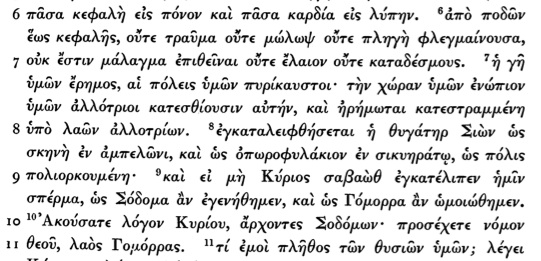
Isa 1.1-5

Tuesday, December 4: Isaiah 1:6–10

Isa 1.6-10

Wednesday, December 5: Isaiah 1:11–15

Isa 1.11_tempIsa 1.12-15_temp

Thursday, December 6: Isaiah 1:16–20

Isa 1.16-20

Friday, December 7: Isaiah 1:21–25

Isa 1.20-25a_tempIsa 1.25b_temp

See here for more resources and links to texts for Greek Isaiah.

Greek Isaiah in a Year: the reading plan, free online LXX texts, and more resources

Isaiah

The beginning of Greek Isaiah in a Year is nigh upon us. There are more than 100 people participating via Facebook, and others besides. This post compiles the reading plan, some texts of Greek Isaiah, and other resources. I’ll be adding to this post as often as I can.

The reading plan

Here it is. 5 verses a day (give or take), 5 days a week (Monday through Friday). 12/20/13 update: Here is the reading plan for the 2014 Greek Isaiah in a Year, the Sequel.

Texts of Greek Isaiah

Folks in the group will be reading whatever Greek texts they have available. My initial foray into Greek Isaiah has suggested that Codex Alexandrinus (A) is a better text than Codex Vaticanus (B) for this particular book. Moisés Silva writes, “While this important manuscript [Vaticanus=B] preserves an excellent text for most books of the LXX, it is less trustworthy in the case of Esaias [Isaiah].” R.R. Ottley and Ken M. Penner, both linked below, agree. Ottley bases his work on Alexandrinus, writing, “In the Book of Isaiah… it is thus quite allowable to suggest that B falls below its usual standard, relative or absolute.”

Without further ado, then, some texts to consider, and where to find them:

Rahlfs LXXIsaiah in Rahlfs LXX (German Bible Society, eclectic/critical text). Find it free, legal, and online here. Note that due to copyright restrictions I cannot post the Rahlfs text myself publicly, but you can access the whole thing from the site above. The Rahlfs edition has been called “semi-critical,” so that the textual notes in his apparatus are not extensive. But he does not base his text only on one manuscript.

Isaiah LXX OttleyR.R. Ottley’s Book of Isaiah According to the Septuagint (based on Codex Alexandrinus). See the archive.org site with description here. Or download a compressed pdf (17 MB instead of 57 MB) here from my site. (Thanks to Jim Darlack for combining both volumes 1 and 2 into a single pdf!) Volume 2 has the full Greek text with Ottley’s notes in an apparatus. This commentary is a gold mine of information about the Greek text, the Hebrew it translated, and more.
Isaiah in Swete’s edition (based on Codex Vaticanus). That’s here.

Isaiah in the NETS (New English Translation of the Septuagint), with an introduction by Moisés Silva. This is the leading English translation of the Septuagint. Find the pdf of Isaiah with intro here.

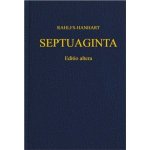
Isaiah by ZieglerThe Göttingen edition of Isaiah. Whereas everything above is available for free online, Göttingen is not. It’s here on Amazon (affiliate link) and here at the publisher’s site. It’s not cheap, but you may be able to find a used edition somewhere. This edition, edited by Joseph Ziegler, is also available from Accordance Bible Software as a single volume here, and from Logos Bible Software as part of a larger collection here. (If it’s Göttingen you’re using, I’ve begun a short primer on how to read and understand the Göttingen editions, their apparatuses, etc.)

More resources for Greek Isaiah

Ken M. Penner, who is writing the Isaiah volume for the Brill Septuagint Commentary series, graciously shared some of his notes with the Biblical Greek Forum last year. See here and here for detailed notes and discussion.

Do you like vocabulary? Like it or not, Septuagint vocabulary is more expansive than New Testament vocabulary. Here is a list (pdf) of all the words in Isaiah that occur 100 times or less in the Septuagint, sorted by frequency. Here is that same list sorted alphabetically. My friend, co-worker, and fellow churchgoer M. Ryan has put the vocabulary list into Quizlet.

The Great Isaiah Scroll (1QIsaa) from the Dead Sea Scrolls is available online for viewing. When you hover over a part of the scroll, an English translation pops up. The scroll is in Hebrew, and is close to the Masoretic Text (MT) of Isaiah, which you can access here, if you want to look at the Hebrew of Isaiah at any point.

Did I miss anything? Please let me know in the comments, and I’ll keep this page updated. Happy reading! Before Monday I will post again with the coming week’s schedule and text.

My 5-year-old son reviews The Friendly Beasts

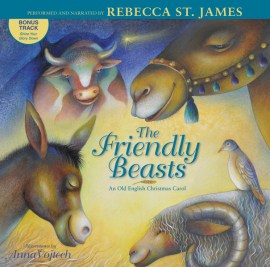
The Friendly Beasts

This book tells the story of the friendly beasts. The friendly beasts are a cow, donkey, dove, and lamb. I don’t see another animal. But there’s baby Jesus! And there’s a camel in there. The camel brought him a gift. The donkey carried Jesus’ mama.

Jesus was a baby. (I knew that before I even had this book.) He was born in a manger.

I liked the CD [AKJ: that comes with the book–four tracks, including “The Friendly Beasts” by Rebecca St. James], because it was about Jesus. I liked the book because of the animals.

This book is good for 8-year-olds and 6-year-olds and 1-year-olds and 5-year-olds. This book would make people feel good.

Thanks to Zondervan/Zonderkidz for the review copy for my 5-year-old son to review with his honest impressions. Click on the image above to find out more about the book.

Biblical Studies Carnival (November)

carnival

Bob MacDonald hosts this month’s Biblical Studies Carnival here. What, you thought blogs were so 2008? Well, they were. But they’re pretty 2012, too. Bob compiles a long list of blog posts in the field of Biblical Studies from the month of November.

I’m hosting the carnival next month, so if you know of good links I should include (anything that will be posted in December), please feel free to let me know.

Aslan’s Library: Best site for children’s books that communicate theological truth in a beautiful way

If you are a parent (and even if you’re not), Aslan’s Library will nourish your soul and the soul of the children in your life. I went to school with, and had the great privilege of serving in youth ministry alongside with, one of the blog’s co-authors. Here’s from the Library’s introductory post:

When we became parents and started thinking about how we wanted to raise our children, meaningful interaction with great literature was a top priority for each of us.  Wonderful children’s books are available in abundance, and we have delighted in exploring the world of kids lit.

However, when we began to search for Christian children’s books that were on the same par as our favorite nonreligious titles, we were disheartened.  More often than not, the Christian books we encountered were theologically sloppy or artistically mediocre – or both.  Since such books don’t do justice to the beauty and truth of Christianity, we were unwilling to share them with our young ones.

We believe that the literary and artistic qualities of all types of childrens’ books matter – and we believe that the quality of Christian books matters even more because those books attempt to reflect God to their young readers.  Children’s ideas about God’s character, his creation, and the story of redemption are important, so we care about how those stories unfold in literature.  The religious books our children read will deeply impact their spiritual imaginations: what could be more important?

Check out their children’s book list, which I especially appreciate for its focus on Advent and Christmas, Lent and Easter. And let this recent post restore you–“When Advent is Neither Quiet Nor Still.”

There is much to explore at Aslan’s Library; it’s a site to refer to often.